Podcast: Play in new window | Download
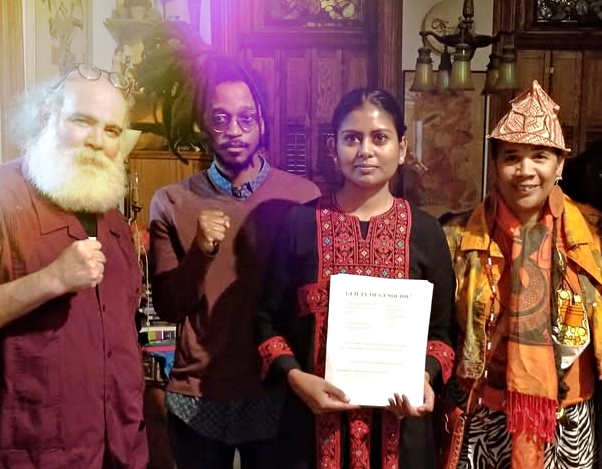
Guilty of Genocide
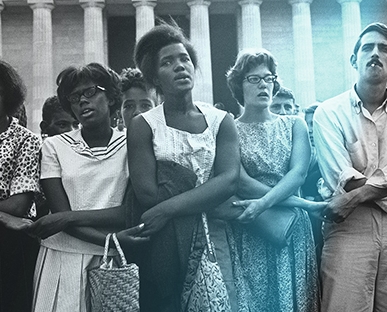
For decades, activists in the United States have argued that racial violence, political repression, and systemic inequality are not simply domestic issues. They’re also violations of international human rights law. A new collection, Guilty of Genocide, revisits that argument through the lens of the 2021 International Tribunal on U.S. Human Rights Abuses Against Black, Brown, and Indigenous Peoples. The book gathers testimony, legal analysis, poetry, artwork, and organizing documents from a landmark people’s tribunal convened by the Spirit of Mandela Coalition.
After hearing testimony on policing, incarceration, political prisoners, environmental racism, and colonialism, an international panel of jurists delivered a sweeping verdict finding the United States guilty of multiple human rights abuses.
Guest – Matt Meyer an internationally recognized peace educator, author, and activist. He was nominated for the 2026 Nobel Peace Prize alongside the International Peace Research Association in recognition of his lifelong commitment to nonviolence and global peace education. Author of more than a dozen books, including Guns and Gandhi in Africa, Matt has played a major role in building international peace studies and justice networks across Africa, Latin America, Asia, Europe, and North America.
—-
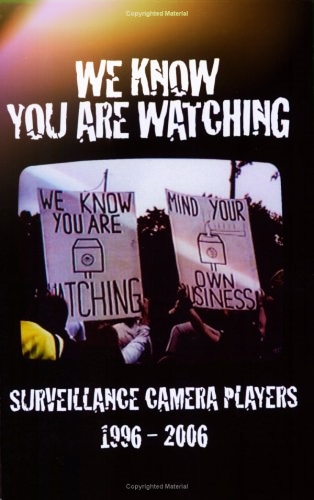
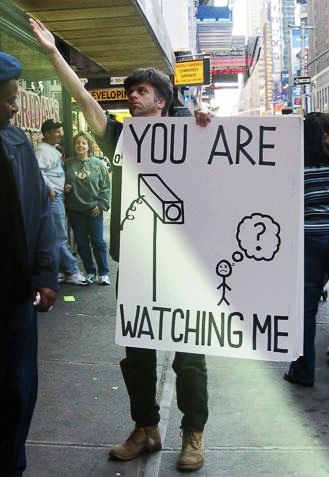
A Look Back At The Inception Of New York City’s Panopticon
When Law and Disorder first interviewed privacy activist Bill Brown in 2005, the landscape of surveillance in New York City — and across the United States — was already alarming. Bill was warning us about hundreds of NYPD cameras going up in Brooklyn, federal Homeland Security dollars flooding into local surveillance infrastructure, and the proposed “ring of steel” around lower Manhattan modeled on London’s vast camera network. What seemed like a dire warning then looks almost quaint today.
In the years since, mass surveillance has expanded in ways that would have been difficult to imagine. Amazon’s RING doorbell cameras, now installed on tens of millions of private homes, have become a vast, crowd-sourced surveillance network — with police departments across the country routinely requesting footage from residents, sometimes without a warrant. Meanwhile, a newer and perhaps even more insidious technology has taken hold: FLOCK Safety cameras, license plate readers now deployed in thousands of communities, logging the movements of ordinary Americans going about their daily lives and making that data available to law enforcement across jurisdictions. Add to this the explosion of facial recognition technology, social media monitoring, and AI-driven predictive policing tools, and the surveillance state Bill Brown cautioned us about has arrived in full force.
But Americans are pushing back. Civil liberties organizations including the ACLU have won outright bans on government use of facial recognition in cities including San Francisco, Boston, and Portland. Community organizers have successfully blocked FLOCK camera contracts in several cities after exposing how the data is shared and retained. And a growing movement of digital rights advocates, tenant organizations, and privacy activists continues to fight surveillance expansion at the local, state, and federal level — carrying on exactly the kind of work Bill Brown was urging listeners to take up all those years ago.
Since 2006, New York City’s surveillance infrastructure has evolved from a fragmented network of video cameras. It’s now an integrated, intelligence-driven system powered by the Domain Awareness System (DAS) and advanced biometric tools. The NYPD’s intelligence and counterterrorism budget quadrupled from $83 million in 2006 to $349 million in 2021, enabling the deployment of technologies originally designed for counterterrorism to monitor routine street crime and protests. These include facial recognition software, license plate readers, and mobile X-ray vans.
The scale of physical surveillance has expanded dramatically. By 2021, Amnesty International estimated more than 15,000 police cameras in Manhattan, the Bronx, and Brooklyn alone, up from roughly 2,400 visible cameras in Manhattan in 1998. This network is further augmented by cellphone surveillance tools like Stingray trackers and cell tower dumps. Those allow police to identify individuals at protests or public gatherings without warrants.
This evolution has created a surveillance state that disproportionately impacts communities of color. There’s a well-documented correlation between surveillance density and higher rates of stop-and-frisk incidents in minority neighborhoods. Police maintain that these tools are essential for solving crimes and preventing attacks — but the lack of public oversight and the use of data scraped from social media have intensified debates over privacy rights and racial bias in policing.

————-