CIA Sponsored Terror, Civil Liberties, Criminalizing Dissent, Guantanamo, Habeas Corpus, Human Rights, Targeting Muslims, Torture, Truth to Power
Podcast: Play in new window | Download
Updates:
———-
Lynne Stewart Heard A Death Sentence Today
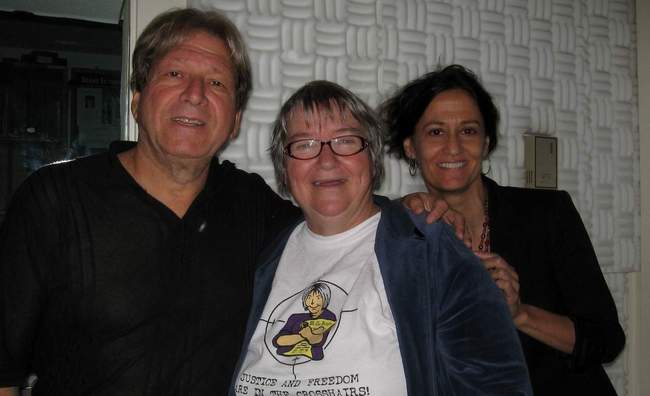
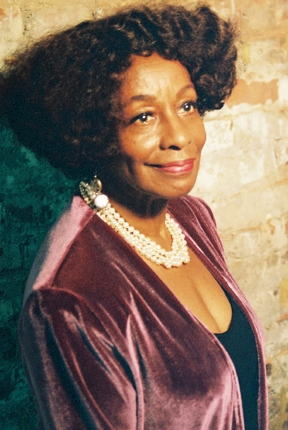
As many listeners know Judge John G Koeltl sentenced defendant, Lynne Stewart: 120 months incarceration in the Danbury Federal Correctional Institution Connecticut on five counts to be served concurrently. Lynne Stewart is 70 years old, she’s a breast cancer survivor with other pending health issues. We’re joined by Vinie Burrows today, she is the UN representative for the Women’s International Democratic Federation and the founding member of the Granny Peace Bridgade. Vinie Burrows made powerful statements in her article titled Lynne Stewart Heard A Death Sentence Today that calls terrorism by its real name under the draconian Patriot Act.
Vinie writes, “over and over again in his remarks leading up to the sentencing, Judge Koeltl used the term “terrorist enhancement.” Those warning words bring up the specter of some of the nastiest aspects of the Cold War and its present re-incarnation in the Patriot Act which by expanding law enforcement’s surveillance and investigative powers represents a significant threat to civil liberties. Read the official text… “Uniting and Strengthening America by providing Appropriate Tools Required to Intercept and Obstruct Terrorism. The Sentencing of Lynne Stewart by Michael Steven Smith.
Vinie Burrows:
- Being at Lynne Stewart’s court hearing was useful to see the judge, to see the players, the 2 prosecuting lawyers and to see Lynne Stewart who made a marvelous opening statement. It was one of the great speeches before the bar
- I felt as he was reading, Judge Koeltl was responding to each dictate of the appellate court.
- We have to define terror. We can’t go by what the legislative, judicial and now executive define as terror. We’re looking in the wrong places for terror. A single mother with 3 children living in a shelter, she knows terror. When she doesn’t know where her next meal is coming from, that’s terror.
- When her home is foreclosed on, that’s terror, and of course our banks are the biggest terror of all.
- We can’t even think of Lynne Stewart when we talk of terror, she is a human rights defender. She’s been deprived of the ability to defend human rights.
- I think we have to go to “who are the terrorists?” who are the victims of terror?
- We have to talk about the state, the state usually the perpetrator of human rights violations.
- The state must recognize that poverty is a weapon of mass destruction.
- I think we need to talk about the Universal Declaration of Human Rights as a legal basis to mount some sort of appeal.
- Michael Ratner: This is the Time of the Toad (A Study of Inquisition In America)
- Lynne Stewart has another appeal against this severe sentence.
Guest – Vinie Burrows is an award-winning Broadway actress. She has been active at the United Nations Economic and Social Council on the issues of the status of women and Southern Africa. Burrows won the Paul Robeson Award in 1986. She was to appear in a show titled Sister! Sister! at the University of Delaware in Newark in November 1991. She was to be a panelist in the 2000-2001 African Diaspora lecture series at the Center for Ideas and Society in Riverside, California.
——–


Mountain Top Removal Activists Arrested For Direct Action In Virginia (Updated)
Last week 4 activists with Climate Ground Zero and Mountain Justice were arrested for using direct action to shut down a coal mining mountaintop removal effort in Virginia. Two of the 4 activists locked themselves to heavy machinery in the coal mining pit and were later arrested. The activists say they are drawing public attention to the dangers associated with the Brushy Fork Sludge Impoundment, which contain up to 8 billion gallons of toxic coal waste. The area is unstable, Brushy Fork’s foundation is built on a honeycomb of abandoned underground mines. If the foundation were to collapse, as others have, the toxic slurry could engulf communities nearly 14 miles away, according to Marfork Coal Co.’s emergency warning plan. Meanwhile, one of the activists, Jimmy Tobias was still in jail during this interview and is now released.
Dea Goblirsch:
- Mountain top removal is a destruction form of coal mining that uses explosives, that blow up the tops of mountains to get to the coal seams beneath. It’s cheaper and more efficient than underground mining, it also employs fewer miners.
- So far there have more than 800 miles of peaks flattened. They also take the rubble from the tops of mountains and dump it into nearby valleys. They are called valley fills. The creation of the valley fills cover up the headwater streams.
- A lot of these valleys feed into water systems that supply water to the Eastern United States.
- Brushy Fork is the largest earthen dam in the Western Hemisphere.
- Coal River Mountain was the highest elevation in the area that hadn’t been mountaintop removal mined.
- You can’t always see mountain top mining from the roadside, they tend to keep a veil of trees.
- The work we’re doing is primarily civil disobedience and direct action. Tree sits within the blast range. Bails and sentencing are widely uneven.
- Community groups to start sustainable energy initiatives in Appalachia, we see this happening in Kentucky, and Virginia and other parts of the coal mining region.
- A woman publicly slapped Judy Bonds, the director of Coal River Mountain Watch.
- A strip miner threatened to slit the throat of a child
—–
Katie Huscsza:
- We attached ourselves to the high wall miner (equipment) for 4 hours.
- Me and Colin were charged with trespassing, conspiracy and obstruction.
- There are around 30 people this summer actively working to stop mountain top removal.
- We I first learned about it (MTR) I almost didn’t believe that something so awful and destructive could be taking place
—–
Guest – Dea Goblirsch with Climate Ground Zero and Katie Huscsza, also with CGZ had locked herself to highwall coal mining machines, arrested and released on bail.
Music interludes in this segment by Canton Becker
——————————————————————————–
Civil Liberties, Criminalizing Dissent, Habeas Corpus, Human Rights, Iraq War, Supreme Court, Targeting Muslims, Torture, Truth to Power
Podcast: Play in new window | Download
Updates:
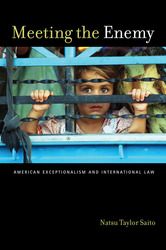
Natsu Saito, Meeting the Enemy: American Exceptionalism and International Law
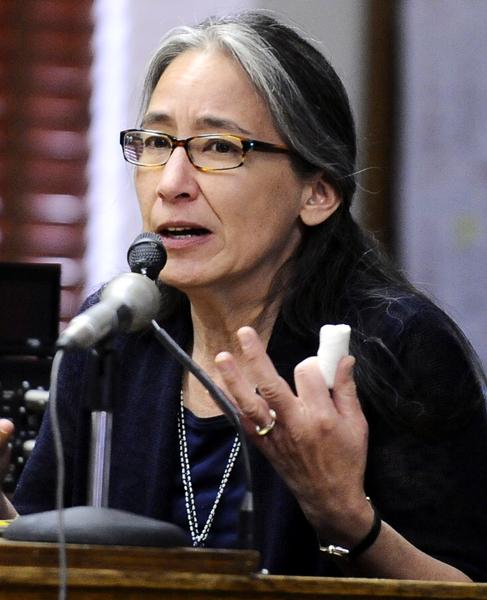
Meeting the Enemy: American Exceptionalism and International Law is the title of Natsu Saito’s recent book, Natsu is an attorney and professor of Law at Georgia State University’s College of Law in Atlanta. The book boldly points out how the United States violated international law since its declaration of independence. As often discussed here on Law and Disorder, international courts and institutions have been at the forefront of holding the torture conspirators accountable. Meeting the Enemy gives disturbing insight into the origins of American exceptionalism.
Natsu Saito:
- The duality is that the US does exempt itself (from international law) very consistently and very frequently and yet promotes international law very strongly and relies upon it.
- It has relied upon certain premises that are fundamental to the whole outlook and paradigm of colonialism – which is that there is a higher good, a more civilized approach the US embodies.
- The law doesn’t apply because we have a higher aim of civilization and that justifies not playing by the rules.
- The United States making others comply with human rights standards while exempting itself.
- Moving humanity toward this higher goal is so critical because if you strip that away and you look at the realities on the ground, you see what has been termed Western civilization has been incredibly barbaric.
- In order to get around that analysis, you have to say it was for a higher good.
- I think the “left” tends to accept the general framework, and to make particular criticisms of policies and practices that are obviously problematic. The US government engaging in torture for example, but each instant is accepted as anomalous instead of the larger picture.
- It is too frightening even for the people on the left to deal with the reality that this is a country that sits on occupied land, illegally occupied by its own rules. People on the left want to make it a kinder, gentler colonialism.
- I started out thinking I was writing a book about the failure of the United States failure to comply with international law, as I got into it, the more interesting questions were the push / pull dynamics between reliance on international law
- The current system of international law evolved from the international law which was the agreement between the European colonial powers of how they were not going to destroy each other in the process of taking over the rest of the world.
Guest – Natsu Taylor Saito teaches international law and human rights, race and the law, immigration, criminal procedure, and professional responsibility, and is an advisor to the Asian American Law Student Association and the Hispanic Student Bar Association. Professor Saito’s scholarship focuses on the legal history of race in the United States, the plenary power doctrine as applied to immigrants, American Indians, and U.S. territorial possessions, and the human rights implications of U.S. governmental policies, particularly with regard to the suppression of political dissent. Read more.
——-
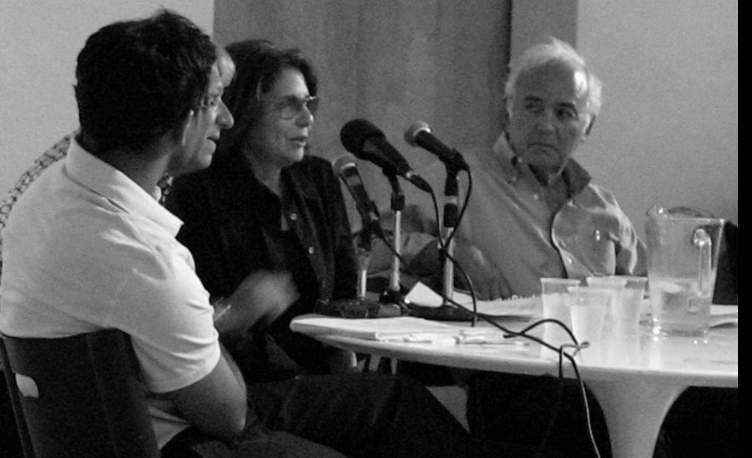
Elena Kagan and the Supremes – Brecht Forum
We hear excerpts from a discussion on the confirmation hearings of Elena Kagan, and how her position may influence the direction of the Supreme Court.
Panelists:
Martin Garbus – one of the country’s leading trial lawyers. Mr. Garbus aggressively represents his clients in the courts and in the media. He has appeared before the United States Supreme Court as well as the highest state and federal courts in the nation. His devotion to ethics, justice and the law has earned him respect among the legal community and beyond as well as prominent awards. Time Magazine has named him “legendary . . . one of the best trial lawyers in the country,” while Newsweek , the National Law Journal and other media agree that Mr. Garbus is America’s “most prominent First Amendment lawyer,” with an “extraordinarily diverse practice.” The National Law Journal named him one of the country’s top ten litigators.
Margaret Ratner Kunstler – former Educational Director at the Center for Constitutional Rights. She’s an attorney and leads the New York City chapter of the National Lawyers Guild and heads the William Moses Kunstler Fund for Racial Justice.
Anand Swaminathan – an associate at Vladeck, Waldman, Elias & Engelhard, P.C. He graduated from the University of Wisconsin in 2001 and the Harvard Law School in 2006. Prior to joining Vladeck he was a law clerk for the Honorable Theodore H. Katz of the United States District Court for the Southern District of New York.
Michael Steven Smith – Law and Disorder co-host, author and New York attorney. Michael Steven Smith is the author, editor, and co-editor of six books, including “The Emerging Police State,” by William M. Kunstler. He has testified before committees of the United States Congress and the United Nations on human rights issues. Mr. Smith lives and practices law in New York City with his wife Debby, where on behalf of seriously injured persons he sues insurance companies and occasionally the New York City Police Department.
———————
Afghanistan War, Civil Liberties, Criminalizing Dissent, Guantanamo, Human Rights, Iraq Veterans, Iraq War, Torture, Truth to Power, War Resister
Podcast: Play in new window | Download
Updates:
—–
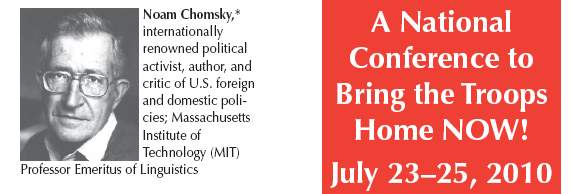
C0-host Michael Smith talks with attorney Jim Lafferty about the upcoming anti-war conference in Albany, New York, July 23-25. Noam Chomsky, internationally renowned political activist, author, and critic of U.S. foreign and domestic policies; Massachusetts Institute of Technology (MIT) Professor Emeritus of Linguistics is the keynote speaker. Click here for flyer (PDF) Groups sponsoring the event: After Downing Street, Arab American Union Members Council, Bail Out the People Movement, Black Agenda Report, Campus Antiwar Network, Campaign for Peace and Democracy, Citizen Soldier, Code Pink, Grandmothers Against the War, Granny Peace Brigade, International Action Center, Iraq Veterans Against the War, Military Families Speak Out, May 1st Workers and Immigrant Rights Coalition, National Assembly to End the Iraq and Afghanistan Wars and Occupations, National Lawyers Guild, Office of the Americas, Peace Action, Peace of the Action, Progressive Democrats of America, Project Salam, September Eleventh Families for Peaceful Tomorrows, The Fellowship of Reconciliation, U.S. Labor Against the War, Veterans for Peace, Voices for Creative Nonviolence, Voters for Peace,Women’s International League for Peace and Freedom, The World Can’t Wait.
—
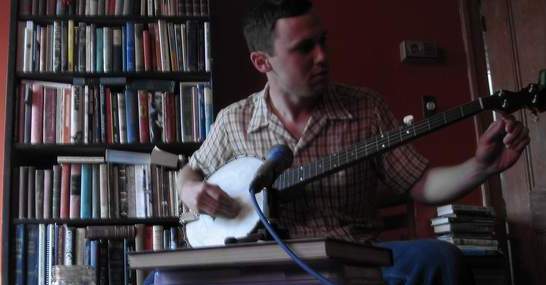
Iraq War Veteran, Conscientious Objector and Musician Clifton Hicks
Clifton Hicks is an activist with the Iraqi Veterans Against the War. Hicks is disabled and enrolled as an Anthropology student at Appalachian State University in Boone, North Carolina. Appalachian State is a center for old-time music, and Hicks is also an accomplished musician and banjo player. Cliff Hicks is psychologically disabled and got out of the Army as a conscientious objector several years ago. In the Spring issue of The Veteran, published by Vietnam Veterans Against the War, there’s printed the following chant, that is repeated by soldiers in training to go to Iraq. “I went down to the market where all the people shop, I pulled out my machete, and I began to chop, I went down to the park where all the children play, I took out my machine gun and I began to spray.” This is the kind of psychological brutalization that our young men are forced to endure that turn them into creatures they never thought they’d become.
Clifton Hicks:
- I was in 9th grade when 9/11 happened. I called the recruiter when I was 16, to try and get in.
- I saw Muslim and Arabic people and thought they were all out to get us.
- I listened to a lot of daytime AM right-wing radio. I had the ole cliche patriotic notions going.
- I wanted to go combat arms from the start, I figured if I was going into the Army, I wanted to fight.
- My feet were on the ground in Iraq in October 2003. The guys I was with that had already been there for a while had gotten pretty nasty. Guys get nasty, because their friends get killed and you realized you can’t trust anybody.
- We were the first division in combat to be out there for more than 13 months.
- They would literally give us candy and toys to give out to Iraqi kids at schools, the next day you’re ridin’ around and you see a b unch of kids get shot.
- I became an anti-war activist while I was still in the Army. We started an IVAW chapter in Gainesville Florida
Guest – Clifton Hicks, Branch of service: United States Army (USA) / Unit: C Troop, 1st Squadron, 1st U.S. Cavalry Regiment / Rank: PFC / Home: North Carolina / Served in: Ft. Knox, OIF 1, Germany. Hicks a musician and is currently a student at Appalachian State University in Boone, North Carolina.
——————————————————————–
Civil Liberties, Truth to Power
Podcast: Play in new window | Download
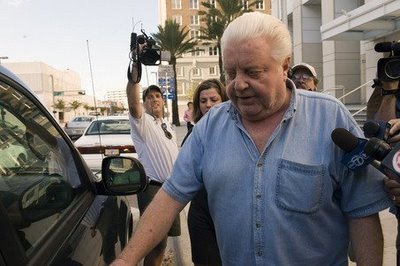
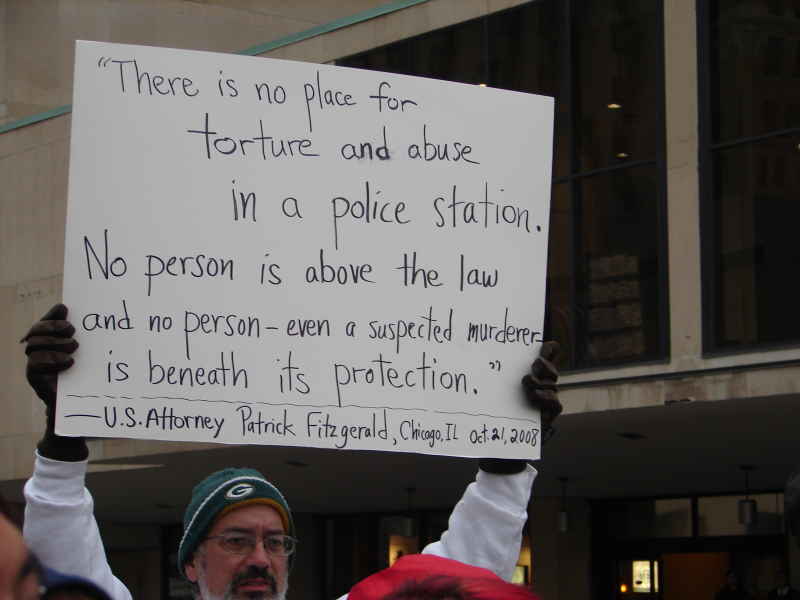
Former Chicago Police Commander Jon Burge Found Guilty
Former Chicago Police Commander Jon Burge was found guilty last week 25 years after the evidence of torture and police abuse was brought forward. Burge was not convicted of abusing prisoners, the statute of limitations on those crimes had passed, he was convicted of perjury and obstruction of justice for lying about the abuse in a civil case.
According to the People’s Law Office in Chicago, at least 24 African American men are still serving sentences for crimes they say they confessed to after being tortured by Chicago Police officers. This happened when the Chicago police precinct was under Commander Jon Burge in the early 70’s to the 1992. Jon Burge is a Vietnam Vet who is said to have brought back torture to Chicago. People’s Law Office Attorney Flint Taylor says Burge shot through the ranks all the way to commander, primarily by leading a band of torturers. They used methods such as electric shock, dry submarino, (suffocating with bags)
The People’s Law Office brought the case in 2005 and the city of Chicago refused to settle while pumping hundreds of thousands of dollars in that case. Attorney with the People’s Law Office Flint Taylor says the city has spent over the 10 million dollars in aiding the defense of former Commander Jon Burge. Mr. Burge, who is 62 and in ill health, was fired from the Chicago Police Department in 1993. He faces up to 45 years in prison.
Attorney Flint Taylor:
- As you know the torture allegations started to arise almost 40 years ago. In 1982, there was evidence that would have put Burge away for torture, but then a movement against torture in the early nineties brought the case back, but Justice Departments refused.
- As time went on, there was no longer the ability to go after him for attempted murder, torture and other substantive charges because the statute of limitations ran out on that.
- They appointed a special prosecutor in the early 2000s but he turned out to be very close to Daley, and he wouldn’t indict. If we couldn’t get Burge for torture, we would get him for obstruction of justice, lying and perjury.
- Burge had exercised all his pre-emptory challenges in court on the jury to get rid of all the black jurors.
- Judge brought back one black person to the jury with Batson law. It was an unbridled racist defense. Jury found Burge guilty on one charge of perjury and two charges of obstruction of justice.
- Federal guidelines would probably put him in the 9 to 10 year sentence category.
- As we uncovered many more cases of torture and master minded by the same commander, movements came together. Movements against police brutality and human rights.
- We are also pursuing that torture be a federal crime without statute of limitations.
- Meanwhile statutes are running out on the Bush Administration torture conspirators.
- But it took 30 years to get this man in the dock, and he’s convicted by a Republican US Attorney. What does that say about the torture by Cheney, and others, with their admissions by the way?
- However long it takes you can’t give up.
- The jury: they’re human beings like we are, and they shouldn’t be tortured.
Guest – Attorney Flint Taylor, a graduate of Brown University and Northwestern University School of Law and a founding partner of the Peoples Law Office. More bio
—


US Social Forum in Detroit Part 1
Co-host Michael Smith talks with Detroit attorney Ron Reosti about, US Social Forum in Detroit and the rebuilding of the Detroit area. Attorney Ron Reosti, born and raised in Detroit, Ron represented left union activists and tenant unions. He also did class employment law and was part of a team that represented women prisoners who were sexually assaulted in Michigan. He’s an National Lawyers Guild member and active in the anti-war movement.
Attorney Ron Reosti:
- Detroit had a radical history before the 1950s based on the labor movement and vibrant black community
- Radicalization in the sixties stemmed from the defeat of McCarthyism in the mid-fifties, civil rights movement in the South and revolt of colonies in third world countries.
- In Detroit we continued to experience the de-industrialization of the city.
- There were a significant number of auto plants that were closed in the fifties and sixties.
- During that time the radicalization kept getting channeled through the democratic party.
- US Social Forum: People are grappling with solutions to the capitalist system.
- Some of the young people aren’t misinformed about Leninism.
- The young people at the social forum seemed to be smarter than we were.
- What kind of society do you build after you overthrow capitalism?
Guest – Attorney Ron Reosti, born and raised in Detroit, Ron represented left union activists and tenant unions. He also did class employment law and was part of a team that represented women prisoners who were sexually assaulted in Michigan. He’s a National Lawyers Guild member and active in the anti-war movement.
—–
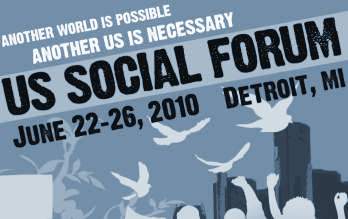
US Social Forum in Detroit Part 2: Detroit Black Radicals
We another perspective on the US Social Forum from John Williams. John Williams is a long time leader of Detroit’s Black community and central organizer of the historic League of Revolutionary Black Workers in Detroit. Williams worked at Ford and Chrysler while teaching at Wayne State University, he was a member of the Black Panther Party, Detroit chapter and a founding member of the Detroit chapter Labor Party. Contact: Rally Comrades / P.O. Box 477113 / Chicago, Illinois 60647 / 773-486-0028.
John Williams:
- US Social Forum this time, questioning captalism and outright anti-capitalism
- The moral question, what this country is doing is wrong, workers laid off, in the streets, immigration, Gaza, Palestine
- LRNA – League of Revolutionaries for a New America, a group of people coming together paying attention to class consciousness in the rising work force.
- We’re talking about workers in the rust belt who have been thrown out of the production. Good union people can’t fight capitalism with the old union ways.
- LRNA ranges from senior citizens to youth who are bound by an understanding of where America is at this point. It’s like a storm that’s developing.
- Back during the League of Revolutionary Black Workers, we moved the Black Panther chapter into the league.
- The head of the Panther party at the time was a Ford worker who had built FRUM. Ford Revolutionary Union Movement
Guest – John Williams, long time leader of Detroit’s Black community and central organizer of the historic League of Revolutionary Black Workers in Detroit. Williams worked at Ford and Chrysler while teaching at Wayne State University, he was a member of the Black Panther Party, Detroit chapter and a founding member of the Detroit chapter Labor Party.
————————————————–
Civil Liberties, Criminalizing Dissent, Guantanamo, Habeas Corpus, Human Rights, Surveillance, Truth to Power
Podcast: Play in new window | Download
Updates:
—
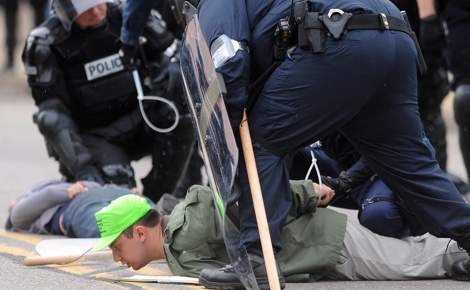

Pittsburgh’s Citizen Police Review Board Demands G20 Police Records, Faces Dismantling
Pittsburgh’s city council is worried that if the city’s Citizen Police Review Board are allowed to scrutinize secret records of officer conduct during the G-20 economic summit, more protesters will sue and possibly jeopardize a $20 million liability insurance policy the city bought before the International Summit last year. We could lose our homes over this,” said City Councilwoman Theresa Smith, chairwoman of the public safety committee.. “If we don’t have insurance, then it falls to us.” The Seeds of Peace Collective and Three Rivers Climate Convergence have filed a joint federal lawsuit against the city charging that police violated their First and 14th Amendment rights at two events. Meanwhile, city hall has started the nomination process to remove most of the members of the Pittsburgh Citizen Police Review Board.
Elizabeth Pittinger:
- The Pittsburgh Citizen Police Review Board does have subpoena power and when they initiated their inquiry last October, a general request of a number of documents to be turned over so we could begin the inquiry. The city resisted providing that information.
- In December the chair of the Citizen Police Review Board issued a subpoena demanding that police reports specified by number be turned over in addition to operational material and documents.
- On March 18, the courts issued an order directing the city to provide the documents. They finally gave us a stack of more than 300 pages of police reports that were so heavily redacted they were substantively illegible.
- We went back to court seeking that they would have to provide the information in an un-redacted form and that has led to this controversy with city council.
- The Pittsburgh City Council is coming forward with a document called “the will of council” urging the police review board to slow down its inquiry.
- What has happened now is that the request of these G20 documents is really the vehicle that the city has now created to challenge the board’s right of access to any document.
- Protesters hit with OC Vapor – Invisible Vaporized Pepper Spray
Guest – Elizabeth Pittinger, the Executive Director of the Pittsburgh Citizen Police Review Board.
——–
“Cyber War” Creates Need For Internet “Kill Switch”
Senator Lieberman and Senator Susan Collins have the attention of civil liberties and privacy experts as they craft a bill that would allow the take over of the civilian internet network during an emergency. After initial outcry, Senator Lieberman told the media, the Internet Kill Switch bill is a matter of national security, and a kill switch is needed to disconnect immediately from a foreign nation in case of an attack. He continues, “Right now, China, the government, can disconnect parts of its Internet in a case of war. We need to have that here too,” Protecting Cyberspace as a National Asset Act of 2010 is the name of the bill, and supporters argue that it is not a kill switch, but a way to divert traffic away from another country. It is added that the President already has broad powers to shut off any and all regulated telecommunications in the 1934 Telecommunications Act.
Tracy Rosenberg:
- I think its clear by the way the bill is currently written, the president could target political groups, but that’s not the intent of the bill. It doesn’t mean it couldn’t be used in that fashion. The information sharing is quite similar to what happened after 9/11. It potentially creates a situation where corporate providers basically rat out parties at the instructions of the government. That could certainly be directed at political viewpoints.
- Internet sites could potentially be shut down. Information about who is posting to them, who is reading them and who owns them will become the property of the federal government.
- Another motivation behind the bill – Litigation and liability protection for internet companies.
- Internet use in China is considerably compromised
Guest – Tracy Rosenberg, Executive Director of Media Alliance since 2007. She has organized and advocated for a free, accountable and accessible media system,focusing on the protection and sustainability of alternative media outlets from Pacifica Radio to low-power FM, public access and Indymedia, monitored the mainstream media for accuracy and fair representation and facilitated the training of numerous nonprofit organizations and citizen’s groups in effective communications.
—–
A Dark Day For Human Rights
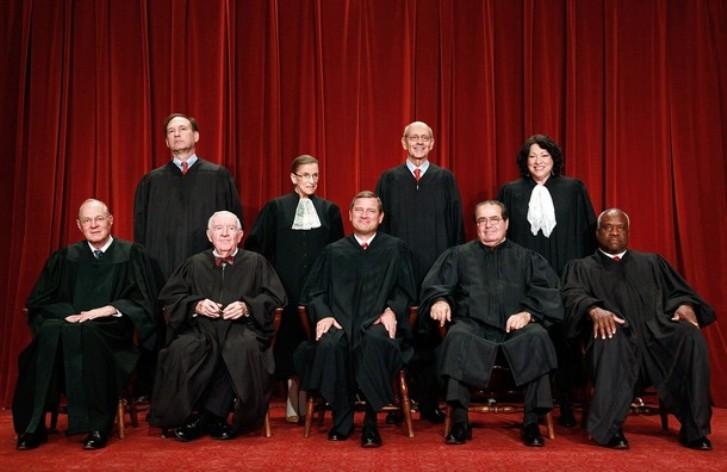
The Supreme Court’s decision to preserve a vague prohibition on aiding and associating with terrorist groups severely reduced the First Amendment rights of American citizens. The decision could have serious impact on lawyers, journalists and academics who represent or study terrorist groups. The new decision came from a case by the Humanitarian Law Project that challenged the law of prohibiting “material support” to terror groups. The law projected wanted to provide advice to two terrorist groups on how to peacefully resolve their disputes with the United Nations and International Law. The Supreme Court ruled that the peaceful assistance is aiding terrorism.
Shane Kadidal:
- A number of Justices were skeptical about the ways this law may be applied to journalists, to lawyers representing unpopular clients. “Speech discouraging violence can be banned under the First Amendment.”
- Solicitor General Kagan was asked if a lawyer is entitled to represent someone on the FTO list.
- Foreign Terrorist Organization List.
- Kagan says if you have some Constitutional right to be in court then the statutes should be interpreted in a way to allow the lawyer to represent someone in those circumstances.
- If you think about it, it took the Guantanamo lawyers 7 years to establish if there was a Constitutional right to challenge your detention if you’re a non-citizen.
- Kagan is saying that lawyers were taking their chances to represent Guantanamo lawyers in the first place.
- Lynn Cheney’s group : Keep America Safe.
- You couldn’t send books on Federalism to the Tigers of Tamil Eelam who are on the FTO list.
- The law defines material support to be more than tangible things like guns, and money but also things like personal services, expert advice and assistance. Those terms are so broad.
- (Treating a wounded person with your medical skills) Humanitarian aid during crisis at risk.
- That’s one of the fundamental problems with vague statutes. They give too much discretion to law enforcement, if everything is prohibited than law enforcement is going to be selective on who they choose to prosecute. The government likes that. Greenpeace would easily qualify.
- President Clinton was the first to use this law directed at whole nations such as Nazi Germany or Cuba and instead direct them at political organizations.
- The government has used this law 150 times since 9/11. Statute of limitations of 8 years.
Guest – Shane Kadidal senior managing attorney of the Guantánamo Global Justice Initiative at the Center for Constitutional Rights in New York City. He is a graduate of the Yale Law School and a former law clerk to Judge Kermit Lipez of the United States Court of Appeals for the First Circuit.
————————————————————————