Today on Law and Disorder co-host Heidi Boghosian debriefs Eugene Puryear, Howard University student and key national political organizer for the Jena 6. They discuss the denying of a request to release Mychal Bell whose arrest in the beating of a white classmate sparked last week’s civil rights protest in Louisiana.
Defense lawyers also have complained that Judge J.P. Mauffray Jr. set a high bail for Bell — $90,000 — prior to his conviction in the Barker beating. Mauffray had cited Bell’s criminal record, which included juvenile arrests for battery and damage to property, in setting the bail.
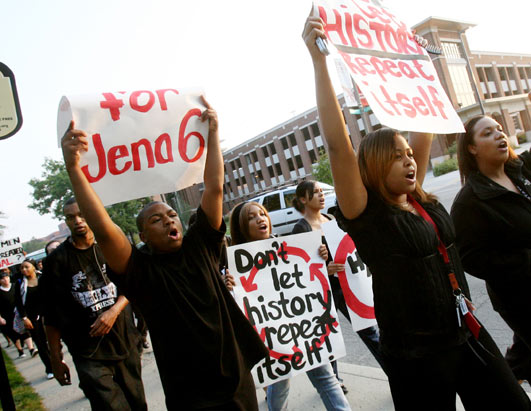
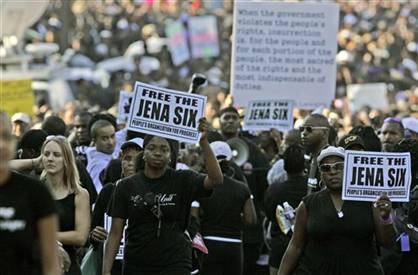
Nearly 60 thousand protestors demonstrated in Jena, Louisiana, a town with the population of 3000. It was called the largest civil rights rallies in the South since the 1960’s. The protest was scheduled around the sentencing of Mychal Bell who was convicted by an all white jury.
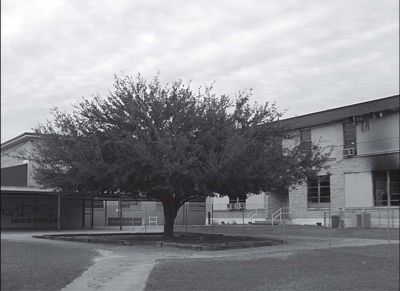
The incidents began when three black high school students decided to sit under a shade tree in the school yard where usually white students sat. The next day three nooses were found hanging from the tree. Though the culprits who hung the nooses were discovered and recommended for expulsion by the principal, the school board chose to reduce their expulsions to a three-day, in-school suspension. After the entire black student body protested peacefully by sitting under the tree, Jena District Attorney Reed Walters informed the school in an assembly that he could take away the lives of the black students with a stroke of his pen.
In the following months several incidents occurred, including threats and acts of violence against black students to which DA Walters did not respond. However, after a white student was beaten up by black students in December, Walters charged six black students with second-degree attempted murder and conspiracy to commit murder. The white student was treated at the hospital, released that same day, and was seen at a social function that very night. Mychal Bell, originally charged with attempted murder for allegedly beating up a white student, was later charged with and convicted of aggravated second-degree battery and conspiracy to commit aggravated battery. The 3rd Circuit Court of Appeals recently vacated Bell’s conviction, stating that Bell should never have been tried in an adult court because the alleged offense occurred when Bell was a minor. The Jena prosecutor has reportedly vowed to appeal the 3rd Circuit’s ruling.
The other five teens, Robert Bailey, Theo Shaw, Carwin Jones, Bryant Purvis and an unidentified juvenile, face charges ranging from aggravated second-degree battery to attempted second-degree murder. Most of the boys spent months in jail before being able to raise tens of thousands of dollars for bail. Bell was never able to raise the money to make bail, and remains in jail even after the overturning of his conviction. Related – Racism in Louisiana – BBC / FBI Probes Anti-Jena 6 Web Page
Guest – Eugene Puryear, Howard University student and key national political organizer for the Jena 6
Call for National Action Tuesday October 2, at 5pm/Justice Dept in Washington DC.
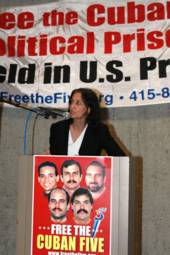
A three-judge panel at the Eleventh Circuit Court of Appeals in Atlanta heard oral arguments earlier this month relating to the case of the Cuban Five. This is the third time in two years the Eleventh Circuit has heard appeals in the case of Gerardo Hernandez, Ramon Labanino, Antonio Guerrero, Fernando Gonzalez, and Rene Gonzalez, who are serving a collective four life sentences and 75 years in prison.
Law and Disorder co-host Heidi Boghosian spoke at the rally and was at the hearing. “The court was filled with international observers jammed the court to observe both US government and defense attorneys deliver their arguments. Observers came from many countries including Belgium, Brazil, Canada, Ecuador, England, Germany, Italy, Spain, and Ukraine.”
We an excerpt from an interview on KPFK’sThe Lawyer’s Guild Radio Show hosted by Jim Lafferty. In this interview Jim Lafferty talks with Len Weinglass, civil rights lawyer and defense attorney for Antonio Guerrero.
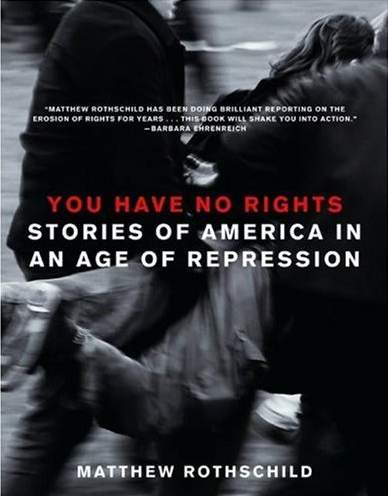
In his recently published book, You Have No Rights; Stories of America in an Age of Repression, author Matthew Rothschild, cites dozens of personal stories that outline the big picture of repression in the United States. Hired goon squads of young republicans shout down protesters with chants of USA – USA – USA!! Remember the lawyer who was arrested at a local mall for wearing a “Give Peace A Chance†t-shirt? As Rothschild points out in his new book, the first, fourth, fifth, sixth and eighth amendments are under siege and very little is being done to protect them.
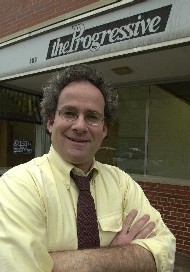
Guest – Matthew Rothschild author of You Have No Rights and editor of the Progressive Magazine since 1993. Previously the editor of Multinational Monitor, a magazine founded by Ralph Nader, he is the host of Progressive Radio.
It is shocking to see those who should know better supporting and in some cases practically fawning over the nomination of Michael Mukasey for Attorney General. There is simply no excuse for anyone who cares about fundamental rights and civil liberties to support Mukasey’s nomination. Read More
Since the summer of 2004, Law and Disorder has brought Pacifica listeners the voices of activists, authors and attorneys from the front lines.
Last week, and in the next three weeks, we examine in a four part series, the foundation for what many view as a police state in the United States. In this series we will talk with guests about the post 9/11 blueprint of this dictatorship/ police state and how the nefarious turn to war, the use of torture and the domestic propagation of fear unfolded.
We have examined at length topics such as torture, domestic surveillance, criminalizing dissent, racial profiling, indefinite detentions and the destruction of constitutional rights as vital information to bring an understanding to listeners as to how it happened and where we go from here.
In this third part of the series we look at several key issues in the crackdown of dissent in this country including how the government has set up a terrorist database to categorize and target domestic activists. As attorneys on the front lines we bring exclusive cases of domestic surveillance of protestors. In previous shows, Law and Disorder has covered the lawsuits involving NSA wiretapping of phone calls and emails by the Center for Constitutional Rights, EFF and the ACLU. We talk with the ACLU’s Michigan Legal Director about their NSA lawsuit and recent victory
Here on Law and Disorder we’ve covered, directly and indirectly, the resurgence of domestic surveillance since the events of September 11. We’ve seen how the government has loosened restrictions on spying on political activists, both locally and nationally. We’ve seen how this administration has exploited the term “terrorism” to justify a host of insidious and often unlawful practices, from engaging in mass arrests of peaceful protesters in order to collect information about their political affiliations, to categorizing and labeling individuals based on their ideologies, to assembling all this information into a comprehensive terrorism watch list called the Terrorist Screening database.
Co-host Michael Ratner, President of the Center for Constitutional Rights recently returned from Berlin after filing a 380 page complaint in German against former Secretary of Defense Donald Rumsfeld and other Bush Administration officials with war crimes. Read the CCR complaint – documents.
Hosts discuss recent Michigan ACLU lawsuit victory against NSA spying.
In the first federal challenge ever argued against the Bush administration’s NSA spying program, U.S. District Court Judge Anna Diggs Taylor rules that the program to monitor the phone calls and e-mails of millions of Americans without warrants is unconstitutional. Calling for a halt to this abuse of presidential power, Judge Taylor states that “there are no hereditary Kings in America and no powers not created by the Constitution,” so all the president’s “inherent powers” must derive from the Constitution.
Guest – Michael J. Steinberg has served as the legal director of the American Civil Liberties Union of Michigan since 1997 where he has worked on numerous high-profile impact cases on a wide range of civil liberties and civil rights issues. He has served as co-counsel on several post-9/11 cases including: the successful Detroit lawsuit challenging the National Security Agency’s warrantless domestic wiretapping; the challenge to Section 215 of the Patriot Act; and the successful challenge to John Ashcroft’s order closing certain immigration proceedings to the press and the public.
In May of 2004, the FBI arrested Mayfield as a material witness in connection with the Madrid bombing attacks and held him for over two weeks before releasing him. Mayfield was never charged, and an FBI internal review later acknowledged serious errors in their investigation.
UC Santa Cruz Students Against War have turned up on a Pentagon database of protest groups, while a conference of Arab-American scholars at Stanford University was targeted by an FBI Task Force. Konstanty Hordynski, a member of the UC Santa Cruz group that was deemed a “credible threat” by the Pentagon remarked, “When I learned our constitutionally protected advocacy was included on a Pentagon list of monitored events, I was taken aback. I was saddened that the Constitution could be so easily ignored.”
Criminalizing Dissent – Law and Disorder Exclusive
Today we’d like to connect some of the dots by talking about a companion database, the FBI’s Violent Gang and Terrorist Organization File, or VGTOF. The VGTOF is the Watchlist’s main source of domestic terrorist information. Among other information, the VGTOF includes names of individuals with no criminal history who are being investigated as being politically active or connected with politically active organizations. In 2002 the FBI memo stated that it will include “Anarchists, Animal Rights Extremists, Environmental Extremists, and domestic extremists. Official never have to justify the decision to place someone on the list, a list that can be accessed by virtually every law enforcement official with whom the person comes into contact.
Guests – Attorney Gideon Oliver and law students Grainne O’Neill and Mark Taylor.
James Lafferty is currently the Executive Director of the National Lawyers Guild in Los Angeles and host of The Lawyers Guild Show, a weekly public affairs program on Pacifica radio station KPFK, 90.7 FM.
He has served as a chief officer of, and spokesperson for, various national anti-war coalitions, including the National Peace Action Coalition, the anti-Vietnam War coalition that organized the largest protests during that war; the National Coalition for Peace in the Middle East; and, the National Campaign to End U.S. Intervention in the Philippines. In the ‘60s and ‘70s, his law firm, Lafferty, Reosti, Jabara, Papakian & Smith, represented virtually all of the left political movements in and around Detroit, Michigan, during which time he became one of this nation’s leading experts on Selective Service law and military law.
In the early ‘80’s, Mr. Lafferty founded and chaired the largest A.C.L.U. Chapter in the State of Michigan. In New York City, in the late 80’s and early ‘90s, he traveled the world organizing on behalf of the labor rights of merchant seafarers. During this time he also taught a course at the New School for Social Research, entitled, Vietnam: The War at Home and Abroad. More recently, he was the Coordinator of the L.A. Coalition to Stop the Execution of Mumia Abu-Jamal, as well as a member of the national steering committee of the Campaign to Stop the Execution of Mumia Abu-Jamal.
He currently serves on the Board of the L.A.-based Office of the Americas and on the steering committee of the anti-war coalition, International ANSWER/L.A. Mr. Lafferty has recently been elected as a Fellow of the L.A. Institute for the Humanities, at the University of Southern California.
—-
Government Aims to Block Accountability for Illegal Spying on Americans
The law effectively removes oversight for spying from the Foreign Intelligence Surveillance Act Court or FISA court and leaves it up to the Executive Branch to monitor itself, with Attorney General Gonzales having the primary responsibility for oversight. The arguments are being heard at the Ninth Circuit Court of Appeals in San Francisco
When we think of doctor closing a wound many things come to mind – sutures, staples, band aids or the like. It might astound many to learn that some doctors use Krazy glue on inmate patients. During a time when government transparency is nearly obsolete, we find the few that act as beacons of hope. When he first requested the records for medical malpractice cases involving inmates in 2000, Paul Wright never imagined how much trouble it would be.
Guest – Paul Wright, editor of Prison Legal News, a publication that looks into our correctional facilities and reports on prisoner’s rights. Paul is also on the board of the National Lawyers Guild.
Police used excessive force when they attacked peaceful protestors who rallied at a University of Michigan event sponsored by the American Movement for Israel. As the senior medical professional on scene, Dr. Catherine Wilkerson took responsibility for the well-being of a middle-aged man who claimed he couldn’t breath and lost consciousness. She exhorted the police to get off of him, and was allowed to check his pulse and breathing.
Wilkerson later protested when Emergency Medical Service (EMS) personnel breached ethical medical practices by forcing ammonia into the man’s nostrils and face. It was at this time that she was physically assaulted and detained by Ann Arbor police.
No charges were filed until after Dr. Wilkerson wrote a complaint to authorities about the actions of the police officers. A week since writing the letter, Dr. Wilkerson was charged by the Washtenaw County Prosecutor Brian Mackie’s office, at the request of the UM police, with two attempted felonies—one against Officer Warner and one against the EMS personnel.
Here on Law and Disorder we’ve followed the pivotal moments in the Mohammed Salah case. Earlier this year, Salah was cleared of terrorism charges but recently convicted of lying about his ties to the Palestinian group Hamas. He faces nearly two years in prison. The sentence for a minor charge of obstruction of justice comes as a major setback for prosecutors who have spent a decade investigating charges that could have put Salah behind bars for life.
In his latest article in the New York Review of Books, David Cole, professor of law at Georgetown University reviews several books including, John Ashcroft’s Never Again: Securing America and Restoring Justice, General Ashcroft: Attorney at War by Nancy V. Baker and It Can Happen Here: Authoritarian Peril in the Age of Bush, by Joe Conason and also Unchecked and Unbalanced: Presidential Power in a Time of Terror by Frederick A.O. Schwarz Jr. and Aziz Z. Huq.
These publications create an outline of how former Attorney General John Ashcroft helped create a platform that allowed the Bush administration to torture, allow coerced confessions and hold defendants indefinitely without trial.
Peter Weiss is Vice-President, former President, of the International Association of Lawyers Against Nuclear Arms and its US affiliate, the Lawyers’ Committee on Nuclear Policy; Vice-President, Federation Internationale des ligues des Droits de l’Homme; and Vice-President, Center for Constitutional Rights. Mr. Weiss is a graduate of Yale Law School and has lectured and written widely on the international law of war and peace, nuclear weapons and human rights. He was the principal author of the draft brief on the illegality of threat or use of nuclear weapons used by many countries in making written submissions to the International Court of Justice in the 1996 nuclear weapons advisory opinion, and served as counsel to Malaysia at the hearings.
He has published several articles on the ICJ opinion, including in the fall 1997 issue of Transnational Law and Contemporary Problems. Mr. Weiss is also a leading human rights lawyer with the Center for Constitutional Rights, and litigated the seminal case establishing the right of victims of torture to sue their torturers in US courts (Filartiga v. Pena-Irala). Since his retirement in 1996 from Weiss Dawid Fross Zelnick & Lehrman, a leading trademark firm, he has been Senior Intellectual Property Counsel to The Chanel Company Limited. He is also a founder and former President of the American Committee on Africa and former Chairman of the Board of the Institute for Policy Studies in Washington. He has also long been an activist for peace in the Middle East and is currently a member of the Arab-Jewish Peace Group in New York and of the Executive Committee of Americans for Peace Now, which supports the Peace Now movement in Israel.
US Marine Corporal Adam Charles Kokesh and other members of Iraq Veterans Against the War (IVAW) wore parts of their Marine Corps Combat Utility Uniforms during a street theater demonstration that marked the 4th anniversary of the Iraq War. The Marine Corp warned the soldiers of disciplinary action for violating uniform policies at political demonstrations. Kokesh tells hosts that he responded with a letter (ending it with “[I] … ask you to please, kindly, go f&%# yourself.”). As a result, a military court convened to look at changing Kokesh’s military discharge from “honorable” to “other than honorable” because of “Disrespect toward a Superior Commissioned Officer”, and violating “Wearing of the uniform” regulation.
At the time Kokesh was part of the Individual Ready Reserve (IRR) Kokesh’s attorney, Mike Lebowitz, claimed that the Marine Corps is attempting to stifle Kokesh’s constitutional right to free speech. Lebowitz and JAG defense counsel LT Joseph Melaragno argued that the military did not have jurisdiction over Kokesh based on the Marine Corps’s use of the Uniform Code of Military Justice, since the UCMJ does not apply to members of the IRR. Ultimately Kokesh was given a general discharge a step lower than honorable, instead of the harsher penalty that included losing access to certain veteran’s health benefits and being forced to pay back more than 10 thousand dollars in educational benefits.
Guest – Adam Kokesh
Guest – Michael Lebowitz, attorney for Adam Kokesh.
Former Staff Sergeant of the Florida National Guard and anti-war activist Camilo MejÃa became known in the antiwar movement in 2004 when he applied for a discharge from the Army as a conscientious objector. After serving in the Army for nearly nine years, he was the first known Iraq veteran to refuse to fight, citing moral concerns about the war and occupation. Mejia spent six months in combat in Iraq where he witnessed the killing of civilians and the abuse of detainees.
After he returned to the United States he decided never to return to fight in Iraq. He went into hiding to avoid redeployment and was classified as AWOL by the military. MejÃa was ultimately convicted of desertion by a military court and sentenced to a year in prison. He has recently written a book titled – Road from Ar Ramadi: The Private Rebellion of Staff Sergeant MejÃa which recounts his journey of conscience in Iraq.