Civil Liberties, Guantanamo, Supreme Court, Torture, Truth to Power
Podcast: Play in new window | Download

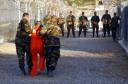
Co-hosts Dalia Hashad and Michael Ratner discuss the Hamden Case, the Military Commissions Act of 2006 and Habeas Corpus.
 Download/Listen to this segment [15 MB]
Lt. Ehren Watada, the First Commissioned Officer Refuses Iraq Deployment Orders
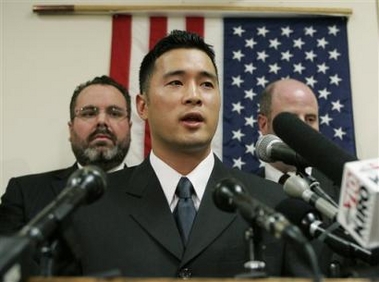
Lieutenant Ehren Watada is the first commissioned officer to publicly refuse to deploy to what many believe a historic illegal war in Iraq. He is a First Lieutenant in the United States Army, a member of the 3rd Brigade, 2nd Infantry Division Stryker Brigade Combat Team, who in June 2006 publicly refused to deploy to Iraq, saying that he believed the war to be illegal and that it would make him party to war crimes.
Watada is charged with one count of missing troop movement and two counts of speaking contemptuously of the president. The contempt charges were dropped in November.
Recently, a US military prosecutor is seeking testimony from Truthout reporters to prove that Watada engaged in conduct unbecoming an officer, directly related to disparaging statements the Army claims Watada made about the legality of the Iraq War during interviews with Truthout. Ehren Watada faces six years in prison.
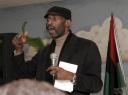
Today we speak with Carolyn Ho, the mother of Lt. Ehren Watada, the first officer to publicly refuse to serve in Iraq. Ho is on a tour throughout the country bringing awareness and garnering support for her son’s case.

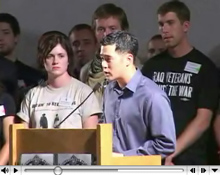
We also play Lieutenant Watada’s entire speech delivered in August 2006 at the Veterans for Peace National Convention. Just as Watada took the stage and began to speak, more than 50 members of Iraq Veterans Against the War filed in behind him. Watada, surprised by the support, draws a deep breath and begins his speech.
Communities Reeling From Police Shooting “Massacre”
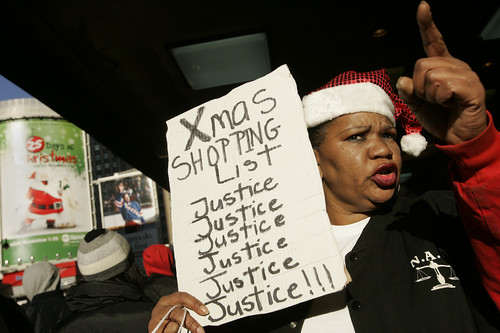
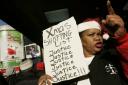
Tens of thousands of protesters silently marched down Manhattan’s Fifth Avenue Saturday as seasonal shoppers looked on. Many held banners and called for the resignation of New York City Police Commissioner Ray Kelly. All of this protesting the fatal police shooting of 23-year-old Sean Bell last month on his wedding day. Bell’s friend and fellow shooting victim Trent Benefield led the march in a wheelchair pushed by the Rev. Al Sharpton.
The death of unarmed Sean Bell, killed by undercover police in a hail of 50 bullets in Queens, New York outraged communities and sent shockwaves through the country. As the investigations into the case proceed, the fallout from the shooting raise new questions about racial profiling and stirred distrust among police and minority communities.
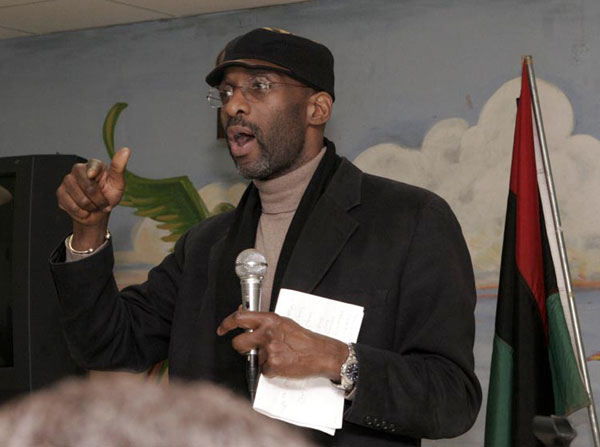
Guest – Roger Wareham attorney and political activist for nearly three decades. He’s a member of the December 12th Movement, organizing in the Black and Latino community around human rights violations, particularly police brutality.
Committee on the Elimination of Racial Discrimination (CERD) – This Convention against Racial Discrimination commits States parties to change national laws and policies that create or perpetuate racial discrimination and aims, among other things, to promote racial equality, which allows the various ethnic groups to enjoy the same social development. The Convention against Racial Discrimination defines racial discrimination as: “any distinction, exclusion, restriction or preference based on race, colour, descent, or national or ethnic origin which has the purpose or effect of nullifying or impairing the recognition, enjoyment or exercise, on an equal footing, of human rights and fundamental freedoms in the political, economic, social, cultural or any other field of public life.”
Civil Liberties, Guantanamo, Supreme Court, Surveillance, Torture, Truth to Power
Podcast: Play in new window | Download

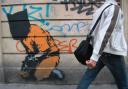
Hosts Michael Ratner and Heidi Boghosian list some positive developments in detentions and the US government’s racial profiling of Muslims. Guantanamo Bay detainees are nearing a fifth year of being kept in cages despite the Center for Constitutional Rights winning two Supreme Court cases. By January 11th, 2007, most of the 460 men in Guantanamo Bay detainment camp, Cuba will have been detained five years as the Bush administration insists in holding them without trial. Among the detainees held for five years – David Hicks – an Australian citizen.
From the Washington Post – “It is often said that ‘justice delayed is justice denied.’ Nothing could be closer to the truth with reference to the Guantanamo Bay cases,” U.S. District Judge Gladys Kessler of Washington D.C. wrote in a ruling Friday, spurning the Pentagon’s attempt to deny Bisher Al Rawi, another Afghan man held at Guantanamo, from representing his friend Al Razak. Read story here.

Gladys Kessler – “The Petitioner . . . identifies the legal, cultural, and psychological isolation in which the detainee exists which demonstrate his inability to challenge the legality of his detention. They are as follows: He is a resident of Afghanistan. He has had virtually no contact with the news media or any word from outside the closed Guantanamo prison system for over 3 years. He has had no contact with his friends or family members outside Guantanamo. He is unfamiliar with the United States Court System. He does not speak English.He likely does not know what the term Habeas Corpus means. He has no criminal charges against him.”
Brandon Mayfield update – wrongly arrested by FBI agents after the 2004 Madrid terrorist bombings, has settled his lawsuit against the U.S. government for $2 million. Read story here.


Eric Schlosser on the United States Prison System
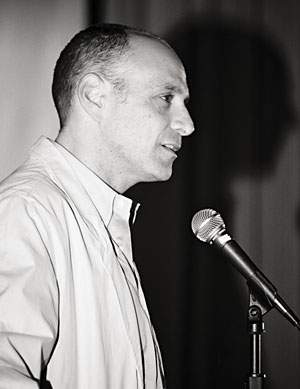
We’ve covered in depth on Law and Disorder the US run prison industry abroad, from Guantanamo Bay prison, Cuba, Bagram prison in Afghanistan and Abu Ghraib in Iraq. These are the exports of one of the most highly profitable businesses in the United States. The prison industrial complex in this country has reached record breaking occupancy. Nearly 2.1 million Americans are behind bars, the majority of them nonviolent offenders, they’re usually poor, many have substance abuse problems and many have are mentally ill. This according to exhaustive research by Fast Food Nation author Eric Schlosser who spoke at Bluestockings Bookstore in New York about his compendium on the American Prison system.
Law and Disorder caught up with Eric during this talk and we listen to an excerpt of his one hour speech. In his talk he warns our society of the perils of a profit driven penal system and backs his research with well-documented facts and staggering statistics.


Radio Frequency Identification – Spychips
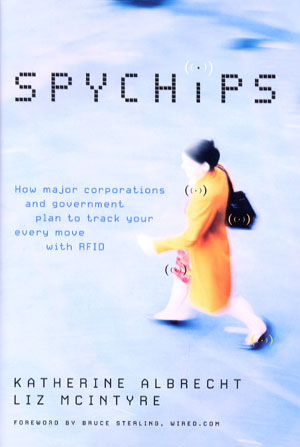
Here on Law and Disorder we’ve brought you stories about Radio Frequency Identification, a technology that uses tiny computer chips smaller than a grain of sand to track items at a distance. RFID “spy chips” have been hidden in the packaging of Gillette razor products and in other products you might buy at a local Wal-Mart, or Target – and they are already being used to spy on people. Some of the world’s largest product manufacturers have been working behind closed doors since 1999 to develop this technology. They plan to use these remote-readable chips to replace the bar code.
Each tiny chip is hooked up to an antenna that picks up electromagnetic energy beamed at it from a reader device. When it picks up the energy, the chip sends back its unique identification number to the reader device, (which can be located anywhere!) allowing the item to be remotely identified. Spy chips can beam back information anywhere from a couple of inches to up to 20 or 30 feet away.
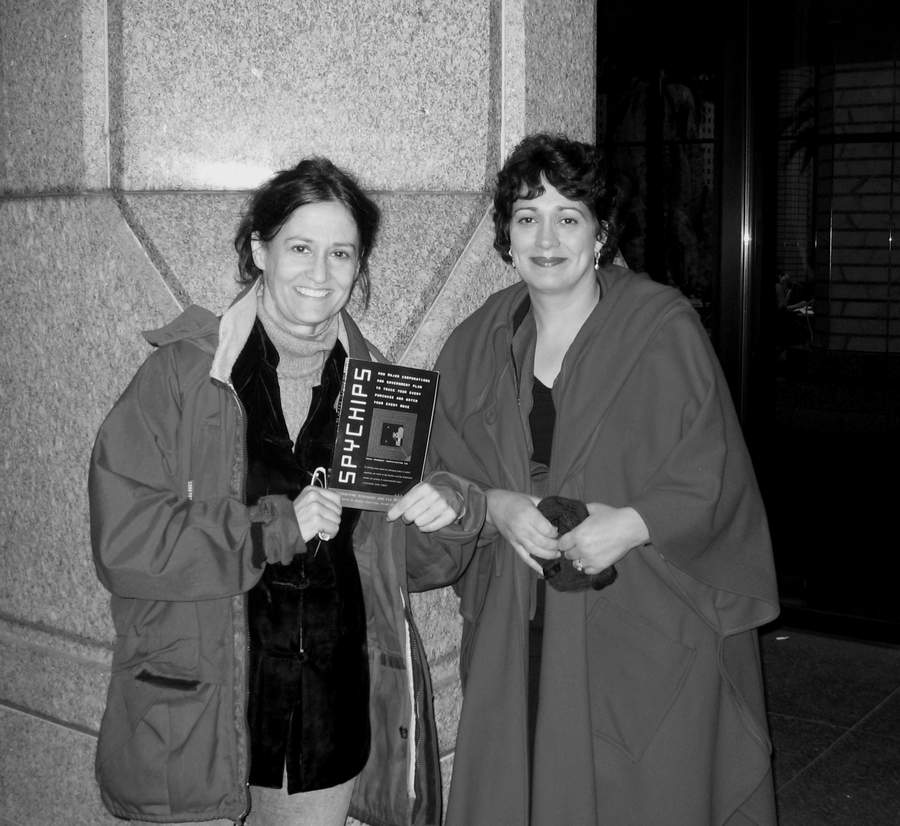
Guest – Liz McIntyre, co-author of Spychips:How Major Corporations and Government Plan to Track Your Every Move with RFID

Photo from double RFID implantee Amal Graastra.
Recent Legislation – SENATE BANKING COMMITTEE MEMBER DENOUNCES “NO-SWIPE” CREDIT CARDS
A member of the Senate Banking Committee denounced RFID “no-swipe”credit cards at a press conference Sunday. Senator Charles Schumer (D-NY) said contracts for the cards should have warning boxes disclosing “the known weaknesses of the technology.” He cautioned cardholders about their vulnerability to identity thieves, commenting you “may as well put your credit card information on a big sign on your back.”
“No-swipe” or “contactless” credit cards contain RFID microchips that communicate account information silently and invisibly by radio waves. These microchips have earned the nickname “spychips” because the information they contain can be read without an individual’s knowledge or consent.
While Congress is just waking up to the dangers of RFID technology, privacy and civil liberties organizations have been sounding the alarm for years.
Civil Liberties, Guantanamo, Torture, Truth to Power
Podcast: Play in new window | Download


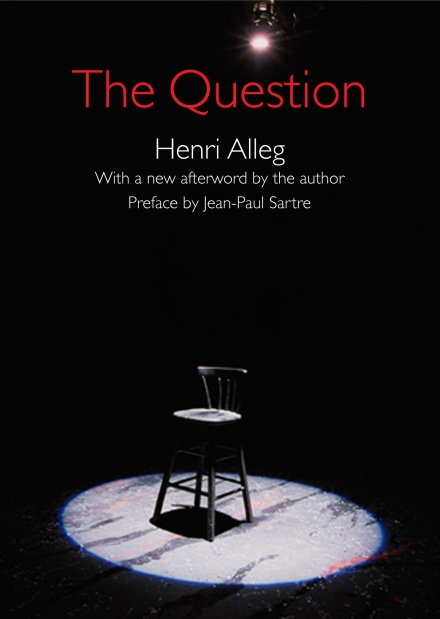
Henri Alleg, Author of the The Question
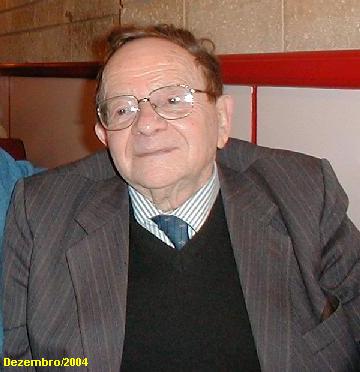
Hosts Michael Ratner and Michael Steven Smith interview Henri Alleg for the first half hour. Alleg, a French journalist living in Paris, supported Algerian independence during the French Algerian War (1954-1962). He was arrested by French paratroppers during the Battle of Algiers in June 1957 and interrogated.
Henri Alleg describes to Law and Disorder hosts in this exclusive interview how he was questioned hung from his feet and tortured with a similar brutality and sadism often described by prisoners in Guantanamo and Abu Ghraib. Alleg talks about his republished book The Question. It’s a moving account of that month of interrogation and his triump over his torturers. Jean-Paul Sartre has written the preface that remains a relevant commentary on the moral and poltical effects of torture on the both the victim and perpetrator. A very moving story.

Incoming National Lawyers Guild President Marjorie Cohn
Law and Disorder welcomes back professor of law and NLG president Marjorie Cohn. Hosts discuss with Marjorie Cohn the Military Commissions Act of 2006, the subsequent loss of Habeas Corpus for non-citizens and permanent aliens in the the United States. Marjorie also comments on the construction of detention centers in the United States contracted by Kellogg Brown and Root (KBR) a subsidiary of Hallibuton. – (Corpwatch – Halliburton)
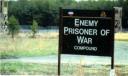

A quote from KBR press release referenced by NLG president Marjorie Cohn – “The contract, which is effective immediately, provides for establishing temporary detention and processing capabilities to augment existing Immigration and Custom Enforcement Detention and Removal Operations (DRO) Program facilities in the event of an emergency influx of immigrants into the U.S., or to support the rapid development of new programs. The contingency support contract provides for planning and, if required, initiation of specific engineering, construction and logistics support tasks to establish, operate and maintain one or more expansion facilities. The contract may also provide migrant detention support to other U.S. Government organizations in the event of an immigration emergency, as well as the development of a plan to react to a national emergency, such as a natural disaster. In the event of a natural disaster, the contractor could be tasked with providing housing for ICE personnel performing law enforcement functions in support of relief efforts.”


Where are the demonstrators?
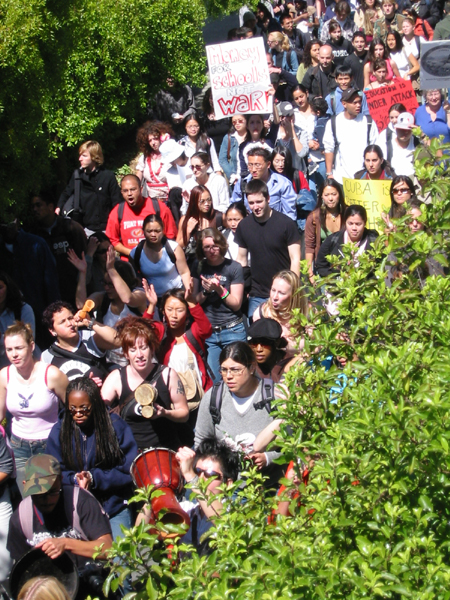
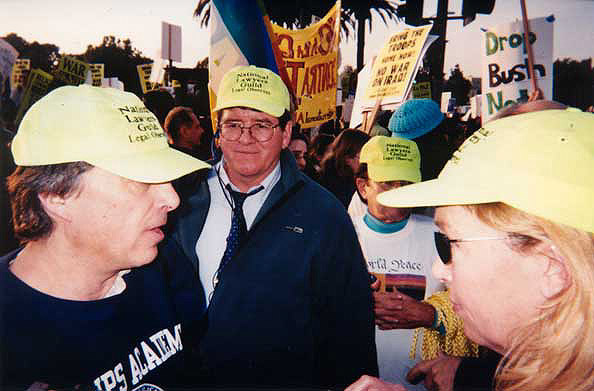
Law and Disorder hosts talk with Jim Lafferty, executive director of the Los Angeles chapter of the National Lawyer’s Guild and host of the Guild Radio Show on Pacifica’s sister affiliate KPFK 90.7 FM in Los Angeles. Hosts talk with Jim Lafferty about fighting the legal battle of protesting in the streets on the west coast and the victories. A serious yet, uplifting interview on the state of the peace movement in the United States.
Law and Disorder – Laying the Foundation Of A Police State – Four Part Series – Click Here to Listen/Download
Civil Liberties, Death Penalty, Supreme Court, Truth to Power
Podcast: Play in new window | Download
Laying the Foundation of a Police State – Part 4 – Iraq
Since the summer of 2004, Law and Disorder has brought Pacifica listeners the voices of activists, authors and attorneys from the front lines.
We’ve examined in a four part radio series, the foundation for what many view as a police state in the United States. In this series we’ve talked with guests about the post 9/11 blueprint of a police state build up and how the nefarious turn to war, the use of torture and the domestic propagation of fear unfolded.
We have examined at length topics such as torture, domestic surveillance, criminalizing dissent, racial profiling, indefinite detentions and the destruction of constitutional rights as vital information to bring an understanding to listeners as to how it happened and where we go from here.
In this fourth part of the series we look at the unjust and illegal war in Iraq.
We believe that taken together, the four-part series chronicle the events, policies and legislation that have shaped a police state in the United States. Law and Disorder calls attention to this emergence by bringing you the voices of strength and opposition from activists, authors and attorneys who are well informed, not silent and standing up against the strangling of democracy.


Iraq: The Logic of Withdrawal
Law and Disorder invite Anthony Arnove back to talk more about his book Iraq: The Logic of Withdrawal, and discuss how is it possible to end the occupation in Iraq. Hosts look at the intentionality of stirring up an unnatural conflict among the Sunnis, Kurds and Shiites and later pull back to discuss the larger picture and draw comparisons to the anti-war movement during the Vietnam conflict.
Guest – Anthony Arnove, author of Iraq: The Logic of Withdrawal, He his also the editor, with Howard Zinn, of Voices of a People’s History of the United States (Seven Stories), the long-awaited primary-source companion to A People’s History of the United States.


Active Duty Anti-War Activist
Jonathan Hutto works and lives on a Norfolk, Virginia based aircraft carrier, the Theodore Roosevelt. Hutto strongly opposes the Iraq war. Supported by antiwar military family and veterans organizations, Hutto and a handful of other service members created a Web site called An Appeal for Redress. This site allows active-duty and reserve troops to e-mail their representatives in Congress for U.S. withdrawal from Iraq. Their message: “Staying in Iraq will not work and is not worth the price. It is time for U.S. troops to come home.” Anti-War Link – Citizen Soldier


The Case of Mohammad Munaf
US citizen Mohammad Munaf has been convicted of a death penalty crime involving his alleged connection with 3 kidnapped Romanian journalists in Iraq. It’s reported that there is little to no evidence against him in this case. Law and Disorder talk with Jonathan Hafetz who with others are trying to make a last ditch effort for appeal to keep Mohammad from being turned over to the Iraqis where it’s likely he will be executed. Originally from Iraq, Munaf immigrated to the United States and became a U.S. citizen in 2000 and in the following year he immigrated to Romania with his wife and three children. . . read more about Mohammad Munaf
Update – The Supreme Court has turned down Mohammad Munaf’s appeal. The US is free to turn Munaf over to the Iraqis where he may be executed.
Guest – Jonathan Hafetz – Associate Counsel at the Brennan Center for Justice at NYU School of Law, and authored the amicus brief of British and American Habeas Corpus Scholars submitted on behalf of the Guant?namo detainees.
Civil Liberties, Supreme Court, Surveillance, Truth to Power
Podcast: Play in new window | Download
Laying the Foundation of a Police State – Part III Surveillance and Criminalizing Dissent
Since the summer of 2004, Law and Disorder has brought Pacifica listeners the voices of activists, authors and attorneys from the front lines.
Last week, and in the next three weeks, we examine in a four part series, the foundation for what many view as a police state in the United States. In this series we will talk with guests about the post 9/11 blueprint of this dictatorship/ police state and how the nefarious turn to war, the use of torture and the domestic propagation of fear unfolded.
We have examined at length topics such as torture, domestic surveillance, criminalizing dissent, racial profiling, indefinite detentions and the destruction of constitutional rights as vital information to bring an understanding to listeners as to how it happened and where we go from here.
In this third part of the series we look at several key issues in the crackdown of dissent in this country including how the government has set up a terrorist database to categorize and target domestic activists. As attorneys on the front lines we bring exclusive cases of domestic surveillance of protestors. In previous shows, Law and Disorder has covered the lawsuits involving NSA wiretapping of phone calls and emails by the Center for Constitutional Rights, EFF and the ACLU. We talk with the ACLU’s Michigan Legal Director about their NSA lawsuit and recent victory
Here on Law and Disorder we’ve covered, directly and indirectly, the resurgence of domestic surveillance since the events of September 11. We’ve seen how the government has loosened restrictions on spying on political activists, both locally and nationally. We’ve seen how this administration has exploited the term “terrorism” to justify a host of insidious and often unlawful practices, from engaging in mass arrests of peaceful protesters in order to collect information about their political affiliations, to categorizing and labeling individuals based on their ideologies, to assembling all this information into a comprehensive terrorism watch list called the Terrorist Screening database.

Co-host Michael Ratner, President of the Center for Constitutional Rights recently returned from Berlin after filing a 380 page complaint in German against former Secretary of Defense Donald Rumsfeld and other Bush Administration officials with war crimes. Read the CCR complaint – documents.
List of International Stories on Google News


NSA’s massive wiretapping program.
Hosts discuss recent Michigan ACLU lawsuit victory against NSA spying.
In the first federal challenge ever argued against the Bush administration’s NSA spying program, U.S. District Court Judge Anna Diggs Taylor rules that the program to monitor the phone calls and e-mails of millions of Americans without warrants is unconstitutional. Calling for a halt to this abuse of presidential power, Judge Taylor states that “there are no hereditary Kings in America and no powers not created by the Constitution,” so all the president’s “inherent powers” must derive from the Constitution.
Guest – Michael J. Steinberg has served as the legal director of the American Civil Liberties Union of Michigan since 1997 where he has worked on numerous high-profile impact cases on a wide range of civil liberties and civil rights issues. He has served as co-counsel on several post-9/11 cases including: the successful Detroit lawsuit challenging the National Security Agency’s warrantless domestic wiretapping; the challenge to Section 215 of the Patriot Act; and the successful challenge to John Ashcroft’s order closing certain immigration proceedings to the press and the public.

Brandon Mayfield Case
In May of 2004, the FBI arrested Mayfield as a material witness in connection with the Madrid bombing attacks and held him for over two weeks before releasing him. Mayfield was never charged, and an FBI internal review later acknowledged serious errors in their investigation.
Guest – Steven Wax, Federal Public Defender for Oregon. FBI apologizes to Oregon Lawyer


Tracked in America – Konstanty Hordynski
UC Santa Cruz Students Against War have turned up on a Pentagon database of protest groups, while a conference of Arab-American scholars at Stanford University was targeted by an FBI Task Force. Konstanty Hordynski, a member of the UC Santa Cruz group that was deemed a “credible threat” by the Pentagon remarked, “When I learned our constitutionally protected advocacy was included on a Pentagon list of monitored events, I was taken aback. I was saddened that the Constitution could be so easily ignored.”

Criminalizing Dissent – Law and Disorder Exclusive
National Lawyers Guild Attorney and Students Investigate Extensive Protestor Database
Today we’d like to connect some of the dots by talking about a companion database, the FBI’s Violent Gang and Terrorist Organization File, or VGTOF. The VGTOF is the Watchlist’s main source of domestic terrorist information. Among other information, the VGTOF includes names of individuals with no criminal history who are being investigated as being politically active or connected with politically active organizations. In 2002 the FBI memo stated that it will include “Anarchists, Animal Rights Extremists, Environmental Extremists, and domestic extremists. Official never have to justify the decision to place someone on the list, a list that can be accessed by virtually every law enforcement official with whom the person comes into contact.
Guests – Attorney Gideon Oliver and law students Grainne O’Neill and Mark Taylor.
Civil Liberties, Death Penalty, Extraordinary Rendition, Guantanamo, Supreme Court, Surveillance, Torture, Truth to Power
Podcast: Play in new window | Download
Laying the Foundation for a Police State – Part 1 – Building Blocks
Since July of 2004, Law and Disorder has brought Pacifica listeners the voices of activists, authors and attorneys from the front lines.
In the weeks to come, Law and Disorder hosts will examine in a four part series, the foundation for what many see as a police state in the United States. In this series they will talk with guests about the post 9/11 blueprint of this dictatorship/ police state and how the nefarious turn to war, the use of torture and the domestic propagation of fear unfolded.
Law and Disorder hosts have covered at length topics such as torture, domestic surveillance, criminalizing dissent, racial profiling, indefinite detentions and the destruction of constitutional rights as vital information to bring an understanding to listeners as to how it happened and where we go from here.
In this first series, the hosts begin with a look back at where they were on the day of September 11th, and how the Patriot Act was pushed through the Legislature immediately after the attacks on that day. They look at the racial profiling and roundup of Muslims and the rush to invade Afghanistan and Iraq using the Authorization for Use of Military Force.
Later in the second, third and fourth parts of the series – a discussion on the recent signing of the military commission act of 2006 and the abolishment of habeas corpus. This, as well the Insurrection Act and the buildup of detention prisons in the United States. The plans for a police state and martial law are slowly locking into place. Law and Disorder will bring attention to this emergence by bringing you the voices of strength and opposition from activists, authors and attorneys who are well informed, not silent and standing up against the strangling of democracy.
Co-host Dalia Hashad describes her experiences as an attorney formerly with the ACLU right after September 11th as thousands of Muslim-Americans were rounded up or corralled because of their ethnicity or political affiliation.
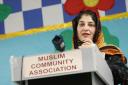
Tracked in America – Samina Sundas
Samina Sundas with American Muslim Voice helped her fellow Muslims and Pakistani-Americans integrate into mainstream American society, and her role intensified after 9/11. When the National Security Entry-Exit Registration System (NSEERS, also known as the Special Registration program) was instituted in September 2002, Muslims all over the United States contacted her confused and worried about how it would affect them. She couldn’t get clear answers from federal immigration officials despite several meetings. After that, she set up an ad hoc hotline that has since become part of an organization called American Muslim Voice.


Framework of Police State laws since 9/11
Co-host Michael Ratner leads the way through the timeline from setting up the legal basis for a global war on terror to justifying a secret system of prisons and interrogation techniques that evade historic safeguards in the Geneva Convention.

Guest – Scott Horton, Chair of International Law Committee at the New York City Bar Association and adjunct Professor of Law at Columbia University. He is also the author of over 200 articles and monographs on legal developments in nations in transition.