CIA Sponsored Terror, Civil Liberties, Criminalizing Dissent, Crony Capitalism, Human Rights, Political Prisoner, Prison Industry, Supreme Court, Surveillance, Targeting Muslims, Truth to Power, War Resister
Podcast: Play in new window | Download
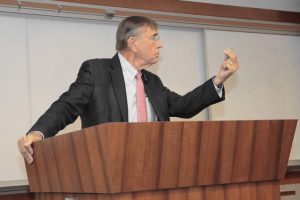
Attorney Michael Tigar: The Mythologies of State and Monopoly Power
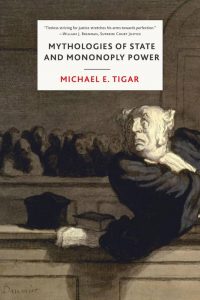
The American criminal justice system is buttressed, sustained and perpetuated by various myths. These myths dominate legal ideology. The most important of these myths concern racism, criminal justice, free expression, workers’ rights, and international human rights. “Ordinary private law categories of property, contract, and tort perform the same social function,” Michael Tigar writes in his important new book “Mythologies of State and Monopoly Power.“
Michael Tigar has worked for more than 50 years with movements for social change as a human rights lawyer, law professor, and writer. He believes that busting these myths is the work of movement lawyers.
Noam Chomsky has written that “for anyone concerned with the rule of law, or more generally with the real significance of freedom and justice, Michael Tigar’s book is “a highly informed and carefully argued study that should be essential reading.”
The book is beautifully written, learned, and profoundly insightful. In a better world Michael Tigar would be a justice of the United States Supreme Court.
The Michael Tigar Papers Launch University of Texas
Tigarbytes.blogspot.com
Guest – Michael Tigar, emeritus professor of law at Duke University and at Washington College of Law. He has been a lawyer working on social change issues since the 1960s. He has argued numerous cases in United States Supreme Court and many Circuit Courts of Appeal. His books include “Law and the Rise of Capitalism”, “ Fighting Injustice ”, and the forthcoming Mythologist of State and Monopoly Power.“
——————–
——————–
CIA Sponsored Terror, Civil Liberties, Climate Change, Human Rights, Prison Industry, Surveillance, Torture, Truth to Power
Podcast: Play in new window | Download
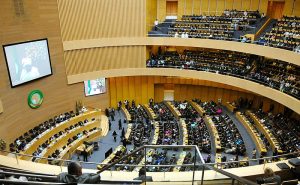
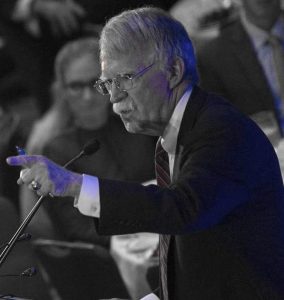
Bolton Threatens ICC Over Probes Into US War Crimes
On September 10, 2018 in Washington DC, President Donald Trump‘s national security adviser John Bolton gave an important and widely publicized speech to the rightist Federalist Society threatening International Criminal Court judges and court personnel if they dared to probe into U.S. torture practices in Afghanistan and three European black sites. The United States is being investigated for torturing captives in Afghanistan, Poland, Estonia, and Lithuania. The charges have been documented by the U.S. Senate in its report of December 14, 2017.
The International Criminal Court is also investigating Israeli war crimes in Gaza where in 2014, 3000 people including more than 500 children were killed by Israeli invaders. This has been documented by the United Nations’ Goldstone Report.
Bolton said that “the United States will use any means necessary to protect our citizens and those of our allies from unjust prosecution by this illegitimate court including tariffs and prosecution.“
He added that “if the court comes after us, Israel, or other allies we will not sit quietly.“
Bolton also announced that the US is shutting down a Palestinian diplomatic office in Washington because Palestinians have indicated that they will request that the ICC prosecute American ally Israel for war crimes and crimes against humanity.
In addition, the United States has cut off payments to the United Nations organization that has provided funds for refugees displaced by Israel when it conquered Palestine in the 1948 war. The funds were used for schools and hospitals in the West Bank and Gaza.
Guest – Attorney Reed Brody, with Human Rights Watch, is a former colleague Michael Ratner, Brody has spent much of his career prosecuting international war criminals for crimes that the International Criminal Court investigators are contemplating with respect to the United States and Israel.
—-
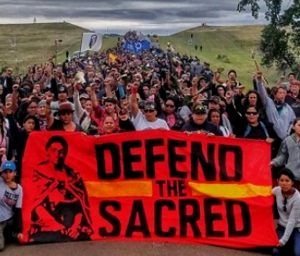
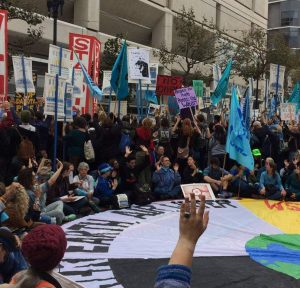
Protect The Protest Coalition Launches To Fight Against SLAPPs
Anti-corporate sentiment in the United States of America is getting increasingly wide and deep. This is especially true when it comes to corporate responsibility for environmental degradation.
The most spectacular example of this is the nationwide mobilization in support of the water protectors at Standing Rock a year ago. The Energy Partners Transfer Corporation was attempting to build a pipeline through land sacred to native peoples in North Dakota. The pipeline went under the Missouri River threatening the water supply.
One of the many organizations supporting the Water Protectors was Greenpeace . As a consequence, they were sued by Energy Transfer Partners and accused of racketeering under the RICO act, a law originally passed to be used against organized crime.
The suit was designed to tie up the resources of Greenpeace , harass them, and cost them money. The lawyers for the corporation are the same firm used by Donald Trump. These legal actions by big corporations are called SLAPP suits. This stands for Strategic Litigation Against Public Participation.
In recent times these lawsuits have been proliferating. Two weeks ago 18 organizations including the Center for Constitutional Rights banded together to fight back.
Guest – Attorney Deepa Panmanabha, the assistant general counsel with Greenpeace since 2011 and is based in Washington DC. Deepa is involved in defending Greenpeace against two lawsuits attempted to silence the organizations advocacy work brought by Resolute Forest Products and Energy Transfer Partners. She also advises on a variety of legal matters and managers criminal law cases where green peas after this engage in civil disobedience. Deepa represents Greenpeace USA in the Protect the Protest Task Force, a recently formed coalition created to confront corporations that file lawsuits design to silence dissent and provide resources to individuals and groups facing these suits.
————————
————————
CIA Sponsored Terror, Civil Liberties, Criminalizing Dissent, Human Rights, Truth to Power
Podcast: Play in new window | Download
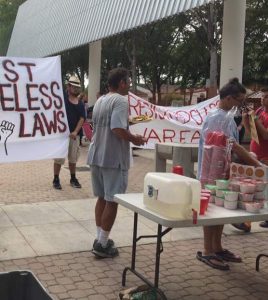
First Amendment Case: Food Not Bombs
In a remarkable victory for free speech, in late August three 11th Circuit judges held that the Ft. Lauderdale Food Not Bombs’ weekly outdoor food sharing is expressive conduct protected by the First Amendment. The Florida group is affiliated with the international organization Food Not Bombs, and engages in peaceful political direct action. It conducts weekly food sharing events at Stranaham Park in downtown Ft. Lauderdale, distributing vegetarian or vegan food free of charge. Their message is clear: society can end hunger and poverty if we redirect our collective resources from the military and war and that food is a human right, not a privilege, which society has a responsibility to provide for all. Providing food in a visible public space and sharing meals with others is an act of political solidarity meant to convey the organization’s message.
Guest – Keith McHenry, and seven friends founded Food Not Bombs in Cambridge, Massachusetts. Keith has been arrested more than 100 times for making a political statement of sharing free food in San Francisco and he has spent more than 500 nights in jail for peaceful protest.
—-
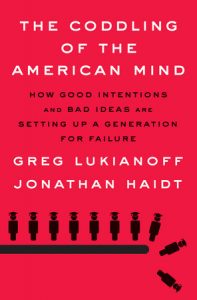
The Coddling of the American Mind: How Good Intentions and Bad Ideas Are Setting up a Generation for Failure.
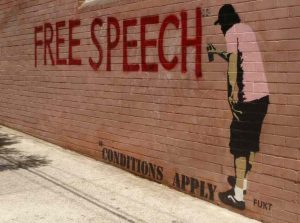
Over the past five years or so, American colleges and universities have been dealing—quite publicly–with issues related to free speech on campus.
In a widely read opinion piece in the Atlantic in 2016, Greg Lukianoff and Jonathan Haidt argued that American students are being coddled as administrators cede to their demands for protection from offensive ideas and words. The authors wrote that requests to be shielded from offensive words and behaviors come at the expense of both intellectual rigor, and the First Amendment.
Two years later, professors are still eliminating controversial material from their classes to avoid facing Bias Incident Reports. College administrators are dis-inviting speakers whose viewpoints may make students feel “unsafe,” and many students are afraid to talk or write openly out of fear they will face public shaming.
Guest – Greg Lukianoff, teamed up with Jonathan Haidt once again in writing the newly-published book The Coddling of the American Mind: How Good Intentions and Bad Ideas Are Setting up a Generation for Failure. The book lays out the continued assault on free speech on U.S. campuses and the disservice it does by treating students as fragile. It also examines how conditions have worsened with polarizing politics. And the authors offer suggestions for change. Greg is also author of the 2014 book, Unlearning Liberty: Campus Censorship and the End of American Debate.
Civil Liberties, Criminalizing Dissent, Human Rights, Hydraulic Fracturing, Political Prisoner, Prison Industry, Surveillance, Targeting Muslims, Torture, Truth to Power
Podcast: Play in new window | Download
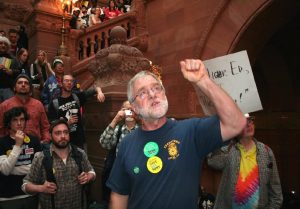
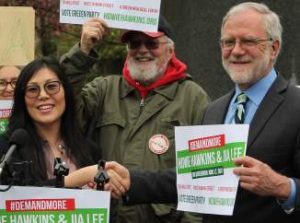
Green Party Candidate for New York Governor: Howie Hawkins
Former United States President Jimmy Carter has pointedly observed that the United States is not a democracy, it is an oligarchy. That is, it is a country ruled by a handful of rich people, the 1%, at the expense of the vast majority, the 99%, the famous description by the Occupy Movement.
The political and ideological mechanism for keeping this state of affairs Is the two party system in the USA, which in reality, as independent presidential candidate Ralph Nader has written, is really one party of big business with two wings, the Republicans and the Democrats.
Although the two party system was not mentioned in our constitution, state laws make it extraordinarily difficult for a third, independent, party to get on the ballot. Their ideas receive little media exposure reinforcing their exclusion.
This lack of the political process even as we are witnessing a radicalization, especially among young people, has led to a discussion on the left among socialists, democratic socialist, and progressives generally about how to move forward. The main question being debated is “do we support socialists who run on the democratic party ticket“ or do we stay independent of the democratic party or, do we work both inside and outside of the Democratic Party? Ballot Access News
Guest – Howie Hawkins, retired teamster from Syracuse, New York and the Green party candidate for New York governor. He previously ran as a The Green Party’s gubernatorial candidate in 2010 and 2014. During the later campaign he received 5% of the vote. He is the author of the recent article “the case for an independent left party: from the bottom up.“. It was published in Black Agenda Report.
—-
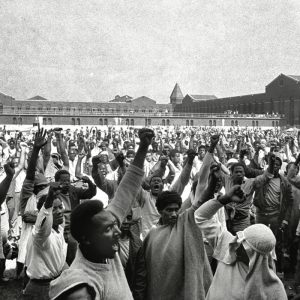
Nationwide Prison Strike 2018
Slavery never ended, human rights attorney Bryan Stevenson has observed, it just evolved. One form of this evolution is the huge number of African-American men in America’s prisons and the conditions of their confinement.
More than half of America’s 2.3 million prisoners are African-American. Many prisoners, black, brown, and Latino, went on strike on August 21. The strike ended on September 9, 2018. The prisoners did work stoppages, sit-ins, commissary boycotts , and hunger strikes to demand major reforms to our country’s prison and criminal justice systems. They demanded humane living conditions, access to rehabilitation, sentencing reform, and an end of what they termed “modern day slavery.“
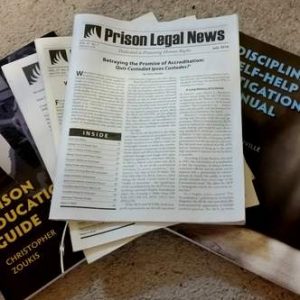
Guest – Paul Wright, founder and Executive Director of the Human Rights Defense Center. He is also the editor of Prison Legal News, the longest running independent prisoner rights publication in US history. A former prisoner himself, Paul Wright was behind bars for 17 years in the state of Washington until his release in 2003.
——————
——————
Civil Liberties, Criminalizing Dissent, Human Rights, Human Trafficking, Torture, Truth to Power
Podcast: Play in new window | Download
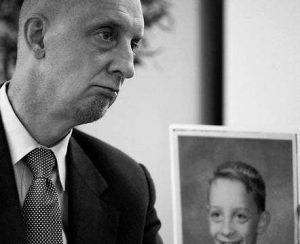
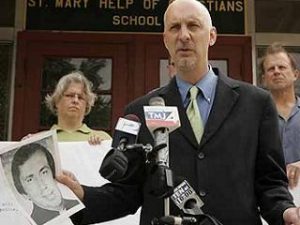
Beyond Apology: Child Torture and Cover Ups In the Catholic Church
“How does the Catholic Church evaluate cases of pedophilia committed by priests?” This is the first question posed in the pamphlet titled “Pedophilia and the Priesthood,” written by Monsignor Raffaello Martinelli. The answer reads in part: These crimes of pedophilia have been labeled as “a crime against the most weak,” “a horrendous sin in the eyes of God,” a crime “that damages the Church’s credibility.”
The most severe condemnation, a source of clear and unequivocal blame, is found in the words of Jesus when, identifying himself with the little ones, affirms in the synoptic Gospels: And whoever receives one child such as this in my name receives me. Whoever causes one of these little ones who believe in me to sin, it would be better for him to have a great millstone hung around his neck and to be drowned in the depths of the sea (Matthew 18:5-6, Mark 9:42, Luke 17:1-2).
In August 2018 it came to light that for over 70 years, Roman Catholic Bishops and other Church officials in Pennsylvania covered up child sexual abuse by more than 300 priests. They dissuaded victims from reporting the abuse and they convinced police not to investigate it. This is all according to a grand jury report issued last month.
The report, initiate by Attorney General Josh Shapiro, is the widest inquiry by a US government agency into Catholic Church sexual abuse of children. It covers six of the state’s eight Catholic dioceses. It found more than 1,000 identifiable victims but says there are likely thousands more whose records have been lost or who were too afraid to come forward. Shapiro said in a press conference that the cover up by senior officials in the church reached at times up to the Vatican.
At the same time, allegations have been raised that Pope Frances knew Cardinal Theorore McCarrick had abused seminarians, but that he lifted penalties imposed on him by Pope Benedict the 16th.
With these news reports, the Catholic Church has been thrown into turmoil. On the one side are traditional members who argue that sexual abuse can be stopped with stricter adherence to church doctrine. On the other side are reformists urging that the church stop condemning homosexuality and permit gay priests to be open about their sexual preferences.
Today on Law and Disorder we bring you a special examination of the continuing revelations into the extent of sexual abuse of children by Catholic priests, and cover-ups of abuse by Church officials.
After PA Grand Jury Report, Survivors Renew Demand For Federal Investigation Into Church Sexual Violence And Cover-Up
Guest – Attorney Pam Spees from the Center for Constitutional Rights. She has worked closely with SNAP, the Survivors Network of those Abused by Priests, since 2011 with the filing of a complaint at the International Criminal Court. The complaint called for an investigation and prosecution of high-level Vatican officials, including then-Pope Benedict, for the widespread and systematic rape and sexual violence within the Catholic Church.
Guest – Peter Isely founding member of End Clergy Abuse, a new global organization, launched in Geneva in June, of survivor leaders and human rights activists from five continents and 28 countries. Peter wrote a 2003 SNAP white paper to the Department of Justice calling for federal intervention into the matter of clergy sexual abuse. He is a survivor of childhood sexual assault by a Wisconsin priest, one of the founding members of SNAP and previous Midwest Director. A graduate of Harvard Divinity School and a psychotherapist in private practice, Peter established and directed the nation’s only inpatient program for victims of clergy sexual trauma at Rogers Memorial Hospital located outside Milwaukee.
New York Attorney General Underwood Announces Clergy Abuse Hotline: 1-800-771-7755 or File Complaint Online
—————–
—————–
CIA Sponsored Terror, Civil Liberties, Criminalizing Dissent, Human Rights, Political Prisoner, Prison Industry, Supreme Court, Truth to Power
Podcast: Play in new window | Download
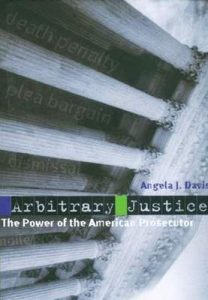
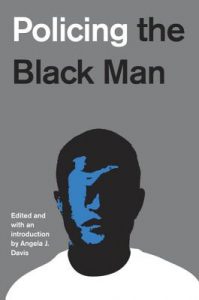
Attorney Angela Davis: Arbitrary Justice
“In the halls of justice”, it has been quipped, “the only justice you find is in the halls.” H. Rap Brown, a leader of SNCC, the Student Non-violent Coordinating Committee, said that justice in America means “just us”. There are 2.3 million people in American prisons today. A great proportion of them are African-Americans. If you assume Europe has the same social situation that we do in America, it is a telling fact that we have seven times as many prisoners. Part of the explanation for this phenomenon, In addition to the racist nature of the United States of America, is the power that the American prosecutor has. It is the power to choose whom to prosecute and for what crime. It is the power to obtain convictions, not to seek justice. It is a power that is discretionary and open to abuse. This abuse is rarely reviewable or punished.
Guest – Attorney and Professor Angela J. Davis, author of Arbitrary Justice: The Power of the American Prosecutor. Her most recent book “Policing the Black Man” covers the key issues of the Black Lives Matter movement. Angela J. Davis, professor of law at American University Washington College of Law, is an expert in criminal law and procedure with a specific focus on prosecutorial power and racism in the criminal justice system. Davis previously served as director of the D.C. Public Defender Service, where she began as a staff attorney representing indigent juveniles and adults. She also served as executive director of the National Rainbow Coalition and is a former law clerk of the Honorable Theodore R. Newman, the former Chief Judge of the D.C. Court of Appeals. Davis is the author of Arbitrary Justice: The Power of the American Prosecutor
———
———