Civil Liberties, Criminalizing Dissent, Human Rights, Political Prisoner, Surveillance, Truth to Power, War Resister
Podcast: Play in new window | Download

Prison Visitation and Support
In hundreds of correctional facilities across the nation, in person visits are being phased out. Instead, video technology run by Securus and other companies is used to replace these visits. One researcher at the Prison Policy Initiative has pieced together hard to gather stats that suggest at least 600 US prisons have video visitation programs in place. In Florida, for example, on retired prison inspector who writes about video visitation, says that over the past five years, most jails there are using only video visitation and have altogether stopped in-person visitation.
The Prison Policy Initiative’s data suggests that 74% of US correctional facilities that implement video calling end up either reducing in-person visits, or totally eliminating them. Is the elimination of prison visits a human rights violation? Most prisoners receive few, if any visitors, or human contact.
Guest – Steve Gotzler, executive director of the Prison Visitation and Support. Steve is the former program director at the Pennsylvania Prison Society, and he knows firsthand what it’s like to spend time in federal prison.
—-


Supreme Court Rules On Civil Forfeiture
In a unanimous decision, the U.S. Supreme Court recently ruled that the Constitution limits the ability of state and local law enforcement to seize and then use cash, property, and other assets that may have been used the commission of crimes, especially when used to fill the coffers of police departments. Law enforcement need only suspect the property has been used as a crime; they don’t need to charge you.
Ruth Bader Ginsburg wrote the opinion on her first day back at the court. Civil liberties organizations have criticized this practice for years. That’s because many local governments use these fines to raise revenue, increasing incentives for arrests.
Not surprisingly, civil asset forfeiture disproportionately affects vulnerable communities, notably African Americans and lower-income neighborhoods. In the state of South Carolina, for example, The Greenville News reported that the state took $17 million from seizures from 2014 to 2016. Sixty-five percent of those targeted were African American. The high Court said that fines may not be excessive, and that states are currently using excessive fines for improper purposes, including for raising revenue.
Guest – Josie Duffy Rice is a lawyer and writer in New York. Josie is a former research director with the Fair Punishment Project.
CIA Sponsored Terror, Civil Liberties, Criminalizing Dissent, Human Rights, Political Prisoner, Prison Industry, Supreme Court, Surveillance, Targeting Muslims, Torture, Truth to Power, War Resister
Podcast: Play in new window | Download

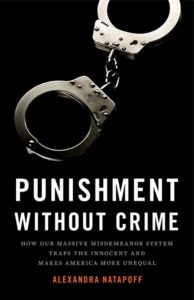
Punishment Without Crime: How Our Massive Misdemeanor System Traps the Innocent and Makes America More Unequal
In the overburdened U.S. criminal justice system, with its burgeoning prison population, we hear a lot about felony convictions. Felonies are crimes usually punishable by a term of more than one year, or the death penalty. What we don’t hear much about are misdemeanors, low level offenses punishable by fines or short terms of imprisonment in local jails.
With ten million petty cases filed annually, most U.S. convictions are misdemeanors. Unlike felonies, however, their processing is typically informal and deregulated. Much like fast-food justice, they have high-volume arrests, weak prosecutorial screening, an overtaxed defense bar, and high plea rates. There is often little meaningful scrutiny to see if convictions are supported by evidence. Innocent people who can’t afford bail often plead guilty just to get out of jail.
What the result of misdemeanor convictions? It’s pretty serious: stigma of a criminal record, misdemeanants are often heavily fined, incarcerated, and/or lose jobs, housing, and educational opportunities. Petty convictions are more frequent and burdensome even as we devote fewer institutional resources to ensuring their validity.
The misdemeanor phenomenon has profound systemic implications. It invites skepticism about whether thousands of individual misdemeanants are actually guilty. It reveals an important structural feature of the criminal system: that due process and rule-of-law wane at the bottom of the penal pyramid where offenses are pettiest and defendants are poorest. Misdemeanor processing is the way poor defendants of color are swept up into the criminal system with little or no regard for actual guilt.
In her new book, Punishment Without Crime: How Our Massive Misdemeanor System Traps the Innocent and Makes America More Unequal, Law Professor Alexandra Natapoff takes an in-depth look at the misdemeanor process is an institutional gateway that explains many of the criminal system’s dynamics and dysfunctions.
Guest – Alexandra Napatoff, University of California Irvine law professor and a member of the American Law Institute. She’s also a former federal public defender, a community organizer, and the recipient of an Open Society Institute Community Fellowship.
—-

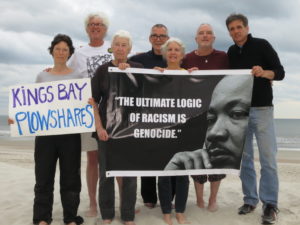
Kings Bay Plowshares 7
In our society nuclear weapons that can destroy all creation are taken as a normal, even an inevitable, part of life. In a dramatic action to break what they call “the crime of silence“ seven Catholic peace activists entered the Kings Bay trident submarine base in Georgia last April to perform an act of symbolic disarmament.
They used hammers to follow the prophecy of Isaiah “to beat swords into plowshares” and poured blood to make holy what was evil in a sacramental action.
Kings Bay is homeport to six ballistic missile trident submarines, each of which deploy 16 trident missile’s carrying four or more warheads of at least 100 kilotons. The Hiroshima bomb was 14 kilotons. Each submarine thus has the distructive power of at least 500 Hiroshima bombs.
The plowshares seven face up to 25 years in federal prison. Their trial is coming up in the next month. Theirs was the latest of 100 plowshares actions around the world since 1980.
Guest – Martha Hennessey, Kings Bay Plowshares 7 co-defendant, activist and volunteer with the New York Catholic Worker.
Guest – Carmen Trotta, Kings Bay Plowshares 7 co-defendant, activist and volunteer with the New York Catholic Worker.
——————

——————
CIA Sponsored Terror, Civil Liberties, Criminalizing Dissent, FBI Intrusion, Human Rights, Political Prisoner, Prison Industry, Supreme Court, Surveillance, Truth to Power, War Resister
Podcast: Play in new window | Download
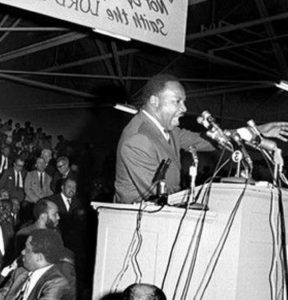
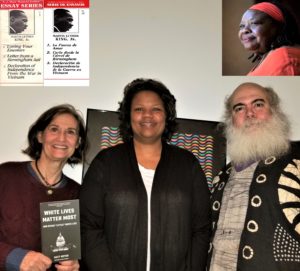
Honoring the Legacy Of Dr. Martin Luther King Jr.
Today on Law and Disorder we bring you a special hour-long program honoring the life and legacy of the Rev. Dr. Martin Luther King. Our listeners know all too well that the Nobel Peace Prize laureate was shot on April 4, 1968–51 years ago. Not so well known is the radical Dr. King, who said in the last months of his life that:
“Our only hope today lies in our ability to recapture the revolutionary spirit and go out into a sometimes hostile world, declaring eternal hostility to poverty, racism, and militarism. With this powerful commitment we shall boldly challenge the status quo.”
Joining us are special guests Ruby Sales, a colleague of Dr. King’s and co-founder of the Student Nonviolent Coordinating Committee; and Rev. Dr. Emma Jordan-Simpson, Executive Director of the Fellowship of Reconciliation (F.O.R.). We’re also joined by author and activist Matt Meyer, a board member of the AJMI.
Dr. King began close ties with A.J. Muste and with the F.O.R. during the Montgomery bus boycott, when FOR staff members Bayard Rustin and Glenn Smiley came to Alabama to support local efforts nonviolently challenging racial segregation. Dr. King developed a special relationship with former FOR chairman A.J. Muste, whose absolute pacifism King had, as a theological seminary student, questioned.
Before heading F.O.R., Muste was a prominent labor leader, helping to found the militant Congress of Industrial Organizations (CIO). And Dr. King, of course, was killed exactly one year after taking a staunch anti-Vietnam war position and in the midst of supporting a significant strike of sanitation workers, linking—as he had been—issues of race, class, and violence as King deepened his critique of the roots of oppressive U.S. society.
Guest – Ruby Sales is the founder and director of the “SpiritHouse Project”, a national organization that uses the arts, research, education, action and spirituality to bring diverse peoples together to work for racial, economic and social justice as well as for spiritual maturity. A life-long organizer, scholar and public theologian in the areas of civil, gender and other human rights, she was a member of the Student Non-violent Coordinating Committee and served as national convener of the Make Every Church A Peace Church movement.
Guest – Rev. Dr. Emma Jordan-Simpson is the Executive Pastor of The Concord Baptist Church of Christ, Brooklyn, NY. She has combined pastoral ministry with the social justice community. The former Executive Director of the Children’s Defense Fund she is now the Executive Director of the Fellowship of Reconciliation.
Guest – Matt Meyer is Secretary-General of the International Peace Research Association, Chair of the International Fellowship of Reconciliation’s Financial Advisory Committee, Africa Support Network Coordinator of the War Resisters International, and Senior Research Scholar at U-Mass Amherst. As current National co-chair of FOR and former Chair of the War Resisters League, he is second only to AJ Muste in holding the top post of those two historic US peace organizations. He is author of the recently published White Lives Matter Most And Other “Little” White Lies.
———-
———-
Censorship, Civil Liberties, Criminalizing Dissent, Crony Capitalism, Human Rights, Supreme Court, Surveillance, Truth to Power, War Resister
Podcast: Play in new window | Download
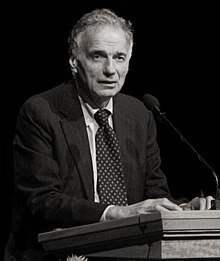
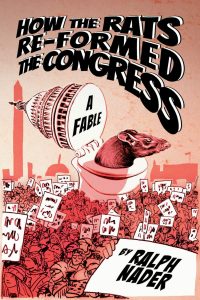
How the Rats Re-Formed Congress
A fable is a short tale that anthropomorphizes animals. The animals personify human virtues and vices, and function as an instrument of moral instruction. We mention this because Ralph Nader joins us to discuss his new book How the Rats Re-Formed Congress. It’s a Fable about an invasion of rats in Congress that triggers a peoples’ political revolt. It begins when a Congressional reporter breaks a bizarre story: “Rats have invaded the toilet bowls” of the Speaker of the House and the Minority Leader. A national news frenzy ensues.
Activists seize on the breaking story to organize for a populist agenda. Spontaneous rallies erupt. The activists see the rats upending “business as usual” routines on Capitol Hill as a symbol against lobbyists and corporate Congress. Millions flood into the nation’s capitol to take back Congress from Wall Street. Congressional offices are deluged with citizen rallies and meetings. Members are challenged in primaries. Incumbents join the movement.
Wall Street and its lobbyists warn of economic collapse and mass layoffs if the people’s agenda passes Congress. Corporate front groups are formed to disrupt peaceful crowds. Despite that, corporate lobbyists and think tanks can’t overcome the organized will of the determined citizenry. Tortmuseum.org
Listen to our past interview with Ralph Nader about the Tort Museum.
Guest – Ralph Nader, one of the nation’s most effective and well-known social critics. He has raised public awareness and increased government and corporate accountability. As a young lawyer in 1965 he made headlines with his book Unsafe at Any Speed, leading to congressional hearings and passage of a series of life-saving auto safety laws in 1966. His example has inspired a generation of consumer advocates, citizen activists and public interest attorneys. Full biography.
————————-
————————-
Civil Liberties, Criminalizing Dissent, Human Rights, Political Prisoner, Prison Industry, Truth to Power
Podcast: Play in new window | Download
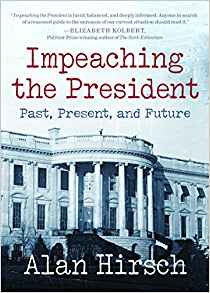
Impeaching the President: Past, Present and Future
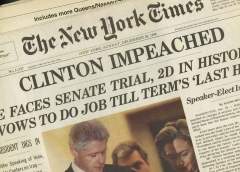
Two U.S. presidents have been impeached: Andrew Johnson in 1868, and Bill Clinton in 1998. Richard Nixon would have been impeached but he resigned in 1974. Rumblings of impeaching the winner of the 2016 president elections even took place before the votes were in. Opponents of Hillary Clinton cited her use of a private e-mail server as Secretary of State as reason. Opponents of Donald Trump cited his business interests disqualified him. Possible criminal activities involving the Trump campaign added fuel to those calls.
Restraints on executive power exist because he greatest risk of tyranny comes from the executive branch. That’s partly because the president is a single person. In contrast, Congress and the Supreme Court must persuade a majority of their colleagues in order to act. As well, presidential authority as commander in chief includes the power to deploy weaponry as the head of the military and law enforcement.
The nation’s founding fathers value checks on tyranny. in part because of oppression by the British monarchy. At the Constitutional Convention some delegates opposed making one person responsible for executing the nation”s laws. While it decided in favor of a one-person executive, it adopted provisions aimed at preventing the president from becoming king-like.
Limits including four-year terms and voter approval to stay in office. The founders knew that even in four years the president could do much damage. So they created a mechanism for quicker replacement of the President if needed. The House of Representatives could “impeach” him, an accusation of wrongdoing that would prompt a trial in the Senate. If the Senate voted by two-thirds vote to convict the president, it would automatically result in removal from office. Impeachment can also be used to remove all federal officers.
Guest – Alan Hirsh, author of Impeaching the President: Past, Present and Future. Alan is a Lecturer in Humanities and Chair of Justice and Law Studies at Williams College. He’s also the author of For the People: What the Constitution Really Says About Your Rights and A Citizen’s Guide to Impeachment.
—-
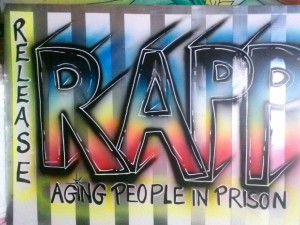
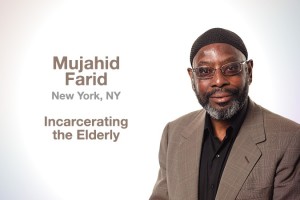
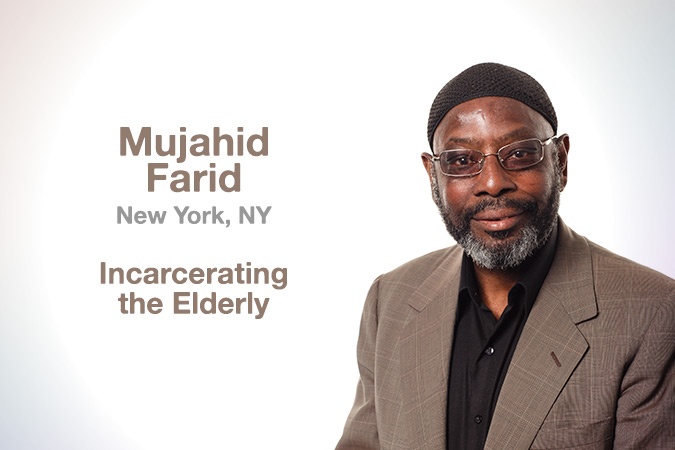
Remembering Mujahid Farid, Lead Organizer of Release Aging Persons in Prison
Today we remember and celebrate the life of Mujahid Farid who passed away last week in New York. Listeners will recall that Farid had been on Law and Disorder several times in the last few years, along with Laura Whitehorn and Dave George from his organization Release Aging Persons in Prison. In 1978, Farid was sentenced to 15 years to life in prison. He was 28 years old. He first became eligible for parole in 1993. He had earned four college degrees including two masters degrees while incarcerated. He was denied parole nine times. As we’ve discussed in prior segments, New York state parole commissioners denied his requests as with many others based on the nature of his crime rather than he many accomplishments he made while in prison.
In an article in the Village Voice, Farid noted that he asked the commissioners: “Is there anything I can do to make myself eligible for release?” He didn’t get a response but said he saw disapproving changes in the body language and facial expressions of the commissioners that his question wasn’t welcome. He was denied again. These denials added 18 years to his incarceration.
In 2011, Farid appeared before the parole boar for the tenth time. He stood before two new commissioners who had high rates of granting parole and that year, Farid was released. Farid became a 2013 Soros Justice Fellow. During his confinement, in 1987 Farid was part of a trio that created and proposed the first HIV/AIDS peer education program in New York State prisons, that later developed into the widely acclaimed state-wide program called PACE (Prisoners AIDS Counseling & Education). Farid participated in the creation of a college certificate program sponsored by New York Theological Seminary, and he taught introduction to sociology courses for people training for Alcohol and Substance Abuse (ASAT) counseling certification.
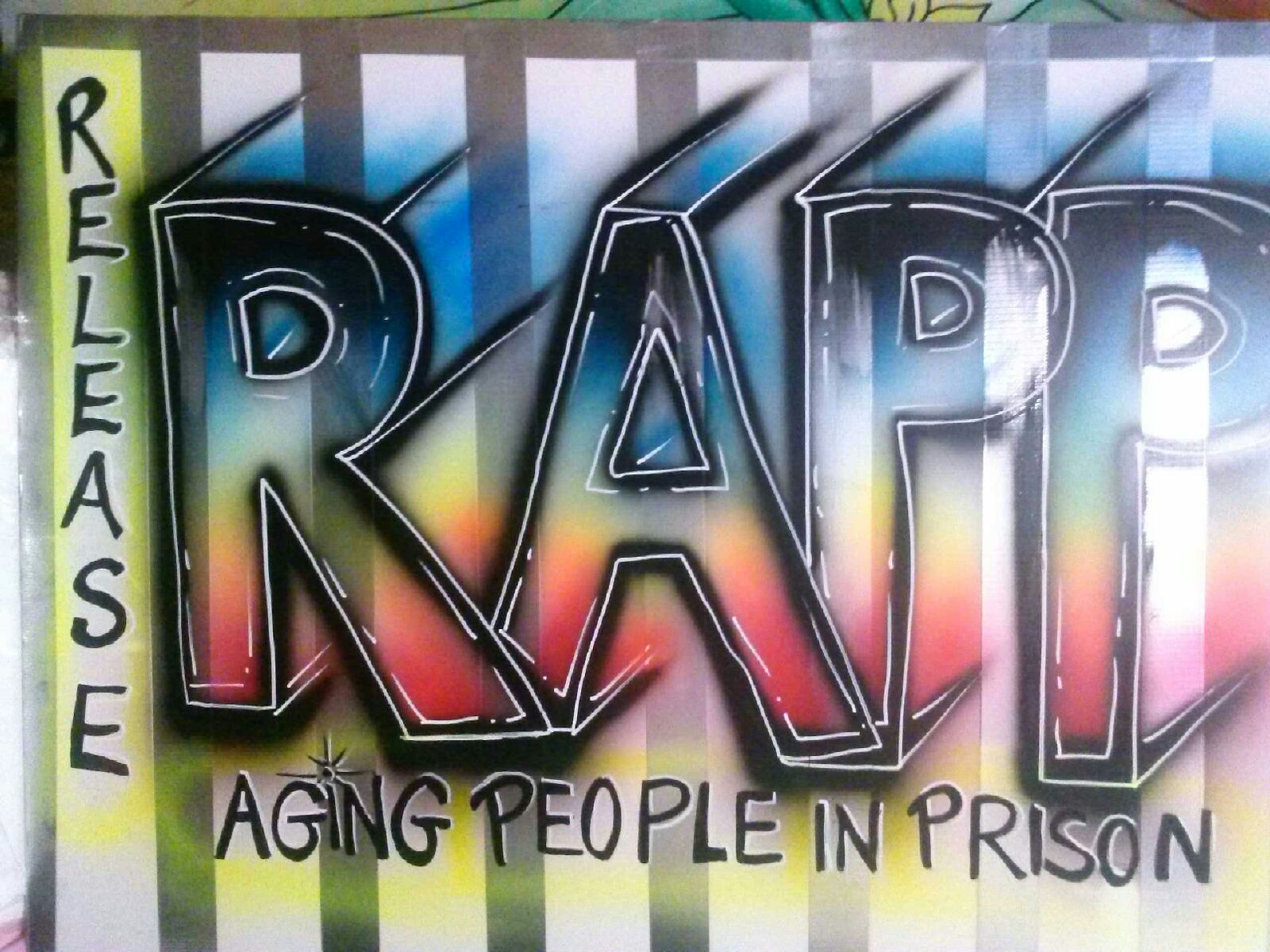
Since his release Farid initiated two programs designed to have an impact on dismantling mass incarceration: The RAPP Campaign and the Rise & Shine Small Business Coalition, the latter providing support for the creation and start-up of community businesses operating on principles of social entrepreneurship. In 2013 Farid was awarded a joint New York State legislative commendation for his community work and a Citizens Against Recidivism, Inc. award for social activism.
As listeners may recall, the number of people aged 50 and older in New York State, where RAPP was founded, has doubled since 2000; it now exceeds 10,000— which is about 20% of the total incarcerated population. This reflects a national crisis in the prison system and the extension of a culture of revenge and punishment into all areas of our society.
RAPP focuses on aging people in prison, many of whom are long-termers convicted of serious crimes. Many of these human beings have transformed their lives and developed skills and abilities they lacked before incarceration. They could be released from prison with little or no threat to public safety. Yet many are denied release, often for political reasons, and they needlessly remain imprisoned into old age. These elders could return to their communities if current mechanisms such as parole and compassionate release were correctly utilized.
Farid, you are in our thoughts and we send you our love.
Guest – Laura Whitehorn is a former political prisoner and native New Yorker, who was active in supporting groups such as the Black Panther Party, the Black Liberation Movement and was active with Students for a Democratic Society and the Weather Underground. Laura worked to help expose the FBI’s Counter Intelligence programs.
Guest – Mujahid Farid co-founded the Prisoners AIDS Counseling and Education program and helped design prison-based sociology and theology courses that allowed others to earn college-credited in prison. He also earned four college degrees and other certifications while incarcerated, including his paralegal certificate, NYS Department of Labor Certificate in Human Development Counseling, and NYC Department of Health Certificate in HIV/AIDS Counseling.
—————————-
—————————-
CIA Sponsored Terror, Civil Liberties, Criminalizing Dissent, Guantanamo, Military Tribunal, Political Prisoner, Prison Industry, Targeting Muslims, Torture
Podcast: Play in new window | Download
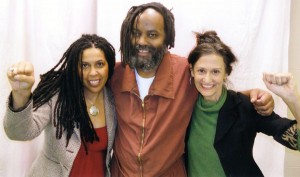
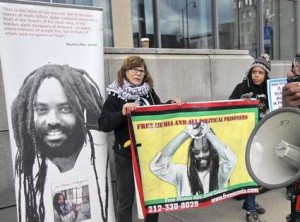
Mumia Abu-Jamal Update October 2018
Last week, attorneys for Mumia Abu Jamal argued in court that conflicts of interest led to unfair rulings against him in his longstanding case. As many know, Abu-Jamal was sentenced to death for the 1981 killing of Philadelphia police officer Daniel Faulkner. The case was riddled with constitutional violations, and his sentence was later commuted to life in prison without parole.
Recently, in the wake of the U.S. Supreme Court’s decision in Williams v. Pennsylvania, Mumia’s attorneys argued that his rights were violated after former district attorney Ron Castille failed to recuse himself in an appeals decision. At the time Castille was a state Supreme Court judge.
Judge Leon Tucker had asked the Philadelphia district attorney’s office to produce an internal memo that might show Castille— back when he was city district attorney — had direct involvement in pursuing Abu-Jamal’s death sentence. If he did, his later denial as Supreme Court justice of Abu-Jamal’s appeal, could be deemed biased.
Defense attorney Judy Ritter said: “Justice Castille has shown himself to be involved in this case, to be biased against a certain class of cases that our client falls into.” The Commonwealth argued that as district attorney, Castille was simply doing his job.
“It’s nothing remarkable that a DA would send a letter to the governor asking him to sign death warrants which the governor was required to do,” said attorney Tracey Kavanaugh. Emotions ran high, both inside and outside of the courtroom. Maureen Faulkner, the widow of Daniel Faulkner, stood up and cried in the middle of court proceedings when the judge announced that both sides would need to wait until December for any possible closure in the case. Presiding Judge Leon Tucker has indicated that he will make a ruling in the case some time after December 3, 2018.
Guest – Professor Johanna Fernandez, is a native New Yorker. She received a PhD in History from Columbia University and a BA in Literature and American Civilization from Brown University. Professor Fernández teaches 20th Century U.S. History, the history of social movements, the political economy of American cities, and African-American history. She has previously taught at Carnegie Mellon University in Pittsburg, PA and Trinity College in Hartford, CT and is, most recently, the recipient of a Fulbright Scholars grant to the Middle East and North Africa that will take her to Jordan in spring 2011, where she will teach graduate courses in American History. She is with the Campaign to Bring Mumia Home.
—-
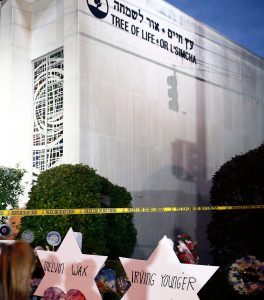

In Response to Pittsburgh, We Must Come Together as One
Last week, acts of hatred claimed the lives of 13 innocent persons in the United States. A white supremacist killed two African American persons in Kentucky. An anti-semite killed 11 Jewish persons in a synagogue in Pittsburgh where even more were wounded, including first responders and police officers.
Not surprisingly, the slaughter of the 11 Jews brought forth calls of the need for a strong Israel; the same response that followed anti-Semitic killings in France and Brussels.
It also inflamed political and theological differences between Israelis and American Jews. Israel’s Ashkenazi chief rabbi avoided saying “synagogue” because it is not Orthodox, but Conservative, a liberal branch of Judaism — because it is not Orthodox, but Conservative, one of the liberal branches of Judaism rejected by religious authorities who define the state’s Jewishness.
The attacker’s anti-refugee, anti-Muslim rants prompted some on the Israeli left — like many American Jewish liberals — compare the views of nationalistic leaders who influence their governments.
In Israel, longstanding animosity between left and right has escalated. Orthodox parties are hoping to increase their influence and Jewish law on day to day life; disputes about who cdan serve in the military and what stores can open on the Sabbath are rampant.
Guest – Phyllis Bennis is a fellow of the Institute for Policy Studies, where she works on anti-war, US foreign policy and Palestinian rights issues. She has worked as an informal adviser to several key UN officials on Palestinian issues. Her books including Calling the Shots: How Washington Dominates Today’s UN, and Understanding the Palestinian-Israeli Conflict.
—-

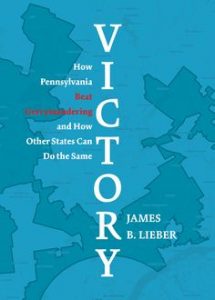
VICTORY: How Pennsylvania Beat Gerrymandering and How Other States Can Do the Same
An important victory against gerrymandering was recently won in the State of Pennsylvania in the case of League of Women Voters of Pennsylvania v. Commonwealth of Pennsylvania.
The first paragraph of the complaint lays it out. “This case is about one of the greatest threats to American democracy today: partisan gerrymandering. A partisan gerrymandering occurs when the political party in control of redistricting redraws congressional or state legislative districts to entrench that party in power and prevent voters affiliated with the minority party from electing candidates of their choice. The result is that general election outcomes are rigged – they are predetermined by partisan actors sitting behind a computer, and not by the voters.“
In Pennsylvania although the Democrats have more supporters than the Republicans Republicans had 13 seats in the US Congress and the Democrats had only five.
The U. S. Supreme Court has not been willing to rule on gerrymandering taking the position that there is no clear way to determine if there has been gerrymandering and therefore it is a non-judicable issue.
To get around this in 2018 Pennsylvania activists engineered a brilliant legal effort in the the state courts of Pennsylvania to attack the lopsided redistricting, and won after fighting pitched battles all the way up to the state Supreme Court. Now activists around the country can do the same. The next congressional redistricting occurs after the 2020 census: progressive need to be ready well before then.
We speak today with constitutional litigator James R. Lieber who has provided a real time report on effective trial lawyers, working to facilitate the will of the people. He explains the strategies of counsel and the evidence presented and has provided a roadmap to social justice litigants for pursuing constitutionally protected claims in state court based on the state constitution and avoiding federal review.
Guest – Attorney James B. Lieber is the author of 3 previous books, and a lawyer who focuses on constitutional, civil rights, and discrimination cases. He has won two cases before the U. S. Supreme Court and is widely published in magazines of national stature.
—————————————–
—————————————–