CIA Sponsored Terror, Civil Liberties, Criminalizing Dissent, Crony Capitalism, FBI Intrusion, Guantanamo, Human Rights, NSA Spying, Political Prisoner, Prison Industry, Surveillance, Torture
Podcast: Play in new window | Download
Updates:
—-

The Drug War: Policing and U.S. Militarism at Home and Abroad
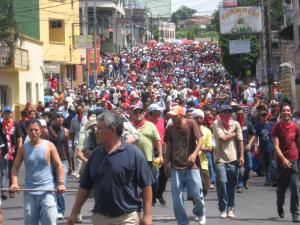
Last week the Center for Constitutional Rights hosted an event titled The Drug War: Policing and U.S. Militarism at Home and Abroad. We’re joined by one of the panelists David Vivar, he’s an author and scholar at National Autonomous University of Honduras at the Faculty of Political Science and International Relations of the University of Calabria. His work focuses on the U.S. cooperation in the Honduran military coup of 2009 and the centrality of drug trafficking to state power in Honduras. What you will hear in this interview is that the U.S. Drug War has not only fueled mass incarceration and discriminatory policing practices here in the U.S. but also supports violence and militarization throughout Latin America. We get the details of that and David’s strategies to resist the racist, and devastating war.
David Vivar:
- It’s been constant that Congress asks to stop human rights violations.
- This goes all the way back to the simulation of the rule of law, to a democratic state.
- We have the highest murder rate in the whole world, and we have no war, not a consistent war declared except the war on drugs.
- We’re fighting a war that has turned the current conditions into a civil war.
- When you start having conflicts between drug lords, Mexican cartels and Colombian cartels – what do they do? They go to the space right in the middle, which is Central America and the northern triangle.
- Guatemala, Honduras and El Salvador have seen the consequences. We are the collateral damage.
- 79 percent of the cocaine that travels to the United States goes via Honduras. Basically what the Department of State is doing is investing money on kingpins and drug lords in the Honduran institutions.
- After the coup the military took back power and the U.S constantly supported this new democratic military civil alliance, which in the hand is what happened in Mexico.
- The (Honduran) military has drug lords of its own.
- Miguel Facusse is the most powerful man in Honduras. He’s got the Dinan Corporation which has African Palm plantations throughout the whole drug path.
- Basically the conflict around land is a failed agrarian reform.
- You have indigenous populations that lost their land. Their land was given to this man. The most powerful person, he gets the African Palm plantations which is the best place, as we know from wikileaks to establish small airports for aircraft to land there and deal with the drugs.
- The resistance is still in the streets against a lot of laws – the opening for business of the country – model cities and charter cities are something we’re fighting back in keeping our resources ours.
Laura Raymond:
- The U.S. did cut off military aid for a short amount of time directly after the coup but instead of backing the movement from the Honduran civil society for reinstatement of President Zelaya – throughout that summer and fall there was a huge movement, the streets were filled with people calling for the reinstatement of their president – the United States instead pushed for new elections that fall which was what ended up happening.
- The elections were heavily boycotted by civil society yet the U.S. was the primary force in the region for supporting those elections.
- After those elections took place and Pepe Lobo is elected as president, the U.S. reinstated their support for the Honduran military and police, despite massive human rights violations that were taking place on an almost daily basis.
- You really have a very close relationship between the Honduran military and police and the U.S. government and military.
- There have known to be drug planes that have landed on his property (Miguel Facusse) We know that the U.S.State Department knows about that because of wikileaks and the U.S. goes on to have this cozy relationship with him and the political arm of Honduras that he runs in.
- The World Bank continues to fund him and give him subsidies for the African Palm plantations. Where is the interest in stopping the drugs if you’re working with this person who there are drug planes landing on his property.
- He has a private army basically. He has all these private security contractors that implicated in murders. The Center for Constitutional Rights has laid those out in a report to the International Criminal Court, naming Miguel Facusse as a criminal that needs to be prosecuted.
- The U.S. depends on the Honduran government to have a very friendly government in the region. We have a lot of military presence there, we have a lot of bases. It’s a relationship that depends on the repression of civil society throughout Honduras.
- There’s a massive resistance movement that has taken a lot of repression in the last four years. What’s going on with the drug wars, its very dark and scary but the other side is this movement that David is part of.
Guest – David Vivar, is a sociologist, currently a scholarship holder from the National Autonomous University of Honduras at the Faculty of Political Science and International Relations of the University of Calabria, where he studies dependence, international asymmetry and the division between center and periphery nations. His articles and essays analyze media discourse and public opinion; the representative intermediations of Honduran democracy, the influence of U.S. cooperation in the military coup of 2009 and the centrality of drug trafficking to state power in Honduras and its inextricable relation with the neoliberal impoverishment and the ongoing usurpation of democracy.
Guest – Laura Raymond, has over fourteen years of experience organizing, writing, and advocating on social justice and human rights issues in the U.S. and internationally. Much of Laura’s work focuses on the impact of U.S. actors, corporations and government policies and practices abroad.
—–
Imagine: Living In A Socialist U.S.A – Kazembe Balagune
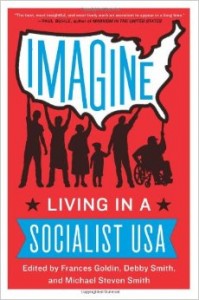
In the past weeks we’ve featured contributors to the book Imagine: Living In A Socialist U.S.A. This book as many know was conceived and edited by Frances Goldin and our own Michael Smith with his wife Debby. We continue to discuss the essays in this ground breaking anthology. Today we speak with Kazembe Balagun, who wrote We Be Reading Marx Where We From: Socialism and the Black Freedom Struggle.
Kazembe Balagun:
- The chapter starts out with a short story on Paul Robeson at the Carnegie Hall in 1957. He sang a song called I Dreamed of Joe Hill last night.
- When we talk about Wall Street, the first commodity were Black slaves. The reason they called it Wall Street is to keep the Native Americans out.
- There’s always been an interweaving of Black freedom struggles in the socialist experience.
- One of the first socialist experiments happens in the Sea Islands of South Carolina and Georgia where General Butler issuing Article 15 calling for all land held in common for negros.
- Then you have John Brown issuing an alternative constitution of the United States which calls for all land to be held in common between blacks and whites.
- Martin Luther King Jr (in a speech said) there has to be some form of socialism in the United States in order to achieve economic democracy.
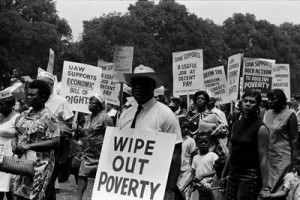
- The Poor People’s march going forward in 1968 in his fight for Memphis, these are all parallels for economic democracy.
- What we find today is that these socialist ideas are prevalent in the African-American community.
- I think there’s a way we can excavate this history for our own social movement.
- This capitalist society really has little to offer people, particularly young people of color.
- I always take into account is that there’s always been a tradition of African-American prophetic tradition which always looks beyond what’s been given to us and looks at the condition of possibility.
Guest – Kazembe Balagun, an activist and cultural organizer from the Bronx and former program director at the Brecht Forum. He is currently the project manager at the Rosa Luxemburg New York Foundation.
———————————————————
CIA Sponsored Terror, Civil Liberties, Crony Capitalism, Guantanamo, Habeas Corpus, Human Rights, Military Tribunal, Political Prisoner, Prison Industry, Prosecution of the Bush Administration, Supreme Court, Surveillance, Targeting Muslims, Torture
Podcast: Play in new window | Download
Updates:
- Prisoner’s Hunger Strike: Pelican Bay Prison, Guantanamo Bay Prison, Palestinians In Israeli Prisons
- CCR Lawsuit – Pelican Bay Prisoner Class Action
- 20 Plus Palestinians On Hunger Strike In Israeli Prisons Demand Better Conditions For Pelican Bay Prisoners
- Federal Judge Gladys Kessler Says the President Is The One To Stop Force Feeding and Release Cleared Guantanamo Bay Detainees
- Bradley Manning Trial: Important Proceedings During Defense Case At Ft Meade, Maryland
—-
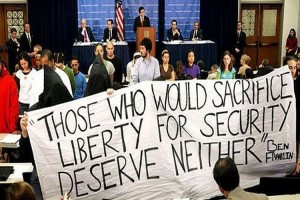
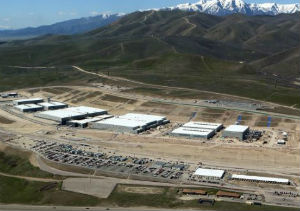
Secret Federal FISA Court Advocate of National Security State
Here on Law and Disorder we’ve discussed the process of the US government expanding its power to get wiretapping permission from the Foreign Intelligence Surveillance Court or FISA court. This is under a provision called section 215 of the Patriot Act which if listeners might recall was set to expire in 2009. It did not. We discussed how the FISA court will be accessed by what’s called Lone Wolf Authority or National Security Letter Authority whereby the FBI can write a letter to the court without suspicion of terrorism and get bank, telephone and internet records.
The 11-member FISA Court has been central to allowing a massive surveillance state to exist by granting US agencies such as the NSA access to private telecommunication data. Today, the FISA court essentially operates as an advocate for the national security state. It’s judicial oversight now parallels the Supreme Court. But more troubling, these FISA Court Justices operate in complete secrecy and base their decisions from hearing only one side the argument, the US government’s.
Attorney Scott Horton:
- The Nixon Administration attempted to use “intelligence gathering” as a justification. Congress reacted to that by saying we’re not going to agree that the government has the right to wiretap people in the United States on the grounds of intelligence gathering. We’re going to require this judicial check, so Congress created this special court the FISA court.
- The court has been around for a long time, but its become a far more significant entity doing much more work after 9/11.
- It has 11 judges. The judges are selected by the Chief Justice of the Supreme Court, John Roberts.
- The judges are picked from courts all around the country.
- It’s not a secret court in that we know that it exists. It IS a secret court in that it operates in secret.
- Literally, the public doesn’t know what papers are filed with it and doesn’t know about its decision.
- That’s a highly controversial matter because decisions by federal courts constitute law.
- This means that this court is manufacturing secret law that the people don’t know about.
- We don’t know the jurisprudence of this court, we don’t know its decisions, we don’t know the full rationale for all its decisions because most of them have been secret.
- It is very aggressively expanding the power and authority of the NSA in surveillance areas.
- This is a court picked by Roberts who share his attitude. Out of 11 judges we have 10 Republican appointees. It’s very well known that Roberts in making appointments here looks very closely to select only judges who reflect his attitudes about the national security state.
- It is a cherry picked court. A movement conservative perspective which is quite hostile to civil liberties.
- The court has become an advocate for national intelligence services.
- It really puts the whole institution of the court under a cloud right now.
- If you want to disperse that cloud you would make sure those judges are representatives of the country.
- The legal reasoning and interpretation of statutes that should be there for people to see and know and understand and criticize.
- Telecoms: Here they are service providers dealing with consumers, lying to their clients and allowing the government free access to all this information.
- That is a criminal act under various statutes of states including New Jersey and Maine. That have rules that say they may not allow governments, investigators access to this information other than pursuant to a government subpoena or court order.
- This court is sweeping away core rights and making a joke out of the 4th Amendment.
- Whistle-blower damage control strategy: A program to deflect attention from the disclosures themselves.
- There is a move afoot to take this out on the American service providers who cooperate with the NSA, Verizon, AT&T. . .Google and so forth.
Guest – Scott Horton, human rights lawyer and contributing editor to Harper’s Magazine. Scott’s column – No Comment. He graduated Texas Law School in Austin with a JD and was a partner in a large New York law firm, Patterson Belknap Webb & Tyler.
—-


Left Forum 2013: Ron Reosti
Capitalists are not necessary to run firms, nor to run macro-economies and investment says Ron Reosti in his presentation at the Left Forum Panel titled Imagine Living In A Socialist USA, Part 2: Making The American Socialist Revolution.
Speaker – Ron Reosti, his Italian parents imparted to him a working-class identity, a sense of social justice, a belief in the possibility of social change, a commitment to democracy, and a hatred of the undemocratic ruling class. He embraced socialism in his early teens, during the McCarthy era, and has remained committed to that vision. He practices law and is part of the radical community in Detroit.
———————————————-
Civil Liberties, Criminalizing Dissent, Crony Capitalism, Human Rights, Prison Industry, Torture, Truth to Power
Podcast: Play in new window | Download
Updates:
—
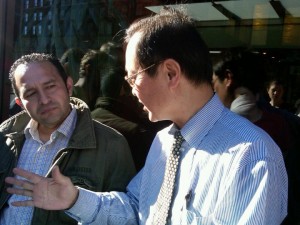
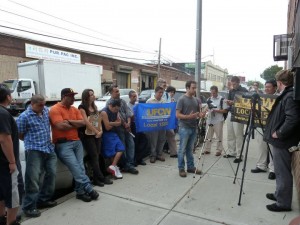
Workers Win Large Settlement at Supplier to Chinese Restaurants After Hard Fought Campaign
A bitterly contested campaign against Pur Pac, a food distribution warehouse giant reached a settlement of 470 thousand dollars for workers who had their wages illegally withheld and more. The workers organized with Focus on the Food chain, Brandworkers and International Workers of the World to challenge sweatshop conditions, wage theft, retaliation and discrimination in the sprawling industrial corridor of food processing and distribution that service New York City markets and restaurants. Daniel Gross, the executive director of Brandworkers said – quote – The conditions in the sector are deplorable and systemic but, as the Pur Pac workers have shown, positive workplace change can and will be won.”
Attorney Daniel Gross:
- Pur Pac is typical of an industrial corridor of food processing and distribution warehouses that service a tremendous amount of food to restaurants and supermarkets in New York. Much of what we eat in restaurants is processed in sweatshops.
- Pur Pac is a distributor of restaurant and food supplies to Chinese Restaurants, cafes and bakeries. They distribute huge quanitities of rice, cooking oil, chopsticks.
- Sweatshop, tremendous amount of wage theft, hundreds of thousands of dollars. Vicious retaliation for workers who stand up for their rights, exhausting long shifts, very heavy work.
- We facilitate worker led, comprehensive campaigns. The company used several tactics to avoid accountability here, the main approach that they used is they engaged in sham sales.
- They would fraudulently transfer assets, rebrand the company. The company was originally called Easy Supply. Easy Supply escaped accountability by purporting to go out of business, now same factory, same trucks, same products was called Sunrise Plus. We caught up with Sunrise Plus and they engaged in another sham sale and that created Pur Pac.
- We were also able to win a binding code of conduct, which creates very powerful protective mechanisms for collective activity, going forward.
- We were able to win recognition for the IWW, as exclusive bargaining agent for Pur Pac workers. It was really the biggest victory for Focus On The Food Chain.
- I was a low wage worker mostly in retail and fast food. I was working at Borders Books and Music and really felt the sting of a multi-national employer which at the time was highly profitable. It didn’t pay a fair wage, offered an insecure and unpredictable schedule.
- It employed a management force that really showed tremendous disrespect for rank and file workers.
- We had 44 Starbucks stores that were infested with rats and insects. We did worker-citizen journalism and we got photos and video of these rats and roaches, we inflated a huge, inflatable rat in front of the stores and shared our video and photographic evidence.
- Starbucks is still engaged in really a scorched Earth effort, complete disrespect for the right to organize and free association.
- The National Labor Relations Board (NLRB) is the administrative agency charged under federal with administering union management affairs. They have jurisdiction over cases under the National Labor Relations Act.
- Mezonos Maven Bakery is a food production sweatshop. Mezonos Maven was cheating workers out of their wages, disrespecting workers, and the workers came together, they didn’t join a union but they came together with community groups, etc. Mezonos Maven, started illegally firing workers.
- When the workers stood up to the most basic worker’s rights, they were subjected to fierce immediate retaliation.
Guest – Attorney Daniel Gross, Executive Director of Brandworkers, a non-profit organization protecting and advancing the rights of retail and food employees.
—–
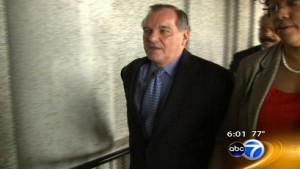
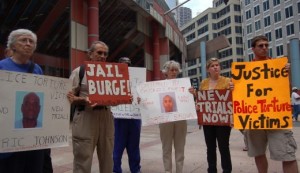
Federal Judge Rules Former Mayor Daley Can Be Sued For Alleged Torture Cover Up
We continue to bring updates on the ongoing police torture and abuse scandal revolving around former Chicago police commander Jon Burge. Recently, a federal judge has now ruled that former Chicago Mayor Richard Daley can be allowed to be kept in the lawsuit where he is charged with conspiracy to cover up police abuse and torture. As many listeners may know, Burge has been sentenced to 4 and a half years in prison for obstruction of justice and lying about torturing prisoners to obtain coerced confessions. The People’s Law Office brought the case in 2005 and the city of Chicago refused to settle while pumping hundreds of thousands of dollars into the case.
In the beginning of September, attorney Flint Taylor will depose former mayor Richard Daley which will force him to answer questions about the abuse of African Americans under Burge’s command. This case has already cost Chicago taxpayers more than 43 million dollars in settlements and legal fees. Past shows with Attorney Flint Taylor
Attorney Flint Taylor:
- Daley was the state’s attorney for Cook County for eight years in the 80s during that time he was specifically informed of police torture.
- Instead of doing anything about it and dealing with the torturers, Jon Burge and company, he continued to encourage it by prosecuting men who had been falsely arrested and charged based on tortured confessions sending as many of them to death row.
- When he became mayor, he continued to have an active role in the cover up of the torture practice.
- He had at various times as chief of law enforcement and chief executive of the city of Chicago, the power and obligation to act and if he did, we wouldn’t have had all these men on death row, and in the penitentiary and we wouldn’t have had all these men tortured.
- We brought it several times in lawsuits starting in 2003. Judges had consistently turned their backs on that claim.
- The new Chicago mayor Rahm Emmanuel who has successfully tip toed past this both in his campaign and now as the first 100 days of being mayor had to respond to it.
- They’ve paid over 13 million dollars to defend these civil cases that we’re in. We take the mayor at his word, and we hope this leads to settlements and compensation for the men who’ve been tortured.
- There are six men who have lawsuits in court. Unfortunately because of statute of limitations most torture survivors don’t have lawsuits.
- There are still 15 men behind bars in Illinois, based on tortured confessions that Jon Burge and the Area 2 torturers coerced from them. We’re fighting to have them all get new hearings.
- I don’t know if a Daley denial in some of the actions in this case would tantamount to perjury that Fitzgerald would be interested in.
- There is a major memoranda that was sent from the police superintendent at that time to Daley, a kind of CYA saying “I’ve been giving this powerful evidence of torture from a doctor over at the county hospital.
Guest – Attorney Flint Taylor, a graduate of Brown University and Northwestern University School of Law and a founding partner of the Peoples Law Office. More bio
———————————————-
Civil Liberties, Crony Capitalism, Guantanamo, Habeas Corpus, Human Rights, Surveillance, Truth to Power
Podcast: Play in new window | Download
Updates:
- Tim DeChristopher Sentencing – Bidder # 70
- Aaron Schwartz, Anonymous Activists and Paypal
- Australian Government Seize Profits from David Hicks’ new book – Guantanamo, My Journey
—-
From Economic to Social Crisis: Deficits, Debt and a Little Class History
We welcome returning guest Rick Wolff, Professor of Economics. We talk with him about his latest article, From Economic to Social Crisis: Deficits, Debt and a Little Class History. Earlier this year Rick pointed out how the Democrats and Republicans debate over spending cuts at around 40 to 60 billion. Rick says the debate is inconsequential, when the federal budget’s projected deficit of $1.5 trillion will carry an annual interest cost of $40-60 billion. Now, as both parties are committed to a broken, corrupt system, Rick points out that historically transitioning to another economic system is not in the public discussion. He says, the tools used to recover from the 1930s economic collapse can’t be used today mainly because of the last 75 years of rising national debt and budget deficit.
Professor Rick Wolff:
- This is mostly theater, the people I talked to in the business of finance and government are quite clear that the United States will work this out.
- It is a sign of the political dysfunction that they can’t do it in a reasonable way.
- It is a normal procedure to periodically ask for the debt ceiling to be raised, so that they can borrow the amount of money stipulated by the budgets they have passed. The sitting president asks for the debt ceiling to be raised, Bush did it eight times. It’s normal.
- The only thing the Democrats have left, to not look defeated, is to make a big deal out of the cuts they’re willing to accept are smaller than the “draconian” version that the Republicans want.
- The Republicans don’t know, the Democrats don’t know (what will happen). They fundamentally don’t care, because they have long ago decided that their political needs and strategies are unhooked from the underlying economic situation.
- We’re spending 3.5 trillion dollars this year as a Federal Government. We’re raising 2 trillion. That means 1.5 trillion has to be borrowed otherwise its not going to happen.
- That’s money that will be used to help old people’s needs, help fight wars in Iraq, Afghanistan, Libya, Pakistan, to help cities and states that need support, etc.
- The actual creditors in the immediate situation have nothing to fear.
- For the rest of the world you have a double whammy, which is what we should be thinking about.
- We have the driver of the world’s economy collapse in 2007/2008 and having been unable to recover since.
- The bottom line is this economy isn’t working well and isn’t solving its crisis. This is now a deeper, longer crisis than any since the Great Depression.
- That means every other player in the world, from a Chinese official, to a Spanish bank to an investor in Brazil has to rethink what he or she thought.
- A thousand small decisions are going to be made a little differently from now on.
- There is no proposal working its way through Congress to provide employment to the tens of millions of people who have no work.
- The president’s statement (is a bipartisan commitment to ignore the problem of unemployment.)
- The most extreme proposal is to cut 4 trillion dollars in the next ten years. This year alone the US deficit will run one thousand five hundred billion. 1.5 trillion.
- The debtors know that at a certain point there’s going to be trouble.
- You can’t continue to cut the masses’ standard of living to make money for big bankers, that’s not a political sustainable program. Not here, not in Greece, not anywhere else.
- The silence of the press here is stunning. There have been multiple general strikes across Europe.
- The greed of the corporations, they’ve had their way for 30 years. Republicans and Democrats alike, have basically gone in the direction they want. Corporate taxes have been cut, regulations relieved, money is everything, wealth is everything, consumption is where you are.
- The smaller business (corporations, etc) are late to party. They still want to get theirs. Those who already got theirs don’t want them to mess up the game. I believe you will see big splits emerging among the Right in America because these are different attitudes.
- They want a stable United States so that they can grow in the rest of the world, because that’s where they think growth is coming.
- They don’t need to maintain the roads like they did, they don’t need to maintain the education in this country.
- You can appeal to them, you need these workers, you need these consumers. No we don’t. We don’t need them as workers, and we don’t expect them to be much in the way of consumers, because they would have to borrow and we’re not going to lend to them.
- They would have to have higher wages, and we’re not going to give that to them. We have no reason to, we have cheaper better workers elsewhere.
- You are subjecting your working class to a major sustained attack on its standard of living. To believe this is all going to happen and they’re quietly going to sink some resignation with no consequence is nutty.
- The attempt to isolate, to freeze, to inoculate the population so they don’t fear what’s coming. It’s falling apart in Europe, but it will fall apart here too.
Guest – Richard D. Wolff is Professor of Economics Emeritus, University of Massachusetts, Amherst where he taught economics from 1973 to 2008. He is currently a Visiting Professor in the Graduate Program in International Affairs of the New School University, New York City. He also teaches classes regularly at the Brecht Forum in Manhattan.
CIA Sponsored Terror, Civil Liberties, Crony Capitalism, Human Rights, Hydraulic Fracturing, Targeting Muslims, Truth to Power
Podcast: Play in new window | Download
Updates:
—-
Natural Gas Drilling Moratorium To Be Lifted in New York
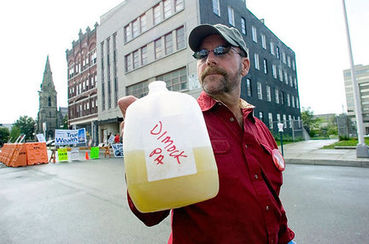
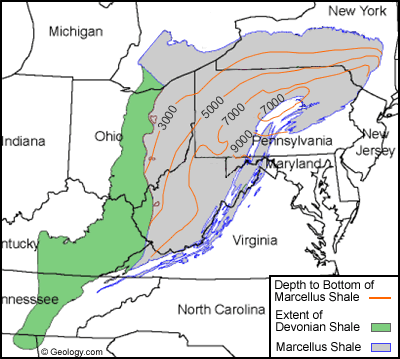
New York Governor Andrew Cuomo is pushing to lift the moratorium on natural gas drilling, known as hydraulic fracturing in New York State. Hydro-fracking as its called is in many opinions an environmentally wreck-less technique to extract natural gas from shale. While the lifting of the moratorium is still months away, it comes despite the massive efforts from environmental and community groups in New York, New Jersey and Pennsylvania who have protected the Marcellus Shale watershed.
In a statement released by the State Department of Environmental Conservation, there will be environmental restrictions placed on the natural gas drilling permits in New York State, such as no drilling within 2000 feet of a public reservoir.
However, ninety percent of the New York City’s drinking water comes from ground zero of where various oil companies want to drill into the Marcelle Shale for natural gas. Every time a well is drilled, the companies use an estimate of 5 to 9 million gallons of water. Each time a well is fractured, it’s another 5-9 million gallons of water, a well can be fractured multiple times. Up to 275 different toxic chemicals are used in the process and after the well is drilled, there are millions of gallons of industrial waste, it’s essentially radioactive water. 40-70 percent of this water stays underground.
The watershed is 13 thousand square miles and includes four and those that want to mine this resource say it will reduce dependence on foreign oil and boost the economy. However, many have shown this statement to be false as the natural gas from the United States is being sold to foreign countries such as Norway and France.
Meanwhile, a lawsuit is pending against several federal agencies affiliated with the Delaware River Basin Commission to block final regulations on hydro-fracking until a full environmental review can be conducted. Past shows on hydro-fracking: Law and Disorder March 21, 2011 / Law and Disorder March 29, 2010
Attorney Jordan Yeager:
- Hydro-fracking is part of a broader industrial practice. Basically what we’re doing is allowing companies to drill down a mile deep through our aquifers, which we all depend on for our drinking water.
- Once they get down there, they start to drill horizontally, they’re aiming for the shale formations underground.
- In order to release the gas from the shale, they blast it with this nasty stuff, chemicals that they don’t want to disclose.
- They’re also developing and industrializing large swaths of land. When they do that they’re polluting the waters of New York and Pennsylvania and every place where this is happening.
- Generally what is proposed is to allow around 85 percent of New York State that has Marcellus Shale to be open to drilling that they would not allow drilling to take place in the New York City and Syracuse watersheds. And they would not allow it to take place within what they primary aquifers and state owned game land.
- But all other places and private land, they would allow it to happen.
- Those people who live in New York City, and in Syracuse, those people would be protected from this activity, but the people in the rest of the state would be subjected to it.
- For every 17 or 18 gas wells that you drill, you can expect to see water contamination from that.
- But then we’d ask why would we allow the rest of New York to be exposed to it?
- In Pennsylvania, its completely ruining the roads in the northern half of the state, its tearing up communities. In Bradford County we had a blowout, not too long ago, which caused damage not only to streams but to drinking water in that area.
- We are going to see continued failures wherever this happens. The question is . . . are we going to allow it to happen? Are we going to force this practice to follow the science and only allow it to happen if the science says it can be done safely? We’re simply not there.
- In Pennsylvania, what we’re seeing is most of those jobs they’re talking about are going to folks outside the state. They’re bringing in people from the western states, who have experience in drilling. You to also look at the broader economic impact. When a community loses its water supply, that is bigger impact than a handful of jobs.
- If we don’t have clean water in order to live and for other businesses to operate, we’re going to see much greater economic damage.
- We’ve been dealing with the Delaware Water Basin Commission to make sure they don’t allow the Delaware River to be poisoned by these activities.
- When the people of Pennsylvania, the people of New York and New Jersey, are fully awakened to the dangers of this activity, we’ll be able to build a movement and reign it in.
- There are dangers associated with these industrial activities, and we have to look at the dangers in the broadest sense.
- Natural gas has been identified by some as a clean fuel, but that’s when they compare it to how it burns and how coal burns. That’s one part of the natural gas story.
- You have to also look at the dangers in the process of extraction. When we drill down a mile deep, we’re finding naturally occurring radioactive material and as part of the drilling process, we’re then bringing that up to the surface.
- Look, we need energy. We need to decide what level of risk we’re comfortable with. In my opinion, we need to be looking at renewable energy, like solar, like wind, get investments, and get them to a larger scale.
- With this new direction from New York, we need to make sure there’s adequate time public participation and what was announced last week, is they would only allow a 60 day public comment period. That’s simply not enough. They haven’t looked at the research that’s been established since they closed the record in 2009.
- The public needs more than 60 days to educate the folks at the state level about what we’ve been learning since December 2009. We ought to be looking at a 6 month period on what was proposed for New York State.
Guest – Attorney Jordan Yeager, a National Lawyers Guild member, a cooperating attorney with the Center for Constitutional Rights and member of Damascus Citizens. Curtin & Heefner LLP recently elected leading public interest attorney Jordan B. Yeager to its partnership. Mr. Yeager is a member of the firm’s Employment and Public Sector Section. Formerly in private practice as the named partner in a public interest law firm, Mr. Yeager served successfully as counsel in several groundbreaking cases, including matters involving constitutional rights issues; claims of reasonable accommodation against a municipal defendant; and the right to a jury trial in a whistle-blower retaliation case.
——
Second Austerity Measure Imposed On Greece
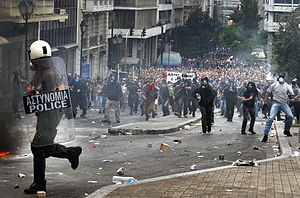
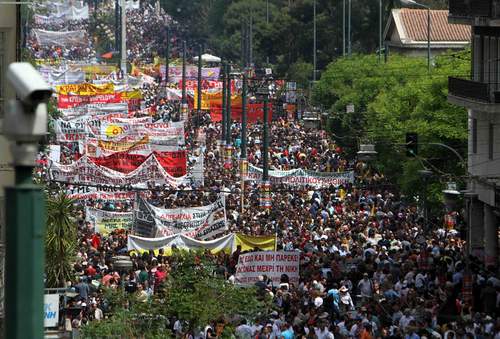
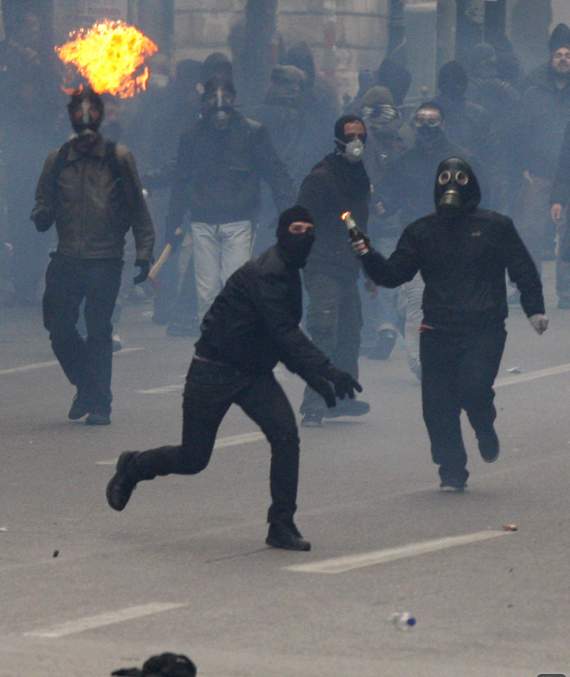
Protests and demonstrations continue to erupt in Greece as demonstrators rise up in the streets against deep cuts in services and jobs from austerity. Austerity is the name of the government’s response to the demand of its creditors. Austerity imposes on society a severe regimen of rising taxes, or cut government spending to please and satisfy creditors. Greece as predicted by Economics professor Rick Wolff a year ago has been hit the hardest by the global economic disaster. Why? For many reasons, it has a strong working class, socialist roots and a public sector made primarily of union jobs. The austerity has cut into the working class jobs as the country privatizes the post office, gas, water works and railway. Meanwhile, the wealthy continue to evade taxes in Greece and in the United States. Past shows on Greece: Law and Disorder
Professor Costas Panayotakis:
- I was in Athens that last few days, what you have in the European Union is imbalances that resulted partly from the introduction of the Euro, but also, by the general phenomena in the division of the world of some countries more technologically advanced and others that are not.
- Right now you have a crisis, partly a European crisis, its not that the Greek culture is a pathological culture, as the mainstream media sometimes presents. Each crisis has its specifics, Ireland, Portugal, in Greece, the specificity is that the wealthy are not paying taxes.
- There are tax evasion problems, the problem in Greece is of primarily of revenues rather than spending.
- The mainstream media talks about the “bloated” public sector of Greece. The public sector is aligned with other public sectors in other countries. Now what they’re trying to do of course, traffic out jobs from the public sector to make Greece a public sector a small part of the economy as it is in developing countries in Africa.
- Because its debt has become so unmanageable, there was an austerity pack that was adopted last year that 110 billion dollars. Drastic cuts in public spending, welfare state,
- Now what’s happened as is often the case, with IMF problems, the program didn’t work the way they said it was going to. Now Greece needs another loan to keep servicing its debt. One of the conditions is that Greece has this huge fire sale of all its public assets. The hope is that its going to raise 50 billion Euros.
- Because values in all the public companies have shrunk rapidly, whoever buys them will buy at a really low price. Many Greeks are up in arms about that. Now they see the banks wanting to follow up with more of the same, that’s why 80 percent of the Greeks oppose this policy.
- We had a 2 day general strike last week, a 48 hour general strike had not happened in Greece for decades.
- You also have a demand for real democracy, direct democracy. One of the demands was not to pass the austerity package.
- Every 3 months there are news measures that have to be adopted in order for Greece to get the next installment of the loan. If Greece defaulted on their loan, it would effect the Eurozone in a very direct way, it would effect European banks.
- I think the lesson to take away from this is fighting back is necessary.
Guest – Costas Panayotakis, a professor at the New York City College of Technology.
———————————————–
Civil Liberties, Climate Change, Crony Capitalism, Supreme Court, Truth to Power
Podcast: Play in new window | Download
Updates:
- Food Not Bombs Plans To Sue Orlando Mayor
- Pelican Bay Hunger Strike
——–
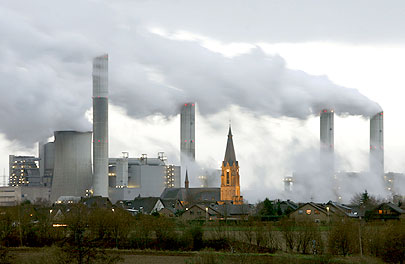

Supreme Court Decision On Climate Change
Last month the Supreme Court, reaffirmed that it is the job of the Environmental Protection Agency to curb carbon pollution under the Clean Air Act. This was decided in the Connecticut v. American Electric Power case which doesn’t allow states to directly bring a lawsuit against five of the largest power companies to regulate their emissions as a public nuisance. As many listeners may know, power plants are the nation’s biggest climate polluters. They can pump more than two billion tons of carbon dioxide into the air each year. Other polluters include automobile emissions and housing stock. Some of the world’s top scientists report that pollution has been linked to climate change.
Law Professor Eleanor Stein:
- In the 2004 case, the court decided the EPA had to assess any air pollutant and decide whether it endangered public health and welfare and if it found that it did, it would have to set limits on that pollutant.
- The EPA had refused to do that, this is the Bush era EPA and said we don’t have the authority under the Clean Air Act to do it, and even if we did, this is essentially a problem for the president to solve, and he’s doing a great job.
- The court found that unsatisfactory and held that the EPA had an obligation to regulate if it found endangerment.
- This case 2011, reaffirmed the central core of the Massachusetts decision, which is the EPA has the authority and the responsibility to regulate green house gases.
- The 2nd Circuit in a ringing militant statement on climate, reversed the district court and squarely held that states could bring this lawsuit which is against the five biggest CO2 emitters in the country, under a common law theory of public nuisance.
- The heart of the petitioners camp were a group of attorneys generals from several states, the fundamental authority of an attorney general is to bring lawsuits in a state against public nuisances of all kinds.
- So they had this idea to elevated this authority into a federal common law claim.
- The court endorses no particular view of the complicated issues related to carbon dioxide emissions.
- For this they cite an article in the New York Times 2 years from Princeton physicist Freeman Dyson who said a lot of climate denier stuff and is kind of a gadfly, who is not a climate scientist.
- In New York City for example, we burn a great deal of natural gas to heat our houses. #6 heating oil both heavy emitter of CO2
- We’re creating a layer that is preventing reflection of solar rays back out into space.
- Much more of it is being trapped into the atmosphere than pre-industrial times.
- There’s uncertainty about how fast and what kind of changes, but there are some things that are confidently predicted. We’re already seeing tremendously fast melting of ice in Greenland and the polar cap.
- There’s no question that this is a product of both rapid industrial development, of uncontrolled growth policies, without any consideration of the impacts of growth, especially when you talk about the disparity of impact.
- www.350.org
Guest – Law Professor and Attorney Eleanor Stein teaches the Law of Climate Change: Domestic and Transnational at Albany Law School and SUNY Albany, jointly with the Environmental and Atmospheric Sciences Department at SUNY.
—–
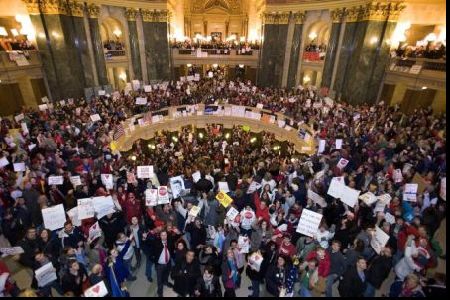
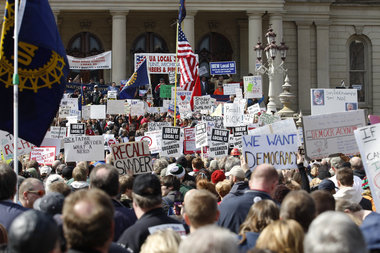
Michigan Citizens File Suit Challenging Unconstitutional Emergency Manager Law
Twenty-eight citizens of Michigan have filed a lawsuit in an effort to bring down the recently signed Emergency Manager Law, claiming it will give Governor Rick Snyder and his appointees vast, unlawful power over financially struggling cities and school districts. Bill Goodman, an attorney with the Sugar Law Center of Detroit, the firm that filed the lawsuit called it a power grab by Lansing politicians. Goodman also said the law violates the state constitution by giving Snyder powers over cities normally granted to the state Legislature. Those powers include replacing elected officials, nullifying collective bargaining agreements, privatizing public services and dissolving cities. Earlier this year we interviewed Zainab Akbar, Legal Fellow at the ACLU of Michigan about the same law being used the mostly black community of Benton Harbor. Democracy Emergency
Attorney John Philo:
- We think this is an important issue, not just for Michigan but nationally. We think this is so viable to our notion of fundamental constitutional rights that we could not let this pass without a legal challenge.
- The first constitutional law violation that we see is that it attacks what is known as the democratic form of government. We all believe we have a right to a democratic form of government, that we can elect our officials at the local, state and federal level. This lawsuit is testing, where is that in the Constitution, where is it recognized?
- We think that people would find it in absurdity that they don’t have that right to vote for their local officials.
- We have a provision in our constitution that says that can’t pass unfunded mandates. They can’t put costs on a local government without providing some revenue stream or providing some mandatory adjustment.
- This legislation puts all the costs on the local government that already find to be in distress.
- In Benton Harbor alone, the salary of the “emergency manager” is running 11 thousand a month.
- That’s before we even get to the consultants and the financial review people that they bring in, the staff.
- There are a number of states looking to pass the emergency managers law.
- This is a nationwide problem that everyone recognizes to regulate banks, and Wall St., and national economic policies that have hit the Midwest hardest and we would say below the belt.
- What will the law do to pensions? Contract rights and pension funds.
- There is a provision that says the state treasurer can request the communities to sort of enter into a consent agreement, before they’ve even been found in financial distress.
- There are citizens, conservation folks, in various places who’ve request the state appoint an emergency manager in their community. This sends the mayor and the city council reeling because they don’t feel they have to.
- They’re acting to prevent this because of the broad discretion given to treasurer and the governor, whether there is a financial situation where they could appoint a manager.
- We’re asking for an order of the court that declares the provisions of Public Act 4 unconstitutional and then an injunction that prevents any further implementation.
- I think people would be shocked if they realize people don’t have a right to elected government.
——————
Tova Perlmutter:
- We see this litigation as one tool in a broader people’s movement. Here in Detroit we have some phenomenal leaders. The first day we filed was the biggest day in my career.
- We with a lot of help with allies and friends held seven press conferences in cities across the state.
- We blanketed the airways and the press, that’s how we got national coverage as well.
- The Maurice & Jane Sugar Law Center for Economic & Social Justice
- We’ve been around for 20 years, based in Detroit but we do serve folks nationally, our mission is to use legal and other public advocacy to advance the rights of working people and their communities.
- One of the cities that has had the most extreme emergency managers is Pontiac.
- There’s no coincidence here, this is a very clear effort to exert a paternalistic and corporate friendly control over communities that might otherwise be speaking out and exerting autonomy.
- www.democracyemergency.org
Guest – Attorney John Philo -Sugar Law’s Legal Director, is responsible for litigation, legal research, delivery of training, and supervision of all staff and interns working on legal tasks. John is an attorney with over 18 years of experience representing and advocating for workers and other disenfranchised people.
Guest – Tova Perlmutter – Executive Director, has over 20 years experience in administration, communications, fund raising and public education for nonprofit organizations. She obtained professional certification as a Senior Human Resources Professional while working to promote fair employment practices at a major corporation.
————————————————————–