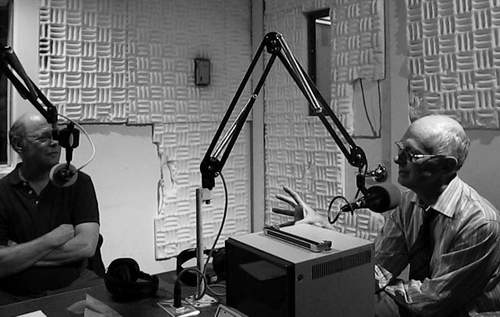
The 2nd U.S. Circuit Court of Appeals ruled that Sheik Mohammed Ali Al Moayad and Mohammed Mohsen Zayed, convicted of supporting terrorists, can have new trials. The men were convicted in federal court in Brooklyn after a six week trial in early 2005 on charges of conspiring to support Al Qaida and Hamas.
National Lawyers Guild Lawyer, Robert Boyle: This case involved an FBI sting operation where the FBI and the Dept of Justice lured Sheik Mohammed Ali Al Moayad and Mohammed Mohsen Zayed from their native Yemen to Germany.
They were lured on the promise (…and this was an FBI informant that told them this) that they would provide hundreds of thousands of dollars to Al Moayad’s charitable organizations. The issue was entrapment – set up by the FBI.
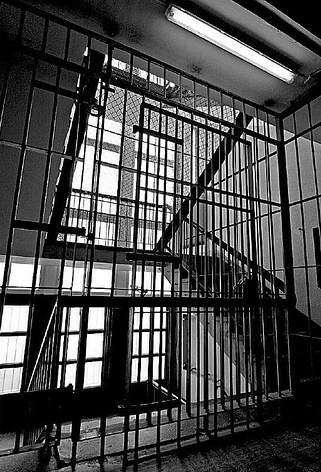
The Sheik went to Germany arrested there in 2003 after meetings with the informant -all recorded. He was brought to trial in Brooklyn but imprisoned in a Florence, Colorado supermax prison.
The trial judge allowed the government to introduce a host of prejudicial and irrelevant evidence.
Robert Boyle – “Its rare that they find the cumulative prejudicial evidence as grounds for reversal. This decision is gratifying and unique, its rare to get a reversal in a case where there is alleged terrorism.”
Extremely similar to Lynne Stewart’s case, if you don’t have direct evidence, prejudice the jury. Raise the spectre of Osama Bin Laden and you hope that the jury overlooks the weaknesses of the government’s case and convicts.
Guest – Robert Boyle, a national lawyers guild attorney who represented Sheik Mohammed Ali Al Moayad and former civil rights lawyer Lynne Stewart who tells us why this brings other issues to light in her case.
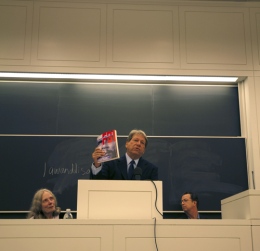
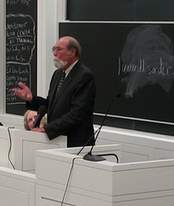
We hear a speech from Wayne Smith, Senior Fellow, Center for International Policy, he was among three speakers. We e will hear Brian Becker, Director of the A.N.S.W.E.R. Coalition in the weeks to come.
Wayne Smith addressed the failure of the United States, specifically the Bush family to prosecute Luis Posada Carriles on charges of terrorism. The failure to charge Posada with terrorism is an open violation of the Resolution 1373 of the UN Security Council. A resolution George Bush pushed through on the days following the attacks on 9/11.
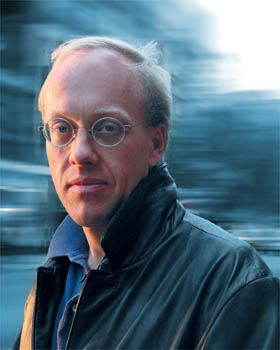
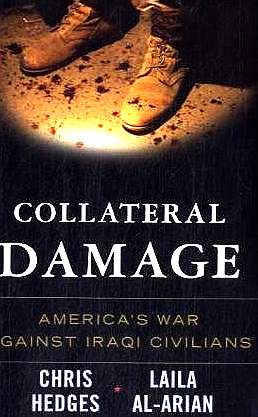
Author, journalist Chris Hedges exposes the dark violence deep within the ranks of the Iraq War. The type of violence and eyewitness accounts you don’t hear about in the media. His book pulls together the 50 stories from by combat veterans as they describe the day to day carnage.
Chris Hedges:
We wanted to give people a window into the sheer terror that has been visited on Iraqi civilians.
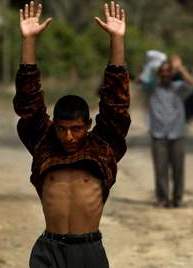
Convoys have to keep moving: Running over children. If an IED goes off, soldiers lay down withering suppressive fire.
The Sunnis are building a powerful force and will soon unleash a civil war
Barack Obama speaks in the same toxic language of war bequeathed to us by the Bush Administration. He wants to expand the war in Afghanistan, he talks about leaving behind troops in the green zone and the super bases and fighting terrorism.
We have no rights as citizens of this country to debate the terms of this occupation, in post Nuremberg terms this war is a criminal war of aggression.
Resistance. We find our spiritual worth in our ability to resist and to take moral stance n0 matter how lonely.
Guest – Chris Hedges, author of many books specializing in American and Middle Eastern politics and society. He spent nearly two decades as a foreign correspondent in Central America, the Middle East, Africa and the Balkans and right now, he’s a senior fellow at The Nation Institue in New York City and a lecturer in the Council of the Humanities.
In this interview Professor Rick Wolff focuses on the larger issues beyond finance such as banking, money lending and credit, he says it was a problem in the making for the last 30 years. He describes historic underlying causes such as the end of the wage increase back in 1970. From 1820-1970 the American economy delivered a rising standard of living, wages went up every decade in that time and they used that money to buy more things.
In the last 30 years the wages in the United States did not go up. In order to keep buying things, people worked more hours and borrowed money, exhausting themselves in additional work and taking on more debt. From the workers point of view, there is increased anxiety and exhaustion, their lives are strained, pressurized. Meanwhile financial markets and banks compete with each other to profit from the workers’ massive debt.
Bail outs and extreme right anti-immigration moves will not solve underlying problem. A fundamental reorganization of the American economic system will not be done by the people who run the corporations, yet the change has to begin at the Board of Directors, the small groups of people heading corporations who have been making decisions in a classical way for 150 years.
Rick Wolff – Possible Solutions:
Reorganize the way business works so that the people become there own board of directors.
Corporations reorganized so that workers collectively become there own boss.
Mon-Thurs – You come to work and do your job as you always did, less hours, wage increase.
Friday – Attend meetings all day to assess the impact of the product on the community, what products to make, what to do with profits. Cultivating the community.
“This, instead of a handful of people, “the bosses†set against the employees in a conflicted situation that periodically makes each group behave in antagonistic ways in turn destroying the community – which is where we are now.â€
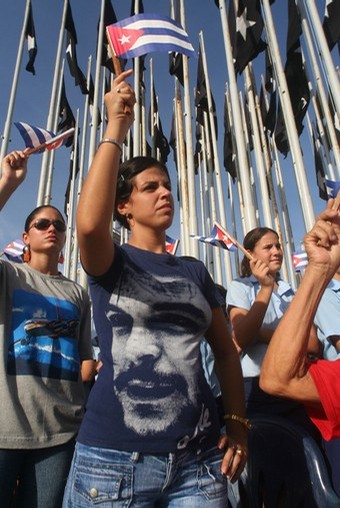
We hear a speech from Historian, Jane Franklin, she was among three speakers. Jane is a contributing editor to the Cuba Update, the journal of th eCenter Cuban Studies in New York City, since 1979. She is the author of two books: Cuban Foreign Relations 1959-1982 and Cuba and the United States: A Chronological History (Ocean Press, Melbourne, Australia) Jane has published numerous articles, poems and film reviews and has lectured extensively about Cuba, Vietnam, Nicaragua El Slavador and Panama.
We will be hearing from speakers Wayne Smith, Senior Fellow, Center for International Policy and Brian Becker, Director, A.N.S.W.E.R. Coalition in the weeks to come.
From the New York Daily News: “It took years, but he is finally going to be charged in the U.S. for his crimes – even if only symbolically. It will occur here, in New York, when a tribunal composed of scholars and human rights activists take up the case of international terrorist Luis Posada Carriles, a man who is responsible for a long list of murderous attacks.
Posada, though, is a very lucky man. Despite his dark history, Posada remains free to roam Miami’s sunny streets and happily lives at home with his family. His rap sheet is long and deadly. A convicted terrorist in two countries – he escaped Venezuela and was pardoned in Panama – Posada is considered the mastermind behind the 1976 bombing of Cubana Airlines Fight 455, which killed the 73 passengers on board, including the Cuban national fencing team. He is believed responsible for a string of hotel bombings in Cuba, resulting in the death of Italian tourist Fabio diCelmo. But these are only two examples of his treachery. Posada later boasted about the diCelmo killing in a New York Times interview, which should give everybody a clear idea of what kind of person this man is. Inexplicably, the Justice Department has refused to classify the former CIA operative as a terrorist. The reason may have to be found in Posada’s long and extensive ties with the CIA and several other nation’s intelligence agencies.”
In this interview Professor Rick Wolff focuses on the larger issues beyond finance such as banking, money lending and credit, he says it was a problem in the making for the last 30 years. He describes historic underlying causes such as the end of the wage increase back in 1970. From 1820-1970 the American economy delivered a rising standard of living, wages went up every decade in that time and they used that money to buy more things.
In the last 30 years the wages in the United States did not go up. In order to keep buying things, people worked more hours and borrowed money, exhausting themselves in additional work and taking on more debt. From the workers point of view, there is increased anxiety and exhaustion, their lives are strained, pressurized. Meanwhile financial markets and banks compete with each other to profit from the workers’ massive debt.
Bail outs and extreme right anti-immigration moves will not solve underlying problem. A fundamental reorganization of the American economic system will not be done by the people who run the corporations, yet the change has to begin at the Board of Directors, the small groups of people heading corporations who have been making decisions in a classical way for 150 years.
Rick Wolff – Possible Solutions:
Reorganize the way business works so that the people become there own board of directors.
Corporations reorganized so that workers collectively become there own boss.
Mon-Thurs – You come to work and do your job as you always did, less hours, wage increase.
Friday – Attend meetings all day to assess the impact of the product on the community, what products to make, what to do with profits. Cultivating the community.
“This, instead of a handful of people, “the bosses” set against the employees in a conflicted situation that periodically makes each group behave in antagonistic ways in turn destroying the community – which is where we are now.”
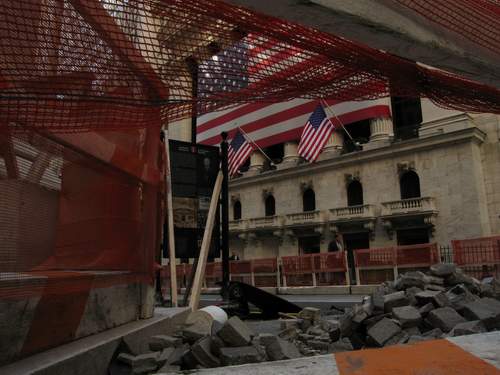
Michael Smith and Michael Ratner host a lively discussion with economist Max Wolff and political science professor and author John Ehrenberg. Max Wolff begins with an anatomy of the financial collapses – “Low wage growth for majority of Americans, meanwhile global capacity for productive enterprise has skyrocketed and the way to make money is to find something to produce for very low wages. This creates a classic problem of insufficient aggregate demand. We can make it cheap, we can find this 11 year old in the rain forest to work in the factory for 39 cents an hour. Not successful if you can’t find a buyer. So, your success breeds a nightmare, the nightmare is resolved by international financial markets and growing debt.â€
In the last half hour John Ehrenberg joins in. He says the US needs a new New Deal, and though this is a dangerous time, it could be an opportunity for strong social movements. The Republican vetting of Palin is a major concern – “The sneering contemptuous disdain for serious thought or consideration for deliberation.†Faux populism that rewards capital and punishes labor and yet coming forward as a party for the common man.
Guest – Max Fraad Wolff , freelance researcher, strategist, and writer in the areas of international finance and macroeconomics. Max’s work can be seen at the Huffington Post, The AsiaTimes, Prudent Bear, SeekingAlpha and many other outlets.
Guest – John Ehrenberg, author of the book “Servants of Wealth: The Right’s Assault on Economic Justice.†A professor of political science at Long Island University, in this, his third book, critically analyzes the rise of an ideologically coherent Right. He dissects their themes of military weakness, moral decay, racial anxiety, and hostility to social welfare to reveal their central organizing objective of protecting wealth and assaulting equality.
Attorney Rhonda Copelon is a professor at the Law School of the City University of New York and director of the school’s International Human Rights Law Clinic. Rhonda is also the Legal Advisor to the Women’s Caucus for Gender Justice.
From Article on New International Criminal Court: “The breadth and specificity of gender crimes in the court’s enabling statutes are directly attributable to a global caucus of women that formed in 1997 in the face of apathy and active resistance to prosecuting gender-based crimes. “Women made a huge difference,” said Rhonda Copeland, a professor at the Law School of the City University of New York and director of the school’s International Human Rights Law Clinic.
“They made it impossible to ignore that women have been left out of justice and that we have to be in it,” Copelon said. “If there were nobody there saying ‘this is violence,’ I don’t know how it would have happened.”Rhonda shares with listeners, her history of fighting for the constitutionality of the abortion cases in New York City and its effect on poor women in a pre-Roe v Wade climate. She also discuss the Harlem 6 case. This is the first part of the interview with Rhonda Copelon.
—
Bill Would Let Insurers Track Where, When, How You Drive
A bill proposed by the California legislature would allow insurance companies to install black boxes on vehicles that track milage but also measure more sensitive information such as how aggressive you drive. The bill is structured so that insurance companies can encourage people to drive less with lower insurance. Consumer watchdogs say drivers shouldn’t have to choose between fair insurance rates and protecting their privacy when there are less intrusive ways to collect data.
Under the proposed bill titled AB 2800, the “black box†would allow insurance companies to track how fast drivers accelerate, where motorists go and which neighborhoods they drive through. The device would also monitor whether they come to a full stop at a stop sign; and when they apply their brakes. Privacy protection groups are also watching as similar proposals are being introduced in other states.
Currently under the Endangered Species Act, federal agencies are required to consult with federal wildlife experts to make sure activities such as mining, logging and road construction do not threaten endangered species. Now, the Bush administration has proposed a new plan that will give federal agencies the decision of whether they want expert consultation to determine if activities will affect endangered species.
Thousands of these consultations happen each year and federal wildlife experts have finely tuned their knowledge of protecting endangered species in the last twenty years. Critics say the proposal is a disturbing reversal.
Police Tactics Used During The RNC: Legal Analysis
Law and Disorder hosts debrief activist Laurie Arbieter who was among the demonstrators protesting during the Republican National Convention. Laurie was among a group of activists pulled over in St. Paul, held at gunpoint and let go. We later talk with Bruce Nestor, president of the Minnesota chapter of the National Lawyers Guild. Bruce gives us the background on the terrorism charges brought against 8 members of a prominent activist group. Most of the 8 defendants were arrested during the pre-emptive house raids and face up to seven years in prison. Ramsey County authorities have described the charges as “ in furtherance of terrorism,†based on the 2002 Minnesota version of the Patriot Act.
In an article published on the website – AfterDowningStreet, author David Swanson lays out another powerful case as to why it is critical to hold leadership accountable for war crimes. He explains that if much needed change is made in the United States such as a transparent electoral process, eliminating secret government and constitutional amendments, it would still not be enough to “chain the dogs of war.” Hosts discuss with David Swanson about why it’s critical to hold a conference to plan the prosecution of Bush and Cheney.
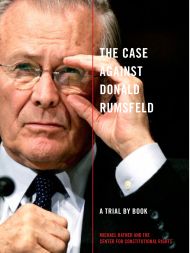
We are very pleased to talk with our own Michael Ratner, president of the Center for Constitutional Rights about his recent book The Trial of Donald Rumsfeld: A Prosecution by Book. Michael’s book exposes how hundreds of individuals were victims of gruesome crimes inside the secret prisons in Iraq, Afghanistan and Cuba while under International and American law. Michael Ratner not only levels the charge against former US secretary of defense Donald Rumsfeld but lists others to be guilty of the US War Crimes Act of 1996 such as David Addington, George Tenet, Alberto Gonzales, and John Yoo.
The case is presented in shocking detail, it’s a blueprint for prosecuting war criminals and a powerful reference tool for holding the Bush administration’s rogue leadership accountable. One review states that it quote “presents a case that a prosecutor could bring against Donald Rumsfeld were he not shielded by dubious immunity doctrines crafted by the Bush administration and the judges it has appointed.â€
Law and Disorder RNC Street Coverage: Audio Document
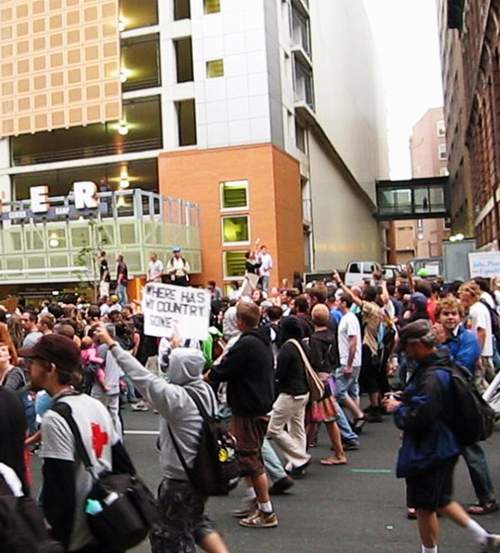
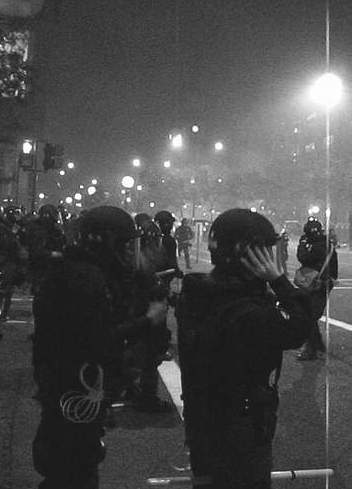
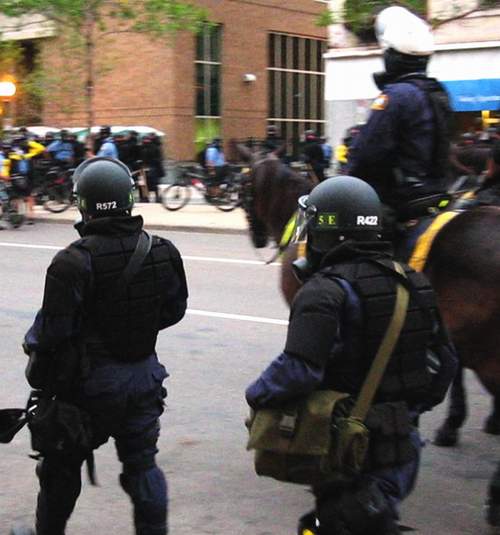
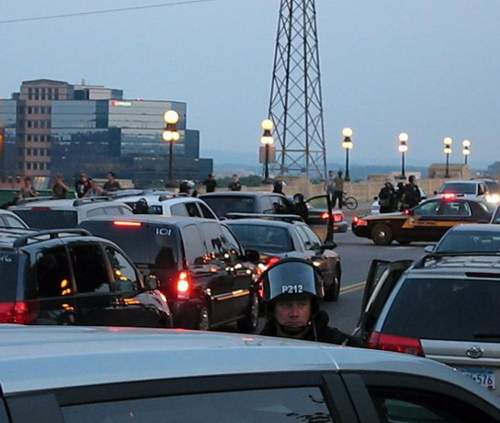
Heidi Boghosian, Law and Disorder co-host and Executive Director of the National Lawyers Guild took to the streets of St. Paul Minnesota with producer Geoff Brady during the Republican National Convention. We bring you the voices and sounds of protesters, demonstrations, and interviews with legal observers, lead activists and lawyers. We begin this audio document with attorney Bruce Nestor, president of the Minnesota Chapter of the National Lawyers Guild. Amid this heavily militarized area of St. Paul, Bruce Nestor describes how riot police use minivans as quick, efficient transport and the trapping of protesters on a bridge.
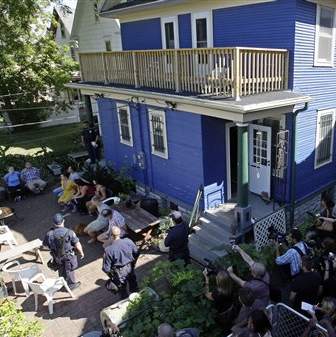
Just blocks from the Xcel Center, Heidi catches up with local activists and independent journalists who describe first hand accounts of police confrontations. A local journalist named Nick tells of the launching of paint and flash-bang grenades, the arrests and detainment of journalists and unwarranted use of pepper spray and tasers. On 4pm on Tuesday, marchers rally at Mears Park for the scheduled Poor Peoples March. There we spoke with a New York videographer named Dan, he described the pre-convention raids on I-Witness Video and more accounts of excessive police force. Below is a photo of the pre-convention raids from their website.
National Lawyers Guild attorney Bruce Nestor provides a chronology of events beginning with legal details involving the pre-convention raids on convergence centers. He also analyzes the overall impact of free speech when various factors come together. 1) Demonizing protesters and their message. 2) This allows use of military force by police. 3) Intelligence gathering and targeting lead organizers of alternative press. Combined, these tactics squelch the voice of dissent in all age groups and keep people from exercising their first amendment rights.
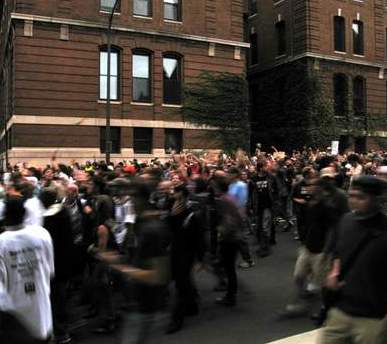
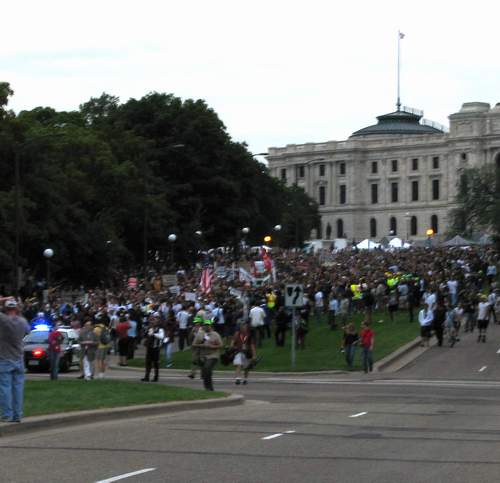
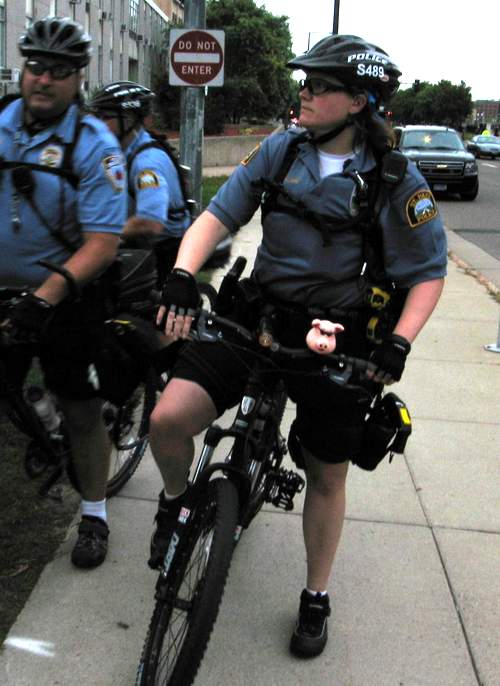
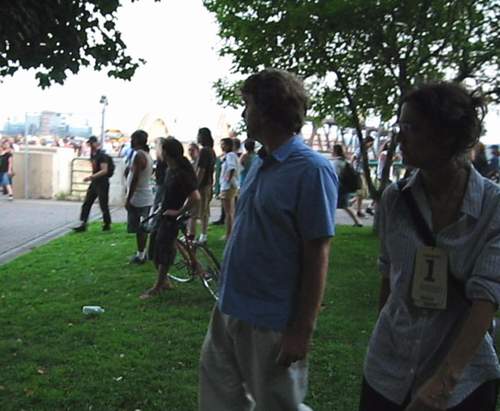
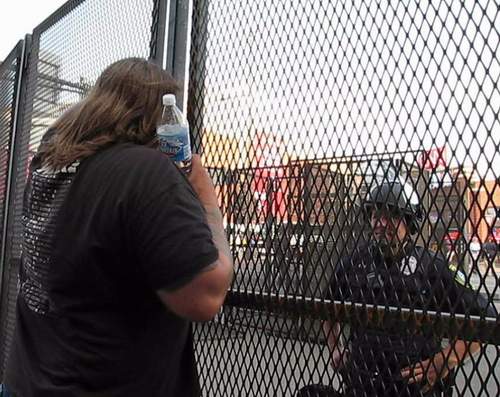
Below: Scenes gathered from the streets of St. Paul during the Republican National Convention 2008