CIA Sponsored Terror, Civil Liberties, Criminalizing Dissent, Guantanamo, Human Rights, Political Prisoner, Prison Industry, Surveillance, Targeting Muslims, Torture, Uncategorized, War Resister
Podcast: Play in new window | Download

Nuclear Posture Review
Not since 1953 when the United States and the Soviet Union exploded thermonuclear bombs has the world been such a powder keg. Last week the Pentagon released its Nuclear Posture Review. It seeks to make use of nuclear weapons more acceptable and plausible. It recommends the spending of $1 trillion to upgrade America’s nuclear arsenal and it appears to end the United State’s commitment to pursue nuclear disarmament.
Last November Senator Bob Corker, a Republican from Tennessee, convened a hearing of the Senate Foreign Relations Committee on the limits of presidential authority to use nuclear weapons. President Trump had been making incendiary comments about North Korea, threatening to totally destroy the country and to unleash fire and fury like the world has never seen.
There are no reliable limits on the president‘s power to order use of nuclear weapons. The International Court of Justice declared in 1996 ruled that the use or threat of use of nuclear weapons is illegal under international law. The United States is not legally bound by the ICJ opinion. Moreover, the United Nations last summer adopted a Treaty On the Prohibition of Nuclear Weapons. It states that the use of nuclear weapons would be against the principles of humanity in the dictates of public conscience. The United States is not legally bound by the new UN treaty either. The United States under President Obama and now Trump has vowed to increase the size of America’s nuclear arsenal. The United States will not agree to simply declare that it is against the first use nuclear weapons.
Guest – Attorney John Burroughs, Executive Director of the Lawyers Committee for Nuclear Policy. John Burroughs represents LCNP and IALANA in Nuclear Non-Proliferation Treaty review proceedings, the United Nations, and other international forums. Dr. Burroughs is contributor, Unspeakable suffering – the humanitarian impact of nuclear weapons (2013) (available here); contributor, Assuring Destruction Forever: Nuclear Weapon Modernization Around the World (2012) (available here); co-editor and contributor, Nuclear Disorder or Cooperative Security? U.S. Weapons of Terror, the Global Proliferation Crisis, and Paths to Peace (2007) (available here); co-editor and contributor, Rule of Power or Rule of Law? An Assessment of U.S. Policies and Actions Regarding Security-Related Treaties (2003); and author of The Legality of Threat or Use of Nuclear Weapons: A Guide to the Historic Opinion of the International Court of Justice (1998). He has additionally published articles and op-eds in journals and newspapers including the Bulletin of the Atomic Scientists, the World Policy Journal, and Newsday. Dr. Burroughs has taught international law as an adjunct professor at Rutgers Law School, Newark. He has a J.D. and Ph.D. from the University of California at Berkeley and a B.A. from Harvard University.
—-
Injustice: The Story of the Holy Land Five Foundation
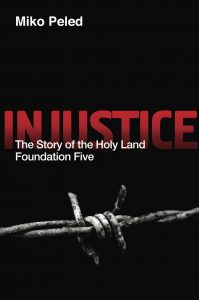
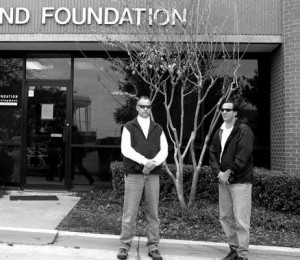
In July 2004 federal agents raided the homes of five Palestinian-American families, arresting the five dads. The first trial of the Holy Land Foundation Five ended in a hung jury. The second, marked by highly questionable procedures, resulted in very lengthy sentences for supporting terrorism by donating to charities with whom the US government itself and several respected international agencies work.
Capitalizing on post 911 Islamaphobic hysteria, the US government used secret evidence and conflated charity with terrorism to convict the five men of providing material support for terrorism.
The destruction of the Holy Land Foundation, the largest Muslim charity in the United States, constitutes one of the great judicial injustices in the so called war on terror
of which there have been many. The US government, relying on the testimony of anonymous Israeli security experts, convicted the five men of the crime of providing humanitarian aid to Palestinians suffering under an illegal and punishing occupation.
This case is one of several repressive post 911 US prosecutions that have been brought with the assistance of Israeli security police, targeting US-based Palestinian Muslim activists.
Guest – Miko Peled is an Israeli writer and activist living in the US. He was born and raised in Jerusalem. His father was the late Israeli General Matti Peled. Driven by a personal family tragedy to explore Palestine, its people and their narrative. He has written a book about his journey from the sphere of the privileged Israeli to that of the oppressed Palestinians. Peled speaks nationally and internationally on the issue of Palestine. He supports the creation of a single democratic state in all of Palestine, and a firm supporter of BDS. Author of Injustice: The Story of the Holy Land Five Foundation and The General’s Son: Journey of an Israeli in Palestine.
CIA Sponsored Terror, Civil Liberties, Criminalizing Dissent, FBI Intrusion, Human Rights, NSA Spying, Political Prisoner, Prison Industry, Surveillance, Targeting Muslims, Truth to Power, War Resister
Podcast: Play in new window | Download
Attorney Prevails Against CFAA Charges In Click Fraud Trial
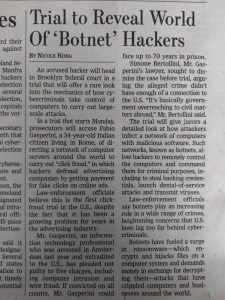
In a trial that was closely watched by cybersecurity experts, Italian citizen Fabio Gasperini was charged for allegedly violating the Computer Fraud and Abuse Act, or CFAA. Computer experts claimed it was the first so-called “click fraud” trial and would test the U.S. government’s ability to link individuals to complex cybercrimes.
As covered before on Law and Disorder, the CFAA is an antiquated law passed in 1986 before personal computers and smart devices were omnipresent in all aspects of our lives. It affords law enforcement extremely wide latitude to prosecute virtually any computer-related activity, including violations of Terms of Service agreements. Each offense can bring up to 20 years in prison, and when multiple counts are charged individuals can face decades behind bars.
In 2017 Simone Bertollini became the first known attorney to prevail against CFAA charges. His 34-year-old client, Mr. Gasperini, was found not guilty on several felony counts of wire fraud, computer intrusion and money laundering for which he faced 70 years in prison; he was convicted on only one count of computer intrusion, a misdemeanor, which is current being appealed. Mr. Bertollini disputed prosecutors’ version of events and noted that none of the expert witnesses had ever seen the botnet that Gasperini allegedly used. He also questioned how he could be charged with conspiracy when no conspirators were named or charged. Cross Examination Transcript
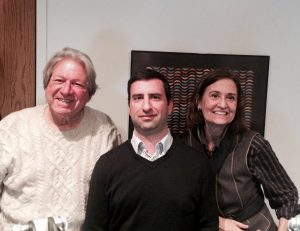
Guest – Attorney Simone Bertollini – After graduating from law school in Rome, Italy, Simone moved to the United States where he graduated with a Juris Doctor degree, becoming one of the very few Italian lawyers in New York with full academic qualifications in both Italy and the United States. Simone first came to the United States with an F-1 student Visa to attend law school. After, he started his own legal practice, and obtained E-2 Treaty Investor Visa status. Later, Simone became a Lawful Permanent Resident, and now he is a proud American citizen. In the course of his career, Simone handled hundreds of immigration cases, including removal proceedings and federal appellate matters. Simone has also substantial criminal jury trial experience.
—-

Electronic Frontier Foundation on NSA Spying Extension
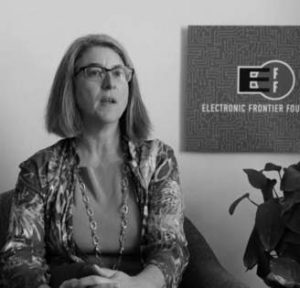
A few weeks ago the U.S. Congress voted to pass a bill extending, for another six years, the NSA’s practice of Internet surveillance. Cindy Cohn, executive director of the Electronic Frontier Foundation, called this “a significant blow against the basic human right to read, write, learn, and associate free of government’s prying eyes.” The vote happened without public debate on a matter of great public concern.
The legislation in question allowing warrantless surveillance is Section 702 of the FISA Amendments Act. The Act is intended to target foreigners abroad. In practice it puts a great deal of our internet activities to government scrutiny, as they pass through key internet checkpoints, and as they are stored by providers like Google and Facebook. The NSA is thus able to gather and store private communications of countless non-suspect Americans.
Guest – Cindy Cohn, Executive Director of the Electronic Frontier Foundation. From 2000-2015 she served as EFF’s Legal Director as well as its General Counsel. Ms. Cohn first became involved with EFF in 1993, when EFF asked her to serve as the outside lead attorney in Bernstein v. Dept. of Justice, the successful First Amendment challenge to the U.S. export restrictions on cryptography.
——————————-
Civil Liberties, Criminalizing Dissent, Human Rights, Political Prisoner, Prison Industry, Surveillance, Truth to Power
Podcast: Play in new window | Download

The End Of Policing
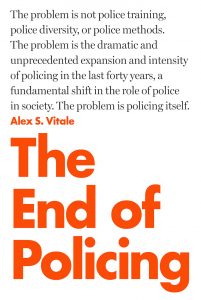
The recent book The End of Policing by New York professor Alex Vitale feels especially timely right now. Burgeoning grassroots movements responding to police violence in Ferguson, Missouri have drawn attention to the increased militarization of law enforcement in the treatment of civilians, and helped to raise public awareness of failed policies. Yet, no amount of media exposure seemed to result in any workable solutions to systemic violence.
Vitale has written an immensely readable and thorough chronology of the origins of modern policing as a tool of social control. He reveals how increased policy authority is incompatible with social justice and community empowerment. Kirkus Reviews calls the book a “tightly constructed monograph filled with reform suggestions” that is “a clearly argued, sure-to-be-controversial book.”
He cites research internationally to show how law enforcement, rather than help an array of social problems, is actually making things worse.
Guest – Alex S. Vitale is associate professor of sociology at Brooklyn College and author of City of Disorder: How the Quality of Life Campaign Transformed New York Politics. He is senior adviser to the Police reform Organizing Project and serves on the New York State Advisory Committee to the US Civil Right Commission.
—-
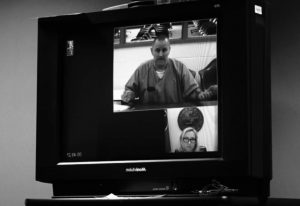

Lawyers You’ll Like: Attorney Michelle Lewin
In response to requests from people at Otisville Correctional Facility in upstate New York, nearly five years ago the National Lawyers Guild held a training for volunteers interested in participating in a Parole Preparation Project. The Project’s goals were to pair volunteers (law students, social workers, family and friends of incarcerated persons among others) with individuals who face long prison sentences and have been repeatedly denied parole.
Today the Parole Preparation Project is a flourishing nonprofit organization, in large part to the efforts of its executive director Michelle Lewin. Volunteers collaborate with parole applicants in New York State to gather necessary documentation for upcoming parole hearings, and work with them on practicing for the actual interview. Volunteers also support volunteers in soliciting meaningful letters of support from friends, family, co-workers, and the Project writes letters of support as well.
Guest – Attorney Michelle Lewin. Prior to co-founding and heading the Parole Preparation Project, Michelle was a Court Advocate at the Fortune Society; she also co-directed the “Right to Write” Program at the Westchester County Correctional Center.
—-
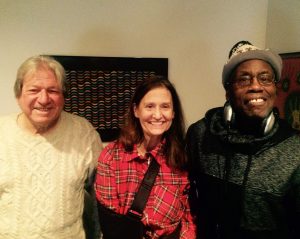

Poet Raymond Nat Turner
We welcome back to Law and Disorder political poet to start the new year. Turner is the poet in residence of the internet site and radio show Black Agenda Report.
Guest – Raymond Nat Turner, currently Poet-in-Residence at Black Agenda Report, Turner has been the opening act for such people as James Baldwin, Cynthia McKinney, radical sportswriter Dave Zirin and Congresswoman Barbara Lee after her lone vote against attacking Afghanistan.
CIA Sponsored Terror, Civil Liberties, Criminalizing Dissent, Death Penalty, FBI Intrusion, Habeas Corpus, Human Rights, Political Prisoner, Prison Industry, Supreme Court, Surveillance, Torture, Truth to Power
Podcast: Play in new window | Download
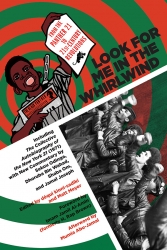

Look for Me in the Whirlwind: From the Panther 21 to 21st-Century Revolutions
The Black Panther Party was formed by community college students in Oakland California in 1966, the year after Malcolm X was murdered in New York City. It’s original name was the Black Panther Party For Self Defense.
The Black Panther Party set an example by its community programs and courage in declaring that it would defend itself against police brutality. The Black Panther Party spread westward from California to New York where chapters were organized in Brooklyn and Harlem, where Malcolm X was from. The Panthers frightened America’s elite. J Edgar Hoover and the FBI set out to destroy them and eventually succeeded. A great courtroom battle took place place in New York City shortly after the establishment of the chapters. Twenty one Black Panthers were framed up on baseless conspiracy charges.
They spent two years in prison including one year on trial. The jury was out for only one hour and acquitted them totally of all the baseless charges. The collective story of the New York City black panthers and their trial is told in the newly re-issued book Look For Me In The Whirlwind. The book is edited by Dequi Kioni-sadiki and Matt Meyer. It has a forward by Imam Jamil Al-Amin (formerly H. Rap Brown), the former head of the Student Nonviolent Coordinating Committee now in prison for life in Georgia and it contains an afterword by Mumia Abu-Jamal.
Guest – Matt Meyer is a New York City–based educator, organizer, and author who serves as War Resisters International Africa Support Network Coordinator, and who represents the International Peace Research Association at the United Nations Economic and Social Council. A former draft registration resister, Meyer’s extensive human rights work has included support for all political prisoners and prisoners of conscience, solidarity with Puerto Rico and the Black Liberation Movement, and board membership on the A.J. Muste Memorial Institute.
Guest – déqui kioni-sadiki is the chair of the Malcolm X Commemoration Committee and was a leader of the Sekou Odinga Defense Committee, which waged a successful campaign for the release of her husband. A tireless coalition-builder and organizer, déqui is a radio producer of the weekly show “Where We Live” on WBAI-Radio, Pacifica; an educator with the NYC Department of Education; and a member of the Jericho Movement to Free All Political Prisoners.
Guest – Sekou Odinga was a member of Malcolm X’s Organization of Afro-American Unity, a founding member of the New York chapter of the Black Panther Party as well as the Black Panther International Section, and was a member of the NY Panther 21. A citizen of the Republic of New Afrika and combatant of the Black Liberation Army, Sekou was captured in October 1981, mercilessly tortured, and spent the following thirty-three years behind bars—a prisoner of war and political prisoner of the U.S. empire. Since his release in November 2014, he has remained a stalwart fighter for justice and for the release of all political prisoners.
—-
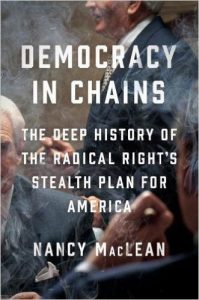
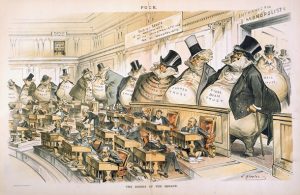
Democracy in Chains: The Deep History of the Radical Right’s Stealth Plan for America
The spectacle of President Donald Trump and the palace intrigue in the White House has served daily to distract people from the political strategy and accomplishments of the radical right, which is taking over the Republican Party.
Over time, the GOP has been transformed into operation conducting a concerted effort to curb democratic rule in favor of capitalist interests in every branch of government, whatever the consequences. It is marching ever closer to the ultimate goal of reshaping the Constitution to protect monied interests. This gradual take over of a major political party happened steadily, over several decades, and often in plain sight.
Duke University Professor Nancy MacLean exposes the architecture of this change and it’s ultimate aim. She has written that “both my research and my observations as a citizen lead me to believe American democracy is in peril”.
Guest – Professor Nancy MacLean, whose new book, Democracy in Chains: The Deep History of the Radical Right’s Stealth Plan for America, has been described by Publishers Weekly as “a thoroughly researched and gripping narrative… [and] a feat of American intellectual and political history.” Booklist called it “perhaps the best explanation to date of the roots of the political divide that threatens to irrevocably alter American government.” The author of four other books, including Freedom is Not Enough: The Opening of the American Workplace (2006) called by the Chicago Tribune “contemporary history at its best,” and Behind the Mask of Chivalry: The Making of the Second Ku Klux Klan,named a New York Times “noteworthy” book of 1994, MacLean is the William H. Chafe Professor of History and Public Policy.
CIA Sponsored Terror, Civil Liberties, Criminalizing Dissent, Habeas Corpus, Human Rights, Military Tribunal, NSA Spying, Political Prisoner, Prison Industry, Prosecution of the Bush Administration, Supreme Court, Surveillance, Targeting Muslims, Truth to Power, War Resister
Podcast: Play in new window | Download


Will the 911 Case Finally Go To Trial?
Sixteen years have passed since the 911 attacks. The truth of who was behind the attacks has come out in a class action lawsuit brought by more than 6500 victims and survivors. The lawsuit alleges that it was elements of the Saudi Arabian government that attacked us on 9/11. The Defendant in the lawsuit is Saudi Arabia.
The Saudi Arabian government hired 15 public relations firms to help them deny responsibility. They hired several Washington white shoe high powered connected law firms. They hid behind the law of sovereign immunity, which had to be overturned by an act of Congress in order for the lawsuit to proceed. They were helped by the US government in the cover-up by the Bush and Obama administrations. But after 16 years the case is now proceeding rapidly through the Federal courts and will either be settled or tried. The object of the lawsuit is to obtain money explained Sharon Pemboli, one of the plaintiffs and leaders of a group of women from New Jersey known as “the Jersey girls” who lobbied to win passage of the law which made the lawsuit possible. She believes that if the Saudi Arabian government is deprived of funds it will not be able to fund Al Qaeda and the extremist Wahhabi clergy responsible for supporting the terrorism of Al Qaeda.
The American public has been led to believe mistakenly that Saddam Hussein and Iraq were behind 911. The attack on Iraq was a war of aggression. At the end of World War II the United States set up the Nuremberg trials to try Nazi war criminals. They wanted to set forth principles that were not merely victor’s justice. At the Nuremberg trials the Germans were found guilty of starting a war of aggression, which was called the greatest of all crimes because it has contained within it all other crimes.
Guest – Andrew Cockburn, the Washington editor of Harper’s magazine. He has written an extremely important article in the October issue titled Crime and Punishment: Will the 9/11 Case Finally Go To Trial? about the class-action law suit brought by the victims of 9/11 against the government of Saudi Arabia.
—-


U.S. Magdalene Laundries and the Indiana Women’s Prison Researchers
From the 18th to early 20th centuries Catholic institutions known as the Magdalene Laundries in Ireland effectively enslaved unmarried mothers, where infants and mothers were subjected to brutal conditions and died in the hundreds. In 1993, a mass grave containing 155 corpses was uncovered in the convent grounds of one of the laundries. This led to media revelations about the operations of the secretive institutions Investigations into these homes have brought apologies and official compensation by the state of Ireland.
Few realize, however, that these homes also existed in the United States. Reports of the inhumane conditions in these homes has encouraged survivors of U.S. Magdalene Laundries to share their own their experiences. Surprisingly, few religious leaders, journalists and historians have yet to address and speak out about this chapter in our history.
That is, until scholars at the Indiana Women’s Prison began to research Magdalene Laundries, and their impact on girls and young women of all faiths across the United States for over 100 years. They believe that these homes were in effect the first prisons for women in the nation. And their work is being published and helping to spark a national discussion.
In a law review article that they published in the Journal of the Indiana Academy of the Social Sciences, the researchers note that their discovery of the laundries and their role in confining women is ‘stark evidence of historical amnesia.They say that the laundries played an important role in shaping attitudes toward female sexuality, identity, and societal reintegration.
Guest – Kelsey Kauffman, in 2012 she and two friends started a small college program at the Indiana Women’s Prison that has grown to 14 teachers and 80 students. She has worked as a prison officer and has taught in three prisons. Her research, which has taken her to more than 80 prisons on four continents, focuses primarily on the impact prison employment has on officers.
——————————————
CIA Sponsored Terror, Civil Liberties, Criminalizing Dissent, Death Penalty, FBI Intrusion, Habeas Corpus, Human Rights, Surveillance, Targeting Muslims, Torture, War Resister
Podcast: Play in new window | Download

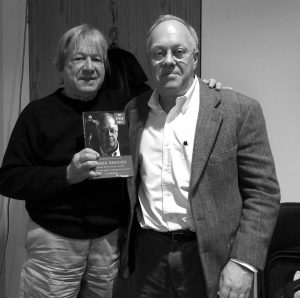
Chris Hedges – Unspeakable
The year 2017 has seen a qualitative acceleration and consolidation of power by the forces on the right which have been accurately described as a form of fascism. Three significant books were published this year addressing this phenomena, where it came from, and how to fight it. We have interviewed Nancy MacLean on her book Democracy in Chains about the origins and organization of the billionaire forces like the Koch brothers who have orchestrated the takeover of 25 state legislatures and who are attacking every institution of what is left of American democracy. We interviewed John Bellamy Foster on his book Trump in the White House about who supports the Trump agenda and why.
Guest – Chris Hedges, Pulitzer-Prize winning author and journalist. He was also a war correspondent, specializing in American and Middle Eastern politics and societies. His most recent book is ‘Death of the Liberal Class (2010). Hedges is also known as the best-selling author of War is a Force That Gives Us Meaning (2002), which was a finalist for the National Book Critics Circle Award for Nonfiction. The recent book Unspeakable consists of talks with David Talbot about the most forbidden topics in America. Chris Hedges teachers at two prisons in New Jersey. He was active in the Occupy movement, writes a weekly column for Truthdig and is also the author of American Facism: The Christian Right and the War on America.
—-
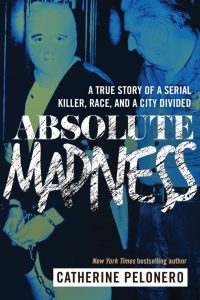
Absolute Madness by Catherine Pelonero
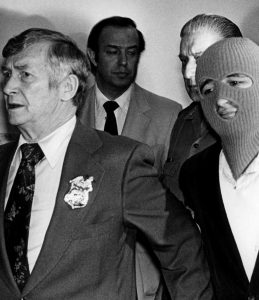
The new book Absolute Madness details the true story of a serial killer in New York whose targets were African American males. A young, white Joseph Christopher struck fear into the residents of Buffalo and New York City in the 1980s. This former Army private, who was dubbed both the .22-Caliber Killer and the Midtown Slasher, murdered at least 17 men in a four-month spree across the state.
Christopher, suffered from paranoid schizophrenia, had tried to admit himself to the Buffalo Psychiatric Center in September 1980, but was told he was not a danger to himself or others so could not be admitted. Two weeks later, the killings began.
Noted FBI profiler John Douglas assisted in the investigation that drew national attention and criticism from Jesse Jackson and other civil rights leaders. When the killer was finally found, he seemed on the surface to be an unlikely person to have held New York in such a grip of terror.
But Douglas’s capture would not be the end of the story. Racial discontent heightened during a series of prosecutions and judicial rulings that prompted cries of a double standard within the criminal justice system. Absolute Madness also chronicles one vulnerable man’s descent into madness and how the United States mental health system ignored his many pleas for help.
Guest – Catherine Pelonero, true crime author and commentator. Her book Kitty Genovese: A True Account of a Public Murder and Its Private Consequences was a New York Times bestseller. She is a contributing writer for Investigation Discovery’s CrimeFeed and has appeared on episodes of A Crime to Remember and Fox Files, among others. She lives in Los Angeles, California.
———————————–