Academic Freedom, Civil Liberties, Criminalizing Dissent, Human Rights, Political Prisoner, Prison Industry, Targeting Muslims, Truth to Power
Podcast: Play in new window | Download
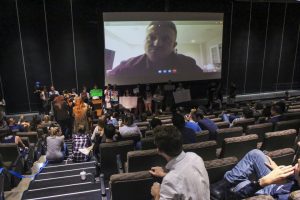
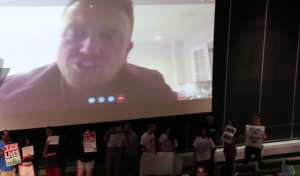
Columbia University Protesters Charged For Disrupting Controversial Speaker
On October 10, 2017 the notorious British anti-Semite and Islamophobe Tony Robinson appeared by Skype on the Columbia university campus. He was invited by the College Republican Club.
Many Columbia University students registered for the event and protested the things he said. The protesters did not disrupt the event but rather engaged the speaker’s comments.
17 students were investigated and interrogated and charged with Columbia University rules violations for “briefly interrupting a university function“ or “ disrupting a university function or rendering it’s continuation impossible.“
Guest – Columbia Law Professor Attorney Katherine Franke about the commission’s findings and recommendations and the objections to the reports conclusions. Katherine Franke is a former executive director of the National Lawyers Guildthe and chair of the board of the Center for Constitutional Rights. She is the Sulzbacher Professor of Law at Columbia Law School, and also the Faculty Director of the Public Rights/Private Conscience Project, a think tank that brings legal academic expertise to bear on the multiple contexts in which religious liberty rights are in tension with other fundamental rights to equality and liberty. Her book is titled “Wedlocked: The Perils of Marriage Equality”.
Guest – Kayum Ahmed is a Doctoral Fellow in International and Comparative Education at Teachers College, Columbia University, and an Adjunct Faculty member at Columbia Law School. Before joining Columbia, Kayum served as Chief Executive Officer of the South African Human Rights Commission from 2010 to 2015. During this period, he led a team of 178 colleagues to monitor, protect and promote human rights in South Africa, and oversaw the management of nearly 45,000 human rights cases.
—-

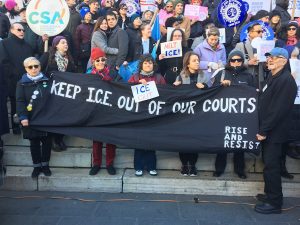
Immigration Defense Project: ICE Arrests Increase
Although they have yet to hunt down undocumented people in churches, hospitals, and schools, ICE is now arresting people inside of our state courthouses. Making people afraid to enter court houses is another indication of the further disintegration of democracy which has rapidly accelerated under the Trump administration.
There have been 900 incidences of ICE arresting people inside of a courthouse in America this year, 70 in New York City. Just two weeks ago in Brooklyn a rebellion of legal aid attorney’s occurred when ICE tried to arrest a client of Brooklyn Attorney Rebecca Kavanaugh‘s who was there appearing on an order of protection matter.
The persons arrested in court houses are people that are free to leave, not in jail, not held on any charges – in all kinds of court houses including where people are coming to seek protective orders in domestic violence situations, special human trafficking courts, and family courts. There has been a 900% increase in court house arrests in New York City alone this year. In response to this, there has been much organizing going on to get ICE out of the courthouses.
Guest – Andrew Wachtenheim – Supervising Attorney at IDP. He works with IDP’s non-profit and pro bono partners on litigation before the federal courts and Board of Immigration Appeals, and provides technical assistance, litigation support, and training to immigration and criminal law practitioners on the immigration-criminal law intersection. Andrew came to IDP from the immigration practice at The Bronx Defenders, where he represented noncitizens in immigration-related proceedings primarily at the agency level, and consulted with noncitizen defendants and criminal and family defense attorneys about the potential immigration consequences of contacts with the criminal justice and child welfare systems. Andrew is a graduate of Wesleyan University and Fordham Law School.
———————————————–
Civil Liberties, Criminalizing Dissent, Human Rights, NSA Spying, Prison Industry, Supreme Court, Targeting Muslims, Torture, War Resister
Podcast: Play in new window | Download
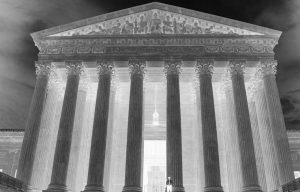

CCR: Current Supreme Court Dockets
We are currently living through an attack on every aspect of American democracy. This phenomena predated the Trump presidency and has been qualitatively accelerated by it.
This across-the-board constriction of the power and rule of the American people, to the extent that it had existed, has encompassed the suppression of voting rights; an attack on public education; the growth of enormous income inequality; the unimpeded influence of money in elections; the threat and constriction of the right of women to control their own bodies; the attack on peoples’ rights to build and join effective unions; the refusal to close the offshore prison of Guantánamo and the refusal to prosecute illegal torturers; the attack and net neutrality and access to the internet; the increase by the state of the surveillance of American citizens; the militarization of the police; encouragement of racism; the banning of Muslims; suppression of the right to demonstrate; and the growth in executive authority.
Guest – Attorney Baher Azmy, the Legal Director of the Center for Constitutional Rights. The CCR was founded in 1966 to advance the goals of the civil rights movement. Michael Ratner, our co-host and founder of Law And Disorder Radio, was its president emeritus at the time of his passing in May of last year.
—-
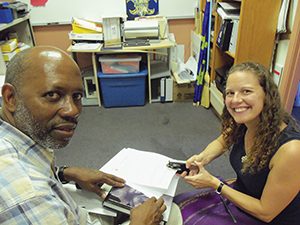

Lawyers You’ll Like: Alison McCrary
As part of our Lawyers You’ll Like series, today we are joined by Alison McCrary. Alison is a social justice attorney, a Catholic nun, president of the Louisiana Chapter of the National Lawyers Guild, and a Spiritual Advisor on Louisiana’s death row. She is the former Program Director for the Community-Police Mediation at the New Orleans Office of the Independent Police Monitor where she created a national model for improving community-police relationships, taught at the New Orleans Police Academy, and helped develop similar programs in cities across the nation.
As a 2010 Soros Justice Advocacy Fellowship in New Orleans, Alison challenged and helped reform policing practices and policies to transform relationships between police officers and the bearers of New Orleans’ indigenous cultural traditions. Alison has served as a National Lawyers Guild legal observer trainer and the New Orleans Legal Observer® Program Coordinator.
Before law school, she worked at the Capital Post-Conviction Project of Louisiana providing litigation support on death penalty cases and at the United Nations in New York monitoring the implementation of U.N. Security Council Resolutions.
Guest – Attorney Alison McCrary. In New Orleans, Alison worked, clerked, and/or volunteered at Southeast Louisiana Legal Services, the Louisiana Voters’ Rights Network, Equity and Inclusion Campaign for the Louisiana Disaster Recovery Foundation, Orleans Parish Public Defenders Office, Louisiana’s Fourth Circuit Court of Appeals, and Loyola University’s Community Justice Clinic. Nationally, Alison coordinates and provides legal support for social justice movements such as the School of the Americas Watch. She received her J.D. from Loyola University’s College of Law in New Orleans and her B.A. in English at Georgia State University in Atlanta.
————————————–
Civil Liberties, Criminalizing Dissent, Human Rights, NSA Spying, Political Prisoner, Prison Industry, RFID, Supreme Court, Surveillance, Truth to Power
Podcast: Play in new window | Download
Law and Disorder Editorials:
- FDA Approves Digital Pill by Heidi Boghosian
—-
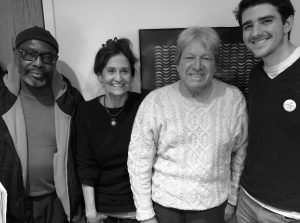
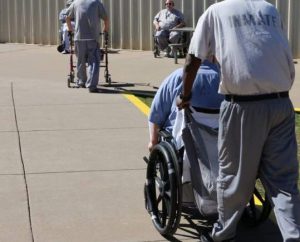
Release Aging People in Prison Campaign
The number of persons 50 years and older in New York State has risen more than 98% since 2000; it now exceeds 10,000—nearly 20% of the total incarcerated population. This reflects a national crisis in the prison system and the extension of a culture of revenge and punishment into all areas of our society.
The organization Release Aging People in Prison, or RAPP, works to end mass incarceration and promote racial justice by getting elderly and infirm people out of prison.
Led by Mujahid Farid, a 2013 Soros Justice Fellow who was incarcerated for 33 years in New York before his release in 2011, RAPP focuses on aging people in prison, many of whom are long-termers convicted of serious crimes. Many of these human beings have transformed their lives and developed skills and abilities they lacked before incarceration. They could be released from prison with little or no threat to public safety. Yet many are denied release, often for political reasons, and they needlessly remain imprisoned into old age. These elders could return to their communities if current mechanisms such as parole and compassionate release were correctly utilized. We also support legislation in New York to correct the parole system and increase the number of releases.
Guest – Mujahid Farid co-founded the Prisoners AIDS Counseling and Education program and helped design prison-based sociology and theology courses that allowed others to earn college-credited in prison. He also earned four college degrees and other certifications while incarcerated, including his paralegal certificate, NYS Department of Labor Certificate in Human Development Counseling, and NYC Department of Health Certificate in HIV/AIDS Counseling.
—-
Guest – David George, Associate Director of RAPP. In the last few years Dave has organized with and on behalf of currently and formerly incarcerated people, including at the Osborne Association and Correctional Association of New York.
—-
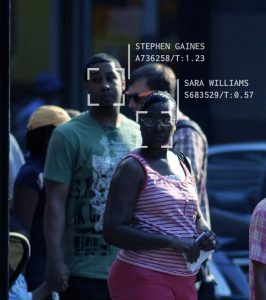

Perpetual Line Up: Unregulated Police Face Recognition In America
The presence of surveillance cameras across the United States has enabled targeted facial recognition surveillance at essentially any place and any time. Each day law enforcement puts in place more and more cameras, including CCTV cameras, police body cameras, and cameras on drones and other aircraft. The FBI’s Next Generation Biometric Identification Database and its facial recognition unit, FACE Services, can search for and identify nearly 64 million Americans, either from its own databases or through access to state DMV databases of driving license photos.
It’s likely that government agencies will soon be able to pinpoint your location and even with whom you’ve been, just by typing your name into a computer.
The release of Apple’s IPhone X has drawn scrutiny to this technology. Despite civil liberties and privacy concerns, there are few limits on facial recognition technology. In March 2017 Congress held a hearing to discuss the risks of facial recognition surveillance. There is concern that facial recognition can be used to get around existing legal protections against location tracking, opening the door to unprecedented government monitoring an logging of personal associations, including protected First Amendment-related activities. Knowledge of individual’s political, religious and associational activities could lead the way to bias, persecution and abuse.
As with many technological advances, there are benefits, too. Facial recognition can assist in locating missing persons or for other public safety purposes.
Guest – Clare Garvie, Clare is a Law Fellow at the Georgetown Law Center on Privacy and Technology. Her research with the Center is on face recognition use by law enforcement and the disparate impact of payday lending on vulnerable communities. She worked on the Center’s 2016 report on facial recognition technology.
CIA Sponsored Terror, Civil Liberties, Criminalizing Dissent, Human Rights, Political Prisoner, Prison Industry, Supreme Court, Targeting Muslims, Torture, Truth to Power, War Resister
Podcast: Play in new window | Download
Updates:
- Co-host Attorney Heidi Boghosian Discusses Robert “Sugar Bear” Lark Case
- Government Targeting Black Resistance Groups
—-
Victory In Al Shimari v CACI
President Trump told us during the campaign that he was in favor of torture because “it works.“ The Center for Constitutional Rights recently won a significant round in a case against a private military contractor, CACI who had tortured three of its clients at the infamous Abu Graib prison in Iraq in 2003 and 2004.
When he was president of the Center for Constitutional Rights, Michael Ratner maintained that if the torturers were not prosecuted, the practice of torture would be repeated. In fact none of the architects were held accountable in court. That is why the this recent procedural victory by CCR, in the case of Al Shimari is so important.
Guest – Attorney Katherine Gallagher is a Senior Staff Attorney at the Center for Constitutional Rights. She works on universal jurisdiction and international criminal law cases involving U.S. and foreign officials and torture and other war crimes, and cases involving private military corporations and torture at Abu Ghraib. Her major cases include Al Shimari v. CACI, the international U.S. torture accountability cases, and Survivors Network of those Abused by Priests (SNAP) v. Vatican, seeking accountability for the crimes against humanity of sexual violence by clergy and cover-up.
—-

International Association of Lawyers Against Nuclear Arms: North Korea
Not since the Cuban missile crisis of 1962, 55 years ago, has the prospect of nuclear war seemed so frightening. President Donald Trump, who alone can commence a nuclear attack, has threatened North Korea with “fire and fury.“ North Korea has a population of 25 million people.
Gabriel Sherman writing recently in the magazine Vanity Fair said that the situation with Trump has gotten so out of control that Trump’s Chief of Staff, General John Kelly, and his Secretary of Defense, General Jim Mattis, have discussed ways to stop Trump should he order a nuclear attack.
Obviously, the solution to winding down the escalating confrontation needs to be one of diplomacy. But when Secretary of State, Rex Tillerson, the chief diplomat in America, attempted to do just that President Trump said publicly that “you are wasting your time.“
Guest – Peter Weiss, distinguished international lawyer and President Emeritus of the International Association of Lawyers Against Nuclear Arms and its US affiliate, the Lawyers Committee on Nuclear Policy. He helped draft their October 10th, 2017 statement North Korea: Solution or Disaster. Peter Weiss was a founder of the Center for Constitutional Rights and its former Vice President.
———————————-
CIA Sponsored Terror, Civil Liberties, Habeas Corpus, Human Rights, Iran, Iraq War, Prison Industry, Surveillance, Targeting Muslims, Torture, War Resister
Podcast: Play in new window | Download
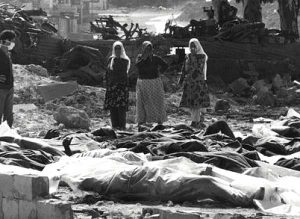
35th Anniversary of Palestinian Mass Slaughter in Lebanon Refugee Camps
This month marks the 35th anniversary of the mass slaughter of civilian Palestinians by Lebanese fascists in their Lebanon refugee camps of Sabra and Shatila. The Palestinians who lived in the camps had been driven out of their villages in the Galilee by Israel. They had lived there for hundreds of years until the Zionist colonialists expelled them in 1948. The Israeli Army aided in the 1982 slaughter. The 1982 Israeli invasion of Lebanon, which preceded the massacre, was given the greenlight by the United States. Up to 1982, the Palestine Liberation Organization, known as the PLO, had its headquarters in Beruit, Lebanon. This Israeli Army invaded Lebanon and succeeded in driving the PLO out. The United States gave written commitments to the PLO about protecting the civilian population in order to secure the PLO’s evacuation from Beruit the month before the slaughter at Sabra and Shatila camps.
Israeli Defense Minister Ariel Sharon falsely asserted that there were 2000 terrorists in the camps. US Envoy to Lebanon Morris Draper did not dispute this falsehood. Sharon told Draper that ” We will kill them. They will not be left there. You are not going to save them.” Sharon sent Lebonese fascists into the refugee camps. They silently killed hundreds of Palestinians and Lebanese, mostly women and children and old men, using knives and bayonets. The Israeli Army lit up the killing fields with flares. There was such a worldwide outcry that Israel was forced to set up a commission of inquiry. That commission found that Sharon bore “personal responsibility” for the massacre and recommended that he be dismissed from his post as Defense Minister.
The blowback from these events in Lebanon 35 years ago still echo today in the wars America is conducting in Syria and Iraq.
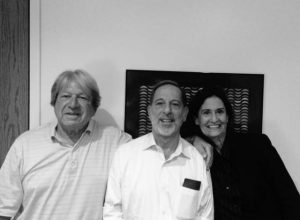
Guest – Rashid Khalidi, Edward Said Professor of Arab Studies at Columbia University. He is the author of “Under Siege: PLO Decision Making During the 1982 War”. and most recently “Brokers of Deceit: How the US Has Undermined Peace in the Middle East.” Professor Khalidi recently had an article on the Sabra and Shatila massacre in The Nation magazine.
—-
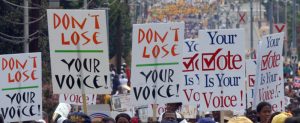
Community Votes
The Queensbridge House public housing project in Long Island City Queens is the largest such complex in the country. With more than 7,000 residents, it’s a community with little faith in civic engagement. Like other public housing communities, and low-income neighborhoods in general, poor people vote at considerably lower rates than wealthier ones. Many feel apathetic, that the system is rigged, and that their votes don’t matter.
One nonprofit in NYC is using innovative partnerships with community-based social service organizations to conduct nonpartisan voter mobilization so more underrepresented citizens participate in our democracy.
Community Votes is trying to change the culture and mindset of large nonprofit social service agencies so they integrate into their day-to-day operations civic engagement activities. These activities include promoting awareness of elections and issues and encouraging voting and other participation in federal, state, and city policy making. A few years ago Community Votes partnered with the Jacob Riis Neighborhood Settlement, a longtime provider of social services in the Queensbridge Houses, to engage in personalized messaging to mobilize voters. The results were a considerably higher rate of voter turnout in the 2014 midterm elections.
Guest – Louisa Hackett is the director of Community Votes. Louisa founded Community Votes in 2013. Through her work at Community Resource Exchange providing consulting services to New York City nonprofit organizations, she recognized the assets direct service organizations have to turn more citizens into voters.
—————————————————–
CIA Sponsored Terror, Civil Liberties, Crony Capitalism, Human Rights, Prison Industry, Surveillance, Truth to Power
Podcast: Play in new window | Download
U.S. Antiwar Leaders Call for Actions to Oppose the Escalation of the Afghanistan War During the Week of the 16th Anniversary of the Invasion, October 2 – 8.
—-
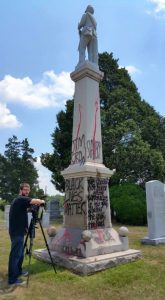
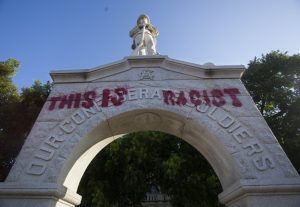
Confederate Monuments and The Meaning of the Civil War
The American Civil War fought from 1861 to 1865 killed more Americans than all other wars combined. 600,000 Americans died in a war that was fought over whether slavery was to be abolished in the United States. The Confederate General, Robert E Lee, had only an 1100 acre plantation in Virginia and 60 slaves. The value of a slave was about $30,000 in today’s dollar. Jefferson Davis, the president of the Confederacy, owned a 1400 acre cotton plantation in Mississippi.
The institution of slavery was enormously profitable and led to the establishment of America as a leading capitalist power in the world. Slavery was supported in the south not just by the slave owners themselves but by many white persons who by virtue of their skin color saw themselves as superior to blacks. It was widely believed that black people were inferior to white people, both intellectually and morally. Lincoln issued the revolutionary Emancipation Proclamation in 1863, freeing southern slaves. They began taking up arms and fighting against the slaveowners. In the wake of the Civil War biracial democratic institutions were established in the south. This was overthrown shortly thereafter when the Northern capitalists and politician made a deal with the ex-slave owners in the south. Union troops which were supporting the black population were withdrawn.
Thereafter a system of Jim Crowe segregation was instituted and blacks were nearly reenslaved and used as landless sharecroppers or prison laborers. Segregation was reestablished and enforced by massive terror by whites against blacks. The Ku Klux Klan was founded and thousands of lynchings were undertaken, carried out before the white public who assembled in crowds for the event.
Statues of southern generals like Robert E Lee and monuments to the confederacy were erected, not after the Civil War, but many years later to reinforce Jim Crowe and combat the civil rights movement.
Guest – Bruce Carlin Levine – Civil War historian and University of Illinois Professor Emeritus. His latest book titled “Fall of the House of Dixie” is widely appreciated as one of the best books on the Civil war. “Bruce Levine has taught history at the University of California and the University of Illinois. He has written four books on the Civil War, including The Fall of the House of Dixie (Random House, 2005). He’s now writing a book for Simon & Schuster about the radical Republican leader during the Civil War era, Thaddeus Stevens.”
—-

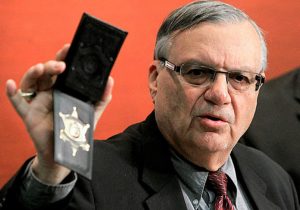
Joe Aripao, Sheriff of Maricopa County Pardoned By President Trump
Last week President Trump pardoned, without him even requesting it, the infamous Joe Aripao, Sheriff of Maricopa County, which includes the heavily Latino community of Phoenix. Arizona. Sheriff Joe was in office for 26 years. Observers have called it a “reign of terror.”
He himself called his jail a “concentration camp.” He kept prisoners outside in tents with temperatures ranging from 40° to over 100°. Prisoners died at an alarming rate, often without explanation. He paraded hundreds of Hispanic prisoners in chains dressed in black and white stripes through the streets of Phoenix. Another time he force them to wear pink underwear.
He was pardoned by President Trump, who praised him lavishly, after a federal judge found him in contempt of court for ordering his department to arrest people soley because they looked Latino and ignoring a court order to stop. Arpaio was about to be sentenced when Trump stepped in and overrode the judge.
Guest – Professor Ellen Yaroshefsky, she teaches ethics at the law school at Hofstra University. She is a former staff attorney and later board member at the Center for Constitution Rights and a leader of the National Lawyers Guild.
———————————