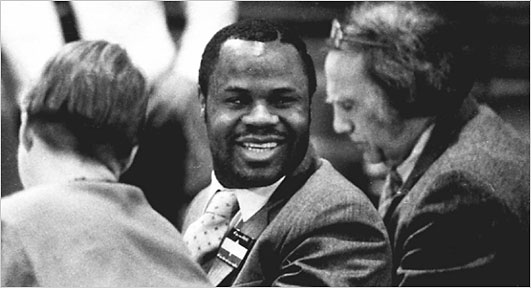
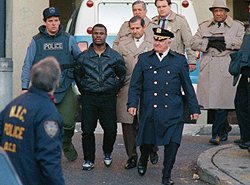
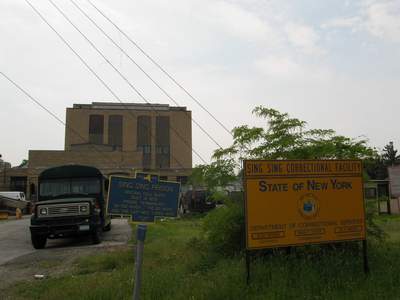
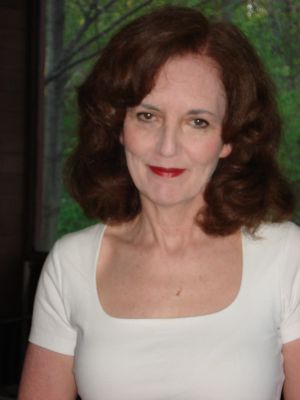
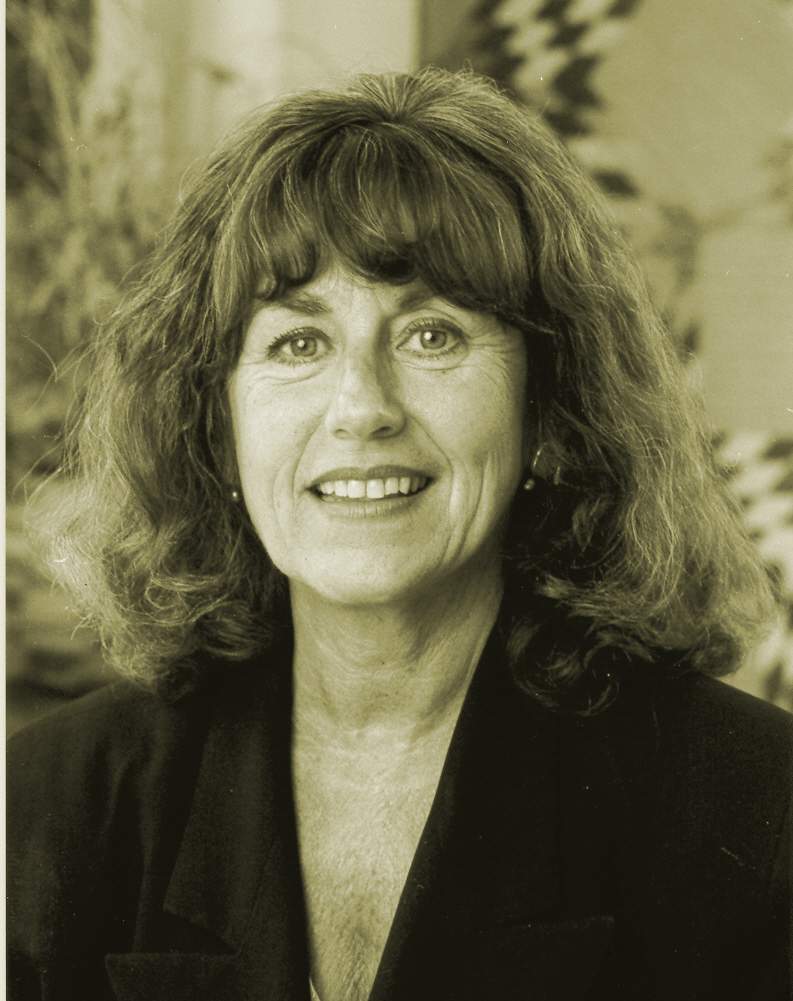
Today we welcome back civil rights attorney Lynne Stewart to discuss the recent stabbing death of Larry Davis in an upstate New York prison. Davis became known in the 80s when he was suspected of murdering drug dealers in the city. When police raided his apartment, Davis fired a pistol and shotgun from a darkened room and fled.
After more than a two week NYPD manhunt, Davis was captured. Davis’ legal defense included Lynne Stewart and prominent civil rights attorney Bill Kunstler who provided evidence of a frame up. In a recent New York Times article chronicling Davis’ story, it was written that Davis’ defense was quote made up of assertions without evidence.
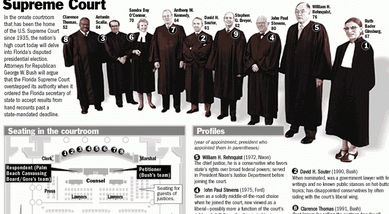
On this last day of 2007, Law and Disorder will look at the stories that have taken civil liberties in this country many steps in the wrong direction. We start with the question of impeachment, what happened, why it stalled, we’ll look at damaging supreme court decisions and draconian legislation that took large bite out of the right to free speech and dissent in this country.
Co-host Michael Ratner enumerates several key stories of torture in 2007, including the destruction of the CIA videotapes, the Mahar Arar case, and the confirmation of Attorney General Michael Mukasey who says he’s not certain if water-boarding is torture.
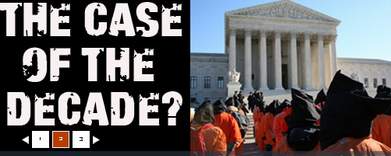
Law and Disorder hosts then talk about the recent Supreme Court arguments regarding the remaining Guantanamo Bay Cuba detainees and the horrible failure to restore habeas corpus. This case may determine once and for all whether there is a constitutional right to habeas corpus – that is, a fair hearing before a real court – for everyone detained by the U.S. government at Guantánamo.
Increases in surveillance powers were also on the list of wrong-turn stories this year, co-host Heidi Boghosian points out the legislation that extends the Foreign Intelligence Surveillance Act. In the wake of Congress approving a dramatic expansion of U.S. warrant-less wiretapping powers, the Center for Constitutional Rights has argued that the NSA’s program is unconstitutional and should be struck down. The argument in CCR v. Bush comes after Congress and the Bush administration passed the Protect America Act of 2007 which broadly expands the government’s power to spy on Americans without getting court approval.
The 5-4 ruling that race cannot be a factor in the assignment of children to public schools. Free speech not an option for students regarding (Bong Hits For Jesus).
Campaign Finance Reform – The Supreme Court has thrown out part of the McCain-Feingold campaign finance law that placed restrictions on corporations and unions from buying television ads close to elections
The citizens’ ability to challenge government violations of the separation of church and state, Hein v. Freedom from Religion Foundation 5-4, the Justices ruled that taxpayers do not have standing to challenge the White House program on federal aid to faith-based organizations.
“One of the country’s foremost defenders of human rights and civil liberties, Michael Ratner has led the fight to demand due process for Guantánamo detainees, adequate safeguards against intrusive government surveillance, and an end to torture and extraordinary rendition.”
When we think of doctor closing a wound many things come to mind – sutures, staples, band aids or the like. It might astound many to learn that some doctors use Krazy glue on inmate patients. During a time when government transparency is nearly obsolete, we find the few that act as beacons of hope. When he first requested the records for medical malpractice cases involving inmates in 2000, Paul Wright never imagined how much trouble it would be.
Guest – Paul Wright, editor of Prison Legal News, a publication that looks into our correctional facilities and reports on prisoner’s rights. Paul is also on the board of the National Lawyers Guild.
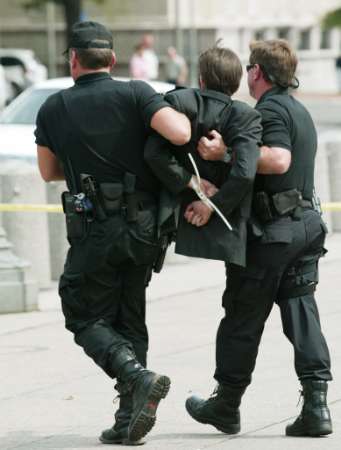
Police used excessive force when they attacked peaceful protestors who rallied at a University of Michigan event sponsored by the American Movement for Israel. As the senior medical professional on scene, Dr. Catherine Wilkerson took responsibility for the well-being of a middle-aged man who claimed he couldn’t breath and lost consciousness. She exhorted the police to get off of him, and was allowed to check his pulse and breathing.
Wilkerson later protested when Emergency Medical Service (EMS) personnel breached ethical medical practices by forcing ammonia into the man’s nostrils and face. It was at this time that she was physically assaulted and detained by Ann Arbor police.
No charges were filed until after Dr. Wilkerson wrote a complaint to authorities about the actions of the police officers. A week since writing the letter, Dr. Wilkerson was charged by the Washtenaw County Prosecutor Brian Mackie’s office, at the request of the UM police, with two attempted felonies—one against Officer Warner and one against the EMS personnel.
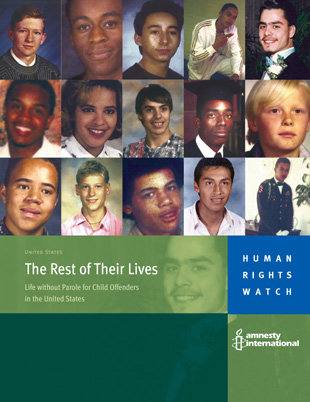
Children In Conflict With The Law: The U.S. Leads The World In Sentencing Children To Life Without Parole.
There are more than 2000 child offenders serving life without parole sentences in U.S. prisons for crimes committed before they reached the age of 18. The United States is one of few countries in the world that permit children to serve a life sentence without parole. Forty-two states currently have laws allowing children to receive life without parole sentences. The Convention on the Rights of the Child, ratified by every country in the world except the United States and Somalia, forbids this practice, and at least 132 countries have rejected the sentence altogether.
Human Rights Watch and Amnesty International have published a 130 page report on this topic called The Rest of Their Lives (PDF). The statistics are staggering and includes four juvenile offenders in South Africa, one in Tanzania and five in Israel. It is based on self-reported cases found in these countries’ reports to the U.N. International Convention on the Rights of the Child (CRC). While many of the child offenders are now adults, 16 percent were between 13 and 15 years old at the time they committed their crimes. An estimated 59 percent were sentenced to life without parole for their first-ever criminal conviction.
Alison Parker historically references where these laws came from. In the United Kingdom the sentence was known as “Detention During Her Majesty’s Pleasure”, the only sentence available to the courts for a person convicted of murder who was aged over 10 but under 18 at the time of the offence.
Guest – Alison Parker, Senior Researcher at Human Rights Watch. Alison says she is among many helping to change the legislation that incarcerate children permanently without rehabilitative options.
Guest – David Berger, attorney with O’Melveny & Myers. David is a former researcher for the Amnesty International report.
—–
Bernadine Dohrn
Bernadine Dohrn joins Law and Disorder to discuss juvenile justice and the development of Draconian laws for children in conflict with the law. Bernadine is a clinical professor at the Children and Family Justice Center at Northwestern University in Chicago. Bernadine is also the former leader of the Weathermen. She now serves on the board of numerous human rights committees and teaches comparative law. Since 2002, she has served as a Visiting Law Faculty at the Vrije Universiteit in Amsterdam.
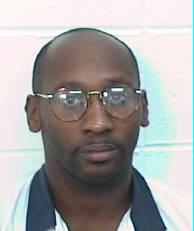
Troy Davis was sentenced to death in Georgia, for the murder of a police officer. The case against him consisted entirely of witness testimonies that were full of inconsistencies, even at the time of trial. Since then, all but two of the states’ nine non-police witnesses from the trial have recanted their testimony. Many state in sworn affidavits that they were pressured or coerced by police into testifying or signing statements against Troy Davis. There is no physical evidence linking Troy Davis to the crime and no murder weapon has ever been found. With his appeals exhausted and courts refusing to consider the recanted testimony, Troy Davis is scheduled to be executed later this month. The only thing that stands between him and execution is the Georgia Parole Board.
Larry Cox, Executive Director of Amnesty International said “The Supreme Court decision is proof-positive that justice truly is blind — blind to coerced and recanted testimony, blind to the lack of a murder weapon or physical evidence and blind to the extremely dubious circumstances that led to this man’s conviction. At times there are cases that are emblematic of the dysfunctional application of justice in this country. By refusing to review serious claims of innocence, the Supreme Court has revealed catastrophic flaws in the U.S. death penalty machine.”
The Georgia Parole Board has scheduled Troy Davis to be executed on July 17th at 7pm. The first available day of a schedule window set from July 17-24.
Nearly 2.1 million Americans are currently serving time in prison. One out of every six of these inmates is in federal prison on marijuana.-related charges. Astonishingly, according to the laws in 15 U.S. states, one can receive a life sentence for non-violent marijuana infractions.
Law and Disorder hosts Dalia Hashad, Michael Ratner and Michael Smith discuss the recent alleged suicide at Guantanamo Bay Prison in Cuba. The Saudi Arabian detainee died last Wednesday at Guantanamo Bay prison. The U.S. military says he apparently committed suicide.
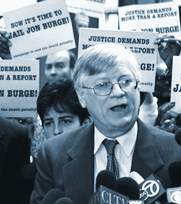
The case includes a four-year investigation focused on allegations that 148 black men were tortured in Chicago police interrogation rooms in the 1970s and ’80s. The men say detectives under the command of Lt. Jon Burge beat them, used electric shocks, played mock Russian roulette and started to smother at least one to force confessions. Prosecutors described this type of criminal justice system where top officials in a position to put a stop to police torture appeared blind to the abuse. Among them, Mayor Richard Daley, when he served as Cook County state’s attorney.
Guest – Flint Taylor – Attorney with the People’s Law Office, leading the fight against covering up torture by the Chicago Police Department.
Last month we heard author Joel Kovel discuss his book at the Brecht Forum. He recently joined Law and Disorder in the studio for a riveting interview that also looked into Kovel’s personal changes that led him to write Overcoming Zionism. Toward the end of the interview, co-host Dalia Hashad asks why Joel Kovel chose the word “overcoming” in his title.
“This book is absolutely fundamental for those who reject the unfortunate confusion between Jews, Judaism, Zionism and the State of Israel — a confusion which is the basis for systematic manipulation by the imperialist power system. It convincingly argues in favour of a single secular state for Israelis and Palestinians as the only democratic solution for the region.” Samir Amin, Director of the Third World Forum.
Guest – Joel Kovel author of Overcoming Zionism: Creating a Single Democratic State in Israel/Palestine, has been engaged in struggles for peace and justice since the Vietnam War era. He has worked within the antiwar and antinuclear movements, the solidarity movements in Central America and the Caribbean, the movements for democratic media, and, increasingly, for ecological transformation. He lived in Nicaragua for a period in 1986, and accompanied Pastors for Peace as they broke the US blockade on Cuba in their 1994 Friendshipment. He has acted in films, worked frequently with the Bread and Puppet theatre, and lectured on four continents. Kovel joined the Green Party since 1990. In 1998, he was the Green Party candidate for US Senator from New York, and in 2000 sought their Presidential nomination.