Here on Law and Disorder we’ve talked with many guests on the dangers of Taser stun guns. Recently Taser International Inc., the largest stun-gun maker, lost a $6.2 million jury verdict over the death of a California man who died after police shot him multiple times with the weapon. A San Jose, California jury says that Taser failed to warn the police of Salinas, California that prolonged exposure to Tasr’s electric shock could cause a risk of heart attack. The 40 year old victim Robert Heston died February 20, 2005 after his father had called Salinas police because his son was “acting strangely,” and seemed to be on drugs, according to the lawsuit complaint.
Nearly 400 people in the United States have been killed in Taser-related deaths in the past 7 years.
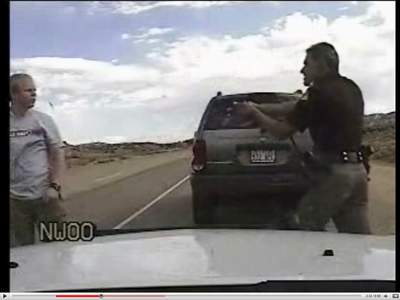
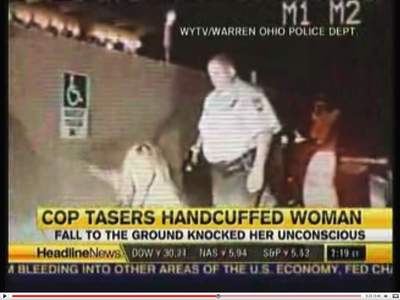
Stun guns are already widely abused on people who take too long to pull out ID, who are loud in public, elderly, disabled or in the wrong place at the wrong time.
Medical examiners are afraid to rule Tasers as the primary or contributory cause of death out of fear of retribution. In meetings with coroners, Taser International has actually threatened to sue if stun guns are cited on death certificates.
Taser International has formed questionable PR ties with law enforcement. It established and funded the Taser Foundation for Fallen Officers in 2004.
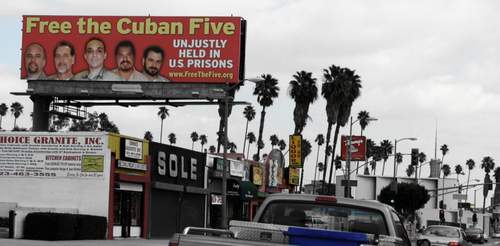
We’ve been following the case of the Cuban Five for years. Last week, the 11th U.S. District Court of Appeals in Atlanta upheld the convictions of the Cuban Five who are serving long prison sentences charged with spying and conspiracy to commit murder. The Five were falsely accused by the U.S. government of committing espionage conspiracy against the United States, and other related charges.
The Five pointed out vigorously in their defense that they were involved in monitoring the actions of Miami-based terrorist groups, in order to prevent terrorist attacks on their country of Cuba. The Five’s actions were never directed at the U.S. government. They never harmed anyone nor ever possessed nor used any weapons while in the United States. The Cuban Five are five Cuban men who are in U.S. prison, serving four life sentences and 75 years collectively, after being wrongly convicted in U.S. federal court in Miami, on June 8, 2001.
Taking Back The Right To Dissent: The Case of the Bangor Six
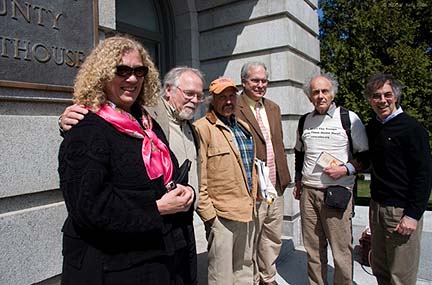
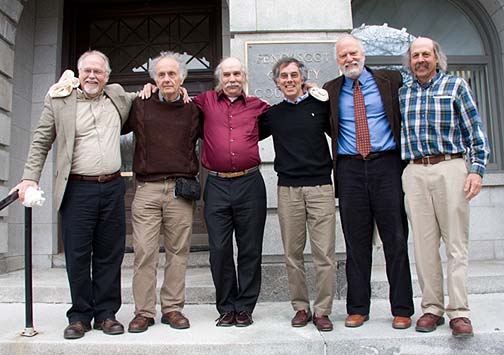
Recently, jurors in the Case of the ‘Bangor Six’ brought back a decisive verdict of ‘not guilty.’ The six veterans for peace, anti war protesters were arrested in March of last year after refusing to leave the federal building where their senator, Republican Susan Collins has her office. The six activists were among 12 that say they were protesting Bush’s proposal to increase troops in Iraq to support a military strategy known s the surge and also urged Collins to vote against continued funding for the war. Collins did not vote against funding for the war and did not meet with activists. Six of the activists were later arrested. (Collins Watch)
Now, during this trial, the jury was allowed by the judge to decide whether the defendants believed that they were not guilty in making a conscious choice to break Maine law because they thought international law was being violated. The jurors decided unanimously that the protesters did believe they had the ‘license and privilege’ to act as they did, in rendering the ‘not guilty’ verdict.
Guest – Bar Harbor attorney Lynne Williams, also with Maine Lawyers for Democracy a group of 65 Maine lawyers, calling for the impeachment of President Bush and Vice President Cheney.
List of Bangor Six – Jonathan Kreps, 57, of Appleton, Henry Braun, 77, of Wells, James Freeman, 59, of Verona, Dudley F. Hendrick, 66, of Deer Isle, Douglas Rawlings, 61, of Chesterville, and Robert Shetterly, 61, of Brooksville,
chose to go to trial. The other six pleaded guilty and paid fines.
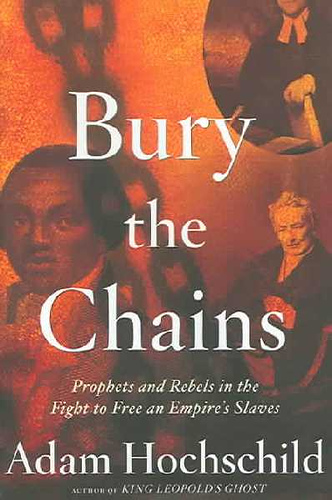
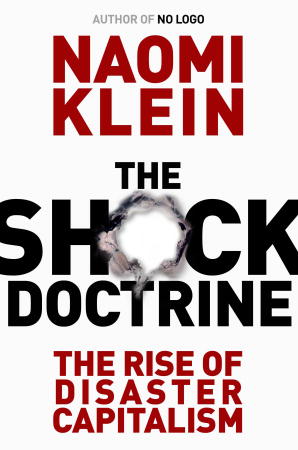
We go now to hear two speeches from this year’s Left Forum Opening Plenary from author/ professor Adam Hochschild and writer/ filmmaker Naomi Klein author of The Shock Doctrine. The Left Forum was titled Cracks In The Edifice. The many panels at the 2008 Left Forum addressed and challenged the current economic and political catastrophes in the United States and discussed possibilities for social movements to build better world in its place.
In her speech, Naomi Klein discusses how the lack of response in the devastation of Hurricane Katrina and the illegal wars in Iraq and Afghanistan are intentional strategies she calls “disaster capitalism.†At the 2008 Left Forum Naomi suggests that many in the United States have woken up to roughshod profiteering of disaster capitalism.
Operation Torch:Â Heavily Armed Subway Patrols Making New York City Safer?
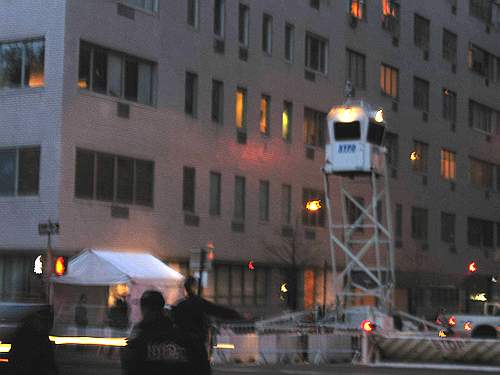
A couple weeks ago our own co-host Heidi Boghosian described how under cover policemen and a K9 unit were intimidating a subway rider on the platform with the dog barking viciously near his face. We’ll follow up on that story and also talk about the teams of police armed with MP5 submachine guns, body armor and bomb sniffing dogs now patrolling the subway systems of New York City. They’re called Torch Teams. Torch, an acronym for Transit Operational Response With Canine and Heavy Weapons. The teams are funded to patrol in 12 hour shifts everyday, Penn Station, Herald Square, Columbus Circle, Rockefeller Center Times Square and Atlantic Avenue in Brooklyn.
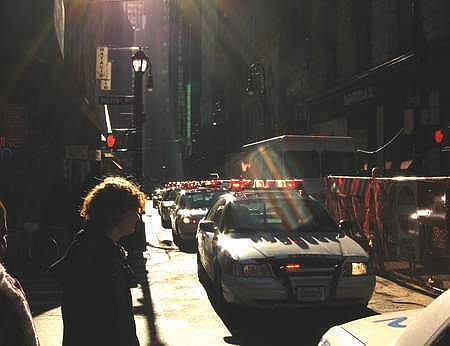
Co-host Michael Smith also commented on the use of police car convoys (photo above) that rally at ground zero and run up the FDR with lights blazing. Moore says it’s a federally funded event that acts as “window dressing” but he says, when you see police state displays such as Operation Torch and the police car convoys, know that it is only the tip of the iceberg. We’ll be investigating more on the depth of the police state in weeks to come.
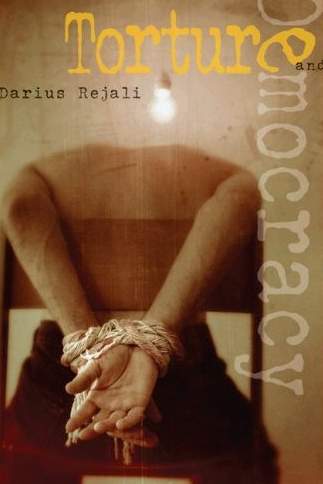
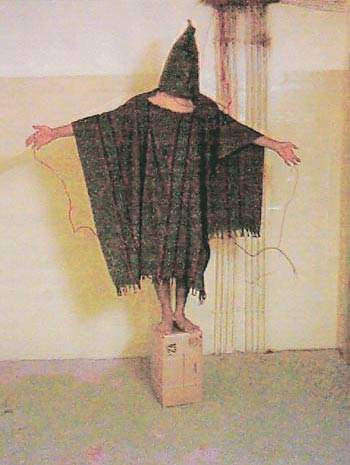
Here on Law and Disorder we’ve taken an in depth look at torture with various authors and guests including authors Al McCoy, Marnia Lazreg and Henri Alleg. Today we speak with Reed College professor Darius Rejali, author of the book Torture and Democracy. In this book, Rejali tracks behaviors, trends and traditions that have brought torture to where we see it has emerged today. Rejali, a leading expert on government interrogation techniques, argues that torture is an ancient craft and technique passed on from teacher to apprentice.
Rejali says knowledge of the torture craft often flows both ways between colonial powers and occupied peoples. This is a powerful book filled with information on techniques. One review writes, this book lays the groundwork, torturers and their keepers may find it useful, not as an academic study but as a field manual.
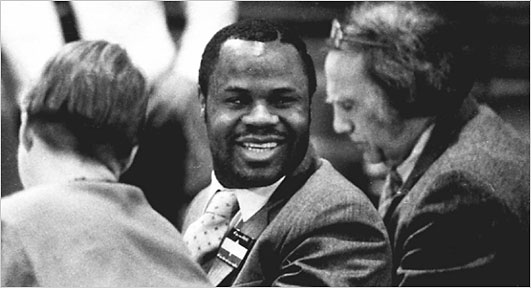
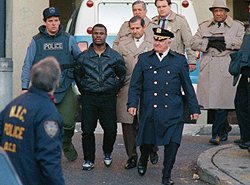
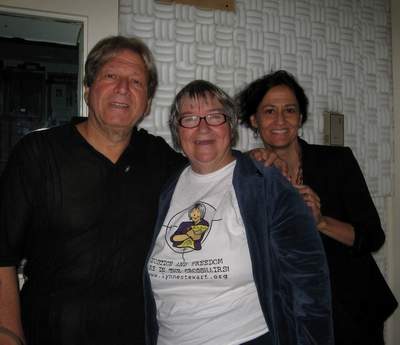
Today we welcome back civil rights attorney Lynne Stewart to discuss the recent stabbing death of Larry Davis in an upstate New York prison. Davis became known in the 80s when he was suspected of murdering drug dealers in the city. When police raided his apartment, Davis fired a pistol and shotgun from a darkened room and fled.
After more than a two week NYPD manhunt, Davis was captured. Davis’ legal defense included Lynne Stewart and prominent civil rights attorney Bill Kunstler who provided evidence of a frame up. In a recent New York Times article chronicling Davis’ story, it was written that Davis’ defense was quote made up of assertions without evidence.
Law and Disorder hosts were live in the studio with Naomi Wolf. Naomi Wolf is a feminist, social critic and political activist. The New York Times called her book, The Beauty Myth, one of the most important books of the 20th century. Wolf is the co-founder of The Woodhull Institute for Ethical Leadership, teaching young women to become leaders and agents of change. Naomi Wolf blog in the Huffington Post
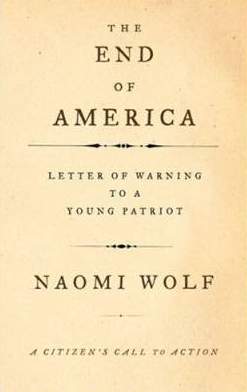
Her latest book The End of America: A Letter of Warning to a Young Patriot is a call to return to the beliefs of our founding fathers. Wolf’s new book illustrates ten steps historically taken by leaders who are attempting to dismantle a democracy. Wolf jokingly called it the The Greatest Hits of Facism.
In The End of America, Wolf gives voice to the cause of every American patriot: the preservation of the Constitution and the liberties it embodies and protects.
“Recent history has profound lessons for us in the U.S. today about how fascist, totalitarian, and other repressive leaders seize and maintain power, especially in what were once democracies. The secret is that these leaders all tend to take very similar, parallel steps. The Founders of this nation were so deeply familiar with tyranny and the habits and practices of tyrants that they set up our checks and balances precisely out of fear of what is unfolding today. We are seeing these same kinds of tactics now closing down freedoms in America, turning our nation into something that in the near future could be quite other than the open society in which we grew up and learned to love liberty,†stated Wolf.
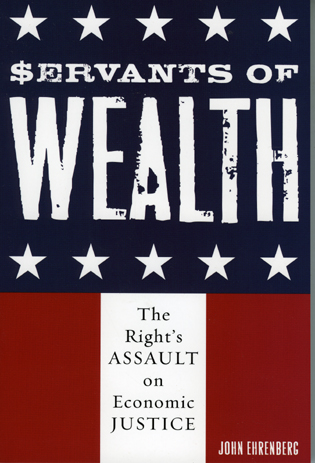
“Freedom and democracy†are two words we’ve been hearing from the right wing in this country for 25 years. In their quest to shore up support for the politics of wealth and privilege, the Right has organized patiently and consistently by focusing on a core ideology to amass a formidable base. The Right’s commentary on world affairs, morality, the state, and the economy, though, has had an overarching focus, namely to eliminate social equality as a legitimate public policy goal. Its success has resulted in one of the most dramatic, undemocratic, and insidious transfers of wealth and power in recent American history.
Guest – John Ehrenberg, author of the book “Servants of Wealth: The Right’s Assault on Economic Justice.†A professor of political science at Long Island University, in this, his third book, critically analyzes the rise of an ideologically coherent Right. He dissects their themes of military weakness, moral decay, racial anxiety, and hostility to social welfare to reveal their central organizing objective of protecting wealth and assaulting equality.
U.S. Court of Appeals for the Second Circuit Hears Lynne Stewart’s Arguments
Law and Disorder hosts welcome back civil rights attorney Lynne Stewart. Lynne Stewart has been free on bail pending appeal since federal judge John Koeltl gave her a 28 month sentence in October 2006. As you may recall Lynne Stewart was initially facing up to 30 years after being found guilty of conspiring to aid terrorists. She was convicted of distributing press releases on behalf of her jailed client Sheik Omar Abdel Rahman who is serving a life sentence on terror-related charges.
Here on Law and Disorder we’ve followed Lynne Stewart’s case as it contains key breaches of civil liberties such as government eavesdropping into attorney/ client conversations.
Pro-independence Puerto Ricans subpoenaed by NYC grand jury
Three Puerto Rican activists and artists have been ordered to appear before a Brooklyn federal grand jury. The activists are graphic designer Tania Frontera, social worker Christopher Torres and filmmaker Julio Antonio Pabon.
Federal grand jury investigations are secret by law. There are indications that it is part of a probe into the Popular Boricua Army (EPB)-Macheteros, a rebel pro-independence group whose leader, Filiberto Ojeda Rios, was killed by FBI agents in Puerto Rico on Sept. of 2005. The FBI is also trying to locate Hector Rivera, one of the founders of the Welfare Poets, a New York-based collective of activists and poets, in order to serve him with a subpoena. Supporters of the three activists speculated that the FBI had aimed at harassing the Puerto Rican legal movement to obtain independence for the U.S. territory.