CIA Sponsored Terror, Civil Liberties, Climate Change, Human Rights, Prison Industry, Surveillance, Torture, Truth to Power
Podcast: Play in new window | Download
Bolton Threatens ICC Over Probes Into US War Crimes
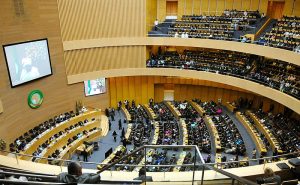
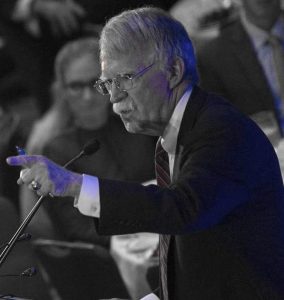
On September 10, 2018 in Washington DC, President Donald Trump‘s national security adviser John Bolton gave an important and widely publicized speech to the rightist Federalist Society threatening International Criminal Court judges and court personnel if they dared to probe into U.S. torture practices in Afghanistan and three European black sites. The United States is being investigated for torturing captives in Afghanistan, Poland, Estonia, and Lithuania. The charges have been documented by the U.S. Senate in its report of December 14, 2017.
The International Criminal Court is also investigating Israeli war crimes in Gaza where in 2014, 3000 people including more than 500 children were killed by Israeli invaders. This has been documented by the United Nations’ Goldstone Report.
Bolton said that “the United States will use any means necessary to protect our citizens and those of our allies from unjust prosecution by this illegitimate court including tariffs and prosecution.“
He added that “if the court comes after us, Israel, or other allies we will not sit quietly.“
Bolton also announced that the US is shutting down a Palestinian diplomatic office in Washington because Palestinians have indicated that they will request that the ICC prosecute American ally Israel for war crimes and crimes against humanity.
In addition, the United States has cut off payments to the United Nations organization that has provided funds for refugees displaced by Israel when it conquered Palestine in the 1948 war. The funds were used for schools and hospitals in the West Bank and Gaza.
Guest – Attorney Reed Brody, with Human Rights Watch, is a former colleague Michael Ratner, Brody has spent much of his career prosecuting international war criminals for crimes that the International Criminal Court investigators are contemplating with respect to the United States and Israel.
—-
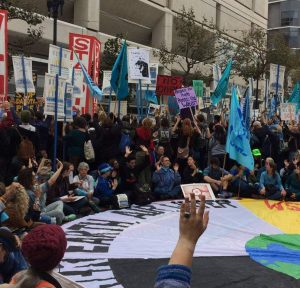
Protect The Protest Coalition Launches To Fight Against SLAPPs
Anti-corporate sentiment in the United States of America is getting increasingly wide and deep. This is especially true when it comes to corporate responsibility for environmental degradation.
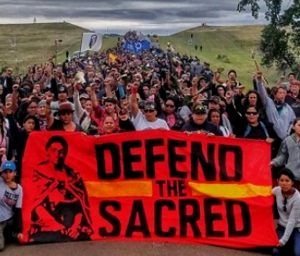
The most spectacular example of this is the nationwide mobilization in support of the water protectors at Standing Rock a year ago. The Energy Partners Transfer Corporation was attempting to build a pipeline through land sacred to native peoples in North Dakota. The pipeline went under the Missouri River threatening the water supply.
One of the many organizations supporting the Water Protectors was Greenpeace . As a consequence, they were sued by Energy Transfer Partners and accused of racketeering under the RICO act, a law originally passed to be used against organized crime.
The suit was designed to tie up the resources of Greenpeace , harass them, and cost them money. The lawyers for the corporation are the same firm used by Donald Trump. These legal actions by big corporations are called SLAPP suits. This stands for Strategic Litigation Against Public Participation.
In recent times these lawsuits have been proliferating. Two weeks ago 18 organizations including the Center for Constitutional Rights banded together to fight back.
Guest – Attorney Deepa Panmanabha, the assistant general counsel with Greenpeace since 2011 and is based in Washington DC. Deepa is involved in defending Greenpeace against two lawsuits attempted to silence the organizations advocacy work brought by Resolute Forest Products and Energy Transfer Partners. She also advises on a variety of legal matters and managers criminal law cases where green peas after this engage in civil disobedience. Deepa represents Greenpeace USA in the Protect the Protest Task Force, a recently formed coalition created to confront corporations that file lawsuits design to silence dissent and provide resources to individuals and groups facing these suits.
————————
————————
Civil Liberties, Criminalizing Dissent, Human Rights, Hydraulic Fracturing, Political Prisoner, Prison Industry, Surveillance, Targeting Muslims, Torture, Truth to Power
Podcast: Play in new window | Download
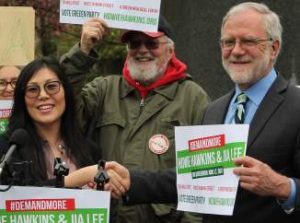
Green Party Candidate for New York Governor: Howie Hawkins
Former United States President Jimmy Carter has pointedly observed that the United States is not a democracy, it is an oligarchy. That is, it is a country ruled by a handful of rich people, the 1%, at the expense of the vast majority, the 99%, the famous description by the Occupy Movement.
The political and ideological mechanism for keeping this state of affairs Is the two party system in the USA, which in reality, as independent presidential candidate Ralph Nader has written, is really one party of big business with two wings, the Republicans and the Democrats.
Although the two party system was not mentioned in our constitution, state laws make it extraordinarily difficult for a third, independent, party to get on the ballot. Their ideas receive little media exposure reinforcing their exclusion.
This lack of the political process even as we are witnessing a radicalization, especially among young people, has led to a discussion on the left among socialists, democratic socialist, and progressives generally about how to move forward. The main question being debated is “do we support socialists who run on the democratic party ticket“ or do we stay independent of the democratic party or, do we work both inside and outside of the Democratic Party? Ballot Access News
Guest – Howie Hawkins, retired teamster from Syracuse, New York and the Green party candidate for New York governor. He previously ran as a The Green Party’s gubernatorial candidate in 2010 and 2014. During the later campaign he received 5% of the vote. He is the author of the recent article “the case for an independent left party: from the bottom up.“. It was published in Black Agenda Report.
—-
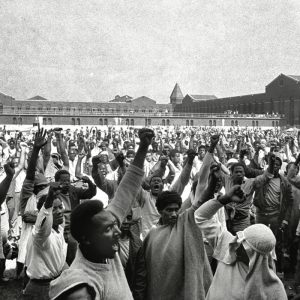
Nationwide Prison Strike 2018
Slavery never ended, human rights attorney Bryan Stevenson has observed, it just evolved. One form of this evolution is the huge number of African-American men in America’s prisons and the conditions of their confinement.
More than half of America’s 2.3 million prisoners are African-American. Many prisoners, black, brown, and Latino, went on strike on August 21. The strike ended on September 9, 2018. The prisoners did work stoppages, sit-ins, commissary boycotts , and hunger strikes to demand major reforms to our country’s prison and criminal justice systems. They demanded humane living conditions, access to rehabilitation, sentencing reform, and an end of what they termed “modern day slavery.“
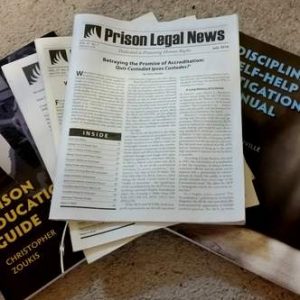
Guest – Paul Wright, founder and Executive Director of the Human Rights Defense Center. He is also the editor of Prison Legal News, the longest running independent prisoner rights publication in US history. A former prisoner himself, Paul Wright was behind bars for 17 years in the state of Washington until his release in 2003.
——————
——————
Civil Liberties, Criminalizing Dissent, Habeas Corpus, Human Rights, Political Prisoner, Prison Industry, Supreme Court, Surveillance, Torture, Truth to Power
Podcast: Play in new window | Download


Holding Smart City Projects Accountable – Sidewalk Labs Toronto
Around the world, countries are talking about the idea of, and developing plans to implement, so-called “smart cities.” Smart Cities are urban areas that use electronic data to collect information, which is then used to manage financial assets and other municipal resources. Data is collected from citizens and electronic devices, and is then processed and used to monitor and inform the management of traffic, transportation systems, hospitals, schools, law enforcement, water supplies, and other community services, such as libraries.
The Smart City concept uses information and communication technology to interact with the cities infrastructure and to monitor its development and evolution. Proponents claim it will increase efficiency. Information and Communication Technology is used to increase the contact between local citizens and government to reduce costs and enhance the quality and interactivity of urban spaces within cities. Critics say it vests too much power in profit-minded corporations, and that total connectivity may makes smart cities a hacker’s dream.
In 2018, the Canadian government launched a Smart Cities Challenge offering prizes up to $50 million dollars for towns and cities that will work to improve residents’ lives through innovation, data, and connected technology. A few months earlier, in October 2017, the Google-affiliated company Sidewalk Labs announced plans to build a neighborhood “from the Internet up” along Toronto’s waterfront in a spot known as Quayside. The goal is to create an “advanced microgrid” to power electric cars, bring down housing costs, improve recycling and use data to improve public services. The project has had support from Prime Minister Justin Trudeau who declared it a “testbed for new technologies.”
Guest – Bianca Wylie, an open government advocate with a background in technology and public engagement, Bianca leads work on public sector technology policy for Canada at Dgen Network and is a co-founder of Tech Reset Canada.
—-
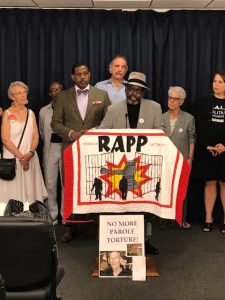
The New York State Parole Board: Failures in Staffing and Performance
“All people have in them a dream of being free again,” writes D.B., a 40-year-old who has spent 21 years in prison. During this time, D.B has had a total of 12 hearings at the Department of Corrections: four postponements, two de novo hearings, and eight board hearings.
Like D.B., many inmates have the same dream of being free, but for those being reviewed by parole commissioners W. William Smith and Marc Coppola, their chances are slim. In an extensive report co-authored by the RAPP (Release Aging People in Prison) and the Parole Preparation Project, “The New York State Parole Board: Failures in Staffing and Performance” outlines the serious problems within the New York State Parole Board, focusing on the board’s inability to perform while significantly under-staffed and allowing the continued malpractice of board commissioners Marc Coppola and W. William Smith.
W. William Smith has been on the board since 1996 when he was appointed by Governor George Pataki. He was re-appointed by Governor Cuomo in 2017. Although the rules and regulations around the Parole Board have been updated and modernized, Smith continues to deny parole to people convicted of violent crimes despite demonstrated rehabilitation.
Marc Coppola, like Smith, frequently denies parole because of a person’s crimes rather than their demonstrated low level of risk to public safety. His political ties and financial gifts to the elected officials in charge of confirming parole board members suggests that he is not a fair or ethical candidate for the position of Parole Commissioner. Both Smith and Coppola have been known to be condescending and unprofessional in their interviews for the parole board.
Guest – Dave George, Associate Director of RAPP or Release Aging Persons in Prison.
Guest – Jose Saldana, Jose was recently released from prison after serving 38 years. He works with parole reform organizations and RAPP.
—————-
—————-
CIA Sponsored Terror, Civil Liberties, Human Rights, NSA Spying, Surveillance, Truth to Power
Podcast: Play in new window | Download
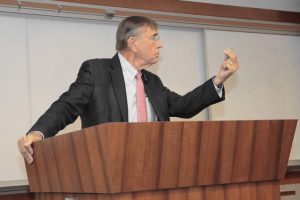
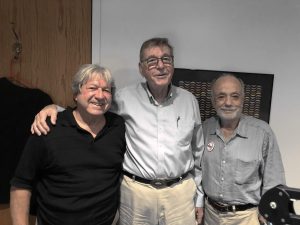
Michael E. Tigar On Challenges Lawyers Currently Face
Recently on Law And Disorder we interviewed Baher Azmy, Legal Director at the Center for Constitutional Rights, and National Lawyers Guild President Natasha Bannan. We were interested in their views of the challenges facing leftist lawyers and their movement clients face in these difficult times.
Attorney Jim Lafferty, the former head of the Los Angeles chapter of the National Lawyers Guild, who has a program on our sister station in Los Angeles, KPFK, joins me in the studio to cohost. We are going to speak for the entire hour with human rights attorney Michael Tigar.
Since the attacks on September 11, 2001, our democracy, however restricted at the time, has been even further shrunk by the growth of the national security state and the all knowing surveillance apparatus that has been set up. Moreover, the President, as the head of the executive branch of the government, has gathered unto to himself an unprecedented amount of power over the judicial and the legislative branches of the government. tigarbytes.blogspot.com/
Guest – Michael Tigar, emeritus professor of law at Duke University and at Washington College of Law. He has been a lawyer working on social change issues since the 1960s. He has argued numerous cases in United States Supreme Court and many Circuit Courts of Appeal. His books include “Law and the Rise of Capitalism”, “ Fighting Injustice ”, and the forthcoming Mythologist of State and Monopoly Power.“
———————
———————
Civil Liberties, Criminalizing Dissent, Human Rights, Surveillance, Truth to Power
Podcast: Play in new window | Download
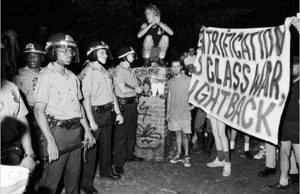
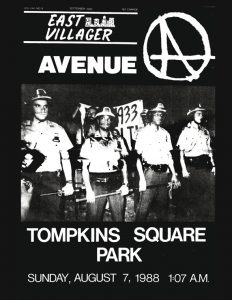
Tompkins Square Park Police Riot 30th Anniversary Special
Thirty years ago, a singular event occurred in Manhattan’s East Village that would prove transformative to many lives for years to come. Today on Law and Disorder we bring you a special program on the August 1988 Tompkins Square Park Police Riot as recounted by several individuals who were there for the entire event. We share firsthand observations of unbridled police violence, talk about how we came to be there, and discuss how the riot marked the linchpin to transform an entire neighborhood from a mecca of creativity and political activism, to the new home of TARGET, Starbucks and other hallmarks of American gentrification.
Tompkins Square Park is bounded on the West and East by Avenues A and B, and on the North and South by 10th Street and 7th Streets. It falls in the part of that neighborhood often referred to as Alphabet City, named for its 4 Alphabet numbered avenues, that in the 1960’s and 1970’s were a haven for drug sellers and squatters and a large Puerto Rican community. The park had a history of activism as it was the site of a riot in 1874 on behalf of the city’s labor movement.
In 1988, a homeless encampment was erected in the park, attracting a wide range of activists, squatters, and homeless persons. Several local residents complained and in a controversial move, the local governing body, Community Board 3, on June 28, approved a 1 AM curfew from what had long been a 24-hour open park. The Avenue A Block Association supported the curfew as it represented the few local businesses that existed then. Many residents opposed the curfew, including those who would have to take a longer walk around the park to get home.
The New York City City Parks Department agreed to enforce the curfew, and on July 31, 1998 protesters gathered at a rally there. Police, responding to alleged noise complaints, entered the park. A skirmish ensued, and several civilians and six officers were treated for injuries. Four men were arrested on charges of reckless endangerment and inciting to riot.
Guests – Susan Howard, East Village Community Activist, John McBride, Photographer and Arthur Nersesian, East Village Writer.
Written by Attorney Heidi Boghosian and produced by Geoff Brady
————
————
CIA Sponsored Terror, Civil Liberties, Criminalizing Dissent, Guantanamo, Human Rights, Political Prisoner, Prison Industry, Supreme Court, Surveillance, Torture, Truth to Power, War Resister
Podcast: Play in new window | Download
Challenges Lawyers Face As Democratic Institutions Dismantled
What are the the challenges lawyers on the left face in this historic period? That is the concern of today’s show. Since 911 we have seen the consolidation of an authoritarian state. The radical right working over the last 30 years and funded by the Koch brothers and their billionaire allies, are strategic and have been very successful.
They now hold the reins of power in 33 states, the Senate, House of Representatives, the Supreme Court, and the presidency. Their ultimate goal is to “dismantle the administrative state“, which is their formulation for taking away every social benefit that we have earned since 1930s. To prevent us from fighting back they have restricted democracy with voter suppression and gerrymandering. The right wing Supreme Court has declared that corporations are people and have the right to unlimited amounts of corporate dark money. Our access to information has also been constricted. Five major corporations own all the major media. New algorithms by Google and Facebook restrict access to people looking for alternative media, like Law And Disorder Radio.
We are also seeing the dismantling of programs that benefit people and the hollowing out of the democratic rights necessary to defend them. Racism and dehumanization are employed to divide and conquer. But at the same time we have seen the growth of social movements with our movement attorneys right in there fighting as important auxiliaries. Since 911 and the passage of the Patriot Act government surveillance of our private lives and political affiliations has become pervasive.
Guest – Attorney Natasha Lycia Ora Bannan, President of the National Lawyers Guild.
Guest – Attorney Baher Azmy, the litigation director at the center for constitutional rights National Lawyers Guild – Chicago 1937 as an alternative to the all white American Bar Association. It’s gotten principle was announced: human rights over property rights. The center for constitutional rights was founded by civil rights attorneys who had been active in the south in 1966 including William Kunstler, the attorney for Martin Luther King.
—-

Julian Assange And Political Asylum In Danger
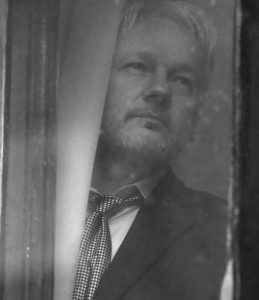
WikiLeaks founder the truth telling publisher Julian Assange is in certain and imminent danger of being sent from England to America where he would likely be tried for espionage, a crime that carries the death penalty.
Assange and WikiLeaks have revealed American war crimes in the middle east, CIA global machinations , and the work of Clinton Democrats in preventing the popular Bernie Sanders from heading up the party ticket.
Assange is presently holed up in the Ecuadorian embassy in London where he was granted political asylum six years ago by past leftist president Rafael Correa. But now, with the change of presidents in Ecuador, Assange has been cut off from the outside world. He has no phone, no computer, and no visitors.
The fresh offensive against him occurred the day after American General Joseph DiSalvo, the head of the US Southern Command, the Pentagon’s arm in Latin America, visited the new right wing Ecuadorian President Lenin Moreno. Irene was told that if he did not cooperate he would not get an International Monetary Fund loan. Moreno has said that Assange is “an inherited problem” and is seeking s better relationship with the United States government, to whom he has already granted a military base.
Guest -Attorney Renata Avila has represented International human rights lawyer and digital rights advocate. In her practice, she represented indigenous victims of genocide and other human rights abuses, including the prominent indigenous leader and Nobel Peace Prize Laureate Rigoberta Menchu Tum. She also represented awarded journalist Julian Assange and Wikileaks since 2009. Avila sits on the
Board of Creative Commons, is a trustee of the Courage Foundation, – an organisation set up to assist whistleblowers at risk – and is an advisory board member of Diem25, a movement to democratise Europe launched by Yanis Varoufakis. Her book Women, Whistleblowing Wikileaks” was published by OR Books. She is currently writing a book on Digital Colonialism and regularly writes for several international newspapers.
—————-
—————-