Civil Liberties, Criminalizing Dissent, Habeas Corpus, Human Rights, Prison Industry, Supreme Court, Surveillance, Targeting Muslims, Torture, Truth to Power
Podcast: Play in new window | Download
Naomi Wolf – Guantanamo Bay: The Inside Story
Has President Obama begun to honor his promise to close Guantanamo detention camp and undo secretive detention and interrogation policies within the year? Author and political consultant Naomi had to find out for herself. She is back from Cuba and wrote a highly descriptive narrative-style article of the trip titled Guantanamo Bay: An Inside Story. Naomi takes the reader into a surreal world where detainee handlers and lawyers flatly contradict each other and prisoners are viewed from a safari-tour distance.
Naomi Wolf:
- In order to close down an open society, you need secret prisons where torture takes place to create a police state.
- I’ve admired the work at CCR, and I thought since we have a new president I should go down to Guantanamo and see for myself if anything has changed.
- Getting off the plane in Cuba: It was like the Soviet Union in 1948, I was immediately separated from Pardiss Kebriaei. (CCR Attorney)
- Journalists are shadowed, literally every they’re there. Not only do they keep lawyers from doing their jobs, they keep journalists from doing their jobs.
- They literally treat detainees like animals in a cage. Any action that would humanize the detainees is categorically forbidden. They showed us camp x-ray first – the dog kennel-like cages.
- Running around these cages are rats the size of bulldogs.
- I went into another room and there was a huge pile of chairs. I looked closely at the legs and arms of chairs, there were duct tape marks as if someone were taped to the chair for interrogation.
- It was clear that the Obama Team wanted to communicate there was a kinder, gentler Guantanamo.
- Mohammad Al Anashi – alleged suicide. Banality of Evil
- Their bodies are crimes scenes but they can’t talk about what happened to them because it’s classified.
Guest – Naomi Wolf, author of seven books, and the groundbreaking book The End of America: A Letter of Warning To A Young Patriot, which was also turned into a feature documentary. In the book, Naomi addresses ten steps that societies, dictators, and sometimes democracies use to close an open society to move it toward facsism. Her new book is titled Give Me Liberty: A Handbook for American Revolutionaries which is a call to action for every person, activist or not. When you ask that question “What Can I Do?” The answers are outlined in Give Me Liberty.
Listen to past Law and Disorder shows with Naomi Wolf.
————–

Mohammed Jawad
The Obama Administration proposed a new strategy last week for continuing the detention of Mohammed Jawad, he’s an Afghani being held for allegedly wounding two US soldiers with a grenade in 2002. Jawad may have been as young as 12 when he was picked up in 2002. Last month, the Obama administration conceded defeat when US District Judge Ellen Segal Huvelle told Justice Department lawyers that the case for holding Jawad was quote riddled with holes. Now, the Obama administration under pressure to release Jawad to Afghanistan, is asking to hold Jawad and try the case in a US District Court. A military judge has already ruled that his confession to Afghanistan authorities had been coerced by torture because they threatened to arrest and kill his family.
Jonathan Hafetz:
- Mohammed Jawad, arrested in Afghanistan in 2002 for allegedly throwing a grenade in a crowded market place that injured 2 US service members and their Afghan interpreter.
- Following his arrest, he was beaten and tortured by corrupt Afghan police who also threatened to kill him and his family if didn’t confess to throwing grenade.
- He was then turned over to Americans who continued to torture and terrify him. They then obtained a different false confession.
- He was taken to Bagram Prison at the peak of torture and abuse in December 2002.
- He was then rendered from his home country and taken to Guantanamo in February 2003.
- Mohammad Jawad suffered psychological stress, was observed to be in a trance state, then psychologists saw this as an opportunity to completely break him.
- He was sleep deprived, moved 110 times during a 2 week period.
- Fall of 2008, a military judge threw out false confessions that Jawad made to Afghan and US officials.
- By the end of 2008, the military commissions case was literally on life support, meanwhile Jawad enter’s his seventh year of detention.
- Even after a judge dismissed the coerced torture evidence, Obama administration still tried to use this evidence against Jawad.
- The case now under US District Judge Ellen Segal Huvelle; had granted Habeas petition, ordered Jawad to be released.
- New law: Before transferring a detainee from GTMO to another country, the president must provide notice to Congress. The power to decide release of Guantanamo prisoners still in Executive Branch of US Government.
Guest – Jonathan Hafetz, attorney with the ACLU’s National Security Project and one of Jawad’s lawyers. Jonathan Hafetz blasted the Obama administration for its “pathetic attempt to prolong an outrageous case and to manipulate the court system.”
—————————————————————————–
Afghanistan War, Civil Liberties, Criminalizing Dissent, FBI Intrusion, Green Scare, Habeas Corpus, Human Rights, Surveillance, Torture, Truth to Power
Podcast: Play in new window | Download
Blood and Oil in Central Asia
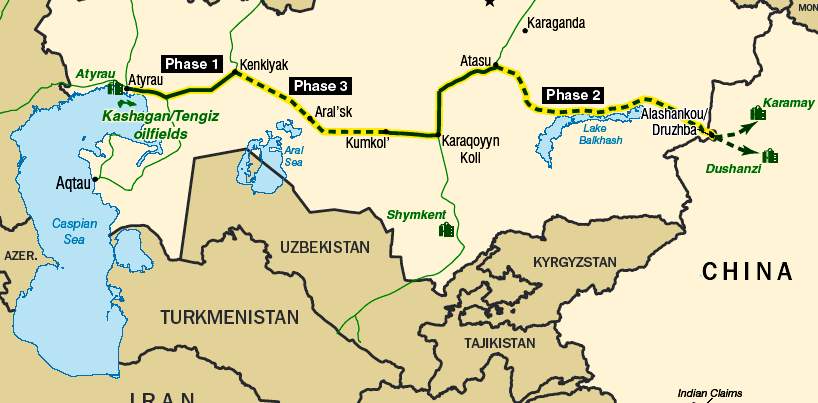
Is the Afghanistan War less over terrorism than it is over energy? It’s a high stakes chess board writes Conn Hallidan, a foreign policy analyst, and if the US controls the sources of energy of its rivals, Europe, Japan and China, and other nations, they win. Hallinan, says strategic energy alliances are forming between Russia and China. China is planning a 4 thousand mile pipeline from the Caspian Basin to the Guangdong Province while Russia is locking up natural resources such as natural gas in Kazakhstan and Uzbekistan.
Conn Hallinan:
- It’s about the United States attempting to control energy sources at a time when world oil reserves are beginning to drop.
- In fact there’s going to be a sharp drop in world oil reserves while Brazil India and China are growing fast. There’s a growing sharp competition for controlling those energy resources.
- The United States pretty much has its thumb on the Middle East oil reserves and has been maneuvering to control natural gas and oil coming out of Caspian Basin.
- Follow the roadways for Pipelanistan, looking at energy resources as looking at a map.
- This is a battle for control of energy resources. Whoever holds the high ground in the next half century will have their hand on jugular vein of their competitors.
- Tremendous expansion of NATO into former Soviet areas and into Central Asia creates the counter-response. Shanghai Cooperation Organizations
- The SCO is on a roll. China loaned Turkmenistan 3 billion dollars.
- Long term goals for current administration not very different from past administration.
- I want to go the White House and sit down with Obama and say, “ok, look just read Kipling, read Kim, the poem, Arithmetic on the Frontier.”
- The situation is a complete disaster, we’re destabilizing India and Pakistan, the most single dangerous flash-point in the world right now.
Guest – Conn Hallinan , a columnist for Foreign Policy In Focus and a lecturer in journalism at the University of California, Santa Cruz.
————-
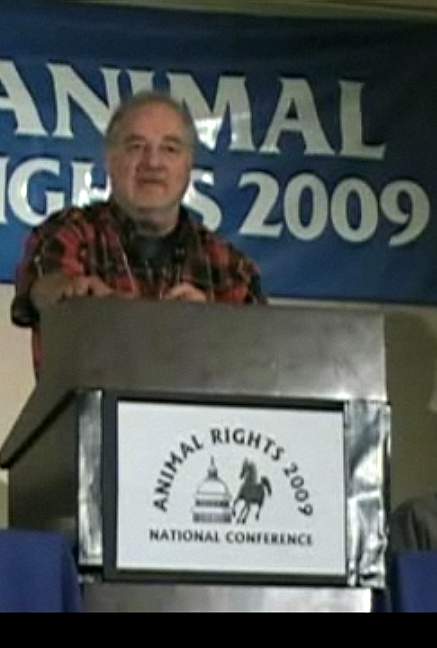
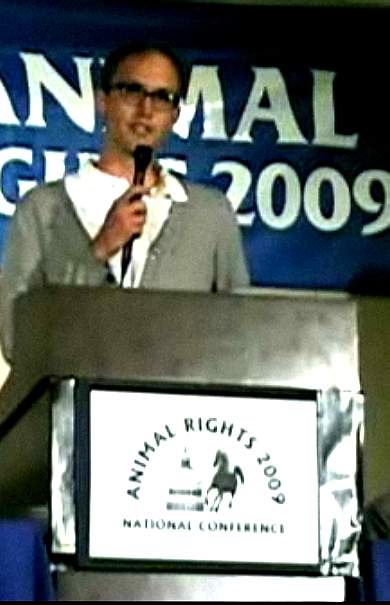
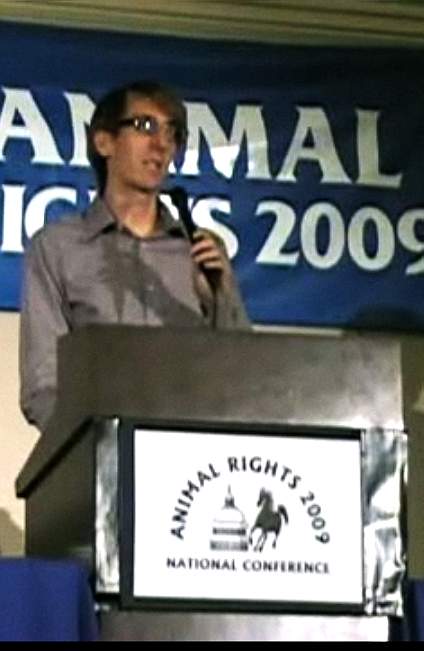
Animal Rights Annual Conference 2009 Speeches
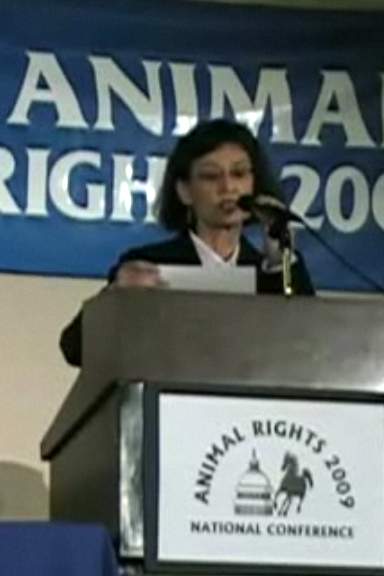
We hear four speeches from the Animal Rights Annual Conference this year. The speakers are our own co-host Heidi Boghosian, Attorney Matthew Strugar, Social Justice Attorney Bob Bloom, and Will Potter. Full list of speakers.
Heidi Boghosian:
Bob Bloom:
- One of the defense attorneys for the Animal Terrorism Enterprise Act 4.
- What I learned defending the Black Panther Party, in the criminal justice system, is that there is a particular mechanism to control people who want to make things better, who want to change things. Courts are not for justice, they’re for repression.
- Under the animal enterprise act, you can have a business enterprise that uses and tortures animals. It just doesn’t seem right.
- Ask the experimenters why they experiment on animals and the answer is quote – because the animals are like us.
- Ask the experimenters why its morally ok to experiment on animals and the answer is quote because the animals are not like us.
Will Potter:
- GreenIsTheNewRed
- Communication enhancement facilities are political prisons for those who have been widely connected with others. When you have secretive facilities and special legislation or so-called second tier terrorism inmates, you’ll soon have secretive facilities and special legislation or so-called third tier terrorism inmates and secretive facilities and fourth tier terrorism inmates, until brick by brick, the barriers of what is being labeled a protester and an activist and a dissident and a terrorist have completely crumbled.
Matt Streuger:
——
The Animal Enterprise Terrorism Act (AETA) is a United States federal law It was signed by the President of the United States November 27, 2006. Earlier versions of the bill were known as S. 1926 and H.R. 4239. The bill is described by the author as being intended to “provide the Department of Justice the necessary authority to apprehend, prosecute, and convict individuals committing animal enterprise terror.”
Analysis of The Animal Enterprise Terrorism Act
—————————————————————————
Afghanistan War, CIA Sponsored Terror, Civil Liberties, Guantanamo, Habeas Corpus, Human Rights, Prosecution of the Bush Administration, Supreme Court, Surveillance, Targeting Muslims
Podcast: Play in new window | Download
Host Updates:
Segments This Week:
——-


Washington DC Check Points Not Legal: Mara Verheyden-Hilliard
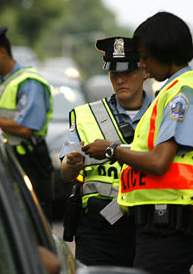
Last summer, D.C. police set up checkpoints around the city’s Trinidad neighborhood and denied access to drivers who refused to disclose their destination. The purpose of the checkpoints, according to the Metropolitan Police Department, was to deter violence after a string of drive-by shootings in 2008. Recently, a federal appeals court ruled that these checkpoints are unconstitutional. In the opinion, Chief Judge David Sentelle of the D.C. Circuit Court of Appeals wrote that “citizens have a right to drive upon the public streets of the District of Columbia or any other city absent a constitutionally sound reason for limiting their access.” The Partnership for Civil Justice
Mara Verheyden-Hilliard:
- We do think if we had not succeeded with this case, it would have been a model in implementation in urban environments throughout the U.S.
- In the District of Columbia, last summer the mayor and the attorney general deployed an extraordinary checkpoint program. It was really a blockade or barricade program.
- It was the sealing off of an entire neighborhood, police setting up check points and not letting anyone through without being interrogated. It’s an interrogation and seizure program.
- The police would question you, as to where you were going, who you were visiting, demand that you provide identity information, information on your associates, information on what you were doing, who you knew.
- You could not continue to drive on this public roadway unless you proved to the satisfaction of the police, a legitimate reason to travel further. When we challenged them, they stayed in court, they defended the program, saying it was absolutely constitutional.
- Plaintiffs included a 50 year old resident, a retired DC school teacher. He would have to be stopped at the checkpoint to get to his own home. Visitors were reluctant to come over, to avoid getting tangled with the police. Racial profiling, police misconduct, abuse of power.
- It’s not nearly that your stopped by the police and you can explain your way in. The police set up 6 defined categories of legitmate reasons for entering. Visiting a friend is not a legitimate reason.
- If crime became the prevention for fundamental fourth amendment rights, then there wouldn’t be any fourth amendment rights to speak of.
- The issue is you have the right to travel down a public roadway without being seized by the police without any allegation of criminal activity or suspicion of criminal wrong doing.
- The Trinidad neighborhood is on the cusp of gentrification. We’re seeing a lot of these programs happening in areas that are moving toward gentrification.
- The community wants geniune responses to crime in their neighborhoods, this program was not only unconstitutional but ineffective.
- We believe they were collecting information at the checkpoints and collecting a criminal database.
- We demanded that they cease that activity and expunge the information collected in the database.
- They were sending in tag readers, they’re mounting cameras on government vehicles, they do a mass scan on license tags and suck up information on where you are.
Guest – Mara Verheyden-Hilliard is an attorney and co-founder of the Partnership for Civil Justice, which represented three drivers challenging the checkpoints.
—————-
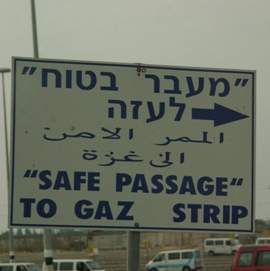
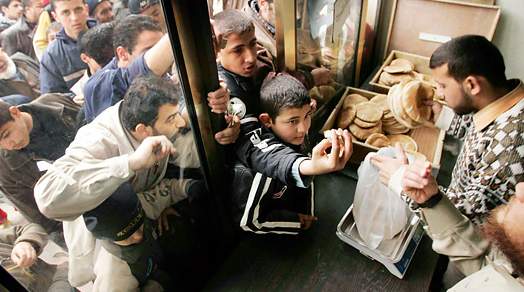
Jewish Fast For Gaza
A group of American Rabbis have launched a water-only fast, aimed at breaking the Jewish Community’s silence over Israel’s collective punishment of Palestinians. The initiative, called Jewish Fast For Gaza includes Reform, Reconstructionist, Orthodox and Conservative rabbis who call for lifting the blockade on Gaza. They plan to fast the third Thursday of each month, lasting from sunrise to sunset.
Rabbi Brian Walt:
- This idea of a fast in a time of trouble is an ancient tradition. We were stunned by the silence among the Rabbis.
- So we decided to gather together as a Minyan, to break the silence in our community.
- It’s not a Jewish-only initiative, it’s a Jewish initiated event to draw people of all faiths.
- The state that is the state of the Jewish people is preventing food from reaching children whose growth is stunted by these actions. To be silent in the face of that as a Rabbi, is inconceivable to me.
- Can’t one separate out, an opinion about a government and collective punishment of a whole people?
- Four goals: Lifting Israeli blockade, bring in food, make peace with your enemies.
- Does Israel recognize the Palestinian people?
- Why is Israel asking two things of it’s partner that its not prepared to do?
- It’s a pretext because Israel doesn’t want to negotiate. If Israel doesn’t want to negotiate, they’ll say the other side doesn’t want to, it’s a trick that Israel has done for decades.
- Anyone can join the fast, nearly 600 have joined. 70 Rabbis so far.
- The most vile and violent responses we get come from Israel.
- I grew up under apartheid in South Africa in a very Zionist family with deep connections in Israel.
Guest – Rabbi Brian Walt, co-coordinator of Jewish Fast For Gaza. Rabbi Walt is also the founding executive director of Rabbis for Human Rights-North America and Rabbi Emeritus of Congregation Mishkan Shalom, a synagogue in Philadelphia, PA. He is dedicated to the integration of spiritual life and social justice. Born in Cape Town, South Africa, he was active in the struggle against Apartheid. He is a member of the board of the National Religious Campaign against Torture.
———————————————
Civil Liberties, Human Rights, Surveillance, Targeting Muslims, Torture, Truth to Power
Podcast: Play in new window | Download

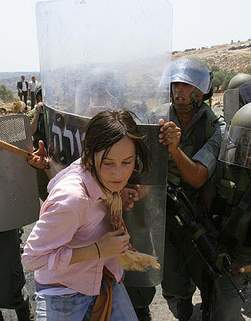
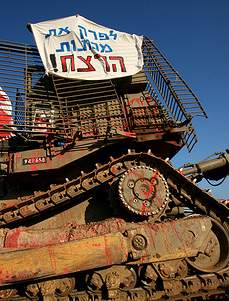
CODEPINK Returns From Delegations To Gaza/Palestine/Israel
Another delegation from Code Pink Women For Peace and other organizations brought humanitarian and emotional support to women and children in Gaza. According to human rights groups, the children of Gaza are suffering physically and psychologically for the continuing siege and the 22 day Israeli military attack last December and January. That attack killed more than 1440 Palestinians and injured nearly 5000. We talk with Code Pink organizer Helen Schiff and legal activist Dennis James about their experiences in Israel, Gaza and Palestine.
Dennis got into Israel through Egypt and delivered playground equipment. As we’ll hear in this interview the 1.5 million people of Gaza are deprived of basic needs and humanitarian aid that stopped from getting into Gaza. Supplies are warehoused and food is left to rot at the hands of the IDF.
For the first time, Americans are partnering with Jewish and Arab Israelis to demand that the Israeli government end the siege. Earlier this year, we talked with Code Pink organizers about how the Israelis wear down the fighting spirit of the people in Gaza by forbidding pasta, jam, candy and any building materials. Desalinization plants were bombed, and children have kidney disease because Israelis have siphoned off the good water and there’s too much salt seeping into the wells.
So far Code Pink has coordinated five delegations into Gaza in the past two months bringing nearly 200 activists from around the world to witness the destruction of the Palestinian people. Meanwhile, an aid ship heading to Gaza was intercepted by Israeli forces. Twenty one human rights workers were abducted including former Congresswoman Cynthia McKinney. (photo credit ActiveStills) Check out Mondoweiss (Philip Weiss’s blog)
Dennis James and Helen Schiff:
- Dennis James: On May 29-June 4, I was on a Code Pink Delegation to Gaza. 66 persons 2 buses and truck load of playground equipment and we gained entry through the Raifa crossing into Gaza Strip.
- The Southern end of Gaza; Israel often bombs the area. They estimate 1000 tunnels in the area.
- Helen Schiff: We did not get into Gaza through Erez crossing, we thought it was important to get publicity on that. We brought playground equipment.
- It’s important for them (Palestinians) to know that people are supporting them. Jimmy Carter was in Israel at the time and he had known about our attempt. Time magazine quoted Carter mentioning the delegation being refused entry.
- They don’t have to give you a reason for not entering.
- There’s a sinister twist when critically sick Palestinians are allowed to leave Gaza for medical treatment. They have to collaborate with authorities as a condition to get medical help. Anyone who gets surgery is suspect by the people they live in having had to collaborate with them. They ask people to rat on their neighbors basically.
- Everything looked as it did when on January 22. They (IDF) had a tank encampment 20 meters away that was doing target practice on the hospitals
- Fishermen, if they go beyond 2 kilometer, arbitrarily designated line by the Israeli defense force, are fired upon.
- No exports, only essential medicine and food is allowed in. It’s clear that Israel is trying to crush their identity as a people and try to reject any form of soverignty they may excercise over their own fate.
- They’re (Palestinians) not having it. They’re determined to govern and provide for themselves. They have a literacy of 95-98 percent. 44 Percent between 18-24 attend university.
- Our trip was run also by Israeli Women’s Coalition for Peace. I wanted to see Israel, and the best way to describe it is there’s always a catch 22, no matter what. Israel says, we don’t withhold anything from Gaza, we deliver everything. They drop it off and then the Israeli Defense Force decides to send it to Gaza. The stuff rots in the warehouse. About1/4 of supplies are let in to Gaza.
- Dove Weinglass, an Israel official says we’re going to put those people on a diet.
- The vindictiveness of the IDF was to bomb and kill as many animals as they could, so there’s no protein sources in the country.
- Jaffa now is being gentrified into a Williamsburg Brooklyn area for Israeli artists.
- I believe this is a time where there is a crack in the wall where ordinary Americans are beginning to listen. The Gazans want public attention, more than they even want the supplies, reconstruction material or money.
- Book: The Ethnic Cleansing of Palestine
Guests – Code Pink member Helen Schiff and legal activist Dennis James, both had boots on the ground in Gaza and give their first hand accounts of the devastating aftermath.
—
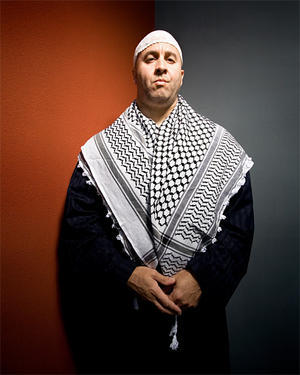

FBI Defends Use of Informants To Spy On Mosques
Recently FBI Director Robert Mueller defended the practice of using informants to monitor mosques in the United States, despite being heavily criticized by attorneys, and Muslim American leaders. Last month a judge ordered the FBI to submit 100 documents detailing the bureau’s surveillance of Muslim leaders in California, which revealed the FBI paid informants to be provocateurs. These cases fit into patterns where paid informants (often a former felon) entice innocent people into a crime, not unlike the Liberty 7 case, the Fort Dix case and the recent Memorial Day weekend terror plot in upstate New York. In the New York case, Mike German, a former FBI agent of 16 years and now an attorney with the ACLU told Law and Disorder, they “could have wrapped up without making it seem like they’re saving New York City from this terrible destruction.” The media then reports the story which will often prop up the ongoing “War on Terror.”
Shakeel Syed:
- Council of Islamic Organizations sent a letter to Attny Gen. Eric Holder complaining about the FBI infiltration and harassment
- We are baffled at this time, there is a great deal of surplus of rhetoric by the current administration and a deficit at the policy level.
- When Mueller says the FBI will escalate surveillance of mosques and the Obama Administration is silent, that disturbs me.
- This is legal religious bigotry, Mueller is lying in regard to they’re not surveilling the mosques but only the suspected individuals.
- I have stopped using the word provocateur, I shuffle between using the word provocateur and predator.
- Those targeted have pending immigration and naturalization files or converting from H1 visa to resident visa.
- When our community was doing outreach with public officers, I was in the FBI offices during 2003-2005, and I realized then I was being tailgated.
- My phone was tapped on. A few times the phone automatically dialed the local police.
- My hope as a Muslim American is that good American people will stand up in these challenging times.
Guest – Shakeel Syed, Executive Director of the Islamic Shura Council of Southern California.
———————————————————-
Civil Liberties, Criminalizing Dissent, Habeas Corpus, Human Rights, Supreme Court, Surveillance, Targeting Muslims, Torture, Truth to Power
Podcast: Play in new window | Download
Updates:
—
Segments This Week
————–
Charges Dismissed Against March of the Dead Activists: Laurie Arbeiter
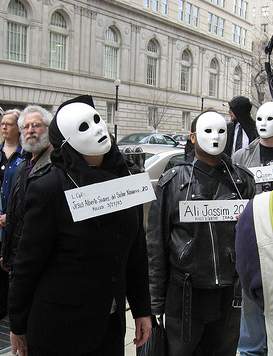
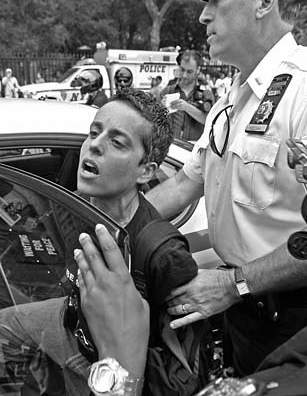
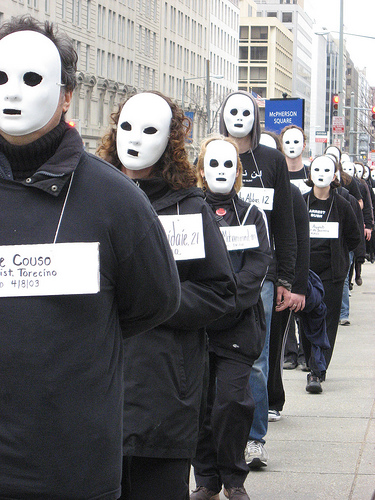
On January 6, 2009, artist and activist Laurie Arbeiter joined seventy others from around the country for the March of the Dead. Participants assembled in Washington and began to read the names of those killed in Iraq, Afghanistan and Palestine before the Capitol Police interrupted the event and arrested seventeen people. Four of them, including Laurie, appeared in court last week on charges of unlawful assembly and disorderly conduct, where the judge nullified their case. Robbie Diesu, Michelle Grise, and Pete Perry also appeared in court with Laurie. In the event that Laurie and others would be convicted, she prepared a statement to read outside of the courthouse. Click here to read that statement.
Laurie is a member of The Critical Voice, which started the We Will Not Be Silent T-shirt campaign.
Laurie Arbeiter:
- Four of us were put on trial for an action that we did Jan 6, 2009. The first day of 111th Congress.
- People came from all over the country to circle the Capitol in death masks carrying the names of the dead from Iraq, Afghanistan and Gaza.
- On that day, 17 of us were arrested and some of us were brought all the way to trial.
- Last week, we went into court for disorderly conduct and unlawful assembly.
- We didn’t get to mount our case because of the gross misconduct of the government, including tampering with evidence, they destroyed evidence.
- We were followed by police both on bicycles and motorcycles, throughout the day. But then we decided to go into the Senate Hart Building, in the atrium. We continued with the March of the Dead. Another group hung billboard sized banners.
- When we did the solemn procession before we got to the Capitol, the police on bikes were waiting for us. I was in the lead, wearing a death mask and police officers started taunting me, pointing at me saying, “we know who you are.” It makes me feel more defiant.
- As Barack Obama said, “those who stand up for justice are always on the right side of history.”
- I am one of many that stand proud in solidarity with all the other people that came from around the country.
- During the court case, the police officer kept saying how loud we were, but we are all quiet, and read the names of the dead reverently.
- The police asked the court to see a youtube video, edited, sound enhanced, the judge allowed it. They had problems projecting the video in court.
- So, they used the judge’s laptop. My lawyer cross-examined the police officer, where are your notes, the log of the event. The cop answered they went away. At that point the case was dismissed.
- This case was about what is allowed of a free people who feel an urgency because war crimes are being committed in their time. What are we as a free people allowed to do? Where do we go to seek justice?
- I would have asked the court – if crimes are being committed why wouldn’t decent people speak up so their voices could be heard? Why is that a crime? While the people who committed the most heinous acts against human beings are set free. Why are we being prosecuted?
Guest – Laurie Arbeiter, artist, prominent activist, and designer of “We Will Not Be Silent” T-shirt series. To order T-shirts, email Laurie at – Arrestbush(at)gmail.com. Her website (currently being built) is wewillnotbesilent.net.
—-
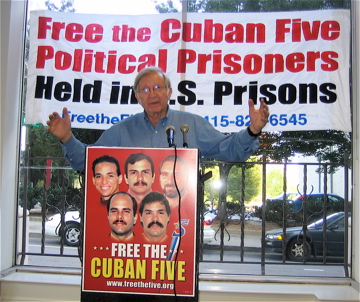
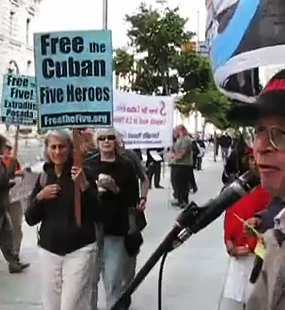
Supreme Court Denies Certiorari In the Cuban Five Case
As listeners may already know, the Supreme Court recently declined to hear the case of the Cuban Five. The request for review, which included a record-setting 12 amicus briefs and received widespread international attention, was the Cuban Five’s last chance for a new trial.
The Five’s defense attorneys argued it was impossible for the men to get fair trials in Miami, where anti -Castro sentiment runs high, and that the convictions should be overturned.
Last year, the 11th U.S. District Court of Appeals in Atlanta upheld the convictions of the Cuban Five who are serving long prison sentences charged with spying and conspiracy to commit murder. Joining us again to discuss the case is noted criminal defense attorney Leonard Weinglass, who represented the Cuban Five. Len, welcome back to the show. Demonstration video link
Len Weinglass:
- 98 Percent of all petitions for Cert are denied. We were optimistic because our position was so strongly stated and unprecedently joined by 11 briefs and friends of the court including 10 Nobel Prize winners.
- Then June 15, the news came down. The court rejected out of hand without a single dissenting opinion.
- We were hoping against experience that teaches otherwise, that the Obama Administration would lighten up on this case and acknowledge some of the undisputed facts.
- Timing: June 5, 2009 Kendall and Gwendolyn Meyers arrested for passing classified information to Cuban handlers.
- Batson Case – The government permitted several minorities on the jury who were elderly and less well educated as a shield against challenges of racial bias. The record shows the government removed seven younger well educated minority jurors. We brought this to the court’s attention, because this is happening throughout the country (Mumia Abu Jamal case – instruction film to purge minority jurors)
- Community prejudice issue: Trying the Cuban Five case in Miami.
- This is the first “conspiracy to commit espionage” case in which there was not a single classified document.
- The options have become narrower, three of the five are up for re-sentencing. I’m hopeful my client Antonio Guerrero will not get a life sentence but will get a set term of years.The Cuban Five have served 10 years.
- Analagous cases – Ben-Ami Kadish – recently (Dec 2008) received a suspended sentence and 50 thousand dollar fine ( which he responded, no problem judge.) for taking classified documents to his handler’s home in Riverdale, Bronx several times (including information about nuclear weapons, a modified F-15 fighter, and the Patriot missiles) and let an unnamed Israeli government worker take photographs of them.
- Posada Carriles, has a long standing association with the CIA, which his attorney acknowledged in court papers. Carriles was charged with the murder of 73 people, he escaped prison, (with help of unknown persons) He was then hired by the CIA, paid by the US tax payer to help in the war against the elected government of Nicarargua.
- Carriles was involved in bringing down the first commercial plane in mid-flight. Cubana airline, the bomb exploded (C4) that was placed in a toothpaste tube left in the mens room. The tail assembly was damaged, then pilots lost control and plane plummeted into ocean. Carriles was named by the person who he paid them to do it. That person is a cab driver in Caracas, Venezuela and is available to the media.
- Going forward with the Cuban Five cases, there are legal options, specifically 18 US C2255 – Federal Habeas. We could raise constitutional issues that haven’t previous been raised and litigated, we have one year in which to file. We’re not completely out of court, but what’s called the “direct appeals” are over. We now have collateral appeals.
- It’s up to the Obama Administration to recognize the reality here of what happened and begin the process of returning the Five home.
Guest – criminal defense attorney Leonard Weinglass, who represented the Cuban Five, as William Kunstler’s younger partner, Len Weinglass was considered the work horse of the defense team. He’s worked on a number of political cases including the Pentagon Papers trial and the Angela Davis case. He’s a Yale Law School graduate and former U.S. Air Force Captain.
——————————————————————————-
Afghanistan War, Civil Liberties, Guantanamo, Habeas Corpus, Human Rights, Iraq War, Supreme Court, Surveillance, Targeting Muslims, Torture, Truth to Power
Podcast: Play in new window | Download
Host Updates:
Segments this week:
——-
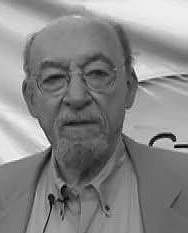


Peter Weiss : International Human Rights Law and the Royal Dutch Shell Settlement
Europe’s largest oil company Royal Dutch Shell settled a landmark lawsuit last week, agreeing to pay 15.5 million to avoid a trial over it’s alleged involvement in human rights violations in the Niger Delta. The case was brought by relatives of human rights and environmental activists killed in Nigeria who accused Shell of complicity in the 1995 executions of Nigerian writer and environmentalist Ken Saro Wiwa and eight others. Charges in the case include summary execution, crimes against humanity, torture, inhumane treatment, arbitrary arrest, wrongful death, assault and battery, and infliction of emotional distress. Attorney Peter Weiss explains how historic laws such as the Alien Tort Claim are used to hold multinational corporations accountable for human rights crimes.
Peter Weiss:
- They (Royal Dutch Shell) knew all along that they were complicit. Decades ago I was involved in the struggle against colonialism in Africa. What that settlement represented was a victory against neo-colonialism.
- I think we all hope at the Center for Constitutional Rights that this will send a signal to other companies.
- Peter Weiss and Rhonda Copeland were instrumental in beginning the first cases in which human rights violations, taking place in other countries could actually be litigated in the United States.
- Alien Tort Statute Claim: We first discovered that during the Mei Li massacre. It’s a one sentence law that goes back to the first judiciary act in the United States in 1789.
- It simply says, an alien shall have a right of action in district court for a violation of the law of nations. (as international law was called in the 18th century)
- Ten years later Amnesty International got in touch with CCR, saying we have this torturer in Paraguay. Which became known as Filartica – 1978 / 1980 was the decision. It set the stage for hundreds of cases.
- About 15 years ago, CCR applied that statute to the human rights crimes of corporations in foreign countries.
- We’ve had a few victories and one of them was the UNOCAL case, where UNOCAL was using slave labor. That case was settled. Now, the Wiwa case was settled.
- If you’re familiar with what corporations are doing around the world, you can imagine how many such cases can be brought.
- Royal Dutch Shell was actually paying these Nigerian soldiers that were committing these atrocities.
- The worst thing that they did was go to the Nigerian government and say we have to get rid of these trouble makers.
- Nigeria was under a corrupt dictatorship at the time.
- We’re not the only ones, the Center for Justice and Accountability out in California have victories against Salvadorian torturers
- Jerry Nadler had a hearing on the state’s secrets act and on the opening statement, he says people bring these suits and the government comes in and says state secrets, the suit can’t go forward. But there’s an international law says Nadler, that has to be a remedy for every right.
Guest – Peter Weiss, former Vice President, Center for Constitutional Rights and Vice President, of the International Association of Lawyers Against Nuclear Arms.
—–
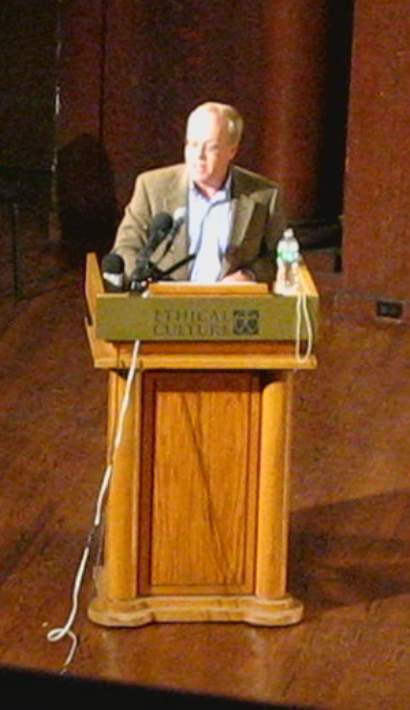
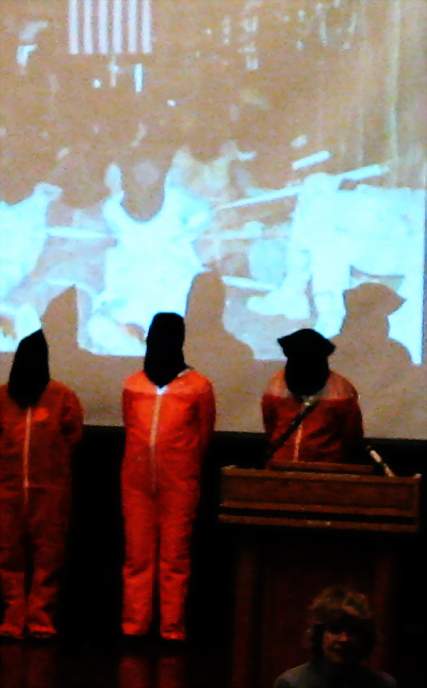
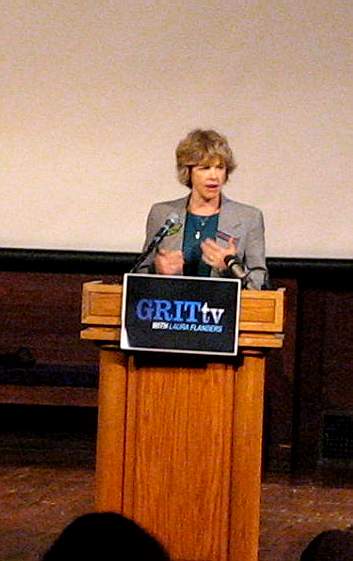
A Revolution Books Town Hall Meeting: TORTURE AND THE NEED FOR JUSTICE
We hear from Laura Flanders, journalist and host of GRITtv, and Chris Hedges, former New York Times Mideast bureau chief, author of many books specializing in American and Middle Eastern politics and society. He spent nearly two decades as a foreign correspondent in Central America, the Middle East, Africa and the Balkans. He was also the Middle East bureau chief for The New York Times. Chris Hedges’ new book, “Empire of Illusion: The End of Literacy and the Triumph of Spectacle,” will be out in July and can be preordered at your local bookstore.
Speakers :
Organized by Revolution Books / Libros Revolucion
—–
For WBAI Listeners
Men, Mobs and Law by Rebecca Hill
Men Mobs and Law is the title of Rebecca Hill’s new book that explores the complexities of protest movements, race, class and gender. Hill draws comparisons in two types of left protest campaigns, those that defend labor organizers from prosecution and the anti-lynching groups that seek to memorialize lynching victims. Hill says, both groups have influenced each other throughout history and she specifically connects the narratives and stories of the NAACP’s anti lynching work to the IWW’s labor defense campaigns.
Rebecca Hill’s treatment of these dramatic stories has been called “fresh, lively, richly detailed, and impassioned.”
Rebecca Hill:
- When I first started the book it was about martyrdom and the American Left and heroic politics. I’ll take these particular cases, John Brown, Haymarket etc.
- In the research I found that this other problem that there is no law enforcement and the source of terror that black activists were dealing with was extra-legal. . . . and their anti-lynching activism that started in the 60s – and I then went back to Ida B Wells, Dubois – 1887-1890s
- Ida B Wells talking about how dangerous passion is. This is a problem in leftest activism in general. It goes to the big questions of political theory and rationale, the role of emotions, questions of what is the meaning of popular action,
- I didn’t want to condemn either side, the anti lynching movement strategy or and the socialist left defense organizing, because they both came out of experiences that informed their politics.
- If you’re facing terroristic mobs, you’re going to respond with a strategy. The anarchists and socialists movement response spoke to the lynching and their response was in inadequate – “rise up in self defense.”
- If you lived in the post reconstructive South, rising up in self defense was not realistic without legal protection.
- What came out of the Haymarket movement in the 1880s was the idea that the key element of solidarity in a labor movement is when somebody is arrested, or victimized as a result of organizing, its the membership that can save them. Not the law. The law is a tool, it’s not enough perhaps.
- The courts are structured by the ruling class, they’re stacked against the worker who is in court. They didn’t want the court room take away from the radicalism of the movement.
- Elizabeth Gurley Flynn – defense expert in IWW trials and Sacco Vanzetti case. Anarchists connected to Sacho and Vanzetti case didn’t want structure and organizing
- I was very active in the Mumia Abu Jamal campaign, you see the greater successes in the popular defense organizing it’s not based on the legal strategy, its when is the movement stronger. You see more victories in the thirties because the labor movement was big and the consensus was moving to the left during the New Deal
- John Brown’s defense is close to the fugitive slave rescues which were anti-court . John Brown’s notion that the courts are wrong and should answer to a higher power, not the current law of slavery. John Brown attempted to make available weapons for slaves to take up arms. See the book John Brown Mysteries
- I don’t really think of John Brown as a religious zealot, I think he really believed in popular organizing and popular activism.
Guest – Rebecca Hill, author of Men Mobs and Law.