CIA Sponsored Terror, Civil Liberties, Human Rights, Iraq War, Military Tribunal, NSA Spying, Political Prisoner, Surveillance, Targeting Muslims, Torture, War Resister
Podcast: Play in new window | Download
—-
Illegal Preventive War
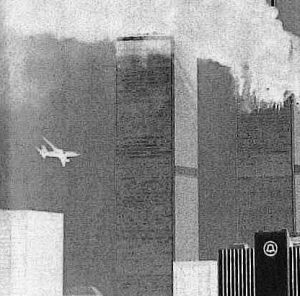
Sixteen years ago today two hijacked planes flew into the twin towers and another one into the Pentagon. Fifteen of the 19 attackers were Saudi Arabians. They were funded by elements of the Saudi Arabian government. Osama bin Laden, a Saudi Arabian fundamentalist from a wealthy Saudi family took responsibility for the attack. He said he did it for three reasons: The American support of Israel against the Palestinians; the presence of US bases near the Saudi Arabian holy cities of Mecca and Medina; and the US economic and trade sanctions against Iraq which killed 600,000 children.
When the attack occurred, the feckless and unpopular George W. Bush had been in office less than a year. He told his national security advisor to figure out a way to blame the attacks on Iraqi dictator Saddam Hussein. A lie was propounded by Bush , his vice president Dick Cheney, and his secretary of defense Donald Rumsfeld that Iraq had contact with Osama bin Laden and that Iraq was developing nuclear weapons, weapons of mass destruction. First, Afghanistan was bombed, even though it’s leaders offered to turn over Osama bin Laden. Then an illegal war was launched against Iraq initiated with horrific bombings called “shock and awe.” In the following years 1 million people were killed in that country. Half of the population are refugees or internally displaced.
In the wake of the 911 attacks, the Patriot Act was hastily pushed through Congress bringing an American police state closer into being. The war on terror was declared even though terror is a tactic and war is traditionally had been fought against other countries. This has given it a permanent character. A campaign of fear was whipped up. Torture and kidnapping by the CIA was instituted. Eventually the United States under President Obama was fighting six were simultaneously in Iraq, Afghanistan, Syria, Yemen, Libya, and Somalia. Trump continues this aggression.
Guest – Ajamu Baraka, a member of board of directors of Cooperation Jackson, in Jackson Mississippi, editor and contributing columnist for Black Agenda Report, and National Organizer for the Black Alliance for Peace. He recently ran for vice president on the Green party ticket. He is a former board member at the Center for Constitutional Rights and a leader of the United National Anti-war Coalition.
U.S. Antiwar Leaders Call for Actions to Oppose the Escalation of the Afghanistan War During the Week of the 16th Anniversary of the Invasion, October 2 – 8.
—-

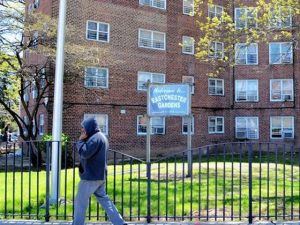
The Bronx 120 and Secor 19
A year ago we reported on the largest gang raid in NY history. It took place, pre-dawn, in the Williamsbridge section of the North Bronx, with 700 law enforcement officers arresting 120 young men indicted on conspiracy charges using the 1970 RICO Act. In one apartment, more than a dozen police threw flash-bang grenades and broke down the front door with assault weapons aimed at a mother and her two daughters, then forced them to crawl down their hall on all fours toward the officers.
At that time, police held a press conference and characterized the young men as “the epitome of organized crime today.” Cooperating federal agencies included the DEA, the ATF, the US attorney general, and ICE’s Homeland Security Investigations. Community members question this portrayal, saying the young men were not highly organized gangsters terrorizing a community; they lacked money and weapons and were living at home with their parents.
Critics claim that applying RICO to street gangs has racist implications. Under RICO, individuals can be found guilty by association. Despite gang-related crime accounting for less than 2 percent of city crime, two weeks after the raid, James O’Neill, now NYPD Commissioner, promised more raids.
He came through with that promise this past April. Multiple arrests were made at the Boston Secor Houses in the Bronx, and federal charges were brought against 19 young persons. They have been charged with racketeering conspiracy, narcotics conspiracy, robbery conspiracy, extortion, and firearms offenses. We’re joined today by a FAMILY MEMBER of one of the young men arrested.
———————————————–
Afghanistan War, CIA Sponsored Terror, Civil Liberties, Criminalizing Dissent, FBI Intrusion, Gaza, Guantanamo, Human Rights, Military Tribunal, NSA Spying, Political Prisoner, Prison Industry, Prosecution of the Bush Administration, Supreme Court, Surveillance, Targeting Muslims, Torture, Truth to Power, War Resister
Podcast: Play in new window | Download
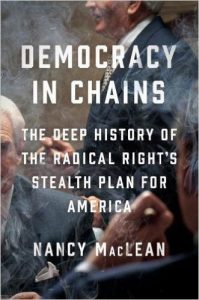
Democracy in Chains: The Deep History of the Radical Right’s Stealth Plan for America
The spectacle of President Donald Trump and the palace intrigue in the White House has served daily to distract people from the political strategy and accomplishments of the radical right, which is taking over the Republican Party.
Over time, the GOP has been transformed into operation conducting a concerted effort to curb democratic rule in favor of capitalist interests in every branch of government, whatever the consequences. It is marching ever closer to the ultimate goal of reshaping the Constitution to protect monied interests. This gradual take over of a major political party happened steadily, over several decades, and often in plain sight.
Duke University Professor Nancy MacLean exposes the architecture of this change and it’s ultimate aim. She has written that “both my research and my observations as a citizen lead me to believe American democracy is in peril”.
Guest – Professor Nancy MacLean, whose new book, Democracy in Chains: The Deep History of the Radical Right’s Stealth Plan for America, has been described by Publishers Weekly as “a thoroughly researched and gripping narrative… [and] a feat of American intellectual and political history.” Booklist called it “perhaps the best explanation to date of the roots of the political divide that threatens to irrevocably alter American government.” The author of four other books, including Freedom is Not Enough: The Opening of the American Workplace (2006) called by the Chicago Tribune “contemporary history at its best,” and Behind the Mask of Chivalry: The Making of the Second Ku Klux Klan, named a New York Times “noteworthy” book of 1994, MacLean is the William H. Chafe Professor of History and Public Policy.
——
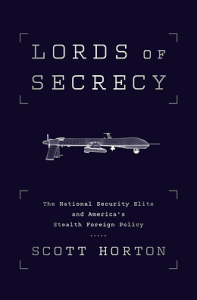
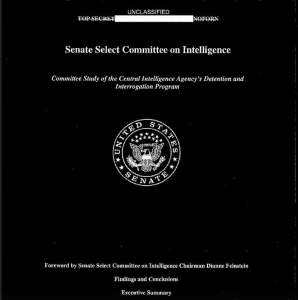
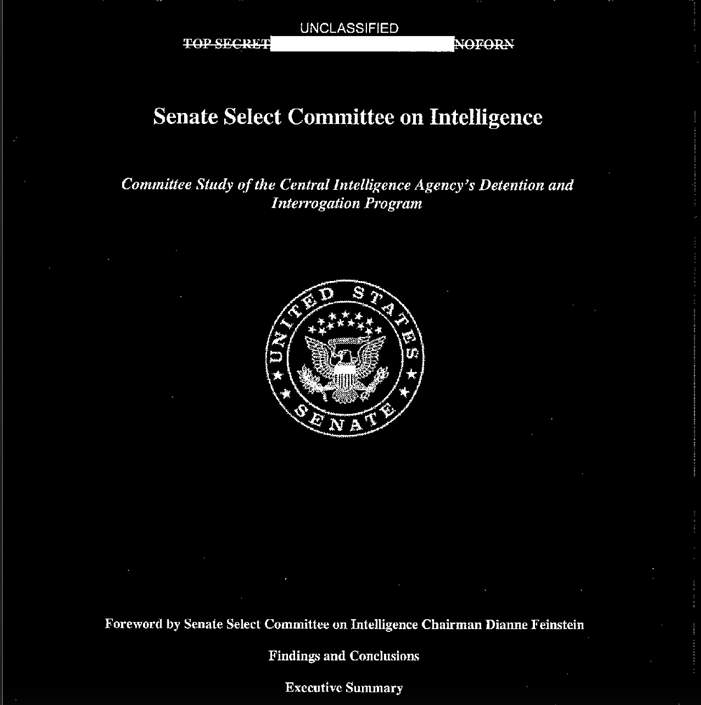
Senate Intelligence Committee Torture Report: Attorney Scott Horton
Guantanamo suicides, CIA interrogation techniques, CIA ordered physicians who violate the Hippocratic oath, are topics of some recent articles by returning guest attorney Scott Horton. Last month, he was on Democracy Now to debate former CIA General Counsel John Rizzo on the question of declassifying a Senate Select Committee on Intelligence report about the agency’s secret detention and interrogation programs. His book Lords of Secrecy The National Security Elite and America’s Stealth Foreign Policy will be published January 2015.
Attorney Scott Horton:
- I think the results flow directly from the media coverage (ABC poll on Torture report)
- Now major publications and broadcasters that hedged using the word torture have stopped doing that. There are only a handful of media sources that won’t do it. NPR being one of them.
- The media also presents roughly twice as much time devoted to people justifying the use of torture techniques to those criticizing it.
- Barack Obama who should lead the push back has gone completely silent. It’s beyond silent he talked about “tortured some folks” making it very casual, and then he said the torturers were patriots.
- I thought it was electrifying reading. 90 percent of it I’ve heard about before and still when you read them in this clinical, plain, highly factual style and things were developed with a continuous flow with lots of background in decision making in Washington at the top and how all this effected what happened on the ground.
- As a consumer of Congressional reports this probably the single most impressive Congressional oversight report I’ve ever seen.
- It’s an excellent example of what the oversight committee should be doing all the time.
- They’re doing this with respect to a program which was essentially or very largely wrapped up by October 2006.
- We’re talking about 8 1/2 years ago.
- They’re only able to do this kind of review in any depth when its historical, not when its real time oversight, that’s disappointing.
- One thing that emerges from looking at these reports and the military reports is that there is a huge black hole which has never been fully developed and explored and that’s JSOC, its the military intelligence side.
- That escaped review within the DOD process and it escaped review in CIA process and its clear that there’s a huge amount there.
- I certainly don’t expect prosecutions to emerge for the next couple of years in the United States, but I see a process setting in that may eventually lead to prosecutions.
- On the one hand we’re seeing a dangerous deterioration in relations with Russia, is an aggressor, which has seized territory in the heart of Europe, is waging a thinly veiled war on one of its neighbors. That is very unnerving to the major NATO powers.
- On the other hand there’s never been a period in the history of the alliance when there is so much upset at the United States.
- That’s come largely from the rise of the surveillance state and the role of the NSA.
- I was looking at this report, and we know that in 2006, there was an internal review that led the CIA to conclude that these interrogation techniques were ineffective and the CIA internally decided to seek a large part of the authority for EIT’s and operation of black sites rescinded.
- Another thing that’s very important here from this report, it tells us that Michael Hayden, George Tenant, Porter Goss and other very senior people at the CIA repeatedly intervened to block any form of punishment of people who are involved with torture and running the black sites.
- That’s important because of the legal document Command Responsibility. The law says when command authority makes a decision not to prosecute and immunize people involved with torture and abuse, that results in the culpability of these crimes migrating up the chain of command.
- I interviewed CIA agents who were involved in this program, and they told me they’ve all been brought out by legal counsels office and told – they may not leave the country.
- That means you’ve got roughly 150 CIA agents, including many people near the top of the agency who can’t travel right now.
- Lords of Secrecy The National Security Elite and America’s Stealth Foreign Policy
Guest – Scott Horton, human rights lawyer and contributing editor to Harper’s Magazine. Scott’s column – No Comment. He graduated Texas Law School in Austin with a JD and was a partner in a large New York law firm, Patterson Belknap Webb & Tyler. His new book Lords of Secrecy The National Security Elite and America’s Stealth Foreign Policy.
CIA Sponsored Terror, Civil Liberties, Criminalizing Dissent, Habeas Corpus, Human Rights, NSA Spying, Surveillance, Targeting Muslims, Truth to Power, War Resister
Podcast: Play in new window | Download
Update:
- Rev Billy And The Stop Shopping Choir: Radical Ritual At Trump Tower
—-
Democracy in Chains: The Deep History of the Radical Right’s Stealth Plan for America
The spectacle of President Donald Trump and the palace intrigue in the White House has served daily to distract people from the political strategy and accomplishments of the radical right, which is taking over the Republican Party.
Over time, the GOP has been transformed into operation conducting a concerted effort to curb democratic rule in favor of capitalist interests in every branch of government, whatever the consequences. It is marching ever closer to the ultimate goal of reshaping the Constitution to protect monied interests. This gradual take over of a major political party happened steadily, over several decades, and often in plain sight.
Duke University Professor Nancy MacLean exposes the architecture of this change and it’s ultimate aim. She has written that “both my research and my observations as a citizen lead me to believe American democracy is in peril”.
Guest – Professor Nancy MacLean, whose new book, Democracy in Chains: The Deep History of the Radical Right’s Stealth Plan for America, has been described by Publishers Weekly as “a thoroughly researched and gripping narrative… [and] a feat of American intellectual and political history.” Booklist called it “perhaps the best explanation to date of the roots of the political divide that threatens to irrevocably alter American government.” The author of four other books, including Freedom is Not Enough: The Opening of the American Workplace (2006) called by the Chicago Tribune “contemporary history at its best,” and Behind the Mask of Chivalry: The Making of the Second Ku Klux Klan, named a New York Times “noteworthy” book of 1994, MacLean is the William H. Chafe Professor of History and Public Policy.
—-
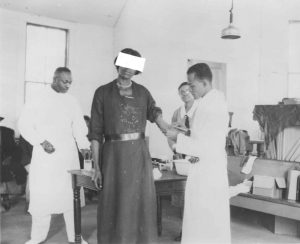
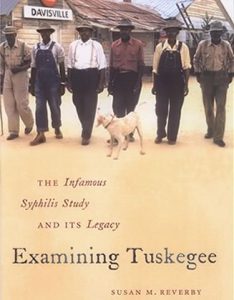
Tuskegee Syphilis Study Aftermath
The Tuskegee Syphilis Study was a biomedical clinical study conducted by the US Public Health Service for four decades between 1932 and 1972. Its purpose was to observe the natural progression of untreated syphilis in rural African-American men in Alabama under the guise of receiving free health care from the government.
It collaborated with the historically black Tuskegee University in Alabama. Investigators enrolled a total of 600 impoverished African American sharecroppers from Macon County, Alabama. Of these men, 399 had previously contracted syphilis before the study began, and 201 did not have the disease. They were given free medical care, meals, and free burial insurance for participating in the study. After a cure for syphilis was discovered in penicillin, the study still continued without informing the men they would never be treated. According to the Centers for Disease Control, the men were told they were being treated for “bad blood,” a local term for various illnesses that include syphilis, anemia, and fatigue.
Guest – Professor Susan Reverby is Marion Butler McLean Professor in the History of Ideas and Professor of Women’s Studies at Wellesley College. She is editor of Tuskegee’s Truths: Rethinking the Tuskegee Syphilis Study.
——————————————
CIA Sponsored Terror, Civil Liberties, Criminalizing Dissent, Human Rights, Political Prisoner, Surveillance, Targeting Muslims, Truth to Power, War Resister
Podcast: Play in new window | Download
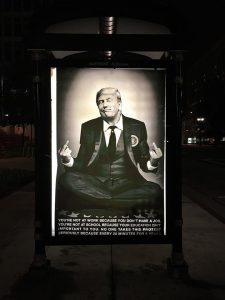
This is Not Populism : John Bellamy Foster
Is Trump a neofascist? Thoughtful analysts on the left like Cornell West, Noam Chomsky, and Judith Butler think he is. But mainstream liberal commentators refuse to associate the Trump phenomena with fascism. They call him a right wing populist. What is neofascism? Right wing Populism? Does it really matter what Trump is called? The great German playwright and political thinker who lived in Germany during Hitler’s reign, Berthold Brecht, asked in 1935: “How can anyone tell the truth about fascism, unless he’s willing to speak out against capitalism, which brings it fourth?” We speak today with John Bellamy Foster, the editor of the venerable magazine “Monthly Review”. He wrote the lead article in the current June 2017 issue titled “This Is Not Populism.”
Guest – John Bellamy Foster is editor of Monthly Review and professor of sociology at the University of Oregon. He has written widely on political economy and has established a reputation as a major environmental sociologist. He is the author of Marx’s Ecology: Materialism and Nature (2000), The Great Financial Crisis: Causes and Consequences (with Fred Magdoff, 2009), The Ecological Rift: Capitalism’s War on the Earth (with Brett Clark and Richard York, 2010), and The Theory of Monopoly Capitalism: An Elaboration of Marxian Political Economy (New Edition, 2014), among many others.
—-

Crossing Hitler: The Man Who Put the Nazis on the Witness Stand
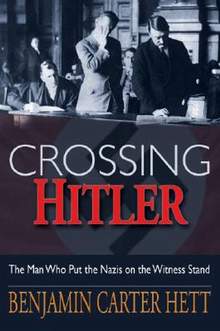
Author Benjamin Hett outlines the fascinating and tragic story of a young lawyer Hans Litten in his recent book Crossing Hitler: The Man Who Put the Nazis on the Witness Stand. Before the Nazis rose to power in the early 1930s, they incited calculated violence among the working class in German taverns. Four Nazi stormtroopers were charged with firing randomly into a dance hall where a communist hiking club were holding a party. Three young men were wounded. Hans Litton was the advocate for the 3 men.
Hans Litten called Hitler to the witness stand to show that the Nazi party was a violent party, and by cross examining Hitler he tried to prove that. Litten forced Hitler to contradict himself, reducing him to humiliating rage that revealed his true intention. At that time, Hitler wanted to be a legal party in Germany and of course you couldn’t be a party that was extra-constitutional and legal but at the same time he didn’t want to disappoint the base of his party which was this violent working class aspect. Two years later, the Nazi Party rose to power.
What came after the Reichstag Fire was the arrest of about 5 thousand people across Germany who the Nazis have identified as opponents or potential opponents. Hans Litten was among them and sent to a concentration camp. Author Benjamin Hett describes a powerful narrative of Hans facing torture yet still telling stories and teaching art to other prisoners.
Hans Litten was born in 1903 in Halle in Central Germany, his father was a law professor and Jewish but converted to German evangelical (Lutheran).
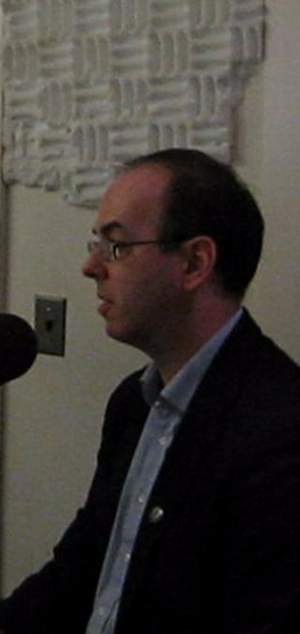
Guest – Benjamin Hett, author of Crossing Hitler: The Man Who Put the Nazis on the Witness Stand. Hett is a former trial lawyer, and now Associate Professor of History at Hunter College.
————————————————–
CIA Sponsored Terror, Civil Liberties, Crony Capitalism, NSA Spying, Supreme Court, Targeting Muslims, Torture
Podcast: Play in new window | Download
Law and Disorder Outtakes: Disorderly Bloopers
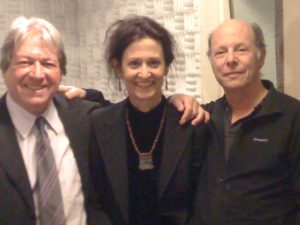
We first began recording Law and Disorder in 2004, the same year the Republican National Convention—and large protests—were held in New York City. When we started, we had four hosts—Dalia Hashad and Michael Ratner along with Michael Smith and Heidi Boghosian.
After a few years, Dalia moved to California, leaving us with three hosts. In late spring 2016 we lost Michael Ratner to cancer. Now there are just two of us.
It is our special pleasure to share with listeners our first segment of The Disorderly Bloopers, behind-the-scenes audio outtakes from the first years we were on the air.
Law and Disorder was created during the George W. Bush administration to cover what we thought would be some of the darkest days in the nation’s history. As part of our special summer episode we thought these studio snippets might provide a few minutes of much-needed levity.
It’s important to take a few minutes to laugh at ourselves, and to look back at the hundreds of fun days that we here at Law and Disorder have had over the years.This has also been a trip down memory lane for Heidi and Michael as we hear hilarious interchanges with Dalia and Michael Ratner.
As we covered some of the most serious topics in the news, and amidst the enormous respect we had for all of our guests, the four of us wholeheartedly enjoyed a special relationship, along with our longstanding producer Geoff Brady. It’s a relationship that comes from working closely together and respecting each other as colleagues and friends.
—-
Hosts Read Some of the Best Courtroom Transcripts
Q: Doctor, before you performed the autopsy, did you check for a pulse?
A: No.
Q: Did you check for blood pressure?
A: No.
Q: Did you check for breathing?
A: No.
Q: So, then it is possible that the patient was alive when you began the autopsy?
A: No.
Q: How can you be so sure, Doctor?
A: Because his brain was sitting on my desk in a jar.
Q: But could the patient have still been alive nevertheless?
A: It is possible that he could have been alive and practicing law somewhere.
—-
The Relevant Lawyer: Reimagining the Future of the Legal Profession
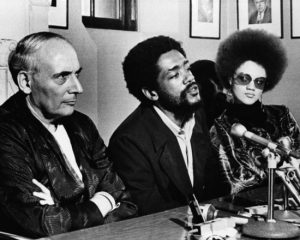
Hosts alternate in reading part of a chapter on Attorney Charles Garry in the book The Relevant Lawyer: Reimagining the Future of the Legal Profession by Paul A. Haskins. Haskins is senior counsel in the American Bar Association Center for Professional Responsibility and lead counsel for the Standing Committee on Professionalism.
——————————————————-
Civil Liberties, Habeas Corpus, Human Rights, Iraq War, NSA Spying, Political Prisoner, Prison Industry, Prosecution of the Bush Administration, Supreme Court, Surveillance, Targeting Muslims, Torture, War Resister
Podcast: Play in new window | Download
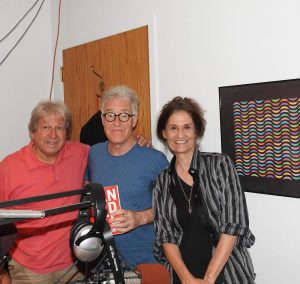
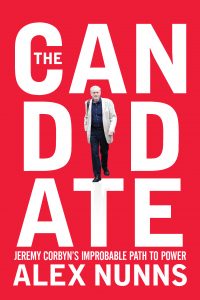
Jeremy Corbyn Labour Party Victory
One of the bright and hopeful developments in world politics was the wide support that Jeremy Corbyn, the leader of the British Labor Party got in that country’s recent elections. Corbyn ran on an unabashedly left platform. His party recruited tens of thousands of young people before and after the election. Although the conservative Government of Prime Minister Teresa May is still in power this is not likely to last long. To speak with us today about these developments in Great Britain and their relevance to the United States where we saw a similar phenomenon with the rise of Bernie Sanders, is Colin Robinson.
Guest – Colin Robinson is from Liverpool England and he lives in New York City. He’s the publisher of OR Books. Colin Robinson worked as a senior editor at Scribner and was previously managing director of Verso Books and publisher of The New Press. Among the authors he has published are Tariq Ali, Noam Chomsky, Alexander Cockburn, Mike Davis, Norman Finkelstein, Eduardo Galeano, Eric Hobsbawm, Lewis Lapham, Mike Marqusee, Rigoberta Menchú, Matt Taibbi and Jann Wenner.
—-
Raymond Nat Turner
Poem: Low Regard
—-
SCOTUS on CCR CASE
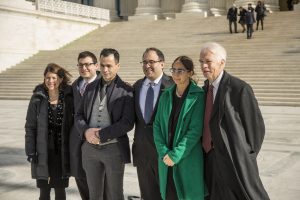
Just a few weeks ago the Supreme Court reversed a federal appeals court ruling that former high-level Bush administration officials may be sued for their roles in the post-9/11 profiling and abuse of Muslim, Arab, and South Asian men.
After the 9/11 attacks, hundreds of non-citizens were rounded up solely on the basis of their race, religion, ethnicity, and immigration status. They were held in extremely restrictive confinement and physically and psychologically abused. The Court held that high-level government officials who implement and create clearly unconstitutional policies alleged to be based on national security are nonetheless shielded from liability.
However, the Court did allow plaintiffs the chance to prove their case against Warden Dennis Hasty, finding that complaint’s allegations, “plausibly show the warden’s deliberate indifference” to the abuse plaintiffs suffered while they were held at the MDC. The claims against the Warden will be sent back to the lower courts for an opportunity to show that prison administrators are not entitled to the same immunity given to high-level officials in this case.
Guest – Senior Managing Attorney Shane Kadilal from the Center for Constitutional Rights. His cases there include challenges to the indefinite detention of men at Guantánamo and domestic immigration sweeps. He has been counsel in major CCR cases challenging the material support statute, the low rate of African-American firefighter hiring in New York City, and the NSA’s warrantless surveillance program.
———————————————