Afghanistan War, Civil Liberties, Human Rights, Iraq War, Targeting Muslims, Torture, Truth to Power, Uncategorized
Podcast: Play in new window | Download
Updates:
—–

Israeli Policy and Palestinian Children – Nora Barrows-Friedman
We talk today with the Nora Barrows-Friedman, she is the host of radio show Flashpoints at KPFA in Berkeley California. Nora spent the last month in the occupied West Bank and East Jerusalem. She’s been investigating stories about the ongoing violations of Palestinian human rights and has been frequently traveling to Palestine since 2004. Today we look specifically at the Israeli policy against children from arresting, detaining, interrogating, torturing, imprisoning and beating children, some as young as 10. Nora says International laws designed to protect children — including the UN convention on the rights of the child are being circumvented and violated on a daily.
Nora Barrows Friedman:
- Kids randomly picked off the street, allegedly for throwing stones. The Israeli punishment is 10 years in prison for a child.
- Israeli military can arrest (Palestinian only) children as young as 12. Right now there are 300 Palestinian children in Israeli prisons.
- Hebron is a city where settlers have been given half of the old city, a settlement colony is inside the Palestinian community
- These two young children were followed and taken into a military center inside the settlement colony.
- This whole family had been destoryed by these illegal actions against these 2 brothers. The only recourse this family has is to take it to the Israeli military court. Motive: trying to get Palestinian families to leave.
- This family lives in an area where settlers have their eye on, seems to be very deliberate.
- There are hundreds of women in Israeli prisons, there’s a story where a woman gave birth in the prison, and the baby is now a prisoner.
Guest – Nora Barrows Friedman: Senior producer and co-host of KPFA’s Flashpoints.
————-
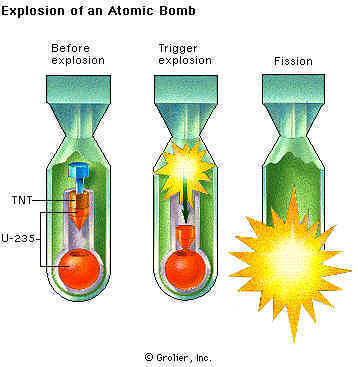

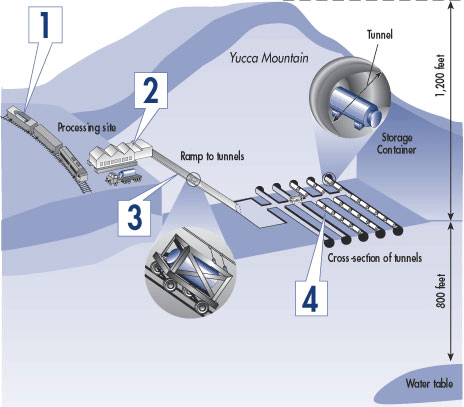
Obama’s Plan for Elimination of Nation-Controlled Nuclear Power
Nine nations now have a combined total of more than 22 thousand nuclear weapons. The United States has about 5 thousand nuclear weapons, 500 of them are land based warheads which can fly in three to four minutes after the order is given. President Obama recently hosted a nuclear security summit in DC with more than 45 foreign leaders, he traveled to Prague and signed a treaty that would cut the combined US and Russian stockpile by a third. Meanwhile, the US nuclear stockpiles have been shrinking for the last 40 years. We talk more about the current nuclear disarmament effort with attorney Peter Weiss is Vice-President, former President, of the International Association of Lawyers Against Nuclear Arms.
Peter Weiss:
- Leave the doomsday clock where it is. Reaffirming of the status quo. The agreement with Russia in reducing the nuclear weapons allowed to each country from 2200 to 1500. They count all the warheads on a bomber plane as one, instead of 10 or 12 weapons.
- Jimmy Carter: A single nuclear armed submarine had enough weaponry to destroy every Russian city of 100 thousand or more.
- Nuclear Posture Review – Zero document / “It’s difficult to operationalize a vision.”
- Obviously there is a great danger of loose nukes. No one seems ready to adopt an anti-nuclear convention except the countries that don’t have nuclear weapons.
- Conference in Riverside Church on May 1, 2010, United For Peace and Justice
- The anti-nuke movment will be re-energized.
- The US wants to be the sole repository of weapons grade nuclear material, committment from Chile, and Canada, to ship WGNM to the US. That’s kind of weird isn’t it?
Guest – Peter Weiss, former Vice President, Center for Constitutional Rights and Vice President, of the International Association of Lawyers Against Nuclear Arms.
——
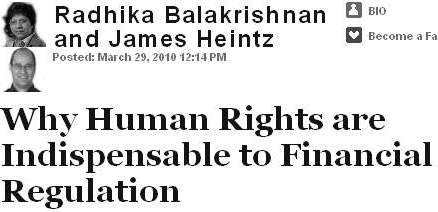

Why Human Rights are Indispensable to Financial Regulation
Today we speak with Radhika Balakrishnan, Professor of Economics and International Studies at Marymount Manhattan College, about her recent article in the Huffington Post titled Why Human Rights are Indispensable to Financial Regulation. Balakrishnan enumerates the global human fallout from the world financial crisis. The World Bank estimates an additional 400 thousand children will die before their fifth birthday, while those responsible for the turmoil are benefiting from bailouts and promotions. She references the Universal Declaration of Human Rights and its inclusion of economic and social rights, that is the right to work, to education, to rest, to an adequate standard of living. Dr. Balakrishnan has also outlined steps for meaningful reform that we will also examine today. She is currently working on a project trying to use human rights norms to evaluate and construct macroeconomic policy.
Radhika Barakrishnan:
- We pretend there is no criteria regulating (economic policies) We argue in our piece, that human rights have a way to set up an ethical basis and framework. Most people don’t know that human rights include economic and social rights.
- In the United States the assumption is you can vote the people in to give you social and economic rights.
- The idea that the market is this Greek Oracle that we can’t question. . . is a problem.
- We’re saying there is a form of biased market regulation, where the state has the interest of the financiers and the banks.
- and not those of the working people and the working class. One example is the minimum wage.
- The Federal Reserve has a dual mandate, one is to have price stability, the other is the right to work.
- In the United States, we have not signed the Convenant on Economic and Human Rights.
- The Federal Reserve is a government agency and the fact that they act in a cloak of secrecy is a real problem.
- I think there is a great case to be brought, as far as freedom of information.
- What kind of financial models are they using to make their decisions? This cloak of secrecy because you independence to make monetary policy? But independence doesn’t mean secret.
- Their Board of Governors are from the commercial banks, whose interest will they work for?
- Bailout Bill – TARP / This went to financial agencies to give them the money. 720 Billion dollars overnighted to the Federal Reserve has not gone out? The Stimulus Money, for employment creation, though it was used for tax cuts.
- Congress did not extend unemployment benefits for Spring recess.
- The United States is coming up for the Universal Periodic Review in the Human Rights Council of Geneva
- The Center for Women’s Global Leadership
Guest – Radhika Balakrishnan, Executive Director of the Center for Women’s Global Leadership and Professor in Women’s and Gender Studies. She has a Ph.D. in Economics from Rutgers University. Previously, she was Professor of Economics and International Studies at Marymount Manhattan College. She has worked at the Ford Foundation as a program officer in the Asia Regional Program. She is currently the Chair of the Board of the US Human Rights Network and on the Board of the Center for Constitutional Rights. She has published in the field of gender and development.
——————————————————————————
Afghanistan War, Civil Liberties, Gaza, Human Rights, Iraq War, Prison Industry, Targeting Muslims, Truth to Power
Podcast: Play in new window | Download
Updates:
—————-
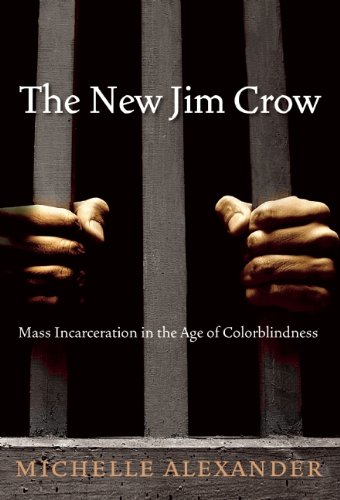
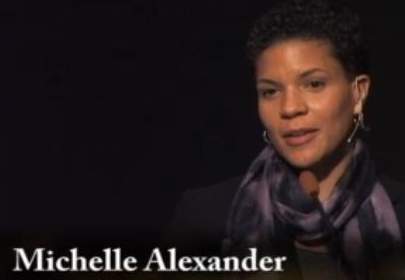
The New Jim Crow: Mass Incarceration in the Age of Colorblindness – Michelle Alexander
Michelle Alexander, author of the new book The New Jim Crow: Mass Incarceration in the Age of Colorblindness joins hosts. Michelle book has been called an incisive critique of racial caste system in America. As many celebrate the “triumph over race” with the election Barack Obama, the majority of young black men in the US are locked behind bars or permenantly labeled felons. Michelle Alexander, a former litigator who is a legal scholar, argues that the civil rights community—and all of us— are challenged to place mass incarceration at the forefront of a new movement for racial justice in America.
Michelle Alexander:
- I began in my own research to question the prevailing political media narrative about the reasons of people of color and ghetto communities cycle through the criminal justice system today, it is not as it appears.
- I argue that in a few decades after the collapse of Jim Crow, we as a nation, have managed to re-create as a racial caste in America, in some major American cities, the majority of African American men, are locked behind bars, labeled felons for life.
- Legally discriminated in employment, housing, access to education, and public benefits. We have not ended racial caste, we redesigned it.
- The Drug War was declared in relation to racial politics, not drug crime. About 30 million were arrested for drug offenses after the launch of the drug war. Most were for marijuana possession, now considered less harmful than alcohol or tobacco.
- Drug markets like American society generally are segregated by race and class
- The Supreme Court has made it virtually impossible for these cases to be brought.
- Baldus Study: McKleskey v Kemp
- Finding proof of conscious intentional discrimination is nearly impossible. Severe racial disparities are of no consequence, immunized not just the death penalty.
- I wrote this book, largely because I was deeply troubled by the failure of civil rights organizations and black leadership in this country to place mass incarceration and the war on drugs at the top of our racial justice agenda.
- Ten of millions of people in the United States are now regulated permanently to an under-caste, who are barred by law from seeking jobs or housing, public benefits, food stamps.
- Prisons have been holding many rural towns together as jobs have disappeared. The majority of people put behind bars are non-violent offenders. Every race suffers from this drug war, there are white people doing decades in prison for drug possession charges. The suffering of the drug crosses the color lines, and we got to be able to galvanize a level of public awareness and support.
- Something akin to a racial caste system is alive and well in the United States.
Guest – Professor Michelle Alexander, joined the OSU faculty in 2005. She holds a joint appointment with the Moritz College of Law and the Kirwan Institute for the Study of Race and Ethnicity. Prior to joining the OSU faculty, she was a member of the Stanford Law School faculty, where she served as Director of the Civil Rights Clinic.
Professor Alexander has significant experience in the field of civil rights advocacy and litigation. She has litigated civil rights cases in private practice as well as engaged in innovative litigation and advocacy efforts in the non-profit sector. For several years, Professor Alexander served as the Director of the Racial Justice Project for the ACLU of Northern California.
———
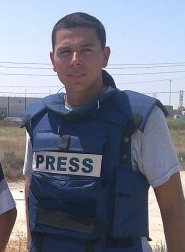


Ayman Mohyeldin, Al-Jazeera TV correspondent
Ayman joins hosts in the studio. He is an Al Jazeera TV correspondent and former CNN producer based in Baghdad. He was the only news producer allowed to observe and report on the US handover of Saddam Hussein to an Iraqi judge. Ayman has been stationed in the Gaza Strip since May 2008, where he has covered the Gaza siege. Ayman talks with hosts about his experience covering the destruction during Operation Cast Lead. Filmmakers and producers are working on a documentary film about Ayman’s war reporting in Palestine. Facebook link
Ayman Mohyeldin:
- Saturday December 27th, 2008, I had been based in Gaza. It had been quiet in Gaza up to November 4th.
- We started hearing the first wave of Israeli air-strikes that destroyed government buildings, police station within minutes. It kicked of a series of air strikes throughout the day. 200 hundred Palestinians were killed that day.
- We really saw everything, I can’t begin to describe the horrors of what we saw. On the first day we went to the main Gaza hospital.
- People of Gaza were trapped in a territory subjected to a very modern sophisticated, well trained and equipped Army.
- By Israel’s own admission rocket fire into Israel had dropped 98 percent 4 months ago (before Operation CastLead)
- What were the real reasons for the attack, the war was unnecessary given what was achieved in the 4 months prior.
- The siege on Gaza has allowed Hamas to tighten it’s grip on Gaza. The siege has not punished Hamas.
- Palestinians have recycled the rubber and steel from the destruction.
- I was standing on a rooftop and they were dropping hundreds of leaflets from planes, that read “your area is going to be attacked, if have any information about Hamas, please call this number.”
- Goldstone Report: Israel while bombing did not distinguish between military and civilian targets. Not a mistake.
- Targets include – Mosques, schools, ambulance drivers, government buildings, ministries, Palestinian Legislative Council Building.
- Gaza, historically was not an affluent place, it was a merchant trade route from Africa into Asia and Europe.
- Stunted growth is starting to appear among Palestinian children.
- Gaza: Desperate, frustrated, a sense of abandonment by the international community.
Guest- Ayman Mohyeldin, Arab American journalist based in the Middle East and is the Gaza Correspondent for the English language channel Al-Jazeera. Previously a producer with CNN and NBC, Ayman was one of the first western journalists allowed to enter and report on the handing over and trial of the deposed President of Iraq Saddam Hussein by the Iraqi Interim Government for crimes against humanity
———————-
Afghanistan War, Civil Liberties, FBI Intrusion, Habeas Corpus, Human Rights, Prison Industry, Surveillance, Targeting Muslims, Torture
Podcast: Play in new window | Download
Updates:
—–
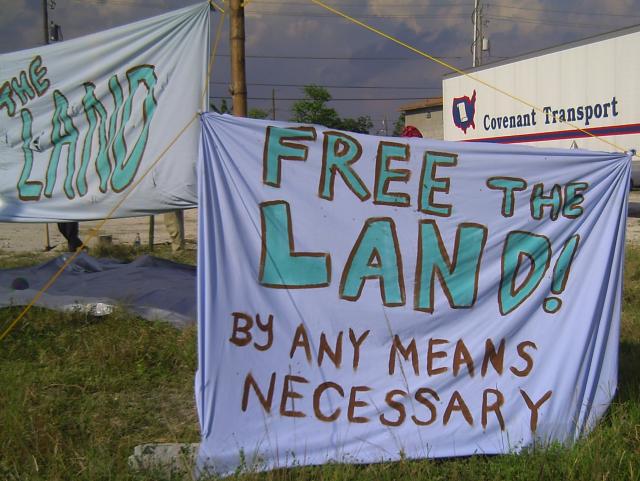
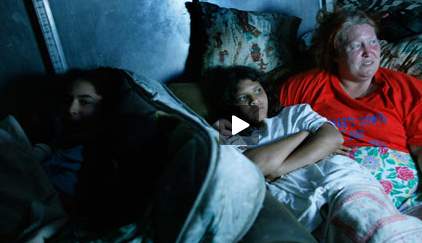
Take Back The Land and The Center For Constitutional Rights Delegation To South Africa
The national movement, Take Back the Land has demanded housing for the homeless in Miami, New York City and is in South Africa to engage in anti-eviction and land reform work. Lawyers with the Center for Constitutional Rights will also join Take Back the Land and provide legal support to the social justice movements. The two groups will be in Cape Town with the Anti-Eviction Campaign and 3 days in Durban with Abahlali bs Mjondolo or (ABM). Among the core beliefs of this project called the Center for Pan African Development are, land is an essential element of liberation, the black community must collectively control land in the black community and the path to liberation is pave through self-determination, not the accommodation of those in power.
Sunita Patel:
- The history of Apartheid is so connected to land and redistribution of land. We spent a few days in Cape Town with the Anti-Eviction Campaign. We traveled to Durban and visited with ABM there. Throughout the trip activists and community members had shared stories of displacement and mass evictions at the government’s hands, without any redress. We have a lot to learn from the movement in South Africa.
- In the United States, we can’t think beyond the private ownership of land.
- Housing is not a constitutionally protected right. Where we can gain from international human rights law, we need to infuse that into our work. The Universal Declaration of Human Rights, recognizes housing as a human right.
- South African Constitution states in articles 26 and 33 affording one house for one family.
Guest – CCR staff attorney, Sunita Patel is involved with racial profiling, immigrant rights and other human rights litigation. Prior to her position at CCR, she held a Soros Justice Fellowship at The Legal Aid Society, Immigration Law Unit in New York where she represented immigrant detainees in removal proceedings and worked with criminal justice and human rights groups to create independent community oversight for detention operations through public accountability boards.
————–
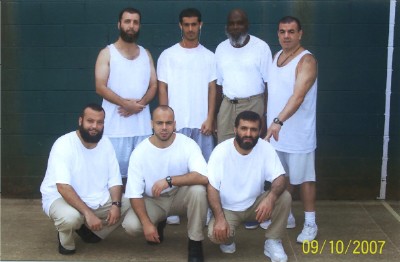

CCR Challenges Experimental Prison Units that Restrict Communication
The Center for Constitutional Rights filed a lawsuit challenging violations of fundamental constitutional rights, including the right to due process, at two experimental federal prison units called “Communications Management Units” (CMUs). The units are being used overwhelmingly to hold Muslim prisoners and prisoners with unpopular political beliefs.
CCR filed Aref v. Holder in the D.C. District Court on behalf of five current and former prisoners of the units in Terre Haute, IN and Marion, IL; two other plaintiffs are the spouses of prisoners. The CMUs were secretly opened under the Bush administration in 2006 and 2007 respectively and were designed to monitor and control the communications of certain prisoners and to isolate them from other prisoners and the outside world. More about Aref
Rachel Meeropol:
- It’s the first time we’ve seen units like this in the federal system. The Bureau of Prisons secretly created these prisons in 2006 and 2007 under the Bush Administration.
- The bureau of prisons initially offered a public comment period and were flooded with comments of what a bad idea this is. They withdrew the public comment and continued to build the prison in secret.
- There’s no meaningful process at all as to who should be put in this unit.
- The Bureau of Prisons has published very broad criteria about the types of individuals, it thinks belongs there.
- The criteria is so broad it could encompass tens of thousands of prisoners.
- When we look at who is being sent the unit, it’s mostly Middle Eastern Muslims, African Americans who have converted to Islam in prison, and also a lot of people with unpopular political views.
- One of our clients Daniel McGowan, is an environmental activist who is serving a term in prison. He never violated a prison rule, he was a low security prison for the first part of his sentence, and then without any reason, he is moved to this highly restricted unit.
- The CMU is an experiment in social isolation. Very few opportunities for visits. Uniquely cruel for individuals who have to undergo it.
- Bad public policy, these individuals are going to be released at some point.
- We are seeking to challenge the extreme limitations on their phone calls and visits.
- Most inmates get 300 minutes a month of phone calls, my clients for years had only one 15 minute call a week.
- For prisoners with large families, this is incredibly difficult. It seems to me this is truly about silencing advocacy from inside the prison.
- Some of our clients including Mr Aref were convicted on terrorism related charges, in his case material support.
- When prisons move prisoners into the CMU of extremely restricted confinement without any process or explanation, of course leads to putting prisoners in the CMU for discriminatory or retaliatory reasons.
Guest – Rachel Meeropol has worked at the Center for Constitutional Rights (CCR) since 2002. She is the co-editor and primary author of the Jailhouse Lawyers Handbook, a widely-requested resource for prisoners, and the editor of America’s Disappeared: Secret Imprisonment, Detainees, and the “War on Terror,” (Seven Stories Press, 2005).
—————–
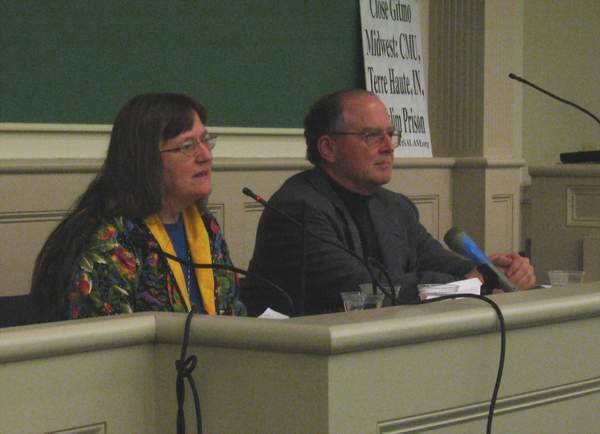
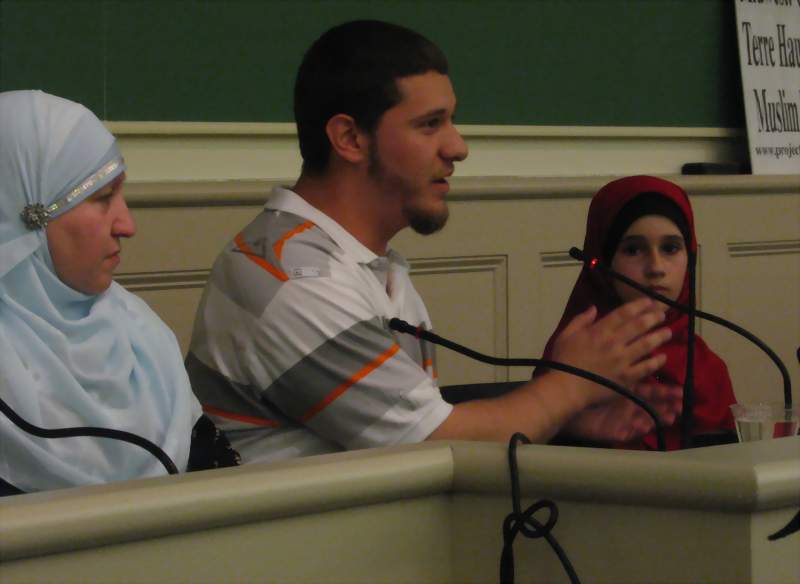
FBI Entrapment: Personal Stories of Preemptive Prosecution
We go now to hear segments from the event titled FBI Entrapment: Personal Stories of Preemptive Prosecution sponsored by the National Lawyers Guild, Middle Eastern Law Students Association (MELSA), Islamic Law Students Association (ILSA) and Law Students for Human Rights.
Families and community members gathered in a room at NYU to discuss their cases, and how their family members were entrapped by FBI informants and agent provocateur tactics. As we have reported in the past years, the FBI have used these tactics to target Muslims and others by offering money and assets within impoverished communities. Some FBI groups target mosques and incite violent action. Most informants are felons, that have made plea-deals with the FBI. As we have seen, these stories make headlines across the country on Memorial Day or the 4th of July, meanwhile, these men implicated in the FBI stings are serving long sentences. We get an inside perspective from their families. We hear from Lynne Jackson and Attorney Stephen Downs from Project Salam. We also hear from 12 year old Lejla Duka, and her cousin, family members with the Fort Dix Five case.
Lynne Jackson / Attorney Stephen Downs
- CCR filed Aref v. Holder in the D.C. District Court
- Aref/Hossain have left behind 2 families, 10 children, ranging in ages 4-16 years old.
- What is going on with our country?
- We formed Project Salam, we need to look at all these case together, there are hundreds of cases.
- We’ve had no response at all from President Obama or Attorney General Holder
- The Cheney one percent doctrine. If there is one percent chance that a Muslim will commit a terrorist act down the road you have to take them out.
- One of the worst things you can do as Muslim is be generous. The government made good use of the material support for terrorism statute.
- Certainly from my point of view, as a lawyer I assume every conversation I have is being monitored. I think all of you should to.
- Check out prisoner database at CMU’s (PDF)
Lynne Jackson, volunteer and co-founder of Project Salam, Attorney Stephen Downs, a retired New York State attorney and a volunteer attorney for the Yassin Aref case. Listen to last year’s Law and Disorder interview.
————————————————————————–
Gaza, Human Rights, Targeting Muslims, Truth to Power
Podcast: Play in new window | Download
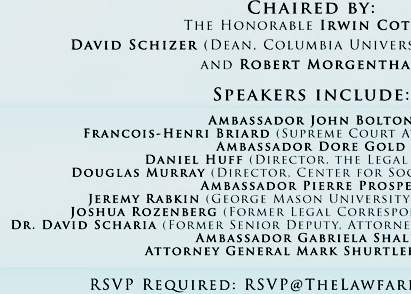
Inside the Lawfare Project: Netanyahu’s Attack on Human Rights NGO’s Hits the States
Earlier this month, the Lawfare Project, a not-for-profit organization described as dedicated to raising awareness about the abuse of the law and legal systems, held an event at the New York Lawyers Association. The project’s goals state: to facilitate a response to the perversion and misapplication of human rights law, mobilize resources and bring interested parties together in a common forum.
Max Blumenthal, award-winning journalist, was there, and reports back in his recent article, Inside the Lawfare Project: Netanyahu’s Attack on Human Rights NGO’s Hits the States. Our own Michael Ratner and the Center for Constitutional Rights was also a target. Blumenthal writes, The Center for Constitutional Rights was singled out because its founder, Michael Ratner, went on the recent Gaza Freedom March with Code Pink. None of the factual documentation these groups released was challenged by the NGO Monitor report or in Herzberg’s presentation. Instead, the groups and their leadership are being targeted with a scattershot of accusations that recall McCarthyism in its crudest form.
Max Blumenthal:
- This conference was convened at the New York Lawyers Association, with the Dean of the Columbia University Law School presiding over it.
- Politicians, neo-conservative think tank heads, and Israeli high officials, convening basically to bash the Goldstone Report which they consider to be the zenith of law fare against Israel.
- To bash the human rights groups that contributed data to the Goldstone Report.
- Law fare: Using law as a means to conduct foreign policy. Past manifestations of law fare, used by British to legitimatize laws to break up their colonies.
- Law fare Project, singled out human rights groups such as the Center for Constitutional Rights and Michael Ratner
- Israel is going further and further outside of the scope of international law. Instead of Israel having to deny charges of war crimes in a public forum they attack Judge Goldstone.
- PR firms associated with the Lawfare Project. 5wPR, which used to represent birth right of Israel. The firm is run by Ronn Torossian, who has been involved with settler attacks on Palestinians.
- They’re being funded by the law firm of Pat Robertson. The American Center for Law and Justice.
- This is I think really an effort of public diplomacy by the Israeli government funded by right wing Jewish and Christian Zionists interests.
- The NGO monitor headed by Gerald Steinberg, who is notorious in helping to de-fund, and de-legitimatize all Israel human rights groups. Israel had its first human rights march this year.
- Human rights group members in Israel, have their homes graffit’d with “price tag”, settler slang for you’ll be assassinated.
- In addition, you Michael Ratner were singled out as a traitor to the United States of America, openly and you’re in this NGO monitor black list. Put together by NGO monitor legal advisor, Ann Herzberg, you are accused of NGO lawfare. You and Human Rights Watch.
- We heard David Matas who is a Canadian lawyer, says this is equivalent to anti-Semitic gangs beating up Jews in the street, – – because International law is the legacy of the holocaust, it should always side with Israel.
- Michael Ratner: Israel wants an exemption. I’ve gone after human rights violaters in nearly every country in the world. We do a little bit of work on human rights violations in Gaza and the West Bank and all of a sudden I’m an enemy of United States, I’m anti-Semitic.
- They’re seeking emotional and subtle ethnic justification for their defense without debating the Goldstone Report.
- I think it puts Jews in danger, when they claim the Gaza assault which killed more than 700 civilians is somehow a reflection of the Jewish ethos.
- The image of it is intended to intimidate those who want to speak out, especially in the Jewish community but haven’t done so yet. We sound hopeful on this show, but this is a time for deep, deep concern.
- People are wondering, where’s the Palestinian Ghandi? My father was a White House advisor, my mother worked in the White House, my father worked in the Washington Press Corp Israel is in the grip of a mass psychosis.
- In the youth of Israel, we’re seeing a trend in favoring apartheid.
Guest – Max Blumenthal, award-winning journalist and bestselling author whose articles and video documentaries have appeared in The New York Times, The Los Angeles Times, The Daily Beast, The Nation, The Huffington Post, Salon.com, Al Jazeera English and many other publications. He is a writing fellow for the Nation Institute. His book, Republican Gomorrah: Inside The Movement That Shattered The Party, is a New York Times and Los Angeles Times bestseller.
———
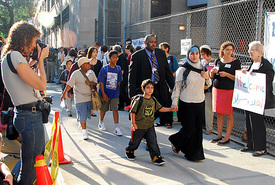
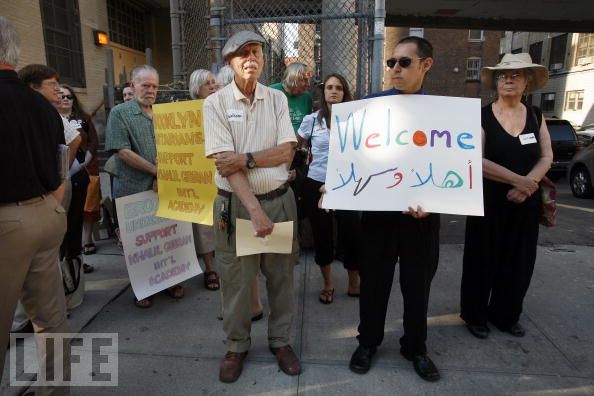
Khalil Gibran International Academy Principal Discriminated Against.
Last week the Equal Employment Opportunity Commission found that the Department of Education discriminated against interim principal Debbie Almontaser in 2007 when they forced her to resign from Khalil Gibran International Academy. The school was envisioned to provide knowledge and understanding of Arab language and culture and controversy arose before its doors opened. As we covered in November of 2007, Almontaser was forced to resign after she was quoted explaining in the New York Post that the word “intifada” literally means “shaking off” in Arabic. This was in reference to a controversy stirring over a t-shirt that read “Intifada NYC” created and worn by a group called Arab Women Active in the Arts and Media. Almontaser came under criticism by the community for not denouncing it. The EEOC ruling calls on the Department of Education to reach a “just resolution” as well as meet Almontaser’s demand, of a reinstatement, back pay, damages and legal costs. Communities In Support of KGIA
Alan Levine / Mona Eldahry:
- DOE had capitulated to mob pressure, to community prejudice, when the firestorm erupted after the New York Post article, August 2007.
- DOE, instead of quelling the fire, days went by and the fire grew. Debbie Almontaser’s qualifications were questioned, she was told if she didn’t resign the school would be closed.
- Debbie was out of central casting for the position, she couldn’t have been more perfect for it. The DOE knew about that record, that’s why they selected Debbie as principal for Khalil Gibran International Academy.
- The EEOC found that because the DOE capitulated, they became the discriminator.
- Mona : The t-shirts in question, had nothing to do with Debbie, but somehow she was associated with them. The DOE required Debbie to do this interview with the New York Post, not with the Times.
- The Post misquoted and misrepresented her as the EEOC found.
- Alan: The DOE had succumbed to the kind of prejudice that the Khalil Gibran International Academy was intended to dispel.
- The claim is based on that Debbie Almontaser was attacked by a bigoted community based on being an American Muslim and a government agency to its great shame capitulated to that prejudice.
- Certainly the DOE could have expected a strong reaction from the Arab-American community.
- Alan: The DOE investigation is accessible to us, what people said in this investigation will be part of the record in this case (federal) The EEOC is the premier agency in the country for evaluating employment discrimination claims.
Guests, attorney Alan Levine and Mona Eldahry, co-founder of Arab Women Active In the Arts.
——————————————————–
Afghanistan War, Civil Liberties, Gaza, Human Rights, Iraq Veterans, Iraq War, Targeting Muslims, Torture, Truth to Power
Podcast: Play in new window | Download
Updates:
—
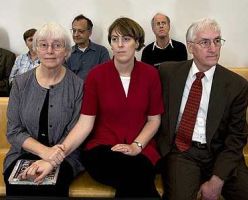
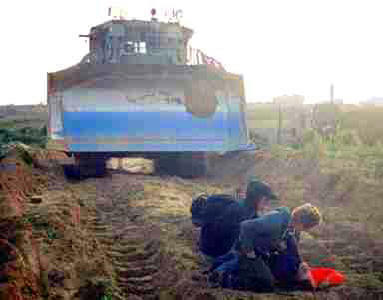
Rachel Corrie wrongful death v Israel
This month, the Haifa District Court in Israel will begin hearing eyewitness testimonies in a civil lawsuit filed in 2005 by Rachel Corrie’s family against the State of Israel for her unlawful killing in Rafah, Gaza. On March 16, 2003, Rachel was crushed to death by a Caterpillar D9R bulldozer while trying to protect the home of a Palestinian doctor from demolition. She was run over and killed by an IDF soldier who was operating the bulldozer. Seven years later, Rachel’s parents are still seeking the truth. The trial is expected to show the circumstances of her death and hold the Israeli military reponsible. Four eyewitnesses to Rachel’s killing have been recently granted visas by Israel to testify but Israel is refusing to allow the Palestinian doctor who treated Rachel and confirmed her death into Israel.
Maria LaHood:
- CCR represented Rachel Corrie in the United States because she was run over by a Caterpillar bulldozer. The same month in 2005, the Corries brought a suit against Israel, in Israel for the killing.
- This suit was on the advice of the US State Department. You can sue Israel, the country. Israel claims immunity.
- Israel’s defense that the bulldozer driver couldn’t see Rachel Corrie in the bright orange jacket.
- Expert witness says Israel’s heavy machinery operator policy says do not use around people.
- Rachel was defending the home and the bulldozer crushed her. Rachel was with the International Solidarity Movement. The Corrie family will present their evidence to the Israeli court and then there’s a 30 day break in the trial. This is not a jury trial, it is before a judge. Corries are asking for information, and accountability.
- In the attacks of Gaza a year ago, more than 4000 houses were demolished.
- Someone was filming at the border at the time of Rachel’s death, the actual part of the tape where she was crushed is missing.
- Mamilla Cemetery Case Update: We’ve asked the special rapporteurs of the United Nations to intervene.
- Michael Ratner: It does seem to be intentionally provocative. To be doing this on a cemetery and calling it the “Center for Tolerance” MamillaCampaign website.
Guest – Staff attorney Maria LaHood. Maria specializes in international human rights litigation, seeking to hold government officials and corporations accountable for torture, extrajudicial killings, and war crimes abroad. Her cases include Arar v. Ashcroft, against U.S. officials for sending Canadian citizen Maher Arar to Syria where he was tortured and detained for a year; Matar v. Dichter, against an Israeli official responsible for a “targeted assassination” that killed 15 Palestinians; Belhas v. Ya’alon, against a former Israeli official responsible for the 1996 shelling of a United Nations compound in Qana, Lebanon, that killed over 100 civilians; Corrie v. Caterpillar, on behalf of Palestinians killed and injured in home demolitions, and Rachel Corrie, a U.S. human rights defender who was killed trying to protect a home from being demolished.
———–
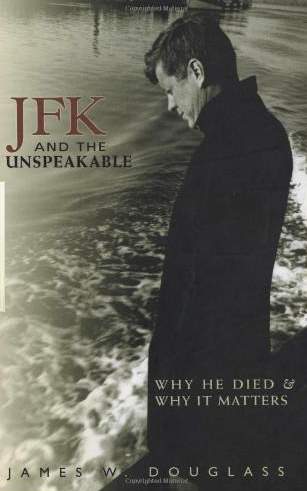
JFK and the Unspeakable: Why He Died and Why It Matters by Jim Douglass
JFK, The Unspeakable, is the first book of 3 on the assassinations of the 1960s. Orbis Books has commissioned author James W. Douglass to write about the murders of JFK, Malcolm X and Martin Luther King, and his the third will be on the assassination of Bobby Kennedy. The heart of JFK the Unthinkable, is not how Kennedy was killed or how Kennedy became a threat to the systemic war machine, but why DID Kennedy die? Author James Douglass says Kennedy knew that he would die and had the guts to stand up to the system and take the hit. This narrative was lost for decades, obscured by disinformation about Kennedy’s character and the conspiracy of his assassination. One review summarizes Douglass’s book in this way : JFK’s belated effort to turn America from an armed culture of victory to a member of an international peaceful world was shot down in Texas for a reason.
Jim Douglass:
- John F. Kennedy’s experience in WWII: He was in the South Pacific, he volunteered. He was on that PT boat.
- What happened on that PT boat, is that it got split into two by a Japanese destroyer. He lost brothers and friends at that time. An extraordinary experience being adrift on the ocean warning other PT boats. The experience create a distrust in military authority.
- He said that he wanted to splinter the CIA into a thousand pieces and scatter to the winds.
- As Kennedy said to his friends, “they figured me all wrong.”
- The Unspeakable: the kind of evil and deceit that seems to go beyond the capacity of words to describe. The midst of war and nuclear arms race, the assassinations of Kennedy, Martin Luther King and Malcom X that the term was used.
- JFK’s vision is articulated in the address June 10, 1963, arising from the turnaround of the missile crisis and Bay of Pigs.
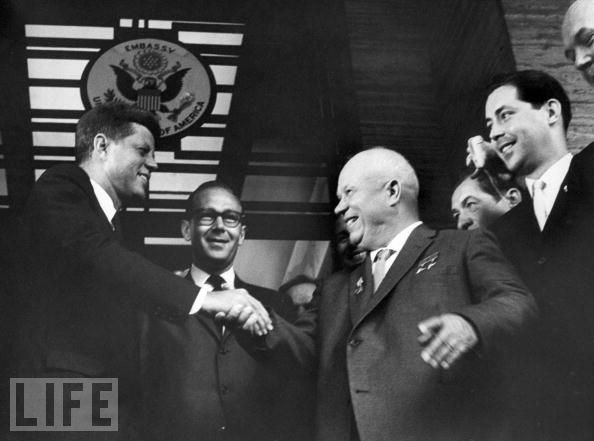
- He wanted to move step by step into a disarmed world. Nikita Khrushchev put that speech all over the Soviet Union. The Cuban Missile Crisis is a deeply misunderstood part of our history, because it’s usually portrayed as Kennedy going to war with Nikita Khrushchev and beating him.
- The truth was that Kennedy and Nikita Khrushchev were in over their heads, the US generals wanted nuclear war, because they had more warheads than the Soviets.
- Nikita Khrushchev: We now have a common enemy from those pushing us toward war.
- At that point the Cold War turned upside down because Kennedy and Khruschev became closer to each other than either was toward their own military power system.
- Vietnam: Kennedy’s military people would not give him an exit policy. He signed the withdrawal order from Vietnam before he was assassinated.
- His friends said that he had an obsession with death. It was not an obsession but a real assessment that he was going to die. If you try to turn around a national security state that is dominating the world,
- and you do so as president of the United States, of course you’re going to die. Kennedy knew that.
- The book is a story on the deliberate destruction of hope, the vision of change, a turning of this country all of which was happening and had to be stopped. US Agencies killed Dr. Martin Luther King – 1999 Verdict
- We’re in the same scene right now with Petraeus and McChrystal setting up Obama. They were dictating terms to Obama, unlike Kennedy, he did not face them down.
- We need to get out ahead of Obama so that he can do something.
Guest -author, James W. Douglass. He’s a longtime peace activist and writer. James and his wife Shelley are co-founders of the Ground Zero Center for Nonviolent Action in Poulsbo, Washington, and Mary’s House, a Catholic Worker house of hospitality in Birmingham, Alabama.
—————————
Civil Liberties, Criminalizing Dissent, Gaza, Human Rights, Prosecution of the Bush Administration, Supreme Court, Surveillance, Targeting Muslims, Torture
Podcast: Play in new window | Download
Updates:
—
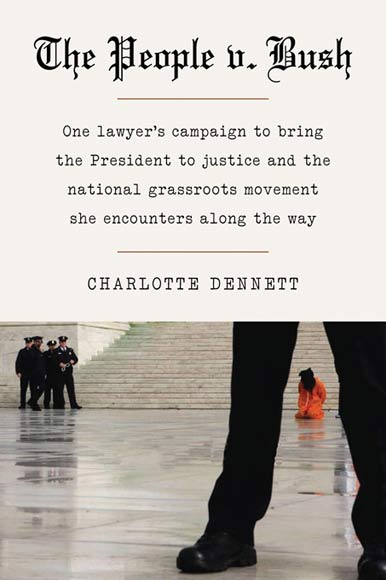
People v Bush, Charlotte Dennett
Today we talk with former Vermont Attorney General Candidate Charlotte Dennett. Listeners may remember Charlotte ran for office of Attorney General on the platform that if elected she would immediately undertake the prosecution of George W. Bush for the unnecessary deaths of Vermont soldiers in Iraq. The strategy was to establish jurisdiction in the cases for Attorneys General in each state as outlined in The Prosecution of George W. Bush for Murder, written by former prosecutor Vincent Bugliosi. Charlotte Dennett didn’t get the votes to become Vermont’s new attorney general. Now, a year later Charlotte describes from an inside perspective the “accountability movement” in her new book titled The People v. Bush. Is impeachment or prosecution still off the table?
Charlotte Dennett:
- If we don’t act on them now, then the impunity will get worse, we have to clamour for Cheney’s prosecution. We’ve got to keep the pressure on the department of justice. We know that the Spanish prosecutors have done that.
- I’ve come to realize that Obama’s mantra that we have to move forward and not look backward is really translated into: Don’t Prosecute.
- Brennan who was involved with crafting torture policy is playing a role advising Obama not to prosecute.
- It’s up to the accountability movement to step forward. There are going to be major events on March 20th, the anniversary of the war on Iraq.
- In my book the People v. Bush, I’ve got 10 pages in the appendix of all the different resources that people can turn to, to pressure Congress, sign petitions.
- The first half of the book is about my campaign for attorney general in Vermont, where I pledged to prosecute Bush for murder. I also lay out the evidence of how we can still do this, we can still do this by the way.
- I became hooked on accountability, this is a struggle for democracy and the soul of our nation.
- The book also looks at how the Obama Administration deals with the crimes of its predecessors.
- I have to tell you Michael Ratner, you were one of the first people to start raising the alarms (Obama Administration). My book shows the gradual shock and disillusionment of his supporters.
- People are upset that John Yoo, is doing talk shows, he showed up on John Stewart recently (OUCH)
- Regarding Sen. Leahy of Vermont: I tracked his effort to put together a truth commission and not prosecution. There were 37 towns in Vermont, that in their town meetings, voted for impeachment.
Guest – Charlotte Dennett, is an author and attorney who resides in Cambridge Vermont. She and her husband, Gerard Colby, have lived in Vermont since 1984. Charlotte has been practicing law since 1997, representing injured Vermonters in negligence, medical malpractice and wrongful death cases, as well as civil rights litigation and family law, and has argued before the Vermont Supreme Court.
——-

Lawyers You’ll Like: Center For Constitutional Rights Legal Director, Bill Quiqley
This week, CCR Legal Director Bill Quigley joined Law and Disorder hosts during a marathon 3 hour fund raiser for Pacifica’s WBAI. Bill talked about his trip to Gaza during Operation Cast Lead, his recent trip to Haiti and his death penalty work in Louisiana.
Bill Quigley:
- I went to Gaza with activist Audrey Stewart and Kathy Kelly, an International Peace Activist.
- We went over there, a year ago January, while the bombing was still going on. We were on the Egyptian side of the border where we could see the bombing of Gaza
- There were constant drones going over head, they had aerial balloons that were doing surveillance. It was sort of like a sociopath beating a baby. There was no defense, there was no anti-aircraft, people were literally sitting ducks.
- In my life, it compared to a time when one of my clients was being executed, in death row in Louisiana. To see the apparatus of the state, move into action, very calm, step by step.
- Then with full force and the respect of state behind it, pull on a switch and my client was no more. (at that time) It was a surprise that anyone in the U.S. would support the Palestinians.
- Death Penalty: there really is a community of deathy penalty advocates who train themselves how to communicate with juries. It is trending in the right direction by it still continues as a terrible tool, that the state has an opportunity to use when they choose to.
- Stop and frisk case update: New York is fighting this every step of the way. The term they use to justify this is: Furtive activity
- Culture of Intimidation: If young men don’t look at them the way they want to be looked at, if people don’t recognize their presence with the kind of respect that the police department thinks that they’re entitled to by the mere fact that they’re wearing a uniform and carrying a weapon.
- It is something that clearly could stop if the message was sent from the top.
- But clearly something has a green light from the top to engage in this. Authoritarian order that inconsistent with law and order, with the constitution.
- Endemic: If you have a society that values violence, the violence we institute around the world, the way we support Israel, the way they deal with Palestine. If we value deep racism, then what else what would we expect from a police or a military. The police and military are tools of a violent and racist regime.
- Part of our job is to re-educate police officers. We are going to be engaged in this activity over again, in every city in the country in varying degrees. The root problem is that we have a racist and violent criminal justice system, education system, a racist and marginalizing housing system, employment system.
- Most people don’t have the educational opportunities to know what’s going on with Haiti, Gaza, Iraq and even within our own country. Haiti: You could travel for miles and see no indication that international community even cared about what happened in Haiti. Most people were under a sheet or a blanket, could break some of the sun.
Guest – Bill Quigley. Bill is the Legal Director for the Center for Constitutional Rights, a national legal and educational organization dedicated to advancing and defending the rights guaranteed by the United States Constitution and the Universal Declaration of Human Rights. Bill joined CCR on sabbatical from his position as law professor and Director of the Law Clinic and the Gillis Long Poverty Law Center at Loyola University New Orleans. He has been an active public interest lawyer since 1977.
———————————————-