Civil Liberties, Criminalizing Dissent, Habeas Corpus, Human Rights, Iraq War, Supreme Court, Targeting Muslims, Torture, Truth to Power
Podcast: Play in new window | Download
Updates:
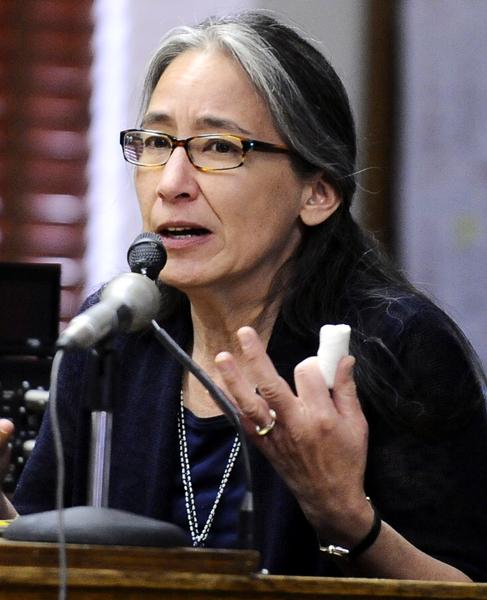
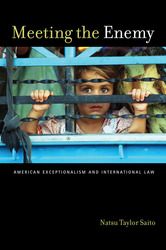
Natsu Saito, Meeting the Enemy: American Exceptionalism and International Law
Meeting the Enemy: American Exceptionalism and International Law is the title of Natsu Saito’s recent book, Natsu is an attorney and professor of Law at Georgia State University’s College of Law in Atlanta. The book boldly points out how the United States violated international law since its declaration of independence. As often discussed here on Law and Disorder, international courts and institutions have been at the forefront of holding the torture conspirators accountable. Meeting the Enemy gives disturbing insight into the origins of American exceptionalism.
Natsu Saito:
- The duality is that the US does exempt itself (from international law) very consistently and very frequently and yet promotes international law very strongly and relies upon it.
- It has relied upon certain premises that are fundamental to the whole outlook and paradigm of colonialism – which is that there is a higher good, a more civilized approach the US embodies.
- The law doesn’t apply because we have a higher aim of civilization and that justifies not playing by the rules.
- The United States making others comply with human rights standards while exempting itself.
- Moving humanity toward this higher goal is so critical because if you strip that away and you look at the realities on the ground, you see what has been termed Western civilization has been incredibly barbaric.
- In order to get around that analysis, you have to say it was for a higher good.
- I think the “left” tends to accept the general framework, and to make particular criticisms of policies and practices that are obviously problematic. The US government engaging in torture for example, but each instant is accepted as anomalous instead of the larger picture.
- It is too frightening even for the people on the left to deal with the reality that this is a country that sits on occupied land, illegally occupied by its own rules. People on the left want to make it a kinder, gentler colonialism.
- I started out thinking I was writing a book about the failure of the United States failure to comply with international law, as I got into it, the more interesting questions were the push / pull dynamics between reliance on international law
- The current system of international law evolved from the international law which was the agreement between the European colonial powers of how they were not going to destroy each other in the process of taking over the rest of the world.
Guest – Natsu Taylor Saito teaches international law and human rights, race and the law, immigration, criminal procedure, and professional responsibility, and is an advisor to the Asian American Law Student Association and the Hispanic Student Bar Association. Professor Saito’s scholarship focuses on the legal history of race in the United States, the plenary power doctrine as applied to immigrants, American Indians, and U.S. territorial possessions, and the human rights implications of U.S. governmental policies, particularly with regard to the suppression of political dissent. Read more.
——-
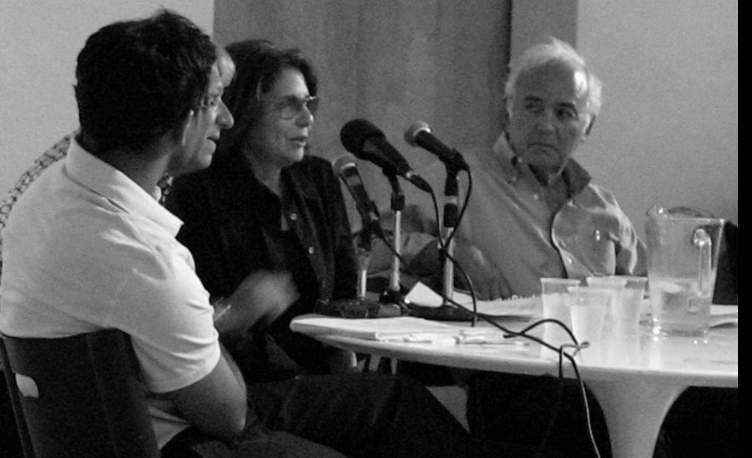
Elena Kagan and the Supremes – Brecht Forum
We hear excerpts from a discussion on the confirmation hearings of Elena Kagan, and how her position may influence the direction of the Supreme Court.
Panelists:
Martin Garbus – one of the country’s leading trial lawyers. Mr. Garbus aggressively represents his clients in the courts and in the media. He has appeared before the United States Supreme Court as well as the highest state and federal courts in the nation. His devotion to ethics, justice and the law has earned him respect among the legal community and beyond as well as prominent awards. Time Magazine has named him “legendary . . . one of the best trial lawyers in the country,” while Newsweek , the National Law Journal and other media agree that Mr. Garbus is America’s “most prominent First Amendment lawyer,” with an “extraordinarily diverse practice.” The National Law Journal named him one of the country’s top ten litigators.
Margaret Ratner Kunstler – former Educational Director at the Center for Constitutional Rights. She’s an attorney and leads the New York City chapter of the National Lawyers Guild and heads the William Moses Kunstler Fund for Racial Justice.
Anand Swaminathan – an associate at Vladeck, Waldman, Elias & Engelhard, P.C. He graduated from the University of Wisconsin in 2001 and the Harvard Law School in 2006. Prior to joining Vladeck he was a law clerk for the Honorable Theodore H. Katz of the United States District Court for the Southern District of New York.
Michael Steven Smith – Law and Disorder co-host, author and New York attorney. Michael Steven Smith is the author, editor, and co-editor of six books, including “The Emerging Police State,” by William M. Kunstler. He has testified before committees of the United States Congress and the United Nations on human rights issues. Mr. Smith lives and practices law in New York City with his wife Debby, where on behalf of seriously injured persons he sues insurance companies and occasionally the New York City Police Department.
———————
Civil Liberties, Guantanamo, Habeas Corpus, Human Rights, Targeting Muslims, Torture, Truth to Power
Podcast: Play in new window | Download
Updates:
—

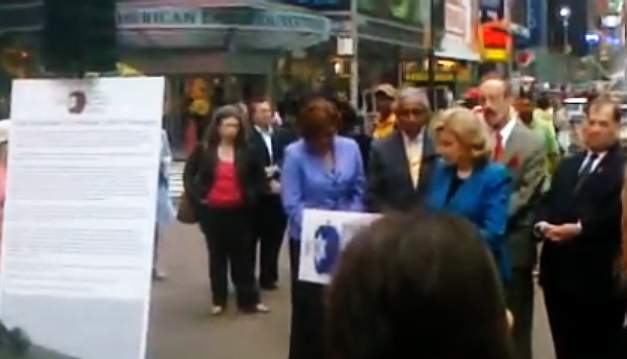
Mavi Marmara Survivors Have A Right To Be Heard
Last week, two eyewitnesses who were aboard the Turkish ship that was stormed by Israeli Naval Commandos told their stories at the Brooklyn’s historic House of the Lord Church. As many listeners know 9 unarmed passengers were murdered, the oldest, Ibrahim Bilgen, was 61, the youngest was 19, a U.S. citizen born in Troy , N.Y. This speaking event almost didn’t happen. Last Monday, June 14, City Council speaker Christine Quinn, Reps. Jerry Nadler, Anthony Weiner, Carolyn Mahoney, Charles Rangel and others, gathered in Times Square to demand the State Department investigate the invited speakers for “ties to terrorism.” They want to prevent or delay their entry the United States. Video
Bill Doares:
- U.S. filmmaker Iara Lee and British political organizer Kevin Ovenden, and Ahmet Unsal, a former Member of Turkey’s Parliament
- Their hands in my opinion are dripping with blood. Anthony Weiner actually called those on the ships “terrorists.” IHH Turkish Charity
- Every bullet fired by Israel is paid for by the United States.
Guest – Bill Doars with New York Labor Against the War / Al-AWDA New York
——–
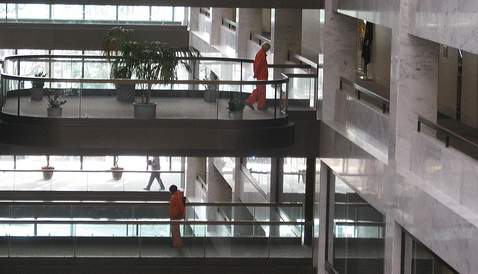
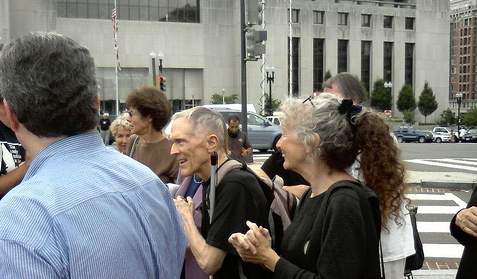
24 Anti-Torture Activists Acquitted
Last week, 24 anti-torture activists were acquitted in trial for protesting at the US Capitol, calling for Guantanamo’s closure and an investigation of deaths at the prisoner detention camp. The activists were aquitted of charges of (quote) unlawful entry with disorderly conduct which stemmed from demonstrations in January 21 of this year. The date President Obama promised to close Guantanamo prison. “With his decision, the judge validated the effort of the demonstrators to condemn the ongoing crime of indefinite detention at Guantanamo,” says Bill Quigley, legal adviser to the defendants and the Legal Director of the Center for Constitutional Rights. FDL story
Bill Quigley:
- There was a big protest on the day that Guantanamo Bay prison was supposed to be closed by Witness Against Torture.
- Witness Against Torture started in 2005 by going to Cuba and marching to the gates of Guantanamo asking that the people there be released.
- In January this year they had a number of people who did a water-only fast for 11 days, it ended on January 21, 2010. They put 20 something people on the steps of the Capitol who were in orange jump suits and black hoods, unfurled a banner with rose petals in the rotunda.
- About 35 people were arrested that day. They were charged with unlawful assembly with intent to breach the peace. The trial was last week, and they were given the option of paying a 50.00 fine. Most wanted to go to court and put Guantanamo on trial in the superior court.
- I prepared and argued for a necessity defense, an international law defense and the importance of the first amendment to what they were doing. I analagized their conduct to the people who resisted in Germany, the illegal crimes of Hitler and the like, the responsibility of citizens to challenge the crimes of their government.
- I think the judge didn’t want to get involved with this (activist work globally to shut down Guantanamo)
- Maybe a sign for a chance to turn the tide.
Guest – Bill Quigley, Legal Director for the Center for Constitutional Rights, a national legal and educational organization dedicated to advancing and defending the rights guaranteed by the United States Constitution and the Universal Declaration of Human Rights. Bill joined CCR on sabbatical from his position as law professor and Director of the Law Clinic and the Gillis Long Poverty Law Center at Loyola University New Orleans. He has been an active public interest lawyer since 1977.
——-
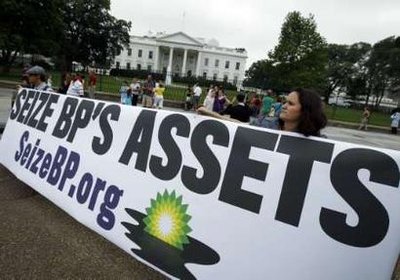

Seize British Petroleum Assets
As the blood red crude oil continues to gush from the bottom of the Gulf of Mexico, many industries and communities are being hit hard economically and environmentally. Meanwhile British Petroleum, Haliburton and Trans-ocean sidestep compensation and trade blame. Organizers of the Seize BP campaign say their demand is straightforward, “Seize assets of BP sufficient to compensate the people they harm.” There are several paths to compensation says Carl Messineo, attorney with the Partnership for Civil Justice and organizer of the Seize BP group. First, the BP claims process whereby BP determines what to cover and how much to pay. On this road all power rests with BP. Second, through the courts, where people can file litigation and lawsuits against BP. Both BP and the Obama administration want to push everyone seeking compensation down these two paths, but these two paths lead nowhere.
Third, the seizure of BP’s assets in an amount commensurate with estimated damages and the delivery of immediate and ongoing compensation to all those who have suffered and will suffer lost jobs, wages and business for years to come.
Attorney Carl Messineo:
- Seize BP is a campaign that was started of course a few weeks ago, around a single, simple demand, which is the US government needs to seize assets of BP. Place them in trust and make them immediately available for people in the Gulf coast who are in severe desperation at this time.
- People can’t pay the mortgage with rhetoric, they can’t eat rhetoric. The Obama administration can choose to take action. They can seize assets of BP.
- The president of the United States needs to request that Tony Hayward to please set aside some money? The president has legal authority, the Congress has legal authority. They can compel action.
- That’s their responsibility. Obama has acted like the calm captain of corporate interest within his presidency.
- He funneled health care through the corporations. Instead of serving the people, he’s really been subservient to corporate interest. This is a defining moment for his presidency.
- BP was the responsible party, this was avoidable, why do we turn to BP and ask them “please?”
- Right now, we know that BP can put aside 20 billion dollars. This is the same corporation that chose not to put the 500 thousand dollar safety valve.
- The US government has decided over the years to be willingly incompetent. This is something that they admit. They are incompetent technologically and using government resources.
- Obama can’t say that this is inertia from the bad policy of George Bush. He made personal decisions to expand offshore oil drilling. His administration is no worse than the others. There’s no change.
- Accidents happen, that’s why there needs to be independent redundant systems to respond to catastrophes.
- BP is a profit maximizer. It’s goal is to make as much money as possible, to limit its expenditures in order to maximize its profits.
- These handful of individuals hold in their hand, the safety and the ecology of clearly between 5 and 10 coastal states. It can’t be left to the profit making decisions.
- The largest share and holder of BP is the Chase Bank.
Guest – Attorney Carl Messineo with the Partnership for Civil Justice and organizer of SeizeBP
————————————-
Afghanistan War, Civil Liberties, Habeas Corpus, Human Rights, Surveillance, Targeting Muslims, Torture, Truth to Power
Podcast: Play in new window | Download

No End In Sight, Number One In War
What will you remember on Memorial Day? US law officially proclaims Memorial Day “as a day of prayer for permanent peace.” – However, the US is much closer to permanent war than permanent peace – writes Bill Quigley, legal director of the Center for Constitutional Rights in his recent article titled No End In Sight, Number One In War. The article outlines, the rising costs of war, the damage to country and who reaping massive profits. At what point do we begin to transition to permanent peace?
Bill Quigley:
- Yes, politicians are making hay from the permanent war, but there’s also a lot of people who are making an awful lot of money from the US military.
- We discount the role they’re playing, in keeping the US constantly fearful and preparing for and perpetrating war in every place across the globe.
- This is something that people are afraid to talk about.
- The “Axis of Evil” spends less than one percent of what the US spends. This coming year the US will spend 708 billion dollars on war and another $125 billion for Veterans Affairs.
- Al-Qaeda spends less than one percent of one percent of what the US spends.
- You have to ask yourself “why?” Why are people in the United States more afraid than anybody in the whole world? Fanning the flames of fear. Behind the scenes are huge corporations that are making billions of dollars.
- We talk about Blackwater, but there are a couple corporations that dwarf Blackwater.
- Lockheed Martin, a huge corporation that runs almost entirely on tax payer money. 140 thousand employees.
- A corporation totally reliant on the United States Congress. You spend 125 thousand lobbying Congress and Congress doesn’t get some benefit from that.
- The US is spending 10 times more on the military than China. Who is calling for accountability on this spending?
Guest – Bill Quigley. Bill is the Legal Director for the Center for Constitutional Rights, a national legal and educational organization dedicated to advancing and defending the rights guaranteed by the United States Constitution and the Universal Declaration of Human Rights. Bill joined CCR on sabbatical from his position as law professor and Director of the Law Clinic and the Gillis Long Poverty Law Center at Loyola University New Orleans. He has been an active public interest lawyer since 1977.
—


End The Korean War
Hosts get an update on the uneasy tensions between North and South Korea. A multinational investigation concluded last week that a North Korean submarine had torpedoed the 1200 ton warship called the Cheonan back in March killing 45 people. North Korea denies involvement in the sinking, South Korean defense ministry denies that any of its ships had crossed “Northern Limit Line.” Meanwhile, the threat of sanctions against the already oppressed North Korean population escalate. South Korea and the Obama administration have agreed to initiate joint anti-submarine military exercises near North Korean border. Right now, there are almost 29,000 U.S. troops in South Korea.
Eric Sirotkin:
- When you look into the history of the conflict, and we are still technically at war, as an armistice doesn’t technically end a war only stops the shooting.
- These kind of incidences occur because you don’t have a peace regimen to fall back on.
- There is a very conservative South Korean government. Very hawkish toward the North
- The intitial report of them torpedoing the boat, there are a lot of questions, there are people who are writing about Tonkin Bay, and thinking about.
- You have a choice to march toward war or go toward peace.
- The United States at this point is ramping up the rhetoric.
- Before this situation with the South and the North, we had a lot more exchanges and things were going in a positive direction. If you think there’s no exit strategy after Iraq, look at Korea, sixty years later.
- We’re working with a campaign to end the Korean War.
Guest – Attorney Eric Sirotkin, is a member of the National Lawyers Guild and helped found Korean Peace Project. Eric Sirotkin, the founder and Director of Ubuntuworks, LLC mixes his experience as a human rights lawyer, film producer, author and peacemaker. Over the years his peacemaking activities have taken him around the world, including India, Peru, Cuba, South Africa, Japan, North and South Korea, France, Netherlands, Canada and China. He contributed to dialogue on the new Constitution in South Africa, was a UN sponsored election observer at President Mandela’s election and coordinated an international monitoring Project of the South African Truth and Reconciliation Commission.
——


Omar Khadr, First Military Commission Trial Under Obama
Last week the first military tribunal opened under the Obama administration. It is the case of Omar Khadr, the Canadian citizen, military prosecutors say that Omar Kadr threw a grenade that killed a US Special Forces medic in Afghanistan and helped build roadside bombs to use against American soldiers. We look at why the Obama Administration is putting a detainee on trial who was 15 when he was captured and whether the self – incriminating statements he has made can be used as evidence. Unless the Prime Minister acts to request repatriation, Khadr could face conviction by a jury of U.S. military officers based on evidence extracted by torture.
Attorney Jonathan Hafetz:
- International law is very clear on how you treat child soldiers. In 2001, military commissions were struck down by the Supreme Court, in 2006 in the Hamdan Case, Congress created them again.
- The hope was that Obama was going to close this chapter and end military commissions.
- Obama suspended military commissions for 4 months and brought it back.
- You have huge issues in Khadr’s case. He was a child soldier. He was accused of killing an American soldier in a fire fight. Number one, the US doesn’t seem to have any credible evidence not derived from torture or other abuse that Khadr actually killed the serviceman.
- Even if they had evidence that Khadr was responsible for the death of this serviceman, it’s not a war crime. It’s part of war but not a war crime. The US government’s theory of war is totally distorted.
- On the day of the first war crimes trial of a juvenile in US history, the day its starts and new rules are handed out, I don’t think they had enough copies to give to all the council.
Guest – Jonathan Hafetz, attorney with the ACLU’s National Security Project.
——————————————————
Civil Liberties, Habeas Corpus, Human Rights, Prosecution of the Bush Administration, Surveillance, Targeting Muslims, Truth to Power
Podcast: Play in new window | Download
Updates:
—-
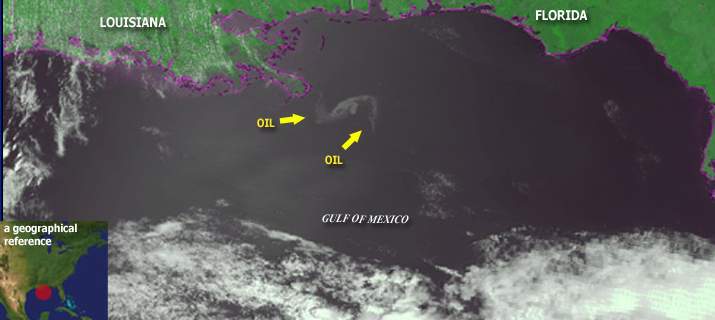
Update on BP Oil Disaster in the Gulf of Mexico
There are reports that nearly 200 thousand gallons of crude oil is spilling into the Gulf of Mexico each day as engineers work to cap the well head. Meanwhile an oil dispersant is deployed on the water surface to break up the oil slick before it reaches sensitive estuaries and shoreline. On the edge of what human engineering can accomplish, BP says it would use a giant, 100-ton dome-like device placed over the wellhead that might collect oil gushing out of the well.
Jackie Savitz:
- 200 thousand gallons per day, possibly 10 times more than that. It’s been gushing for almost 2 weeks.
- May take another week to stop, not guaranteed. Back up plan could take months.
- Gulf of Mexico: rich area biologically, a lot of our shellfish come from there. Many of the species that make their home in the Gulf are endangered, such as sea turtles, North Atlantic Right Whale, Bluefin Tuna, Snapper, Grouper
- In many cases, these animals are using the Gulf as a nursery. We may never fully know the impacts on populations of these animals. Fishing ban.
- Why do they let companies like BP drill in these dangerous circumstances that can pose these types of impacts without a plan? The public was convinced on offshore drilling by 3 myths. 1. Lower the price of gas at pump. 2 Energy Independence. 3. Drilling was safe.
- Why would we let these companies gamble with our lifestyle with no actual return.
- We’re looking at a potential reset moment. Politicians respond to public sentiment.
- We’re working toward a ban on exploratory drilling. This was an exploratory well.
Guest – Jackie Savitz, Senior Campaign Director for Oceana’s Pollution Campaigns. Savitz has shaped and led campaigns and projects dealing with global warming pollution from ships, mercury contamination of fish, and cruise ship pollution among other issues. Savitz has a background in marine biology and environmental toxicology combined with more than fifteen years of policy analysis experience through which she has developed expertise on a variety of pollution issues involving toxic contamination, water pollution and air pollution
————

ICE Media Spin / Immigration Law Movement
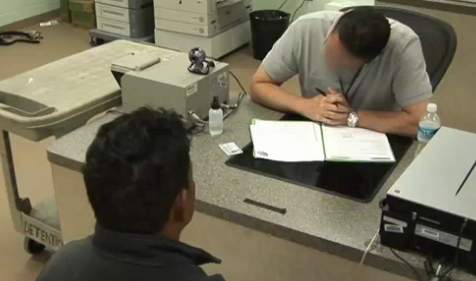
Center for Constitutional Rights staff attorney, Sunita Patel joins us today to give an update on the recent six-page internal memo from United States Immigration and Customs Enforcement (ICE) that was leaked to the press. The memo was a response to civil rights groups Uncovering the Truth on ICE and Police Collaboration, but specifically aiming at their campaign of week long rallies in 14 cities. The week of advocacy was launched on Tuesday in conjunction with a FOIA lawsuit filed in the Southern District of New York by the National Day Laborer Organizing Network, the Center for Constitutional Rights and the Immigration Justice Clinic of Benjamin Cardozo School of Law to demand records relating to the Secure Communities program.
Sunita Patel:
- ICE launches media offensive against community organizations. Exposed: DHS plans to publish Op Eds by the head of ICE.
- DHS interface with local law enforcement – incentives to racial profile to determine status that could lead to: Non citizens to stay in jail even if there is police misconduct or unlawful arrest
- We want more information so communities can make reasonable decisions.
- FOIA lawsuit requests information on “Secure Communities” Program, a finger printing system operating inside jails. To be deployed to all jails in US by 2013.
- We want to stop these collaborations with local law enforcements, they make the community less safe and less secure.
Guest – Sunita Patel, Center for Constitutional Rights Staff Attorney, she is involved with racial profiling, immigrant rights and other human rights litigation. Prior to her position at CCR, she held a Soros Justice Fellowship at The Legal Aid Society, Immigration Law Unit in New York where she represented immigrant detainees in removal proceedings and worked with criminal justice and human rights groups to create independent community oversight for detention operations through public accountability boards
———————

Omaha Two / Black Panthers
We talk today with Claus Walischewski, a representative of Amnesty International in Germany. Claus has been working with Amnesty International following and investigating the case of 2 former Black Panthers Ed Poindexter and Mondo we Langa (David Rice). The case is known as the Omaha 2. Amnesty International has found that the two men were unjustly convicted of murder and have been in prison since the 1970s. Amnesty has called for a retrial or release for these men.
Claus Walischewski:
- We don’t call them political prisoners because in the US you can have a fair trial.
- They were both Black Panthers in Omaha in the 1970s.
- The police answered a 9/11 call and went to a vacant building, there was a bomb in a suitcase, the police picked it up, it detonated, and the policeman was killed. The police thought it was the Black Panthers.
- Information that the FBI were working COINTELPRO in Omaha during this time.
- An individual named Dwayne Peak was arrested for the crime, and named the two Black Panthers.
- When he saw the 2 men and was asked if they were involved, he said “no.”
- The 9/11 call was not Dwayne Peak’s voice, it’s the voice of a much older man, not a 15 year old.
- Analysis has shown it’s not the same voice, still no re-trial. Caught and arrested in 1970, Poindexter 62, Mondo 67. I’ve visted them 10 years ago, they’re both very educated, no threat to anybody.
Guest – Claus Walischewski, a representative of Amnesty International
—————————————————
Afghanistan War, Civil Liberties, Human Rights, Iraq War, Targeting Muslims, Torture, Truth to Power, Uncategorized
Podcast: Play in new window | Download
Updates:
—–

Israeli Policy and Palestinian Children – Nora Barrows-Friedman
We talk today with the Nora Barrows-Friedman, she is the host of radio show Flashpoints at KPFA in Berkeley California. Nora spent the last month in the occupied West Bank and East Jerusalem. She’s been investigating stories about the ongoing violations of Palestinian human rights and has been frequently traveling to Palestine since 2004. Today we look specifically at the Israeli policy against children from arresting, detaining, interrogating, torturing, imprisoning and beating children, some as young as 10. Nora says International laws designed to protect children — including the UN convention on the rights of the child are being circumvented and violated on a daily.
Nora Barrows Friedman:
- Kids randomly picked off the street, allegedly for throwing stones. The Israeli punishment is 10 years in prison for a child.
- Israeli military can arrest (Palestinian only) children as young as 12. Right now there are 300 Palestinian children in Israeli prisons.
- Hebron is a city where settlers have been given half of the old city, a settlement colony is inside the Palestinian community
- These two young children were followed and taken into a military center inside the settlement colony.
- This whole family had been destoryed by these illegal actions against these 2 brothers. The only recourse this family has is to take it to the Israeli military court. Motive: trying to get Palestinian families to leave.
- This family lives in an area where settlers have their eye on, seems to be very deliberate.
- There are hundreds of women in Israeli prisons, there’s a story where a woman gave birth in the prison, and the baby is now a prisoner.
Guest – Nora Barrows Friedman: Senior producer and co-host of KPFA’s Flashpoints.
————-

Obama’s Plan for Elimination of Nation-Controlled Nuclear Power
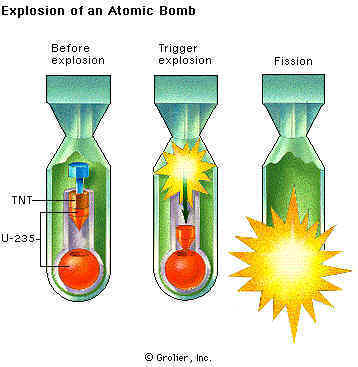
Nine nations now have a combined total of more than 22 thousand nuclear weapons. The United States has about 5 thousand nuclear weapons, 500 of them are land based warheads which can fly in three to four minutes after the order is given. President Obama recently hosted a nuclear security summit in DC with more than 45 foreign leaders, he traveled to Prague and signed a treaty that would cut the combined US and Russian stockpile by a third. Meanwhile, the US nuclear stockpiles have been shrinking for the last 40 years. We talk more about the current nuclear disarmament effort with attorney Peter Weiss is Vice-President, former President, of the International Association of Lawyers Against Nuclear Arms.
Peter Weiss:
- Leave the doomsday clock where it is. Reaffirming of the status quo. The agreement with Russia in reducing the nuclear weapons allowed to each country from 2200 to 1500. They count all the warheads on a bomber plane as one, instead of 10 or 12 weapons.
- Jimmy Carter: A single nuclear armed submarine had enough weaponry to destroy every Russian city of 100 thousand or more.
- Nuclear Posture Review – Zero document / “It’s difficult to operationalize a vision.”
- Obviously there is a great danger of loose nukes. No one seems ready to adopt an anti-nuclear convention except the countries that don’t have nuclear weapons.
- Conference in Riverside Church on May 1, 2010, United For Peace and Justice
- The anti-nuke movment will be re-energized.
- The US wants to be the sole repository of weapons grade nuclear material, committment from Chile, and Canada, to ship WGNM to the US. That’s kind of weird isn’t it?
Guest – Peter Weiss, former Vice President, Center for Constitutional Rights and Vice President, of the International Association of Lawyers Against Nuclear Arms.
——

Why Human Rights are Indispensable to Financial Regulation
Today we speak with Radhika Balakrishnan, Professor of Economics and International Studies at Marymount Manhattan College, about her recent article in the Huffington Post titled Why Human Rights are Indispensable to Financial Regulation. Balakrishnan enumerates the global human fallout from the world financial crisis. The World Bank estimates an additional 400 thousand children will die before their fifth birthday, while those responsible for the turmoil are benefiting from bailouts and promotions. She references the Universal Declaration of Human Rights and its inclusion of economic and social rights, that is the right to work, to education, to rest, to an adequate standard of living. Dr. Balakrishnan has also outlined steps for meaningful reform that we will also examine today. She is currently working on a project trying to use human rights norms to evaluate and construct macroeconomic policy.
Radhika Barakrishnan:
- We pretend there is no criteria regulating (economic policies) We argue in our piece, that human rights have a way to set up an ethical basis and framework. Most people don’t know that human rights include economic and social rights.
- In the United States the assumption is you can vote the people in to give you social and economic rights.
- The idea that the market is this Greek Oracle that we can’t question. . . is a problem.
- We’re saying there is a form of biased market regulation, where the state has the interest of the financiers and the banks.
- and not those of the working people and the working class. One example is the minimum wage.
- The Federal Reserve has a dual mandate, one is to have price stability, the other is the right to work.
- In the United States, we have not signed the Convenant on Economic and Human Rights.
- The Federal Reserve is a government agency and the fact that they act in a cloak of secrecy is a real problem.
- I think there is a great case to be brought, as far as freedom of information.
- What kind of financial models are they using to make their decisions? This cloak of secrecy because you independence to make monetary policy? But independence doesn’t mean secret.
- Their Board of Governors are from the commercial banks, whose interest will they work for?
- Bailout Bill – TARP / This went to financial agencies to give them the money. 720 Billion dollars overnighted to the Federal Reserve has not gone out? The Stimulus Money, for employment creation, though it was used for tax cuts.
- Congress did not extend unemployment benefits for Spring recess.
- The United States is coming up for the Universal Periodic Review in the Human Rights Council of Geneva
- The Center for Women’s Global Leadership
Guest – Radhika Balakrishnan, Executive Director of the Center for Women’s Global Leadership and Professor in Women’s and Gender Studies. She has a Ph.D. in Economics from Rutgers University. Previously, she was Professor of Economics and International Studies at Marymount Manhattan College. She has worked at the Ford Foundation as a program officer in the Asia Regional Program. She is currently the Chair of the Board of the US Human Rights Network and on the Board of the Center for Constitutional Rights. She has published in the field of gender and development.
——————————————————————————
Afghanistan War, Civil Liberties, Gaza, Human Rights, Iraq War, Prison Industry, Targeting Muslims, Truth to Power
Podcast: Play in new window | Download
Updates:
—————-
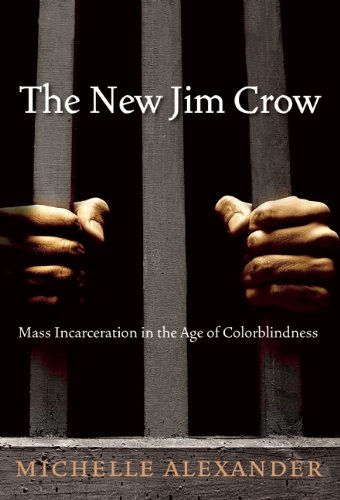
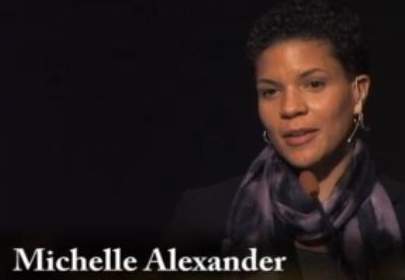
The New Jim Crow: Mass Incarceration in the Age of Colorblindness – Michelle Alexander
Michelle Alexander, author of the new book The New Jim Crow: Mass Incarceration in the Age of Colorblindness joins hosts. Michelle book has been called an incisive critique of racial caste system in America. As many celebrate the “triumph over race” with the election Barack Obama, the majority of young black men in the US are locked behind bars or permenantly labeled felons. Michelle Alexander, a former litigator who is a legal scholar, argues that the civil rights community—and all of us— are challenged to place mass incarceration at the forefront of a new movement for racial justice in America.
Michelle Alexander:
- I began in my own research to question the prevailing political media narrative about the reasons of people of color and ghetto communities cycle through the criminal justice system today, it is not as it appears.
- I argue that in a few decades after the collapse of Jim Crow, we as a nation, have managed to re-create as a racial caste in America, in some major American cities, the majority of African American men, are locked behind bars, labeled felons for life.
- Legally discriminated in employment, housing, access to education, and public benefits. We have not ended racial caste, we redesigned it.
- The Drug War was declared in relation to racial politics, not drug crime. About 30 million were arrested for drug offenses after the launch of the drug war. Most were for marijuana possession, now considered less harmful than alcohol or tobacco.
- Drug markets like American society generally are segregated by race and class
- The Supreme Court has made it virtually impossible for these cases to be brought.
- Baldus Study: McKleskey v Kemp
- Finding proof of conscious intentional discrimination is nearly impossible. Severe racial disparities are of no consequence, immunized not just the death penalty.
- I wrote this book, largely because I was deeply troubled by the failure of civil rights organizations and black leadership in this country to place mass incarceration and the war on drugs at the top of our racial justice agenda.
- Ten of millions of people in the United States are now regulated permanently to an under-caste, who are barred by law from seeking jobs or housing, public benefits, food stamps.
- Prisons have been holding many rural towns together as jobs have disappeared. The majority of people put behind bars are non-violent offenders. Every race suffers from this drug war, there are white people doing decades in prison for drug possession charges. The suffering of the drug crosses the color lines, and we got to be able to galvanize a level of public awareness and support.
- Something akin to a racial caste system is alive and well in the United States.
Guest – Professor Michelle Alexander, joined the OSU faculty in 2005. She holds a joint appointment with the Moritz College of Law and the Kirwan Institute for the Study of Race and Ethnicity. Prior to joining the OSU faculty, she was a member of the Stanford Law School faculty, where she served as Director of the Civil Rights Clinic.
Professor Alexander has significant experience in the field of civil rights advocacy and litigation. She has litigated civil rights cases in private practice as well as engaged in innovative litigation and advocacy efforts in the non-profit sector. For several years, Professor Alexander served as the Director of the Racial Justice Project for the ACLU of Northern California.
———
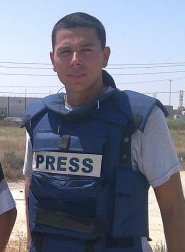


Ayman Mohyeldin, Al-Jazeera TV correspondent
Ayman joins hosts in the studio. He is an Al Jazeera TV correspondent and former CNN producer based in Baghdad. He was the only news producer allowed to observe and report on the US handover of Saddam Hussein to an Iraqi judge. Ayman has been stationed in the Gaza Strip since May 2008, where he has covered the Gaza siege. Ayman talks with hosts about his experience covering the destruction during Operation Cast Lead. Filmmakers and producers are working on a documentary film about Ayman’s war reporting in Palestine. Facebook link
Ayman Mohyeldin:
- Saturday December 27th, 2008, I had been based in Gaza. It had been quiet in Gaza up to November 4th.
- We started hearing the first wave of Israeli air-strikes that destroyed government buildings, police station within minutes. It kicked of a series of air strikes throughout the day. 200 hundred Palestinians were killed that day.
- We really saw everything, I can’t begin to describe the horrors of what we saw. On the first day we went to the main Gaza hospital.
- People of Gaza were trapped in a territory subjected to a very modern sophisticated, well trained and equipped Army.
- By Israel’s own admission rocket fire into Israel had dropped 98 percent 4 months ago (before Operation CastLead)
- What were the real reasons for the attack, the war was unnecessary given what was achieved in the 4 months prior.
- The siege on Gaza has allowed Hamas to tighten it’s grip on Gaza. The siege has not punished Hamas.
- Palestinians have recycled the rubber and steel from the destruction.
- I was standing on a rooftop and they were dropping hundreds of leaflets from planes, that read “your area is going to be attacked, if have any information about Hamas, please call this number.”
- Goldstone Report: Israel while bombing did not distinguish between military and civilian targets. Not a mistake.
- Targets include – Mosques, schools, ambulance drivers, government buildings, ministries, Palestinian Legislative Council Building.
- Gaza, historically was not an affluent place, it was a merchant trade route from Africa into Asia and Europe.
- Stunted growth is starting to appear among Palestinian children.
- Gaza: Desperate, frustrated, a sense of abandonment by the international community.
Guest- Ayman Mohyeldin, Arab American journalist based in the Middle East and is the Gaza Correspondent for the English language channel Al-Jazeera. Previously a producer with CNN and NBC, Ayman was one of the first western journalists allowed to enter and report on the handing over and trial of the deposed President of Iraq Saddam Hussein by the Iraqi Interim Government for crimes against humanity
———————-