Censorship, Civil Liberties, Criminalizing Dissent, Gaza, Guantanamo, Habeas Corpus, Human Rights, Military Tribunal, Prison Industry, Targeting Muslims, Torture, Truth to Power
Podcast: Play in new window | Download
Updates:
—

Historic International Support: Gaza Freedom March Debrief
Hundreds of activists with the Gaza Freedom Marchers have returned from Israel, Palestine and Egypt bringing home incredible stories from the largest international mobilization of people in solidarity. We hear first hand accounts from our own Michael Ratner who with his family were among the 13 hundred solidarity marchers. We are also joined by Felice Gelman who has also returned from the Gaza Freedom March. As many listeners may know, the Egyptian authorities refused to allow the 1,365 participants from 43 countries to enter the Gaza Strip, but later 100 people were let in to Gaza.
Felice Gelman / Michael Ratner:
- It was a remarkable event despite not getting into Gaza. 1400 people from 43 countries, Europe India, Australia, South Africa. Within 3 days the Egyptian government went from we need more info, we’re working with you to . . . you’re not coming.
- We were unable to get a meeting place at any time for any group of people. The Egyptians said that any gathering of more than six people would be illegal. One of the prerequisites in order to get into Gaza is you don’t engage with local opposition in Egypt. In a way it was a perfect demonstration of what the siege in Gaza is all about.
- Egypt is a police state. There are 2 million police for a population of 60 million.
- Egyptian police are very brutal with their people. They’re disappeared, they’re tortured. No room for democracy. No support for a civil society to express itself to protest.
- The thing that was incredible was the number of Egyptians that wanted to join us. There were a couple of instances where people were hurt. The secret police would try to single people out at a demonstration and punch or hit them.
- They would identify women who were Muslims. I don’t know if was that they were Egyptian and they (secret police) thought they could get away with it. They beat up a 12 year old girl and a 75 year old woman, they were not discriminating.
- Egyptians (opposition) joined in with GFM demonstrations in Cairo.
- We had a demonstration at the US Embassy in Cairo, the police surrounded them for five hours before they could get into Embassy. The US Embassy didn’t seem to think that this was bizarre until they were reminded of their legal obligation to help their citizens.
- the US Embassy informed the Egyptian police that they had no objection of us going to Gaza.
- There were some people who went to Al-Arish, and the Egyptian police were onto that. They surrounded a hotel in Al-Arish
- (Michael Ratner) I can’t imagine the logistics and the organizing nightmare it was for you guys
- I can’t think of a time since the Spanish Civil War, that there was a contingent of such size and national breadth that traveled to assist people in their distress from a brutal attack.
- I think this was an incredible demonstration of where the world stands on Gaza.
- My kids 19 and 21, seeing people with the courage to go to these demonstrations from all over the world. Out of that I think there will be a global organizing structure.
- The other thing is the drafting of the Cairo Declaration, drafted by the South African delegation. Calling on the ending of the occupations of Gaza and the West Bank, primarily with global BDS movements. (Palestinian unified call)
- When Gaza was getting attacked, it was the South African trade unionists that refused to load the weapons that were being sent to Israel.
- The potential for labor to move on this is enormous and powerful.
- The Gaza Freedom March website will be handed over to the committee working on the Cairo Declaration.
- New York Report Back – Judson Memorial Church January 21 / 55 Washington Square S.
Guest: Felice Gelman, member of the Wespac Middle East Committee and a member of the Steering Committee that organized The Gaza Freedom March. She has traveled to Gaza twice since the Israeli invasion last year.
—————–
The Response: Sig Libowitz – Combatant Status Review Tribunals
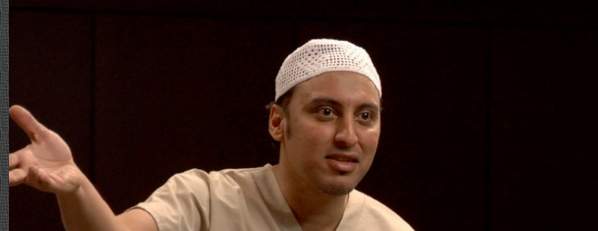
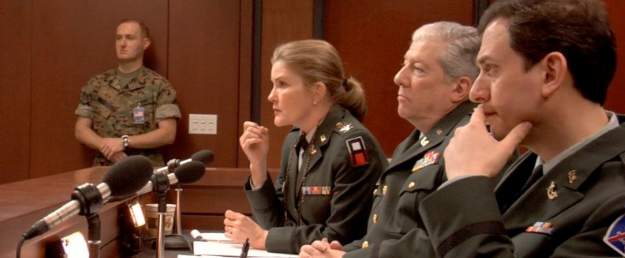
January 11, 2010 marked the 8th anniversary since the Bush administration turned the US Naval Base at Guantanamo Bay, Cuba into a “enemy combatant” detention facility. Essentially re-commissioning the base as a torture chamber and legal black hole, where prisoner suicides are considered acts of war. As we’ve reported on in the last few months, the Obama administration has held on to the power to allow for a preventive detention system that would indefinitely jail terror suspects in the United States without trial. Meanwhile, military tribunals are now mainstream news, the tribunals are called Combatant Status Review Tribunals, where military justices discern who is an enemy combatant. These trials are also the subject of a 30 minute film titled The Response. The film is written and produced by actor Sig Libowitz who is transitioning from being an actor playing an attorney on the TV series Law and Order, to becoming a real lawyer. While in law school, Libowitz was tranfixed by the tribunal process of no jury and no defense lawyer. The film is based on actual court transcripts and is shortlisted for The Academy Award. The Response is screening at Columbia University’s School of Law on January 20th at 6pm.
Sig Libowitz:
- Michael Ratner: First of all there was no real process for people in Guantanamo. Then we won the right to Habeas Corpus, to go into a federal court and challenge their detention. At that point the Bush Administration set up a special process in Guantanamo.
- As we depict in the film, this is a process where the detainees don’t have a lawyer, they are not provided with the evidence that’s against them. The real transcripts told the story of the detainees and the judges in these CSRTs. From that I saw an incredible movie, and incredible opportunity.
- Because, I thought I had an understanding of what Guantanamo was all about, then I read the transcripts (of a CSRT) It gives a human dimension to the detainee and the military judges.
- Screening at Columbia Law School, Wednesday January 20th 6PM All the cast will be there and Shane Kadidal and Matthew Waxman. We’ve screened the movie at the Pentagon.
Guest: Sig Libowitz, an American lawyer, actor, film executive and director. Libowitz is notable for producing, directing and starring in a film, The Response, he wrote after reading some transcripts from Guantanamo captives‘ Combatant Status Review Tribunals. Libowitz is an executive for the acquisitions department of Turner Classic movies. He had a recurring roles in The Sopranos and Law and Order.
——————

Free Fahad Hashmi
Fahad Hashmi a Pakistani born American student, has spent nearly 2 1/2 years in solitary confinement in a Manhattan detention facility. He has been isolated for one of the longest periods in America as a suspect before trial. Hosts reported on this case in March 2008, we spoke with Fahad Hashmi’s father Syed Anwar, and Fahad’s attorney Sean Mayer. Fahad is accused of storing waterproof socks, ponchos and raincoats. The US charges were based on allowing an acquaintance “Janaid Babar” to store this rain gear in the closet of his London flat. Janaid Babar was a paid government cooperator who has been used to testify against Muslims around the world. Nicknamed ‘Supergrass’ by the British media, Babar was used by the UK government to testify against Omar Khyam and several other Muslim men in the so-called Fertilizer Case. Meanwhile Fahad’s trial is expected in January 2010, the prosecution will use Junaid as a main witness. Hashmi has been held under the SAM’s Special Administrative Measures that include a 23 hour a day lockdown, constant video surveillance of his cell and limited visitation.
(Fahad’s Brother)Faisal Hashmi:
- I’m under SAMs as our family is. Our visits with him, we can’t talk about it, but I can say from open court, he looks frail, he looks jittery He’s been in solitary confinement for 2 and half years.
- He’s in the Metropolitan Correctional Center a few blocks from here. Within his own cell, he’s videotaped at all times. He’s not allowed to talk out loud. He has a microphone in his cell.
- This is about deconstructing a human being, depriving him of his humanity. He’s 29 years old.
- Charged with four counts of material support for terrorism. He stored ponchos and rain gear.
- In 2004, this acquaintance while working on his Master’s degree stayed with Fahad.
- This was January 2004, he went to the US in April 2004, was arrested, and became a cooperating witness for the US government. At this time about 8 people got arrested, some in Pakistan, London and Canada, all on Junaid Barbar’s witness cooperation.
- In June 2006, my brother gets arrested. They tell Fahad, that Junaid gave the ponchos and gloves to Al-Qaeda and you gave material support to terrorists. You let Junaid use your cell phone, and Juanaid borrowed 300.00 from Fahad, saying that his ailing daughter needed the money. Fahad’s trial starts January 6, 2010
- FreeFahad.com This case has nothing to do with ponchos and socks.
Jeanne Theoharis:
- This is a case we need to be concerned about for those who value the first amendment. I had Fahad as a student in Brooklyn College in 2002
- There’s no way to understand this case without understanding the way Fahad was being watched many years ago even as a college student. We’ve sent a letter to the attorney general addressing 3 main issues, the conditions of his confinement, the way his due process is being violated and then first amendment issues.
- The letter was signed by more than 550 scholars and writers. Organizing among the Muslim student community.
- Theaters Against War calling attention to Fahad’s case.
- Free Fahad Vigil January 18, 2010
Guests: Fahad’s brother Faisal Hashmi and Jeanne Theoharis, an associate professor of political science at Brooklyn College, City University of New York. She was one of Fahad’s professors and she has been following this case.
———————————————————————
Afghanistan War, Civil Liberties, Human Rights, Iraq Veterans, Iraq War, Supreme Court, Surveillance, Targeting Muslims, Torture, Truth to Power, War Resister
Podcast: Play in new window | Download
Updates:
—

Historic Win for Constitutional Rights! Injunction Granted in CCR Lawsuit on Behalf of ACORN
Recently, a federal judge blocked Congressional effort to withhold funding to the community group ACORN. In the decision, the court found that ACORN can show that the targeting by Congress in de-funding the anti-poverty group, is a violation of the Constitution’s prohibition against the Bill of Attainder. This is a legislative act which singles out a specific person or group for punishment. Jules Lobel, CCR Vice-President and Cooperating Attorney says quote “This historic decision by the Court affirms the fundamental constitutional principle that the Congress cannot be judge, jury, and executioner.” Following the decision, Bertha Lewis, ACORN’s Executive Director, said quote “The court’s decision is a victory not only for the many dedicated citizens who work with ACORN to improve their communities and promote responsible lending and homeownership, but for the Constitution and the rights of all Americans.”
Bertha Lewis:
- ACORN is 39 years old, started in Little Rock, Arkansas. It grew out of the welfare rights movement, George Wiley founder of WRO. We began to organize folks in the South first, just around bread and butter issues.
- Red-lining banks, block busting racist strategies, potholes. Most people would know us by the housing work that we did, we challenge the banks for the red-lining tactics. I was the executive director for New York, I’ve been with ACORN for almost 20 years.
- We had an internal scandal, where the founder Wade Rasky had allowed his brother in a 2 year period of time misappropriate almost a million dollars. I was appointed CEO after that for my New York City organizing work. We’re (ACORN) the best organizers, but we’re not the best managers.
- It was fine if we stuck with soup kitchens, etc, but we started registering poor people to vote around issues. The minimum wage law passed in Florida. I think we became a threat when we actually moved those people to the polls. Now we begin to change the balance of power.
- We need to organize multi-ethnic, multi-culture, multi-issue, and build an institution where people have real power. Karl Rove leaked emails revealed : “Bring me the head of ACORN.”
- The organizing was effective because we’re not a single issue organization. We can be better managers, but I guess we had a naivete about the forces we’ve been going against all these years.
- Since 2000, the right has seen us as a growing threat, we were effective and almost immediately we were accused of voter fraud, voter registration fraud. Nothing stuck. They decided, we got to keep (ACORN) in the news, we gotta keep attacking them.
- This filmmaker – James O’Keefe made up this fantasy scenario, was racist and sexists. So, they had this series of videos, when you looked at it, it was very sensational.
- Anyone could see it was highly edited, where they had this woman say she hadn’t paid taxes, and there are these girls from Honduras we want to bring over.
- So, what you see in these tapes is some of our workers giving advice. Next thing it was online, it went viral. Funders were saying they didn’t want to be associated with us. Five hundred organizers, four hundred thousand member families.
- Three times before the Republicans tried to say ACORN was a criminal organization, no due process. In October after that video, they put in writing, no funds given to ACORN. Omnibus funding bill. The bill passed, only 7 brave senators voted against it.
- Congress (right wing) was pushed to name ACORN, because federally funded groups such as Blackwater / KBR / would be snared in broad language net. This is about the Constitution, it applies to poor people, it applies to poor people’s organizations.
- CCR lawyers – “I call them Jedi Knights for Justice”
Guest – Bertha Lewis, Chief Executive Officer and Chief Organizer of ACORN, the largest community organization in the country. Appointed in May 2008, Ms. Lewis oversees the operations of its 400,000 strong membership, which is active in over 110 cities across the country. A 16 year veteran of the organization, Ms. Lewis was most recently the Executive Director of ACORN’s New York affiliate and is a founding Co-Chair of the New York Working Families Party.
——————-
Why Are We in Afghanistan?
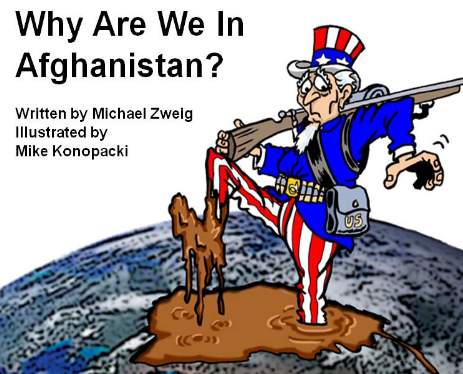
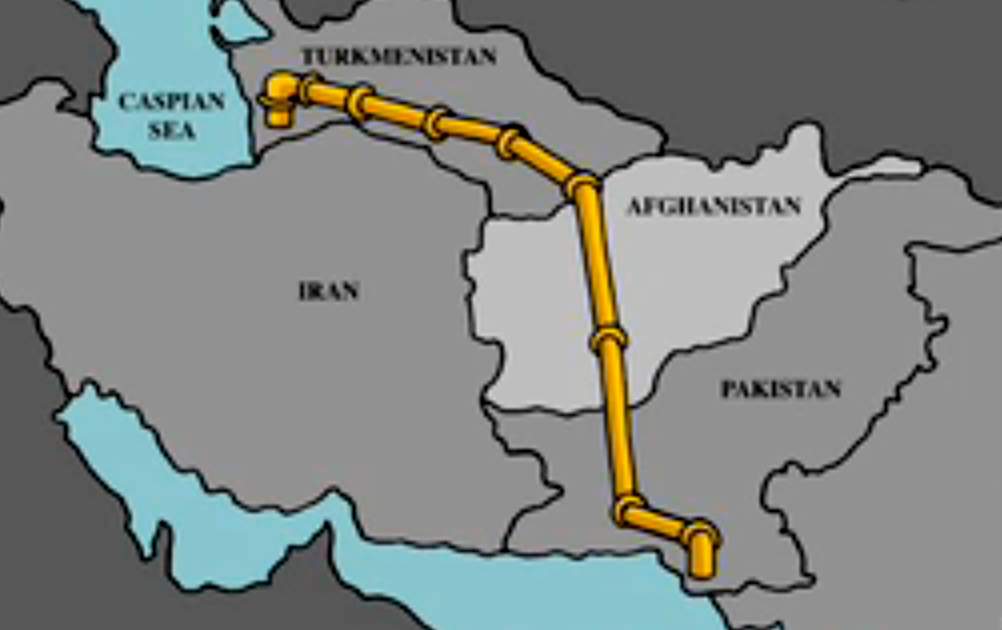
Why Are We in Afghanistan is the question many listeners still have and is the title of a film by Michael Zweig. The film examines how the reasons for the Afghanistan war have clouded since September 11, 2001. The conflict centers on geo-political positioning that holds the US in the war torn landscape. At this stage, the Afghanistan war is a humanitarian disaster, the civilian casualities are stunning and conditions on the ground are desperate for Afghani women and children. The film, Why Are We in Afghanistan? is an educational resource for communities, unions, veterans and active duty military, classes, and anyone who wonders why we are in Afghanistan, and what to do about it.
Michael Zwieg:
- We started out being in Afghanistan because of the 9/11 attacks, the idea was they attacked us from a base in Afghanistan, and we’re going to get the bad guys. Once they were there it became clear, that they weren’t interested in going to Afghanistan, they were interested in invading Iraq.
- Starting in 2002, the focus left Afghanistan, we were there, in an inactive state. Then comes the presumed resolution in Iraq, then Obama comes in and tries to be the president, running the campaign of prosecuting the good war.
- Why are we now doubling down in Afghanistan?
- Obama’s latest speech says primary reason for war escalation is Taliban, who are sheltering Al-Qaeda. To “nation-build” – stabilize Afghanistan. Al-Qaeda is in Pakistan, though, if you were to stabilize Pakistan, Al-Qaeda would go to Somalia, etc. It’s like wack-a-mole.
- General Petraeus’s American Counterinsurgency Doctrine. 2006
- They accept in the doctrine, that counter-insurgency is 80 percent civilian work and taking care of civilian population / 20 percent military. But if you look at the budget in place right now for 2010, it’s 6 percent civilian and 94 percent military.
- So, what’s going on? It’s not really about counterinsurgency, it’s not really about Al-Qaeda? We shouldn’t downplay the domestic and military pressure to do this.
- Sentiment about Afghanistan War changed in the US Labor movement summer of 2009
- Pipelanistan: During collapse of Soviet Union, the central asia “stan” countries came in to play.
- The US department of Energy forecasts between the year 2000 and 2025, China’s need to import oil is going to increase to 73 percent of its oil needs they will have to import.
- Pakistan’s agent in Afghanistan are the Taliban.
- Unocal – Moderate size US oil company, negotiating with Taliban and Pakistan to build pipeline.
- Unreported: There were meetings in Turkmenistan, in 2002 with the Bush Administration and Asian development Bank to build a pipeline going to Arabian Sea.
- There was a meeting in 2001 before 9/11, with Cheney and energy executives. They issued a report on American energy strategies May 2001. They identified the Central Asia republics as a major source of oil and natural gas.
- They identified these resources, Cheney and his crew, as a source to block from the Chinese and others from getting those resources.
- We’re in Afghanistan because of both strategic interests which include the oil resources and to block others.
- What are going to do, we can’t win, but we can’t not fight it. Obama doesn’t see a way unless there’s a mass movement in this country or military rebellion.
- Barbara Tuchman – March of Folly – Leaders of countries lead them into disasterous courses, against advice and alternative policies.
- You can’t reduce it all to simple, rational calculations because there are other courses that they could do.
- How do you make it hot for Obama on the decisions that he’s made? How do you build the social movement.
- We’ve built quite a presence in the labor movement around Iraq.
- Almost spending 100 billion dollars a year in Afghanistan. You could create a lot of jobs, tax relief, stimulus systems.
- War good for economy? No. For every dollar spent on military spending, you create way fewer jobs than the same money spent on building roads, or turbines for wind farms.
Guest – Michael Zwieg, Professor of Economics and Director of the Center for Study of Working Class Life at the State University of New York at Stony Brook, where he has received the SUNY Chancellor’s Award for Excellence in Teaching. His most recent books are What’s Class Got To Do With It? American Society In the 21st Century and The Working Class Majority: America’s Best Kept Secret (2000). He was executive producer and co-writer of the documentary Meeting Face to Face: The Iraq-US Labor Solidarity Tour. (Center for Study of Working Class Life, 2006).
Professor Zweig received his PhD in economics in 1967 from the University of Michigan where, as an undergraduate, he was a founding member of Students for a Democratic Society (SDS), and as a graduate student helped found the Union for Radical Political Economics (URPE).
——————————————————-
Civil Liberties, Gaza, Human Rights, Surveillance, Torture, Truth to Power, Uncategorized, War Resister
Podcast: Play in new window | Download
Updates:
——–

Historic International Support: Gaza Freedom March
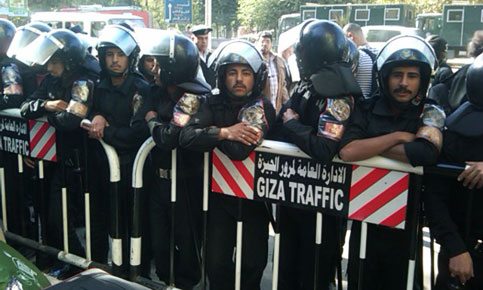
Hundreds of activists from more than 40 countries staged demonstrations and sit-ins in Cairo to protest the Egyptian government’s refusal to allow them to cross the border into Gaza. Our own Michael Ratner and his family are among the 13 hundred solidarity marchers in the Gaza Freedom March. Among the marchers, 300 from the United States, 80 from New York State and 250 marchers from France. Last week organizers said an offer by Egyptian authorities to allow only 100 members of the group into Gaza was not enough. The Egyptian embassy has stalled the marchers and some were detained by police as crowds outside the embassies grew.
Abdeen Jabara / Dorothy Zellner:
- This has truly been one of the truly great, historic, international mobilizations of people in solidarity.
- Thousands upon thousands over the course of months have been working in over 42 countries around the globe.
- They go to Cairo, Egypt as a transit point to go to Gaza.
- This effort has heightened the consciousness about the siege on Gaza and exposed the United States, Israel and the Egyptian government to promote the division of the middle east for their own selfish reasons.
- There is the Gaza Freedom March, then there is Viva Palestina, which is a convoy of trucks loaded with humanitarian aid that actually made it into Gaza several months ago.
- Viva Palestina is led by George Galloway, former British parliament member, they are stuck in Jordan.
- The Egyptians initially said the trucks can go through but the people can’t. This is a massive international effort to prevent the Palestinians from getting the help that they need.
- The French have been lying down in the streets in front of the French Embassy for 3 days already.
- The Gaza Freedom March had been working with the Egyptians for months and it was only until the organizers got to Cairo that the Egyptians changed their decision.
- They said we didn’t come here to create any difficult for the government, we came here to stand in solidarity with the Palestinians in Gaza.
- The Egyptian government then allowed 100 people to come through to Gaza, and to give them the names in 2 hours. A divide and rule approach, more conflict against the marchers.
- Congress voted to make Egypt the second largest aid recipient in the world : 1.7 Billion annually.
- Congress tried to take 100 million dollars away from Egypt because of the “smuggling tunnels to Gaza.” Egypt got the message. Egypt is not a democracy, Mubarak has been in power since 1981. It’s essentially a police state, they more people in their intelligence and police than they have in the Army.
- Egypt is planning to put in (with the help of the US Army Corp of Engineers) metal barriers, 50 feet into the ground to prevent tunneling to Gaza. Sixty percent of the Gaza is dependent upon that tunnel trade.
- This is the largest civilian population of the world that is completely trapped. If you ever go to Gaza, this could be the Riviera of the Mediterenean. This could be an unbelievable place if they would let them live like human beings.
- The problem is with the campaign finance system and the money that keeps them in office. This is where the problem is.
Guests – Abdeen Jabara and Dorothy Zellner give a broader scope on the Gaza Freedom March and the significance of demonstrations. Abdeen Jabara, civil rights lawyer and former president of the American-Arab Anti-Discrimination Committee. Dorothy Zellner, civil rights activist with Jews Say No, who has organized groups opposing Israeli violence in the occupied territories.
—————————————-
Victor Toro: Chilean Socialist Faces US Deportation After 25 Years
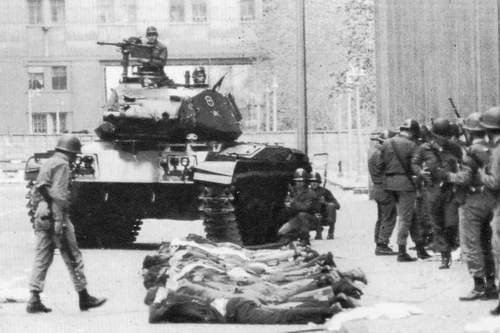
Ex-political prisoner and human rights organizer Victor Toro joins us in the studio. Victor is a Bronx community organizer and he was a former leader in the resistance to Chile’s military dictatorship during the 1970s. In July of 2007 Victor was arrested in an immigration sweep by border officials aboard an Amtrak train in Rochester, New York. He was charged for being in the country illegally and has been out on bail since. Before coming to the United States in 1984, Toro helped found and lead the MIR, or Revolutionary Left Movement. The group opposed the US -sponsored coup against the military dictatorship led by Augusta Pinochet. The Department of Homeland Security and US Immigration are seeking to deport Toro, the prosecution has filed a 46 page court brief containing information on the MIR, claiming the group attacked government buildings. Meanwhile, a deportation hearing for Victor Toro was adjourned until Jan. 11, 2010. Victor joins us in the studio with his translator Gonzalo Venegas.
Victor Toro:
- I was arrested by Pinochet’s regime, April 20th, 1974. I was incarcerated for 3 years in different concentration camps in which I was tortured. I was expelled from Chile, and given a document stating never to return. I was expelled to Sweden, and then Cuba.
- When I was forced to leave Chile, I was officially declared dead by the Pinochet regime.
- I ended up in Mexico, where I was given transitional asylum, however my safety was at risk in Mexico, because agents of Pinochet were trying to murder me. I left Mexico in 1984, fleeing persecution of Pinochet’s agents.
- Well, in the South Bronx, I continued doing the work, an extension of the work I had done in Chile in my earlier years. Working in the community and with unions.
- I’ve worked with undocumented people and immigrants in the United States. In California in 2007, I was engaging in the advocacy work for immigrant rights. On a train back to New York, I was caught in an immigration raid, with bomb sniffing dogs.
- Initially, I was facing the same case as any undocumented worker in the US. Recently the case took a political turn where the government has presented documents against me.
- I went from undocumented worker to becoming a terrorist because of my affiliations and work that I did in Chile in the 1970s.
- I was the leader of the organization MIR, that was building a socialist left movement. MIR resisted Pinochet’s oppressive tactics. MIR was branded a terrorist organization by the US.
- If you look at Chile’s current president of the senate, and house of representatives, the Navy, it all lead by former members of Pinochet’s political party.
- Demand asylum for Victor Toro / Friday January 8, 2010 – SEIU 1199 / Martin Luther King Auditorium. 310 West 43rd Street / between 8th and 9th Avenues.
- Monday January 11, 2010 – Court date 9 AM – / Rally afterward at NOON at 26 Federal Plaza, NY.
Guest – Victor Toro, a Chilean activist in the Bronx who fought against the Pinochet dictatorship in Chile. Toro is one of tens of thousands of immigrants who are racially profiled and targeted for deportation unjustly and unfairly.
—————————————————————————
Civil Liberties, Gaza, Habeas Corpus, Human Rights, Targeting Muslims, Torture, Truth to Power, War Resister
Podcast: Play in new window | Download
Updates:
—
Fraunces Tavern: Magna Carta and the Foundations of Freedom
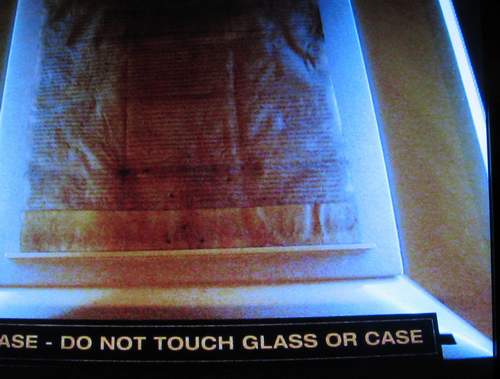
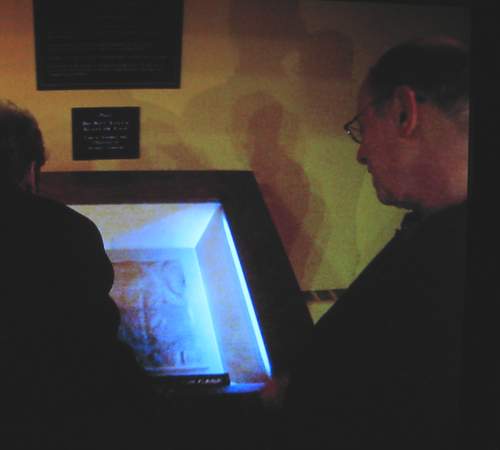
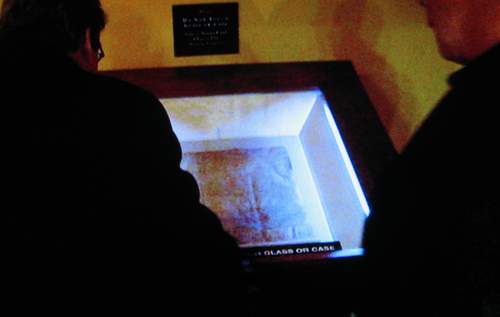
Hosts visit Fraunces Tavern Museum in lower Manhattan, where the Magna Carta document was on display from September 15 to December 15. It’s been nearly 800 years since it was originally drafted, and this copy has traveled from Lincoln Cathedral in England to New York City very few times. The first was for the 1939 World’s Fair.
Fraunces Tavern was built in 1719, it was a residence and then bought by tavern keeper Samuel Fraunces. It’s also known as the site where George Washington gave his farewell address to the officers of the Continental Army in 1783. When New York City was the nation’s capital, the tavern was rented to house offices of the Department of War, Treasury and Foreign Affairs.
Jennifer Patton/Tony Wellman:
- The tavern was originally built as a house by the Delancey family in 1719.
- There’s been a lot of changes to the buildings, restorations throughout the centuries, and it does make it the oldest surviving building in Manhattan. Light would fade the document, the lighting is no more than 50 lumens.
- This 1215 document was one of four reproduced. Hand copied in Latin, the language of education and communication of those days. This was the only way to spread news, there was no paper, this is on sheepskin.
- Taxation issues, women’s issues, trial by ones peers issues. Written in very tiny tiny script by a Monk.
- At the bottom you’ll see 3 holes for a ribbon where the King’s seal was attached.
- The idea started with a select few, and you can’t hold that back. The Magna Carta was lost for 600 years.
- Article 39 of the Magna Carta
- In the Razul v Bush case, they actually cited the Magna Carta. They said when King John at Runnymede in 1215 was forced to sign the Magna Carta
- We have since that time been against executive detention. I have a feeling that when King John affixed his seal on this document he had no intention of it existing for very long.
- Other charters, Providence plantations and Virginia charter, rights to property and not have it taken away for various reasons.
- Flushing Remonstrance. When New York was New Amsterdam, established by the Dutch in 1624. When Peter Stuyvesant came in 1657 all of New Amsterdam was is in disarray, lawlessness. Stuyvesant established hospitals, schools and also made it by law that you had to go to the Dutch church.
- These are ideas that came out of the Magna Carta, traveled to these shores and became deep within our own laws here. This is truly a revolutionary museum, the only museum dedicated to the American Revolution.
- Bill of Rights: Five of the amendments on the Bill of Rights come from the ideas of the Magna Carta.
- Estover – Charter of the Forest / The Royal Forest / Land that is claimed by the King.
- You can’t do anything on the land without the King’s approval. You can’t kill game, or fish. The Magna Carta was originally called the Charter of Liberties. Articles 48 and 47 of the Charter of the Forest.
- Charter of the Commons – Creative Commons. Magna Carta is being revived.
Guest – Educational Director of Fraunces Tavern Museum Jennifer Patton, and Communications Director, Tony Wellman. Fraunces Tavern was built in 1719, it was a residence and then bought by tavern keeper Samuel Fraunces. It’s also known as the site where George Washington gave his farewell address to the officers of the Continental Army in 1783. When New York City was the nation’s capital, the tavern was rented to house offices of the Department of War, Treasury and Foreign Affairs.
—————
Magna Carta Manifesto: Liberties and Commons for All
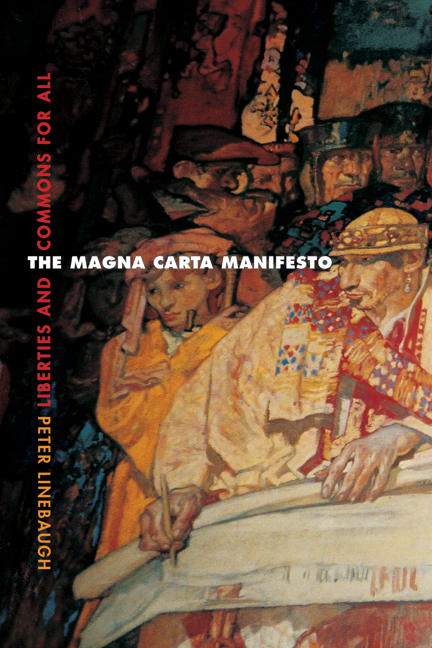
In January of 2008, hosts interviewed author Peter Linebaugh on his book the Magna Carta Manifesto. It’s a sweeping history of the Magna Carta as a longstanding retraint against tyranny, the support of trial by jury and due process of law, the prohibition of torture and the rights of habaes corpus. Peter Linebaugh worked to construct the original history of the Great Charter and it’s little known companion, the Charter of the Forest, which was created to protect the rights of the poor.
Peter Linebaugh:
- On November 11, 1217, after the 1215 document was lost and civil war had resumed, the Magna Carta was founded again and a smaller version was produced called the Charter of the Forest.
- Charter of the Forest: Forms of protection of subsistence rights for people to the woodlands. The woods was the form that hydrocarbon energy took.
- There’s a parallel with the protection of woodlands for all, back then, and our own oil economy. Common Rights for oil, share in the wealth of commons.
- Origins of rights. Magna Carta and Charter of Forest dividing civil and economic rights. Similar to UN documents now.
- W.E.B. DuBois attacked the separation of rights of the “stomach” from rights of speech, or from civil and political rights and economic rights.
- DuBois argued with Eleanor Roosevelt at Breton Woods on behalf of millions of people in the third world.
- Gerrard Winstanley – “The Earth Belonged To No One” It is a common treasury for all. John Locke was afraid of them and developed his notions of private property in contrast to them.
- The lessons for us today, depends on creativity and widespread discussion that must occur at the grassroots.
- Historically, the ruling class has been able to retain it’s avaricious powers only to the extent that it keeps us apart. We’re familiar with gender and racial divisions, and we’ve become a Carceral continent.
- When we get together we learn that so much of our history has been stolen from us. Our land, wealth, we must recover the knowledge of our own Commoning.
Guest- Peter Linebaugh, Professor, a student of E.P. Thompson, received his Ph.D. in British history from the University of Warwick in 1975. A graduate of Swarthmore and of Columbia, he taught at Rochester, New York University, University of Massachusetts-Boston, Harvard and Tufts before joining The University of Toledo in 1994. Grants from the Max Planck Institute in Göttingen and from the Fulbright and Mellon fellowship programs have supported his research. Peter Linebaugh is currently at work on a study of an Irish insurrectionary during ‘the great transformation’ of the Atlantic revolutions.
——————————————————————————————-
Civil Liberties, Death Penalty, Habeas Corpus, Human Rights, Supreme Court, Surveillance, Torture, Truth to Power
Podcast: Play in new window | Download
Updates:
————
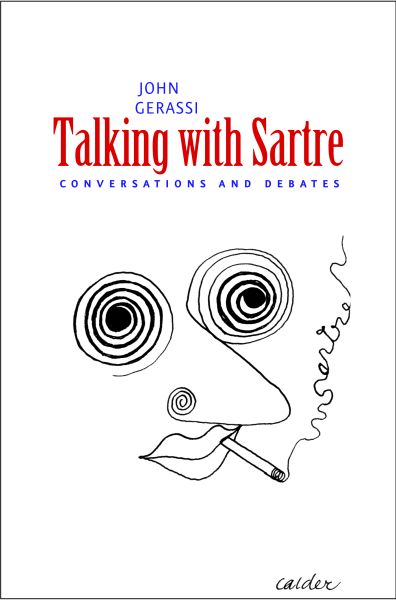
Talking With Sartre: Conversations and Debates
Professor John Gerassi, author of the recently published book titled – Talking With Sartre: Conversations and Debates joins hosts in studio. As a child, Gerassi’s parents had become close friends with the French existentialist philosopher, playwright, and novelist, Jean Paul Sartre. Later in his life, Gerassi conducted a series of interviews in the early 70s. These interviews are now edited into book form and as one review states, – quote – it has produced this revelatory and breathtaking portrait of one of the world’s most famous intellectuals.
The brings into to focus Sartre’s thinking on the Spanish Civil War, World War II, and the disintegration of colonialism, it also reveals how Sartre has wrestled with the apparent contradiction between his views on freedom and the influence of social conditions on our choices and actions.
John (Tito) Gerassi:
- My father was an artist and said ridiculous things like I don’t care if my son starves or my wife starves, first I paint.
- This appealed to Sartre who said in effect the same thing as a man of letters.
- Sartre became fascinated by my father. My father refused to join the OSS / CIA
- Gerassi to Sartre: You have a problem uniting the idea of free choice that you have in existentials because you begin with the I, to the Marxist situation which is a class derivative to which you want to align. I don’t see how you can align them.
- After a series of criticisms to this dichotomy, Sartre said, “This kid’s brilliant.” And so I became part of the family.
- Sartre always supported counterterrorism. Those who fought the establishment’s terrorism.
- Sartre’s anti-position has always been consistently correct.
- He opposed Ridgeway when Ridgeway took over NATO. Get your base out of France.
- No country is free with a foreign base on its territory. If you get rid of Ridgeway don’t put in a European general.
- During the Algerian War, the magazine that Sartre basically created called Modern Times, supported the Algerians right from the beginning.
- It supported sedition, that was a step further than any lefty in France.
- Supporting sedition is one thing, but they actually supported it in action.
- They were called the suitcase carriers, they gave medicine and ammo to Algerians in suitcases.
- The editor in chief of Modern Times assembled 120 intellectuals and produced the Declaration of 121.
- It included Sartre and existentials but also the Catholic left and notable communist intellectuals.
- That began the split in the communist party.
- In Algeria, the communist party there was in favor of the Algerian revolution.
- Sartre : Never judge the powerless by the same criteria that you judge the powerful.
- That means you support the Palestinians, and you praise the suicide bombers because you judge them with a different criteria than Israelis who have tanks, airplanes etc . .
- Sartre interpretation: The fact that he (Ft Hood shooter) is a member of a dominated class, and he is rebelling against the dominating class. He is perfectly justified in what he’s doing.
- Sartre: The trouble with all revolutions is they give up too soon.
- He did go to all sorts of places and because he was Sartre, he got to see the leaders of Russia and China, the only influence where he was pleased with contact was Che Gueverra.
- Supporting the early action of the Palestinians: When Israel subjugates the Palestinians, takes away their lands. . I’ve always supported counterterror against established terror.
- Marxist – Group Infusion – people briefly connecting, moving from I to we.
Guest – Professor John Gerassi, once an editor at Time magazine, then at Newsweek, who obtained his PhD at LSE, is a long time civil rights and anti-war militant. He is the author or editor of ten books and scores of articles and pamphlets published on both sides of the Atlantic. He is currently Professor of Political Science at the City University of New York.
———————————————–
Afghanistan War, Censorship, Civil Liberties, Climate Change, Criminalizing Dissent, FBI Intrusion, Habeas Corpus, Human Rights, Surveillance, Targeting Muslims, Torture, Truth to Power
Podcast: Play in new window | Download
Updates:
—————————–
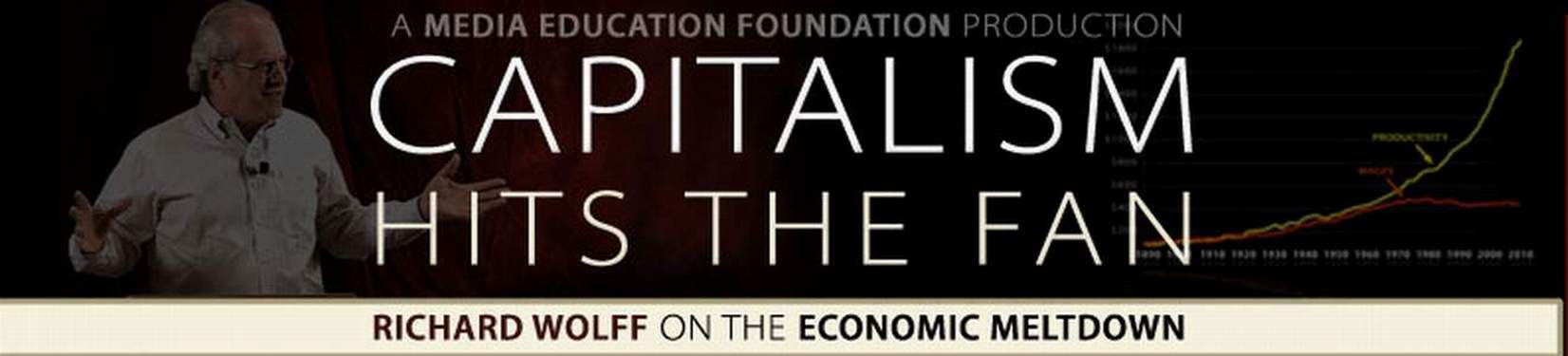
Capitalism Hits the Fan: The Global Economic Meltdown and What to Do About It (THE BOOK)
Today we welcome back Rick Wolff, Professor of Economics at the University of Massachusetts to discuss his new book titled Capitalism Hits the Fan: The Global Economic Meltdown and What to Do About It. In his book, Rick takes the reader back to 2005 and step by step reveals how policies, economic structures and wage-to-profit systems led to a global economic collapse.
Rick Wolff will give us an update on why the media claims the recession is over, he also tells us if there be another leg down as predicted in the September 21st interview. Another leg down meaning, will the economy continue to drop? This was mentioned because of the way people were investing, investing in a way that expected the market to drop.
Rick Wolff:
- The origin of the economic crisis goes deep into history. It’s one of the key things that people don’t understand or want to face. Roots of a System’s Crisis
- We were a country founded by foreigners coming here, they got rid of the indigenous population. They established a mix system. Capitalism on one hand, with employers and employees, and then self employed farmers and small crafts people, and in the Southern US, slavery.
- When the dust cleared, capitalism came through, it destroyed slavery and suboridinated the self employed to be small and on the margins.
- For 150 years – 1820-1970 the growth of capital was outrunning the available labor supply. Laborers had options, could go West.
- For 150 years, the goods and services a person could buy from an hour of their wages kept going up. It produced a strange and unusual notion that you were blessed, if you worked hard you would make more money.
- That Americans could have a dream like that. . their children could have a better life and deliver on the promise.
- It drew millions of immigrants from all over the world etc.
- Then after the 1970s capitalism reminded us that it is not a guarantee that if you work hard you will be rewarded.
- In the last 30 years wages have not anymore gone up. It’s a sea change in our culture’s history.
- Wages stayed the same for these reasons:
- The arrival of the computer that substituted people for machines on a mammoth scale
- The movement of corporations to other parts of the world to take advantage of cheaper labor.
- Women and immigrants moving into the paid labor force. This plunged the US economy into a disaster zone.
- The end of rising wages. Americans today work 20 percent more hours a week, than their counterparts in France, Germany or Italy. They are exhausted physically. The families are in disarray.
- Then to consume more, live the American dream, they borrowed on credit, the likes of which no working class in the history of the world has ever done.
- The average debt of US family in the 1920s equaled about 1/3 of its annual income. In 2007, the level of debt equaled 125 percent of annual income. At the same time, the last 30 years have been greatest boom of profitability of American corporations.
- Where did the money come from to lend unprecedented amounts? The money came from the boom in profits made possible by there no longer being a rise in wages. You not only get the profitability of a flat wage situation but you get the added income from the interest that comes from lending.
- The reforms and regulations we’ve seen, don’t work. The only thing that got Americans working again after a 10 year depression – 1929-1939, was not economic reform and regulation, it was something called WWII.
- Corporations used their profits to weaken reform laws, buy politicians, create army of Lobbyists.
- The American people MUST demand different responses to this crisis than what there was in the past.
- Handing corporations the citizen’s tax money as bail out is folly.
- We have 15 million adults looking for work, 10 million more are discouraged and have given up.
- The first thing this government should do is provide work for the unemployed.
- Not bailing out the banks. The private sector has failed in the United States.
- The government should support enterprises that workers run them, form them as their own enterprises in a collective way that is different from capitalist corporations
- Let workers choose if they want to work for an enterprise run by workers or capitalists. Let us as consumers choose from good and services produced in a non-capitalist way alongside the capitalist.
Guest – Rick Wolff, Professor of Economics at University of Massachusetts at Amherst. In his new book Capitalism Hits the Fan: The Global Economic Meltdown and What to Do About, Rick takes the reader back to 2005 and step by step reveals how policies, economic structures and wage to profit systems led to a global economic collapse.
—–
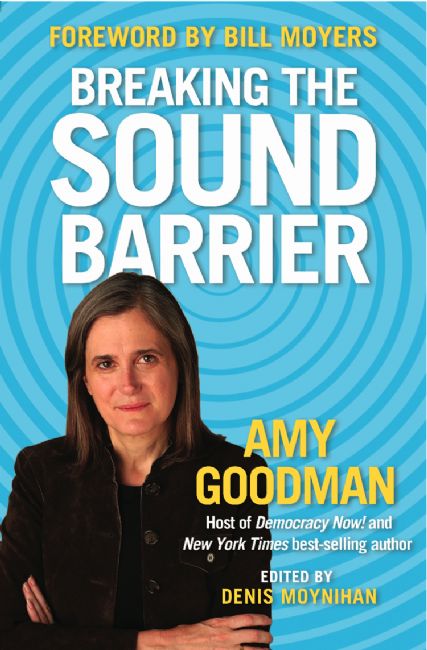
Amy Goodman: Breaking the Sound Barrier.
Today, we’re very pleased to talk with award-winning investigative journalist and syndicated columnist, author and the host/executive producer of Democracy Now! Amy Goodman. Her new book titled Breaking the Sound Barrier is a collection of wide-ranging articles reminding the reader of what true independent journalism can do. Amy’s style of journalism breaks through the corporate media noise with stories from community organizers in New Orleans to the brave soldiers resisting war in Iraq and Afghanistan. Truthout
Author and journalist Chris Hedges writes : “Amy Goodman is one of the most important voices in America. She defies the noise and clamor of celebrity gossip. She challenges the manipulation of information and dissemination of lies by the power elite. She refuses to pander to a culture where news is seen as another form of entertainment designed to bolster corporate profits. She holds steadfast to the core values of our trade. Her integrity and honesty remind us that a culture that cannot distinguish between illusion and reality dies.”
Amy Goodman:
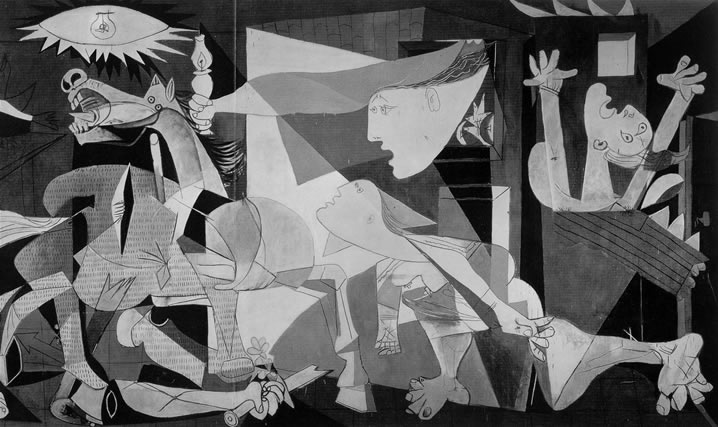
- Picasso’s famous anti-war painting Guernica in front of the UN Security Council. When Colin Powell went to the UN and they had a press conference, this painting was the backdrop and so they shrouded it in a blue curtain. We have to rip that shroud every which way, we have to tear it, because that’s what journalism is all about.
- Most of the voices in these columns are the people we interview on Democracy Now. The media is ahistoric, it whites out history. How are young people supposed to figure out what to do when they have no sense of what came before? What are the models, what works, what doesn’t work?
- Look at the money shifting from those who least have it to those who most have it, whether we’re talking about the economic meltdown. Obama surrounding himself by the Goldman Sachs folks.
- The model of community organizing has to be adopted by people all over the country.
- It’s not going to happen because there’s one person in the white house.
- The people with money and power walking the halls of the west wing, whispering in the commander in chief’s ear, and he says, if I do that, they will storm the Bastille.
- If there’s no one out there that he’s pointing at, we’re all in very big trouble.
- Breaking the Sound Barrier is the name of the column I do every week and the column appears in more than a hundred newspapers around the country. I think it is very important for people who consider themselves activists in this country hold their leaders accountable.
- It’s the right for people to conduct their lives in this country without being spied on or infiltrated.
Guest – Amy Goodman, host and executive producer of Democracy Now!, a national, daily, independent, award-winning news program airing on over 800 TV and radio stations in North America. Time Magazine named Democracy Now! its “Pick of the Podcasts,” along with NBC’s Meet the Press.
Goodman is the first journalist to receive the Right Livelihood Award, widely known as the ‘Alternative Nobel Prize’ for “developing an innovative model of truly independent grassroots political journalism that brings to millions of people the alternative voices that are often excluded by the mainstream media.” She is also one of the the first recipients, along with Salon.com blogger Glenn Greenwald, of the Park Center for Independent Media’s Izzy Award, named for the great muckraking journalist I.F. Stone.
—————————————————————-