CIA Sponsored Terror, Civil Liberties, Criminalizing Dissent, Habeas Corpus, Human Rights, Political Prisoner, Prison Industry, Surveillance, Targeting Muslims, Torture, Truth to Power
Podcast: Play in new window | Download


Securing The Iran Nuclear Deal
Phyllis Bennis joins us today to talk about the Iran Nuclear Deal. We get her perspective on this topic in the context of a broader geopolitical front including ongoing wars, the increased US funding of Israel and challenges to Iran from Saudi Arabia.
Guest – Phyllis Bennis, directs the New Internationalism Project at IPS. She is also a fellow of the Transnational Institute in Amsterdam. She has been a writer, analyst, and activist on Middle East and UN issues for many years. In 2001 she helped found and remains on the steering committee of the U.S. Campaign to End Israeli Occupation. She works closely with the United for Peace and Justice anti-war coalition, co-chairs the UN-based International Coordinating Network on Palestine, and since 2002 has played an active role in the growing global peace movement. She continues to serve as an adviser to several top UN officials on Middle East and UN democratization issues.
—-
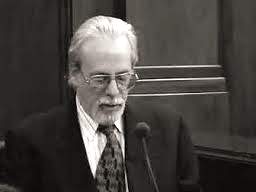
Lawyers You’ll Like: Attorney Bill Schapp
Attorney William Schaap graduated from the University of Chicago Law School in 1964 and has been a practicing lawyer since. Bill specialized in military law and practiced in Asia and Europe. He later became the editor in chief of the Military Law Reporter in Washington for a number of years. In the 70’s and 80’s he was a staff counsel of the Center for Constitutional Rights in New York City. In the late 80s, he was an adjunct professor at John J. College of Criminal Justice of the City University of New York where he taught courses on propaganda and disinformation.
Attorney William Schapp:
- One of first cases at this big Wall Street firm, they had some outside counsel working on it, one of whom was David Lubel, and Dave Lubel who had I think been a recruiter for the Communist Party in his youth, was always good at spotting somebody who was always worth recruiting and he started to tell me there was this convention of this lawyers group.
- It was this 1967 Lawyers Guild Convention in New York. He dragged me to one event, I met Bill Kunstler, I met Arthur Kinoy, I met Victor Rabbinowitz. I’d been on Wall Street for a year or two, I said I didn’t know there were lawyers like this.
- I joined the same day and met Bernadine Dorhn and a few weeks she called me and said we need your help.
- She said you gotta defend a bunch of Columbia students. The next thing I knew the riot started at Columbia and she said you have to go down there and defend them.
- I signed up to be staff counsel on the National Lawyers Guild Military Law Project in Okinawa, Japan.
- When you work overseas in that kind of a climate with the military you learn a lot fast about American imperialism.
- Once you learn that, you learn about the CIA.
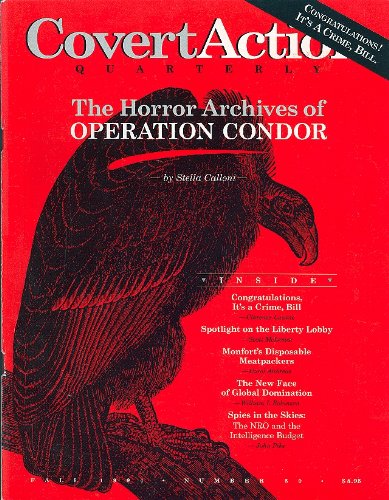
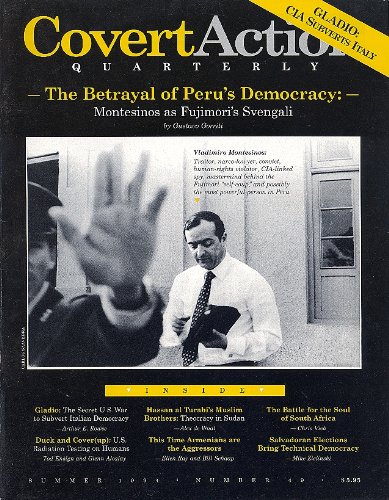
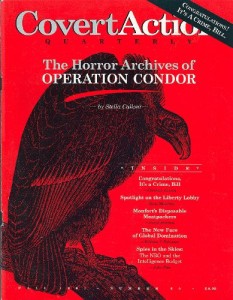
- That led us to originally working on Counter Spy magazine and then on Covert Action Magazine.
- The original purpose was to expose the CIA. We worked with Lou Wolf who is an expert in uncovering CIA agents in US embassies, not through any classified documents but because if you knew how to read the paperwork and State Department things, you could tell who are the “ringers.”
- We were so successful that Congress passed a law against us.
- Our goal was to make these people ineffective because the only way most CIA could work, particularly the ones that were assigned to an embassy was to have to pretend to be something else.
- They were all third assistant political secretaries and those were all phony things. Their job was to finagle their way into various community organizations in whatever foreign capital they were posted to recruit people to turn against their own countries and become traitors to their own countries, to become spies for the U.S.
- We thought if we identified these people, it might make their job a little bit harder, which it did.
- Of course, the problem with that is the government said we were trying to get them killed which we weren’t trying to do and nobody we did expose ever did get killed.
- He (Philip Agee) had been an adviser to Counter Spy. Counter Spy folded when Welch got killed, cause the pressure was too much and started Covert Action Quarterly.
- He was not the person discovering who the under cover people were, Lou Wolf was doing that.
- Phil wrote articles for us in every issue and we worked very closely with him.
- Once you start exposing these things, they really don’t have any defense.
- They tried to catch us in something phony. We would get tips that would turn out to be CIA trying to get us to print some story that wasn’t true so they could then discredit us.
- We had more interference from the government when we were doing military law work, before Covert Action Quarterly.
- They would plant bugs in our attic in Okinawa, things like that.
- The Intelligence Identity Protection Act has 2 parts. One makes it a crime for someone in the government who has classified information to reveal someone’s identity. The second part makes it a crime to reveal the identity of someone you did not learn from classified information or you position. (But if you were in the business of exposing these people . . .)
- Regarding his newsletter The Lies of Our Times – It was in the 90s, from 1990 to 1995 I think. To a certain extent, the abuses we were crying about got a little bit less over time because that’s sometimes the helpful result of that kind of exposure.
- We were just tired of people thinking that if it was in the New York Times it must be true.
- The fact is that those people lie all the time.
- I think we’ve gotten to a point where people recognize that the government lies to them and that there’s an awful lot that goes on that they don’t know.
Guest – Attorney William Schapp graduated from the University of Chicago Law School in 1964 and has been a practicing lawyer since. Bill specialized in military law and practiced in Asia and Europe. He later became the editor in chief of the Military Law Reporter in Washington for a number of years. In the 70’s and 80’s he was a staff counsel of the Center for Constitutional Rights in New York City. In the late 80s, he was an adjunct professor at John J. College of Criminal Justice of the City University of New York where he taught courses on propaganda and disinformation.
In addition to being a practicing lawyer, Bill was a journalist, publisher and a writer specializing in intelligence as it relates to media. He was the co-publisher of a magazine called the Covert Action Quarterly for more than 20 years. He also published a magazine on propaganda and disinformation titled Lies Of Our Times. Attorney Bill Schapp has written numerous articles and edited many books on the topic of media and intelligence.
———————————————————-
CIA Sponsored Terror, Civil Liberties, Criminalizing Dissent, FBI Intrusion, Guantanamo, Habeas Corpus, Human Rights, NSA Spying, Political Prisoner, Prison Industry, Supreme Court, Surveillance, Torture, Truth to Power, War Resister
Podcast: Play in new window | Download
Update:
- Remembering Julian Bond, Social Activist, Civil Rights Leader, Politician, Professor and Author.
—-
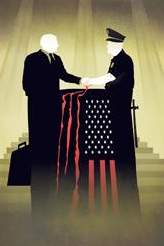
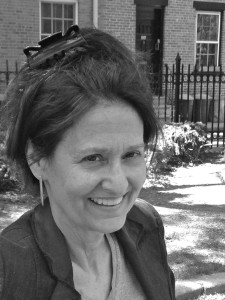
Heidi Boghosian: Prevent Police Killings Before They Happen
America has awakened in the past year to the epidemic of police killings of unarmed civilians, many of whom are African-American. The list of names grows longer by the week — Eric Garner, Michael Brown, Tamir Rice, Freddie Gray, Rekia Boyd, John Crawford and Sandra Bland to name several recently. Each time one of these criminal acts is committed, a cry goes up to prosecute the police officer responsible and bring justice to the victim. Read More.
Attorney Heidi Boghosian is the executive director of the A.J. Muste Memorial Institute, a nonprofit charitable foundation providing support to the nonviolent movement for social change. Before that she was executive director of the National Lawyers Guild. She is author of the book “Spying on Democracy: Government Surveillance, Corporate Power, and Public Resistance” (City Lights, 2013).
—-
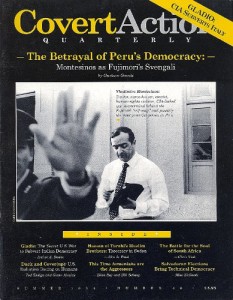
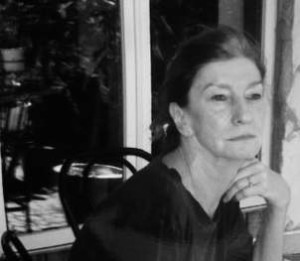
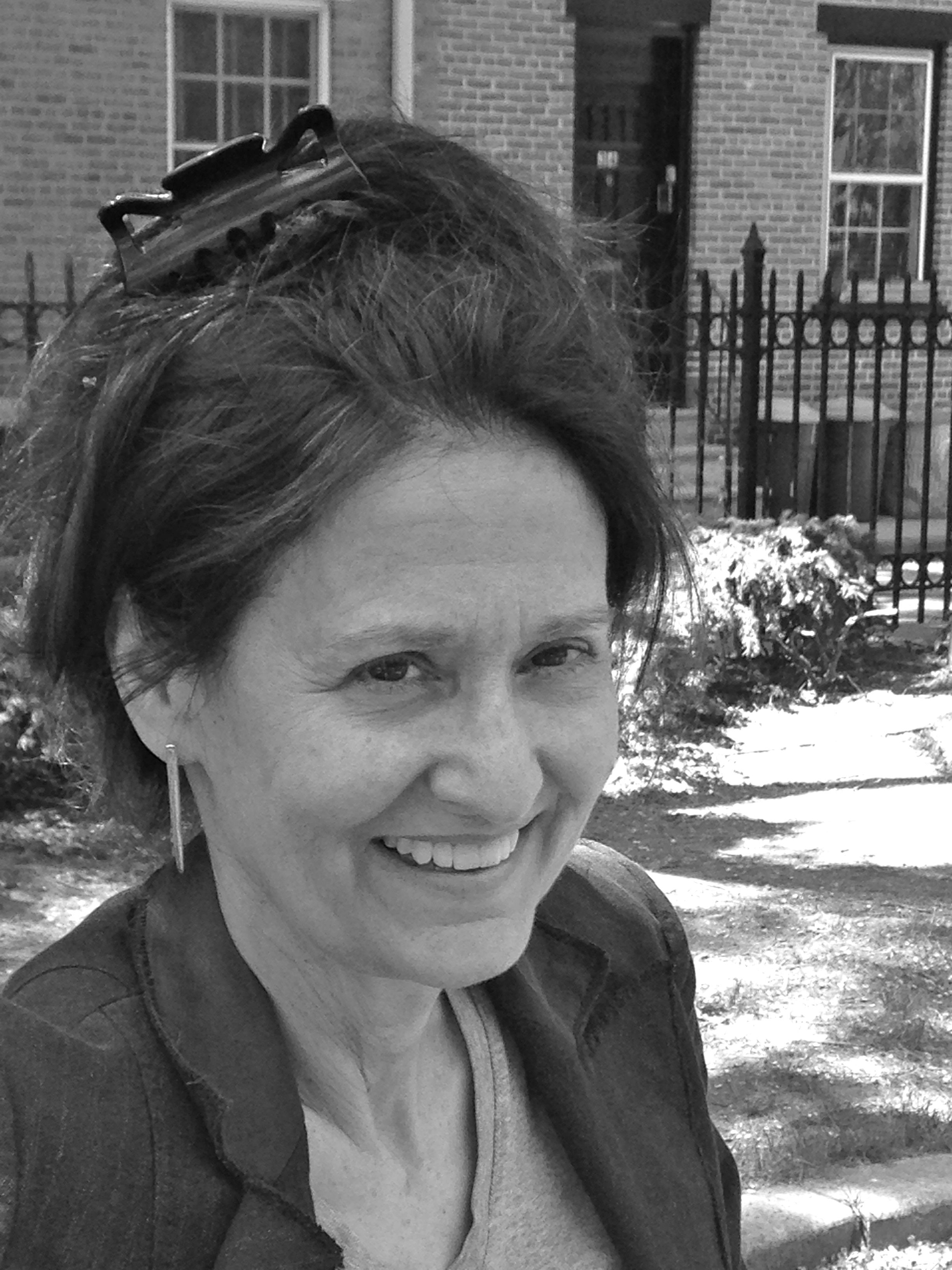
Ellen Ray: Co-Publisher of Covert Action Information Bulletin
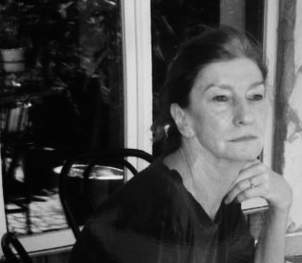
Last week family and friends gathered at St Marks In The Bowery Church to remember documentary filmmaker, publisher, journalist and activist Ellen Ray. Ellen Ray was co-publisher of the magazine Covert Action Information Bulletin, which exposed CIA covert actions around the world, publishing the names of hundreds of CIA agents. As a result, the law changed (The Intelligence Identities Protection Act of 1982) making it illegal. As head of Sheridan Square Press, Ellen Ray published the memoir of New Orleans District Attorney Jim Garrison, which became the basis of Oliver Stone’s film, “JFK.” Ray is survived by her husband, attorney Bill Schaap, she was 75. Text of the speech by Michael Smith. Here is the video produced Joe Friendly.
—-
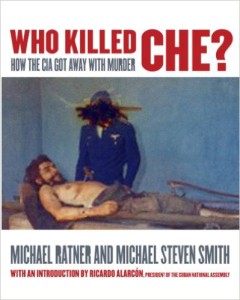
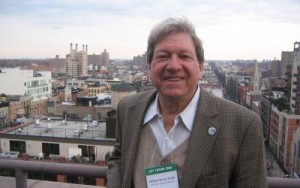
Different Ways to Skin a Cat: From the US Assassination of Che to Obama’s Recognition of Cuba
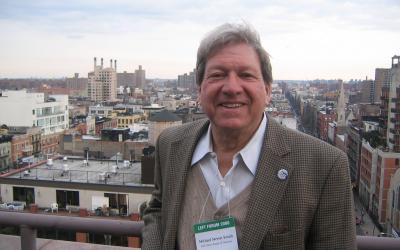
We hear a speech delivered by our own Michael Smith at Socialism Conference in Chicago titled Different Ways to Skin a Cat: From the US Assassination of Che to Obama’s Recognition of Cuba. The highpoint of U.S. counter-revolutionary policy towards Latin America came with its murder of Che Guevara, in Bolivia and the overthrow of governments including Allende’s in Chile, thus isolating Cuba throughout Latin America. Now the U.S. is isolated and the American government has had to change its tactics. The strategy of overthrowing the gains of the Cuban revolution and capitalist restoration remain.
—————————————————
Afghanistan War, CIA Sponsored Terror, Civil Liberties, Criminalizing Dissent, Death Penalty, FBI Intrusion, Habeas Corpus, Human Rights, Political Prisoner, Prison Industry, Supreme Court, Surveillance, Truth to Power, War Resister
Podcast: Play in new window | Download
Lawyers You’ll Like : Attorney Linda Backiel
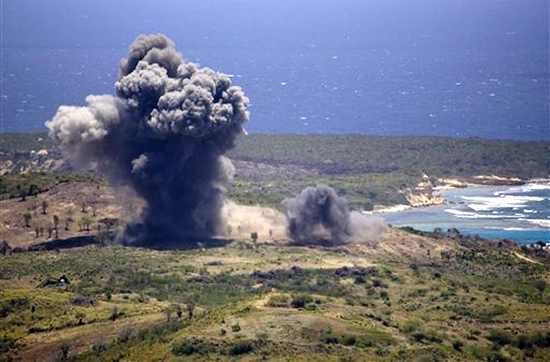
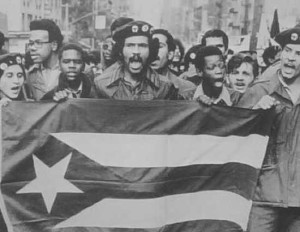
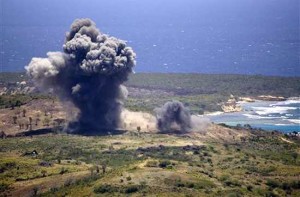
As part of our Lawyers You’ll Like series today we speak with attorney Linda Backiel. She’s a lawyer and poet living in San Juan, Puerto Rico. She’s played an instrumental role in defending independentistas in the fight against colonialism in Puerto Rico. As part of that struggle she defended those who were ultimately successful in kicking the military out of Vieques. A small island near Puerto Rico. For 40 years of law practice, she devoted much of her energy to the defense of political prisoners often with her friend and mentor, Lenny Weinglass. A Poem For Lenny Weinglass.
Guest – Attorney Linda Backiel, a criminal defense attorney and poet living and practicing law in San Juan, Puerto Rico. Here is Linda Backiel’s transcript from the talk she gave at the celebration of the 50th anniversary of the Criminal Justice Act.
—-
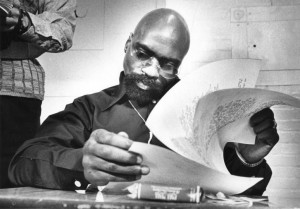
Rubin “Hurricane” Carter 1937-2014
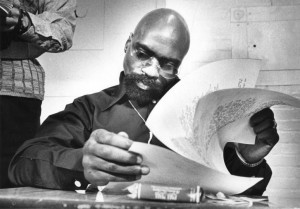
In April of this year, celebrated boxer and prisoner-rights activist Rubin “Hurricane” Carter died at the age of 76. He had become an international symbol of racial injustice after his wrongful murder conviction forced him to spend 19 years in prison. Carter was arrested for a triple murder in his hometown of Patterson, New Jersey. He said he was innocent, was convicted by an all white jury, and sentenced to three consecutive life sentences. In 1976, the New Jersey State Supreme Court overturned his conviction on grounds the authorities withheld material evidence from the defense. But Carter was convicted again in a second trial in 1976. In 1985, that conviction was overturned by a U.S. district court judge, who concluded the state made an unconstitutional appeal to racial prejudice. In 1988, the Passaic, New Jersey, Prosecutor’s Office dropped all charges against Carter.
Attorney Myron Beldock:
- He was a defendant in a criminal case in New Jersey involved the triple shooting and three murders of 3 people in the Lafayette bar in Patterson, New Jersey.
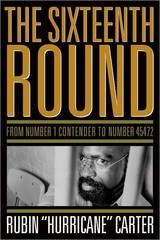
- He and his co-defendant John Artis were represented at the first trial and they lost, (convicted) and Rubin started his campaign to get out of jail and wrote his book the 16th Round.
- He was charismatic and powerful, a great thinker, very very intellectually strong person as well as being spiritually strong.
- Almost a typical case, high profile case, where you get people who are vulnerable and easily manipulated because of their need for their own benefits to falsely testify.
- We set aside the convictions when we learned about the benefits that were given to the witnesses.
- We went again to trial in 1975. At that time the atmosphere had changed. There was a new prosecutor, they came up with a theory that it was actually a racial revenge killing.
- Earlier that night, a white former bar owner had shot and killed the black purchaser of the bar from him.
- That was always known and there was no motives attributed to the killings in the first trial but the second trial really based on speculation and bias, they argued persuasively to the jury that this was a racial revenge killing.
- Mr. Bellow who was the supposed eye witness who testified, there were two of them in the first trial, was being questioned by me on the stand as to why he recanted his recantation. The prosecutor persuaded him to again tell the story he told at the first trial, identifying Rubin and John and I was trying to establish that they had falsely manipulated him when I was pulled into the chambers along with my co-counsel Louis Steele who represented John Artis and told that if I question him further, the jury would learn that he passed the lie detector test, supporting what he said at the first trial. Supporting his identification (of Rubin Carter)
- We did have that test. It seemed like that was the result because that’s the way it was written. In fact that was a fraud.
- The polygraph results were completely opposite of what they were purported to be.
- The prosecutors in that case, two of them became judges, rewarded for what they did.
- Rubin was not a popular person, he had been an outspoken civil rights person. It was a cesspool of rumors without any evidentiary basis.
- The entire community there almost in Passaic New Jersey treated us like we were the devil.
- It was the coldest community reception I ever encountered in any place.
- Rubin would call every year (from Canada) on the anniversary of his release. He got a group of Canadian do-gooders and free thinkers to join him in fighting to set aside convictions for people who were wrongly convicted in Canada.
- He would vet the briefs that we sent. He was a very unusual client.
- Rubin refused to act as a prisoner because he wasn’t anyone who was guilty he said.
- So, he didn’t eat prison food, he didn’t take prisoner assignments, he didn’t wear prison clothes and somehow or other he was able to pull that off.
- People think of it as being another time, I’ve been practicing law long enough and I don’t think anything changes.
- The same kind of bias runs deep throughout the community its just masked somewhat differently.
- You make your luck in these cases, you have to forge ahead.
- His insistence on being an innocent person and will not compromise with the system is the kind of inspiration that pushes us on as lawyers.
Guest – Attorney Myron Beldock, graduated from Erasmus Hall High School in 1946, Hamilton College in 1950 and Harvard Law School in 1958. He served in the U.S. Army from 1951 to 1954 and as an Assistant U.S. Attorney in the Eastern District of New York from 1958 to 1960. After several years as an associate with a small New York City firm and as a single practitioner, he brought together two friends and former Assistant U.S. Attorneys, Elliot Hoffman and Larry Levine, to form Beldock Levine & Hoffman in 1964. He is best described, by his own definition, as an old-time general practitioner. He concentrates on trial and appellate litigation, in state and federal courts, in defense of criminal charges and in pursuing plaintiffs’ civil rights actions based on police and prosecutorial misconduct and employer and governmental discrimination. He regularly consults and defends charges of professional discipline. He represents plaintiffs and defendants in a wide variety of personal and business related matters, working with others in the firm’s various practice areas.
———————————————-
CIA Sponsored Terror, Civil Liberties, Human Rights, Iraq War, Targeting Muslims, Truth to Power, War Resister
Podcast: Play in new window | Download
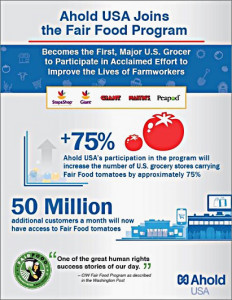

Coalition of Immokalee Workers: A Big Victory For Farm Workers
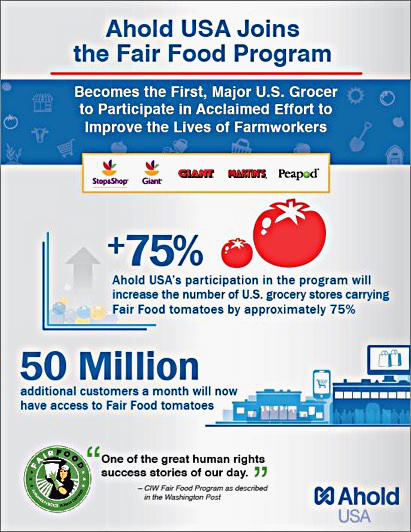
Co-host attorney Michael Ratner discusses the landmark development for the Fair Food Program plus the work of Jake Ratner and Elena Stein. Ahold USA and the Coalition for Immokalee Workers announced that Ahold has agreed to join the award-winning social responsibility program, bringing worker-certified Fair Food tomatoes to over 50 million new customers a month in nearly 780 new stores in 14 states.
—
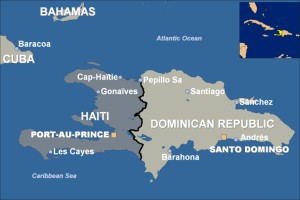
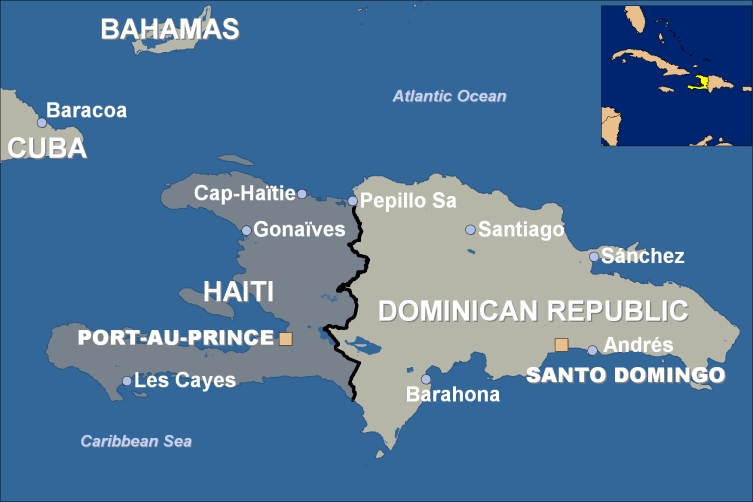
100th Anniversary of the United States Occupation of Haiti
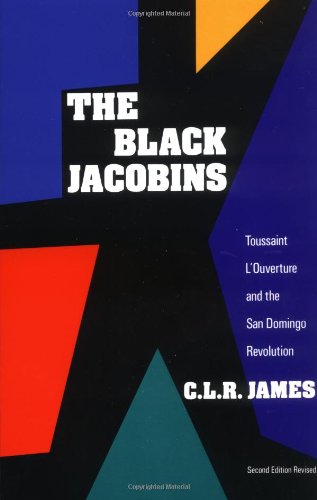
Co-host attorney Michael Ratner describes key politically historic events in the colonizing of Haiti as July 28, 2015 marks the 100th anniversary of the commencement of the U.S. occupation of Haiti. Suggested reading – The Black Jacobins: Toussaint L’Ouverture and the San Domingo Revolution
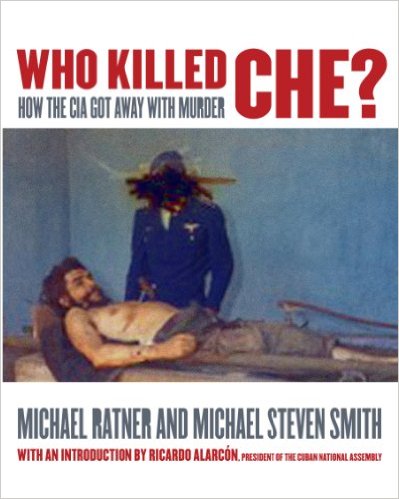
Law and Disorder Co-host Attorney Michael Ratner, President Emeritus of the Center for Constitutional Rights (CCR), a non-profit human rights litigation organization based in New York City and president of the European Center for Constitutional and Human Rights (ECCHR) based in Berlin. Ratner and CCR are currently the attorneys in the United States for publishers Julian Assange and Wikileaks. He was co-counsel in representing the Guantanamo Bay detainees in the United States Supreme Court, where, in June 2004, the court decided his clients have the right to test the legality of their detentions in court. Ratner is also a past president of the National Lawyers Guild and the author of numerous books and articles, including the books Who Killed Che? How the CIA Got Away With Murder, The Trial of Donald Rumsfeld: A Prosecution by Book, Against War with Iraq and Guantanamo: What the World Should Know, as well as a textbook on international human rights.
—-
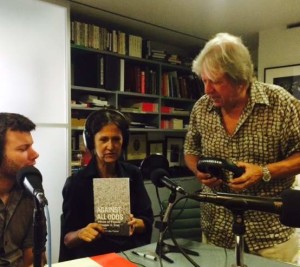
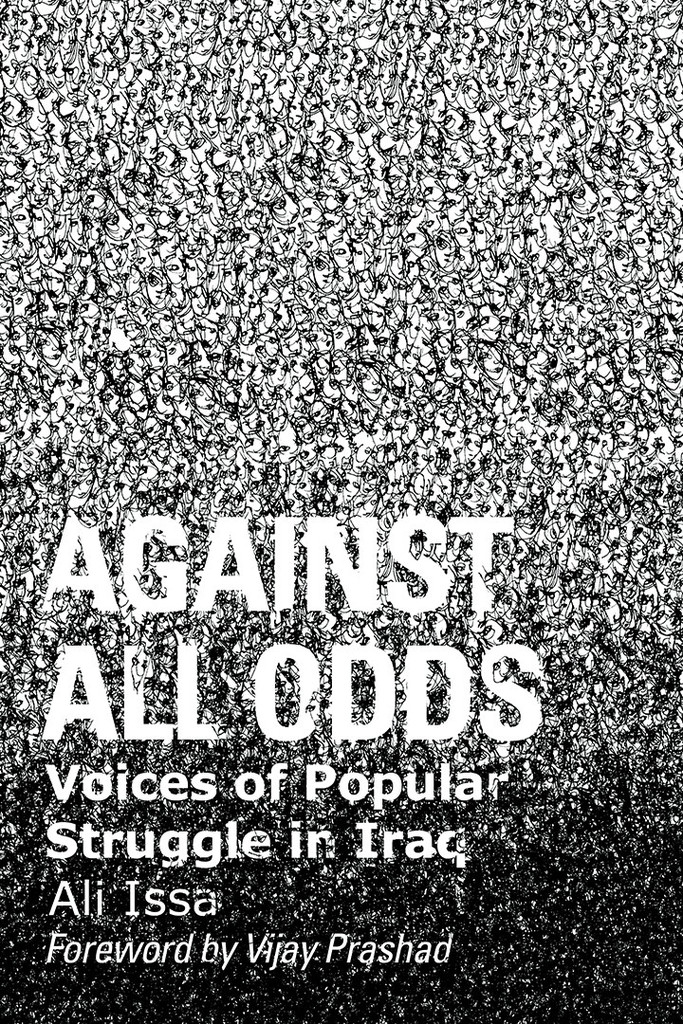
Against All Odds: Voices of Popular Struggle In Iraq
Long before the US imposed sanctions in Iraq, and long before the brutal and unlawful invasion, our government supported a dictatorship and attendant torture and extermination. Individuals engaging in acts of resistance in Iraq faced mass rapes, enslavement and massacres. Missing from our country’s media coverage and political narrative surrounding Iraq are the courageous stories of progressive Iraqi voices.
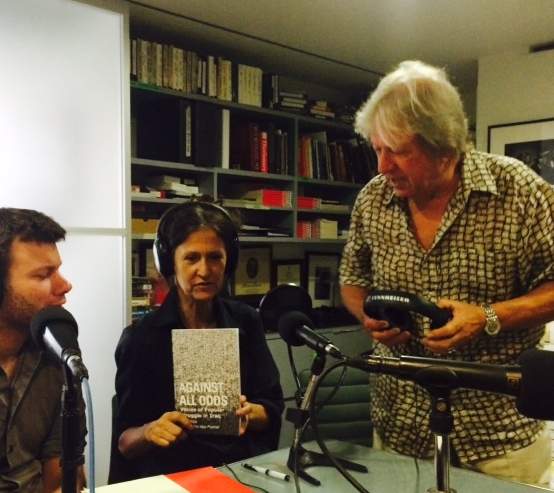
Activist Ali Issa’s recent book Against All Odds: Voices of Popular Struggle In Iraq goes a long way toward filling this void. An organizer with the War Resisters League, he has assembled a rich account of Iraqi organizers and revolutionaries–their analysis, their political works, their visions, their challenges. This important compendium provides much-needed insight to the committed and just-minded individuals who worked to rebuild society and social institutions amidst disappearances and assassinations.
Guest – Ali Issa is the National Field Organizer for the War Resisters League. He is author of the forthcoming book Against All Odds: Voices of Popular Struggle in Iraq. It’s published by Tadween Publishing and the War Resisters league.
——————————————————
Censorship, CIA Sponsored Terror, Civil Liberties, Criminalizing Dissent, Crony Capitalism, FBI Intrusion, Gaza, Human Rights, NSA Spying, Political Prisoner, Prosecution of the Bush Administration, Surveillance, Targeting Muslims, Truth to Power
Podcast: Play in new window | Download
Updates:
—-
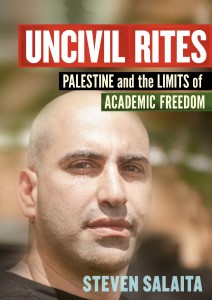
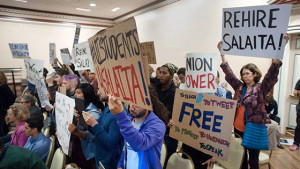
Steven Salaita Hired by American University of Beirut
In what we can view as a major victory for supporters of Palestinian human rights fired Professor Steven Salaita has been hired at the American University in Beirut in the American Studies Department. The American Association of University Professors calls Steven Salaita’s firing one of the significant violations of academic freedom in this decade. Nationwide over 5000 academics pledged to boycott the university resulting in the cancellation of dozens of scheduled talks and conferences at the University of Illinois. The University of Illinois’ action was part of a broader campus crackdown on Palestinian human rights activism that threatens both the foundational role of the university as a place of critical thinking and debate and the ability to advocate for Palestinian rights.
Guest – Professor Steven Salaita, former associate professor of English at Virginia Tech. He is the author of six books and writes frequently about Arab Americans, Palestine, Indigenous Peoples, and decolonization. His current book project is entitled Images of Arabs and Muslims in the Age of Obama.Steven grew up in Bluefield, Virginia, to a mother from Nicaragua (by way of Palestine) and a father from Madaba, Jordan. Books by Salaita, his upcoming book is titled Uncivil Rights and The Limits Of Academic Freedom by Haymarket Press.
—-
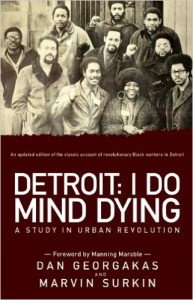
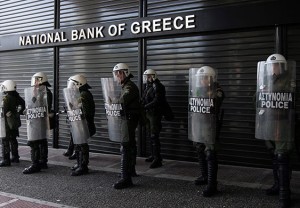
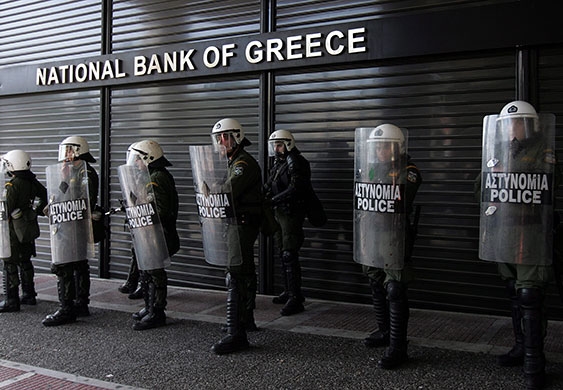
Greece Economic Crisis 2015 Update
Earlier this year we spoke with regular columnist for the National Herald Dan Georgakas about the historic election as the people of Greece voted in the anti-austerity party of Syriza, led by Alexis Tsipiras winning a 149 seats of the 300 seat Parliament. Today, the economic and political state in Greece is in a tremendous state of flux. Will Greece leave the EU and the Eurozone? Will its debt be written down and restructured?
Guest – Dan Georgakas, regular columnist for the National Herald, the leading Greek American weekly newspapero co-author of Detroit: I Do Mind Dying and coeditor of Solidarity Forever: An Oral History of the IWW. He was a frequent contributor to now defunct Journal of the Hellenic Diaspora and the Journal of Modern Hellenism. Dan has taught at NYU, CUNY, Van Arsdale Labor College, Columbia University and University of Oklahoma.
—————————————-
CIA Sponsored Terror, Civil Liberties, Cuba, Habeas Corpus, Human Rights, Prison Industry, Supreme Court, Surveillance, Truth to Power, War Resister
Podcast: Play in new window | Download
Updates:
- Ireland Same Sex Marriages
- DOJ Reaches Settlement With Cleveland Over Police Excessive Use Of Force
- Inquiry to Examine Racial Bias in the San Francisco Police
- Wyoming Criminalizes Sharing Photos And Citizen Science
—–
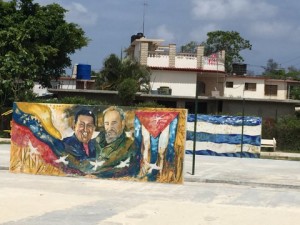
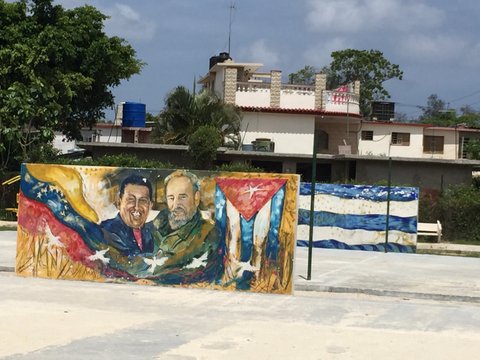
Understanding The Cuban Reality: Michael Ratner
Our own Michael Ratner returns from Cuba and dispatches this update. The United States officially takes Cuba off the terrorist list. Cuba was placed on the terrorist list years ago along with Iran, Syria and Sudan. Getting to Cuba is easier now that travel restrictions are decreased. Michael explains the importance in how Cuba maintains its fundamental economic rights in a non-capitalist government structure. Cuba also represents solidarity with the oppressed around the world and shares his personal experiences at Revolution Square in the early 70s. As the economic embargo continues to impact many facets of life for the people of Cuba, Michael Ratner points out the specific trade lifted by the Obama Administration were goods going from the United States to Cuba and not Cuba selling to the United States. The goal of every U.S. administration was to choke off and kill the Cuban Revolution. Lastly, Michael asserts that Cuba won’t become a U.S. neo-colony with IMF austerity plans privatizing state run enterprise.
Law and Disorder Co-host Attorney Michael Ratner, President Emeritus of the Center for Constitutional Rights (CCR), a non-profit human rights litigation organization based in New York City and president of the European Center for Constitutional and Human Rights (ECCHR) based in Berlin. Ratner and CCR are currently the attorneys in the United States for publishers Julian Assange and Wikileaks. He was co-counsel in representing the Guantanamo Bay detainees in the United States Supreme Court, where, in June 2004, the court decided his clients have the right to test the legality of their detentions in court. Ratner is also a past president of the National Lawyers Guild and the author of numerous books and articles, including the books Who Killed Che? How the CIA Got Away With Murder, The Trial of Donald Rumsfeld: A Prosecution by Book, Against War with Iraq and Guantanamo: What the World Should Know, as well as a textbook on international human rights.
—–
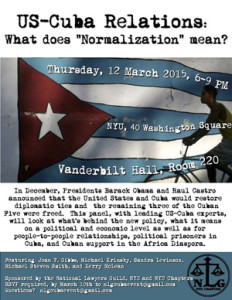
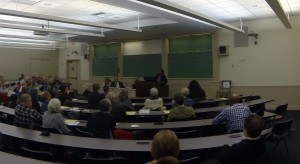
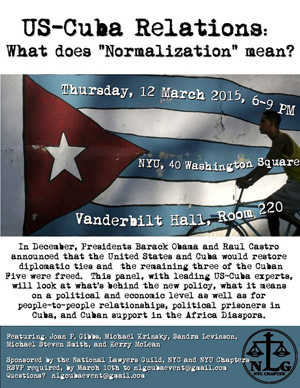
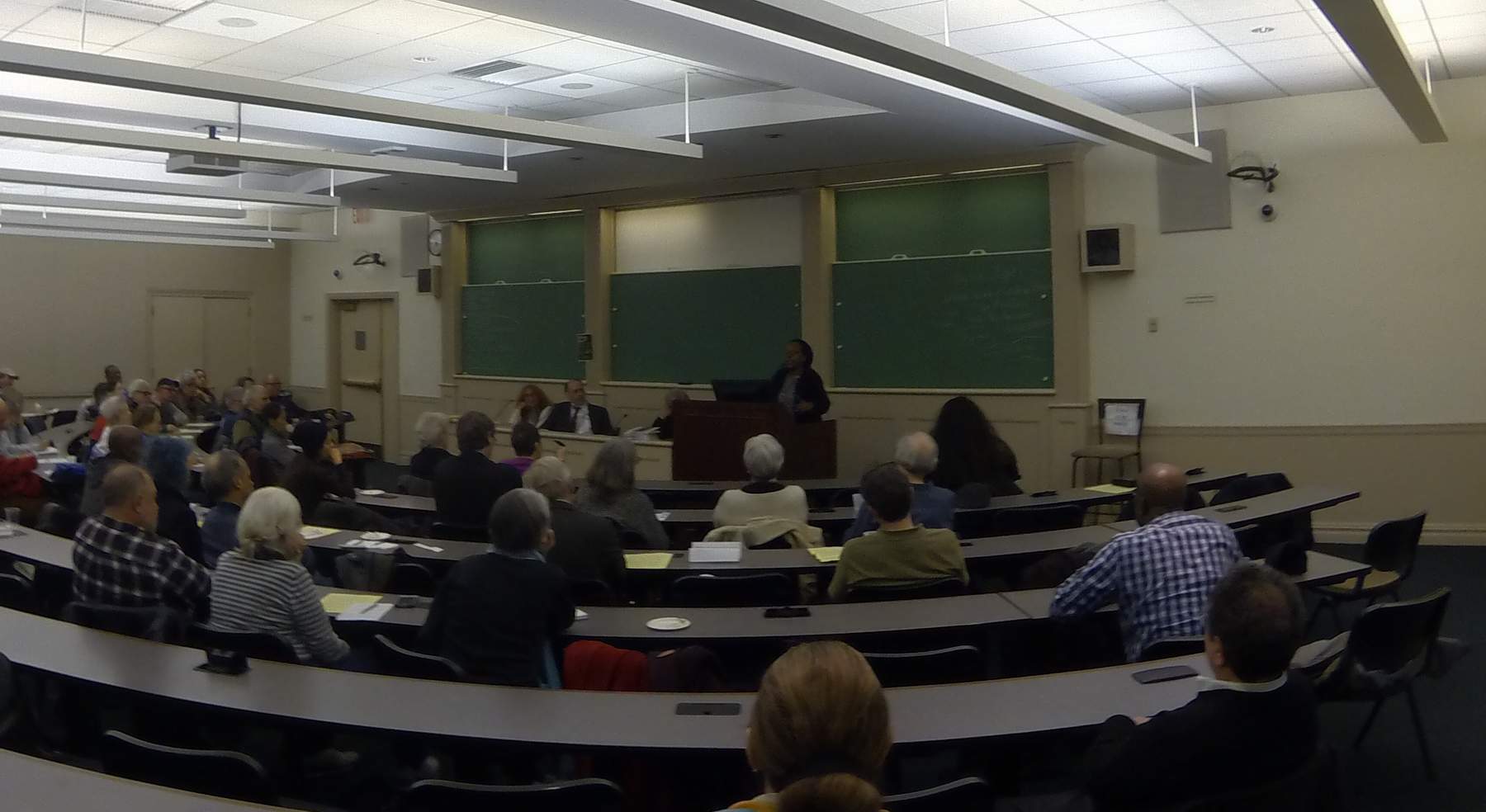
US-Cuba Relations: What does “Normalization” Mean?
In December, Presidents Barack Obama and Raul Castro announced that the United States and Cuba would restore diplomatic ties and the remaining three of the Cuban Five were freed. This panel, with leading US-Cuba experts,will look at what’s behind the new policy, what it means on a political and economic level as well as for people-to-people relationships, political prisoners in Cuba, and Cuban support in the African Diaspora.
Speaker – Sandra Levinson, founder and Executive Director of the Center for Cuban Studies in New York City and Director of the Center’s Cuban Art Space who has traveled to Cuba more than 300 times, often as consultant to major news organizations. Sponsored by the National Lawyers Guild, NYC and NYU Chapters and International Committee.
——————————————————–