Civil Liberties, Human Rights, Prison Industry, Supreme Court, Surveillance, Torture, War Resister
Podcast: Play in new window | Download
Update: Hosts Discuss U.S. Primary Election
—-
Trump’s Judges Imperil Our Rights for Decades
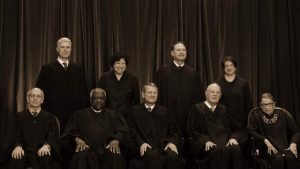
In less than two years, Donald Trump has two installed not one, but two, right-wing justices on the Supreme Court, ensuring a conservative majority for decades to come.
Republican congressional leadership appropriated (stole?) a high Court appointment from Barack Obama and appointed Neil Gorsuch. Gorsuch has cast the deciding vote in 14 cases that hurt workers, consumers, voters, immigrants and reproductive rights, while upholding abuses of government authority. Notably, he cast the deciding vote to uphold Trump’s Muslim travel ban in Trump v. Hawaii.
Republicans then pushed through the appointment of Brett Kavanaugh, who lied under oath and displayed conduct unbecoming a Justice. Just as Gorsuch has upheld the views of conservative Federalist Society and Heritage Foundation backers, Kavanaugh will surely do the same.
The public is less aware, however, of Trump’s systematic appointment of 29 right-wing judges on the federal circuit courts of appeals. And he hopes to appoint even more by year-end. These circuit court appointees have handed down regressive decisions favoring interests of the rich and upholding unlimited spending in politics. Judges who sit on the circuit courts wield enormous power because most cases are resolved at that level.
Seventh Circuit Judge Amy Coney Barrett, for example, voted in one case to allow a corporation to racially segregate its workplace. She also rejected the asylum claim of an immigrant who alleged he was tortured, without even considering the case merits. In the Sixth Circuit Judge Amul Thapar voted to allow public officials to lead Christian-only prayers at public Board of Commissioners meetings.
These decisions are just the tip of the iceberg.
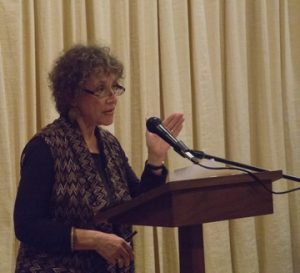
Guest – Attorney Marjorie Cohn, professor emerita at Thomas Jefferson School of Law where she taught for 25 years. The former president of the National Lawyers Guild and criminal defense attorney is a legal scholar and political analyst who writes books and articles, and lectures throughout the world about human rights, US foreign policy, and the contradiction between the two. She has testified before Congress and debated the legality of the war in Afghanistan at the prestigious Oxford Union. Her columns appear on Truthout, HuffPost, JURIST, Truthdig, Portside, Alternet, CommonDreams and Consortium News, and she has provided commentary for CBS News, BBC, MSNBC, CNN, Fox News, NPR and Pacifica Radio. Her website is http://marjoriecohn.com/
—-

The Nature of American Fascism
One hundred and eleven years ago American socialist and famed novelist Jack London in his book “The Iron Heel” anticipated what we are seeing developing in the USA today. He wrote “There is a shadow of something colossal and menacing that even now is beginning to fall across the land. Call it the shadow of an oligarchy if you will; it is the nearest I dare approximate it. What its nature may be I refuse to imagine. But what I wanted to say was this: you are in a perilous position.“
With our experience with fascism in the 20th century in Germany and Italy and with what we see developing in the USA right now we can clearly imagine what American fascism would look like.
– Socialism would be illegal and it’s proponents imprisoned
– Labor unions would be totally illuminated as an organization for those without property
– Quality public education would be further reduced
– The independence of public universities would be totally undermined
– Billions of dollars would continually being devoted to slick propaganda
– Much of traditional government functions with the exception of the police and the armed forces would be privatized
– The media and the Internet would be put under direct government control
– Minorities, blacks, Muslims, Jews, Mexicans, and LBGTQ people would be scapegoated for societies’ills.
– Women would be denied control over their own bodies
– Church and state would no longer be separated
– The rule of law would be cast aside.
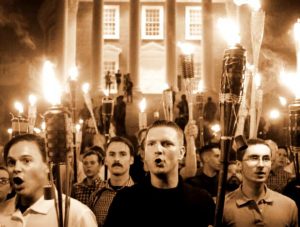
Fascism doesn’t just doesn’t descend on us all at once like the falling of a dark curtain. It creeps in. It has been creeping in over the last 40 years of neoliberalism and with the rise of the ultra right who have taken over the Republican Party. All this was topped off to years ago with the election of Trump. In the last two weeks it has gotten even worse. Two black people were assassinated in Kentucky, 11 Jews were slaughtered inside there Pittsburgh synagogue, Trump canceled a nuclear non-proliferation pact with Russia, he declared himself a nationalist, really a white nationalist, and then sent 14,000 troops to the Mexican border to prevent desperate mostly women and children walking north from Honduras from claiming their lawful ride to asylum, and then he threatened to cancel birthright citizenship, a right guaranteed by the 14th amendment to our constitution.
We know which fascism looks like. We have identified it. But what do we do to fight it?
Guest – Barry Sheppard, is a political writer from Oakland California, a longtime socialist, activist, and author. Contact email: Lundshep@att.net
————————–
————————–
CIA Sponsored Terror, Civil Liberties, Climate Change, Criminalizing Dissent, Green Scare, Human Rights, Iran, War Resister
Podcast: Play in new window | Download
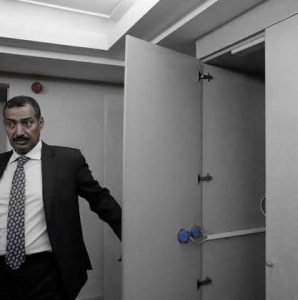
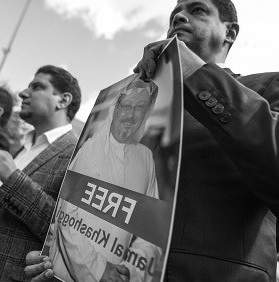
What Happened To Journalist Jamal Khashoggi?
This much has become clear: 33-year-old Saudi Arabian crown prince Mohammed bin Salman knew of or directed the gruesome torture, murder, and dismemberment of Saudi journalist and Washington Post columnist Jamal Khashoggi at the Saudi consulate in Istanbul on October 2, 2018.
The US has had an alliance with the Saudi theocratic monarchy since it was forged by President Roosevelt in 1945 at the end of World War II.
The United States needs Saudi Arabia to help rule the Middle East. It needs their cooperation in keeping oil prices low, their petro-dollars, their arms purchases, and it needs Saudi Arabian support for both its planned war against Iran and it’s support for a joint Israeli/American planned effort to permanently repress the Palestinian people, an effort which Trump has put his son-in-law Jared Kushner in charge of. But with the murder of Khashoggi the US/ Saudi alliance is beginning to fray.
Guest – Attorney Abdeen Jabara, the former president of the Arab American Anti-discrimination Committee, a leader of Palestine solidarity work in the National Lawyers Guild. He’s also a former board member at the Center for Constitutional
—-
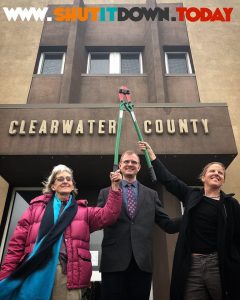
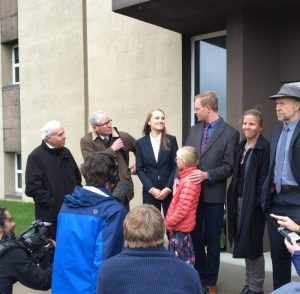
Necessity Defense: Climate Defense Project
Earlier this month a judge dismissed the case against three environmental activists who were charged with damaging a northern Minnesota pipeline in 2016. The defendants call themselves as “valve turners.” They shut off the valves of two Enbridge Energy Company pipelines near Leonard in Clearwater County to protest the oil industry’s contribution to climate change. The action was part of a coordinated effort across several states.
Like the defendants, their 3-person legal team traveled thousands of miles to present their case in the small northwoods town. The team consisted of Kelsey Skaggs from the Climate Defense Project in San Francisco and Twin-Cities based attorney Timothy Phillips along with Oregon-based Lauren Regan.
State representative Pat Garofalo, said: “Today’s decision is irresponsible, and sends the message that protesters are free to engage in reckless, illegal, and dangerous behavior that puts Minnesotans’ safety at risk.” He said this dangerous action needs to be corrected in the next legislative session.” Judge Robert Tiffany dismissed the case at the defense attorneys’ request midway through the second day of trial after County Attorney Alan Rogalla rested his case.
Tiffany granted the dismissal based on arguments from the defense attorneys, one of which was that the prosecution failed to prove the defendants had damaged the actual pipeline rather than merely the chains and locks bound to the pipeline valve. Enbridge supervisor Bill Palmer testified that simply shutting off the valve would not have caused any damage to the pipeline.
Guest – Kelsey Skaggs, Executive Director of the Climate Defense Project.
——————
——————
Civil Liberties, Criminalizing Dissent, Crony Capitalism, Human Rights, Prison Industry, Surveillance, Targeting Muslims, Truth to Power, War Resister
Podcast: Play in new window | Download

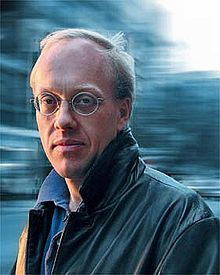
Chris Hedges – America: the Farewell Tour
We are living in terrible times. Novelist Barbara Kingsolver has said that “it feels like the end of the world.” Last week hurricane Michael destroyed much of the Florida Panhandle. Before that hurricanes decimated Puerto Rico and before that Houston and before that New Orleans. Climate scientists predict it will only get worse and that we are rapidly running out of time to hold the disaster.
Many people have observed that Trump is a symptom, not the disease. The insurgency in the Republican Party has installed a purposeful, strategic and successful ultra right into power in all three branches of the Federal government and in the legislatures of half the states.
The war in Afghanistan has been pursued for 17 years. Iraq and Libya have been destroyed. The military budget was increased by 10% and is now some $700 billion a year, half of what the government spends all together. Are we on the verge of climate catastrophe, a great economic crash, or the end of the American empire?
Guest – Chris Hedges has written 11 books including the recently published America: the Farewell Tour. Although he is a recipient of the Pulitzer Prize for journalism, Chris Hedges was pushed out of the New York times where he was reporter for publicly criticizing the Iraq war. Pulitzer-Prize winning author and journalist. He was also a war correspondent, specializing in American and Middle Eastern politics and societies. His most recent book is ‘Death of the Liberal Class (2010). Hedges is also known as the best-selling author of War is a Force That Gives Us Meaning (2002), which was a finalist for the National Book Critics Circle Award for Nonfiction.
———————
———————
Censorship, CIA Sponsored Terror, Civil Liberties, Habeas Corpus, Human Rights, Torture, War Resister
Podcast: Play in new window | Download
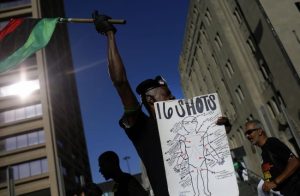
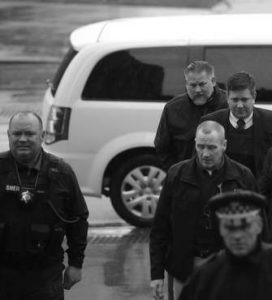
The Power of Public Outrage: Laquan McDonald’s Place in History
Jason van Dyke, the Chicago police officer who four years ago shot 17-year-old Laquan McDonald 16 times in the back, was found guilty on October 5th of second-degree murder and 16 counts of aggravated battery by Chicago jury.
This was the first time in 50 years that a Chicago police officer has been found guilty of murdering somebody while he was on duty.
The McDonald murder was massively covered up beginning with the cops who were on the job with van Dyke, the commanding officers of the Chicago police department, up to the office of the Mayor Rahm Emanuel.
Key to the conviction was video footage taken by a police car dash camera. This video was suppressed by the police, and the mayor for three years and only revealed after a massive campaign by a number of Chicago grassroots organizations. Nationally, there have been no convictions in the murders of Eric Gardner, Michael Brown, or Trayvon Martin.
Chicago is one of the most segregated cities in the USA. Recently 50 Chicago schools have been closed as well as many mental health clinics. Even the parking meters have been sold in a wave of divestment from the inner-city.
Guest – Attorney G.Flint Taylor, a graduate of Brown University and Northwestern Law School, is a founding partner of the People’s Law Office in Chicago, an office which has been dedicated to litigating civil rights, police violence, government misconduct, and death penalty cases for more than 40 years.
—-
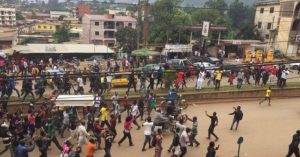

Neo-Colonial Regime Kill Peaceful Ambazonian Protesters in Africa
Ambazonia is an English-speaking territory located between Cameroon and Nigeria in West Africa. Also known as the Southern Cameroons, for most of its recent history it has been under military occupation by the French neo-colonial regime in Cameroon. A majority of Ambazonians reject the legitimacy of this regime and its military control.
In violation of an agreement to create an equal confederacy between the two autonomous states, French Cameroon has been dismantling and defunding Ambazonian systems, and pillaging its resources since the country was created in 1961.
Since December 2016, French Cameroon military has responded to peaceful protests with force, killing over 400 civilians. 200 more have been disappeared and are feared dead. More than 90 villages burnt down, resulting in 60,000 people fleeing to neighboring Nigeria.
More than 2,500 activist and peaceful protesters imprisoned, some tried in military courts, a violation of international law, and some sentenced for terrorism and other unjustifiable charges. Prisoners include prominent nonviolence advocate Julius AyukTabe and 11 of his senior aides, arrested in January 2018, and unlawfully repatriated. Julius’s appeal hearing just happened last Thursday.
On January 26, 2018—with no extradition treaty between Cameroon and Nigeria, and without a presiding judge—Nigeria forcibly handed 10 of the prisoners and 37 other refugees to Cameroon. That was in violation of international law forbidding a country receiving asylum seekers from returning them to a country where they likely face persecution. This action drew condemnation from Amnesty International, the UNHCR, the U.S. Department of State, and other leading human rights advocates. The Ambazonia Prisoners of Conscience Support Network, or APOCS, was recently formed to address this crisis.
Guest – Sphynx Eben, a founding member of APOCS and also a longtime media organizer with the Indymedia Africa Working Group. https://www.facebook.com/apocsnetwork/
——————-
——————-
CIA Sponsored Terror, Civil Liberties, Criminalizing Dissent, Crony Capitalism, Human Rights, Political Prisoner, Prison Industry, Supreme Court, Surveillance, Targeting Muslims, Truth to Power, War Resister
Podcast: Play in new window | Download
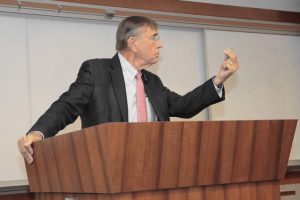
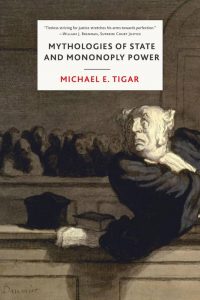
Attorney Michael Tigar: The Mythologies of State and Monopoly Power
The American criminal justice system is buttressed, sustained and perpetuated by various myths. These myths dominate legal ideology. The most important of these myths concern racism, criminal justice, free expression, workers’ rights, and international human rights. “Ordinary private law categories of property, contract, and tort perform the same social function,” Michael Tigar writes in his important new book “Mythologies of State and Monopoly Power.“
Michael Tigar has worked for more than 50 years with movements for social change as a human rights lawyer, law professor, and writer. He believes that busting these myths is the work of movement lawyers.
Noam Chomsky has written that “for anyone concerned with the rule of law, or more generally with the real significance of freedom and justice, Michael Tigar’s book is “a highly informed and carefully argued study that should be essential reading.”
The book is beautifully written, learned, and profoundly insightful. In a better world Michael Tigar would be a justice of the United States Supreme Court.
The Michael Tigar Papers Launch University of Texas
Tigarbytes.blogspot.com
Guest – Michael Tigar, emeritus professor of law at Duke University and at Washington College of Law. He has been a lawyer working on social change issues since the 1960s. He has argued numerous cases in United States Supreme Court and many Circuit Courts of Appeal. His books include “Law and the Rise of Capitalism”, “ Fighting Injustice ”, and the forthcoming Mythologist of State and Monopoly Power.“
——————–
——————–
CIA Sponsored Terror, Civil Liberties, Criminalizing Dissent, Guantanamo, Human Rights, Political Prisoner, Prison Industry, Supreme Court, Surveillance, Torture, Truth to Power, War Resister
Podcast: Play in new window | Download
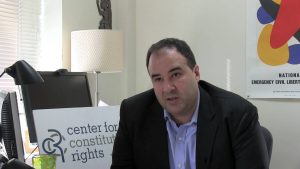
Challenges Lawyers Face As Democratic Institutions Dismantled
What are the the challenges lawyers on the left face in this historic period? That is the concern of today’s show. Since 911 we have seen the consolidation of an authoritarian state. The radical right working over the last 30 years and funded by the Koch brothers and their billionaire allies, are strategic and have been very successful.
They now hold the reins of power in 33 states, the Senate, House of Representatives, the Supreme Court, and the presidency. Their ultimate goal is to “dismantle the administrative state“, which is their formulation for taking away every social benefit that we have earned since 1930s. To prevent us from fighting back they have restricted democracy with voter suppression and gerrymandering. The right wing Supreme Court has declared that corporations are people and have the right to unlimited amounts of corporate dark money. Our access to information has also been constricted. Five major corporations own all the major media. New algorithms by Google and Facebook restrict access to people looking for alternative media, like Law And Disorder Radio.
We are also seeing the dismantling of programs that benefit people and the hollowing out of the democratic rights necessary to defend them. Racism and dehumanization are employed to divide and conquer. But at the same time we have seen the growth of social movements with our movement attorneys right in there fighting as important auxiliaries. Since 911 and the passage of the Patriot Act government surveillance of our private lives and political affiliations has become pervasive.
Guest – Attorney Natasha Lycia Ora Bannan, President of the National Lawyers Guild.
Guest – Attorney Baher Azmy, the litigation director at the center for constitutional rights National Lawyers Guild – Chicago 1937 as an alternative to the all white American Bar Association. It’s gotten principle was announced: human rights over property rights. The center for constitutional rights was founded by civil rights attorneys who had been active in the south in 1966 including William Kunstler, the attorney for Martin Luther King.
—-

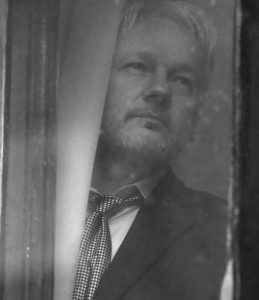
Julian Assange And Political Asylum In Danger
WikiLeaks founder the truth telling publisher Julian Assange is in certain and imminent danger of being sent from England to America where he would likely be tried for espionage, a crime that carries the death penalty.
Assange and WikiLeaks have revealed American war crimes in the middle east, CIA global machinations , and the work of Clinton Democrats in preventing the popular Bernie Sanders from heading up the party ticket.
Assange is presently holed up in the Ecuadorian embassy in London where he was granted political asylum six years ago by past leftist president Rafael Correa. But now, with the change of presidents in Ecuador, Assange has been cut off from the outside world. He has no phone, no computer, and no visitors.
The fresh offensive against him occurred the day after American General Joseph DiSalvo, the head of the US Southern Command, the Pentagon’s arm in Latin America, visited the new right wing Ecuadorian President Lenin Moreno. Irene was told that if he did not cooperate he would not get an International Monetary Fund loan. Moreno has said that Assange is “an inherited problem” and is seeking s better relationship with the United States government, to whom he has already granted a military base.
Guest -Attorney Renata Avila has represented International human rights lawyer and digital rights advocate. In her practice, she represented indigenous victims of genocide and other human rights abuses, including the prominent indigenous leader and Nobel Peace Prize Laureate Rigoberta Menchu Tum. She also represented awarded journalist Julian Assange and Wikileaks since 2009. Avila sits on the
Board of Creative Commons, is a trustee of the Courage Foundation, – an organisation set up to assist whistleblowers at risk – and is an advisory board member of Diem25, a movement to democratise Europe launched by Yanis Varoufakis. Her book Women, Whistleblowing Wikileaks” was published by OR Books. She is currently writing a book on Digital Colonialism and regularly writes for several international newspapers.
—————-
—————-
