CIA Sponsored Terror, Civil Liberties, Human Rights, Iran, Political Prisoner, Prison Industry, Surveillance, Targeting Muslims, Truth to Power, War Resister
Podcast: Play in new window | Download
Political Analysis: United States Attacks On Syria
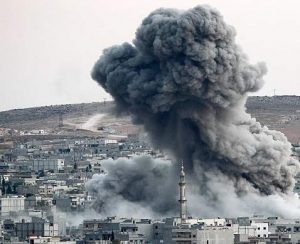
The recent American cruise missile attack on alleged chemical war infrastructure in Douma, Syria have been defended as legitimate, if not legal. Trump called Syrian president Assad “ an animal“ who gassed his own people and had to be deterred from further attacks on them.
Critics of the attack have said that it violated both American and international law and risked nuclear warfare. They argued that our Constitution states that only Congress can declare war, that there was no question of self-defense, that the United States was under attack, and that in any case The United Nations charter, to which the United States is a signatory, precludes what United States did. The UN charter is a treaty which binds America and is part of American law.
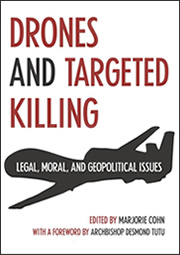
Guest – Attorney Marjorie Cohn, professor emerita at Thomas Jefferson School of Law and former NLG president. My book, ‘Drones and Targeted Killing: Legal, Moral, and Geopolitical Issues,’ was recently published in a second, updated edition. marjoriecohn.com.
—-
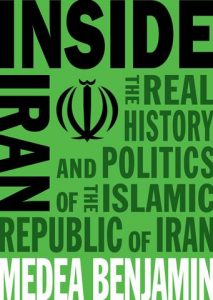
Inside Iran: The Real History And Politics Of The Islamic Republic Of Iran
Medea Benjamin presented a powerful book talk at the A.J Muste Memorial Institute. Medea was introduced by our own Heidi Boghosian.
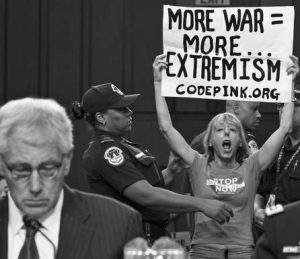
Medea Benjamin is the co-founder of the women-led peace group CODEPINK and the co-founder of the human rights group Global Exchange. She has been an advocate for social justice for more than 40 years. Described as “one of America’s most committed — and most effective — fighters for human rights” by New York Newsday, and “one of the high profile leaders of the peace movement” by the Los Angeles Times, she was one of 1,000 exemplary women from 140 countries nominated to receive the Nobel Peace Prize on behalf of the millions of women who do the essential work of peace worldwide. She received numerous prices, including: the Martin Luther King, Jr. Peace Prize from the Fellowship of Reconciliation, the Peace Prize by the US Peace Memorial, the Gandhi Peace Award, and the Nuclear Age Peace Foundation Award. She is a former economist and nutritionist with the United Nations and World Health Organization.
——————-
——————-
Civil Liberties, Criminalizing Dissent, Human Rights, Human Trafficking, Supreme Court, Torture, Truth to Power, War Resister
Podcast: Play in new window | Download
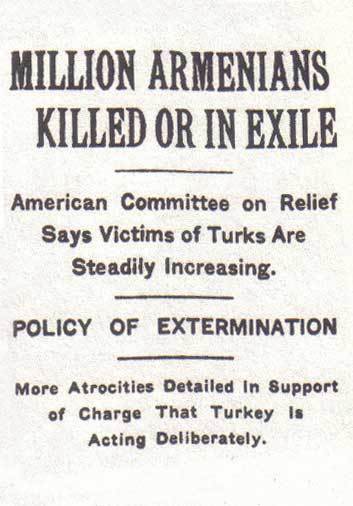
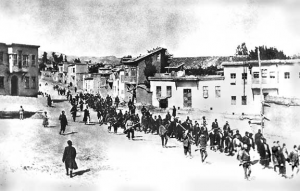
Speaking In Turkish: Denying the Armenian Genocide
Around the world, April 24 marks the observance of the Armenian Genocide. On that day in 1915 the Interior Minister of the Ottoman Empire ordered the arrest and hangings of Armenian intellectuals and community leaders in Constantinople. It was the beginning of a systematic and well-documented plan to eliminate the Armenians, who were Christian, and who had been under Ottoman rule and treated as second class citizens since the 15th century.
The unspeakable and gruesome nature of the killings—beheadings of groups of babies, dismemberments, mass burnings, mass drownings, use of toxic gas, lethal injections of morphine or injections with the blood of typhoid fever patients—render oral histories particularly difficult for survivors of the victims.
Why did this happen? Despite being deemed inferior to Turkish Muslims, the Armenian community had attained a prestigious position in the Ottoman Empire and the central authorities there grew apprehensive of their power and longing for a homeland. The concerted plan of deportation and extermination was effected, in large part, because World War I demanded the involvement and concern of potential allied countries. As the writer Grigoris Balakian wrote, the war provided the Turkish government “their sole opportunity, one unprecedented” to exploit the chaos of war in order to carry out their extermination plan.
As Armenians escaped to several countries, including the United States, a number came to New Britain, Connecticut in 1892 to work in the factories of what was then known as the hardware capital of the world. By 1940 nearly 3,000 Armenians lived there in a tight-knit community.
Pope Frances calls it a duty not to forget “the senseless slaughter” of an estimated one and a half million Armenians by the Ottoman Turks from 1915 to 1923. “Concealing or denying evil is like allowing a wound to keep bleeding without bandaging it,” the Pope said just two weeks before the 100th anniversary of the systematic implementation of a plan to exterminate the Armenian race.
Special thanks to Jennie Garabedian, Arthur Sheverdian, Ruth Swisher, Harry Mazadoorian, and Roxie Maljanian. Produced and written by Heidi Boghosian and Geoff Brady.
———————————————
CIA Sponsored Terror, Civil Liberties, Criminalizing Dissent, FBI Intrusion, Human Rights, Iraq War, NSA Spying, Political Prisoner, Prison Industry, Surveillance, Targeting Muslims, Torture, Truth to Power, War Resister
Podcast: Play in new window | Download
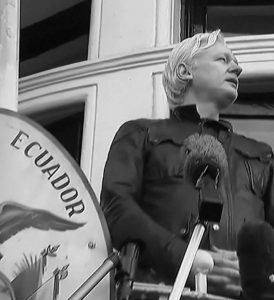
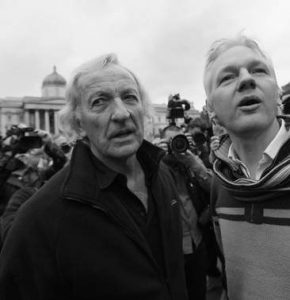
Mass Support Needed For Julian Assange
Two weeks ago, WikiLeaks founder and internet publisher Julian Assange , who is holed up in the Ecuadorian embassy in London, had his Internet access cut off due to pressure by the British and American governments on Ecuador. Ecuador had granted him political asylum in their embassy where he has been living in two small sunless rooms for five years. Ecuador gave him political asylum after he sought refuge in the embassy to avoid extradition to Sweden, which would have sent him to the US. Assange was under protracted investigation for a rape claim, made up by the Swedish police and Swedish prosecutor and denied by the purported women victim. Sweden finally dropped the case, but Assange remains subject to arrest in Britain jumping bail.
Assange and WikiLeaks had been steadily revealing the war crimes and illegalities of the American government since it first published the Iraq war logs eight years ago. The war logs included video footage of American soldiers assassinating Iraqi civilians and a Reuters journalist. Chelsea Manning, who was recently released after seven years in prison, furnished WikiLeaks with the war logs.
The United States government is seeking to capture Assange and bring him back to the United States to stand trial for espionage, a crime which carries the death penalty.
Guest – John Pilger, an Australian-British journalist based in London. John has worked in many facets of journalism, including a correspondent in the Vietnam War, the Middle East Desk for Reuters in London, a documentary film maker, and a producer for the Independent Television Network in London. Pilger is known for his conscience, bravery and acute historical insight. His articles appear worldwide in newspapers such as the Guardian, the Independent, the New York Times, the Los Angeles Times.
—-


You Thought We Wouldn’t Notice: Intellectual Property
Laws protecting artwork and intellectual property are increasingly being put to the test amid claims from rising artists marketing their work online whose work is being copied by others.
Art piracy can include music posters, clothing design, book cover art, signage, record sleeve art, and typography. Under copyright law, one artist using another artist’s idea is generally legal, while one artist using another’s expression of that idea is generally illegal. Only a fact-intensive analysis can provide a bit of clarity, and even that is subject to a judge’s or jury’s review.
Sometimes copyright cases expand into major litigation. A New York judge recently ruled that graffiti, or aerosol artists, were entitled to a $6.7 million verdict after New York developer Gerald Wolkoff destroyed their well-known public work. The claim in the so-called FivePointz case arose under the Visual Artists’ Rights Act, or VARA. It’s the kind of case that attorney Scott Burroughs says rarely goes to trial. Several artists created aerosol art pieces on the walls of an abandoned development in the once downtrodden and now gentrified neighborhood of Long Island City, Queens. Wolkoff destroyed their art as part of a development plan. Read Scott’s Column Above The Law.
Guest – Attorney Scott Burroughs, an advocate for artists’ rights who curates the art law blog You Thought We Wouldn’t Notice and has a weekly copyright law column on legal website Above the Law.
———————————————-
CIA Sponsored Terror, Civil Liberties, Criminalizing Dissent, Human Rights, War Resister
Podcast: Play in new window | Download
Updates:
- Co-host Michael Smith Discusses Being Plaintiff In Saudi Arabia Terror Lawsuit
—-
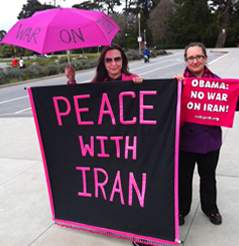

President Donald Trump Picks John Bolton For National Security Adviser
In these unsettling times it was particularly disturbing to a lot of people to learn last week that President Trump chose John Bolton to replace general H. R. Macmaster as his National Security Adviser. Trump also replaced Secretary of State Rex Tillerson with the neo-conservative CIA director Mike Pompeo. It will be remembered that John Bolton was instrumental in getting the USA to attack Iraq on the pretext that Iraq had weapons of mass destruction and ties with the terrorist organization Al Qaeda.
Bolton now alleges that Iran is building nuclear bombs and advocates for preemptively bombing Iran, which would be an illegal act of aggression.
Guest – Phyllis Bennis directs the New Internationalism Project at IPS, working as a writer, activist and analyst on Middle East and UN issues. She is also a fellow of the Transnational Institute in Amsterdam. In 2001 she helped found and remains active with the U.S. Campaign to End the Israeli Occupation. She works with many anti-war organizations, and writes and speaks widely across the U.S. and around the world as part of the global peace movement. She has served as an informal adviser to several top UN officials on Middle East and UN democratization issues. Phyllis Bennis writes about issues related to the Middle East and the United Nations. She wrote the book Understanding the US Iran Crisis: A Primer. She has contributed articles to the Nation magazine, the New York Times, The Washington Post, and Counterpunch.
—-
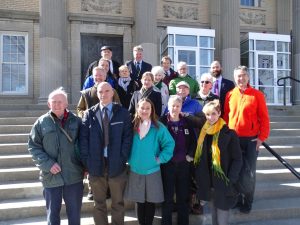
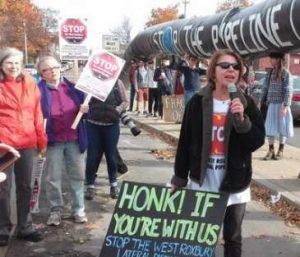
Judge Finds Activists Not Guilty On Necessity Defense
Thirteen environmental protesters were recently found not guilty in actions protesting a gas pipeline in the densely populated West Roxbury, Massachsuetts. In 2015 activists climbed into holes dug for the pipeline being built by the Houston-based company Spectra Energy. Judge Mary Ann Driscoll found them not responsible after hearing each one argue their actions to try and stop climate change were a legal “necessity”.
The so-called necessity defense is rarely accepted in US courts. Defendants relying on this defense argue that they should not be held liable for their actions because their conduct was necessary to prevent a greater harm.
In this case, the official court record will only state the charges were converted from criminal misdemeanors to civil infractions and that all defendants were found “not responsible.” But the judge DID state from the bench, on the record, that she was finding the defendants “not responsible” on the basis of necessity.
In response, environmentalist Bill McKibben, Tweeted this message: “Good golly! A few minutes ago a Boston judge acquitted 13 pipeline protesters on the grounds that the climate crisis made it necessary for them to commit civil disobedience. This may be a first in America.”
In general, a judge hearing a civil infraction case doesn’t have to give any reasons for finding a defendant not responsible. Here, the judge told lead counsel Andrew Fischer that she would state on the record that necessity was her reason for finding them not responsible.
The sustained resistance campaign would not have been possible without the support of the Massachusetts Chapter of the National Lawyers Guild, who represented every person who was arrested (often through multiple appearances) and supported the ongoing training efforts.
Guest – Kelsey Skaggs, Executive Director of the Climate Defense Project, she has worked on environmental issues at Crag Law Center in Oregon; on international environmental policy at Universal Rights Group in Geneva; and defending free speech activists at Media Legal Defence Initiative in London. Kelsey has also written about First Amendment issues related to NSA surveillance programs. She holds a B.A. in International Relations from the University of California, Davis, and a J.D. from Harvard Law School. Kelsey is licensed to practice law in the State of California.
Guest – Marla Marcum, Director of the Climate Disobedience Center and is a United Methodist committed to supporting people of all faiths and no particular faith to act boldly for justice. An experienced campaigner, trainer, pastor and lay leader, she brings two decades of social justice organizing experience with faith-based, youth, and grassroots groups.
——————————————
——————————————
CIA Sponsored Terror, Civil Liberties, Criminalizing Dissent, Human Rights, Political Prisoner, Prison Industry, Surveillance, Targeting Muslims, Torture, Uncategorized, War Resister
Podcast: Play in new window | Download
Gina Haspel, Rule of Law And Torture
Nazi generals and Nazi leaders were prosecuted at the end of World War II for war crimes and crimes against humanity and genocide. These crimes were incorporated into international law.
The chief prosecutor was Robert Jackson, a Supreme Court judge. The Nazis defended themselves by arguing that they were just following orders. This defense was deemed unavailing. In many cases, they were found guilty and sentenced to lengthy prison terms or hung. He said that the war crimes tribunal at Nirenberg was not merely victors’ justice. But that the principles it followed would be universal and applied in the future, to all countries including the USA. And indeed, the United States signed on to the Geneva Conventions and Convention Against Torture and incorporate both the crimes and the concept of universal jurisdiction into its law.
Gina Haspel has been nominated by President Donald Trump to head the CIA. She is a war criminal. She violated both international and national law by running a black site secret detention center in Thailand where men were tortured. Although there were several court orders that the evidence be preserved, Gina Haspel had the videotapes of torture destroyed.
John Brennan, Obama’s ex head of the CIA, who was involved in the torture program, recently came to her defense, stating that she was just following orders: The Nazi defense.
Trump supports torture. He believes that torture works. This is both immoral and untrue. He says he is for waterboarding and worse. He now has a subordinate with whom he is in agreement.
Obama refused to prosecute the lawbreakers. Instead he threw CIA whistleblower John Kiriakou in prison for two years for disclosing American torture. He said we must look forward, not backward. This greenlighted what is going on now with Haspel.
Michael Ratner warned us about this eventuality. The European Center for Human and Constitutional Rights may seek Haspel’s arrest if she goes to Germany.
Such is the irony of history that the German fascist government that perpetrated the greatest crimes against humanity has been superseded by an American government which condones and is perpetuating them as well.
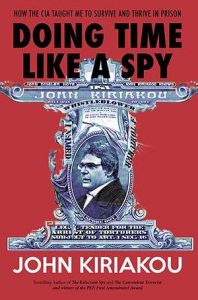
Guest – John Kiriakou, a former CIA agent, he is the author of Doing Time Like a Spy: How the CIA Taught Me to Survive and Thrive in Prison. He spent 15 years working for the CIA including the period following September 11 2001. The next year he was invited to be certified in enhanced interrogation techniques and said no, rightly recognizing it as sanctioned torture. He was privy to all the details of the American torture program and personally knew Gina Haspel. In 2007 when ABC News asked him to rebut charges that he tortured and Al Qaeda prisoner he went on the air and disclose details about American torture policy. For this the CIA had him tried and convicted. He spent 23 months in prison.
Guest – Katherine Gallagher is a Senior Staff Attorney at the Center for Constitutional Rights. She works on universal jurisdiction and international criminal law cases involving U.S. and foreign officials and torture and other war crimes, and cases involving private military corporations and torture at Abu Ghraib. Her major cases include Al Shimari v. CACI, the international U.S. torture accountability cases, andSurvivors Network of those Abused by Priests (SNAP) v. Vatican, seeking accountability for the crimes against humanity of sexual violence by clergy and cover-up.
—-
The National Immigration Project And Protecting Haitian Refugees
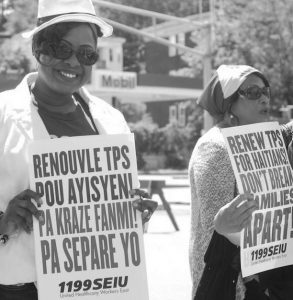
The National Immigration Project of the National Lawyers Guild filed a lawsuit in Brooklyn on March 15 to block President Trump’s cancellation of temporary protected status which had been granted to more than 50,000 Haitian refugees because of the terrible conditions in that country since the hurricane in 2010. The National Immigration Project declared President Trump’s actions to be unlawful, racially motivated, and evidence of a complete lack of knowledge of immigration law.
The TPS program exempts from deportation people from countries in turmoil due to war, natural disasters, and other extraordinary conditions.
The suit alleges that the federal government was arbitrary and capricious in his decision to end the program and was motivated by Donald Trump’s “racial and national origin animus towards patients.” The suit cites Trump’s demeaning remarks towards Haitians and Haiti. He has said that Haitians have AIDS and Haiti is a “s&*t hole” country. The Trump administration‘s position is that protecting Haitians is no longer necessary because conditions in Haiti have improved.
Guest – National Lawyers Guild Attorney Sejal Zota is the Legal Director of the National Immigration Project of the Guild. Sejal works on issues of removal defense, post-conviction, enforcement, and immigration consequences of crimes through litigation, education, and technical assistance. Previously, Sejal taught and wrote about the impacts of immigration on state and local government at University of North Carolina’s School of Government. She also regularly trained and advised defense attorneys throughout North Carolina on the immigration consequences of crime, and is the lead author of Immigration Consequences of a Criminal Conviction in North Carolina.
—-
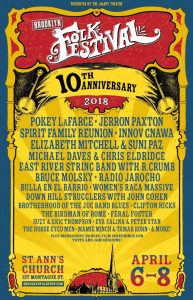

Brooklyn Folk Festival 2018
Co-host Michael Smith reminds listeners of this year’s Brooklyn Folk Festival.
———————————————————
Academic Freedom, CIA Sponsored Terror, Civil Liberties, Human Rights, Iraq War, Military Tribunal, Political Prisoner, Prison Industry, Targeting Muslims, Torture, Truth to Power, War Resister
Podcast: Play in new window | Download
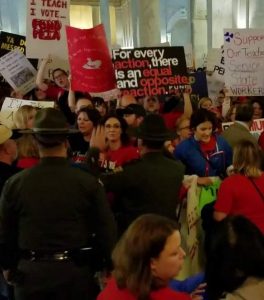
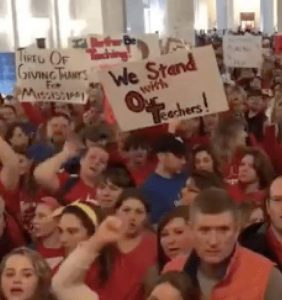
Victory: West Virginia Teachers’ Strike
After nine days on strike, the West Virginia governor and the state legislature caved, granting the teachers and all school staff a 5% wage increase. The pay raise also covers all state employees.
In an attempt to save face the Republicans talked about funding the pay increase by cutting social services and Medicaid. But there is no such wording in the agreement that was signed by the West Virginia Education Association and the American Federation of Teachers , the two workers organizations.
One strike supporter in West Virginia stated that “At this point the teachers and school staff have all the momentum and they can fight to make sure the funds for the raise come from the rich, not working people when the budget is eventually passed. Strikers here are ecstatic, people are literally hugging strangers, and whipping enjoy. It’s in a stark victory for the working class. Hopefully it will be the first of many to come.”
The strike was caused by decades of stagnating pay and rising health costs. 3/4 of the teachers are women.They played leading roles in the strike. West Virginia, especially its southern counties, have a history of militancy, Especially in the coal mines. Teacher job actions and walkouts spread from these very same southern counties.
The West Virginia teachers have shown Americans what it takes to win a strike. This is especially important when the anticipated Supreme Court ruling in the Janus case comes down. That ruling will likely reduce the power of public employee unions by taking away their right to collect dues.
Guest – Dale Lee is a graduate of Clinch Valley College (Wise, VA) and obtained his special education certification through the West Virginia College of Graduate Studies (WV COGS). He is completing his Master’s degree through Salem International University. A veteran teacher of 22 years, Dale’s assignment was teaching special education at Princeton Senior High School
—-


Law Firm Files 911 Terror Lawsuit Against Saudi Arabia
Nearly sixteen years have passed since the 911 attacks. The truth of who was behind the attacks has allegedly come out in a class action lawsuit brought by over 6500 victims and survivors. The lawsuit alleges that it was elements of the Saudi Arabian government that attacked the United States on 9/11. The Defendant in the lawsuit is Saudi Arabia. The Saudi Arabian government hired 15 public relations firms to help them deny responsibility. They hired several Washington white shoe high powered connected law firms They hid behind the law of sovereign immunity, which had to be overturned by an act of Congress in order for the lawsuit to proceed. They were helped by the US government in the cover-up by the Bush and Obama administrations.
After more than sixteen years the case is now proceeding rapidly through the Federal courts and will either be dismissed, settled or tried. The object of the lawsuit is to obtain money explained Sharon Pemboli, one of the plaintiffs and leaders of a group of women from New Jersey known as “the Jersey girls” who lobbied to win passage of the law which made the lawsuit possible. She believes that if the Saudi Arabian government is deprived of funds it will not be able to fund Al Qaeda and the extremist Wahhabi clergy responsible for supporting the terrorism of Al Qaeda.
The American public has been led to believe mistakenly that Saddam Hussein and Iraq were behind 911. The attack on Iraq was a war of aggression. At the end of World War II, the United States set up the Nuremberg trials to try Nazi war criminals. They wanted to set forth principles that were not merely “victor’s justice.“ At the Nuremberg trials the Germans were found guilty of starting a war of aggression, which was called the greatest of all crimes because it has contained within it all other crimes.
Guest – Attorney Justin Green, Justin has successfully represented families in many major aviation cases. These include airline disasters, corporate airplane and helicopter accidents, and civil airplane and helicopter accidents. His practice has also included personal injury and wrongful death cases arising from other transportation accidents.
—-

Lynne Stewart Anniversary 2018
Hosts remember fearless activist and attorney Lynne Stewart. Heidi reads an excerpt from Michael’s yet to be published Lawyers You’ll Like. We’ll also hear a powerful speech by Chris Hedges delivered at Lynne’s memorial.