Afghanistan War, CIA Sponsored Terror, Civil Liberties, Criminalizing Dissent, Human Rights, NSA Spying, Political Prisoner, Prison Industry, Supreme Court, Surveillance, Torture, War Resister
Podcast: Play in new window | Download
Updates:
- NSA Collecting MetaData And Content On Five Countries
- Julian Assange-Glenn Greenwald Twitter Storm
- Host Discussion On NSA Ubiquitous Data Collecting
——-
The United States vs. Private Chelsea Manning
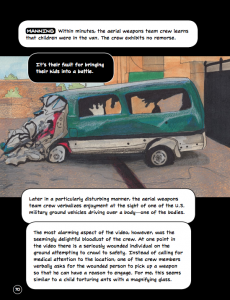
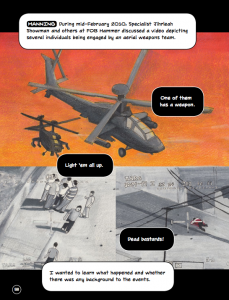
Last year our own Michael Ratner made many trips to Fort Meade to attend the very secretive Private Chelsea Manning trials. Michael had also explained in past shows about how he heard Chelsea testify as to why he released each set of documents such as the Iraq war logs, the Afghanistan war logs, State Department cables and more. She said her decision to release the documents were done as an act of conscience. Our guest Wikileaks activist and artist Clark Stoeckley was also at this historic trial. His recent graphic novel titled The United States vs. Private Chelsea Manning is a collection of his vivid sketches from inside the court room. He joins us to talk about his work as an activist and his experiences producing the book. Welcome to Law and Disorder.
Clark Stoeckley:
- As I understand the transcripts are still under seal.
- Those sketches took a little bit longer, ones that where full court room where I drew a lot of people.
- I would work in pencil and draw as quickly as I could everything that I saw in the court room and then I would come back and fill it in with color and hard outlines.
- What she was doing was offering up 20 years of her life, accepting full responsibility and that takes a lot of courage and bravery to do that – being the smallest person in the court room and being noble about it.
- Unfortunately the media wasn’t there to catch the pre-trial. They only showed up on the first day and then the sentencing and the verdict.
- I remember how the court room fell to a complete silence when that video came on and the tears, and the blank stares on the prosecutions’ faces.
- I’m looking through the book right now, I see you, you’re in the picture there Michael Ratner, in the background sitting behind Chelsea.
- 35 years was the sentence and that’s going to be appealed. As I understand the appeal will start as early as December.
- They didn’t like that we’re holding vigils every week and holding large protests there. They shut down the road and they had to re-route traffic. It was the largest protest Ft. Meade had every seen.
- Just a heads up to anyone who wants to correspond with Chelsea, you know have to use the name Chelsea when addressing envelopes. http://www.chelseamanning.org/
- I just started putting them in libraries today.
- CHELSEA E. MANNING 89289 / 1300 NORTH WAREHOUSE ROAD / FORT LEAVENWORTH, KANSAS 66027-2304
Guest – Clark Stoeckley, is an artist and author of the book The United States v. Private Chelsea Manning. He’s also the owner of truck with the WikiLeaks logo emblazoned on it. Stoeckley’s vivid sketches from inside the court and beyond, together with carefully selected transcripts of the proceedings, trace the arguments as they move back and forth between the defense and the prosecution.
——-


Net Neutrality – The Time Warner/Comcast Merger and New Rules Proposed By The FCC
In our last interview with attorney Matt Wood, policy director at Free Press, we talked about the 45 billion dollar Comcast -Time Warner merger and its implications to net neutrality. This proposed merger would unite the nation’s largest cable TV and internet service provider with the second largest cable company. If combined, these companies would offer service to two thirds of U.S. households. We get an update on the merger and we also discuss the new rules proposed by the FCC about net neutrality. Net neutrality essentially means preventing unreasonable discrimination against content on the internet. The Free Press maintains that the new FCC rules would kill rather than protect net neutrality and allow rampant discrimination online.
Attorney Matt Wood:
- What the court said was that you can’t treat broadband providers as common carriers – not as some insurmountable conclusion but simply based on the way the FCC has decided to treat them up to this point.
- So the FCC up to this point has tried to deregulate and yet tried to maintain some of the protections we all need from our communications.
- Though its in the FCC’s discretion according to the majority and according to the DC circuit, what the courts have said, the FCC has made this decision in the past. They still haven’t reversed it, they still want to say that broadband is not a common carrier service and therefore the FCC can’t adopt common carrier or common carrier like obligations for broadband.
- There’s obviously a grave concern to government secrecy and censorship especially when it comes to whistle-blowers and the kind of information that Edward Snowden brought to all of us.
- If you used the phone to commit a crime whether that is wire fraud or you’re talking to your co-conspirators about how to conduct the crime. It is not the telephone company’s place and either say you can or can’t make that call.
- Net neutrality is a way of insuring that the carrier of our speech (that’s typically a private company) doesn’t have a role or not in deciding whether that speech goes through.
- If and when the government steps in and says hey we want to tap that line because we’re actually conducting an investigation or if and when there’s a punishment for the activity that you used the phone to plan that’s obviously a very important legal debate.
- Net neutrality is not a way for the government to control our speech. It is a way to insure that our cable and phone companies do not control our speech.
- The FCC in its current mode is basically saying well even if we’re required to allow these two tiers or multiple tiers of service, we can still step in and protect you and provide a basic level of service.
- This isn’t just about big internet companies on one side and big telephone and cable companies on the other side, its about that we all use the internet especially in a cloud based system. We’re using it not just to watch movies which is an important cultural activity but to back up our files, to send educational videos.
- What the cable and telephone companies want to do is charge you extra to reach their customers and they want to charge in both directions.
- If you want to reach them at all Netflix or Google, Law and Disorder, you also have to pay us now.
- Its no secret that FCC Chairman Wheeler headed not just one but two telecommunication lobbies.
- The FCC has this proceeding that it will be running over the summer. What Chairman Wheeler has proposed we think is not good enough but its not a done deal either so the FCC will take comments not only from companies and groups like ours but members of the public.
Guest – Attorney Matt Wood helps shape the policy team’s efforts to protect the open Internet, prevent media concentration, promote affordable broadband deployment and prioritize a revitalized public media. Before joining Free Press, he worked at the public interest law firm Media Access Project and in the communications practice groups of two private law firms in Washington, D.C. Before that, he served as editor-in-chief for the Harvard Civil Rights-Civil Liberties Law Review, worked for PBS, and spent time at several professional and college radio and television stations. Matt earned his B.A. in film studies from Columbia University and his J.D. from Harvard Law School.
—————————————————————————

Please help support Law and Disorder, the show is now a sponsored project of Fractured Atlas, a non-profit arts service organization. Contributions for the charitable purposes of Law and Disorder must be made payable to Fractured Atlas only and are tax-deductible to the extent permitted by law.
Afghanistan War, CIA Sponsored Terror, Civil Liberties, Criminalizing Dissent, FBI Intrusion, Guantanamo, Habeas Corpus, Human Rights, Iraq War, NSA Spying, Political Prisoner, Surveillance, Targeting Muslims, Torture, War Resister
Podcast: Play in new window | Download
The Muslims Are Coming
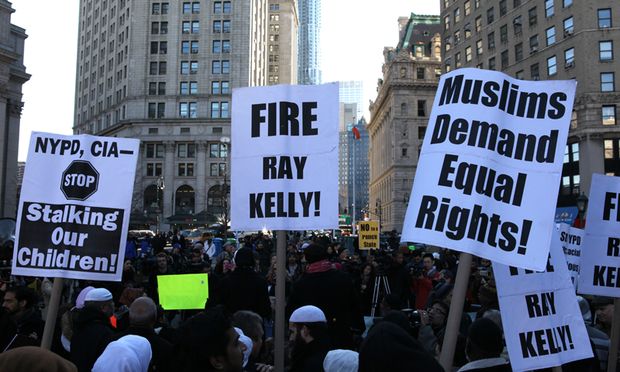
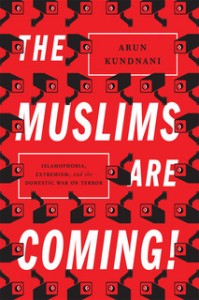
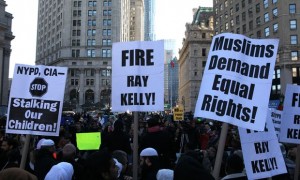
Since the so called war on terror, thousands of innocent Muslims have been entrapped, surveilled, and their communities infiltrated while spending untold resources in search for the radicalized terrorist. In Arun Kundnani’s recent book titled the Muslims Are Coming, he carefully looks at the ideologies and strategies of law enforcement used to create the domestic war on terror. He unveils the disturbing processes of radicalization theories and racial profiling followed by law enforcement.
Arun Kundnani:
- There wasn’t any reflection of what the political causes might be of 9/11 or the political context that might give rise to Al-Qaeda.
- That discussion was basically censored at least in the United States.
- The war on terror has basically failed.
- Radicalization is the chief lens that security officials in Western government lock up Muslim populations.
- The idea of radicalization is that there’s this kind of ideology out there that turns ordinary Muslims into terrorists.
- The FBI and the police department both have the same model of radicalization which they claim tells you the process that someone goes through from being an ordinary member of the public to becoming a terrorist.
- Within that there are various indicators such as behavior or things that people might say or believe that are supposed to be signs that someone is traveling on this path to becoming a terrorist.
- This provides the basis for the very aggressive practice of surveillance that we’ve seen from both of those law enforcement agencies.
- It enables them to have a frame of reference to intervene within Muslim populations within the United States, to tackle the ideology that they see is the root driver for this.
- There are 4 stages in this model. Growing a beard, wearing Islamic clothing, changing the mosque that you attend, being active in a pro-Muslim in a social or political group.
- They often correspond to expression of political opinion.
- The FBI as of 2008 had 15,000 paid informants on its books. That’s a huge number given that half of the FBI’s budget is given to counter-terrorism. The sting operations using informants are the key method of dealing with this.
- The Stasi in Germany had one spy for every 66 East German citizens. It’s that kind of ratio that you can talk about a totalitarian system of surveillance.
- Muslims in America are probably experiencing the same level of surveillance that East Germans faced under the Stasi.
- The liberal take on the war on terror is not the same as the neoconservative take.
- As a Muslim you’re potentially bad and you need to prove that you’re not by the kind of ideology you express. That’s characterized the Obama period in the war on terror.
- The way that the word terrorism or the word extremism or radicalization works is that is serves to criminalize and demonize people who have radical political opinion, irrespective if they’re involved in any kind of violence.
- The structures of surveillance that have been set up in the war on terror, get recycled for all kinds of other purposes.
Guest – Arun Kundnani writes about race, Islamophobia, political violence, and surveillance. His latest book The Muslims are Coming! Islamophobia, extremism, and the domestic War on Terror was published by Verso Books in March 2014. Born and bred in London, he moved to New York in 2010 on a fellowship with the Open Society Foundations and now lives in Harlem. He is the author of The End of Tolerance: racism in 21st century Britain, which was selected as a New Statesman book of the year in 2007. A former editor of the journal Race & Class, he was miseducated at Cambridge University, holds a PhD from London Metropolitan University, and teaches at New York University
———
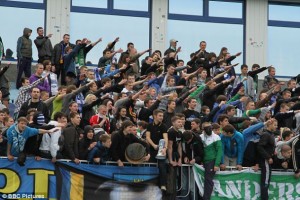
Ukraine’s Neo Nazis
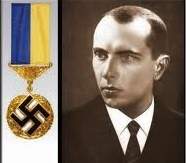
We look at Ukraine’s neo-Nazis and Stepan Bandera and the legacy of World War II. Every important ministry in the Ukraine is now held by ultra-nationalists. The Ministry of Education, social policy, policing, prosecution and national defense are all headed up by people whose party is a direct descendant of the Stepan Bandera movement in the Ukraine during World War II. Bandera and his movement were responsible for the genocide of more than 500 thousand including Poles, Ukrainians and Jews. This fact is played down by the U.S. government, the mainstream media in the United States, the state of Israel and its defenders amongst the Jewish establishment including Abe Foxman of the Anti-Defamation League.
Joel Kovel:
- I think its important to recognize this utterly illegitimate US puppet government I think in large part because it doesn’t have any standing for the Ukrainian people as a whole – has to be defended by neo-Nazi elements which aren’t enormously plentiful, but plentiful enough and they will do the bidding of their masters.
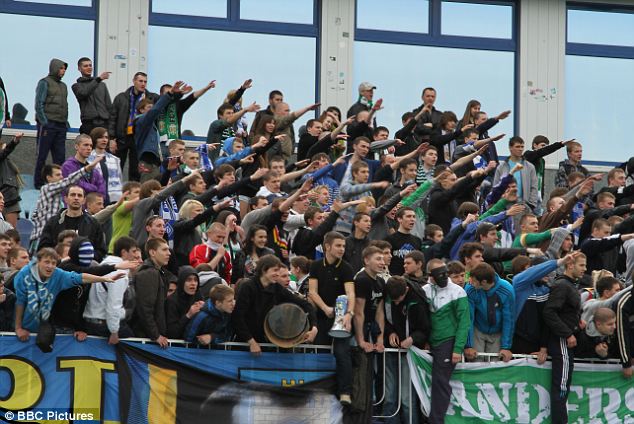
- It started (Odessa, Ukraine) as a quarrel in a soccer stadium, and moved to Odessa. Odessa is an extremely important town it was one of the centers of world Jewish culture for a long time, still has 30 thousand Jews in it.
- The Ukrainian loyalists overwhelmed the other people and drove them into this building, they set fires within the building which led to a hideous massacre.
- One on one violence but also people jumping out of the windows, smoke inhalation.
- Watching it on youtube you saw the total savagery and unspeakable brutality of these thugs, they were laughing, having the time of their lives.
- There were police around, military around, they did nothing to stop this.
- Utterly mystified and denied by the mainstream media, including the main springs thereof, including the Wall Street Journal, the Washington Post, the New York Times.
- My parents were both born in the Ukraine. In the early years of the last century, one third of the Jews in the world lived in the Ukraine.
- You have a blood strewn, contentious history marked by an enormous amount of hatred and vindictiveness. I think all nationalisms are pathological frankly.
- Ukrainian nationalism was particularly virulent. We’re dealing with another brand of ultra-nationalism with the state of Israel, and they’re not unconnected with all this.
- Fascism being a right wing alliance between large bourgeois and nationalist forces using some kind of mythic or racist ideology to legitimate itself.
- Ukraine: there’s never been a solid national identity there’s a tremendous complex mixture of things.
- There’s a book called Organized Antisemitism in Contemporary Ukraine: Structure, Influence and Ideology.
- Of course the US thinks they’re manipulating the puppets so they can control them. You go down that road, there’s going to be a lot of tragedies as the puppet turns on the master.
- The number of Rabbis quoted as saying we’re getting ready to evacuate, we have plans. We’re ready to go in a half an hour. We’re afraid its going to happen again. Meanwhile, this Foxman is saying, don’t worry.
- New York Times had a headline about 3 or 4 weeks ago how this was all overblown Ukraine’s Jews say that Putin not antisemitism is the problem.
- That’s the headline in the New York Times. How could they do that?
- We need a massive onslaught against the program of lies and deception that is being waged by our national media in total lockstep with the imperial interest of the United States. I’ve never in my life seen journalism sink to such an abyss as it has and in the very least this is a front that we can occupy.
- It means a lot because the American don’t want this to be happening. This is something that our power system. One front is the ruthless critique of the media and the lies that our government is putting out.
Guest- Joel Kovel, scholar and an activist. In the former capacity he has published nine books and over a hundred articles and reviews. His books include White Racism, which was nominated for a National Book Award in 1972; A Complete Guide to Therapy; The Age of Desire (in which his work in the psychiatric-psychoanalytic system is detailed); Against the State of Nuclear Terror; In Nicaragua; The Radical Spirit; History and Spirit(1991) – Committee for Open Discussion of Zionism
——————————————————————
Please help support Law and Disorder, the show is now a sponsored project of Fractured Atlas, a non-profit arts service organization. Contributions for the charitable purposes of Law and Disorder must be made payable to Fractured Atlas only and are tax-deductible to the extent permitted by law.
Civil Liberties, Criminalizing Dissent, Habeas Corpus, Human Rights, Torture, Truth to Power, War Resister
Podcast: Play in new window | Download
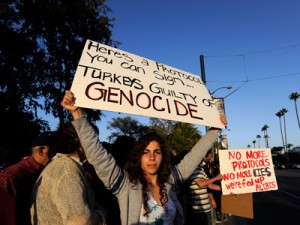
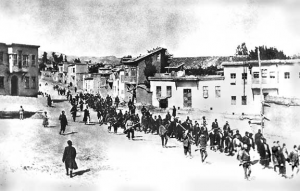
Armenian Genocide Survivor Stories: 99 Years Later
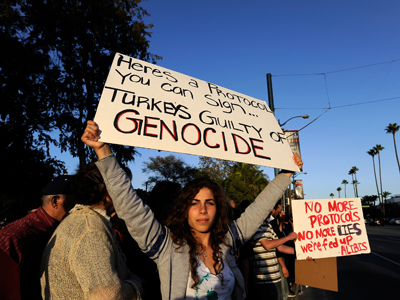
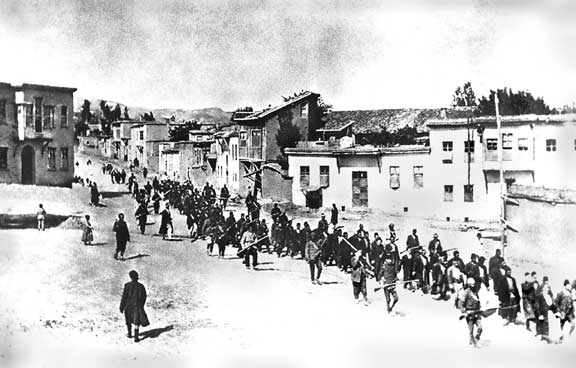
Around the world, April 24 marks observance of the Armenian Genocide. On that day in 1915 the Interior Minister of the Ottoman Empire, Talaat Pasha, ordered the arrest and hangings of Armenian intellectuals and community leaders in Constantinople. The date is widely considered to be the starting date of a systematic and well-documented plan to eliminate the Armenians, who had been under Ottoman rule and treated as second class citizens since the 15th century.
As Armenians escaped to several countries, including the United States, a number came to New Britain, Connecticut in 1892 to work in the factories of what was then known as the hardware capital of the world. By 1940, nearly 3,000 Armenians lived there in a tight-knit community. Meeting together to share memories in conversation are Jennie Garabedian, Harry Mazadorian, Roxy Garabedian, Lucy Simonian, Roxie Maljanian, Mary Abrahamian, John Maljanian, Agnes Karanian, Ruth Swisher, and Artie Shahverdian.
The unspeakable and gruesome nature of the killings—beheadings of groups of babies, dismemberments, mass burnings, mass drownings, use of toxic gas, lethal injections of morphine or injections with the blood of typhoid fever patients—render oral histories particularly difficult. As you will hear from the stories of these first generation Armenian survivors who continue to live in New Britain, a shared history –a shared identity—emerges.
Why did this happen? Despite being deemed inferior to Turkish Muslims, the Armenian community had attained a prestigious position in the Ottoman Empire and the central authorities there grew apprehensive of their power and longing for a homeland. A concerted plan of deportation and extermination was allowed to be carried out, in large part because World War I demanded the involvement and concern of potential allied countries. As the writer Grigoris Balakian wrote, the war provided the Turkish government “their sole opportunity, one unprecedented” to exploit the chaos of war in order to carry out their extermination plan.
Some learned about the massacres directly from their parents or family members, while others were not told at all. Often, surviving women were ashamed to talk about what they had experienced because so many of them had been raped or forced into harems. For others, conjuring visual images of the atrocities was too painful to bear. When parents did speak about the crimes they experienced or witnessed, they frequently spoke in Turkish or Syrian, instead of English or Armenian, so that their children couldn’t understand. Most children of survivors say that the subject was a secret, even forbidden.
————————————————————————
Please help support Law and Disorder, the show is now a sponsored project of Fractured Atlas, a non-profit arts service organization. Contributions for the charitable purposes of Law and Disorder must be made payable to Fractured Atlas only and are tax-deductible to the extent permitted by law.
CIA Sponsored Terror, Civil Liberties, Criminalizing Dissent, Guantanamo, Habeas Corpus, Human Rights, Political Prisoner, Supreme Court, Surveillance, Targeting Muslims, Torture, Truth to Power, War Resister
Podcast: Play in new window | Download
Updates:
——

U.S. Agency Infiltrates Cuba With Fake Twitter Account
Consistent with the NSA’s deceptive strategies in creating fake social networks, the U.S. Agency for International Development masterminded the creation of a “Cuban Twitter: The communications network was designed to undermine the communist government in Cuba. It was financed through foreign banks and constructed through shell companies. The Associated Press learned that the project lasted more than 2 years and had tens of thousands of followers. The content initially was non political such as soccer, music and weather, but it was learned that once a critical mass was reached, political content would be introduced to organize “smart mobs” that could trigger a Cuban Spring.
Jane Franklin:
- When Obama speaks about Cuba you have to read between the lines always and be very careful about what you think he’s saying.
- He said the notion that “the policies we put into place in 1961 would somehow be as effective as they are today in the age of the internet and google and world travel doesn’t make sense.
- We recognize that the aims are always going to be the same and what we have to do is continually find new mechanisms and new tools to speak out on behalf of the issues that we care so deeply about.”
- That’s what he was considering back in November and of course before that this plan to use creative and thoughtful methods to infiltrate Cuba and try to create what the Associated Press calls “smart mobs” which could lead to the downfall of the Cuban government.
- It was called ZunZuneo and was budding in 2009, then it was launched full scale in 2010 with a campaign to use a half a million cell phone numbers that U.S. aids have gotten and sent what they call blasts to those half a million receivers.
- Those people would be told that they could sign up for this program and get news and so on. News that at first would be trivial, and then gradually according to the documents that the AP has – this would increase until they could develop smart mobs – that is street protest that would help lead to the overthrow of the Cuban government.
- They used foreign countries to disguise where the messages came from. They set up a bank account in the Cayman Islands which is a tax haven to use that for money.
- When there was a concert in Havana in 2009 which is described in the report by the AP and the US Aid people blasted the cell phones with questions.
- One of the questions was do you think the two bands that were not in favor of the Cuban government should be on the stage with the band that’s there today?
- If you answered yes, you were what’s called “receptive” to their ideas.
- A few months later they launched this full scale campaign and eventually they had 60 thousand receivers using their program. That’s not many in the population of Cuba. It was a failure and they closed it down.
- They were paying tens of thousands to Cuba Cell, which regulates the cell phones.
- They get millions of dollars from Congress every year to create such programs and try to overthrow the government of Cuba which they’re supposed to do according to U.S. law The Helms-Burton Act requires that.
- It (the report) says that a researcher from Mobile Accord which was the main private contractor was building a mass database about the Cuban subscribers including gender, age, receptiveness and political tendency.
Guest – Jane Franklin is a historian, she has written two books about Cuba: Cuban Foreign Relations 1959-1982 (Center for Cuban Studies, New York, 1984) and Cuba and the United States: A Chronological History (Ocean Press, Melbourne, Australia, 1997). She is co-author of Vietnam and America: A Documented History (Grove Press: New York, 1985, enlarged edition 1995). Her chronology of the history of Panama is in The U.S. Invasion of Panama (South End Press: Boston, 1991). She has published numerous articles, poems and film reviews and has lectured extensively about Cuba, Vietnam, Nicaragua, El Salvador, and Panama. She is a frequent radio commentator about Cuba.
—–
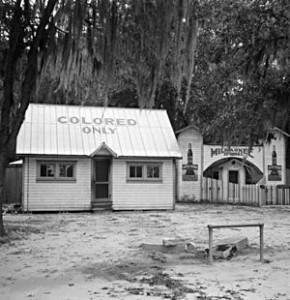
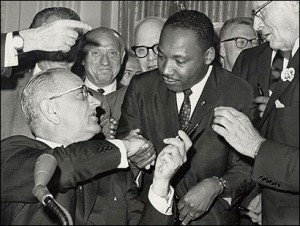
50th anniversary of the Civil Rights Act
This year marks the 50th anniversary of the Civil Rights Act, the most sweeping civil rights legislation since Reconstruction. The Civil Rights Act prohibits prohibits discrimination of all kinds based on race, color, religion, or national origin. The law also provides the federal government with the powers to enforce desegregation. In a speech on June 11, 1963, President John F. Kennedy unveiled plans to pursue a comprehensive civil rights bill in Congress, stating, ‘‘this nation, for all its hopes and all its boasts, will not be fully free until all its citizens are free.”
Professor of Law John Brittain:
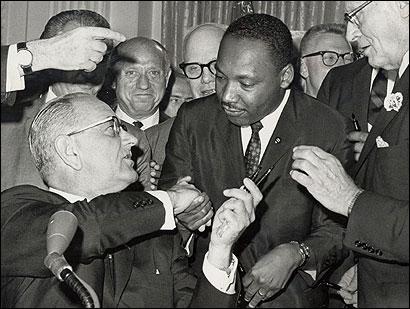
- Yes, I do believe Lyndon Johnson deserves credit, although he had such allies like Martin Luther King. They released some of the unacknowledged tapes by President Johnson in his office in talking with Dr. King both about the 1964 Civil Rights Act as well as he went on to usher in the 1965 Voting Rights Act.
- These acts were a response to a condition on the ground, and the condition was apartheid in the United States, in particularly in the South, but as Malcolm X said anything below the Canadian – US border was the South.
- We’re also celebrating the 50th anniversary of the Summer in Mississippi.
- The demonstrations in the streets no doubt had an effect upon the Congress in passing the 1964 Civil Rights Act to shall we say, let some of the steam out of the kettle.
- He (LBJ) came out of the Lone Star state, the only state that came into the union as a slave state and the state that promoted the white primary, that unless you were white you couldn’t vote in the primary.
- The Missouri Compromise we’d have slave states and free states. After the civil war we’d have a great period of radical Republican reconstruction in the South to give the black former slave equal rights but that died by the 1890s and ushered in a period what we call Jim Crow.
- Coming up to that point in the 1960s and with the riots, to his credit LBJ, notwithstanding that dark cloud over his head, that war in Vietnam which Dr. King called immoral, unjust and illegal and took a lot of criticism for daring to talk about international affairs and indeed talk about a war.
- The minute lawyers went to work in representing the poor, they were cut off by restrictions. The war on poverty and neighborhood legal services was started in 1965-66 but a decade later it was cut off at the knees.
- Johnson said when he was first presented with the idea of legal services – hell I’m not going to pay lawyers to sue the government and win but he was convinced otherwise.
- By the time 65 came around and they created this compromise and started this new federal agency funding called Legal Services corporation to take the political veto out of governors but they had to agree to restriction.
- Legal Services lawyers couldn’t take criminal cases, abortion cases, agitation for labor rights cases, immigration cases, school desegregation cases.
- Just last year 2013, on the eve of celebrating the 50th anniversary of the Voting Rights Act, Chief Justice John Roberts and the right wing on the Supreme Court – Shelby County v Eric Holder
- The Civil Rights Act of 1964 was the same Civil Rights Act of the 1860s. The only difference is they based on a different constitutional provision, not the 14th Amendment which gives Congress the right to enforce the Constitution to provide equality for the former slave, now African American, but instead in 1964, they based it on commerce clause by saying that any segregation interfered with interstate commerce. The act in essence provided for equal accommodation.
- It broke the back of Jim Crow segregation where an African American could go shop, go eat, go live and go play and go to any access in parts of America.
- It would later take the 1968 Fair Housing Act in order to provide equal housing.
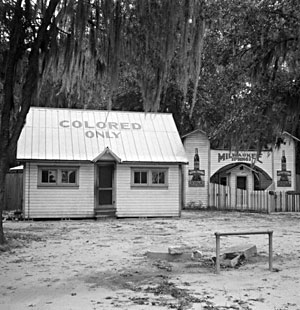
- The 1964 Civil Rights Act gave Congress, gave the Justice Department, the Department of Education too, and others the tools to go in and to stop Jim Crow or “colored only” segregation in our mainly southern states.
- That was the same Justice Department that went on to enforce 1964 Civil Rights Act by bringing legal claims against hotels and restaurants, government facilities that continued to bar blacks from equal access.
- Kennedy said where are the lawyers? By current tort terms, he falsely imprisoned them in the White House and told them they couldn’t leave until they created an organization and out of that grew the Lawyers Committee and immediately they went down to Jackson, Mississippi and created the Jackson Litigation Office.
- I happen to come along in 1969 fresh out of law school to become one of the lawyers in the Jackson litigation and throughout the history of the lawyers committee. The only national legal organization dedicated to equality for African Americans and other people of color have gone on to litigate in education, in voting, in housing and employment discrimination as well as criminal justice.
Guest – Professor John Brittain, tenured professor of law at the University of the District of Columbia, David A. Clarke School of Law. In the past he served as dean of the Thurgood Marshall School of Law at Texas Southern University in Houston, was a veteran law professor at the University of Connecticut School of Law for twenty-two years and was the Chief Counsel and Senior Deputy Director of the Lawyers’ Committee for Civil Rights Under Law in Washington, DC, a public interest legal organization started by President John F. Kennedy to enlist private lawyers to take pro bono cases in civil rights.
———————————————————————-
Please Help Support Law and Disorder
Law and Disorder is now a sponsored project of Fractured Atlas, a non-profit arts service organization. Contributions for the charitable purposes of Law and Disorder must be made payable to Fractured Atlas only and are tax-deductible to the extent permitted by law.
CIA Sponsored Terror, Civil Liberties, Criminalizing Dissent, Extraordinary Rendition, Guantanamo, Human Rights, Political Prisoner, Prison Industry, Surveillance, Torture, Truth to Power, War Resister
Podcast: Play in new window | Download
Updates:
——
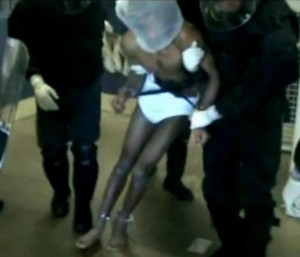
The Dallas 6: Abuse In Solitary Confinement
In April of 2010, a group of inmates locked in solitary confinement at SCI Dallas prison in Pennsylvania were suffering so much abuse and brutal treatment by prison guards they had placed their bedding over the window of their cell doors to attract attention of the prison administrators. Instead of receiving assistance, the inmates were brought up on riot charges. Last December the inmates known as the Dallas 6 defended themselves and presented testimony describing the details of their abuse in solitary confinement.
Shandre Delaney:
- This case, the Dallas 6, began in April 2010. These men were all in the RHU at SCI Dallas, in Dallas PA.
- The RHU is the restrictive housing unit, its an acronym for solitary confinement.
- All of these men had been victims of abuse and torture during their stay in solitary confinement.
- The Dallas 6 are Andre Jacobs, Anthony Kelly, Anthony Locke, Dwayne Peters, Derek Stanley and my son Carrington Keys.
- Most of these guys went into solitary for minor infractions, maybe to stay 60-90 days. My son stayed in there for 10 years, and I think all of the other guys about the same.
- These guys were jailhouse lawyers. These guys were people who spoke up and sent word to the outside about what was going on in solitary confinement.
- Once you do that – they call it misconduct, which are write ups, they’ll give you false write ups, and all types of things just to keep you in there longer.
- The cells are 6X9. In solitary, they might have a window to the outside. There is a bunk that they sleep on. There is only a slot for food to come in and out.
- You’re supposed to come out of your cell for one hour a day. They may get a shower 2 or 3 times a week.
- They lied to me for years and told me he wasn’t allowed visits. I later found out that they’re allowed one visit per month.
- The group that I work for Human Rights Coalition, some of the information that was sent from SCI Dallas, a 93 page report was written called Resistance and Retaliation.
- They sent a copy back in (to SCI Dallas) they didn’t mark out the guys’ names, so once the guards got a hold of this, and saw the guy’s names, they started one by one beating guys.
- They took one guy and put him in a restraint chair. You’re only supposed to be in the restraint chair for 2 hours, they kept there over night.
- They (the guards) told the guys (Dallas 6) we’re comin for you. In order to bring attention from a lieutenant or a superior officer, you have to cover your cell window.
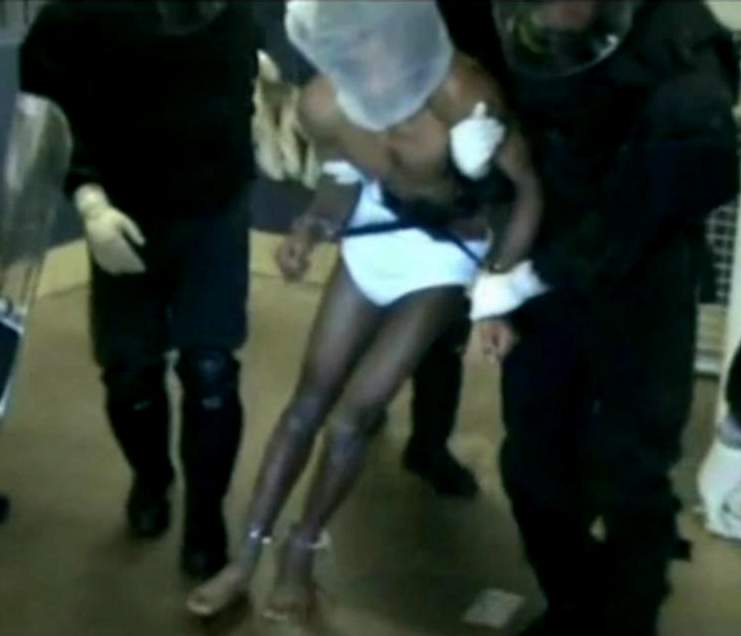
- They covered their cell windows. The guards put on riot gear and one by one they beat these guys very bad.
- It’s all on video tape. They tasered a lot of the guys on their genitals.
- They have you like a hog or something, I saw it on the video.
- They cut their clothes off and left them for hours in cages.
- May 5, 2014 is supposed to be the official trial date. The official trial date has been going on for 2 years.
- I was praying every night hoping the phone didn’t ring and they tell me they killed him.
- They took out to shower and threw him down the steps and broke his nose, they busted his teeth out with a stick before.
- They put glass in his food.
- HRCoalition.org
- Dallas 6 Blog
- Petition to Indict Luzerne County Officials
- Summary in Support of Petition to Indict
Guest – Shandre Delaney, a powerful activist with HRCoalition and the mother of Carrington Keys, one of the Dallas 6.
—–
Rutgers University Plans to Give Condoleezza Rice Honorary Degree
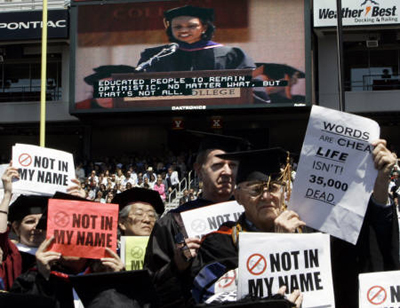
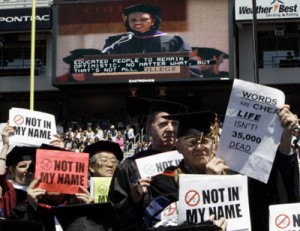
Students and faculty at Rutgers University have rejected the idea to invite former Secretary of State Condoleezza Rice to speak at this year’s commencement ceremony and receive an honorary degree. The Board of Governors in February of this year unanimously voted to award Rice the invite for a fee of 35 thousand dollars. They also voted to give the national security adviser under former President George W. Bush an honorary degree. Resolutions signed by the university faculty and staff calls for Rice to be disinvited.
Professor Deepa Kumar:
- Historically our process at Rutgers University has involved having 20 some faculties, students, involved in the process of selecting the commencement speaker, typically by canvasing students and canvasing faculty and then making a recommendation to the president as to who to invite.
- When president Barchi came to your university in 2012 he completely violated this open and democratic process, formed a committee of 6 people including himself. Then they decided to go ahead an invite Condoleezza Rice.
- We believe that this was actually politically motivated. What suspect is that Chris Cristi who was riding high at that time in 2012, before bridge-gate, very likely wanted to have Condoleezza Rice as Vice Presidential candidate when he runs.
- So far we have taken out a petition drive, the students have their own petition drive, hundreds of people have signed up. We’ve also talked about holding a protest outside should our efforts fail.
- The last time Dr. Rice was invited to be a commencement speaker was at 2006 at Boston College, when everybody turned their back to her when she started to speak.
- Condoleezza Rice was very much a part of the systematic lying to the American public and quite frankly we at Rutgers teach our students to ethical to be responsible citizens.
- At Rutgers we have a 44 percent minority student enrollment. It’s a very diverse school and I welcome African American women as commencement speakers but I think there are better people like Anita Hill or Angela Davis.
- In 2002 we know from a Senate Committee Intelligence Report of 2009 that when Rice was chair of the National Security Council she gave a verbal approval to then CIA director George Tenet to go ahead and use enhanced interrogation techniques.
- She’s been quite steadfast in defending the use of torture. She gave a speech at Stanford University where she argued that if torture is authorized by the president then it doesn’t violate the Geneva Convention against torture.
- Commencement at Rutgers – May 18, 2014.
- Senator Feinstein called the use of torture a dark chapter in the history of this country.
- Clearly torture is a violation of international law and the Geneva Convention and I think to confer a Doctor of Law degree to someone who has been intimately connected with this “dark chapter” in our history I think is a serious embarrassment for Rutgers University.
- I’m really proud to be among the hundreds of faculty members and students who are actually standing up against this to disinvite her.
- Dick Cheney comes out and defends the torture program even now.
- If I Was Allowed To Speak
Guest – Deepa Kumar, an Associate Professor of Media and Middle Eastern Studies at Rutgers University. Her latest book is Islamophobia and The Politics of Empire by Haymarket Books and is in response to the events of 9/11, the Bush administration launched a “war on terror,” ushering in an era of anti-Muslim racism, or Islamophobia. Her first book, Outside the Box: Corporate Media, Globalization and the UPS Strike (University of Illinois Press, 2007), is about the power of collective struggle in effectively challenging the priorities of neoliberalism.
———————————————————————–
Help Support Law and Disorder Right Here
Law and Disorder is now a sponsored project of Fractured Atlas, a non-profit arts service organization. Contributions for the charitable purposes of Law and Disorder must be made payable to Fractured Atlas only and are tax-deductible to the extent permitted by law.
CIA Sponsored Terror, Civil Liberties, Human Rights, Political Prisoner, Prison Industry, Surveillance, Torture, Truth to Power, War Resister
Podcast: Play in new window | Download
Updates:
- Hosts Discuss The CIA Spies On Senate Committee Staff Computers
- Heidi Boghosian: Goes Back To 2009 When The CIA Destroyed Videotapes of Interrogation.
- Michael Ratner: When It Was Disclosed That The NSA Is Surveilling All Of Us, She (Feinstein) Stood In Front Of Everybody And Said Oh, This Is Great.
——
Senate Democrats Help Block Key DOJ Civil Rights Division Nominee
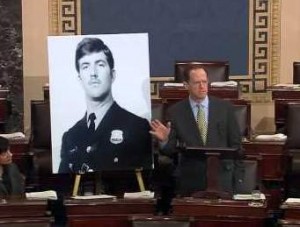
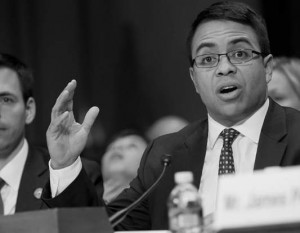
We take a looking at how a group of Senate Democrats broke ranks with President Obama to block key nominee Debo Adegbile as head of the Department of Justice’s Civil Rights Division. Seven democrats joined with Republicans to defeat Adegbile’s bid. That defeat was driven by the Philadelphia Fraternal Order of Police who launched a campaign against Adegbile and his work defending imprisoned Black Panther Mumia Abu-Jamal. Specifically, Adegbile was part of a team of lawyers at the NAACP Legal Defense Fund who successfully argued the trial judge’s jury instructions violated Abu-Jamal’s rights.
Professor Mark Taylor:
- The recent campaign has been foregrounded especially on FOX television news where you heard leading anchors and reporters connecting Dego Adegbile to Mumia Abu-Jamal.
- The Fraternal Order of Police wrote letters to media outlets. They wrote a letter to President Obama objecting to Dego Adegbile. This is fully congruent to what we in Educators for Mumia Abu-Jamal have experienced from the Fraternal Order of Police throughout the years.
- The Fraternal Order of Police will even stoop to maintaining a black list online of any of us Educators around the country not only for working for Mumia but for just for signing ads in the New York Times on behalf of Mumia Abu-Jamal’s new trial or release with restitution, whatever the case, they’ll maintain those charges.
- The Fraternal Order of Police will put pressure on venues that host the events for Mumia Abu-Jamal.
- It is a national organization and in their letter to President Obama they claim to represent some 350 thousand police officers across the country and claim to be speaking for those 350 thousand.
- There are elements of the Fraternal Order of Police all over the country who will step forward to ratchet up this venom against Mumia Abu-Jamal.
- They have always used Maureen Falkner the widow to be in the position of the grieving widow of the slain police officer in spite of the fact that there is exculpatory evidence. They don’t want to discuss that, they want to play the drama of the grieving relative instead.
- Of course that has powerful media appeal it often in our infotainment industry overrides argument, we know.
- There is a stigmatization that is pervasive throughout much of our culture that causes lawyers, public relations officers and others to back away from the issue.
- It’s an outrageous departure and betrayal of a tradition of civil rights advocacy that at least Democratic Party affiliates like to say they have supported through the years.
- We will hope that voters will make them pay a price for this kind of vote.
- We have voting rights issues because Dego Adegbile would have the job of which states to sue for Voter ID laws that are oppressive to African Americans.
- Educators for Mumia Abu Jamal
- Temple News At Temple University Ad Story.
Guest – Professor Mark Taylor, founder of Educators for Mumia Abu Jamal, a group of teachers from all levels of education, organizing since 1995 for a new a trial. Mark Taylor is a professor of Theology and Culture at Princeton Theological Seminary.
———
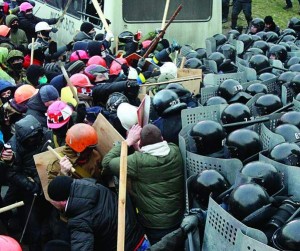
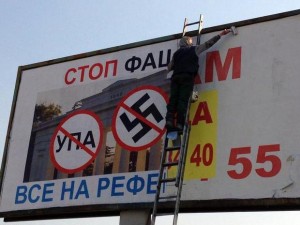
Ukraine and the Pathology of America’s Liberal Worldview. An African American Perspective
In his recent article, Ukraine and the Pathology of America’s Liberal Worldview. An African American Perspective returning guest Ajamu Baracka calls it a massive cognitive deficiency that President Obama asks Congress to agree on a billion dollar package aid for the Ukraine. Meanwhile, the elite opinion in the United States has embraced the position that cuts in public expenditures and services at every level of government are a reasonable and unavoidable necessity. Baracka says the crisis is here in the United States, with extended unemployment benefits for the 1.3 million people who lost thier jobs in Detroit.
Ajamu Baracka:
- It’s clear that there was legitimate social opposition in the Ukraine to some of the policies of the government there and there was an attempt to express some of those concerns that were quickly taken advantage of by some elements of the Ukrainian society that are, have been associated with some of the more fascist elements that have been aligned with the far right for decades.
- Some of those right wing forces ended up being the primary shock troops engaged in all kinds of violent activities.
- A decision was made in which the protesters had won much of their demands in terms of political reforms, but that agreement was jettisoned by those right wing forces.
- The result was that basically they stormed the institutions of the government and proclaimed themselves the new government.
- There’s real danger in characterizing this as a popular revolution. It’s clear that more than half of the population of Ukraine was still not convinced that a revolutionary movement was called for and one in which violated the tenants of the Ukrainian constitution.
- It became clear that the character of this revolution was one that was not really committed to social change.
- Here we have a situation in Detroit a city that is basically bankrupt as a consequence of these predatory banks and the disintegration of the U.S. economy and its urban cores.
- When the city officials went to the administration looking for assistance of course the line was, there’s no assistance for you.
- It’s not just Detroit it’s across the country. We saw in December Congress, when striking their budget deals they eliminated extensions for the long term unemployed.
- When it comes to the American people, the working class, the poor, there’s no money, there’s only growing austerity, but when it comes to advancing what many of us call the “empire” they can always find resources.
- The one billion dollar package to the Ukraine is a stark contrast to the line – There’s no resources to bail out the people of Detroit.
- Ultimately the winners in the Ukraine chess game will be U.S. capital and there would be some European capital that would benefit also.
- Ukrainian economy will be forced to open up. The financial sector will be exposed. Banks will be taken over. Whatever state industries that are viable will be seized, privatized. There will be massive unemployment.
- The Ukrainian workers will find that their wages not only increase but probably will be further eroded because they’re in competition with other poor workers throughout western Europe.
- That’s why the U.S. is salivating at the prospects of penetrating the Ukrainian economy.
- For reasons that are not really clear to me, many folks in the west in the U.S. don’t seem to be able to recognize this growing threat. This tendency to align themselves with the most reactionary elements on the planet.
- The way I see it is a global strategy on the part of U.S. and western imperialism and the alignment they’ve made with what everybody knows to be fascist elements within the Ukraine.
- It’s similar to alignments being made in slightly different ways to the radical right in Venezuela, with the continued support to the right wing government in Israel. .
- What we see is a counter-revolutionary strategy based on closer alignments with right wing forces throughout the world.
- There’s been mass confusion, people not being able to differentiate from the left and right, all they see is opposition and the opposition is enough for them to align with it.
Guest – Ajamu Baraka, Longtime activist, veteran of Black Liberation Movement, Human Rights defender, Former founding director of US Human Rights Network, currently Public Intervenon for Human Rights with Green Shadow Cabinet, member of Coordinating Committee of Black Left Unity Network and Associate Fellow at IPS.
———————————————————————–