Afghanistan War, Civil Liberties, Criminalizing Dissent, Human Rights, Targeting Muslims, Torture, War Resister
Podcast: Play in new window | Download
Updates:
—
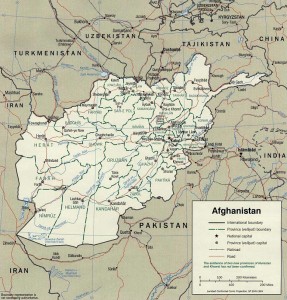
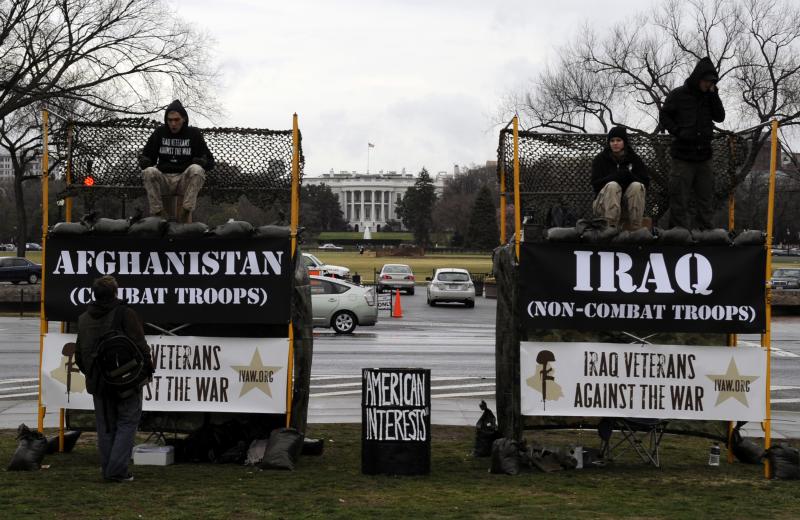
Afghanistan Invasion/Occupation To End Beyond 2014
Thousands took to the streets of London last week to protest against the war in Afghanistan and Iraq, as Nato leaders agreed a strategy to withdraw their troops from the country. US President Barack Obama was expected to announce an exit strategy from Afghanistan at the NATO summit in Lisbon, instead he postponed troop withdrawal beyond 2014. Vice President Joe Biden told one media source “Daddy is going to start to take the training wheels off in October — I mean in next July, so you’d better practice riding.”
Jerry Gordon:
- End date 2014, there’s nothing firm about it. “2014 is a goal not a guarantee.”
- Everything is tentative, nothing is concrete. They are pursuing what has been called an “endless war.”
- what is less known is the US Government supported the Taliban, because their priority was a stable government in Kabul, that would permit the construction of a pipeline.
- They needed a pipeline to transfer these giant hydro-carbon reserves, we’re talking about 206 trillion cubic feet of natural gas and 60 to 200 billion gallons of oil reserves.
- This was all before 2001, it was planned. There’s plenty of evidence. There’s a long speech in the Congressional Record in 1998 about the critical importance of building a new pipeline in Afghanistan.
- This is all geo-political and economic, it’s empire building.
- It became converted into a war on terror, after 9/11.
- At the same time there’s no money to pay unemployment compensation and all the urgent social needs at home to put people back to work
- The anti-war movement needs to reiterate the origins of the war and the rationale.
- There’s no draft, only a small percent of the population has placed Afghanistan at the top of the priority list.
- Past anti-war movements: We had a mass base among the students. We need to tie the war to the economic crisis, bring the war dollars home.
- Rethink Afghanistan: Destroys Failed Logic of War by Jeremy Scahill
- When they kill leaders, they get replaced, and it generates recruiting among the insurgents.
- US Law Labor Against the War was able to get the AFL-CIO to take a position of rapid withdrawal from Iraq.
- Our biggest problem in terms of constituencies, we do not have a mass base. It’s the students the labor movement and the religious community. Everything is imploding in this country.
- Contact Jerry Gordon – natassembly(at)aol.com
Guest – Jerry Gordon, the main organizer of the well attended anti-war conference in Albany last summer. He was the leader in the anti-Vietnam movement and recently retired from the SEIU.
—–

CAIR Files Suit Against Oklahoma Vote Opposing Sharia Law
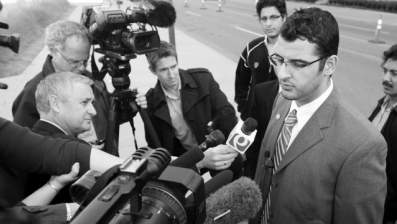
In November, 70 percent of Oklahoma approved ballot initiative “Question 755? — or the “Save Our State” constitutional amendment — which bans Sharia from being considered in Oklahoma courts. The ballot states that Oklahoma courts must “rely on federal and state law when deciding cases” and forbids them from “considering or using international law” and “from considering or using Sharia Law.”
Recently, Muneer Awad, executive director of CAIR-OKC filed a lawsuit challenging the constitutionality of State Question 755, and an Oklahoma City judge extended a temporary ban on implementation of a constitutional amendment. U.S. District Judge Vicki Miles-LaGrange said she will rule after weighing the issues. Muneer Awad, who is Muslim says the amendment demonizes his faith.
Muneer Awad:
- Labeling Islam as a unique threat to Oklahoma courts. It was a clear message that Islam is a threat to Oklahoma.
- I think what happened is a handful of politicians realized that Islamophobia is politically popular.
- I can count on one hand how many politicians didn’t vote to put this on the ballot.
- Those politicians were attacked during the campaign as being people that wanted to bring Sharia to Oklahoma so terrorists can use Islamic law in our courts
- If we don’t act now our state will be in peril. There are politicians that deliberately misinform people, that deliberately lie to people in order to gain political popularity in the polls.
- There are a number of non-Muslim Oklahomans that are concerned by State Question 755 and the perception and effect it has on Oklahoma.
- We’re trying to remind people that this isn’t a reasonable conclusion people made after a lot of thought and reasonable research. These were people that were misled by politicians that have lied to us.
Guest – Muneer Awad, executive director of CAIR-OKC
—–
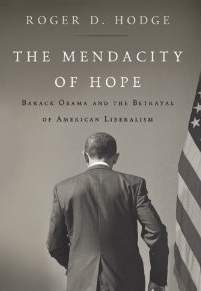
The Mendacity of Hope: Barack Obama and the Betrayal of American Liberalism.
In a scathing attack from the left, former editor in chief of Harper’s magazine, Roger Hodge offers a powerful critique of President Barack Obama in his new book, The Mendacity of Hope: Barack Obama and the Betrayal of American Liberalism. Hodge articulates what many of listeners may already know. President Obama has served the corporate masters. Hodge draws a list of examples, such as cheerleading globalization, designing a health care plan where insurance companies make a killing, extrajudicial assassination of American citizens, boundless state secrecy, and unlimited corporate bailouts, to name a few.
In explaining the book, Hodge told Harper’s magazine in an interview, he used 18th century reflections to James Madison, whose philosophy aligned with republicans such as Machiavelli and James Harrington in the argument that a moderate balance of wealth must be maintained, that too great a distinction between the rich and poor would naturally lead to the decay of republican governance.
Roger Hodge:
- Obama’s most enthusiastic supporters have really been lying to themselves.
- Part of the book is an argument against this tendency for people to deny what’s going on right in front of them.
- We ran a piece in Harper’s by Ken Silverstein, a great investigative reporter who argued, this guy is a conventional machine Democrat.
- He set up shop. Come to me corporate America with your problems and I will try to solve them.
- You listen to this inspiring rhetoric, if you look at it on paper, there wasn’t a lot of content there.
- When it comes to an Obama / McCain-Palin – there’s an arguement to be made constitutionally we might be better off with the Republicans.
- Corporate backers: FIRE sector. Finance/Insurance/Real Estate.
- The number one corporate backer was Goldman Sachs. Goldman Sachs collectively gave Obama, almost 1 million dollars but invested only 230 thousand dollars for McCain.
- Obama’s backers also included, Morgan Stanley, Citi-Group is up there with 750 thousand, JP Morgan Chase . . they don’t do this out of the goodness of their hearts.
- They expect to get something, and as we saw in the rolling bailouts, the financial sector got tremendous return on investments.
- Democratic think tanks set the stage for the financial crisis that we’re still living through, by deregulating finance, by breaking down the New Deal protection, repealing the Glass-Steagal Act, and deregulating derivatives with the Commodities Futures Modernization Act.
- The old idea, that unfortunately is still with us, that the democrats are the liberal party, the party of the common man who are fighting the big business bad guys in the Republican party is really a myth, and it’s a pernicious myth.
- Health Care was a bailout for the insurance companies, Obama and his team always saw that as a bargaining chip, they never really planned on pushing that through. Having health insurance does not guarantee health care.
- Rahm Emanuel, this is a guy without principles, he’s all about winning and raising money.
- You can say, at least he’s tough, but he didn’t fight for anything worth fighting for.
- A president surrounds himself with people who are ill-liberal, who are completely compromised by their connections with Wall Street.
- We have to gain some leverage over our representatives. It’s a real double bind. People don’t want to reckon with the sheer awfulness of the our political culture.
Guest – Roger Hodge, former editor of Harper’s Magazine from March 2006 through January 2010. Hodge attended the University of the South, where he majored in comparative literature. He began graduate work at the New School for Social Research and completed a master’s degree in philosophy, but joined Harper’s before finishing his dissertation. Hodge first came to Harper’s as an intern in 1996 and was subsequently hired as a fact checker. Hodge edited the Harper’s Reading section from 1999 until 2003.
———————————————————————–
Afghanistan War, CIA Sponsored Terror, Criminalizing Dissent, Human Rights, Iraq Veterans, Iraq War, Targeting Muslims, Torture, Truth to Power, War Resister
Podcast: Play in new window | Download
WBAI Listeners Please Click Here For This Week’s Rundown
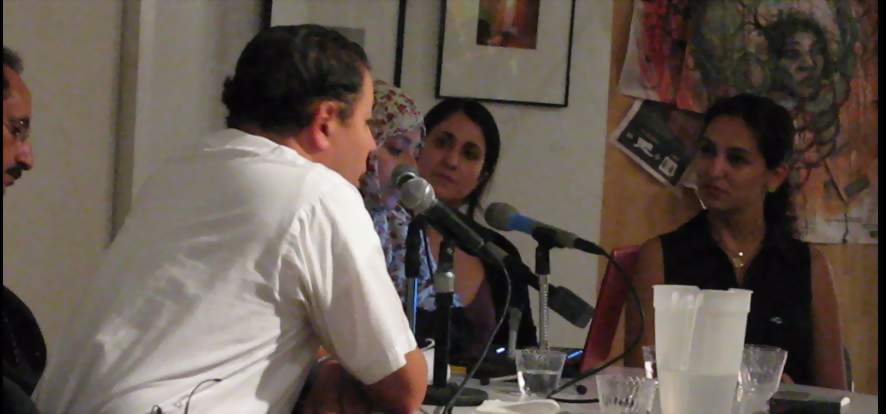

The United States and Yemen: Destroying Lives in the Name of National Security
We hear the voices of leading Yemeni activists and a Center For Constitutional Rights attorney speak on state violence, targeted killings, and human rights abuses enabled by the so-called “War on Terror” from the Brecht Forum event titled The United States and Yemen: Destroying Lives in the Name of National Security. The event was co-sponsored by the International Federation for Human Rights and the Brecht Forum. We hear first from Pardiss Kebriaei staff attorney at the Center for Constitutional Rights. Pardiss is working on a lawsuit to challenge a U.S. government kill-list and the targeting of a U.S. citizen now in Yemen and far from any armed conflict with the United States.
We hear from Tawakkol Karman chairwoman of the Yemeni non-government organization Women Journalists Without Chains, which campaigns for freedom of the press in Yemen and against human rights violations. She is a very prominent young activist, and Reporters Without Borders chose her in 2009 as one of the top seven women who have led change in the world. Karman is among the activists who in 2007 launched the “Phase of Protests and Sit-ins” in Yemen, holding regular sit-ins in the capital’s Freedom Square to demand democratic reforms and an end to human rights violations—including the harassment and imprisonment of journalists and dissidents, closure of critical newspapers, and censorship of news articles. A special thanks to Leili Kashani Education and Outreach Associate for the Guantánamo Global Justice Initiative at the Center for Constitutional Rights.
Also on the panel, to be heard soon, Ezz-Adeen Al-Asbahi, president of Human Rights Information & Training Center (HRITC), a non-governmental organization which seeks to enhance human rights in Yemen and the Arab World, focusing on the Gulf States in particular. HRITC has consultative status with the United Nations, offers training courses and forums on human rights, publishes a quarterly human rights magazine called Our Rights, and has published 30 books on law and human rights. Al-Asbahi is also the coordinator of a large regional network of human rights activists in the Gulf States and the Peninsula, and the president of a Yemeni network of human rights organizations which includes six Yemeni NGOs. A journalist and researcher, he has published eight books on literature and human rights. He is also the head of the civil society sector of the Supreme National Authority to Combat Corruption.
—-

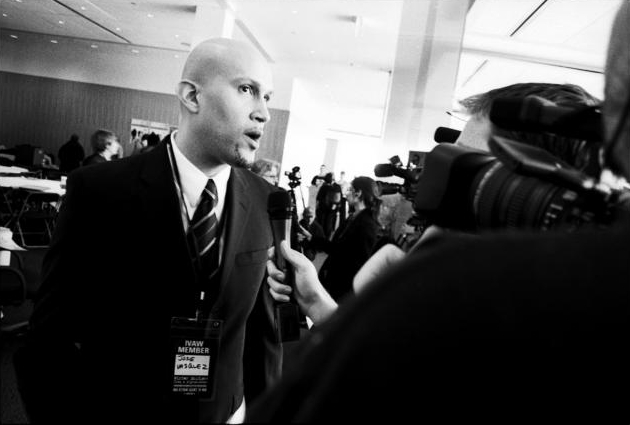
Troops out of Iraq, Permanent Bases and Privatizing the Occupation.
While many reports claim most US troops are leaving Iraq, there will still be 50 thousand troops remaining, 4 thousand will be replaced by 7 thousand security contractors. These are armed private contractors, former military with specialized skills in weaponry, radar and explosives. They will have less accountability in war zones. Meanwhile, massive permanent US bases remain including the world’s largest US Embassy in Bagdhad, Iraq. As the occupation in Iraq is privatized, veterans return back to the US. We’re joined today by conscientious objecter and Executive Director of Iraq Veterans Against the War, Jose Vasquez. Jose joined IVAW in June 2005 and co-founded the NYC chapter serving as the president. He also served on the interim board of directors and was elected to the first official board in 2006. He helped organize numerous actions and events including the Veterans’ and Survivors’ March to New Orleans, Operation First Casualty in NYC, and Winter Soldier: Iraq and Afghanistan.
Jose Vasquez:
- IVAW is a membership based organization, we are all folks who’ve served since September 11th.
- We call for the immediate withdrawal of all occupying forces from Iraq. We also have the same resolution for Afghanistan. We also want reparations for the Iraqis and full benefits for returning service members.
- I signed up right out of high school, graduated in ’92. I went straight in to active duty, I served 4 years as a Calvary Scout. Got out went to school and the Army Reserves as a medic.
- I had been in the military for a while before September 11th. I had a pretty good understanding of what our relationship was to Iraq. It was confusing to me, I was facing deployment. I stumbled across Democracy Now and I just started listening to that show religiously.
- By 2004, I was so upset about the Iraq War, I didn’t care what happened, I was not going to this.
- I started researching conscientious objection, six months later I filed for CO status. It took 27 months to get an answer.
- The Obama Administration has a finger on the pulse in terms of marketing hope. What they’re skimming over is how contractors are on the ground (in Iraq)
- From the perspective of an Iraqi, Americans running around with guns has not diminished that much.
- I think we owe the people of Iraq a lot. This mostly has to do with the US positioning itself to access the resources that they have.
- Stop the deployment of PTSD troops
Guest – Jose Vasquez, Jose was born in Bronx, NY and grew up in Southern California from the age of nine. After graduating high school in 1992, he enlisted in the U.S. Army serving over four years of active duty as a cavalry scout assigned to the 2nd Battalion, 69th Armor Regiment, 24th Infantry Division at Fort Benning, GA, and the 3rd Squadron, 4th Cavalry Regiment, 25th Infantry Division at Schofield Barracks, HI. He was honorably discharged in December 1996 at the rank of specialist (E-4).
Afghanistan War, Civil Liberties, Criminalizing Dissent, Guantanamo, Human Rights, Iraq Veterans, Iraq War, Torture, Truth to Power, War Resister
Podcast: Play in new window | Download
Updates:
—–
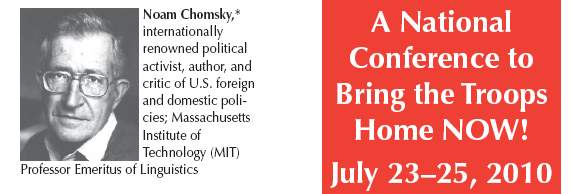
C0-host Michael Smith talks with attorney Jim Lafferty about the upcoming anti-war conference in Albany, New York, July 23-25. Noam Chomsky, internationally renowned political activist, author, and critic of U.S. foreign and domestic policies; Massachusetts Institute of Technology (MIT) Professor Emeritus of Linguistics is the keynote speaker. Click here for flyer (PDF) Groups sponsoring the event: After Downing Street, Arab American Union Members Council, Bail Out the People Movement, Black Agenda Report, Campus Antiwar Network, Campaign for Peace and Democracy, Citizen Soldier, Code Pink, Grandmothers Against the War, Granny Peace Brigade, International Action Center, Iraq Veterans Against the War, Military Families Speak Out, May 1st Workers and Immigrant Rights Coalition, National Assembly to End the Iraq and Afghanistan Wars and Occupations, National Lawyers Guild, Office of the Americas, Peace Action, Peace of the Action, Progressive Democrats of America, Project Salam, September Eleventh Families for Peaceful Tomorrows, The Fellowship of Reconciliation, U.S. Labor Against the War, Veterans for Peace, Voices for Creative Nonviolence, Voters for Peace,Women’s International League for Peace and Freedom, The World Can’t Wait.
—


Iraq War Veteran, Conscientious Objector and Musician Clifton Hicks
Clifton Hicks is an activist with the Iraqi Veterans Against the War. Hicks is disabled and enrolled as an Anthropology student at Appalachian State University in Boone, North Carolina. Appalachian State is a center for old-time music, and Hicks is also an accomplished musician and banjo player. Cliff Hicks is psychologically disabled and got out of the Army as a conscientious objector several years ago. In the Spring issue of The Veteran, published by Vietnam Veterans Against the War, there’s printed the following chant, that is repeated by soldiers in training to go to Iraq. “I went down to the market where all the people shop, I pulled out my machete, and I began to chop, I went down to the park where all the children play, I took out my machine gun and I began to spray.” This is the kind of psychological brutalization that our young men are forced to endure that turn them into creatures they never thought they’d become.
Clifton Hicks:
- I was in 9th grade when 9/11 happened. I called the recruiter when I was 16, to try and get in.
- I saw Muslim and Arabic people and thought they were all out to get us.
- I listened to a lot of daytime AM right-wing radio. I had the ole cliche patriotic notions going.
- I wanted to go combat arms from the start, I figured if I was going into the Army, I wanted to fight.
- My feet were on the ground in Iraq in October 2003. The guys I was with that had already been there for a while had gotten pretty nasty. Guys get nasty, because their friends get killed and you realized you can’t trust anybody.
- We were the first division in combat to be out there for more than 13 months.
- They would literally give us candy and toys to give out to Iraqi kids at schools, the next day you’re ridin’ around and you see a b unch of kids get shot.
- I became an anti-war activist while I was still in the Army. We started an IVAW chapter in Gainesville Florida
Guest – Clifton Hicks, Branch of service: United States Army (USA) / Unit: C Troop, 1st Squadron, 1st U.S. Cavalry Regiment / Rank: PFC / Home: North Carolina / Served in: Ft. Knox, OIF 1, Germany. Hicks a musician and is currently a student at Appalachian State University in Boone, North Carolina.
——————————————————————–
Afghanistan War, Civil Liberties, Human Rights, Truth to Power, War Resister
Podcast: Play in new window | Download
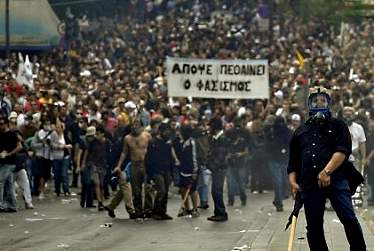
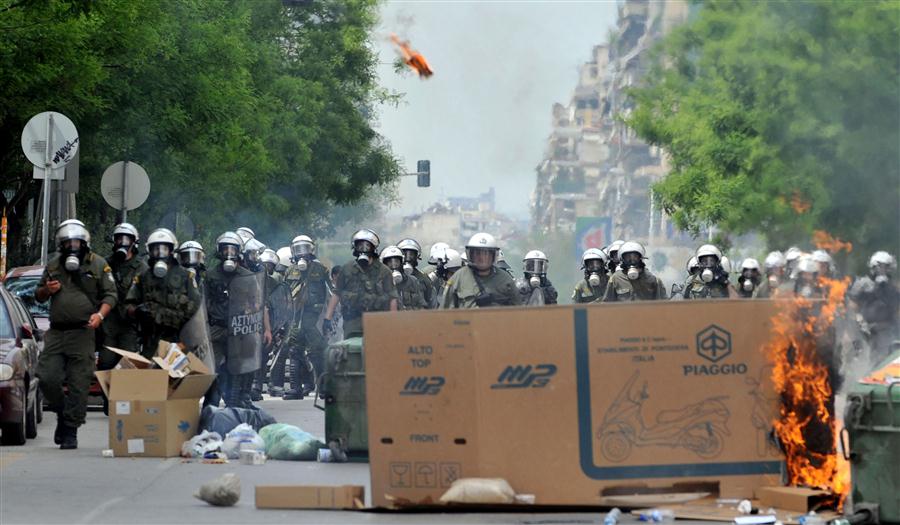
Economic Crisis, Greek Theater, Our Drama
We are joined in the studio by Professor of Economics Rick Wolff and National Lawyers Guild Attorney Eric Poulos. Both have recently returned from Greece. Rick Wolff’s recent articles outline an economic theater playing out in Greece and across the globe. There is no alternative and this is all the worker’s fault, is the mantra from rulers who are cutting wages and pensions in Greece. It’s deceptive and false says Rick Wolff, and the economic conditions in Greece is an old pattern that is replicating everywhere. Greek capitalist enterprises and top shareholders evade paying taxes Rick writes. Meanwhile economic contradictions of Greek capitalism drive employers and employees to demand more from the government. The government can’t finance its expanding services and tries to raise taxes. The masses resist, social movements to tax the rich accelerate, then the rich quickly offer to lend the government more of the money they saved from not paying taxes. There are many more acts to this economic theater , Rick Wolff asks what will the final scenes be in the European working class?
Professor Rick Wolff:
- I looked at the professors faces and I realized the economic crisis had come home and hit them very hard.
- Every single professor received a pay cut, which took a effect as soon as I arrived to Athens. Fifteen to 20 percent less a year for every teacher in the country.
- Not only every teacher, but every public employee, it includes the police, and the foot soldiers in the Army.
- On top of the unemployment, this is a blow against every single working person. We are at the beginning of a major disaster. This also threatens other countries, Spain, Portugal, Italy, Ireland.
- This crisis is showing us we are for years of dysfunctional captialism as a global system.
- Greece is remarkable in that it has a well organized, strong working class. The super rich in Greece do not want to pay taxes. The working class is powerful enough in Greece (unlike here in the United States) to make the government stand up and notice.
- Governments borrow money as a solution for taxation. Lenders ask why lend to a small country with little promise of making good on the loan. Lenders had already loaned to the US. It’s the US crisis that created the dilemma for Greece. The biggest holders of the debt of Greece are French and German banks.
- They turned to the Greek government and said, squeeze them, but don’t squeeze them to the point where they’ll default.
- The people who brought us the crisis are dictating the suffering of masses of people to work their way out of the crisis with no cost to themselves.
- We have a president today in a terrible economic crisis, and not only is there not a government program to hire people, it’s not proposed, it’s defended, our government isn’t explaining our own history has that as the thing we did the last time.
- Those who made out like bandits in the last 30 years, ought to be made to pay, the lion’s share of the cost for cleaning up the economic mess. If democracy means anything it should begin in the place where we spend most of our adult lives. Where we work.
————-
Attorney Eric Poulos:
- Greece is really a society that is smouldering. There have been 3 general strikes since the cutbacks in March.
- 40 thousand jobs a month are being lost in Greece.
- The civil servants in Greece have not had their prescriptions filled since March.
- The country has been run by Socialist for 30-36 years. Socialists and Communists have bought on to this.
- There have already been huge demonstrations in Portugal and Spain. Portugal was huge.
- This is looting. They are looting Greece.
- Greece is now going privatize the post office. The gas, the water works, the railway.
- The banks are really picking off the pieces of Greece.
- They’re interested in suppressing the social wages and whatever they can accumulate.
- The landscape in the United States is not very hopeful because the working class labor movement hasn’t stepped up at all.
- If private corporations want government money to bail them out, we take them over, we run it.
- If there are going to be lay offs. We cut the work week. Work 4 days but the workers get paid 5 days.
- You need the political will and the question is where will that come from and how will that be done.
Guest – Rick Wolff, Professor of Economics at University of Massachusetts at Amherst. In his new book Capitalism Hits the Fan: The Global Economic Meltdown and What to Do About, Rick takes the reader back to 2005 and step by step reveals how policies, economic structures and wage to profit systems led to a global economic collapse.
Guest – Attorney Eric Poulos with the National Lawyers Guild who traveled to Greece.
———-

United National Anti-War Conference
Attorney and radio host Jim Lafferty joins us today. We get updates on the upcoming anti-war conference in Albany New York, the ongoing immigration policy conflicts in Arizona and new developments on the Israeli attacks and killings on the Gaza flotilla. We will also get more information on Attorney Peter Erlinder’s condition in Rwanda. As listeners may know, former National Lawyers Guild president Professor Peter Erlinder was arrested 2 weeks ago by Rwandan Police for allegedly denying the country’s 1994 genocide. He is currently imprisoned in Rwanda and very little information is getting out. Facebook Group – Free Professor Erlinder Now
Jim Lafferty:
- United National Anti-War Conference July 23 / 24
- There’s been an ebb in the anti-war movement in terms of the way it’s manifested itself in the streets.
- US Should Not Condone Israeli Attack – By Michael Ratner
- Sponsored by IVAW / US Labor Against the War / Code Pink / Raging Grannies /
- Hundreds will be gathering in Albany to help revitalize the sentiment.
- During the Vietnam War, the teach-ins preceded the growth of the movement.
- Now that the war has expanded, it’s important to teach to younger generations that this is US imperialism in its worst form. Why it has nothing to do with making us safer.
- Get out of Iraq, get out of Afghanistan and leave the people of Pakistan alone.
- Arizona Immigration Legislation Update
- Peter Erlinder Update – Lawyers have been able to make contact with Peter Erlinder. He was recently denied bail.
- Rwandan Ambassador James Kimonyo – 202-232-2882 / National Lawyers Guild Page Updates
Guest – Jim Lafferty, Executive director of the National Lawyers Guild in Los Angeles and host of The Lawyers Guild Show on Pacifica’s KPFK 90. 7 FM
—————————————————————————–
Afghanistan War, Civil Liberties, Human Rights, Iraq Veterans, Iraq War, Supreme Court, Surveillance, Targeting Muslims, Torture, Truth to Power, War Resister
Podcast: Play in new window | Download
Updates:
—
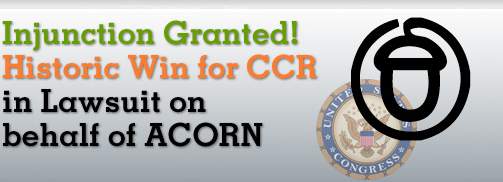
Historic Win for Constitutional Rights! Injunction Granted in CCR Lawsuit on Behalf of ACORN
Recently, a federal judge blocked Congressional effort to withhold funding to the community group ACORN. In the decision, the court found that ACORN can show that the targeting by Congress in de-funding the anti-poverty group, is a violation of the Constitution’s prohibition against the Bill of Attainder. This is a legislative act which singles out a specific person or group for punishment. Jules Lobel, CCR Vice-President and Cooperating Attorney says quote “This historic decision by the Court affirms the fundamental constitutional principle that the Congress cannot be judge, jury, and executioner.” Following the decision, Bertha Lewis, ACORN’s Executive Director, said quote “The court’s decision is a victory not only for the many dedicated citizens who work with ACORN to improve their communities and promote responsible lending and homeownership, but for the Constitution and the rights of all Americans.”
Bertha Lewis:
- ACORN is 39 years old, started in Little Rock, Arkansas. It grew out of the welfare rights movement, George Wiley founder of WRO. We began to organize folks in the South first, just around bread and butter issues.
- Red-lining banks, block busting racist strategies, potholes. Most people would know us by the housing work that we did, we challenge the banks for the red-lining tactics. I was the executive director for New York, I’ve been with ACORN for almost 20 years.
- We had an internal scandal, where the founder Wade Rasky had allowed his brother in a 2 year period of time misappropriate almost a million dollars. I was appointed CEO after that for my New York City organizing work. We’re (ACORN) the best organizers, but we’re not the best managers.
- It was fine if we stuck with soup kitchens, etc, but we started registering poor people to vote around issues. The minimum wage law passed in Florida. I think we became a threat when we actually moved those people to the polls. Now we begin to change the balance of power.
- We need to organize multi-ethnic, multi-culture, multi-issue, and build an institution where people have real power. Karl Rove leaked emails revealed : “Bring me the head of ACORN.”
- The organizing was effective because we’re not a single issue organization. We can be better managers, but I guess we had a naivete about the forces we’ve been going against all these years.
- Since 2000, the right has seen us as a growing threat, we were effective and almost immediately we were accused of voter fraud, voter registration fraud. Nothing stuck. They decided, we got to keep (ACORN) in the news, we gotta keep attacking them.
- This filmmaker – James O’Keefe made up this fantasy scenario, was racist and sexists. So, they had this series of videos, when you looked at it, it was very sensational.
- Anyone could see it was highly edited, where they had this woman say she hadn’t paid taxes, and there are these girls from Honduras we want to bring over.
- So, what you see in these tapes is some of our workers giving advice. Next thing it was online, it went viral. Funders were saying they didn’t want to be associated with us. Five hundred organizers, four hundred thousand member families.
- Three times before the Republicans tried to say ACORN was a criminal organization, no due process. In October after that video, they put in writing, no funds given to ACORN. Omnibus funding bill. The bill passed, only 7 brave senators voted against it.
- Congress (right wing) was pushed to name ACORN, because federally funded groups such as Blackwater / KBR / would be snared in broad language net. This is about the Constitution, it applies to poor people, it applies to poor people’s organizations.
- CCR lawyers – “I call them Jedi Knights for Justice”
Guest – Bertha Lewis, Chief Executive Officer and Chief Organizer of ACORN, the largest community organization in the country. Appointed in May 2008, Ms. Lewis oversees the operations of its 400,000 strong membership, which is active in over 110 cities across the country. A 16 year veteran of the organization, Ms. Lewis was most recently the Executive Director of ACORN’s New York affiliate and is a founding Co-Chair of the New York Working Families Party.
——————-
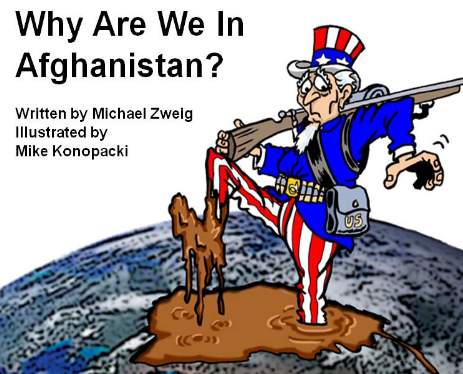
Why Are We in Afghanistan?
Why Are We in Afghanistan is the question many listeners still have and is the title of a film by Michael Zweig. The film examines how the reasons for the Afghanistan war have clouded since September 11, 2001. The conflict centers on geo-political positioning that holds the US in the war torn landscape. At this stage, the Afghanistan war is a humanitarian disaster, the civilian casualities are stunning and conditions on the ground are desperate for Afghani women and children. The film, Why Are We in Afghanistan? is an educational resource for communities, unions, veterans and active duty military, classes, and anyone who wonders why we are in Afghanistan, and what to do about it.
Michael Zwieg:
- We started out being in Afghanistan because of the 9/11 attacks, the idea was they attacked us from a base in Afghanistan, and we’re going to get the bad guys. Once they were there it became clear, that they weren’t interested in going to Afghanistan, they were interested in invading Iraq.
- Starting in 2002, the focus left Afghanistan, we were there, in an inactive state. Then comes the presumed resolution in Iraq, then Obama comes in and tries to be the president, running the campaign of prosecuting the good war.
- Why are we now doubling down in Afghanistan?
- Obama’s latest speech says primary reason for war escalation is Taliban, who are sheltering Al-Qaeda. To “nation-build” – stabilize Afghanistan. Al-Qaeda is in Pakistan, though, if you were to stabilize Pakistan, Al-Qaeda would go to Somalia, etc. It’s like wack-a-mole.
- General Petraeus’s American Counterinsurgency Doctrine. 2006
- They accept in the doctrine, that counter-insurgency is 80 percent civilian work and taking care of civilian population / 20 percent military. But if you look at the budget in place right now for 2010, it’s 6 percent civilian and 94 percent military.
- So, what’s going on? It’s not really about counterinsurgency, it’s not really about Al-Qaeda? We shouldn’t downplay the domestic and military pressure to do this.
- Sentiment about Afghanistan War changed in the US Labor movement summer of 2009
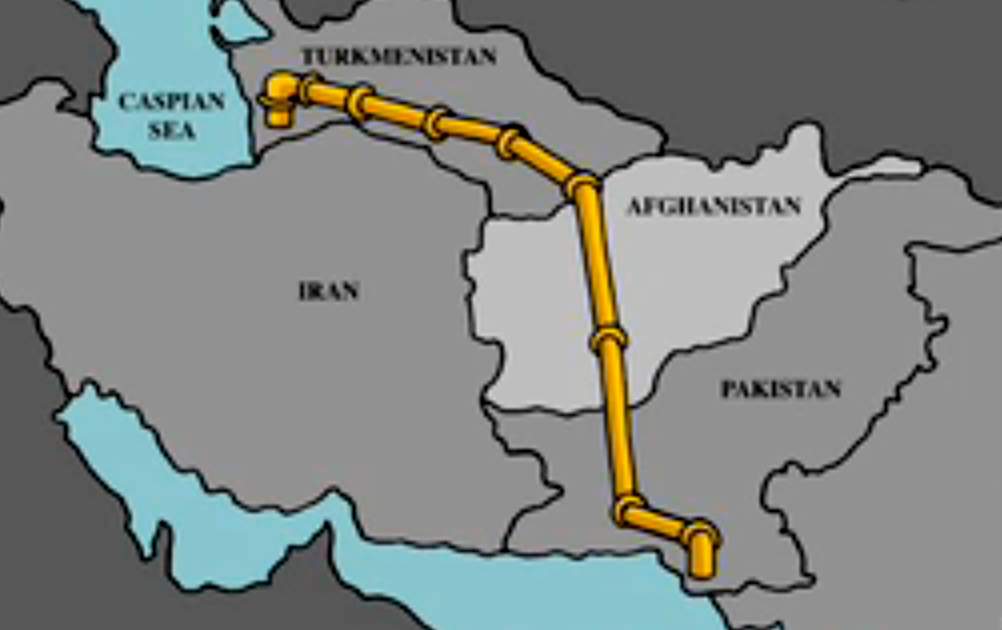
- Pipelanistan: During collapse of Soviet Union, the central asia “stan” countries came in to play.
- The US department of Energy forecasts between the year 2000 and 2025, China’s need to import oil is going to increase to 73 percent of its oil needs they will have to import.
- Pakistan’s agent in Afghanistan are the Taliban.
- Unocal – Moderate size US oil company, negotiating with Taliban and Pakistan to build pipeline.
- Unreported: There were meetings in Turkmenistan, in 2002 with the Bush Administration and Asian development Bank to build a pipeline going to Arabian Sea.
- There was a meeting in 2001 before 9/11, with Cheney and energy executives. They issued a report on American energy strategies May 2001. They identified the Central Asia republics as a major source of oil and natural gas.
- They identified these resources, Cheney and his crew, as a source to block from the Chinese and others from getting those resources.
- We’re in Afghanistan because of both strategic interests which include the oil resources and to block others.
- What are going to do, we can’t win, but we can’t not fight it. Obama doesn’t see a way unless there’s a mass movement in this country or military rebellion.
- Barbara Tuchman – March of Folly – Leaders of countries lead them into disasterous courses, against advice and alternative policies.
- You can’t reduce it all to simple, rational calculations because there are other courses that they could do.
- How do you make it hot for Obama on the decisions that he’s made? How do you build the social movement.
- We’ve built quite a presence in the labor movement around Iraq.
- Almost spending 100 billion dollars a year in Afghanistan. You could create a lot of jobs, tax relief, stimulus systems.
- War good for economy? No. For every dollar spent on military spending, you create way fewer jobs than the same money spent on building roads, or turbines for wind farms.
Guest – Michael Zwieg, Professor of Economics and Director of the Center for Study of Working Class Life at the State University of New York at Stony Brook, where he has received the SUNY Chancellor’s Award for Excellence in Teaching. His most recent books are What’s Class Got To Do With It? American Society In the 21st Century and The Working Class Majority: America’s Best Kept Secret (2000). He was executive producer and co-writer of the documentary Meeting Face to Face: The Iraq-US Labor Solidarity Tour. (Center for Study of Working Class Life, 2006).
Professor Zweig received his PhD in economics in 1967 from the University of Michigan where, as an undergraduate, he was a founding member of Students for a Democratic Society (SDS), and as a graduate student helped found the Union for Radical Political Economics (URPE).
——————————————————-
Civil Liberties, Gaza, Human Rights, Surveillance, Torture, Truth to Power, Uncategorized, War Resister
Podcast: Play in new window | Download
Updates:
——–
Historic International Support: Gaza Freedom March
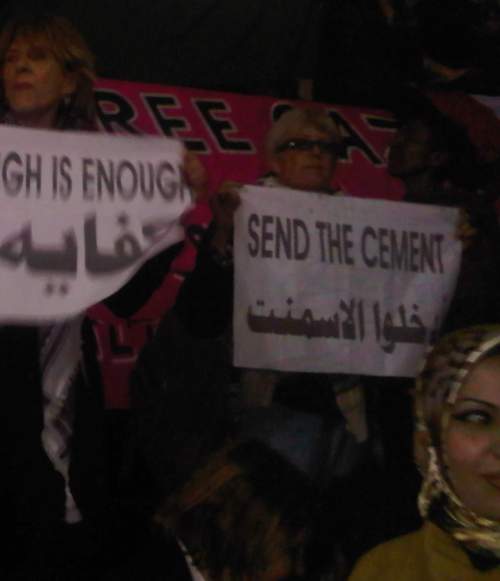
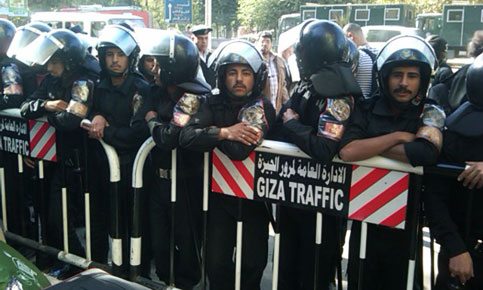
Hundreds of activists from more than 40 countries staged demonstrations and sit-ins in Cairo to protest the Egyptian government’s refusal to allow them to cross the border into Gaza. Our own Michael Ratner and his family are among the 13 hundred solidarity marchers in the Gaza Freedom March. Among the marchers, 300 from the United States, 80 from New York State and 250 marchers from France. Last week organizers said an offer by Egyptian authorities to allow only 100 members of the group into Gaza was not enough. The Egyptian embassy has stalled the marchers and some were detained by police as crowds outside the embassies grew.
Abdeen Jabara / Dorothy Zellner:
- This has truly been one of the truly great, historic, international mobilizations of people in solidarity.
- Thousands upon thousands over the course of months have been working in over 42 countries around the globe.
- They go to Cairo, Egypt as a transit point to go to Gaza.
- This effort has heightened the consciousness about the siege on Gaza and exposed the United States, Israel and the Egyptian government to promote the division of the middle east for their own selfish reasons.
- There is the Gaza Freedom March, then there is Viva Palestina, which is a convoy of trucks loaded with humanitarian aid that actually made it into Gaza several months ago.
- Viva Palestina is led by George Galloway, former British parliament member, they are stuck in Jordan.
- The Egyptians initially said the trucks can go through but the people can’t. This is a massive international effort to prevent the Palestinians from getting the help that they need.
- The French have been lying down in the streets in front of the French Embassy for 3 days already.
- The Gaza Freedom March had been working with the Egyptians for months and it was only until the organizers got to Cairo that the Egyptians changed their decision.
- They said we didn’t come here to create any difficult for the government, we came here to stand in solidarity with the Palestinians in Gaza.
- The Egyptian government then allowed 100 people to come through to Gaza, and to give them the names in 2 hours. A divide and rule approach, more conflict against the marchers.
- Congress voted to make Egypt the second largest aid recipient in the world : 1.7 Billion annually.
- Congress tried to take 100 million dollars away from Egypt because of the “smuggling tunnels to Gaza.” Egypt got the message. Egypt is not a democracy, Mubarak has been in power since 1981. It’s essentially a police state, they more people in their intelligence and police than they have in the Army.
- Egypt is planning to put in (with the help of the US Army Corp of Engineers) metal barriers, 50 feet into the ground to prevent tunneling to Gaza. Sixty percent of the Gaza is dependent upon that tunnel trade.
- This is the largest civilian population of the world that is completely trapped. If you ever go to Gaza, this could be the Riviera of the Mediterenean. This could be an unbelievable place if they would let them live like human beings.
- The problem is with the campaign finance system and the money that keeps them in office. This is where the problem is.
Guests – Abdeen Jabara and Dorothy Zellner give a broader scope on the Gaza Freedom March and the significance of demonstrations. Abdeen Jabara, civil rights lawyer and former president of the American-Arab Anti-Discrimination Committee. Dorothy Zellner, civil rights activist with Jews Say No, who has organized groups opposing Israeli violence in the occupied territories.
—————————————-
Victor Toro: Chilean Socialist Faces US Deportation After 25 Years
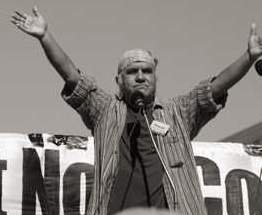
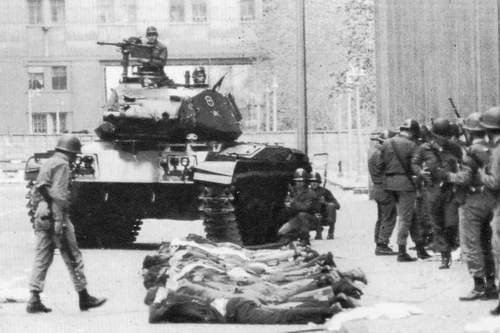
Ex-political prisoner and human rights organizer Victor Toro joins us in the studio. Victor is a Bronx community organizer and he was a former leader in the resistance to Chile’s military dictatorship during the 1970s. In July of 2007 Victor was arrested in an immigration sweep by border officials aboard an Amtrak train in Rochester, New York. He was charged for being in the country illegally and has been out on bail since. Before coming to the United States in 1984, Toro helped found and lead the MIR, or Revolutionary Left Movement. The group opposed the US -sponsored coup against the military dictatorship led by Augusta Pinochet. The Department of Homeland Security and US Immigration are seeking to deport Toro, the prosecution has filed a 46 page court brief containing information on the MIR, claiming the group attacked government buildings. Meanwhile, a deportation hearing for Victor Toro was adjourned until Jan. 11, 2010. Victor joins us in the studio with his translator Gonzalo Venegas.
Victor Toro:
- I was arrested by Pinochet’s regime, April 20th, 1974. I was incarcerated for 3 years in different concentration camps in which I was tortured. I was expelled from Chile, and given a document stating never to return. I was expelled to Sweden, and then Cuba.
- When I was forced to leave Chile, I was officially declared dead by the Pinochet regime.
- I ended up in Mexico, where I was given transitional asylum, however my safety was at risk in Mexico, because agents of Pinochet were trying to murder me. I left Mexico in 1984, fleeing persecution of Pinochet’s agents.
- Well, in the South Bronx, I continued doing the work, an extension of the work I had done in Chile in my earlier years. Working in the community and with unions.
- I’ve worked with undocumented people and immigrants in the United States. In California in 2007, I was engaging in the advocacy work for immigrant rights. On a train back to New York, I was caught in an immigration raid, with bomb sniffing dogs.
- Initially, I was facing the same case as any undocumented worker in the US. Recently the case took a political turn where the government has presented documents against me.
- I went from undocumented worker to becoming a terrorist because of my affiliations and work that I did in Chile in the 1970s.
- I was the leader of the organization MIR, that was building a socialist left movement. MIR resisted Pinochet’s oppressive tactics. MIR was branded a terrorist organization by the US.
- If you look at Chile’s current president of the senate, and house of representatives, the Navy, it all lead by former members of Pinochet’s political party.
- Demand asylum for Victor Toro / Friday January 8, 2010 – SEIU 1199 / Martin Luther King Auditorium. 310 West 43rd Street / between 8th and 9th Avenues.
- Monday January 11, 2010 – Court date 9 AM – / Rally afterward at NOON at 26 Federal Plaza, NY.
Guest – Victor Toro, a Chilean activist in the Bronx who fought against the Pinochet dictatorship in Chile. Toro is one of tens of thousands of immigrants who are racially profiled and targeted for deportation unjustly and unfairly.
—————————————————————————