Welcome to Law and Disorder Radio
Law and Disorder is a weekly independent civil liberties radio program airing on more than 150 stations and on Apple podcast. Law and Disorder provides timely legal perspectives on issues concerning civil liberties, privacy, right to dissent and practices of torture exercised by the US government and private corporations.
Law and Disorder June 24, 2019
Podcast: Play in new window | Download
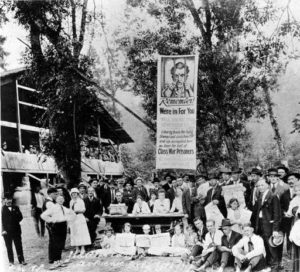
Before World War I, the government reaction to labor dissent had been local, ad hoc, and quasi military. Sheriffs, mayors, or governors would elevate strike breakers to deputies or call out the state militia, usually at the bidding of employers.
At the time, one of the nations largest unions was the Industrial Workers of the World, also known as the Wobblies. The IWW had members in critical industries across the country. In April 1917, when the United States entered the war, the government feared the threat of a labor strike from such a large number of workers that would put in danger or even hold up war production.
Officials in the relatively young Department of Justice determined that a more coordinated strategy would be necessary. To prevent stoppages, the DOJ embarked on a sweeping new effort – replacing gunman with lawyers. The department systematically targeted the IWW, resulting in the largest mass trial in US history. The first of four indictments named 166 defendants in September 1917. The Chicago trial started with 112 men accused, sitting on bleachers, with one small defense team and a judge and prosecutors who did not know their names or faces. As the case unfolded, it became an exercise in raw force, raising serious questions about its legitimacy and revealing the fragility of a criminal justice system under pressure from banks and industrialists who supported the war.
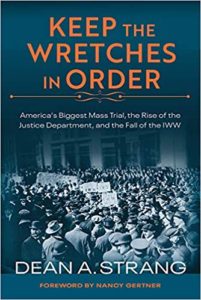
Guest – Attorney Dean A. Strang, criminal defense lawyer in Madison, Wisconsin, and an adjunct professor at the University of Virginia School of Law is author of the new book Keep the Wretches In Order: America’s Biggest Mass Trial, the Rise of the Justice Department, and the Fall of the IWW talks about how the case laid the groundwork for a fundamental different strategy to stifle radical threats and played a major role in the shaping of the modern Justice Department. He is also the author of Worse than the Devil: Anarchists, Clarence Darrow, and Justice in a Time of Terror
—-
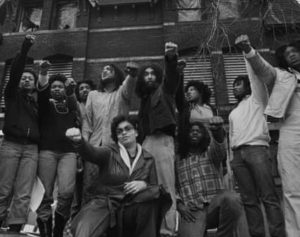

Two Members Of MOVE 9 Released From Prison After 40 Years
After 40 years in prison, Janine Phillips Africa and Janet Holloway Africa were recently released from SCI Cambridge Springs in Pennsylvania after a long fight for parole. Members of the so-called Move 9, 63-year-old Jane and 68-year-old Janet were arrested and imprisoned for a crime they say they did not commit after a police siege of their home in August 1978.The two were the last of four women to be paroled or to die behind bars.
Listeners may recall that Move members lived in Philadelphia in a communal house with founder John Africa. Move championed equal treatment for African Americans and an abiding respect for nature and animals.
Their attitudes brought them into conflict with neighbors and police. After a siege lasting several months, on August 8, 1978 officers went in to clear the group from the property. In the melee, Officer James Ramp was shot and killed. Despite the fact that Move claimed they were unarmed and that Officer Ramp was killed by friendly fire, the five men and four women were each sentenced to 30 years to life.
Guest – Attorney Brad Thomson with the People’s Law Office in Chicago. Brad was one of the attorneys securing the women’s release. Brad’s work at People’s Law Office has focused on civil rights litigation against the Chicago Police, including suits for wrongful conviction, false arrest, police shootings and other cases of police brutality. In addition, he has represented prisoners and criminal defendants, focusing on cases of people charged with crimes based on their political activity.
—————–
—————–
Law and Disorder June 17, 2019
Podcast: Play in new window | Download
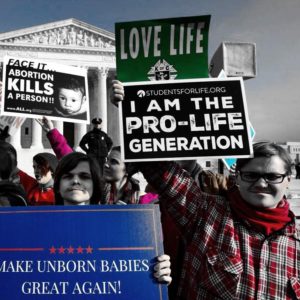
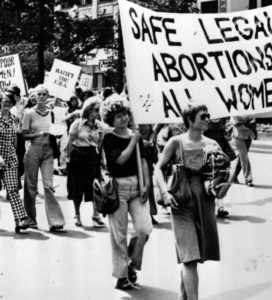
Analyzing Recent Abortion Legislation
Halfway through 2019 nine states have already passed bills to limit abortion. Louisiana recently passed a ban on the medical procedure after a fetal heartbeat is detected. That makes it the 9th state in 2019 year to pass abortion restrictions that could challenge the constitutional right established in Roe v.Wade.
Alabama legislators also recently voted to ban abortions in nearly all cases. Other measures, like Louisiana’s, have limited the procedure to earlier in pregnancy, typically around six weeks.
Georgia, Kentucky, Louisiana, Missouri, Mississippi and Ohio stopped short of outright bans. They’ve passed so-called heartbeat bills that effectively prohibit abortions after six to eight weeks of pregnancy. That’s when doctors usually start detecting a fetal heartbeat. Utah and Arkansas voted to limit the procedure to the middle of the second trimester.
Most other states follow the standard set by the Supreme Court’s 1972 Roe decision, which says abortion is legal until the fetus reaches viability, usually at 24 to 28 weeks.
The latest bans are not yet in effect (Kentucky’s was blocked by a judge), and all bans are expected to face protracted court battles. What does all this mean? More states are considering and will likely pass measures similar to that in Louisiana in an attempt to challenge Roe v. Wade.
Guest – Attorney Elisabeth Smith from the Center for Reproductive Rights. Elisabeth is their Chief Counsel for State Policy. Before that she was Legislative Director at the ACLU of Washington where she was the Legislative Director.
—-

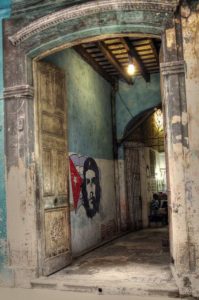
Cuban Revolution 60th Anniversary And The 1996 Helms-Burton Act
July 26, 2019 marks the 60th anniversary of the Cuban revolution. On that date revolutionary troops led by Fidel Castro and Che Guevara marched into Havana. The American supported dictator Batista fled to the Dominican Republic. Other rich Cubans went to Miami. At that time the wealth of Cuba, it’s vast fertile sugarcane and tobacco fields, it’s oil refinery, its phone company, were owned by US corporations and a handful of wealthy Cubans.
To obstruct the revolution, the US owned oil refinery stopped providing oil so there was no gasoline. In response, the Cuban revolutionaries nationalized the refinery, then the phone company, the nickel mines, and the vast land holdings. This was the beginning of the Cuban revolution The Cuban government offered to pay the owners for the nationalized property in the amount that the owners had listed the properties for tax purposes. The owners refused to take the money. Since then the American government has waged economic warfare on Cuba.
In an escalation of this warfare Last week we saw the instigation of the dormant title III section of the anti-Cuba 1996 Helms-Burton Act. This law permits US citizens to sue anyone anywhere in the world in American Courts for using property legally expropriated by the Cuban government after the revolution. Expropriation of a foreign owned property is legal under international law so long as the owners are compensated.
In addition to the invocation of the Helms-Burton law the US government has ended people to people travel to Cuba and drastically reduced the amount of money Cuban Americans living in the US can remit to their families on the island.
Guest – Netfa Freeman, policy analyst with the Institute for Policy Studies and an Organizer in the International Committee for Peace Justice & Dignity.
———————————–
———————————–
Law and Disorder June 10, 2017
Podcast: Play in new window | Download
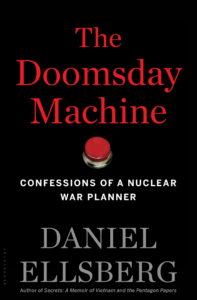
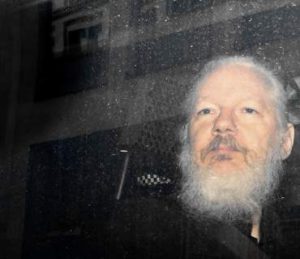
Daniel Ellsberg: Julian Assange’s Case And The Doomsday Machine
Two weeks ago the Trump administration announced it had indicted Julian Assange in the Eastern District of Virginia on 17 counts of violating the 1917 Espionage Act. Assange is currently in the Belmarsh prison hospital in London. If extradited, tried, and convicted he faces 175 years in prison.
The Espionage Act is a 102 year old law used initially to imprison the great socialist Eugene V Debs for an anti-World War I speech he gave in Canton, Ohio and also used to crush the industrial workers of the world, the IWW, a large antiwar union at the time.
In 1971 it was famously used against Daniel Ellsberg who released the Pentagon papers to the New York Times and other media outlets. Lately the Espionage Act has been used against many truth telling whistleblowers during the Obama and Trump administrations.
This is the first time it is being used against a journalist.
Wikileaks Defense Funds:
Guest – Daniel Ellsberg, educated at Harvard and Cambridge and has been an activist since the 1970s. Ellsberg’s latest book, The Doomsday Machine, is an extensive study of nuclear theory and nuclear policy. In 2018 he was awarded the Olaf Palme prize for his “profound humanism and exceptional moral courage.
From 1957-59 he was a Junior Fellow in the Society of Fellows, Harvard University. He earned his Ph.D. in Economics at Harvard in 1962 with his thesis, Risk, Ambiguity and Decision. His research leading up to this dissertation—in particular his work on what has become known as the “Ellsberg Paradox,” first published in an article entitled Risk, Ambiguity and the Savage Axioms—is widely considered a landmark in decision theory and behavioral economics.
———————-
———————-