Welcome to Law and Disorder Radio
Law and Disorder is a weekly independent civil liberties radio program airing on more than 150 stations and on Apple podcast. Law and Disorder provides timely legal perspectives on issues concerning civil liberties, privacy, right to dissent and practices of torture exercised by the US government and private corporations.
Law and Disorder February 18, 2019
Podcast: Play in new window | Download

In the overburdened U.S. criminal justice system, with its burgeoning prison population, we hear a lot about felony convictions. Felonies are crimes usually punishable by a term of more than one year, or the death penalty. What we don’t hear much about are misdemeanors, low level offenses punishable by fines or short terms of imprisonment in local jails.
With ten million petty cases filed annually, most U.S. convictions are misdemeanors. Unlike felonies, however, their processing is typically informal and deregulated. Much like fast-food justice, they have high-volume arrests, weak prosecutorial screening, an overtaxed defense bar, and high plea rates. There is often little meaningful scrutiny to see if convictions are supported by evidence. Innocent people who can’t afford bail often plead guilty just to get out of jail.
What the result of misdemeanor convictions? It’s pretty serious: stigma of a criminal record, misdemeanants are often heavily fined, incarcerated, and/or lose jobs, housing, and educational opportunities. Petty convictions are more frequent and burdensome even as we devote fewer institutional resources to ensuring their validity.
The misdemeanor phenomenon has profound systemic implications. It invites skepticism about whether thousands of individual misdemeanants are actually guilty. It reveals an important structural feature of the criminal system: that due process and rule-of-law wane at the bottom of the penal pyramid where offenses are pettiest and defendants are poorest. Misdemeanor processing is the way poor defendants of color are swept up into the criminal system with little or no regard for actual guilt.
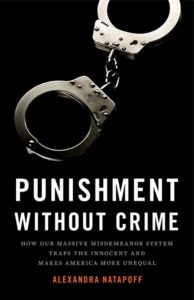
In her new book, Punishment Without Crime: How Our Massive Misdemeanor System Traps the Innocent and Makes America More Unequal, Law Professor Alexandra Natapoff takes an in-depth look at the misdemeanor process is an institutional gateway that explains many of the criminal system’s dynamics and dysfunctions.
Guest – Alexandra Napatoff, University of California Irvine law professor and a member of the American Law Institute. She’s also a former federal public defender, a community organizer, and the recipient of an Open Society Institute Community Fellowship.
—-
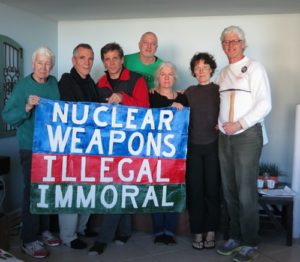
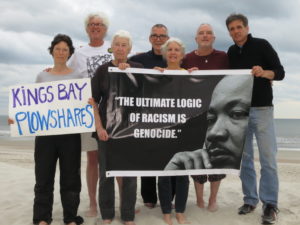
In our society nuclear weapons that can destroy all creation are taken as a normal, even an inevitable, part of life. In a dramatic action to break what they call “the crime of silence“ seven Catholic peace activists entered the Kings Bay trident submarine base in Georgia last April to perform an act of symbolic disarmament.
They used hammers to follow the prophecy of Isaiah “to beat swords into plowshares” and poured blood to make holy what was evil in a sacramental action.
Kings Bay is homeport to six ballistic missile trident submarines, each of which deploy 16 trident missile’s carrying four or more warheads of at least 100 kilotons. The Hiroshima bomb was 14 kilotons. Each submarine thus has the distructive power of at least 500 Hiroshima bombs.
The plowshares seven face up to 25 years in federal prison. Their trial is coming up in the next month. Theirs was the latest of 100 plowshares actions around the world since 1980.
- www.twitter.com/kingsbayplow7
- http://facebook.com/Kingsbayplowshares/
- instagram.com/kingsbayplowshares7/
- facebook.com/groups/1558500837566350/
- Media: kbp7media@gmail.com General: kingsbayplowshares@gmail.com
Guest – Martha Hennessey, Kings Bay Plowshares 7 co-defendant, activist and volunteer with the New York Catholic Worker.
Guest – Carmen Trotta, Kings Bay Plowshares 7 co-defendant, activist and volunteer with the New York Catholic Worker.
——————
——————
Law and Disorder February 11, 2019
Podcast: Play in new window | Download
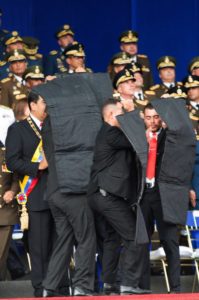
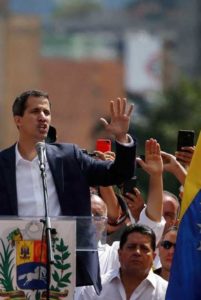
Venezuela Coup d’Etat
The last coup d’état the United States of America sponsored in 2009 in Latin America was under the Obama administration and supported by his Secretary of State Hillary Clinton when they overthrew a mildly social democratic president of Honduras. At that time the USA denied its role.
Today we are witnessing a quite open and blatant coup d’état in oil rich Venezuela against their recently and democratically elected socialist president Nicolas Maduro. The US boldly announced it no longer considered Maduro the legitimate president of his country.
In his stead the USA has recognized Jose Guida, an obscure legislator from the most right wing of the opposition parties after Vice President Mike Pence called him on the phone and gave him the blessings of United States government.
Venezuelan oil assets in the United States which amount to over $7 billion have been frozen. Likewise it’s $1 billion plus bank deposits in the United Kingdom have been seized. The United States has succeeded, in the infamous words of former Secretary of State Henry Kissinger, who engineered the coup against the elected Democratic Socialist President Salvador Allende in Chile on September 11 of 1973, “ to make their economy scream”.
The Venezuelan economy is now half its former size and hobbling along at a depression level. Food and medicine there is increasingly scarce. Tens of thousands of people have been forced to leave their country. Nevertheless, President Maduro has retained popular support including the support of the Venezuelan army.
Guest – Greg Grandin, a professor of history at New York University and a Nation editorial board member, is the author of a number of prize-winning books, including The Empire of Necessity, which won the Bancroft Prize; Fordlandia, which was a finalist for the Pulitzer Prize, the National Book Award, and the National Book Critics Circle Award; Empire’s Workshop; The Last Colonial Massacre; The Blood of Guatemala; and, most recently, Kissinger’s Shadow: The Long Reach of America’s Most Controversial Statesman. His new book, forthcoming this spring, is The End of the Myth: From the Frontier to the Border Wall in the Mind of America.
—-
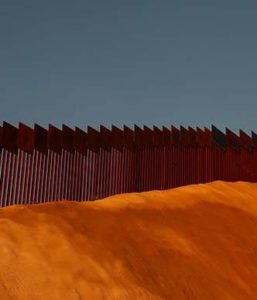
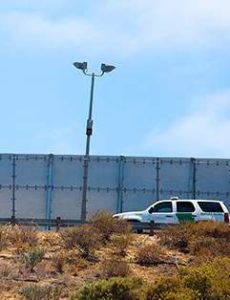
United States Executive Authority in Declaring Emergency Powers
U.S. presidents have the discretion to declare a “national emergency.” As soon as he does, he can sidestep many existing limits to presidential authority. In fact, 100 or more special provisions become available to him. Some provide reasonable responses to real emergencies, while others seem to bolster the power of a so-called unitary executive who wants to amassing or retain power. The president can activate laws allowing him to, for example, shut down many kinds of electronic communications inside the U.S. or to freeze Americans’ bank accounts. Other powers are available without a declaration of emergency, including laws that allow the president to deploy troops inside the country to subdue domestic unrest.
The rationale for having emergency powers is simple: The government’s ordinary powers may not be enough in times of crisis, and amending the laws to provide greater ones would take too long. Emergency powers are intended to give a temporary boost until the emergency passes or there is time to change the law through the regular legislative process. The problem comes when presidents don’t have the best interest of the country in mind.
Guest – Andrew Boyd, Counsel in the Brennan Center’s Liberty and National Security Program. Andrew spent 7 years prosecuting senior Khmer Rouge leaders on behalf of the UN for war crimes, crimes against humanity and genocide. He also worked on cases resulting from the 1994 Rwandan genocide at the International Criminal Tribunal for Rwanda.
———–
———–
Law and Disorder February 4, 2019
Podcast: Play in new window | Download
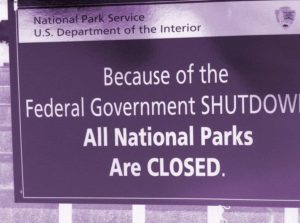
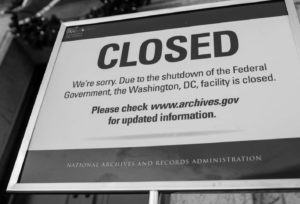
Government Shut Down Impacts
President Donald Trump set a record for the longest-ever government shutdown in history lasting nearly 35 days. There are many ways that the public will feel the impact of a government shutdown. 800,000 federal workers were either barred from working or forced to work without pay. That, despite the continued operation of so called essential services – many of which relate to public safety – that continued to operate. In prior shutdowns these have included border protection, in-hospital medical care, air traffic control, law enforcement, and power grid maintenance.
In 1996, for example, more than 10,000 Medicare applicants were turned away each day of the shutdown. In 2013, the Environmental Protection Agency halted site inspections to 1,200 different sites that included hazardous waste, drinking water, and chemical facilities. The Food and Drug Administration delayed almost 900 inspections.
We examine some of the lesser-reported impacts from the most recent government shutdown such as cybersecurity and food and chemical testing.
Guest – Attorney Melanie Benesh – As EWG’s Legislative Attorney, Melanie provides legislative and regulatory analysis of federal food, farm and chemical law. Melanie grew up in Omaha and received her B.A. from Marquette University. After college, she worked as a research assistant studying Fair Trade coffee in Chiapas, Mexico, and later as a community organizer for Voces de la Frontera in Milwaukee.
Guest – Larry Loeb has written for many of the last century’s major “dead tree” computer magazines, having been, among other things, a consulting editor for BYTE magazine and senior editor for the launch of WebWeek. He has written a book on the Secure Electronic Transaction Internet protocol. His latest book has the commercially obligatory title of Hack Proofing XML. Securitynow.com