Welcome to Law and Disorder Radio
Law and Disorder is a weekly independent civil liberties radio program airing on more than 150 stations and on Apple podcast. Law and Disorder provides timely legal perspectives on issues concerning civil liberties, privacy, right to dissent and practices of torture exercised by the US government and private corporations.
Law and Disorder December 17, 2018
Podcast: Play in new window | Download
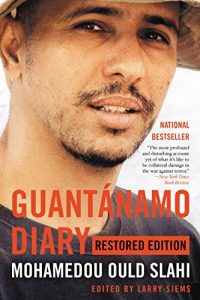

Guantanamo Diary: Mohamedou Ould Slahi
The American offshore prison camp in Guantánamo, Cuba is still operating. After the attacks on September 11, 2001, it was set up as a place where neither American or international law would apply and where prisoners could be brought, tortured, detained forever, and never charged with a crime. Ten years ago, former President Obama promised to close the offshore prison when he ran for office. It remains up and running to this day. Mohamedou Ould Slahi spent 18 years of his life there. He was an electrical engineer from Mauritania in Africa and educated in Germany. He was 32 years old when he was apprehended in his home, taken to Jordan where he was tortured, then to Afghanistan, then to Guantanamo and 16 years later at age 48, he was released. He walked out of Guantanamo Bay Prison in October 2016 without being charged with a crime and returned to his native Mauritania.
While in prison in 2005 he wrote a memoir, in English, one of his four languages. His attorney Nancy Hollander had asked him to do it and she finally got it declassified in 2012 but with heavy redactions. It was made into a book, titled Guantánamo Diary, and published in 2015 and became an international bestseller.
In it, he describes how he was tortured in ways personally approved by then Defense Secretary Donald Rumsfeld. Torture is a criminal act under both US and international law. As many know, Rumsfeld has yet to be prosecuted.
Guest – Mohamedou Ould Slahi joins hosts from his native country of Mauritania where he is a writer. He is the author of Guantanamo Diary.
Guest – Attorney Nancy Hollander has been a member of the firm Freedman Boyd Hollander Goldberg Ives & Duncan, P.A. since 1980 and a partner since 1983. Her practice is largely devoted to criminal cases, including those involving national security issues. She has also been counsel in numerous civil cases, forfeitures and administrative hearings, and has argued and won a case involving religious freedom in the United States Supreme Court. Ms. Hollander also served as a consultant to the defense in a high profile terrorism case in Ireland, has assisted counsel in other international cases and represents two prisoners at Guantanamo Bay Naval Base. Nancy is co-author of WestGroup’s Everytrial Criminal Defense Resource Book, Wharton’s Criminal Evidence, 15th Edition, and Wharton’s Criminal Procedure, 14th Edition. She has appeared on national television programs as PBS Now, Burden of Proof, the Today Show, Oprah Winfrey, CourtTV, and the MacNeill/Lehrer News Hour.
—-
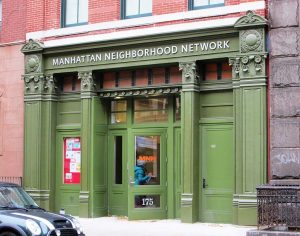
Manhattan Neighborhood Network Supreme Court Case
Is a public-access TV channel run by private nonprofit corporation subject to the First Amendment? The Supreme Court will consider that question in a case involving the Manhattan Neighborhood Network or MNN. In 1991 MNN was designated to operate as a public-access channel in New York City. The Manhattan Borough President has no control over MNN but does pick two of its thirteen board members.
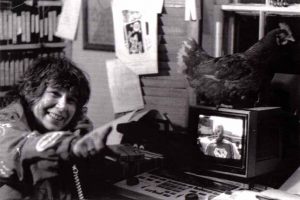
In 2012 Jesus Melendez, an occasional contributor to MNN, was suspended for trying to attend a board meeting. His associate Deedee Halleck then videoed him outside talking about the situation. MNN banned the video from airing. Melendez and Deedee brought a First Amendment claim against MNN asking if the network is a state actor for purposes of their First Amendment rights. The district court said no, noting that, while it was a close call, other circuits had concluded that privately run public-access networks were not state actors.
The Supreme Court hasn’t directly weighed in on this question although Justice Anthony Kennedy, in a 1996 concurrence in a case dealing with laws regulating content on public-access channels, wrote they should be considered state actors who run public fora and thus be subject to the First Amendment. Justice Clarence Thomas disagreed in his concurrence, writing that “franchising authorities require cable operators to create public access channels, but nothing in the record suggests that local franchising authorities take any formal easement or other property interest in those channels that would permit the government to designate that property as a public forum.”
Defenders of MNN claim, that while it’s possible that some public-access channels could be rightly called state actors, the Court should take the case to clarify the state-actor test and to review the Second Circuit’s unnecessarily broad opinion.
Guest – Deedee Halleck one of the plaintiffs in this case and among the top media activists. She’s co-founder of Paper Tiger Television and also the Deep Dish Satellite Network, the first grass roots community television network. She is Professor Emerita in the Department of Communication at the University of California at San Diego.
Guest – Attorney Paul W. Hughes, a partner in the law firm Mayer Brown’s appellate and Supreme Court practice. Paul has handled more than 200 appellate matters, more than 125 of which were in the U.S. Supreme Court. In 2017The American Lawyer named Hughes “Litigator of the Week” in connection with his immigration work.
Law and Disorder December 10, 2018
Podcast: Play in new window | Download
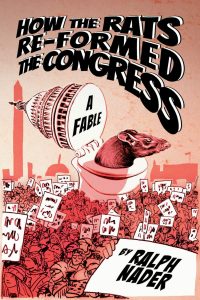
How the Rats Re-Formed Congress
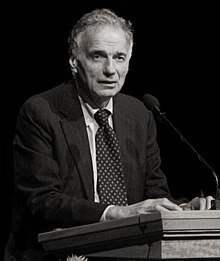
A fable is a short tale that anthropomorphizes animals. The animals personify human virtues and vices, and function as an instrument of moral instruction. We mention this because Ralph Nader joins us to discuss his new book How the Rats Re-Formed Congress. It’s a Fable about an invasion of rats in Congress that triggers a peoples’ political revolt. It begins when a Congressional reporter breaks a bizarre story: “Rats have invaded the toilet bowls” of the Speaker of the House and the Minority Leader. A national news frenzy ensues.
Activists seize on the breaking story to organize for a populist agenda. Spontaneous rallies erupt. The activists see the rats upending “business as usual” routines on Capitol Hill as a symbol against lobbyists and corporate Congress. Millions flood into the nation’s capitol to take back Congress from Wall Street. Congressional offices are deluged with citizen rallies and meetings. Members are challenged in primaries. Incumbents join the movement.
Wall Street and its lobbyists warn of economic collapse and mass layoffs if the people’s agenda passes Congress. Corporate front groups are formed to disrupt peaceful crowds. Despite that, corporate lobbyists and think tanks can’t overcome the organized will of the determined citizenry. Tortmuseum.org
Listen to our past interview with Ralph Nader about the Tort Museum.
Guest – Ralph Nader, one of the nation’s most effective and well-known social critics. He has raised public awareness and increased government and corporate accountability. As a young lawyer in 1965 he made headlines with his book Unsafe at Any Speed, leading to congressional hearings and passage of a series of life-saving auto safety laws in 1966. His example has inspired a generation of consumer advocates, citizen activists and public interest attorneys. Full biography.
————————-
————————-
Law and Disorder December 3, 2018
Podcast: Play in new window | Download
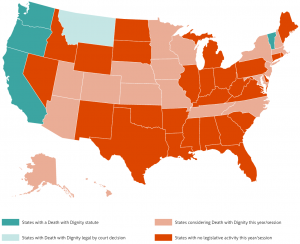
Seventy percent of Americans support the end-of-life option permitting qualified terminally ill people to end their lives through physician-prescribed medications. Despite this, forty-four states don’t have statutes outlining the procedure, and safeguards, for getting medications to hasten inevitable death.
Death with Dignity is a growing movement that works to ensure terminally ill Americans have the freedom to control their end-of-life options, including how they die. Its state-by-state campaign strives to change that.
California, Colorado, Hawaii, Oregon, Vermont, Washington and the District of Columbia have assisted dying statutes. They allow mentally competent, terminally-ill adult state residents to request and receive a prescription medication enabling them to die in a place and time of their choosing.
Guest – Mark Glaze is a strategist in public affairs, advocacy and politics. His clients have included the Open Society Institutes, the American Federation of Teachers, the Human Rights Campaign and Amnesty International. Mark is the former executive director of Everytown for Gun Safety, the nation’s largest gun violence prevention group. After the Newtown mass shooting the Wall Street Journal called him “the face of the gun control movement.”
—-

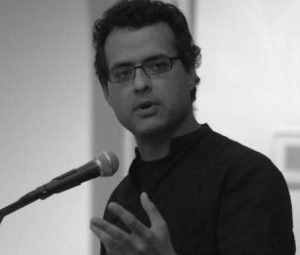
The spectacle and recent emergence of the strong man leader has been seen in a number of countries across the world, not only in the United States. We have witnessed the rise of Modi in India, Duterte in the Philippines, Erdogan in Turkey and Putin in Russia. In the 1920s and 1930s fascist dictators emerged in Germany, Spain, Portugal, and Italy. These men were monsters. The new kind of strongmen are not fascist dictators, but monsters nonetheless. We welcome professor Vijay Prashad who has edited and introduced the recently published book titled Strongmen. The book is a collection of five essays, some of them in the form of a fable, which explains the phenomena of the strong men.
Guest – Professor Vijay Prashad, is the executive director of Tricontinental: Institute for Social Research. He is the author and editor of several books, the most recent is titled Red Star Over the Third World.