Welcome to Law and Disorder Radio
Law and Disorder is a weekly independent civil liberties radio program airing on more than 150 stations and on Apple podcast. Law and Disorder provides timely legal perspectives on issues concerning civil liberties, privacy, right to dissent and practices of torture exercised by the US government and private corporations.
Law and Disorder April 16, 2018
Podcast: Play in new window | Download
Mass Support Needed For Julian Assange
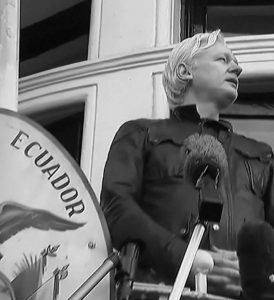
Two weeks ago, WikiLeaks founder and internet publisher Julian Assange , who is holed up in the Ecuadorian embassy in London, had his Internet access cut off due to pressure by the British and American governments on Ecuador. Ecuador had granted him political asylum in their embassy where he has been living in two small sunless rooms for five years. Ecuador gave him political asylum after he sought refuge in the embassy to avoid extradition to Sweden, which would have sent him to the US. Assange was under protracted investigation for a rape claim, made up by the Swedish police and Swedish prosecutor and denied by the purported women victim. Sweden finally dropped the case, but Assange remains subject to arrest in Britain jumping bail.
Assange and WikiLeaks had been steadily revealing the war crimes and illegalities of the American government since it first published the Iraq war logs eight years ago. The war logs included video footage of American soldiers assassinating Iraqi civilians and a Reuters journalist. Chelsea Manning, who was recently released after seven years in prison, furnished WikiLeaks with the war logs.
The United States government is seeking to capture Assange and bring him back to the United States to stand trial for espionage, a crime which carries the death penalty.
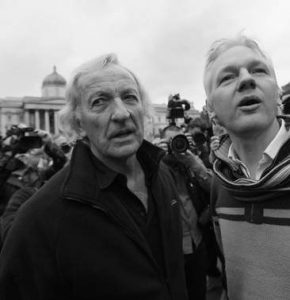
Guest – John Pilger, an Australian-British journalist based in London. John has worked in many facets of journalism, including a correspondent in the Vietnam War, the Middle East Desk for Reuters in London, a documentary film maker, and a producer for the Independent Television Network in London. Pilger is known for his conscience, bravery and acute historical insight. His articles appear worldwide in newspapers such as the Guardian, the Independent, the New York Times, the Los Angeles Times.
—-


You Thought We Wouldn’t Notice: Intellectual Property
Laws protecting artwork and intellectual property are increasingly being put to the test amid claims from rising artists marketing their work online whose work is being copied by others.
Art piracy can include music posters, clothing design, book cover art, signage, record sleeve art, and typography. Under copyright law, one artist using another artist’s idea is generally legal, while one artist using another’s expression of that idea is generally illegal. Only a fact-intensive analysis can provide a bit of clarity, and even that is subject to a judge’s or jury’s review.
Sometimes copyright cases expand into major litigation. A New York judge recently ruled that graffiti, or aerosol artists, were entitled to a $6.7 million verdict after New York developer Gerald Wolkoff destroyed their well-known public work. The claim in the so-called FivePointz case arose under the Visual Artists’ Rights Act, or VARA. It’s the kind of case that attorney Scott Burroughs says rarely goes to trial. Several artists created aerosol art pieces on the walls of an abandoned development in the once downtrodden and now gentrified neighborhood of Long Island City, Queens. Wolkoff destroyed their art as part of a development plan. Read Scott’s Column Above The Law.
Guest – Attorney Scott Burroughs, an advocate for artists’ rights who curates the art law blog You Thought We Wouldn’t Notice and has a weekly copyright law column on legal website Above the Law.
———————————————-
Law and Disorder April 9, 2018
Podcast: Play in new window | Download
Updates:
- Co-host Michael Smith Discusses Being Plaintiff In Saudi Arabia Terror Lawsuit
—-


President Donald Trump Picks John Bolton For National Security Adviser
In these unsettling times it was particularly disturbing to a lot of people to learn last week that President Trump chose John Bolton to replace general H. R. Macmaster as his National Security Adviser. Trump also replaced Secretary of State Rex Tillerson with the neo-conservative CIA director Mike Pompeo. It will be remembered that John Bolton was instrumental in getting the USA to attack Iraq on the pretext that Iraq had weapons of mass destruction and ties with the terrorist organization Al Qaeda.
Bolton now alleges that Iran is building nuclear bombs and advocates for preemptively bombing Iran, which would be an illegal act of aggression.
Guest – Phyllis Bennis directs the New Internationalism Project at IPS, working as a writer, activist and analyst on Middle East and UN issues. She is also a fellow of the Transnational Institute in Amsterdam. In 2001 she helped found and remains active with the U.S. Campaign to End the Israeli Occupation. She works with many anti-war organizations, and writes and speaks widely across the U.S. and around the world as part of the global peace movement. She has served as an informal adviser to several top UN officials on Middle East and UN democratization issues. Phyllis Bennis writes about issues related to the Middle East and the United Nations. She wrote the book Understanding the US Iran Crisis: A Primer. She has contributed articles to the Nation magazine, the New York Times, The Washington Post, and Counterpunch.
—-
Judge Finds Activists Not Guilty On Necessity Defense
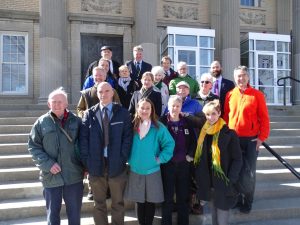
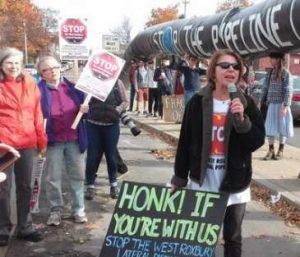
Thirteen environmental protesters were recently found not guilty in actions protesting a gas pipeline in the densely populated West Roxbury, Massachsuetts. In 2015 activists climbed into holes dug for the pipeline being built by the Houston-based company Spectra Energy. Judge Mary Ann Driscoll found them not responsible after hearing each one argue their actions to try and stop climate change were a legal “necessity”.
The so-called necessity defense is rarely accepted in US courts. Defendants relying on this defense argue that they should not be held liable for their actions because their conduct was necessary to prevent a greater harm.
In this case, the official court record will only state the charges were converted from criminal misdemeanors to civil infractions and that all defendants were found “not responsible.” But the judge DID state from the bench, on the record, that she was finding the defendants “not responsible” on the basis of necessity.
In response, environmentalist Bill McKibben, Tweeted this message: “Good golly! A few minutes ago a Boston judge acquitted 13 pipeline protesters on the grounds that the climate crisis made it necessary for them to commit civil disobedience. This may be a first in America.”
In general, a judge hearing a civil infraction case doesn’t have to give any reasons for finding a defendant not responsible. Here, the judge told lead counsel Andrew Fischer that she would state on the record that necessity was her reason for finding them not responsible.
The sustained resistance campaign would not have been possible without the support of the Massachusetts Chapter of the National Lawyers Guild, who represented every person who was arrested (often through multiple appearances) and supported the ongoing training efforts.
Guest – Kelsey Skaggs, Executive Director of the Climate Defense Project, she has worked on environmental issues at Crag Law Center in Oregon; on international environmental policy at Universal Rights Group in Geneva; and defending free speech activists at Media Legal Defence Initiative in London. Kelsey has also written about First Amendment issues related to NSA surveillance programs. She holds a B.A. in International Relations from the University of California, Davis, and a J.D. from Harvard Law School. Kelsey is licensed to practice law in the State of California.
Guest – Marla Marcum, Director of the Climate Disobedience Center and is a United Methodist committed to supporting people of all faiths and no particular faith to act boldly for justice. An experienced campaigner, trainer, pastor and lay leader, she brings two decades of social justice organizing experience with faith-based, youth, and grassroots groups.
——————————————
——————————————
Law and Disorder April 2, 2018
Podcast: Play in new window | Download
Herman Bell Granted Parole After Serving 45 Years In Prison
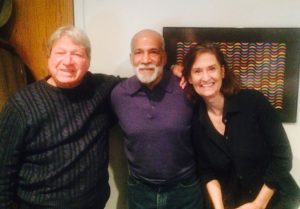
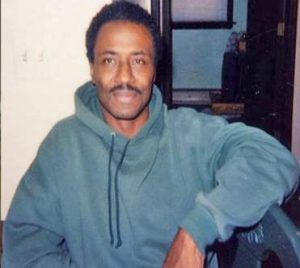
A respected elder, Herman Bell, was granted parole having met all the criteria for release according to his sentence. The parole commissioners recognized his progress after serving nearly 45 years in prison and granted his parole application. He is looking forward to being reunited with his family and friends. Today we talk about some of the opposition, from politicians and the police union, to this decision. Support Herman Bell
Herman Bell – Twitter – #BringHermanHome
Guest – Laura Whitehorn , a former political prisoner who served 14 years for the distruction of government property in connection with a 1983 bombing at the US Capitol where no one was injured. She was released in 1999. Laura Whitehorn is a leader in the Release Aging People in Prison Organization and has been active in challenging the New York state parole board’s intransigence.
Guest – Jose Saldana, joins hosts and Laura Whitehorn to talk about Herman Bell. Jose was recently released from prison after serving 38 years. He’s worked with parole reform organizations and RAPP.
—-
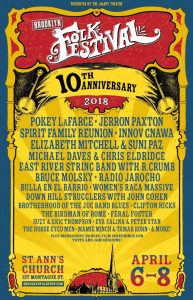
10th Annual Brooklyn Folk Festival
The Brooklyn Folk Festival is coming up April 6-8 at historic St. Anne’s church in downtown Brooklyn.
The Brooklyn Folk Festival celebrates and presents the best in American and world folk music with more than performances, workshops, film screenings, jam sessions, vocal and instrumental workshops, a square dance, and their famous banjo toss contest. The festival was started nine years ago by Eli Smith, the Jalopy Theatre and School of Music. Its a substantial and unique community event.
Folk or old time music runs counter to the commercial establishment music scene. It is truly a people’s music. It is non-commercial, non-corporate, and not a generator of huge profits. As a result this music, which should be central to American culture, has been down played and sidelined.
We know of some of its famous proponents – Woody Guthrie, Pete Seeger, and Bob Dylan . . but there are many great unknown folk musicians whose art is perpetuated and expanded on at the Brooklyn Folk Festival.
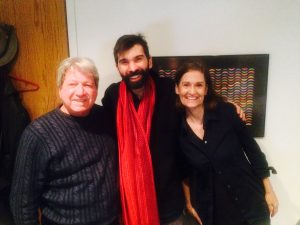
Guest – Eli Smith, the founder and main organizer along with the Jalopy Theatre and School Music, of the Brooklyn Folk Festival. Eli Smith is a banjo player and folk musician. He plays with the band called the Downhill Strugglers. He is a Folkways recording artist and has played around the country including the Library of Congress and the Kennedy Center.
———————————-