Welcome to Law and Disorder Radio
Law and Disorder is a weekly independent civil liberties radio program airing on more than 150 stations and on Apple podcast. Law and Disorder provides timely legal perspectives on issues concerning civil liberties, privacy, right to dissent and practices of torture exercised by the US government and private corporations.
Law and Disorder January 22, 2018
Podcast: Play in new window | Download
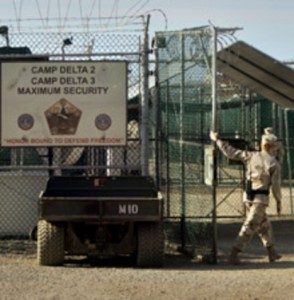
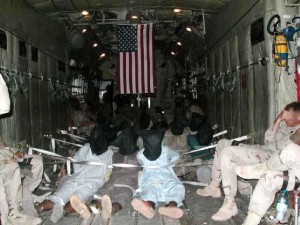
CCR Attorneys Discuss 16 Years Of Guantánamo Prison
Guantánamo is America’s offshore prison island located on the eastern end of Cuba. It has been used for 16 years to detain Muslim men and boys. The prison was used by the Bush-Cheney regime to torture them after 911.
Despite President Obama‘s campaign pledge to close the prison it remains open. 41 prisoners are there now. President Trump has announced that he will not close the prison and, in his words, will “load it up.“ Trump has said that he believes that “torture works.“
Of the 41 remaining prisoners, 5 have been cleared for release. Others are being held under the Authorization for the Use of Military Force law until the end of the war on terror. This war, which has gone on for 16 years, has been called “the forever war“ because it is a war, not against a country, but against a tactic.
Two weeks ago the Center for Constitution Rights and other attorneys filed a motion in federal court in DC challenging the imprisonment without trial of a group of remaining Muslim prisoners.
Guest – Pardiss Kebriaei is a Senior Staff Attorney at the Center for Constitutional Rights, where she works on challenging U.S. government abuses in the national security context. She was lead counsel for CCR in Al-Aulaqi v. Panetta, which challenged the killings of three American citizens in U.S. drone strikes in Yemen, and Al-Aulaqi v. Obama, which challenged the authorization for the targeting of an American citizen added to secret government “kill lists.” She represents current and former Guantanamo detainees, including Ghaleb Al-Bihani, a Yemeni man cleared for release through the government’s Periodic Review Board process after having been designated as a “forever” detainee, but who remains detained without charge, and another Yememi client who, in 2009, was in the last group of detainees to be repatriated to Yemen.
Guest – Aliya Hana Hussain is an Advocacy Program Manager at the Center for Constitutional Rights, where she manages CCR’s advocacy and campaigns on indefinite detention at Guantanamo, the profiling and targeting of Muslim, Arab, and South Asian communities, and accountability for torture and other war crimes. Aliya travels to Guantanamo regularly to meet with CCR’s clients.
—-
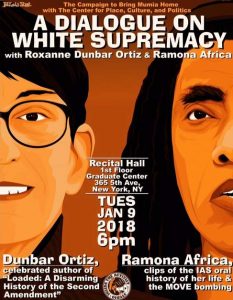
Loaded: A Disarming History of the Second Amendment
Former Law and Disorder guest Roxanne Dunbar Ortiz was in New York City and January 9, 2018 and spoke at the CUNY Graduate Center about her new book Loaded: A Disarming History of the Second Amendment. She did this in a dialogue on white supremacy with Ramona Africa. In a Law Disorder radio exclusive we bring you excerpts from her presentation. Roxanne Dunbar Ortiz is the author of An Indigenous People’s History of the United States and other works on the history of indigenous peoples.
———————————-
Law and Disorder January 15, 2018
Podcast: Play in new window | Download
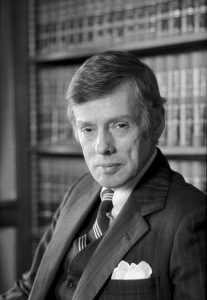
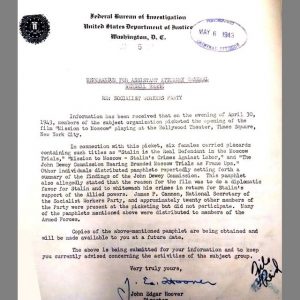
Judge Thomas Griesa : Socialist Workers Party v Attorney General
Retired federal Judge Thomas Griesa died two weeks ago in New York City at age 87. He presided over the historic case Socialist Workers party vs Attorney General. Leonard Boudin, the great leftist constitutional lawyer of his time, was chief counsel for the SWP in the 15 year litigation which ended in an historic victory in 1986 and which is extremely relevant for today.
Leonard wrote that “This lawsuit represented the first wholesale attack upon the entire hierarchy of so-called intelligence agencies that had attempted to infiltrate and destroy a lawful political party.” Further, “for the first time, a court has thoroughly examined the FBI’s intrusions into the political system of our nation and, in unmistakable language, has condemned the FBI activity as patently unconstitutional and without statutory or regulatory authority. The decision stands as a vindication of the first and fourth amendment rights that only of the Socialist Workers Party but of all political organizations in activists in this country to be free of government spying and and harassment.”
The Nation magazine appreciated the significance of the litigation and wrote that “ for the first time the FBI’s disruptions, surreptitious entries and use of informers have been found unconstitutional. All in all, it amounted to a domestic contra operation against a lawful and peaceful political organization, for no reason other than it’s ideological orientation.“
Guest – Jeff Mackler, a longtime socialist activist in California and the West Coast head of The Committee to Free Mumia Abu-Jamal. Jeff Mackler was a plaintiff in the successful 15-year-old battle. Jeff is also the director of The Mobilization to Free Mumia Abu-Jamal in Northern California and also the National Secretary of Socialist Action and its candidate for the U.S., presidency in 2016.
—-
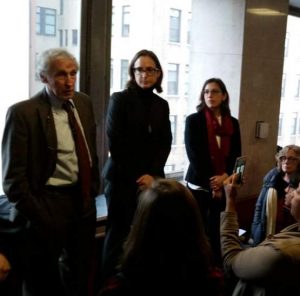
Awad, et al. v. Fordham University
Israel’s enablers in the United States ramped up their efforts to shut down the growing Boycott, Divestment, and Sanctions movement known as BDS. Many states including New York have passed laws against businesses who would boycott Israel as a way of protesting Israel’s colonization of the Palestinian people. An anti-boycott bill is currently before the United States Congress.
In New York City, Fordham University is attempting to prevent Students for Justice in Palestine, a group that supports the boycott, from forming a campus group. The students brought a lawsuit seeking an injunction against the university to enable them to establish a SJP chapter there. Keith Eldridge, the Dean at Fordham University took the position that a SJP group would create polarization on campus and run contrary to the mission and values embraced at the university located in the Bronx.
The students got help from the Center for Constitutional Rights and Palestine Legal. A suit was brought on their behalf in April of last year. Two weeks ago a hearing was held in Civil Court in New York where the students demanded an injunction against Fordham University to permit them to form a chapter.
Guest – Maria LaHood, one of the student’s attorneys and Deputy Legal Director at the Center for Constitutional Rights with expertise in constitutional rights and international human rights. She works to defend the constitutional rights of Palestinian human rights advocates in the United States in cases such as Davis v. Cox, defending Olympia Food Co-op board members for boycotting Israeli goods; Salaita v. Kennedy,representing Steven Salaita, who was terminated from a tenured position for tweets critical of Israel; and CCR v. DOD, seeking U.S. government records under the Freedom of Information Act (FOIA) regarding Israel’s 2010 attack on the flotilla to Gaza. She works closely with Palestine Legal to support students and others whose speech is being suppressed for their Palestine advocacy around the country. She also works on the Right to Heal initiative with Iraqi civil society and Iraq Veterans seeking accountability for the lasting health effects of the Iraq war.
——————
Law and Disorder January 8, 2017
Podcast: Play in new window | Download
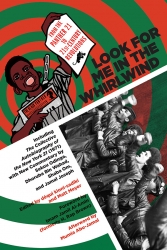
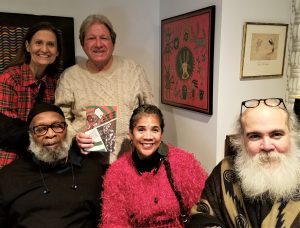
Look for Me in the Whirlwind: From the Panther 21 to 21st-Century Revolutions
The Black Panther Party was formed by community college students in Oakland California in 1966, the year after Malcolm X was murdered in New York City. It’s original name was the Black Panther Party For Self Defense.
The Black Panther Party set an example by its community programs and courage in declaring that it would defend itself against police brutality. The Black Panther Party spread westward from California to New York where chapters were organized in Brooklyn and Harlem, where Malcolm X was from. The Panthers frightened America’s elite. J Edgar Hoover and the FBI set out to destroy them and eventually succeeded. A great courtroom battle took place place in New York City shortly after the establishment of the chapters. Twenty one Black Panthers were framed up on baseless conspiracy charges.
They spent two years in prison including one year on trial. The jury was out for only one hour and acquitted them totally of all the baseless charges. The collective story of the New York City black panthers and their trial is told in the newly re-issued book Look For Me In The Whirlwind. The book is edited by Dequi Kioni-sadiki and Matt Meyer. It has a forward by Imam Jamil Al-Amin (formerly H. Rap Brown), the former head of the Student Nonviolent Coordinating Committee now in prison for life in Georgia and it contains an afterword by Mumia Abu-Jamal.
Guest – Matt Meyer is a New York City–based educator, organizer, and author who serves as War Resisters International Africa Support Network Coordinator, and who represents the International Peace Research Association at the United Nations Economic and Social Council. A former draft registration resister, Meyer’s extensive human rights work has included support for all political prisoners and prisoners of conscience, solidarity with Puerto Rico and the Black Liberation Movement, and board membership on the A.J. Muste Memorial Institute.
Guest – déqui kioni-sadiki is the chair of the Malcolm X Commemoration Committee and was a leader of the Sekou Odinga Defense Committee, which waged a successful campaign for the release of her husband. A tireless coalition-builder and organizer, déqui is a radio producer of the weekly show “Where We Live” on WBAI-Radio, Pacifica; an educator with the NYC Department of Education; and a member of the Jericho Movement to Free All Political Prisoners.
Guest – Sekou Odinga was a member of Malcolm X’s Organization of Afro-American Unity, a founding member of the New York chapter of the Black Panther Party as well as the Black Panther International Section, and was a member of the NY Panther 21. A citizen of the Republic of New Afrika and combatant of the Black Liberation Army, Sekou was captured in October 1981, mercilessly tortured, and spent the following thirty-three years behind bars—a prisoner of war and political prisoner of the U.S. empire. Since his release in November 2014, he has remained a stalwart fighter for justice and for the release of all political prisoners.
—-
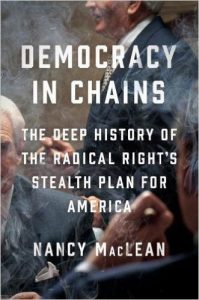
Democracy in Chains: The Deep History of the Radical Right’s Stealth Plan for America
The spectacle of President Donald Trump and the palace intrigue in the White House has served daily to distract people from the political strategy and accomplishments of the radical right, which is taking over the Republican Party.
Over time, the GOP has been transformed into operation conducting a concerted effort to curb democratic rule in favor of capitalist interests in every branch of government, whatever the consequences. It is marching ever closer to the ultimate goal of reshaping the Constitution to protect monied interests. This gradual take over of a major political party happened steadily, over several decades, and often in plain sight.
Duke University Professor Nancy MacLean exposes the architecture of this change and it’s ultimate aim. She has written that “both my research and my observations as a citizen lead me to believe American democracy is in peril”.
Guest – Professor Nancy MacLean, whose new book, Democracy in Chains: The Deep History of the Radical Right’s Stealth Plan for America, has been described by Publishers Weekly as “a thoroughly researched and gripping narrative… [and] a feat of American intellectual and political history.” Booklist called it “perhaps the best explanation to date of the roots of the political divide that threatens to irrevocably alter American government.” The author of four other books, including Freedom is Not Enough: The Opening of the American Workplace (2006) called by the Chicago Tribune “contemporary history at its best,” and Behind the Mask of Chivalry: The Making of the Second Ku Klux Klan,named a New York Times “noteworthy” book of 1994, MacLean is the William H. Chafe Professor of History and Public Policy.