Welcome to Law and Disorder Radio
Law and Disorder is a weekly independent civil liberties radio program airing on more than 150 stations and on Apple podcast. Law and Disorder provides timely legal perspectives on issues concerning civil liberties, privacy, right to dissent and practices of torture exercised by the US government and private corporations.
Law and Disorder December 11, 2017
Podcast: Play in new window | Download

CCR: Current Supreme Court Dockets
We are currently living through an attack on every aspect of American democracy. This phenomena predated the Trump presidency and has been qualitatively accelerated by it.
This across-the-board constriction of the power and rule of the American people, to the extent that it had existed, has encompassed the suppression of voting rights; an attack on public education; the growth of enormous income inequality; the unimpeded influence of money in elections; the threat and constriction of the right of women to control their own bodies; the attack on peoples’ rights to build and join effective unions; the refusal to close the offshore prison of Guantánamo and the refusal to prosecute illegal torturers; the attack and net neutrality and access to the internet; the increase by the state of the surveillance of American citizens; the militarization of the police; encouragement of racism; the banning of Muslims; suppression of the right to demonstrate; and the growth in executive authority.
Guest – Attorney Baher Azmy, the Legal Director of the Center for Constitutional Rights. The CCR was founded in 1966 to advance the goals of the civil rights movement. Michael Ratner, our co-host and founder of Law And Disorder Radio, was its president emeritus at the time of his passing in May of last year.
—-
Lawyers You’ll Like: Alison McCrary
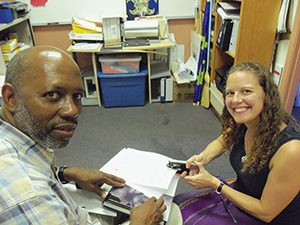
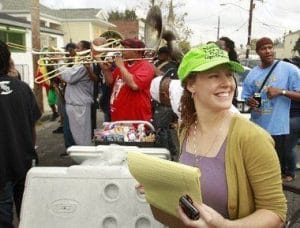
As part of our Lawyers You’ll Like series, today we are joined by Alison McCrary. Alison is a social justice attorney, a Catholic nun, president of the Louisiana Chapter of the National Lawyers Guild, and a Spiritual Advisor on Louisiana’s death row. She is the former Program Director for the Community-Police Mediation at the New Orleans Office of the Independent Police Monitor where she created a national model for improving community-police relationships, taught at the New Orleans Police Academy, and helped develop similar programs in cities across the nation.
As a 2010 Soros Justice Advocacy Fellowship in New Orleans, Alison challenged and helped reform policing practices and policies to transform relationships between police officers and the bearers of New Orleans’ indigenous cultural traditions. Alison has served as a National Lawyers Guild legal observer trainer and the New Orleans Legal Observer® Program Coordinator.
Before law school, she worked at the Capital Post-Conviction Project of Louisiana providing litigation support on death penalty cases and at the United Nations in New York monitoring the implementation of U.N. Security Council Resolutions.
Guest – Attorney Alison McCrary. In New Orleans, Alison worked, clerked, and/or volunteered at Southeast Louisiana Legal Services, the Louisiana Voters’ Rights Network, Equity and Inclusion Campaign for the Louisiana Disaster Recovery Foundation, Orleans Parish Public Defenders Office, Louisiana’s Fourth Circuit Court of Appeals, and Loyola University’s Community Justice Clinic. Nationally, Alison coordinates and provides legal support for social justice movements such as the School of the Americas Watch. She received her J.D. from Loyola University’s College of Law in New Orleans and her B.A. in English at Georgia State University in Atlanta.
————————————–
Law and Disorder December 4, 2017
Podcast: Play in new window | Download
Law and Disorder Editorials:
- Jared Kushner Middle East Policy Advisor
—-


Free Press: New FCC Rules On Net Neutrality
The Federal Communications Commission recently released a plan to do away with landmark regulations ensuring equal access to the Internet. They pave the way for Internet service companies to charge the public higher rates to see certain content and to even deny access to some websites.
The proposal was made by the FCC chairman, Ajit Pai, an opponent to regulation in general. Pai is the former Associate General Counsel for Verizon Communications, Inc.
The proposal is expected to be approved in mid-December. In his first year Pai, who was appointed by Donald Trump, has already eliminated numerous regulations. The agency has stripped down rules governing TV broadcasters, newspapers and telecom companies designed to protect the public interest. In addition to the net neutrality rollback, the chairman announced a plan to eliminate a rule limiting any corporation from controlling broadcasts that can reach more than 39 percent of American homes.
In a broad brushstroke, the new proposal repeals rules put in place by the Obama administration that prohibit high-speed internet service providers, or I.S.P.s, from slowing down or even stopping the delivery of websites. The Obama rules prevent companies from charging customers extra fees for high-quality streaming and other services. These former rules were drafted to preserve the principle commonly known as “net neutrality” and to prevent practices that would created tiers of access to the Internet.
The plan to repeal existing rules that were passed in 2015 would reverse a hallmark decision by the agency to consider broadband a public utility, as essential to modern lives as phones and electricity. The earlier decision created the legal foundation for the current rules and underscored the importance of high-speed internet service.
Guest – Attorney Gaurav Laroia, Policy Counsel at Free Press. Before joining Free Press, he worked at the Government Accountability Project protecting the rights of national security whistleblowers.
—-

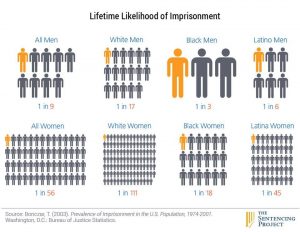
The United States of America imprisons more of its citizens both in absolute numbers and as a percentage of the population than any other country in the world. Only China comes close. On any given day 2,300,000 Americans are in jail or prison, 70% of them are non-white.
Former Alabama senator Jefferson Beauregard Sessions wants these numbers to rise. He has instructed federal prosecutors to prosecute people for the most serious possible crime and to demand the longest possible sentence.
In the last 30 years the number of people in jail and in prison have skyrocketed by factor of five. Prosecutors are increasingly demanding life sentences without the possibility of parole. Judges have lost their discretion with the implementation of maximum minimum sentencing. The long-term impact of mass incarceration has been devastating, especially to black communities.
Attorney General Sessions has stated that there is “a dangerous permanent rise”
in violent crime, despite FBI data showing a sharp decline in the last 20 years. He has falsely charged that crime increases have been caused by immigrants and that prosecutorial policy under Obama caused crime to increase.
Guest – Marc Mauer, the Executive Director of the Sentencing Project and a central figure in the justice reform movement. The Sentencing Project is a Washington DC based research and advocacy group working to reduce the use of incarceration in the United States and to address racial disparities in the criminal justice system.
Follow Heidi Boghosian on Twitter – @HeidiBoghosian
Law and Disorder November 27, 2017
Podcast: Play in new window | Download
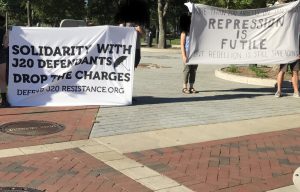
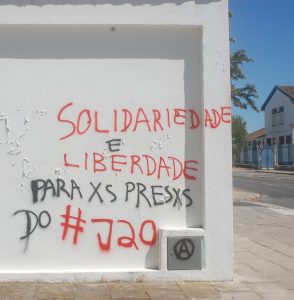
Last January, at Donald Trump’s Inauguration, over 230 people—some protesters, some not—were trapped and arrested by police. Federal prosecutors charged them with a crime that actually doesn’t exist in DC: “felony rioting.” Armed with secret warrants, prosecutors then probed deeply into the defendants’ personal lives.
Charges were dropped for some arrestees, including journalists and legal observers. Over 200, however, saw their charges increased to felony rioting, felony incitement to riot, conspiracy to riot, and property-damage crimes related to broken windows. Each defendant is facing over 60 years in prison.
Prosecutors obtained warrants focused on anti-Trump organizers. Warrants sought a list of visitors to a protest-related website and the Facebook friends and related communications of two organizers, the host of a coalition Facebook page, and those who had “liked” that page.
This prosecution follows a change in local law enforcement’s response to protest that we covered years ago on Law and Disorder. The mass arrests and harsh charges are precisely what new DC policies were designed to avoid. A 2002 mass-arrest and subsequent lawsuit by the Partnership for Civil Justice resulted in the District paying over $10 million in settlements and changing its crowd control policies.
Trials for the inauguration protesters begin mid-November and are expected to continue for a year.
Guest – Yael Bromberg, Yael is a supervising attorney and teaching fellow with the Institute for Public Representation at the Civil Rights Clinic of Georgetown University Law Center. defendj20resistance.org
—-
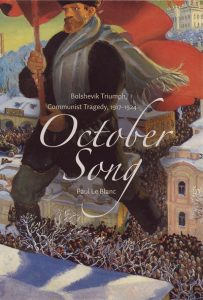
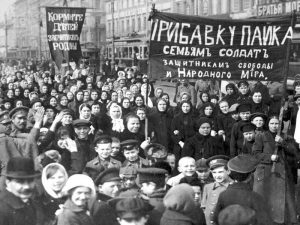
October Song: Bolshevik Triump, Communist Tragedy 1917-1924
This year marks the 100th anniversary of the Russian Revolution of October, 1917. The revolution changed the course of history and determined world politics internationally and in the United States of America for most of the 20th century, until finally, under the unrelenting onslaught of the west and principally the USA, the revolution was overthrown in 1991 when capitalism was restored to that country.
Before the revolution, Russian was a feudal monarchy, headed up by a czar in a country where most of the population were peasants working the land under near slave-like conditions.
World War I started in 1914 and Russia allied with France and Great Britain against Germany and other countries. It was a war for foreign markets, resources, and colonies. By 1917, 30 million people have been killed. In one week alone 250,000 soldiers died.
The Russian revolution was nearly bloodless and nonviolent. The first thing the revolutionary government did was to end their country’s participation in the war, which ultimately ended the war.
The second thing they did was to redistribute the land to the peasants who worked it. Then they nationalized industry under control of the workers in the plants. Thus, the 1% of the Russian elite were dispossessed and the 99% took control of the institutions of their country and ran them through councils of workers and peasants and soldiers, which had been organized prior to the revolution and which were led by socialists.
The Russian revolution inspired the hopes of humankind throughout the industrial and under-developed colonial world. The peasants were given land, women gained equal rights and the right to vote and to get an abortion. Homosexualty was made legal. Minority rights were guaranteed. Education, the arts, and culture received government support. For a period Russia was the most democratic country on the planet.
We speak today with history professor Paul LeBlanc about the Russian revolution and the lessons it teaches for social change activists in America today.
Guest – Professor Paul LeBlanc is the author of the just published book October Song: Bolshevik Triumph, Communist Tragedy, 1917-1924. He is the author of a number of widely read studies including Lenin and the Revolutionary Party and Marx, Lenin, and the Revolutionary Experience. He teaches at Laroche college in Pittsburgh.
Follow Heidi Boghosian on Twitter – @HeidiBoghosian