Welcome to Law and Disorder Radio
Law and Disorder is a weekly independent civil liberties radio program airing on more than 150 stations and on Apple podcast. Law and Disorder provides timely legal perspectives on issues concerning civil liberties, privacy, right to dissent and practices of torture exercised by the US government and private corporations.
Law and Disorder November 20, 2017
Podcast: Play in new window | Download
Law and Disorder Editorials:
- FDA Approves Digital Pill by Heidi Boghosian
—-

Release Aging People in Prison Campaign
The number of persons 50 years and older in New York State has risen more than 98% since 2000; it now exceeds 10,000—nearly 20% of the total incarcerated population. This reflects a national crisis in the prison system and the extension of a culture of revenge and punishment into all areas of our society.
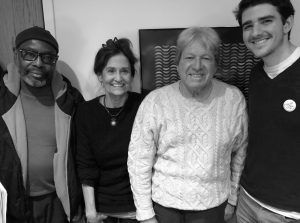
The organization Release Aging People in Prison, or RAPP, works to end mass incarceration and promote racial justice by getting elderly and infirm people out of prison.
Led by Mujahid Farid, a 2013 Soros Justice Fellow who was incarcerated for 33 years in New York before his release in 2011, RAPP focuses on aging people in prison, many of whom are long-termers convicted of serious crimes. Many of these human beings have transformed their lives and developed skills and abilities they lacked before incarceration. They could be released from prison with little or no threat to public safety. Yet many are denied release, often for political reasons, and they needlessly remain imprisoned into old age. These elders could return to their communities if current mechanisms such as parole and compassionate release were correctly utilized. We also support legislation in New York to correct the parole system and increase the number of releases.
Guest – Mujahid Farid co-founded the Prisoners AIDS Counseling and Education program and helped design prison-based sociology and theology courses that allowed others to earn college-credited in prison. He also earned four college degrees and other certifications while incarcerated, including his paralegal certificate, NYS Department of Labor Certificate in Human Development Counseling, and NYC Department of Health Certificate in HIV/AIDS Counseling.
—-
Guest – David George, Associate Director of RAPP. In the last few years Dave has organized with and on behalf of currently and formerly incarcerated people, including at the Osborne Association and Correctional Association of New York.
—-
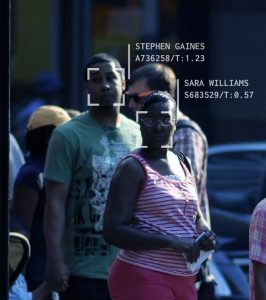
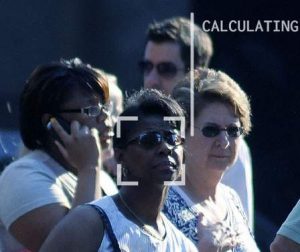
Perpetual Line Up: Unregulated Police Face Recognition In America
The presence of surveillance cameras across the United States has enabled targeted facial recognition surveillance at essentially any place and any time. Each day law enforcement puts in place more and more cameras, including CCTV cameras, police body cameras, and cameras on drones and other aircraft. The FBI’s Next Generation Biometric Identification Database and its facial recognition unit, FACE Services, can search for and identify nearly 64 million Americans, either from its own databases or through access to state DMV databases of driving license photos.
It’s likely that government agencies will soon be able to pinpoint your location and even with whom you’ve been, just by typing your name into a computer.
The release of Apple’s IPhone X has drawn scrutiny to this technology. Despite civil liberties and privacy concerns, there are few limits on facial recognition technology. In March 2017 Congress held a hearing to discuss the risks of facial recognition surveillance. There is concern that facial recognition can be used to get around existing legal protections against location tracking, opening the door to unprecedented government monitoring an logging of personal associations, including protected First Amendment-related activities. Knowledge of individual’s political, religious and associational activities could lead the way to bias, persecution and abuse.
As with many technological advances, there are benefits, too. Facial recognition can assist in locating missing persons or for other public safety purposes.
Guest – Clare Garvie, Clare is a Law Fellow at the Georgetown Law Center on Privacy and Technology. Her research with the Center is on face recognition use by law enforcement and the disparate impact of payday lending on vulnerable communities. She worked on the Center’s 2016 report on facial recognition technology.
Law and Disorder November 13, 2017
Podcast: Play in new window | Download
Law and Disorder Editorials:
—-
Lessons From The Greensboro Massacre
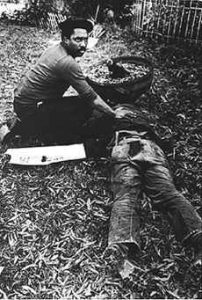
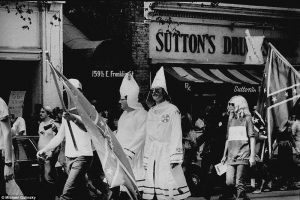
Thirty eight years ago, on November 3, 1979, 35 heavily armed members of the Ku Klux Klan and the American Nazi party drove nine vehicles through the city of Greensboro, North Carolina, and opened fire on a multi-racial group of demonstrators who were gathering at a black housing project in preparation for an anti-Klan march.
Using semi automatic rifles, shotguns and pistols the Nazis and Kukluxers fired 1000 projectiles in 88 seconds killing five march leaders and wounding seven other demonstrators.
Most of the victims were associated with the Communist Workers Party, a multi racial group which had been organizing in the south for workers rights in the cotton mills and against the Ku Klux Klan.
The Greensboro police, the Bureau of Alcohol, Tobacco, and Firearms, and the Federal Bureau of Investigation were all aware of the planned attack. Four TV stations captured the massacre on video. A reluctant local district Attorney obtained six indictments under pressure from the Greensboro Justice Fund which had been organized by the windows of the victims, and the public outcry. A six-month trial resulted in the acquittal of all six defendants.
Then a reluctant Reagan administration Department of Justice tried nine of the Klansmen and Nazis on civil rights conspiracy charges. After a three-month trial all nine were acquitted.
A year after the massacre a civil rights suit was brought on behalf of the 16 victims. It expose d the depth and contours of official involvement.
After an extraordinary dramatic 10 weeks civil trial a southern jury finally convicted a good number of the actors in the massacre. The verdict was national news.
Guest – Attorney G.Flint Taylor, a graduate of Brown University and Northwestern Law School, is a founding partner of the People’s Law Office in Chicago, an office which has been dedicated to litigating civil rights, police violence, government misconduct, and death penalty cases for more than 40 years.
—————
Lawyers You’ll Like: Anne O’Berry
As part of our Lawyers You’ll Like series we’re joined by attorney Anne O’Berry, she’s the Vice President of the Southern Region of the National Lawyers Guild and the author of The Law Only As An Enemy: The Legitimization of Racial Powerlessness Through the Colonial and Antebellum Criminal Laws of Virginia. While in law school, she served as Director of the Women in Prison Project at Rikers Island, where she taught incarcerated women how to prevent termination of their parental rights.
Anne clerked for federal judges in New York, New Jersey and Pennsylvania, including Judge A. Leon Higginbotham, Jr. of the U.S. Court of Appeals in Philadelphia, with whom she co-authored an article on the law as a tool of oppression against slaves and free blacks in pre-Civil War Virginia and taught civil rights and South African apartheid law at the University of Pennsylvania. She later taught Race and the Law at St. Thomas University Law School in Miami, Florida.
In the last 12 years, Anne has served as counsel at a Florida law firm that specializes in class action litigation, particularly in the areas of securities, consumer and economic fraud, as well as some environmental and privacy rights litigation.
- We did a lot of historical research in terms of racism and the law back in pre-civil war Virginia.
- We focused on Virginia because it was a paradigm for slavery basically in the slave laws that were in place.
- We wrote an article for publication, it was published in the University of North Carolina law review. The Law Only As An Enemy:’ The Legitimization of Racial Powerlessness Through the Colonial and Antebellum Criminal Laws of Virginia.
- Depending on your status, if you were a free white person or a slave, you were treated differently by the law.
- As an overall theme, depending on the race of the victim was that would effect what your sentence would be.
- For example, if a black woman was raped, that was not considered a crime. If you were a black person and you stole something, you would be put to death.
- It was ironic for the slave owner because if their slave was put to death, they would have to be compensated by the state.
- If the victim was black, the crime was treated less seriously than if the victim was white.
- I started out working at a firm in New York, a large prominent, Wall Street type.
- Among some people I was known as the pro-bono queen.
- I was there for 2 and a half years and the first pro-bono case was a death penalty case.
- The court ruled back then (1990s) that it was ok to execute the mentally retarded.
- I was so moved by that experience that I gave up my cushy job in New York and go do death penalty work full time.
- I ended up at the Federal Resource Center doing death penalty work in Tallahassee Florida.
- I worked for the Battered Women’s Clemency Project in Florida.
- More recently the Supreme Court did rule that it is unconstitutional to execute people who were juveniles at the time of the offense and unconstitutional to execute people who are mentally retarded.
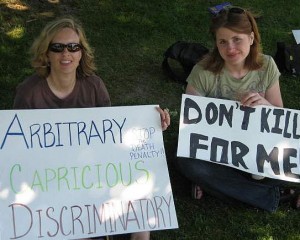
- I believe in my lifetime we will see the end of the death penalty in this country.
- It’s just an amazing system that we have where the courts will say – yes you’ve got compelling evidence of innocence but we’re not going to hear your case.
- I would say what got me through was the victories.
- Presently, I’m working with an attorney Jim Green, who’s a prominent civil rights attorney in West Palm Beach, kind of a legend down here.
- I also some volunteer work with El Sol. It’s a day laborer center in Jupiter, Florida.
Guest – Anne O’Berry, National Lawyers Guild’s Regional Vice President for the Southern Region and a member of the Guild’s South Florida chapter. She obtained her undergraduate degree from the University of Pennsylvania in 1983 and her law degree from New York University Law School in 1986. While in law school, she served as Director of the Women in Prison Project at Rikers Island, where she taught incarcerated women how to prevent termination of their parental rights. She was a member of the law school’s civil rights clinic and an editor on one of the law school’s journals, and authored a law review article on prisoners’ rights. During and after law school, she clerked for federal judges in New York, New Jersey and Pennsylvania, including Judge A. Leon Higginbotham, Jr. of the U.S. Court of Appeals in Philadelphia, with whom she co-authored an article on the law as a tool of oppression against slaves and free blacks in pre-Civil War Virginia and taught civil rights and South African apartheid law at the University of Pennsylvania. She later taught Race and the Law at St. Thomas University Law School in Miami, Florida.
Law and Disorder November 6, 2017
Podcast: Play in new window | Download
Special Prosecutor Mueller Indictments
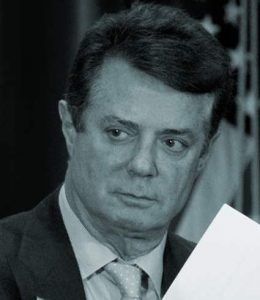
Paul Manafort, who had been Donald Trump’s campaign manager, was indicted last week by special prosecutor Mueller for 12 counts of money laundering involving at least $18 million, setting up a secret overseas bank accounts through which $75 million flowed, lying to federal authorities and operating as an unregistered foreign agent for the president of the Ukraine, tax evasion, and conspiracy. Also indicted was his colleague Rick Gates.
Manafort was a Washington insider. He graduated from Georgetown Law School and went on to work for Gerald Ford and Ronald Reagan. He then became, by his own description, an influence peddler. He was a political adviser to the vicious dictatorships of Marcos in the Philippines and Mobuto in Zaire helping them avoid trouble with the United States. He made millions of dollars advising the elected head of the government of Ukraine before he was overthrown in a coup approved and supported by the United States, in particular Secretary of State Hillary Clinton who held that position under the Obama administration before she ran for president.
Along with the indictments, it was disclosed that George Papadopoulos, a former volunteer adviser to Trump during his campaign, had pled guilty to lying to the FBI about having ties with the Russians and was cooperating with the prosecution. He had urged Trump to meet with Russian officials.
Guest – Ray McGovern, an alumnus of Fordham and was a high-ranking CIA analyst for 27 years. His expertise was Russia and he had one on one briefings daily with President George Bush. He broke with the government under George W. Bush over the cooked intelligence used to rationalize America’s illegal war of aggression against Iraq and helped form the organization Veteran Intelligence Professionals for Sanity. His group issued a memorandum to President Obama which demonstrated that the Russians did not hack into the computers of the Democratic Party or Hillary Clinton and did not therefore influence the American election. http://raymcgovern.com/
—-
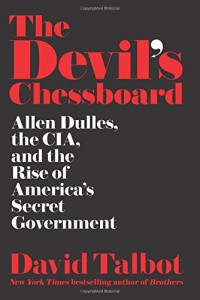
The Devil’s Chessboard: Allen Dulles, the CIA, and the Rise of America’s Secret Government
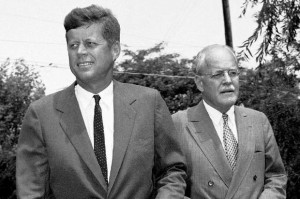
The assassination of President John Fitzgerald Kennedy on November 22, 1963, 54 years ago, was a turning point in American and world history. The official story has been put forward in the Warren Commission Report. It stated that Lee Harvey Oswald was the lone assassin and that there was no conspiracy. The official story has been widely debunked: it is not believed by some 60% of the American people.
Oliver Stone’s 1991 movie JFK led to the reopening of the investigation by a Committee of the US House of Representatives. The committee concluded that there was a conspiracy. They passed a law, signed in 1992 by President George HW Bush, which called for the release of all remaining intelligence files on the assassination by October 26, 2017. Last week some of the remaining documents were released. Those documents must be released within six months unless President Trump decides not to. The intelligence agencies have a say in what further documents will be released but it is President Trump’s decision. It is not believed that the release of the documents will contradict the official story that Lee Harvey Oswald was the loan assassin and there was no conspiracy.
James R. Douglas wrote the definitive book on the Kennedy assassination, demonstrating conclusively that was the work of the CIA. Why? Because the intelligence agency wanted to stop Kennedy from withdrawing American troops from the Vietnam war and he wanted and was working towards a peaceful resolution of the cold war with respect to American policy towards both the Soviet Union and Cuba.
Guest – David Talbot, the author of the New York Times bestseller Brothers: The Hidden History of the Kennedy Years and the acclaimed national bestseller Season of the Witch: Enchantment, Terror, and Deliverance in the City of Love. He is the founder and former editor in chief of Salon, and was a senior editor at Mother Jones and the features editor at the San Francisco Examiner. He has written for The New Yorker, Rolling Stone, Time, The Guardian, and other major publications. Talbot lives in San Francisco, California.
——————————————————-