Welcome to Law and Disorder Radio
Law and Disorder is a weekly independent civil liberties radio program airing on more than 150 stations and on Apple podcast. Law and Disorder provides timely legal perspectives on issues concerning civil liberties, privacy, right to dissent and practices of torture exercised by the US government and private corporations.
Law and Disorder August 28, 2017
Podcast: Play in new window | Download
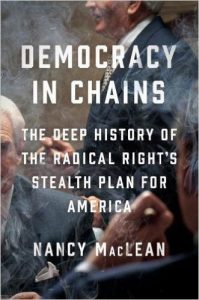
Democracy in Chains: The Deep History of the Radical Right’s Stealth Plan for America
The spectacle of President Donald Trump and the palace intrigue in the White House has served daily to distract people from the political strategy and accomplishments of the radical right, which is taking over the Republican Party.
Over time, the GOP has been transformed into operation conducting a concerted effort to curb democratic rule in favor of capitalist interests in every branch of government, whatever the consequences. It is marching ever closer to the ultimate goal of reshaping the Constitution to protect monied interests. This gradual take over of a major political party happened steadily, over several decades, and often in plain sight.
Duke University Professor Nancy MacLean exposes the architecture of this change and it’s ultimate aim. She has written that “both my research and my observations as a citizen lead me to believe American democracy is in peril”.
Guest – Professor Nancy MacLean, whose new book, Democracy in Chains: The Deep History of the Radical Right’s Stealth Plan for America, has been described by Publishers Weekly as “a thoroughly researched and gripping narrative… [and] a feat of American intellectual and political history.” Booklist called it “perhaps the best explanation to date of the roots of the political divide that threatens to irrevocably alter American government.” The author of four other books, including Freedom is Not Enough: The Opening of the American Workplace (2006) called by the Chicago Tribune “contemporary history at its best,” and Behind the Mask of Chivalry: The Making of the Second Ku Klux Klan, named a New York Times “noteworthy” book of 1994, MacLean is the William H. Chafe Professor of History and Public Policy.
——
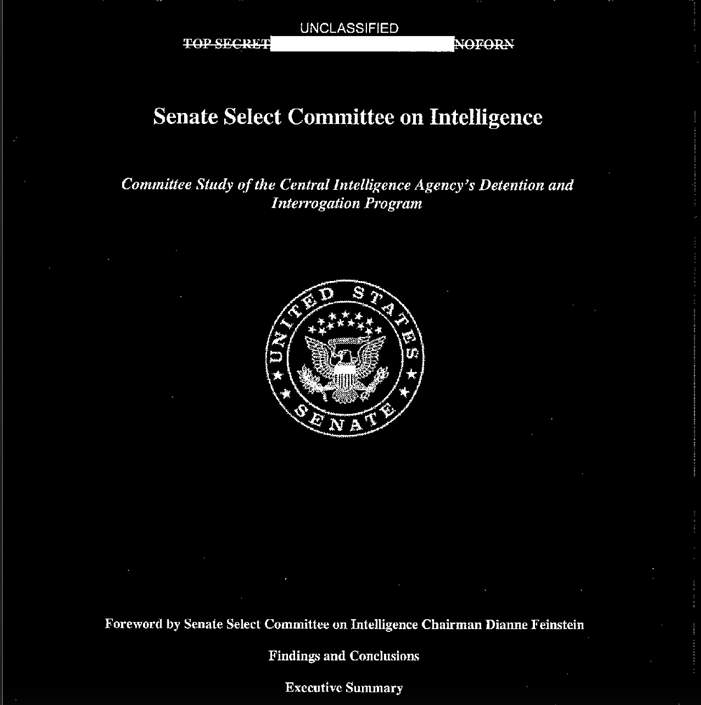
Senate Intelligence Committee Torture Report: Attorney Scott Horton
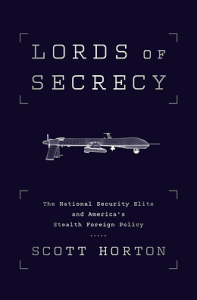
Guantanamo suicides, CIA interrogation techniques, CIA ordered physicians who violate the Hippocratic oath, are topics of some recent articles by returning guest attorney Scott Horton. Last month, he was on Democracy Now to debate former CIA General Counsel John Rizzo on the question of declassifying a Senate Select Committee on Intelligence report about the agency’s secret detention and interrogation programs. His book Lords of Secrecy The National Security Elite and America’s Stealth Foreign Policy will be published January 2015.
Attorney Scott Horton:
- I think the results flow directly from the media coverage (ABC poll on Torture report)
- Now major publications and broadcasters that hedged using the word torture have stopped doing that. There are only a handful of media sources that won’t do it. NPR being one of them.
- The media also presents roughly twice as much time devoted to people justifying the use of torture techniques to those criticizing it.
- Barack Obama who should lead the push back has gone completely silent. It’s beyond silent he talked about “tortured some folks” making it very casual, and then he said the torturers were patriots.
- I thought it was electrifying reading. 90 percent of it I’ve heard about before and still when you read them in this clinical, plain, highly factual style and things were developed with a continuous flow with lots of background in decision making in Washington at the top and how all this effected what happened on the ground.
- As a consumer of Congressional reports this probably the single most impressive Congressional oversight report I’ve ever seen.
- It’s an excellent example of what the oversight committee should be doing all the time.
- They’re doing this with respect to a program which was essentially or very largely wrapped up by October 2006.
- We’re talking about 8 1/2 years ago.
- They’re only able to do this kind of review in any depth when its historical, not when its real time oversight, that’s disappointing.
- One thing that emerges from looking at these reports and the military reports is that there is a huge black hole which has never been fully developed and explored and that’s JSOC, its the military intelligence side.
- That escaped review within the DOD process and it escaped review in CIA process and its clear that there’s a huge amount there.
- I certainly don’t expect prosecutions to emerge for the next couple of years in the United States, but I see a process setting in that may eventually lead to prosecutions.
- On the one hand we’re seeing a dangerous deterioration in relations with Russia, is an aggressor, which has seized territory in the heart of Europe, is waging a thinly veiled war on one of its neighbors. That is very unnerving to the major NATO powers.
- On the other hand there’s never been a period in the history of the alliance when there is so much upset at the United States.
- That’s come largely from the rise of the surveillance state and the role of the NSA.
- I was looking at this report, and we know that in 2006, there was an internal review that led the CIA to conclude that these interrogation techniques were ineffective and the CIA internally decided to seek a large part of the authority for EIT’s and operation of black sites rescinded.
- Another thing that’s very important here from this report, it tells us that Michael Hayden, George Tenant, Porter Goss and other very senior people at the CIA repeatedly intervened to block any form of punishment of people who are involved with torture and running the black sites.
- That’s important because of the legal document Command Responsibility. The law says when command authority makes a decision not to prosecute and immunize people involved with torture and abuse, that results in the culpability of these crimes migrating up the chain of command.
- I interviewed CIA agents who were involved in this program, and they told me they’ve all been brought out by legal counsels office and told – they may not leave the country.
- That means you’ve got roughly 150 CIA agents, including many people near the top of the agency who can’t travel right now.
- Lords of Secrecy The National Security Elite and America’s Stealth Foreign Policy
Guest – Scott Horton, human rights lawyer and contributing editor to Harper’s Magazine. Scott’s column – No Comment. He graduated Texas Law School in Austin with a JD and was a partner in a large New York law firm, Patterson Belknap Webb & Tyler. His new book Lords of Secrecy The National Security Elite and America’s Stealth Foreign Policy.
Law and Disorder August 21, 2017
Podcast: Play in new window | Download
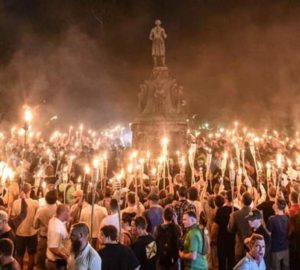
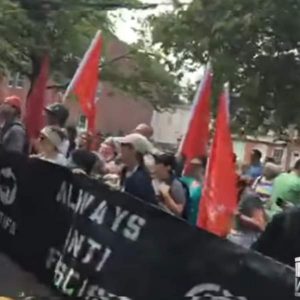
Charlottesville, VA Protests Clash: Analysis
Donald Trump and extreme right supporters, outright fascists, white nationalists – suffered a huge defeat Saturday, August 12 in Charlotteville Virginia at a rally called Unite The Right. Anti-fascist demonstrator 32-year-old Charlottesville paralegal Heather Heyerdahl was murdered when a car driven by a Nazi sympathizer from Ohio ran into her. Nineteen other counter-demonstrators were injured, some of them seriously.
As a consequence of the murder and injuries the fascists and white nationalists were socially isolated even as the United Left welcomed support from a large swath of Americans. Demonstrations were held in many cities and towns across the country.
People jeered Trump at his first New York City homecoming. Hundreds gathered at Trump Tower which was protected by police and twelve garbage trucks. During his campaign Trump clearly refused to disavow ultra-right wing support. After the murder he condemned the violence in Charlottesville laying blame on many sides.
Some 500 fascist and white nationalist forces came together in Charlottesville with the intention on violently suppressing their opponents. They unified around their support of keeping a statue of Confederate General and slave owner Robert E Lee who led the Southern Army from 1861 until 1865 when he finally surrendered to Union General Ulysses S. Grant at Appomattox, Maryland. The South had lost its fight to preserve slavery. More than 600,000 Americans died in this war, more than the combined total of all deaths in all subsequent wars. The ultra-right still embraces this lost cause.
Guest – Jeffrey Fogel, a Charlottesville attorney who has practiced criminal law for many years. He served as Legal Director at the Center for Constitutional Rights before moving to Charlottesville, VA where he recently ran for District Attorney. He was on the scene as a National Lawyers Guild attorney on August 12, 2017.
Guest – Jon Kurinsky is a Chicago activist, he recently gave a speech on the topic of fighting the right at the Socialism 2017 conference in Chicago which had a record attendance of more than 2000 people.
—-


North Korea, the United States, China and Nuclear Weapons
President Donald Trump scared the hell out of us last week with his threat to nuclear bomb North Korea. He promised fire and fury like the world has never seen. He said this at the time of the 72nd anniversary of the US nuclear bombing of the Japanese city of Hiroshima and then, six days later, the Japanese city of Nagasaki. This was done, not to stop the war, which was coming to an end, but to scare the Russians.
These two bombings killed some 160,000 persons instantaneously and tens of thousands died later of nuclear poisoning. So far, this has been the only time nuclear bombs have ever been used.
That United States had previously been at war with North Korea from 1950 to 1953. More than 3 million North Koreans were killed and the country laid to waste. The war never ended, but an armistice was signed in 1953.
North Korea begin its nuclear program in self-defense after George W. Bush in 2004 named it along with Iraq and Iran as part of “the axis of evil.” Then Bush started the war against Iraq, captured and executed it’s leader Saddam Hussein, and destroyed a viable country killing over 1 million people and scattering refugees across the world.
Guest – Richard Becker is the Western Regional Coordinator of the A.N.S.W.E.R.-Act Now to Stop War and End Racism-Coalition. Becker has been a key organizer of many marches, rallies and public forums sponsored by the A.N.S.W.E.R. Coalition opposing U.S., wars, occupations and sanctions against Iraq, Afghanistan, Palestine, Cuba, Venezuela, Syria, Libya and other countries. Becker is the author of Palestine, Israel and the U.S. Empire, published in 2009. He has visited the Middle East on numerous delegations since 1986, including trips to Palestine, Iraq and Syria. Becker represented the ANSWER Coalition in conferences on Palestinian political prisoners in Lebanon in 2014 and Tunisia in 2016. Recent article in the Liberation.
Law and Disorder August 14, 2017
Podcast: Play in new window | Download


U.S. Employees Agree To Be Microchipped
In 2003, 500 of the largest corporations planned to quietly replace universal product codes or barcodes with tiny Radio Frequency IDentifcation (RFID) microchips, creating the Electronic Product Code or EPC. RFID is a technology that tracks items silently and invisibly by radio waves. Over the years, we’ve reported about how RFID chips embedded in consumer products might be used to track people through the things they wear and carry since radio waves travel right through solid objects and can communicate with reading devices that can be hidden almost anywhere.
Corporations have already started embedding RFID microchips into consumer products for many reasons including shipping, inventory and marketing. Some companies have also been very interested in embedding RFID microchips into human flesh.
Years ago, Applied Digital Solutions tried to sell its “Verichip” human implant as a way to store medical information in people–and even to track senior citizens and corpses. Concerned citizens decried the privacy and security issues, forcing name changes and even the selling off of its human chipping business.
Microchip companies with new names and marketing angles are at it again. Recently, fifty employees with the snack kiosk company Three Square Market in Wisconsin agreed to have a microchip embedded into their flesh.
Guest – Liz McIntyre, a consumer privacy expert who is coauthor of a series of books about the societal implications of microchip tracking technology, including Spychips: How Major Corporations and Government Plan to Track your Every Purchase and Watch Your Every Move. She also promotes privacy as a consultant with the search engine StartPage.com
—-
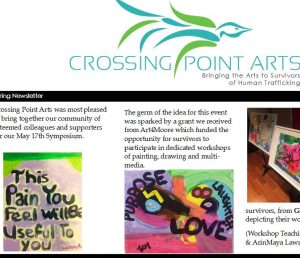

PTSD Therapy For Human Trafficking Survivors
Nearly all survivors of human trafficking are affected by post traumatic stress syndrome and have difficulty assimilating back into the society. Most have managed to silently cope with the emotional and physical trauma of their past. The New York-based organization Crossing Point Arts was created help survivors heal through the arts, including singing, creative art and poetry.
The group provides free art workshops supervised by Creative Arts Therapists. The strategy is based on providing learn long-term coping mechanisms and better manage their PTSD symptoms.
Crossing Point Arts has reached nearly 2,000 survivors in art workshops. The workshops are held on the premises of local anti-trafficking agencies as part of a comprehensive program for survivors, which includes housing, legal and medical assistance, traditional therapy, educational guidance and a range of emotional support.
Guest – Anne Pollack is the Crossing Point Arts founder and executive director. Anne is a musician, visual artist, writer, student of dance and an activist. YourFluteWorks
—————————————————