Welcome to Law and Disorder Radio
Law and Disorder is a weekly independent civil liberties radio program airing on more than 150 stations and on Apple podcast. Law and Disorder provides timely legal perspectives on issues concerning civil liberties, privacy, right to dissent and practices of torture exercised by the US government and private corporations.
Law and Disorder June 16, 2014
Podcast: Play in new window | Download
Updates:
- Michael Ratner: Sunni Muslims Have Taken Mosul, Second Biggest City In Iraq
- Judge Rules That California Teacher Tenure Laws Deprive Students Of Education
- Imagine: Living In A Socialist U.S.A. Book Event- NYC Public Library June 23 6:30PM
——–

The Electronic Privacy Information Center, The NSA, FOIA Requests, And Wikileaks
The Electronic Privacy Information Center or EPIC is among a handful of organizations trying to reveal the massive surveillance of the National Security Agency. We talk about a few of EPIC’s most important cases being litigated that you may not have heard about. EPIC had filed a massive FOIA request on behalf of Wikileaks to the Criminal and National Security Divisions of the Department of Justice, and to the FBI asking for multiple records including any individuals targeted for surveillance for support for or interest in WikiLeaks. We talk about that and their lawsuit involving the NSA not being subject to FOIA requests plus a victory involving the Department of Homeland Security’s ability to deactivate wireless communications networks in a crisis.
- The FOIA requests we made five years ago for the NSA Cybersecurity Authority was a request that we sent to the NSA, litigated in the district court and on appeal in the DC Circuit last Friday just a few days before the government’s brief was due, they contacted us and said they were disclosing to us the document we had been trying to obtain.
- This is National Security Presidential Directive 54 and that outlines all the cyber security authorities for the federal agencies.
- The scope of our work is very much driven by our mission. Our mission is to focus public attention on emerging privacy and civil liberties issues.
- The FBI wants to put together the next generation identification system which will be the largest biometric database in the world and we think the implications for privacy and freedom are just staggering.
- Google also retains everybody’s search histories.
- We also do a lot of open government litigation so people can learn about these issues and we do a lot of amicus briefs.
- In our organization there’s actually deep division about Wikileaks. Some people think Julian Assange is a hero and some people would like to see him arrested.
- What was interesting to us about the Wikileaks case – we did see a persons of expressions of support for Wikileaks as core First Amendment speech.
- We became very interested through the FOIA with how the federal government was apparently intervening with private companies, bank payment companies, cloud service providers and others to try to chill the ability of Wikileaks supporters to contribute to the organization, to get access to hosted documents.
- We simply believe it was wrong for the government to simply discourage people their support or even their opposition.
- With the FOIA, one of the things you’re trying to do is get information out to the public and hope that others find that its useful.
- We think its a fundamental obligation for any internet company that collects personal data to stand up to the government when there are court orders.
- Our other case in the DC Circuit – this concerns a technique used in San Francisco basically to shut down cell phone service among people who had gathered at a protest to object to the police conduct that I think resulted in the death of a person on the BART system.
- Pursuant to a secret policy known as Standard Operating Protocol 303, somehow the Department of Homeland Security got the local telephone service to shut down cell phone service in the region and people couldn’t communicate and the protest was effectively stopped.
- Our FOIA request was for the policy which we think has to be made public. You can’t have a secret procedure that so deeply implicates First Amendment freedoms.
- We went laser focused after that one document and the DHS was throwing up all these law enforcement exemptions, 7E and 7F involving techniques and methods saying this was vitally important to protect public safety which was an interesting argument too.
- Submit FOIA requests – if a government agency has a reason to withhold a record, the burden is on the agency to justify the reason for the withholding.
Guest – Attorney Marc Rotenburg, Executive Director of the Electronic Privacy Information Center (EPIC) in Washington, DC. He teaches information privacy law at Georgetown University Law Center and has testified before Congress on many issues, including access to information, encryption policy, consumer protection, computer security, and communications privacy. He testified before the 9-11 Commission on “Security and Liberty: Protecting Privacy, Preventing Terrorism.” He has served on several national and international advisory panels, including the expert panels on Cryptography Policy and Computer Security for the OECD, the Legal Experts on Cyberspace Law for UNESCO, and the Countering Spam program of the ITU.
—–
Hundreds of California Prisoners in Isolation to Join Class Action Lawsuit
Last year we spoke with attorney Jules Lobel about his lawsuit challenging long term solitary confinement in California prisons. Recently, a federal judge in Oakland California ruled to agree to consider as part of that lawsuit if long term isolation violates a prisoners’ Eighth Amendment rights. Prisoners in prolonged solitary confinement at Pelican Bay prison can spend 22 to 24 hours a day in a cramped, concrete windowless cell. Mostly, they’re there for their alleged connection to gangs and their refusal to become government informants.
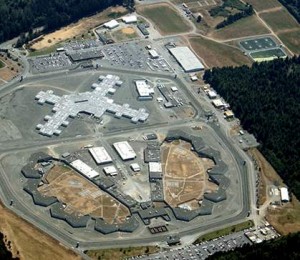
- Pelican Bay is a prison that holds over 1000 prisoners. It’s located on one of the most isolated sections of the United States coast line border between California and Oregon.
- It was deliberately placed there because most of the prisoners are from Los Angeles.
- It’s very hard for their friends and family to visit them.
- They spend virtually their whole day in an 80 square foot cell with no window.
- They virtually get no visitors, they can’t make any phone calls. They’re fairly isolated from the outside world and from each other.
- Many of my clients have been in this kind of cell for over a decade.
- California estimates there are about 225 that have been there for over a decade.
- A number of my clients have been there for over 2 decades.
- California puts them there not because they’ve done anything violent in prison, or in some cases they haven’t done anything violent outside of prison . . mainly drug offenses . . . but because they have an association could be very loose, could be because of having a tattoo or a piece of art work which suggests you’re in some way associated with a gang.
- The only way out was to become an informant and then you and your family were in grave danger of being killed or assaulted by the gang.
- Recently in California after 3 hunger strikes, pressure from the lawsuit, pressure from the legislature, has instituted some reforms so there are for some of the people a way at least to another solitaire prison or the general population.
- They come up for review once every six years in the system that’s currently in place.
- The Ninth Circuit court has said anything over 1 year is too long for reviews.
- There have been hundreds of law suits challenging various aspects of this situation in Pelican Bay, from the due process to they’re not given any chance to prove that they can get to its cruel and unusual punishment to keep people in there for 10-15-20 years.
- Now for the first time the judge has said I’m going to take this as a class action which means I’m going to look at the general policies that California is instituting and if we were to win, try to change the system.
- Our argument is that these conditions are cruel and unusual to keep people in for this long of time.
- We said we need to meet with all of our clients all together. We can’t meet with one individual then another individual.
- The state said that’s impossible, these people are so dangerous you can’t possibly meet with them all together, but the judge ordered it.
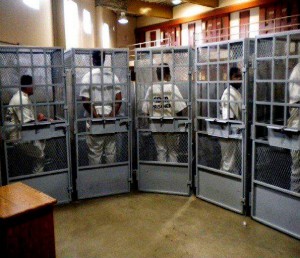
- We got a meeting, if you can imagine the cell that Hannibal was in? They put 10 of these cages side by side, and they put us in a big conference room. They mandated that we had to wear flak jackets. We were seated at a table with Marine outfits.
- What it really is is to force these guys to become informants, to make it as cruel as possible and the only way out is to become an informant.
- It essentially alters your personality. You die a social death.
- Our case, if we were to win would be the beginning of the death knell of solitary confinement in this country.
- 80 thousand prisoners as we speak are in some form of solitary in this country.
- One of the things about this case is that it requires substantial funding and we’re always looking for people to help with funding the case.
Guest – Attorney Jules Lobel, has litigated important issues regarding the application of international law in the U.S. courts. In the late 1980’s, he advised the Nicaraguan government on the development of its first democratic constitution, and has also advised the Burundi government on constitutional law issues. Professor Lobel is editor of a text on civil rights litigation and of a collection of essays on the U.S. Constitution, A Less Than Perfect Union (Monthly Review Press, 1988). He is author of numerous articles on international law, foreign affairs, and the U.S. Constitution in publications including Yale Law Journal, Harvard International Law Journal, Cornell Law Review, and Virginia Law Review. He is a member of the American Society of International Law.
——————————————————————-
Law and Disorder June 9, 2014
Podcast: Play in new window | Download
Updates:
- Michael Ratner: Guantanamo Bay Prisoner Exchange
- Five Taliban In Exchange For A U.S. Prisoner Held In Afghanistan
- 149 Detainees Left In Guantanamo Prison – 88 Cleared For Release
- Michael Smith Reports Back On Highlights At the 2014 Left Forum
——
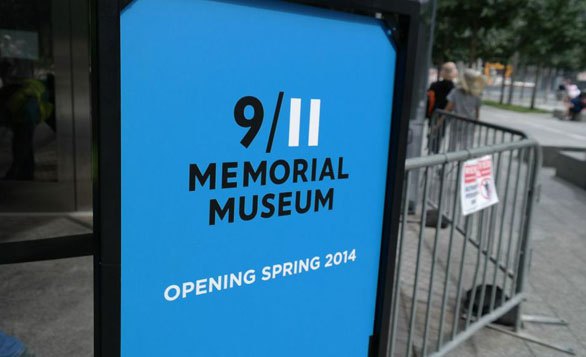
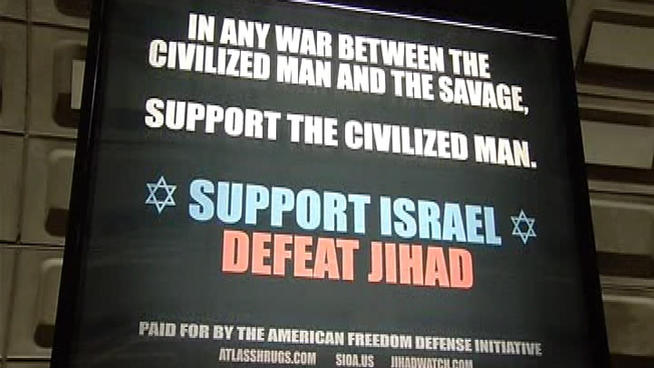
9/11 Memorial Museum Protests
There were many protests during the official opening of the 911 Memorial Museum. Muslim communities and other groups have voiced concern about the film in the musuem titled “The Rise of Al-Qaeda” and how it fails to adequately discern between Al-Qaeda and those of the Islamic faith. Meanwhile, the museum’s official response is that the film is objectively telling the story of what happened.
- We came together because of a concern about a video they were showing called The Rise of al-Qaeda. It’s a 7 minute documentary and the concern is about the problematic language that its using. It makes it seem as if the acts of 9-11 are equated with Islam.
- Our feeling is that the film needs to be edited and could exacerbate an already anti-Muslim climate.
- Quoting criticism – The film in its current state presented risks that visitors would assign collective responsibility for September 11th to Islam and all Muslims.
- There’s a historian Todd Fine who says its an inconsistent array of terminology that gets carelessly thrown around with little concern for the harmful impact it can have on people.
- The video didn’t do enough to separate al-Qaeda from Islam and from mainstream Islam. It’s reckless.
- Despite the fact that the own museum’s own advisory board was instantly concerned when they saw the film and said it should be reviewed and edited – despite the fact that 400 scholars wrote letters saying it contains problematic and contested terminology that conflates terrorism with Islam – and despite the fact that leaders from so many different inter-faith communities have spoken out about this – that the museum continues to stand by its decision not to edit the video – is astonishing.
- I was doing a little research on her (Debra Burlingame-on 911 Memorial Museum Board of Directors) and there’s a high number of racist quotes she’s said. “Islam’s a transnational threat.”
- Millions and millions of people will be going to this museum and museums can have a big impact.
- We have to remember that this is in the context not of a society that welcomes and embraces the Muslim community but one that’s surveilling the Muslim community.
- It’s feeding into this notion that all Muslims are responsible for the acts of a few individuals.
- This video also feeds into police surveillance because what do they say? After 911 we have to be more vigilant and that means surveilling an entire community.
- Communities are coming together and speaking out, including about this video.
- We have to change the structures that enable this to happen. The Islamophobes are really problematic and have connections to some of the institutions.
- We have to make sure our institutions are fomenting Islamophobia.
- Book – Islamophobia and Israel by Elly Bulkin and Donna Nevel
- We wanted to analyze the intersection of Islamophobia and Israeli politics and to look at the way the “war on terror” impacts both. Also to raise an issue that’s basically taboo in the Jewish community as well as outside the Jewish community.
- We have 4 different areas that we look at. Our lengthiest area is “follow the money” where you basically see how connected the Islamophobes are with right-wing Israel crowd, the settlement movement and others as well.
- Jews Against Islamophobia / Jews Say No / Jewish Voices For Peace / Jews For Racial and Economic Justice
- Contact Donna Nevel – denevel(at)gmail(dot).com
Guest – Donna Nevel, a community psychologist, educator, and writer whose work is rooted in Participatory Action Research (PAR) and popular education. Co-author with Elly Bulkin of Islamophobia and Israel. She has been involved with a wide range of organizing efforts to challenge segregation and inequality and further equity and racial justice in public education. She has also been a long-time organizer for Palestinian-Israeli peace and justice and works with groups to challenge Islamophobia and anti-Arab racism.
——
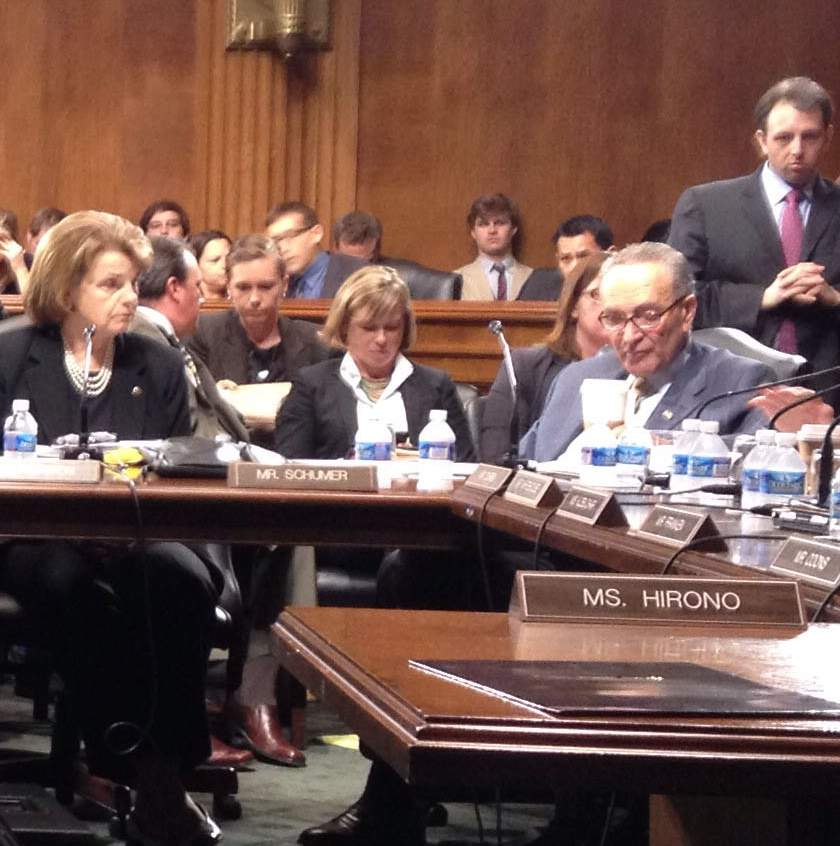
Free Flow of Information Act (Journalist Shield Law)
Current shield laws for journalists in the United States have broad exceptions for national security. This means that a prosecutor can override the law by showing how the information sought would “materially assist” the government in “preventing” or “mitigating” an act of terrorism. Initially, the shield law is set up to provide a confidentiality privilege for journalists so a police officer or FBI agent can’t get that information even with a court order unless there is an unusually strong justification for it. The latest version of the shield law as of September 2013 has a clause telling judges that it only covers legitimate news gathering. This of course makes very easy to declare any kind of news gathering you don’t like as illegitimate, and therefore the sources are not protected. Last month, the House of Representatives voted to approve an amendment to an appropriations bill barring the Justice Department from compelling reporters to testify about confidential sources.
- We are going to get a shield law but its going to be one that doesn’t protect any journalists or sources.
- It’s a lot easier for the FBI and the DOJ to just skip the investigation and go straight to the reporters. Why do they have to any work when they have the journalist getting all the sources for them.
- They subpoenaed records from the Associated Press last summer, they subpoenaed the source for James Risen who wrote a book and that actually appeared before the 4th Circuit of Appeals and was turned down by the Supreme Court for review.
- There’s been a push to try and pass a shield law before but Obama back in 2009 said he wouldn’t let any shield law pass that didn’t have a big national security exemption.
- What happened back in September is that there was a massive compromise with 2 Senators, Diane Feinstein from California and Dick Durbin from Illinois. They wouldn’t let this law go through unless it contained a big national security exception. Meaning any reporter covering national security would have to disclose their sources, and second it had a big exclusion for wikileaks and other organizations that published leaks.
- There’s actually a balancing test as part of this law that tells judges to consider if a journalist is engaged in legitimate news gathering. This is problematic because anyone can be a journalist, this has been the case since the founding of this country.
- They’re trying to put into law the fact that some journalists are legitimate and some are illegitimate.
- The internet has brought this country back to the time of its founding in terms of journalism because when the “press clause” in the First Amendment were passed, anyone could be a journalist.
- The “press clause” was defined as the right to publish.
- I believe we do need shield laws, but not this shield law.
- I think there is a big push by the institutional media to keep journalism as a profession, but that’s not what journalism is. Now with the internet, anyone can publish. As long as anyone as the intention to disseminate information, they should be protected as a journalist.
- When it helps the government the definition of the media is very broad.
- It’s going to be political suicide if Holder or anyone from the Obama administration pushes to send James Risen to jail.
- The DOJ argued in an affidavit that James Rosen was aiding and abetting his source.
- More and more, we’re seeing this administration trying to frame the news gatherer and the source, not as a journalist and a source but as criminals in a conspiracy.
- I was a radio journalist for 3 years. I used to work at the Center for Constitutional Rights where I met Michael Ratner and was involved with Chelsea Manning’s trial.
Guest – Carey Shenkman, has worked with several legal teams including Chelsea Manning’s defense, and legal research defining the protection of new media under the Bill of Rights and The U.S. Constitution.
——————————————————————————————
Law and Disorder June 2, 2014
Podcast: Play in new window | Download
Updates:
- Wikileaks Reveals The Other Country NSA Surveilled All Content: Media Blackout
- U.S. Government Can Destroy People: Informant Sabu (Hector Xavier Monsegur) And Jeremy Hammond
- Remembering League of Revolutionary Black Workers Founder General Gordon Baker Jr.
- Read General’s Letter To The Detroit Draft Board
- Michael Ratner Resigns From Brandeis University
- International Advisory BoardMichael Ratner’s Open Letter To Brandeis University President Published In Forward Thinking
- Coalition of Imokalee Workers Demonstrations In Columbus, Ohio
- Glenn Greenwald Nowhere To Hide Book Tour -Ticket Give Away – Listen To Answer Question
- We Have 5 Tickets In Each City To Give Away
- Dates City
June 17, 2014 Seattle, WA
June 18, 2014 San Francisco, CA
June 19, 2014 Los Angeles, CA
June 21, 2014 San Diego, CA
June 23, 2014 New York, NY
June 26, 2014 Rosemont, IL
——
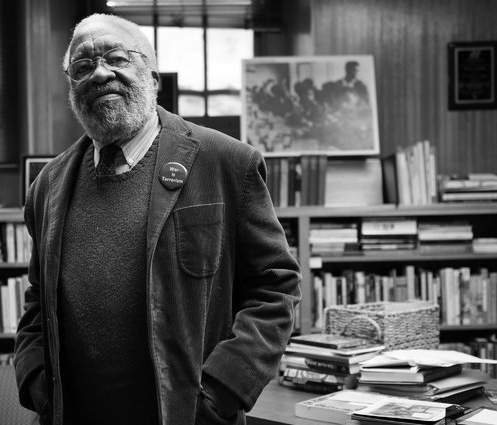
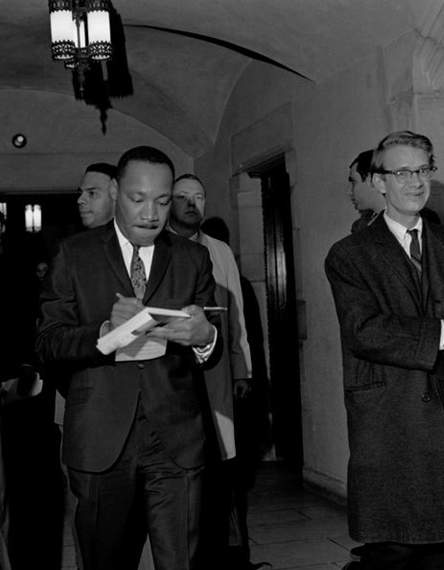
Remembering Dr. Vincent Harding
Last month pioneering historian, theologian and civil rights activist Dr. Vincent Harding had died at the age of 82. Harding was a close adviser to Dr. Martin Luther King Jr. and wrote King’s famous antiwar speech, “Beyond Vietnam: A Time to Break the Silence.” King delivered the address at Riverside Church in New York City on April 4, 1967.
After King was assassinated, Harding became the first director of the Martin Luther King Jr. Memorial Center and of the Institute of the Black World. He later became Professor of Religion and Social Transformation at Iliff School of Theology in Denver. After serving in the Army for several years Harding became a pacifist and later served as co-chairperson of the social unity group the Veterans of Hope Project. He’s the author numerous books including There Is A River and Wade in the Water: The Wisdom of the Spirituals.
- Vincent was sometimes called by black activists across the continent, the gentle giant.
- Giant, not because of his physical size but because of intellectual stature.
- Last summer we did a conference together speaking to a national conference of Quakers.
- He was an incredibly soft-spoken and gentle person, yet could be so absolutely incisive in his quiet comments.
- He was so persuasive that everyone had to pay attention to him.
- On campus he was either in the midst of a student group trying to quietly cajole them into activism themselves or once the students became activists, he was one of the few faculty that was right there with students walking them through that activism.
- Every thing in that speech (Beyond Vietnam) is a part of what Vincent lived every day.
- He was in the Army during the Korean War and became a convert to Gandhi and non-violence theory.
- His participation to bringing me to Iliff was a clear signal that he was one of those civil rights warriors who was not satisfied with interpreting the civil rights struggle as a black and white issue.
- When we engaged in protest on the streets of Denver, beginning around 1989, getting ready for the 1992 Columbian Quinscentenary, we had Iliff students who would come out with the American Indian Movement of Colorado to help us protest what we always framed as state supported hate speech.
- We were never against Italians celebrating their heritage but its the fact that Columbus Day is a federal holiday. It’s a federal celebration then, of the genocide of Indian people.
- About a year and a half ago he joined Jewish activists and African American activists on a trip to Palestine, the West Bank. He came back deeply affected.
- He immediately began to see the deep deep connection between the Palestinian struggle for freedom and American Indians on this continent.
- We’re seeing it still today, US foreign policy is characterized by violence and the threat of violence and if not military violence, economic violence.
- Vincent and Dr. King were men of conscience who once they understood the truth in Vietnam could not help but speak to it.
- 18 year old kids don’t have the clear reading of history to fall back on their decision making. (military)
- His passing is a passing of an era marked by the passing of Maya Angelou. It deeply deeply saddened me because I was hoping this next month to have lunch with him.
Guest – Dr. George Tinker, a colleague of Dr. Vincent Harding at the IIliff School of Theology. Dr. Tinker. He teaches courses in American Indian cultures, history, and religious traditions; cross-cultural and Third-World theologies; and justice and peace studies and is a frequent speaker on these topics both in the U.S. and internationally. teaches courses in American Indian cultures, history, and religious traditions; cross-cultural and Third-World theologies; and justice and peace studies and is a frequent speaker on these topics both in the U.S. and internationally. His publications include American Indian Liberation: A Theology of Sovereignty (2008); Spirit and Resistance: Political Theology and American Indian Liberation (2004); and Missionary Conquest: The Gospel and Native American Genocide (1993). He co-authored A Native American Theology (2001); and he is co-editor of Native Voices: American Indian Identity and Resistance (2003), and Fortress Press’ Peoples’ Bible (2008).
———————————————————————————–

Please help support Law and Disorder, the show is now a sponsored project of Fractured Atlas, a non-profit arts service organization. Contributions for the charitable purposes of Law and Disorder must be made payable to Fractured Atlas only and are tax-deductible to the extent permitted by law.