Welcome to Law and Disorder Radio
Law and Disorder is a weekly independent civil liberties radio program airing on more than 150 stations and on Apple podcast. Law and Disorder provides timely legal perspectives on issues concerning civil liberties, privacy, right to dissent and practices of torture exercised by the US government and private corporations.
Law and Disorder February 24, 2014
Podcast: Play in new window | Download
Updates:
- The Intercept: Snowden Documents Reveal Covert Surveillance and Pressure Tactics Aimed at WikiLeaks and Its Supporters.
- Michael Ratner: The Man Hunting Timeline
- NSA Had Monitored Wikileaks Online Visitors Building Metadata Tree
- Malicious Foreign Actor Document
- NSA Oks Economic Spying On Lawyers Giving Legal Advice To Indonesian Trade Deals
—-

The Drug War: Policing and U.S. Militarism at Home and Abroad
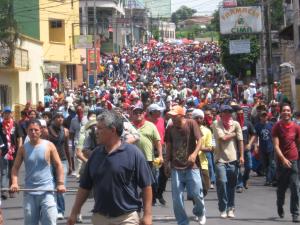
Last week the Center for Constitutional Rights hosted an event titled The Drug War: Policing and U.S. Militarism at Home and Abroad. We’re joined by one of the panelists David Vivar, he’s an author and scholar at National Autonomous University of Honduras at the Faculty of Political Science and International Relations of the University of Calabria. His work focuses on the U.S. cooperation in the Honduran military coup of 2009 and the centrality of drug trafficking to state power in Honduras. What you will hear in this interview is that the U.S. Drug War has not only fueled mass incarceration and discriminatory policing practices here in the U.S. but also supports violence and militarization throughout Latin America. We get the details of that and David’s strategies to resist the racist, and devastating war.
- It’s been constant that Congress asks to stop human rights violations.
- This goes all the way back to the simulation of the rule of law, to a democratic state.
- We have the highest murder rate in the whole world, and we have no war, not a consistent war declared except the war on drugs.
- We’re fighting a war that has turned the current conditions into a civil war.
- When you start having conflicts between drug lords, Mexican cartels and Colombian cartels – what do they do? They go to the space right in the middle, which is Central America and the northern triangle.
- Guatemala, Honduras and El Salvador have seen the consequences. We are the collateral damage.
- 79 percent of the cocaine that travels to the United States goes via Honduras. Basically what the Department of State is doing is investing money on kingpins and drug lords in the Honduran institutions.
- After the coup the military took back power and the U.S constantly supported this new democratic military civil alliance, which in the hand is what happened in Mexico.
- The (Honduran) military has drug lords of its own.
- Miguel Facusse is the most powerful man in Honduras. He’s got the Dinan Corporation which has African Palm plantations throughout the whole drug path.
- Basically the conflict around land is a failed agrarian reform.
- You have indigenous populations that lost their land. Their land was given to this man. The most powerful person, he gets the African Palm plantations which is the best place, as we know from wikileaks to establish small airports for aircraft to land there and deal with the drugs.
- The resistance is still in the streets against a lot of laws – the opening for business of the country – model cities and charter cities are something we’re fighting back in keeping our resources ours.
- The U.S. did cut off military aid for a short amount of time directly after the coup but instead of backing the movement from the Honduran civil society for reinstatement of President Zelaya – throughout that summer and fall there was a huge movement, the streets were filled with people calling for the reinstatement of their president – the United States instead pushed for new elections that fall which was what ended up happening.
- The elections were heavily boycotted by civil society yet the U.S. was the primary force in the region for supporting those elections.
- After those elections took place and Pepe Lobo is elected as president, the U.S. reinstated their support for the Honduran military and police, despite massive human rights violations that were taking place on an almost daily basis.
- You really have a very close relationship between the Honduran military and police and the U.S. government and military.
- There have known to be drug planes that have landed on his property (Miguel Facusse) We know that the U.S.State Department knows about that because of wikileaks and the U.S. goes on to have this cozy relationship with him and the political arm of Honduras that he runs in.
- The World Bank continues to fund him and give him subsidies for the African Palm plantations. Where is the interest in stopping the drugs if you’re working with this person who there are drug planes landing on his property.
- He has a private army basically. He has all these private security contractors that implicated in murders. The Center for Constitutional Rights has laid those out in a report to the International Criminal Court, naming Miguel Facusse as a criminal that needs to be prosecuted.
- The U.S. depends on the Honduran government to have a very friendly government in the region. We have a lot of military presence there, we have a lot of bases. It’s a relationship that depends on the repression of civil society throughout Honduras.
- There’s a massive resistance movement that has taken a lot of repression in the last four years. What’s going on with the drug wars, its very dark and scary but the other side is this movement that David is part of.
Guest – David Vivar, is a sociologist, currently a scholarship holder from the National Autonomous University of Honduras at the Faculty of Political Science and International Relations of the University of Calabria, where he studies dependence, international asymmetry and the division between center and periphery nations. His articles and essays analyze media discourse and public opinion; the representative intermediations of Honduran democracy, the influence of U.S. cooperation in the military coup of 2009 and the centrality of drug trafficking to state power in Honduras and its inextricable relation with the neoliberal impoverishment and the ongoing usurpation of democracy.
Guest – Laura Raymond, has over fourteen years of experience organizing, writing, and advocating on social justice and human rights issues in the U.S. and internationally. Much of Laura’s work focuses on the impact of U.S. actors, corporations and government policies and practices abroad.
—–
Imagine: Living In A Socialist U.S.A – Kazembe Balagune
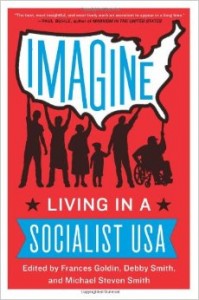
In the past weeks we’ve featured contributors to the book Imagine: Living In A Socialist U.S.A. This book as many know was conceived and edited by Frances Goldin and our own Michael Smith with his wife Debby. We continue to discuss the essays in this ground breaking anthology. Today we speak with Kazembe Balagun, who wrote We Be Reading Marx Where We From: Socialism and the Black Freedom Struggle.
Kazembe Balagun:
- The chapter starts out with a short story on Paul Robeson at the Carnegie Hall in 1957. He sang a song called I Dreamed of Joe Hill last night.
- When we talk about Wall Street, the first commodity were Black slaves. The reason they called it Wall Street is to keep the Native Americans out.
- There’s always been an interweaving of Black freedom struggles in the socialist experience.
- One of the first socialist experiments happens in the Sea Islands of South Carolina and Georgia where General Butler issuing Article 15 calling for all land held in common for negros.
- Then you have John Brown issuing an alternative constitution of the United States which calls for all land to be held in common between blacks and whites.
- Martin Luther King Jr (in a speech said) there has to be some form of socialism in the United States in order to achieve economic democracy.
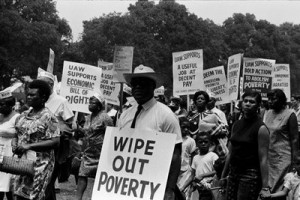
- The Poor People’s march going forward in 1968 in his fight for Memphis, these are all parallels for economic democracy.
- What we find today is that these socialist ideas are prevalent in the African-American community.
- I think there’s a way we can excavate this history for our own social movement.
- This capitalist society really has little to offer people, particularly young people of color.
- I always take into account is that there’s always been a tradition of African-American prophetic tradition which always looks beyond what’s been given to us and looks at the condition of possibility.
Guest – Kazembe Balagun, an activist and cultural organizer from the Bronx and former program director at the Brecht Forum. He is currently the project manager at the Rosa Luxemburg New York Foundation.
———————————————————
Law and Disorder February 17, 2014
Podcast: Play in new window | Download
Updates:
- Heidi Boghosian Book Tour: Spying On Democracy
- Michael Ratner: First Look Media
- The Intercept: The N.S.A’s Secret Role In The U.S. Assassination Program
- Michael Ratner: Virtual Base Transceivers – Mock Cell Tower Data Aggregation Program
- Michael Ratner: They Picked Up Our Cell Traffic At Ecuador Embassy In London
- Michael Ratner: The Real News Archive
- Guantanamo Bay Prison Lawsuit DC Circuit: Hunger Strikers Try To Stop Forcefeeding
- BDS Movement Update: The Anti-BDS Legislation Violates the First Amendment
- Distorting Russia: How the American media misrepresent Putin, Sochi and Ukraine.
——–
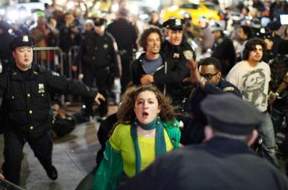
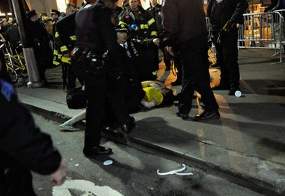
Jury Trial Begins for Occupy Wall Street’s Cecily McMillan
Cecily McMillan faces 7 years in prison after being beaten by the New York Police that left her unconscious at an event marking the 6 month anniversary of the occupation in Zuccotti Park. The Occupy Wall Street activist is charged with felony assault on a police officer a Class D felony in New York. In the course of her arrest McMillan sustained bruised ribs, a seizure and numerous cuts across her body. McMillan was a political organizer and activists speculate that’s why the prosecutor is seeking the full penalty.
Attorney Marty Stolar:
- Cecily is indicted which is somewhat unusual in the Occupy Wall Street cases. There are only 2 serious felonies that made it through the indictment process, Cecily’s is one of them.
- She’s accused of assault in the second degree. She’s accused of assaulting a police officer with intent to disrupt his ability to perform his official duties. She wacked him in the face with her elbow and left a good sized mouse under his left eye, causing him substantial pain and also to miss some work.
- The circumstances however under which she delivered the blow to his cheekbone are what the trial is about.
- Cecily is not the kind of person who would assault a police officer just for the hell of it.
- The police at midnight decided to clear the park of all the people who were there to celebrate the anniversary. Cecily was there not necessarily to celebrate the anniversary but to meet somebody to continue her pub crawling on St Patrick’s day being a McMillan when Cecily is grabbed from behind on her right breast and jerked upwards and she reacts, her arms go up in the air, her elbows go up, and that’s when her elbow and that’s when the elbow makes contact with the officer’s cheekbone.
- At that point Cecily is knocked down to the ground hits her head on the sidewalk and really has no memory of what has occurred until she wakes up somewhat later in a hospital.
- All of sudden she realizes she’s got bruises all over her body. She’s got a bruised rib, cuts all over her back, bumps on her head, she really has no idea how they occurred.
- Cecily for whatever reason was singled out to be prosecuted for a felony and they didn’t offer her a decent plea in the case.
- The officer lost a couple days of work, he was back on the job, his vision was not impaired.
Guest – Attorney Marty Stolar is a criminal defense lawyer and former president of the New York chapter of the National Lawyers Guild.
——
Fair Sentencing Of Youth Campaign
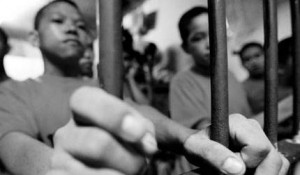
Here on Law and Disorder we’ve been covering the issue of children being sentenced to prison for life without parole for an offense committed during adolescence. The United States was the only country in the world to mete out life without parole to juveniles. But, in the last few years, the United States Supreme Court acted to curb the use of mandatory life sentences for juveniles. It accepted the argument that children, even those who are convicted of murder deserve a chance at redemption. However most state courts are not following the spirit of the recent Supreme Court decision. In Florida, which is the number one state that puts children in prison for life without the possibility of parole, several lawsuits have been brought accusing the state of handing out massive sentences in non-homicide cases that they basically amount to life without parole.
- The youths were involved in homicide cases, Human Rights Watch estimates that 25 percent of those individuals were convicted of felony murder meaning they were the primary perpetrator or they were there at the time the crime was committed but weren’t the trigger men.
- The majority of them 60 percent had no prior record.
- This most extreme sentence has been imposed on people we could not define as our most serious offenders.
- June of 2012 the Miller v Alabama decision was issued which struck down mandatory life without parole sentences for children.
- Each of these cases the court has relied on a growing body of research that really articulate the fundamental differences between children and adults.
- We know that the vast majority of them tend to grow out of any criminal behavior.
- The court has said we can’t impose these most extreme sentences on our children.
- The court has said that children are constitutionally different when it comes to sentencing.
- Two thirds of the people serving these sentences are concentrated in just five states.
- In Pennsylvania the state that leads the nation in this practice there are 500 serving this sentence.
- Back in the 1990s there was this theory known as the super-predator theory that there was going to be this juvenile crime wave.
- The super-predator theory has since been dis-proven by the criminologists who were even the authors.
- We now have an opportunity to be really mindful and careful about how we implement policies at the state level that hold young people accountable for serious crimes.
- Some legislatures have abolished life without parole altogether, Wyoming, Texas, Delaware among them. Some states have reacted in imposing the next available harshest sentence.
- The Mendota Juvenile Treatment Center in Wisconsin.
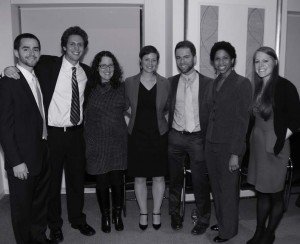
Guest – Jody Kent Lavy, director of the Campaign for the Fair Sentencing of Youth, the organization calls on states to reconsider mandatory terms dispensed before the Miller ruling.
——————————————————————–
CSPAN Book Club Video – Imagine: Living In A Socialist U.S.A.
Law and Disorder February 10, 2014
Podcast: Play in new window | Download
Updates:
—–
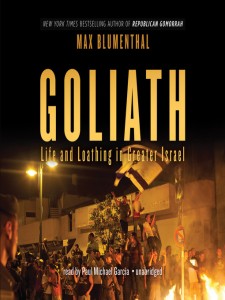
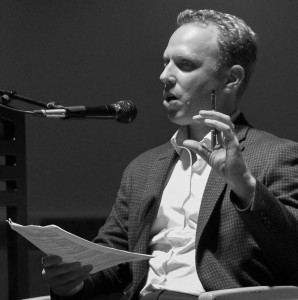
Goliath: Life and Loathing In Greater Israel: Max Blumenthal
Operation Cast Lead in 2008, is a starting point in the book Goliath: Life and Loathing In Greater Israel where award winning journalist and author Max Blumenthal shows the reader how a right wing government in Israel rose to power. His book takes hard look at Israeli authoritarian politics through a cross section of interviews from the homes of Palestinian activists to the political leaders behind the organized assault against civil liberties. Max gives readers a rare look into Israeli society that many will not write about.
- The first title was Master Race Democracy.
- Of course Israel is always portrayed in our media as this plucky little David surrounded by the Arab Goliath. Of course our reality is 180 degrees different.
- Matzpen warned that this would happen, they took a full page ad in Harretz saying we will become a police state and a nation of murderers.
- That’s where I come in to show that all of their darkest prophecies have been fulfilled and realized.
- I take you through Israeli society and through the key institutions of Israeli life to show how its playing out.
- From my time in Jerusalem where an anti miscegenation movement is burgeoning in the streets of Israel, leading mob attacks on young Palestinian men who are accused of making passes at Jewish women to the convention at the Jerusalem Ramada where key state Rabbis sit on a panel before right-wing settlers, including settler vigilantes leaders of the anti miscegenation movement defend a book, a guide on how and when its permissible to kill non-jews. A guide to genocide which is being distributed in Israeli Army units.
- Avigdor Lieberman is the man that basically promised to transfer 100s of thousands of Palestinians. He’s a rising force in Israeli society. It’s the youth whose hearts and minds they command.
- I take you into the Knesset to meet the younger legislators and the rising stars in Lieberman’s party and Netanhayu’s party who are far to the right of Netanyahu. Netanyahu really just commands the hollow center of Israeli politics.
- Rotem was great because he and other hard core right wingers have this whole philosophy of being dugri or straight. There was nothing I could say to shake him. He looks at me coming in at just another pathetic Jewish liberal who doesn’t really get what it takes to prevent a second holocaust and that’s what he said his goal was.
- It’s completely different from talking to a Republican in the United States who has to pander to some kind of civil rights sensibility.
- That’s another thing reviewers missed about my book is that I analyzed these key votes on major anti-democratic laws going back to 2009. Laws like the Nakba Law which basically criminalized observance of Palestine dispossession in 2008. Laws like the Acceptance to Community Law which legitimizes racial and religious discrimination for communities of under 500.
- These are laws that strip off the veneer of democracy and expose apartheid for what it is.
- It’s the right-wing that has captured the heart of Israeli society because they have the dynamism, they’re driving the agenda forward. (using a simple mantra – “finish 48”)
- In 1948 and actually starting in 1947, 750 thousand Palestinian Arabs were expelled to allow the creation of a Jewish state with a Jewish demographic majority, but many stayed behind. 20 percent of the state of Israel is non-Jewish Palestinian.
- They view Palestinian citizens of Israel increasingly as a fifth column, as a trojan horse for the Arab world, for Arab nationalism and Islamism.
- In order to become a citizen of Israel you have swear loyalty to the Jewish state and that applies to Palestinians in east Jerusalem.
- You will meet the people who are trying to push back inside Jewish-Israeli society on the pages of my book because they were my roommates, my friends. They took me to the flashpoints of ethnic cleansing and conflict.
- I would number 700 or less active left wingers who are actively leveling their bodies against the occupation and apartheid.
- The writings on the wall for these activists that there is very little room for them left in Israeli society.
- What they’ve (leftists in Israel) done is call to the outside. They’re calling to us. They organized around the boycott from within committee and they’re signing letters asking performers not to come to Israel. They’re signing letters calling on Americans to boycott their country.
- That is really where the activism of the radical left wing Israelis is going.
- The Jewish National Fund is supposed to operate within the Green Line only and is probably the leading Jewish non-profit in the world. It receives the most donations from diaspora Jews in the world.
- Steven Harper the Prime Minister of Canada recently spoke at one of their banquets. They’ve paid Bill Clinton hundreds of thousands to speak at their banquets.
- They are also the premier organization linked to the Israeli government involved in ethnic cleansing and crimes against humanity.
- It’s something we talk about a lot. How Zionism is trying to capture Judaism and change what it means to be a Jew and declare us to be who are not only not Zionists but object to this redefinition of Judaism and cast us out and declare us to be anathema.
- You can see it in my video Feeling the Hate where I go to the heart of Jerusalem and meet American Jews from around the country and they line up around my camera the night before Barack Obama’s historic address in Cairo.
- Zionism is attracting those who are magnetized by the kind of bellicose identity that it requires and is repelling anyone who has any liberal sensibility or at least throwing them into a moral crisis.
- I showed up as # 9 on Simon Weisenthal Center’s list of anti-Israel, anti-semites and they called me an anti-semitic Jew, not even a self-hating Jew but a Jew who hates Jews.
- I was tied with Alice Walker by the way.
- They literally count the calorie of each Gaza resident with complex mathematical formulas.
- Barack Obama has never challenged the idea of holding 1.8 million under siege because they possess the wrong ethnicity.
- When a situation like this is taking place and expanding as Jeff Halper from the Israeli Committee Against Home Demolitions says into a “global Gaza” where the techniques that have been used to control people in the Gaza Strip are literally being exported because Israel is the only country that has the ability to basically lab test such a regime of domination.
- That’s very appealing to people in the United States, the Department of Homeland Security, to private prison companies like CCA.
- Twitter – @maxblumenthal
Guest – Max Blumenthal, an award-winning journalist and bestselling author whose articles and video documentaries have appeared in The New York Times, The Los Angeles Times, The Daily Beast, The Nation, The Guardian, The Independent Film Channel, The Huffington Post, Salon, Al Jazeera English and many other publications. He is a former Puffin Foundation Writing Fellow for The Nation Institute. His book, Republican Gomorrah: Inside The Movement That Shattered The Party, is a New York Times and Los Angeles Times bestseller.
———————