Welcome to Law and Disorder Radio
Law and Disorder is a weekly independent civil liberties radio program airing on more than 150 stations and on Apple podcast. Law and Disorder provides timely legal perspectives on issues concerning civil liberties, privacy, right to dissent and practices of torture exercised by the US government and private corporations.
Law and Disorder March 4, 2013
Podcast: Play in new window | Download
Updates:
- FISA Court Surveillance: Supreme Court Allows, You Have No Standing
- Hosts Discuss CIA Sponsored Cinema
——–
Zero Tolerance Policy: School to Prison Pipeline?
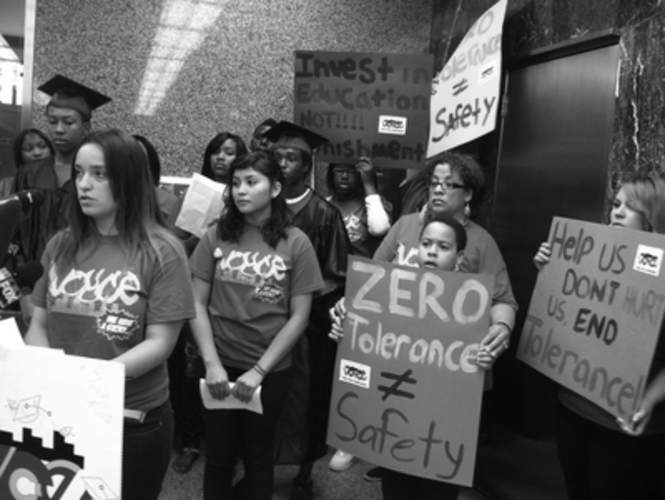
As many listeners may know, zero-tolerance school policies will punish any infraction of a rule regardless of whether it was an accident, a violation out of ignorance or extenuating circumstances. Schools normally forbid cell phones, profanity etc, but with a zero tolerance policy, breaking these rules often result in an inordinately harsh punishment such as suspension or expulsion. These policies are promoted to prevent violence and drug abuse in schools but for years critics have pointed out the subjective nature of these decisions on certain students with disciplinary problems. Some difficult students could become targets of the zero tolerance policy, become less educated by multiple suspensions and expulsion which often lead them into the criminal justice system.
- Zero tolerance grew out of a philosophy of school discipline that really came out of the 1980s, a period where we believed because youth violence was accelerating in our communities, that we were in real danger of being overwhelmed by violence in school settings.
- Interestingly enough data since then has shown us that was never really the case.
- Rates of disruption in schools have remained constant in a 30 or 40 year period.
- Out of that fear grew a response that said the only way we’re going to defend against that and keep our school safe and our students and teachers safe will be by punishing harder and frequently minor incidences we can send a message to kids that certain behavior won’t be acceptable and that will deter other kids.
- Zero Tolerance came out of Broken Windows Theory.
- The Reagan administration used a program in the San Diego harbor where even trace amount of drugs would lead to confiscation of ones boat and an appearance in federal court.
- When there’s a fear response, there does tend to be a belief that we don’t have time to look at the data we just need to do anything necessary to protect out kids.
- Its a dangerous way to make policy.
- The case in Georgia where a girl has a Tweety Bird wallet attached to her backpack with a two inch chain. That was considered a weapon. We all react in horror to those extensions.
- But the more central question is. . . is it effective?
- The APA put together a Zero Tolerance Task Force and they found after a year of studying hundreds of documents that there was no evidence that Zero Tolerance made any contribution to school safety or improvements to student behavior.
- It’s often referred to as the school to prison pipeline. In the last few years there has been a lot of data accumulating that yes in fact that’s the case.
- It’s not a direct line, but there are a lot of links there that kids that are expelled are more likely to be disengaged.
- It has a negative correlation with school achievements.
- We’ve known for a long time that African American students are disproportionately represented.
- Race is still a contributor to disproportionality. Poor black kids are more likely to be suspended than poor white kids but so are middle class. . .
- More African Americans in the school tends to lead to harsher punishment.
- More teachers of color seems to result in reduced rates of disparities.
- We (need) to put programs in place like “conflict resolution” or “positive behavior support” that make clear the expectations for all kids.
- Or mentoring, we know a lot of these situations come from kids who are alienated from school.
- APA Zero Tolerance Task Force / Equity Project – Indiana University / Civil Rights Project – UCLA
Guest – Professor Russ Skiba, professor in Counseling and Educational Psychology at Indiana University, and directs the school outreach practicum in the School Psychology Program. He was a member and the lead author of the American Psychological Association’s Task Force on Zero Tolerance
———
Pope’s Resignation May Make International Prosecution Easier
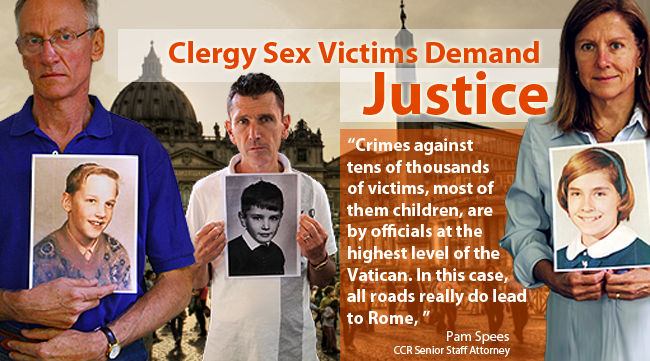
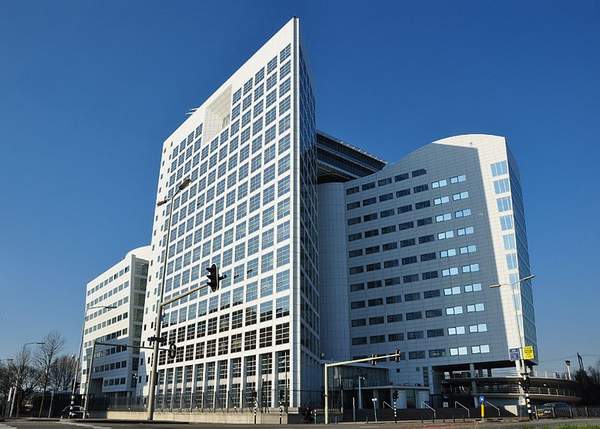
We continue to look at accountability within the church for widespread systematic sexual assault and violence against tens of thousands of victims, mainly children. As many listeners may know, the church’s main priority has been to protect itself and its power instead of insuring the protection of the children in the church and others vulnerable to abuse by priests. The pope is responsible for these criminal acts with direct involvement in covering them up. Now that Pope Benedict XVI is resigning, international prosecution will be easier for national systems of justice. The Center for Constitutional Rights has filed a case with the International Criminal Court on behalf of the organization Survivors Network of those Abused by Priests (SNAP) against the pope and other high-level Vatican officials for crimes against humanity in September 2011 and provided additional documentation in the case in April 2012. The prosecutor is currently reviewing the evidence
- SNAP is a network of survivors who try to help each other with the experience of being either raped, abused, or sodomized by authority figures.
- I think one of the wonderful things that have happened is there is more attention toward this.
- There was a time when print journalism wouldn’t touch the church. They were really able to act under secrecy.
- When I was abused it was the 60s and my father was dying and the priest suggested that if I did certain things a miracle might be wrought.
- After my father died and the miracle wasn’t wrought, I understood more of what was done and tried to go to pastor of the local church.
- There were no places I knew of to turn.
- Eventually I got therapy, I married, I got children.
- What happened in 2002 in Boston, was really the thing that made me become an activist.
- The court is looking at this very seriously, they met with us. This is a court that doesn’t have immunity.
- What I would like to see is accountability and some sort of change that this will not happen again.
Guest – Mary Ward Caplan, leader of Survivors Network of those Abused by Priests (SNAP) in New York City.
———-
- In September 2011, we filed a complaint with the prosecutor of the International Criminal Court, asking to investigate and prosecute 4 highest officials for their role in basically creating the policies and practices that church officials follow around the world, which serves to conceal the widespread sexual violence against children and vulnerable adults.
- Other than conceal, these policies and practices serve to perpetuate it.
- We filed these complaint along with 22 thousand pages of documentation and evidence that’s been gathered in different countries around the world – showing how the high level officials within the Vatican are involved. We’re asking for a criminal investigation and prosecution.
- His resignation does create more opportunity for holding him accountable, specifically in national levels where you have a sitting head of state could actually be a bar to a prosecution for a civil case.
- It’s important to understand we’re not talking about a few bad apples. It is the culture of sexual violence that has built up within the church.
- I think what we’re going to be seeing in the next months is more revelations.
- The committee has ordered the Holy See to report to it this year. This will be the first time an international body with any kind of oversight over the Holy See will be making the Holy See answer questions about the crisis of child sexual abuse in the Holy Church.
Guest – Pam Spees, senior staff attorney in the international human rights program at the Center for Constitutional Rights. She has a background in international criminal and human rights law with a gender focus, as well as criminal trial practice. She serves as lead counsel on several of CCR’s cases and initiatives including, Sexual Minorities Uganda v. Lively, a case brought against a U.S. based anti-gay extremist for his role in the persecution of LGBTI people in Uganda; Murillo v. Micheletti, a case brought by the parents of a youth killed by the coup regime in Honduras; and in the legal effort to hold Vatican officials criminally responsible for the crimes against humanity of rape and sexual violence within the church.
——————————————————————————-
Law and Disorder February 25, 2013
Podcast: Play in new window | Download
Updates:
Private Prison Corporation To Have Its Name on Florida Atlantic Football Stadium
—
Priests of Our Democracy, The Supreme Court, Academic Freedom, and the Anti-Communist Purge
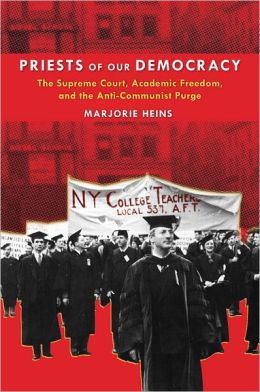
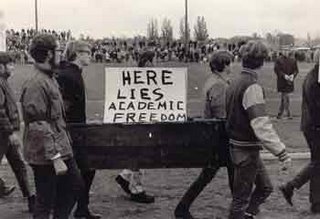
Priests of Our Democracy, The Supreme Court, Academic Freedom, and the Anti-Communist Purge is the title of the recently published book by attorney Marjorie Heins. The book examines a very dark period in academic freedom within New York City’s municipal colleges. In the early 1940s, faculty, students and staff were the target of massive investigations into their political beliefs and associations. They hauled before tribunals of the New York State legislature, dozens were stripped of their careers.
Author Marjorie Heinz shows historically, that academic freedom is nothing to take for granted and is always on shaky ground despite being protected by the First Amendment. The backlash of controversy against Students for Justice in Palestine sponsoring a Boycott Divest Sanction event at Brooklyn College is recent example. This is a book for anyone working in education to understand the court battles that tried to preserve a right protected by the Constitution.
- Boards of Trustees which are dominated by corporate executives don’t like these new scholars in the field of social science who are also activists.
- It’s really an attempt of political purge of this national figure.
- The burgeoning forces of academic freedom rally round him, they see the danger.
- In those early days the main attacks on the activist professors really were on activities outside the classroom in support of labor organizing.
- A bunch of professors get together from around the country and form the AAUP, American Association of University Professors. They for the first time issue a declaration of principles on academic freedom.
- The first is freedom in the classroom. The second is freedom is your research and scholarship to pursue learning where it may lead, which means overturning conventional wisdom.
- The third is what they call extramural speech, outside the walls. That was the main target of repression in that period.
- We have to get all these leftists out of the school system because they’re going to indoctrinate the tender minds of our youth with Marxist ideas.
- Harry Keyishian starts the book, he’s one of the wonderful characters I discovered as I was working on it. The Keyishian v. Board of Regents case, 1967 Supreme Court case is famous among First Amendment lawyers because it reversed prior not so good decisions, strikes down the so called Feinberg law which had been passed in 1949 and upheld by the Supreme Court.
- Feinberg law creates a very sweeping program of loyalty investigations for teachers in the public schools.
- 1952 is the height of the witch-hunt at Queens College in New York City when the Senate Internal Security Sub-committee comes to town.
- The Senate Internal Security Sub-committee starts summoning teachers at city colleges.
- “Would you tell Pablo Picasso that he wasn’t qualified to teach art?”
- It’s obscene to see college administrators running around scared like keystone cops he said.
- Some of these investigations were very broad. What books they read, what magazines they subscribed to, did you have Paul Robeson records in your home?
- It’s not until the Keyishian case in 1967 that the Supreme Court says this whole system of loyalty investigations violates the First Amendment and the due process provisions of the Constitution.
- Marjorie Heins Book Events:
- Revolution Books March 5 is sponsored by the New York Civil Liberties Union – 7PM
- Harvard Bookstore, Cambridge, MA, Friday March 15, 3 pm.
- Talking Leaves Bookstore, Buffalo, NY, Sat. March 23, 5 pm.
- Politics & Prose Bookstore, Washington, DC, Sat. June 15, 1 pm.
- Revolution Books March 5 is sponsored by the New York Civil Liberties Union – 7PM
Guest – Marjorie Heins, a civil liberties lawyer, writer, and teacher, and the founding director of the Free Expression Policy Project. Her previous book, Not in Front of the Children, won the American Library Association’s 2002 Eli Oboler Award for best published work in the field of intellectual freedom. Other books include Sex, Sin, and Blasphemy: A Guide to America’s Censorship Wars; Cutting the Mustard: Affirmative Action and the Nature of Excellence; and Strictly Ghetto Property: The Story of Los Siete de la Raza. She is a graduate of Harvard Law School.
———
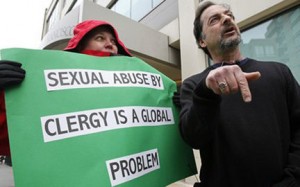
Encore Interview: New Vatican Rules On Handling Priest Sexual Abuse Cases
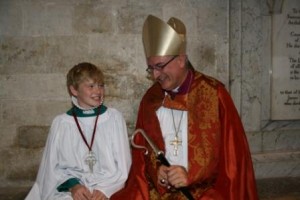
Earlier this year, the Vatican had revised its laws making it easier to discipline sex abuser priests. The new internal of the Vatican will use faster judicial procedures instead of full ecclesiastical trials. Critics of the revisions, say the Vatican merely tweaked the process and the new rules don’t hold bishops accountable for abuse by priests on their watch or require that they report the sexual abuse to the authorities. In the same report was the inclusion that attempting to ordain women as priests was comparable to heresy, apostasy and pedophilia. To many it was a comparison meant to resist any suggestion that pedophilia can be addressed by ending the requirement of celibacy.
- SNAP is now a worldwide movement of survivors. We invite supporters join us, we have approximately 10 thousand survivors. Some are spouses and family members but most are survivors; survivors of sexual abuse by priests or other clergy members. Sometimes by religious brothers, by nuns, deacons even bishops.
- We grew in 2002 and 2003 as the headlines were exploding of abuse by priests.
- We have support group meetings in the United States in about 65 different cities. We were extremely naive, not to mention wounded trying to figure out how to make it from day to day. Its empowering for us if we can protect someone who is 12 or 13 from being abused.
- Some documents was released in 2009 in Ireland. Those were the result of government investigations into the allegations of priests and other religious figures sexually abusing children. Victims across Europe, in Germany and Belgium, Austria, Netherlands, England began speaking out and reporting their abuse. In Ireland at the end of 2009, four bishops were resigning their positions.
- From our perspective, what comes out of the Vatican is a lot of lofty words and empty promises. If you look for concrete action, you’ll see very little if any. We as victims are devout Catholics and its really incredible for us to comprehend that someone in the position of authority in the church would not want us to be protected.
- It was heartbreaking and devastating to learn the policy of the church officials is to protect the predators and their assets and their reputations, not the children.
- They’re accountable to no one and its okay for them to continue and commit these crimes.
- The vast majority of victims still do not report. More than 5 thousand priests have been identified are sexual offenders who have abused children between 1950 and 2008.
- 5 percent of priests abusing children. When someone rapes a child they get fired, in the church they get promoted. SNAPnetwork.org / bishopaccountability.org
- We joined a conversation with SNAP looking for ways to insure accountability for what’s going on.
- Is there a legal framework that gets at the widespread nature of this. There’s one book out that discusses the 2000 year old paper trail of sexual abuse in the church.
- You’ll hear things like a cardinal or a pope attempt to make an apology. They’re sorry for what happened to these folks. It didn’t just happen.
- It shows the lack of attention and lack of awareness of the gravity of what’s going on and a prioritization of the church protecting itself and its power, rather than insuring the protection of the kids in the church and others who are vulnerable to abuse by priests.
- It also looks like an attempt to decentralize the responsibility. There are key legal experts who have discussed this as crimes against humanity.
- These are acts that are committed as a widespread or systematic assault or attack on the civilian population.
- When you’re talking about the massive sustained harm that is being caused here and the lack of awareness and acknowledgment. . it’s really astonishing.
- The International Criminal Court is a possible venue that has jurisdiction on crimes against humanity.
- The Church can’t be trusted to police itself.
Guest – Pam Spees, senior staff attorney in the international human rights program at the Center for Constitutional Rights. She has a background in international criminal and human rights law with a gender focus, as well as criminal trial practice
Guest – Barbara Blaine, founder of SNAP, Survivors Network of those Abused by Priests, the nation’s oldest and largest self-help organization for victims of clergy sexual abuse.
————————————————————
Law and Disorder February 18, 2013
Podcast: Play in new window | Download
Updates:
- Pope’s Resignation May Make International Prosecution Easier
- All Charges Dropped For Occupy Protesters
- A Call for Drastic Changes in Educating New Lawyers
—-
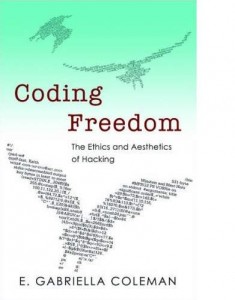
Coding Freedom: The Ethics and Aesthetics of Hacking
In the past 2 years, we’ve discussed in many interviews and updates, the attacks on whistle-blowers and hackers. The emerging movement of programmers, hackers, open source software, online communities has challenged and exposed corporate and government control and surveillance, making them targets of prosecution. As many may know, our own Michael Ratner has represented whistle-blower Julian Assange, computer activist Jeremy Hammond, and has been a legal adviser to many others including the late Aaron Swartz. Today we talk with author Gabriella Coleman about her recently published book Encoding Freedom: The Ethics and Aesthetics of Hacking. It’s a good place to start for those learning about the political significance of free software, intellectual property and the morality of computer hacking.
Gabriella Coleman:
- When you utter the word hacker, usually the image that pops into people’s minds is nefarious criminal. That can be the case but really hackers are composed of an extremely lively group of individuals who tend to be computer programmers and network administrators, who actually are committed to a range of civil liberties such as free speech and privacy. Especially in the last decade they’ve been involved in political activities as well.
- They’re quite a bit of diversity among hackers, technically.
- Hackers – are keenly aware of the issues such as censorship, which impact the present and the future of the internet. Some hackers are committed to insuring internet freedoms for their own productive autonomy.
- Beyond productive autonomy they’re really starting to care about the broader issues relating to internet freedoms and how they relate to democracy at large.
- In order for software to be made, it must be written in a programming language such as C++, Python and Pearl and its written in source code. These are the underlying directions of software.
- A very prominent group of hackers who are committed to always having access to source code have actually reinvented the law to make sure that that source code is eternally available. They’re very much against copyrights and patents and have created something called a copyleft to make sure the source code that powers software is always accessible to them.
- Proprietary software such as the Microsoft Operating System is behind lock and key. We don’t have access to the underlying directions.
- There’s a contingent within the hacker world who believe that access is not only good for the sake of improving technology but is the morally right thing to do.
- That its a collaborative process, that everyone should have access to it. There are other hackers that are a little less concerned about the ethics of access and they’re more concerned about the pragmatics.
- I originally thought that these free software developers who were part of these large projects such as Debion, were raging Leftists. The project itself had collected people from all political orientations.
- Anonymous is a digital phenomena somewhat composed of hackers but not exclusively so, who has engaged in an enormous amount of political activities. They are innovating in the realm of direct action related to digital protest.
- Some will engage in hacking to get information about corporate corruption to leak to the world at large. They also engage in distributed denial of service attacks where a website is so overloaded with requests it comes off line.
- Free software, in order for it to be free speech is also like free beer, you have to make the source code available. But that doesn’t stop people from charging money for support or services.
- In the case of SOPA being passed, there was massive outcry, and massive organization to do something about it to stop it in its tracks. It came from different quarters of society, it came from corporate giants such as google, it came from the Electronic Frontier Foundation, and there was a huge black out where people took down their websites. It had a massive effect and stopped it in its tracks.
- I’m currently working on a book on Anonymous. That should be definitely done by 2013.
Guest – Gabriella Coleman, Wolfe Chair in Scientific and Technological Literacy in the Art History and Communication Studies Department at McGill University. Trained as an anthropologist, she researches, writes, and teaches on hackers and digital activism. Her first book on Free Software, “Coding Freedom: The Aesthetics and the Ethics of Hacking” has been published with Princeton University Press. It is available for purchase and you can download a copy on here.
—-
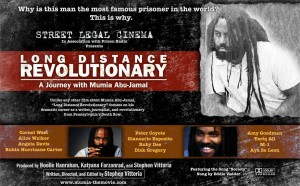
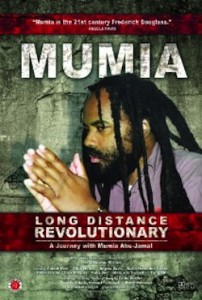
Long Distance Revolutionary: A Journey with Mumia Abu-Jamal
The new documentary, “Long Distance Revolutionary: A Journey with Mumia Abu-Jamal,” is premiering across the country. The film includes interviews from Cornel West, Alice Walker, Ruby Dee, Dick Gregory, Amy Goodman, Michael Parenti, writers Tariq Ali, and Michelle Alexander. This film beautifully captures the importance of Mumia Abu-Jamal’s life as an American journalist, and radical. He published seven books in prison including the best selling “Live From Death Row.”
In Chris Hedges’ review he points out what Cornel West says in the film: “The state is very clever in terms of keeping track, especially [of] the courageous and visionary ones, the ones that are long-distance runners. You can keep track of them, absorb ’em, dilute ’em, or outright kill ’em—you don’t have to worry about opposition to ’em.”
Steve Vittoria:
- The arc of Mumia’s life and the body of his work which is remarkable under harsh and draconian conditions is much more than December 9, 1981. I’ve always seen his life as more than one moment.
- I wanted to tap into what I found was clearly a unique story. Here’s a young man who early on realized he was a revolutionary by the time he was 15 years old.
- He’s writing remarkable work for the Black Panther Party and their newspaper. By 26, he’s a vibrant radio broadcaster and journalist in Philadelphia, reaches NPR and All Things Considered.
- After incarceration, he publishes 7 or 8 books.
- I did from a creative standpoint and a very practical standpoint.
- I wanted to tell a really good story. Any filmmaker, that’s job number one. Mumia, you just have to turn the camera on and you can tell a great story.
- If the film starts to win awards and get fawned over then something’s wrong.
- My favorite interview in the film is Mumia’s sister Lydia Barashango who unfortunately passed away a few months after we interviewed her from her bout with cancer. She went to great lengths to secure her baby brother’s legacy.
- Trying to find what it was like as a young African-American kid growing up in one of the great racist northern cities of Philadelphia, what it was like
- I didn’t realize how funny he could be. He’s kind of a science fiction nerd. He calls himself a nerd.
- Mumia has a very strict schedule for work.
Guest – Steve Vittoria, the writer, director, producer and editor of Long Distance Revolutionary: A Journey with Mumia Abu-Jamal. The film premiered in theaters in New York City earlier this month.
—————————————