Welcome to Law and Disorder Radio
Law and Disorder is a weekly independent civil liberties radio program airing on more than 150 stations and on Apple podcast. Law and Disorder provides timely legal perspectives on issues concerning civil liberties, privacy, right to dissent and practices of torture exercised by the US government and private corporations.
Law and Disorder January 28, 2013
Podcast: Play in new window | Download
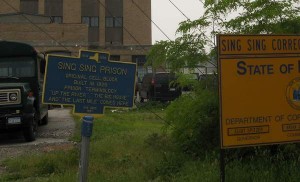
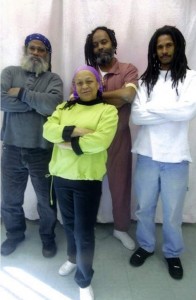
Mass Incarceration Epidemic
On January 19, the Malcolm X Commemoration Committee 1199 SEIU activists presented the 17th Annual Dinner Tribute to the Families of our Political Prisoners & Prisoners of War. It was called Transforming Solidarity: Working Together to End Political Imprisonment and Mass Imprisonment and was held at the Martin Luther King, Jr. Labor Center in NYC.
- The Republican Party begins to craft an ideological backlash against an emerging civil rights and black power movement.
- The Republican presidential candidate at the time Barry Goldwater in a speech begins to link crime to the activism of civil rights protesters that are being incarcerated in the south.
- He is deploying one of the most atrocious fears of the white supremacist South in the post-reconstruction era to delegitamize these protests. That black men are going to rape white women.
- What we see happening in the 1960s is that fear is manufactured by these P.R. firms that are working in consultation with Republican leaders but also with police organizations, the Fraternal Order of Police, and the Police Benevolent Association.
- 1968 saw and huge amount of riots especially in the aftermath of Martin Luther King Jr’s assassination.
- The criminalization of black and Latino protesters was the major strategy used to delegitamate the aspirations and the politics of this emerging revolutionary class.
- The Omnibus Crime Control and Safe Streets Act of 1968 legalized wire-tapping and bugging by federal agents and local police without a court order.
- It also legalized on the stop search and seizure by police.
- The police are exempt from the 1964 Civil Rights Act.
- What is the purpose of this crime mania and moral panic? It’s to delegitamize the influence of black and Latino radicals of the working class of color in the nation.
- In 1970s, the apparatus of mass incarceration emerges.
- This apparatus is being deployed against the most vulnerable sections of American society in urban centers. African-Americans and Latinos that are being devastated by a crisis of de-industrialization.
- The poorest people of color are likely to resist, and this class is going to be controlled.
- It was a fabricated crisis of crime that never existed.
- Fear atomizes people they don’t start thinking in terms of community but individual.
- Crime becomes a code word for African Americans, Latinos and increasingly immigrants.
- The Black Panther Party had an analysis of oppression and inequality that addressed its root causes. It identified capitalism which is driven by profit rather than need as the problem.
- But also they had a newspaper and this is important around the issue of mass incarceration.
- Crime is an ideological wedge that is crafted by the Republican Party and the new Right in this nation for the purposes of social control.
Guest – Johanna Fernández, a native New Yorker. She received a PhD in History from Columbia University and a BA in Literature and American Civilization from Brown University. Professor Fernández teaches 20th Century U.S. History, the history of social movements, the political economy of American cities, and African-American history. She has previously taught at Carnegie Mellon University in Pittsburg, PA and Trinity College in Hartford, CT and is, most recently, the recipient of a Fulbright Scholars grant to the Middle East and North Africa that will take her to Jordan in spring 2011, where she will teach graduate courses in American History.
—-

Policing Trends at National Special Security Events
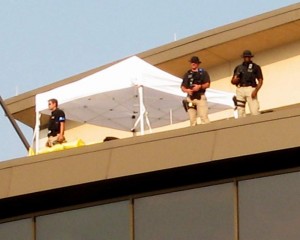
On January 21, 2013, more than 3 thousand law enforcement officers and nearly 13 thousand military troops were activated and deployed to the Washington Mall. This magnitude of security at President Barack Obama’s 2013 inauguration raised the water mark of militarized police mobilization for National Special Security Events (NSSEs) High tech weaponry, mobile checkpoints and a large uniformed presence have become common sights at major sporting events, nominating conventions and international summits. NSSEs were created under President Bill Clinton, a designation that requires federal and local law enforcement to collaborate on event security under the management of the Secret Service. The report was issued by the National Lawyers Guild on NSSE trends is the Guild’s senior researcher.
- The idea that this much security, this kind of multi-level, multi-agency is necessary is the assumption that these events are high profile, will have a lot of people and therefore are likely targets for terrorist attacks.
- There’s been about 40 NSSE’s since the designation was created and these include events like president inaugurations, state funerals, the annual State of the Union address, the Superbowl, Olympics, all International monetary organization meetings and of course the Democratic and Republican National Conventions.
- All to often we’re finding that protesters who are engaging in constitutionally protected and legitimate protest activities are lumped into this security threat.
- Over time, we’ve (NLG) have not only done legal support, we’ve also done a lot of research and writing and analysis of the different kinds of trends we see evolving.
- We wanted to use the RNC and the DNC in 2012 as case studies to look at some disturbing changing trends and express our concern that these security measures are simply becoming more normalized.
- Several months before an NSSE, the local government overrides city codes to create exceptional circumstances for these particular events. That means creating a security zone around the event itself, then limiting How When and Where people can protest within that zone.
- That can lead to limiting the times of demonstrations, the amount of people, the special permitting processes to prohibiting everyday, household items being allowed in the zone.
- What we see leading up to NSSE and this has been very consistent is the DHS and FBI circulating unsubstantiated reports that violent anarchists and outside agitators are plotting to come to these cities really to cause harm and injury – to bring explosive devices, to injure police.
- FBI informants and agents and undercover police were crucial to both encouraging and helping to set up these plots which they then use as evidence later.
- We’re asking law enforcement to stop spreading these unsubstantiated threats of protester violence before NSSEs and acknowledge that most of the violence that has taken place at NSSEs in the past has been on the part of police and not the protesters.
- The combined total of the security budget for the RNC and DNC was 100 million dollars. 50 million dollars going to each city.
- We see the continuation of the militarization of police departments and the NSSEs are playing a part in them.
Guest – Traci Yoder, National Lawyers Guild senior researcher. Before coming to the National Office, she coordinated the NLG Philadelphia Chapter. She holds master’s degrees in Library and Information Studies and Anthropology, with a focus in the latter degree on gender studies and East Africa. In Philadelphia, Traci worked on many projects in addition to the NLG, including the Wooden Shoe Book Collective and the Radical Archives of Philadelphia.
Law and Disorder January 21, 2013
Podcast: Play in new window | Download
—-
Remembering the Life and Influence of Aaron Swartz
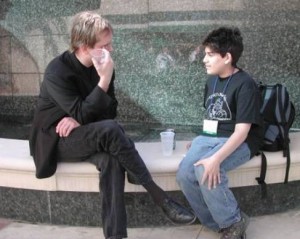
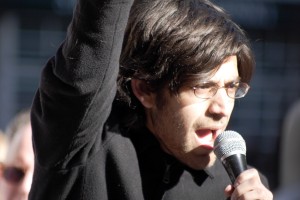
Last week, computer activist and programmer Aaron Swartz allegedly took his own life. Swartz as many listeners may know helped develop RSS, essentially revolutionizing how people use the internet and was the key architect of Creative Commons. He believed information should be free and used his tech-saviness to promote his views. Many blame his unnecessary death on the stress of being the target of federal prosecutors who went after him for covertly downloading millions of public domain academic journals on the MIT campus using a non-profit university research portal. It’s unclear if Swartz broke any laws, MIT provided free access to anybody on campus including visitors without campus affiliation. Swartz has had run ins with the law before in connection with hacktivist activity and would’ve faced a 35 year sentence. Petition to remove US District Attorney Carmen Ortiz from office.
- He’s portrayed as a technical whiz kid, a genius who knew how the internet worked.
- He was a very precocious and very technically adept person who started doing significant work on internet standards and access to information and moving information around communication networks at the age of 13.
- They didn’t know he was 13 until they held an in person conference.
- No one knew he was a kid, he was so widely read and very able to express himself.
- He was a very good organizer of people who were themselves.
- Aaron helped develop this standard. RSS – Really Simple Syndication Format is a means of having a website notify people via an efficient and timely information push mechanism.
- Stop Online Piracy Act, a clampdown on websites that provide access to information in ways that terms of service or restrictive laws in Aaron’s opinion don’t permit.
- Creative Commons is another organization that promotes much loser and more permissive copyright regulations and gives authors and creators of content tools like more liberal licenses to release their content under.
- All of these things he did have one thing in common, giving people access to knowledge.
- Information that is often artificially restricted.
- The wires of the internet are perfectly willing to carry any piece of information. When they don’t its because a human has decided we’re going to block access.
- He’s talking about access to scholarly articles that were funded by tax payer dollars.
- You can think of Reddit as a kind of early facebook in that it gave people an online surface to share conversations on the internet.
- Demand Progress that Aaron helped start that organized a massive protest around SOPA, the Stop Online Piracy Act.
- He was intensely collaborative. He was often an engine of what was moving.
- Questioncopyright.org is founded to change the way the debate of copyright law and copyright practices happen.
- If you talk to people about copyright, they say artists have to make living. People shouldn’t steal stuff.
- It’s not about attribution. It was instituted initially as a regulation to help support the publishing industry and was lobbied for by the publishing industry 300 years ago.
- Aaron understood that and understood that poor frames of debate was causing us to have increasing restrictive laws in an age where we have this gigantic worldwide copy machine.
- CFAA, two parties sharing information with each other, it criminalizes that.
- He was always referred to as a hacker, meaning someone who breaks in and does damage to computers. That’s inaccurate. What these laws say is someone knowingly uses a computer network to use someone else’s server in a way that that person didn’t intend. In other words if you violate terms of service. Everyone clicks through.
- Making criminalized and punishable by jail is ridiculous.
- He was opposed to artificial scarcity. It bothered his sense of justice that we were behaving as if there was a scarcity. It was always portrayed as young hacker steals computer files from MIT.
- What the facts of the case are, he wanted to download a lot of articles from JSTORE. These are articles were available for free. However they put a limit on how many you can download from a given address and time.
- He found a tactical way to work around it by getting into a network closet and using a computer that changes its network address. Yes, he engaged in very mild, non-malicious subterfuge.
- Alex Stamos article: The Truth About Aaron Swartz’s Crime
- He was doing research on the effects of funding on academic research. He wanted to do it in a big data approach.
- He needed these millions of articles in order to write programs to parse them and look for conclusions and funders to do a gigantic database.
- It makes me angry that they (prosecutors) knew what they were doing, they knew what Aaron’s intentions were.
- Their careers should be over. I know that’s cruel to say, but they should go no further.
- I wrote that there might have been something illegal about it but its a bad law.
- Acting for Aaron and Open Access – Adi Kamdar
Guest – Karl Fogel co-founded Cyclic Software in 1995, a company offering commercial CVS support. In 1999 he added support for CVS anonymous read-only repository access, inaugurating a new standard for access to development sources in open source projects. That same year, he wrote Open Source Development with CVS (published by Coriolis), now in its third edition via Paraglyph Press. He has also written Producing Open Source Software, from O’Reilly Media. From 2000-2006, he worked for CollabNet, Inc., managing the creation and development of Subversion, a open source version control system meant to replace CVS as the de facto standard among open source projects. After a brief stint at Google in 2006 as an Open Source Program Specialist, he left to become editor of QuestionCopyright.org. He also participates in various open source projects as a module maintainer, patch contributor, and documentation writer.
—-
Speech by Former Attorney General of the United States Ramsey Clark
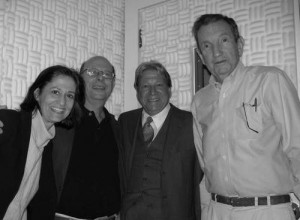
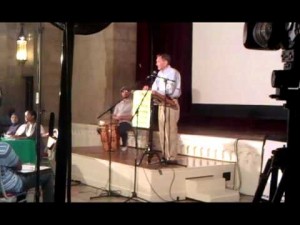
We hear speech delivered by Ramsey Clark at Riverside Church in Harlem celebrating his 85th birthday. Ramsey Clark is a former Attorney General of the United States, under President Lyndon B. Johnson. The first Attorney General at the Justice Department to call for the elimination of the death penalty and all electronic surveillance.
During his years at the Justice Department:
- supervised the federal presence at Ole Miss during the week following the admission of James Meredith;
- surveyed all school districts in the South desegregating under court order (1963)
- supervised federal enforcement of the court order protecting the march from Selma to Montgomery; and
- headed the Presidential task force to Watts following the riots.
- supervised the drafting and executive role in passage of the Voting Rights Act of 1965 and Civil Rights Act of 1968.
After he left the Johnson administration, he became a vociferous critic of the Vietnam War and continued on a radical path, defending the underdog, defending the rights of people worldwide, from Palestinians to Iraqis, to anyone who found themselves at the repressive end of government action.
Past Law and Disorder Interviews with former US Attorney Ramsey Clark:
- Lawyers You’ll Like Interview April 28, 2008
- Attorney Ramsey Clark on Law and Disorder August 8, 2011
————————————————————————–
Law and Disorder January 14, 2013
Podcast: Play in new window | Download
Updates:
- Guantanamo Bay Prison 11th Anniversary
- Abu Ghraib Settlement: Defense Contractor Engility Holdings Pays $5M To Iraqi Torture Detainees
- Stop and Frisk Lawyers Praise Decision Finding NYPD Stops Unconstitutional
- Bradley Manning Case: Judge Gives 112 Days of Sentence If Convicted
- Law and Disorder Tip of the Hat: New Yorkers Respond to Hateful Subway Ads & Declare Them War Propaganda
- In Memory of Adnan Latif, A Cleared Guantanamo Detainee Who Was Found Dead In His Cell
—–
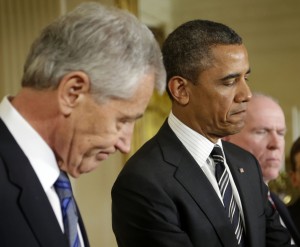

Obama to Nominate John Brennan, ‘Kill List’ Architect, as New CIA Chief
As many listeners know, President Barack Obama has nominated John Brennan as director of the CIA. Brennan is currently Deputy National Security Advisor for Homeland Security and Counterterrorism. In this capacity Brennan meets with the president daily and is governed the administration’s program of extrajudicial assassinations known as the “kill list.”
In 2011 and 2012, Brennan used his position to “re-organize” the process by which people outside of war zones were put on the list of drone targets. Basically, this “reorganization” gave the White House the power to secretly determine who would die in the US assassination program overseas.
We welcome back retired CIA officer, Ray McGovern, now a political activist. McGovern was a federal employee under seven U.S. presidents in the past 27 years. Ray McGovern’s article on Consortium News: The Grilling That Brennan Deserves.
- After 9-11, the acceptance of things like torture has become even more widespread.
- I spent a little time in Germany and I know about Gestapo tactics, and it seem to me that enhanced interrogation techniques sounded very familiar, and indeed its right out of the Gestapo lexicon.
- The immediate post World War II experience was very vivid.
- Obama is very fastidious in looking over this “kill list.” He’s got his own priest.
- It did me great good to know there were a handful at least of Fordham students that stood with their back to Brennan and protested vigorously against not being the commencement speaker but awarded the Doctorate of Humane Letters.
- He openly advocated kidnapping, the euphemism there is extraordinary rendition.
- There are black prisons all over Europe and Asia where these people were kept and tortured.
- He was an open advocate of at least the kidnapping and he was there. He was at the right hand of George Tenet so to speak.
- I have good information that Brennan was among those in the White House basement supervising the demonstration of “enhanced interrogation techniques” that Condeleeza Rice arranged for all the personages there.
- It’s all a master weaving, webbing of deceit and John Brennan is at the bottom of it.
- He was a classis example of a failed analyst. Why did he get where he is?
- He made an important friend George Tenet.
- Is Brennan suggesting that Muslims are hard wired to want to knock down planes over Detroit.
- I have very good information in that report that Brennan is the prime mover in all these abuses.
- It’s not about success, it’s about principle here.
- I like Dr. King’s motto, there is such a thing is too late. Sometimes you really have to put your body into it.
- Unless we act, nothing will be achieved.
- There are 2 CIAs. The one that Truman set up to give him honest answers to what’s going on in the world.
- To speak without fear or favor, to tell ’em the truth. That’s the one I worked in. That’s the one I could with career protection knock noses out of joint in the Pentagon and the State Department. I could do that.
Guest – Raymond L. McGovern, retired CIA officer turned political activist. McGovern was a Federal employee under seven U.S. presidents in the past 27 years. Ray’s opinion pieces have appeared in many leading newspapers here and abroad. His website writings are posted first on consortiumnews.com, and are usually carried on other websites as well. He has debated at the Oxford Forum and appeared on Charlie Rose, The Newshour, CNN, and numerous other TV & radio programs and documentaries. Ray has lectured to a wide variety of audiences here and abroad. Ray studied theology and philosophy (as well as his major, Russian) at Fordham University, from which he holds two degrees. He also holds a Certificate in Theological Studies from Georgetown University.
A Catholic, Mr. McGovern has been worshipping for over a decade with the ecumenical Church of the Saviour and teaching at its Servant Leadership School. He was co-director of the school from 1998 to 2004. Ray came from his native New York to Washington in the early Sixties as an Army infantry/intelligence officer and then served as a CIA analyst from the administration of John F. Kennedy to that of George H. W. Bush. Ray’s duties included chairing National Intelligence Estimates and preparing the President’s Daily Brief, which he briefed one-on-one to President Ronald Reagan’s most senior national security advisers from 1981 to 1985.
—————————————————————————–