Welcome to Law and Disorder Radio
Law and Disorder is a weekly independent civil liberties radio program airing on more than 150 stations and on Apple podcast. Law and Disorder provides timely legal perspectives on issues concerning civil liberties, privacy, right to dissent and practices of torture exercised by the US government and private corporations.
Law and Disorder October 15, 2012
Podcast: Play in new window | Download
Updates:
- Chipotle Signs Fair Food Agreement With Coalition of Immokalee Workers
- Michael Ratner: Supreme Court Rules On Telecom Immunity
- Bush Politicians Accepted Donations From Terrorist Group M.E.K.
- Veterans and Allies Arrested in New York as Afghanistan War Enters Year 12
—-
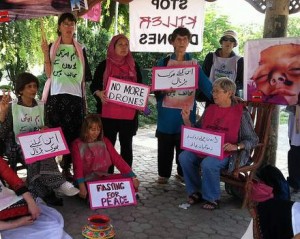
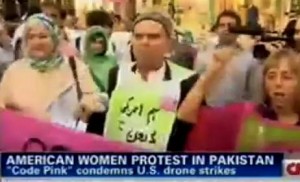
Anti-Drone Action: Code Pink Delegation to Pakistan
Two weeks ago a delegation of 40 members from Code Pink traveled to Pakistan protesting US drone strikes. The group is also visiting families of those injured or killed by drones and to encourage relations amid the broader Muslim world. The delegation is made up of students, doctors, veterans, retirees and artists. Recently the group set out on a massive anti-drone march in Waziristan where drones have killed many civilians. In one statistic, within two years more than 90 drone attacks have killed 5000 innocent Pakistanis. We get an update on the delegation from Code Pink member Rae Abileah. Rae is the co-director of CODEPINK Women for Peace. She is also a founding member of Young Jewish Proud, the youth wing of Jewish Voice for Peace. Rae has visited Israel and the West Bank several times, and has traveled to Gaza and Iran.
- I’m the co-director of Code Pink nationally. Medea Benjamin, co-founder of Code Pink has been doing work on drones for the past year and a half. She recently wrote a book Drone Warfare: Killing By Remote Control
- She partnered with PTI, the Pakistani Political Party and their leader and a well known lawyer for drone victims.
- They got this delegation rolling and ended up with 35 Americans in Islamabad setting out on this caravan to march to a place where really in the past decade no Americans have gone to.
- They put their bodies on the line and joined these Pakistanis going on this march.
- People in Waziristan are living with drones overhead, they don’t know when the next attack is going to come.
- It started out as a car caravan with more than 100 vehicles, they drove for hours.
- The goal was to get to south Waziristan the epicenter of the US drone attacks.
- President Obama has declared all young men in Pakistan to be potential militants. It gives the green light to shooting civilians.
- These soldiers are sitting there all day looking at the screen as if its a video game.
- These military pilots are going to work all day, pressing buttons that kill people thousands of miles away and going home to their dinner table in Vegas at night.
- It’s a primary tool for attracting militants to join the Taliban.
- We’re continuing to build grassroots support to oppose Obama’s drone program.
- During the delegation we were actually able to deliver thousands of signatures collected on a stop drones petition directly to Obama at one of his fundraisers in San Francisco.
- In Congress there’s also a Drones Caucaus, the leaders such as Bill Buck McKeon are taking hundreds of thousands of dollars from drone manufacturers.
- Soda Stream is manufactured in an illegal settlement in the occupied territories.
Guest – Rae Abileah, co-director of CODEPINK Women for Peace and is a co-organizer of Occupy AIPAC, Stolen Beauty boycott of Ahava cosmetics, and Women Occupy. Rae is a contributing author to 10 Excellent Reasons Not to Join the Military; Sisters Singing: Incantations, Blessings, Chants, Prayers, Art and Sacred Stories by Women; Beyond Tribal Loyalties: Stories of Jewish Peace Activists; and Beautiful Trouble: A Toolbox for Revolution. She lives in San Francisco, CA.
——

11 Years of War In Afghanistan
This month marks 11 years since the colonial war in Afghanistan was launched. Operation Enduring Freedom armed forces include the United States, the UK, Australia and the Afghan United Front. We’ve talked with past guests about how multi-national corporations are involved to integrate Afghanistan into the global system by building schools and infrastructure. We’ve also talked about the strategic energy alliances forming between Russia and China on one side and how three Caspian Sea oil companies continue to lock the US in to the war.
- This already the longest war in history.
- We hear from President Obama that within the year 2014 combat troops will be withdrawn.
- We’re hearing new calls from different forces including most recently the Secretary General of NATO indicating there was a possibility that NATO may pull out its troops earlier then the end of 2014 because of the insider killings.
- The only figures we have began in 2007, they began counting some confirmed deaths. About 13 thousand Afghan civilians only since 2007.
- The US is there in two ways, the US has a commander happens to be the NATO commander. Other US troops are there separately. The US has almost 70 thousand troops there now, NATO has 40 thousand other troops and there are about 90 thousand US paid contractors.
- US troop casualties: Even that now is unclear.
- Last week a number of press outlets reported the 2000th US military casualty.
- Young people in Afghanistan join the military for the same reasons young people in the United States join the military, because they’re desperate for a job.
- Remember a couple of weeks ago 9 Afghan women and little girls were killed gathering wood before dawn to build a fire, to make breakfast.
- The Pentagon said, oh sorry, and somehow think that its going to make it ok.
- Add to that the lack of cultural sensitivity, the lack of language training so there’s no sense from soldiers on the ground that they have any idea what this culture is about, who these people are.
- Afghanistan is about 25 million people, the vast majority don’t live in the cities. They live in tiny hamlets and small towns, small villages, very scattered.
- What we’re seeing is an expansion of the global war on terror.
- There is an anti-war movement it’s just not as visible as we’ve seen in earlier times.
- That’s the hardest part of our work, its not building an anti-war movement, its making our government take into account the opinions of not only a movement but the American people.
- Understanding the Palestinian Israeli Conflict.
Guest – Phyllis Bennis, director of the New Internationalism Project at the Institute For Policy Studies. She is also a fellow of the Transnational Institute in Amsterdam. She has been a writer, analyst, and activist on Middle East and UN issues for many years. In 2001 she helped found and remains on the steering committee of the U.S. Campaign to End Israeli Occupation. She works closely with the United for Peace and Justice anti-war coalition, co-chairs the UN-based International Coordinating Network on Palestine, and since 2002 has played an active role in the growing global peace movement. She continues to serve as an adviser to several top UN officials on Middle East and UN democratization issues.
———————————————————————-
Law and Disorder October 8, 2012
Podcast: Play in new window | Download
Updates:
- Mass Probable Cause – 2004 RNC Case Update
- Senate Report: 77 Fusion Centers “Pools of Ineptitude”
- Michael Ratner: Three Important Confinement Cases
- In Memory of Ernesto Che Guevara: 45 Years
- Lynne Stewart Update
——
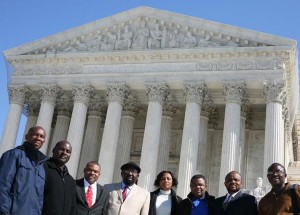

Universal Jurisdiction: Kiobel v. Royal Dutch Shell / Bush 6 Case In Spain
This week the US Supreme Court will decide if corporations could be held liable in U.S. courts for violations of international human rights law in the land mark case Kiobel v. Royal Dutch Petroleum. The case was brought by families of seven Nigerians who were executed by a former military government for protesting Shell’s exploration and development and is pushing to hold corporations accountable for human rights violations. The Supreme Court will also consider how the Alien Tort Statute Claim can be used the Kiobel case. A one sentence law that goes back to 1789 when the first judiciary act was brought in the United States. We’ve discussed this statute with several past guests including attorneys Peter Weiss and Rhonda Copeland who were instrumental in beginning the first cases in which human rights violations, taking place in other countries could actually be litigated in the United States.
We also discuss the recent amicus filing by a group of international human rights organizations and experts before the Spanish Supreme Court. The brief asks the Spanish Supreme Court to overturn a decision not to pursue a criminal case against six former officials from the Bush administration for their role in directing and implementing a systematic torture program. Past shows with Katherine Gallagher.
- The Kiobel case has been in US courts since 2004.
- The claims were brought in the Southern District of New York, under a law from 1789, known as the Alien Tort Statute.
- This law allows non-US citizens to come into a US federal court and assert violations of the Laws of Nations or International Law.
- A recent precedence for this is Citizens United, what happened was that the Second Circuit ruled that corporations could not be held liable for these egregious human rights violations under the Alien Tort Statute.
- The question of corporate liability went up to the Supreme Court first.
- We had 2 judges from a 3 bunch panel in the Second Circuit suddenly come out in the fall of 2009 and say there is no corporate liability. That is the question that went up to the Supreme Court.
- Four other circuits had look at this question and they said of course corporations can be held as liable as an individual, a natural person.
- The Alien Tort Statute allows for a civil suit and civil liability rather than criminal liability.
- The key case from 1980 that CCR brought, the case of Filartiga, this case which the Supreme Court affirmed in 2004 as being on solid legal basis, claims by a Paraguayan, against a Paraguayan for actions that occurred in Paraguay.
- So its very strange that the Supreme Court was asking in a very broad fashion whether the ATS could apply to actions that occurred in another country. That is what the bulk of the cases brought under the ATS have been about.
- Some of the cases where the ATS is used are for some of the most serious violations. Cases of war crimes, crimes against humanity, torture, not your run of the mill case.
- What the justices seem to coalesce around was the issue of whether there’s an alternate forum. If the claims against Shell could have been brought in the UK or in the Netherlands, maybe they don’t need to be brought in the US.
- We’ve seen a trend in the last 20 years of other countries adopting stronger laws that allow for redress, and accountability, so we don’t have to be the world’s policeman.
- There have been 2 cases that percolated up in the last 4 years in Spain.
- The first is a widespread investigation of the torture program then Judge Balthazar Garzon. This is a case looking at torture in Guantanamo, and potentially in Iraq and Afghanistan, looking at the whole U.S. torture program. That case was brought on by 4 named plaintiffs.
- That case is very wide ranging, and willing to go up the chain of command as far as the evidence leads.
- There is a second case that was brought against specific U.S. individuals. They’re known as the Bush 6, including, Jay Bybee, John Yu, David Addington, Alberto Gonzalez. Six men who served as lawyers and argued to have essentially created both the legal structure that enabled the torture program, providing arguements for immunity and protecting participants of the torture program from accountability.
- Spain has a long and proud history of upholding International Law. Spain is where we had the case against Augusto Pinochet in the late 90s.
- We’ll be doing this as long as we need. We need to have accountability, its really critical.
Guest – Katherine Gallagher, Senior Staff Attorney at the Center for Constitutional Rights (CCR), where she focuses on holding individuals, including US and foreign government officials, and corporations, including private military contractors, accountable for serious human rights violations. Among the cases she has worked, or is working, on are international accountability efforts for U.S. officials involved in torture (Spain, Switzerland, Canada); ICC Vatican Officials Prosecution; Arar v. Ashcroft, Corrie v. Caterpillar, Matar v. Dichter, Saleh v. Titan, Al-Quraishi v. Nakhla and L-3, Estate of Atban v. Blackwater.
—————————————————————————————————
Law and Disorder October 1, 2012
Podcast: Play in new window | Download
Updates:
- PFCJ Challenge Sidewalk Arrests During Occupy Wall Street Anniversary
- Insane Clown Posse To Sue The FBI
- Texas Policeman Shoots Wheelchair Bound Man In The Head
———–

ACLU Issues Statement In Response to Father-Daughter Dance Controversy
In Rhode Island, the Cranston School Department recently announced that it is banning traditional “father-daughter” and “mother-son” activities. citing a violation of federal law. The controversy arose when a local parent-teacher organization with support from the school, organized a “father-daughter” dance for female students and a “mother-son” outing to a Pawtucket Red Sox baseball game. When a single mother complained that her daughter could not attend the dance because her father was not a part of their life, the ACLU notified the school district they were suing for gender discrimination under Rhode Island law. The Rhode Island ACLU posted a statement noting that “This type of gender stereotyping only perpetuates outdated notions of ‘girl’ and ‘boy’ activities and is contrary to federal law.”
- Title IV is a federal law, a really crucial law promoting fairness and equality on the basis of gender in the school setting.
- There are certain exemptions, one in particular says its ok for schools to have father-son and mother-daughter events without violating this general ban on sex discrimination in school activities.
- Back in the 1980s, Rhode Island passed its own version of Title IV.
- In April or May of this year, we did receive a complaint from a parent, a single mother who has a daughter in the Cranston School district, and she received a notice of a “Me and My Guy Dinner Dance” for girls attending the school.
- There is no adult male in her life, she’s raised her daughter by herself. When she got this notice she was concerned that she wouldn’t be able to attend. She was also concerned about the mothers and sons event, she was barred from that as well.
- She also pointed out that the PTO was reverting to an old type of tradition that they’d actually stopped a few years previously. Nonetheless the PTO said we want to bring back this father-daughter dance and that’s what we’re doing.
- We very quickly got a letter back from the superintendent not only agreeing with us, but they notified the PTOs previously that they should not be holding these types of events.
- It was a rogue PTO president deciding to bring back this father-daughter dance after it had disappeared for some time. We thought that it was all resolved, until a candidate for state office in Cranston decided to turn it into a political issue.
- If their name (ACLU clients) were out there (in the public) based on what we’ve seen here, I would expect based on some of the vitriol we’ve seen here but also vitriol we’ve experienced in another case in the same school district, that there would be some adverse consequences.
Guest – Attorney Steven Brown, Executive Director of the Rhode Island Civil Liberties Union.
———

Wisconsin Dept of Transportation And Federal Civil Rights Violations
The Federal Highway Administration’s Office of Civil Rights is moving to hold Wisconsin transportation officials accountable for allegedly discriminated against minorities. Though the state says it’s in compliance, a lawsuit proceeds on the legal basis of Title VI of the Civil Rights Act of 1964 which prohibits agencies that receive federal funds from discriminating on the basis of race, color, national origin, gender, age or disability. The lawsuit could freeze construction on a major Wisconsin freeway interchange known as the Zoo Interchange. Meanwhile, the ACLU of Wisconsin and the Black Health Coalition of Wisconsin continue to issue complaints that the Wisconsin DOT has allegedly failed to address their requirements to gather data about the impact their actions have on minorities.
Attorney Kayrn Rotke:
- Title VI – If you get federal money you can’t discriminate on the basis of race.
- Most if not all federal agencies have civil rights offices or units or divisions that enforce those Title VI requirements.
- It prohibits actions that have a discriminatory effect.
- Milwaukee and the counties around it are the most racially segregated region in the United States.
- The other issue if you have job growth in these overwhelmly white suburbs and absolutely no transit access.
- Its making a transportation system that benefits commuters who are disproportionally white.
- At the same time the transit system is biting the dust.
- We see that as a program that is clearly having a discriminatory effect on people of color.
- I think there are hooks that you can look at to try to challenge this.
- State Departments of Transportation have to update Title VI annually.
- This is taking a step back and looking at it in an environmental justice way.
- You can’t have healthy people in a sick community.
Guest – Karen Rotke, senior staff attorney for the ACLU of Wisconsin.
———


The Democrats: A Critical History
As we near the 2012 Presidential election, many are complacent about what they see as having to choose between the lesser of two evils. By choosing political heads of the false left right political paradigm, where third party candidates are marginalized, sidelined or altogether pushed out or sidelined what are are we really supporting? We talk today with author Lance Selfa, who wrote the book The Democrats: A Critical History. It offers a realistic assessment of the Democratic Party and examines the nature of the party beyond the campaign rhetoric and media hype. Lance joins us today to talk about his book, the Democratic Party and the upcoming election.
- I would describe it as one of the two big business parties that runs the American political system that trades off between itself and the Republican Party.
- Though many people don’t see it that way because it has the image of the party of the people. It’s the party that most African-Americans vote for, union members voter for.
- Really what controls it is big business interest.
- It was the party that tied together and held the southern slave holding class with northern financial interest and western farming interest.
- The Democratic Party combined the sense in which it was looked on as the party of social security and medicare and so on, but that was always coupled with commitment of the Democratic Party of an aggressive foreign policy that actually got us into wars like Vietnam.
- There’s a real bipartisan commitment to that empire.
- Both of them Republicans and Democrats answer to big business interests.
- The way Wall Street money is shifting support to Romney shows that business tries to play both parties to insure it’s interests are preserved.
- The Democrats are sort of like the “plan B” party for capital.
- Capital would prefer to have a party that’s just big business that doesn’t have to make any attempt to say that they’re in favor of any kind of programs for the poor.
- The Democrats at least have those rhetorical commitments. They have a social base that they have to placate.
- Business finds out in periods such as the end of the Bush Administration, the most unpopular administration since Richard Nixon that Republicans were going to get turfed out of office so business starts to move their money over to Democrats.
- If one succumbs to the idea that there are only two choices and the only thing anyone can do politically is to choose the lesser of two evils. Will voting for Obama actually advance an agenda of social movement? I would argue no.
Guest – Lance Selfa, author of The Democrats: A Critical History. Lance is a frequent contributor to the International Socialist Review, and writes a column on U.S. politics in Socialist Worker newspaper.
—————————————————————