
Welcome to Law and Disorder Radio
Law and Disorder is a weekly independent civil liberties radio program airing on more than 150 stations and on Apple podcast. Law and Disorder provides timely legal perspectives on issues concerning civil liberties, privacy, right to dissent and practices of torture exercised by the US government and private corporations.
Law and Disorder April 23, 2012
Podcast: Play in new window | Download
Updates:
- Law and Disorder Tip Of The Hat Award: Mara Verheyden-Hilliard and Carl Messinio For Creative Use of FOIA
- Cyber Intelligence Sharing and Protection Act (CISPA)
- Forty years in solitary: Two Men Mark Somber Anniversary in Louisiana Prison
- Movie – Herman’s House
- Creative Protest At the Florida Atlantic University Campus
——
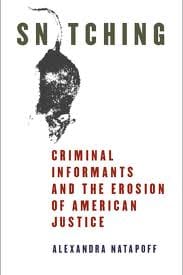
Snitching: Criminal Informants and the Erosion of American Justice
The FBI now spends more than 3 billion dollars a year on counter-terrorism, the bureau maintains a team of 15 thousand spies in a nationwide network of informants. Criminal informants or snitches are part of a criminal system most people know little about. Many of these informants are tasked with infiltrating Muslims communities in the United States. We’ve discussed in the past, the expanded FBI guidelines plus the broad over reaching powers and underhanded tactics the FBI use when targeting Mosques and Muslim Americans.
We talk today with Professor of Law and author Alexandra Natapoff, about her book Snitching: Criminal Informants and the Erosion of American Justice. Her book catalogues the downside in the use of snitches on social structure and democracy and suggests ways to make the use of informants acceptable within the criminal justice system.
- Snitching is such a massive part of our criminal justice system even though the public rarely gets a good look at it.
- It’s an under the radar aspect of the way our criminal justice system handles investigations, the way it handles cases, the way it shapes our case law.
- It’s such a powerful deal, a deal that exerts a huge amount of influence and plea bargaining.
- The reality is that this is a deeply under-regulated arena. The handler is the law enforcement official who creates and uses an informant.
- It could be a police officer talking to a street corner addict cutting a deal right then and there.
- It could be an FBI agent who has an established documented supervised relationship with a long term criminal informant.
- Somebody may be suspected of a crime or even just of interest to the government. People who have mild brushes with the criminal system can end up through this mechanism of criminal informing entering into a world in which really anything can happen to them.
- Argument: Either you let us use informants in an unaccountable, invisible, secretive, undocumented way or we can’t run the criminal system at all.
- We permit the barter of crime under the radar, in a way that is unfair to other defendants and other suspects. We produce unreliable information through the use of informants without regulation.
- My contention is that we shouldn’t ban this practice, but run it as any other public policy with transparency and accountability and some rules.
- My favorite criminal informant of recent is Jack Abramoff.
- Usually we don’t learn when informants have been mistreated because often they have very little power.
- The courts have said, informants proceed at their own risk.
- This is a deal that they can enter if they want to risk their life.
- The law does not owe criminal informants much protection. Our criminal system is built on the principle that the defendant should not have to face the government unaided by council.
- That’s a principle that should be extended to criminal informants.
- The state of Florida passed a ground breaking law, called Rachel’s Law.
- What sort of deal should we permit the government to cut with informants?
- The use of criminal informants is a massive source of error in capitol cases.
- States across the country are starting to impose greater restrictions on the use of criminal informants, in particular jailhouse snitches as a way to improving reliability of the information.
- Confidential Informant Accountability Act – Federal Legislative Proposal
- One of the things the government doesn’t keep track of is how many crimes are committed by criminal informants in the pursuit of investigating new cases.
Guest – Alexandra Napatoff, professor of Law at Loyola Law School, Los Angeles, and a member of the American Law Institute. I have also been a federal public defender, a community organizer, and the recipient of an Open Society Institute Community Fellowship.
————–
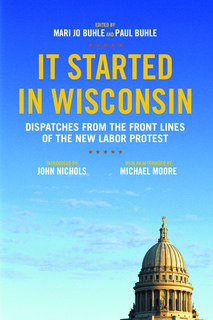
It Started in Wisconsin: Dispatches from the Front Lines of the New Labor Protest
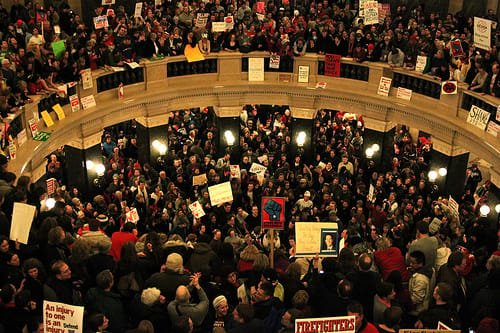
Remember the multi-day occupation of the Wisconsin State Capitol by tens of thousands of people. Massive demonstrations erupted when the Republican controlled state government proposed to dismantle public employee bargaining rights as Wisconsin trade unions already conceded to wage and benefit cuts. These protests became the largest labor demonstrations in modern American history. Protesters from the Middle East sent pizzas and solidarity as thousands occupied Madison’s Capitol building.
We’re joined today by Paul Buhle, historian, and editor of the book It Started in Wisconsin: Dispatches from the Front Lines of the New Labor Protest. A powerful collecton of eyewitness reports and essays by striking teachers, students, and many others. This book exposes the corporate agenda that imposed anti-union legislation across the country and highlights the power of the people coming together in protest.
- Brecht Forum, Friday night – April 27,2012
- The “it” is very large, perhaps vaporous and very promising. We were thinking of occupy in the sense that Madisonians, labor supporters from as far away as California, occupied the State Capitol, the rotunda in February of last year and remained there for some weeks.
- The “it” may mean occupy or the emergence of a new kind of movement.
- We should have seen it coming but we were deluded or Walker, when running for election never mentioned these promises or threats at all and made some statements about getting along with unions when he was a county executive.
- The response was just as stunning as the shock. A mass outpouring that really began with students in Stoten, an old Norwegian community about half an hour south of Madison – working up their own protests with facebook to support their teachers.
- And then, the following weeks, a massive outpouring of people around the Capitol and then occupying the Capitol.
- Things went on and on until there were crowds of 150 thousand in a town of Madison that has normally only 250 thousand residents.
- Pacifica has been in the business from the late 1940s in the Bay area, in providing the documentation that other commercial radio stations rarely provide.
- I would say these protests in Wisconsin are probably the most recorded mass movement of the Left in recent history.
- Among the most important developments, relative to the stories in the history of labor, the unions of public workers are substantially, if not overwhelmingly women.
- So, the shape of the movement, perhaps its cultural character, perhaps the infernal degree of politeness that outsiders frequently complained about, the chant – let us in, let us in please.
- What it demonstrated was that women in the labor movement were ferociously militant.
- My assessment was that the labor movement was in no way prepared to stage a general strike.
- Nor that a massive walk out of public workers mean that the wheels of industry would stop what few wheels are left.
- The sense that public workers wish to put pressure on the political system.
- Contrary to our expectations of the Democratic Party in general, assorted leaders, were quite wonderful in their constituencies and the things that they did, and how they related to the movements.
- As an editor and producer of radical comics, I’m always interested in new developments in the field, and its exciting there are young comic artists who are working in and around “occupy.”
Guest – Paul Buhle, senior lecturer at Brown University, a historian of American radicalism., a former member of Students for a Democratic Society and author of many books including images of American Radicalism. Also, Che, A Graphic Biography, and Isodore Duncan, a graphic biography by Sabrina Jones.
———–
May Day: Workers’ Rights and Immigrant Communities
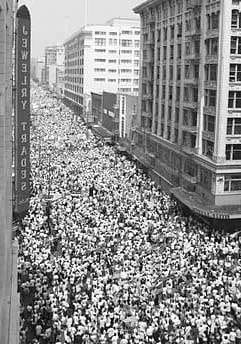
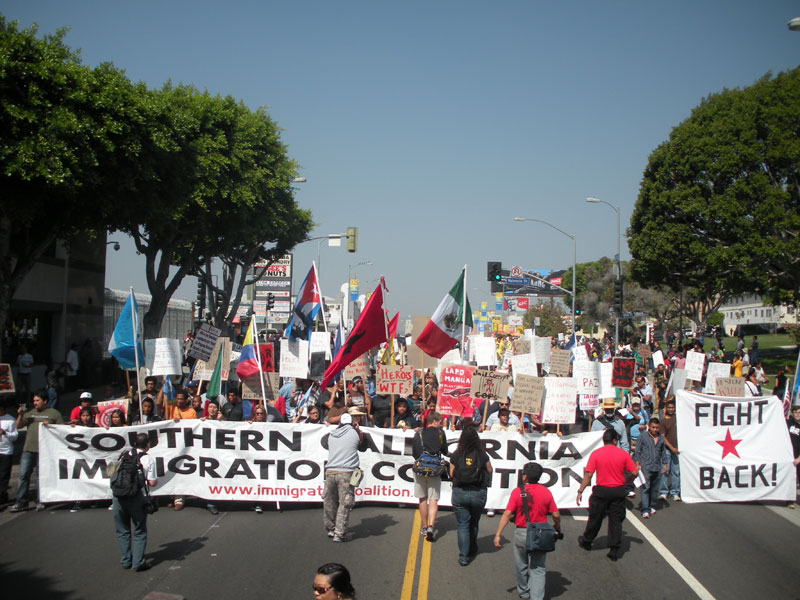
In the past year, public employees around the country have rallied to hold on to their collective bargaining, workers rights and pensions. May Day protests this year will emphasize these issues and will be especially significant for immigrant rights in California that directly effect certain communities. On May Day in 2006, hundreds of thousands took to the streets of San Jose marking one of the largest demonstrations in California history.
Guest – Celina Benitez, director of the Committee In Solidarity With the People of El Salvador, Celina is also with the Southern California Immigration Coalition and produces radio for Suplemento Comunitario on sister station KPFK in Los Angeles.
——————————————————-
Law and Disorder April 16, 2012
Podcast: Play in new window | Download
Updates:
- Cuban Five Rally in Washington DC
- Coalition For Immokalee Workers Rally Tour
- Mumia Abu-Jamal – Occupy The Justice Department
- European Court of Human Rights Allows Extradition: Imprisonment In Supermax Prison Doesn’t Constitute Torture
————————–
Truth and Consequences: The U.S. vs. Bradley Manning
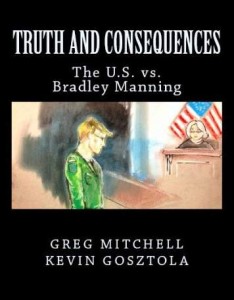
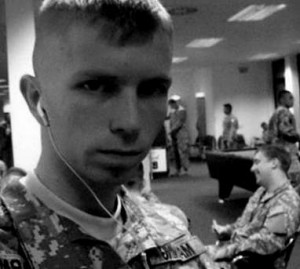
In the past year, we’ve covered Wikileaks and specifically the Bradley Manning case in our updates. We talk today with Greg Mitchell co-author of the new published book, Truth and Consequences: The U.S. vs. Bradley Manning. In the first part of the book titled Solitary Man, Greg Mitchell gives readers a detailed look into the character of Bradley Manning. The second part of the book details the Bradley Manning trials written by co-author Kevin Gosztola. Hard journalism let the voices of friends and family document the important details in Manning’s life leading up to Wikileaks and then the book dives into the complexities of the trial. In the preface Greg writes “Ultimate truths, in this case, may lead to ultimate consequences for one who would not be silent.
- The second half of the book is really the only thing out there that covers in depth what has happened to him in the last few months.
- Namely his court martial proceedings after he was imprisoned for a year and a half. His first hearing was last December. He is awaiting what is expected to come out as a formal court martial in August. If it does start in August, it will be well over 2 years since he was arrested.
- A lot of the charges are related to passing along to Wikileaks, this classified secret information. Course the most dynamite charge is that he gave aid to the enemy.
- Who is the enemy? The government was forced to say that it was Al-Qaeda. That charge potentially carries the death sentence.
- They’re interested in punishing Manning, the big fish they’re after is Julian Assange.
- Last year there was global outrage when he was kept in solitary confinement, being forced to sleep naked, and stand at attention naked.
- All the top media outlets had a falling out with Wikileaks, and I think there’s a spill over from that.
- There hasn’t been any media coverage that really probes into what’s going on here.
- Over and over he (Bradley Manning) cited his outrage at what he was seeing in those cables and in Iraq, and things he was asked to participate in.
- The court martial will be extremely embarrassing to the military because they gave him access to these documents.
- He was a kid who grew up in Oklahoma, his parents eventually got divorced. He was a computer nerd, growing up. He realized in his teens, he was gay.
- He wasn’t a longtime peacenik or things like that, he always had some social conscience, and when he got to Iraq, he saw things that upset him.
- It may have never come out, that he would be arrested, except that he had these online chats with Adrien Lamo, who is a convicted hacker. Lamo decided Manning was talking too much about what he did and went to the authorities.
- The Manning case shows this incredible legacy of our wars in Iraq and Afghanistan, which have gone on for a decade, its never ending and yet the American public has never been brought face to face with what the US has done in those countries, civilian casualties.
Guest – Greg Mitchell writes daily for The Nation magazine’s web site. He is the author of more than a dozen books, including The Campaign of the Century (winner of the Goldsmith Book Prize), So Wrong for So Long: How the Press, the Pundits and the President Failed on Iraq, Why Obama Won, Tricky Dick and the Pink Lady, The Age of WikiLeaks, and with Robert Jay Lifton, Hiroshima in America and Who Owns Death? His most recent books are Atomic Cover-up and Journeys With Beethoven. He was the editor of Editor & Publisher from 2002 to 2009. He also served as longtime editor of Nuclear Times magazine, and before that was senior editor at the legendary Crawdaddy. Hundreds of his articles have appeared in leading publications and he has served as chief adviser for two award-winning documentaries.
—-

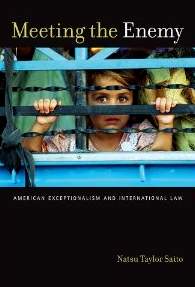
Lawyers You’ll Like – Attorney Natsu Saito
For our Lawyers You’ll Like series, we welcome back attorney and professor Natsu Saito. In our last interview, Professor Saito mentioned how the current system of international law evolved from the a broader agreement between the European colonial powers based on how they were not going to destroy each other in the process of taking over the rest of the world. It is this duality that Natsu writes about in her book Meeting the Enemy: American Exceptionalism and International Law. Professor Saito joined the College of Law faculty in 1994 and teaches international law, human rights, race and the law, immigration, criminal procedure, and professional responsibility. Her scholarship focuses on the legal history of race in the United States, the plenary power doctrine as applied to immigrants, American Indians, and U.S. territorial possessions, and the human rights implications of U.S. governmental policies, particularly with regard to the suppression of political dissent.
- The duality that the US does exempt itself (from international law) very consistently and very frequently and yet promotes international law very strongly and relies upon it.
- It has relied upon certain premises that are fundamental to the whole outlook and paradigm of colonialism – which is that there is a higher good, a more civilized approach the US embodies.
- The law doesn’t apply because we have a higher aim of civilization and that justifies not playing by the rules.
- The United States making others comply with human rights standards while exempting itself
- Moving humanity toward this higher goal is so critical because if you strip that away and you look at the realities on the ground, you see what has been termed Western civilization has been incredibly barbaric.
- In order to get around that analysis, you have to say it was for a higher good.
- I think the “left” tends to accept the general framework, and to make particular criticisms of policies and practices that are obviously problematic. The US government engaging in torture for example, but each instant is accepted as anomalous instead of the larger picture.
- It is too frightening even for the people on the left to deal with the reality that this is a country that sits on occupied land, illegally occupied by its own rules. People on the left want to make it a kinder, gentler colonialism.
- I started out thinking I was writing a book about the failure of the United States failure to comply with international law, as I got into it, the more interesting questions were the push / pull dynamics between reliance on international law
- The current system of international law evolved from the international law which was the agreement between the European colonial powers of how they were not going to destroy each other in the process of taking over the rest of the world.
Guest – Professor Natsu Saito, Department of Ethnic Studies, University of Colorado. Co-Sponsors: UCI Department of Asian American Studies; UCI Department of Planning, Policy, and Design; UCI Department of Criminology, Law and Society; The Center for Unconventional Security Affairs; The Center for Research on Latinos in a Global Society. Legal scholar Dr. Natsu Saito delivered a lecture on homeland security. Her lecture examined the implications of the USA Patriot Act on Civil liberties for immigrant groups and for the rest of the population
——————————————-
Law and Disorder April 9, 2012
Podcast: Play in new window | Download
Updates:
- Mumia Abu-Jamal Appeal Rejected
- Supreme Court Ruling Allows Strip Search For Any Arrest – Targets Minorities
- ICC Declined Investigation Into Operation Cast Lead
————-
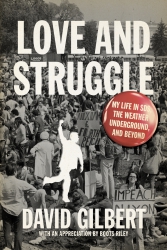
Love and Struggle: My Life in SDS, the Weather Underground, and Beyond
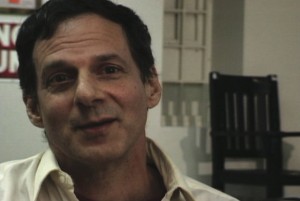
Love and Struggle: My Life in SDS, the Weather Underground, and Beyond is the title of a new book chronicling the militant career of radical activist David Gilbert. As many listeners may know David Gilbert was the founder of SDS, Students for a Democratic Society at Columbia University and he helped build an underground resistance to war and racism known as the Weathermen, one of the most radical movements in the United States. Gilbert was incarcerated because of his involvement in the 1981 Brinks robbery that resulted in four deaths. His book is a very personal account told from first person that marks his various stages as a liberal, a radical and then revolutionary. Gilbert has been in jail for the past 3 decades and readers get a rare glimpse into this retrospective.
- David has been in prison my whole life. As a teenager and activist I needed a mentor.
- I started writing political prisoners and David Gilbert was one of them.
- He was patient and gracious in answering my many questions. Helping me think about race and empire and my role in the world.
- I think he’s done a phenomenal job of walking us through the thought process.
- In his own case, David was reluctant to write about prison conditions, and Love and Struggle is not at all a prison memoir.
- I think its quite rare to have a prisoner write a book that’s not about prison conditions.
- The humanizing effect he writes about is not about the abuse he’s suffered inside. Video with readings
—–
Naomi Jaffe:
- David and I met when we were both graduates at the New School in New York, in ’67 it must’ve been.
- We were co-founders of New School SDS, we were fire-y young students together for several years in New York.
- David wrote (Love and Stuggle) because young people were asking him, what the lessons were from that period. Lessons- the way that our generations have much to learn from each other, passing a legacy from generation to generation.
- There’s a huge amount on racism and white supremacy and being a white ally, an analysis of how you move in a way as a white person to oppose white supremacy.
- To me, its not only the connection but learning from who you learn from.
- His (David Gilbert) ability to figure out that the clearest analysis of an oppressive system comes from people who are on the receiving end of it.
- David says Malcolm X opened the eyes of his generation.
- People are beginning to read it for the transfer of information from one generation to another.
- I think one of the lessons is how has David survived as a prisoner.
- He wrote an earlier book which was a collection of essays called No Surrender. It meant; how do you maintain your spirit?
- From the point of view of the Occupy Movement, the ability to center the narrative of people of color and of the most oppressed people.
Guest – Dan Berger, a writer, activist, and the George Gerbner Postdoctoral Fellow at the University of Pennsylvania. He writes about race and postwar American social movements. His latest book is The Hidden 1970s: Histories of Radicalism
Guest – Naomi Jaffe, writer and prison activist who helped to proof read Love and Struggle, add political and other detailed commentary.
————-
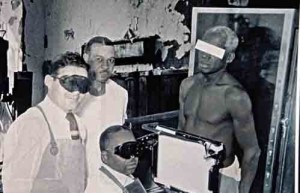
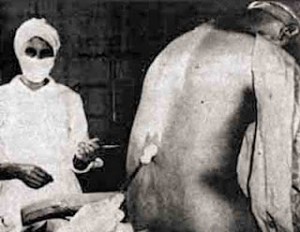
Guatemalan People Experimented On And Used As Test Subjects
We discuss a very shocking story today, about tests conducted by the U.S. Public Health Service on more than five thousand individuals in Guatemala. From 1946 to at least 1953, more than a thousand people were deliberately infected with sexually transmitted diseases. The victims included prisoners, soldiers, the mentally ill and commercial sex workers none of the had consented to this egregious treatment.
In November 2010, President Obama demanded an investigation regarding what he called the “intentional infection of vulnerable human populations.” He noted that “The research was clearly unethical.” President Obama, Secretary Clinton, and Secretary Sebelius have publicly apologized. Last fall, the Presidential Commission for the Study of Bioethical Issues released a report on its investigation into medical experimentation that took place in Guatemala. The Commission called these experiments “especially egregious”.
It’s important to note that the experimentation in Guatemala was overseen by the same lab — the Public Health Services Venereal Disease Research Laboratory — as the STD experiments at Tuskegee. In fact, some of the same researchers were involved and some of the same diseases. In the Tuskegee matter, the parties reached a $10 million settlement in 1974 in which the United States promised to provide medical benefits to the participants and established the Tuskegee Health Benefit Program (now the CDC’s National Center for HIV/AIDS, Viral Hepatitis, STD and TB Prevention).
Meanwhile, a class action lawsuit was filed on behalf of 8 individuals who claim to have been victims in the Guatemalan case, spouses or descendants of victims and is now moving its way through federal courts.
- There were experiments going on in Terra Haute, Indiana and Tuskegee, Alabama.
- There were ethical limitations with what they could do within the United States.
- The US medical researchers went down to Guatemala and targeted vulnerable populations including ophans, mental health patients, prisoners, soldiers; people who never gave consent to be part of these experiments.
- They used different methods, bringing fluid out of the spinal column, mixing that with Syplitic material and injecting that back into the person. Mixing material from genitalia into water and having people drink it.
- The populations that they were working with were in institutions already.
- Susan M. Reverby is the Marion Butler McLean Professor in the History of Ideas and Professor of Women’s and Gender Studies at Wellesley College, and an historian of American women, medicine, public health and nursing.
- There wasn’t a known treatment for syphilis at the time and they wanted to watch the course of the disease, what does it do to the human body left untreated.
- But when penicillin became a known remedy for syphilis, the fact that it was withheld, and that people were intentionally misled.
- In Tuskegee, you have a population that’s not as well protected, not respected, this pre-civil rights movement.
- We’ve brought several claims, some under International Law and some as Constitutional violations.
- International law claims, look at specifically the non-consensual human medical experimentation and also bring a claim of cruel and degrading treatment.
- The statute that we’re proceeding under, the Alien Tort Statute is one you can’t use in court unless you clear the hurdle of having a violation of international law.
- Given the nature of the disease this is something pass on to your spouse, and potentially to your children.
- The defendants in this case are the US Government and the Pan American Health Organization which is the subsequent organization from the Pan American Sanitary Health Bureau.
- They’re arguing that they should be substituted under the Westfall Act for any individual defendants.
- When you substitute the US Government you’re then proceeding under the Federal Tort Claims Act.
- In sum, you can only sue the US Government when the US Government gives you permission to do so.
- Change.org link
Guest – Piper Hendricks, an attorney working on the Guatemalan case, she has served as the International Justice Project Director of The World Organization for Human Rights USA in Washington, D.C
————————————————————–