
Welcome to Law and Disorder Radio
Law and Disorder is a weekly independent civil liberties radio program airing on more than 150 stations and on Apple podcast. Law and Disorder provides timely legal perspectives on issues concerning civil liberties, privacy, right to dissent and practices of torture exercised by the US government and private corporations.
Law and Disorder December 5, 2011
Podcast: Play in new window | Download
Updates:
- Chilean Judge Indicts US Military Official in 1973 Killings – CCR Case
- Newt Gingrich: “Water Boarding Is By Every Technical Rule, Not Torture.”
- Michael Ratner: S.1867 — National Defense Authorization Act for Fiscal Year 2012
—–
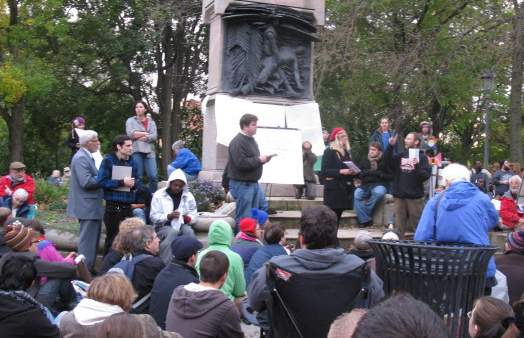
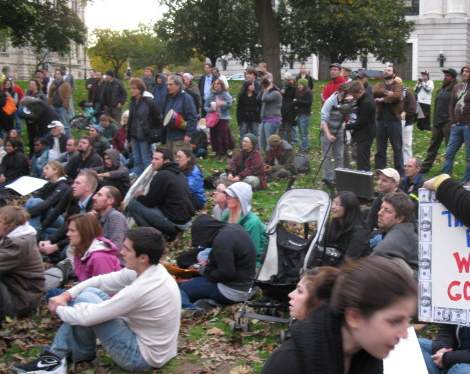
Occupy Albany: Undisturbed By City Officials
The collusion among mayors and police departments around the country to raid and take down Occupy Wall Street movements by force has revealed a particular hierarchy of control. However, as listeners may know there is a unique situation with the Occupy Wall St solidarity movement in Albany, New York. Despite the request of New York Governor Andrew Cuomo and Albany mayor to shut the encampment down at Academy Park, the police refused, then the State Troopers refused. In a memo obtained by the The Times Union, Albany Police Deputy Chief Steven Krofoff stated “At this time I have no intention of assigning officers to monitor, watch, videotape or influence any behavior that is conducted by our citizens peacefully demonstrating in Academy Park.
Attorney Mark Mishler:
- The Governor a few days before the occupation started met with the city of Albany office and as best as we can figure out at that meeting sort of all agreed that this wasn’t going to be permitted.
- It seemed to be permitted that people would not be able to stay past the 11PM curfew at the park.
- We have two very independent minded folks in law enforcement here.
- They took a different view. We have a District Attorney David Soares, who was independently elected as an opponent to the Albany County machine and with a lot of grassroots support.
- David Soares say he wasn’t interested in using his office to prosecute peaceful protesters.
- In correlation with that our police chief in the city of Albany, who also came into office as result from a grassroots movement for improved police / community relations. He also said he didn’t want to use the resources of his department to arrest peaceful protesters.
- The mayor who we believe really wanted to carry out the governor’s direction was really boxed into a corner and couldn’t do that.
- The park is really 2 parks, half of the park is city owned, the other half is state owned.
- We’re now in the sixth week, there are now about 50 tents.
- Essentially completely undisturbed by city officials.
Guest – Mark Mishler, attorney and National Lawyers Guild member.
————–
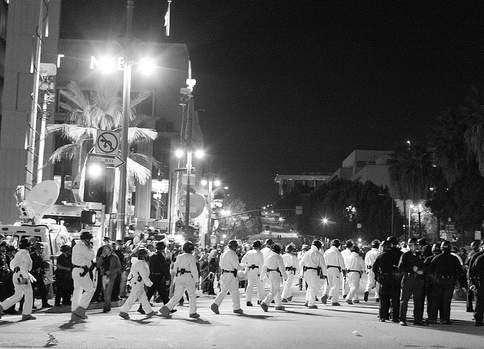
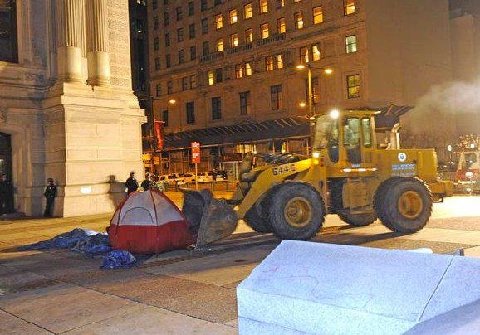
Occupy Los Angeles Legal Action
Occupy Los Angeles and Occupy Philadelphia were among the encampments forcibly removed last week. Occupy LA demonstrators had expected to be evicted after the mayor announced that the park would be closed at 12:01 a.m. on Monday last week. Late the following night, police in riot gear stormed the encampment and dozens were arrested as protesters chanted and stood defiant through the raid. The more than 500 tents have been taken down. The encampment at Philadelphia’s Occupy Wall Street movement was also raided after demonstrators marched to protest their eviction. Up to 40 protesters were arrested.
Hours after the Occupy Los Angeles eviction deadline protesters filed for a federal injunction that would prevent the police from dismantling the occupation in Oakland Park. The city, mayor and chief of police are named in the lawsuit as defendants. The complaint also says the city engaged in “arbitrary and capricious action in violation of the 1st and 14 Amendments by first approving the Occupy presence for 56 days before suddenly revoking permission through the unilateral action of defendants.
Attorney Carol Sobel:
- We filed papers, we argued that the mayor’s actions were unlawful because the City Council of Los Angeles passed a resolution saying that they could stay there.
- The Council, only the Council has the authority to do that.
- Once that Council acts, he could veto it, he chose not to at the time, back in October, or he could get it rescinded. He chose not to.
- Our position is, the Mayor can’t make up the rules as he goes along.
- This is a public forum, we’ve had anti-war marches here, marches to protest the Pope when he came.
- The mayor used to be friend. The Mayor went to the same Guild law school that I did.
- I think that the Mayor is bought and paid for by the developers in Los Angeles. Somebody said to me last night, he’s lost his soul.
- He’s not progressive by any definition of that term. He is the head of the US Conference of Mayors.
- It looks bad for him I guess to have the largest Occupy in the country, in his city, at his doorstep.
- They (LAPD) have agreed that they will not come out with a show of force, unless and until it’s needed.
- If you can’t close the park after the fact, then these arrests were all unlawful.
Guest – Civil rights attorney Carol Sobel, a legal advisor for Occupy protests across the country. Carol Sobel is listed as the attorney on the new complaint.
—
Collusion in the Defense of the 1% is No Vice
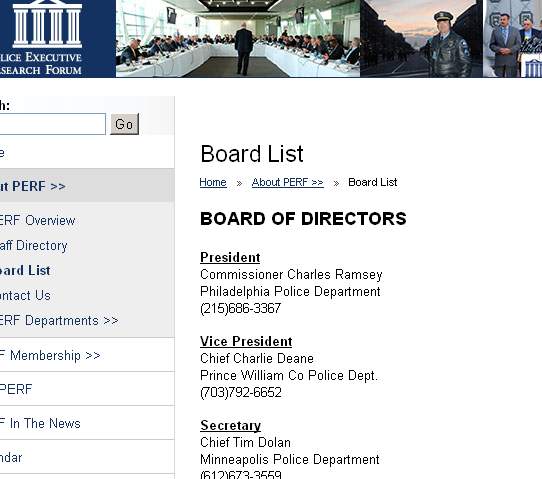
As mayors of cities across the country colluded to crackdown on the OWS encampments, an international non-governmental organization had coordinated with police chiefs and mayors behind the scenes. The group is called the Police Executive Research Forum, it is an influential private membership based organization that is marketed to heads of major metropolitan areas as specialists with mass demonstrations. The group has ties to the US Department of Homeland Security and their general membership in the group is exclusive to former executives leading a state or county funded agency that provided police services.
- The Occupy Seattle movement is community college property.
- The community college let them stay there but at first it was a public square and it was a cat and mouse game with the police.
- From November 4-10, there were conference calls. Much of the local media coverage was very coordinated.
- This smacks of the operations of some of the high ranking people the PERF has been associated with.
- The PERF actually does research on less then lethal weaponry, such as the pepper spray that has been used in lots of different cities.
- Charles Ramsey, Philadelphia Police Commissioner and the chair of PERF’s board of directors is also on the Homeland Security Advisory Council as are a couple of other board members from PERF.
- There’s an entire industry that has sprung up around the militarization of the police forces. The routine use of SWAT teams now for even non threatening situations.
Guest – Geov Parrish, a Seattle-based columnist and reporter. He writes the Straight Shot column for WorkingForChange. Parrish also wrote the article Collusion in the Defense of the 1% is No Vice.
——————————————
- b/w_occupyLAphoto-bymikeywally
- occupyAlbanyphoto – byDylanBoyce
Law and Disorder November 28, 2011
Podcast: Play in new window | Download
Updates:
- New York Historical Society Recognizes Henry Kissinger, Co-host Michael Smith Resigns.
- Wikileaks Cable: Assistant Secretary Posner Discusses Operation Cast Lead With IDF
- Who Killed Che? How The CIA Got Away With Murder – Book Tour Continues
- OWS Precursor: Resurrection City – Michael Ratner On Jesse Jackson’s Radio Show
- Occupy Dartmouth: Heidi Boghosian
—–
Occupy Hudson Valley and Bard College Student Movement
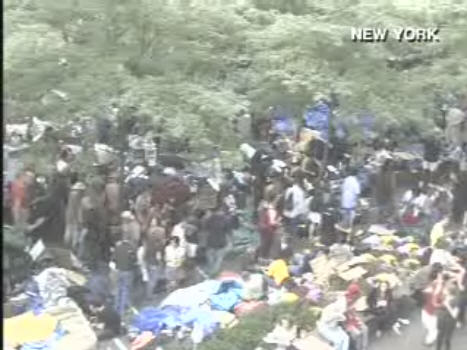
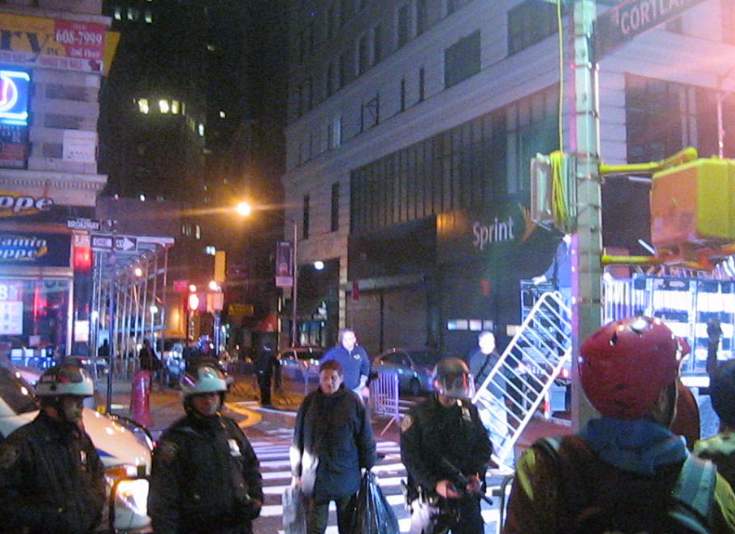
Activist and senior at Bard College, Ana Ratner joins the discussion on Occupy Colleges student movement in the Hudson Valley. Ana, Michael Ratner’s daughter, discusses the mistreatment of workers at the college, specifically employment contractors.
Ana Ratner:
- I think people on their own (at Bard College) had been concerned about the Occupy movement. It was around that time when people found each other and wanted to do something, weekly teach ins, general assemblies.
- At Bard we have a sub-contractor called Aramark .They treat their workers very badly.
- Through the Occupy movement more kids on campus are becoming concerned about worker’s rights and financial transparency and where our money is going, how it effects and who it effects.
- Occupy Poughkeepsie, a local movement, trying to connect the regions in the Hudson Valley. OccupyHudsonValley. They have tents and a kitchen.
- At Bard College: until the Occupy movement, no one really came together. I’m learning about the whole community at Bard.
- For the most part the workers are mostly invisible, they clean your dorm and campus. There’s a group called the Student Labor Dialogue.
- Aramark was kicked off at Bard College, now they want to hire another contractor.
Guest – Ana Ratner, activist and senior at Bard College. Ana has been active with the Occupy Colleges student movement and Occupy Wall Street.
——
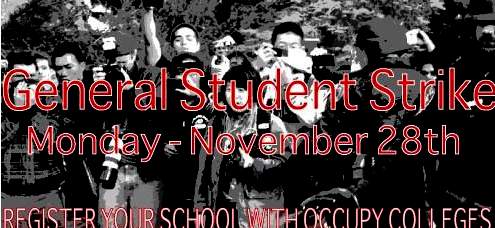
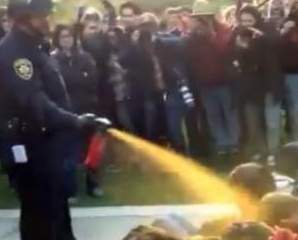
Occupy Colleges Los Angeles and Beyond
Last week, hundreds of students walk out of class and assembled in Union Square Park to demonstrate continued support with the Occupy Wall Street movement. The protests in New York City was part of a full week of student organized action that culminated in a march to Baruch College. This was where the CUNY Board of Trustees had met to vote on a possible tuition increase. Police and students clashed in the lobby in massive brawls, 15 people were arrested.
- OccupyColleges.org is all of the facilitators, it helps inform college students about the occupy movement.
- Ongoing occupy colleges action such as walk outs, teach ins, strikes, demonstrations
- Monday November 28th – In solidarity with UC Davis , UC Berkeley, CUNY Schools and all students who are defending their right to protest against rising tuition cost and out of control student debt. We ask you to STRIKE! No work, no school.
- We’re also circulating a pledge of non violence both for students and the UC Davis Presidents of all the eleven schools to commit to non-violence against students for a peaceful demonstration.
- Its gets harder to enforce non violence as they continue to hurt us.
- Non violence is our weapon.
- We’ve noticed that its all different types of schools, its private schools, its public schools, its community colleges, state colleges, the higher university levels, we really see the whole gamut of students that are joining us.
- Its horizontal, like the regular Occupy Wall St movement runs.
- We’re fighting the rising cost of tuition, the student loan fiasco and the fact that we have a lack of opportunities after graduation.
- Michael Ratner: Hunter College had no tuition from 1874 to 1975. One hundred years without tuition, so we see the shift that’s going on.
- It’s 3 times higher than it was in 1980.
- One of my first points of action is that these administrators need to take pay cuts.
- A lot of us got together from Occupy L.A. and from some past activist groups and we saw that New York schools were calling for a city wide walk out on October 5th and we noticed there wasn’t a national presence.
- We called for a national walk out and had 100 schools participate, almost 8000 students walk out. The interest from all of the students compelled us to continue with this movement. We give ideas to schools on how to set up their occupation. We want to have a very large teach in in the early Spring.
- When somebody else gets tired, somebody else is there to take their place.
- There are always new school calling us and signing up.
- I was called by the student tea party, who were horrified by the violence. The student tea party condemned the violence that happened at UC Davis.
- When we’re a non-violent movement the only way we can lose is by giving up. – Gene Sharpe
Guest – Natalia Abrams, one of the full time facilitators with the OccupyColleges.org website.
—-
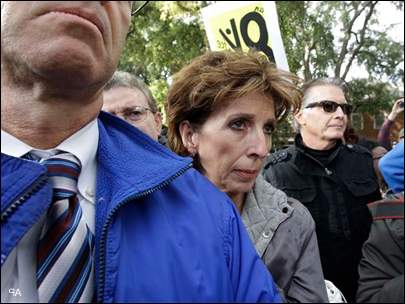
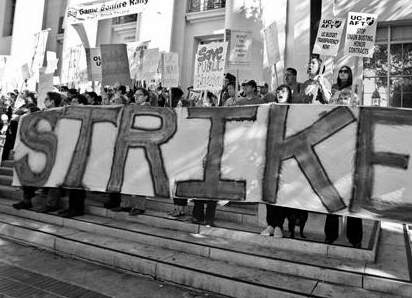
University Faculty, Staff and Students Disgusted At Direction Of California State University
Each year, the state of California makes cuts to the California State University system budget and each year students have responded with angry protests. This year however the protests were much bigger partly because of the Occupy Wall Street movement and the ongoing police brutality against students and protesters. The numbers are staggering, tuition has doubled in the last few years and the California State University Board of Trustees recently approved a 9 percent tuition increase in addition to cuts in courses and student services. Next year, the California legislature is set to impose another 200 million in higher education cuts. Meanwhile, college students from all over the nation have organized four nationwide acts of support with the Occupy Wall Street movement.
- We have about 430 thousand students in the California State University system.
- The number one struggle we’re having (faculty) is the defunding, the starvation of public higher education. That creates one set of problems.
- Piled on top of that is what we consider, misplaced priorities. At a time when resources aren’t that available, you really have to be careful and targeted in how you use the resources you have.
- The students, staff and faculty are disgusted on how the leadership has a focus on their one percent.
- There’s an enormous resonance with the Occupy movement because these are good middle class jobs that are being destroyed.
- Our students are watching their parents get shoved out of the middle class and hoping their education is a pathway into a decent life.
- People have finally emerged from the shock of what’s been happening, and getting angrier and angrier and getting less tolerant of adjusting to it.
- Demand: that the resources that are available be directed at the core mission of the university.
- We’re all over the state and our faculty have been part of Occupy Oakland and everwhere.
- We’ve got to take back more power and authority over our own destiny.
- Student loans are crushing our students, the leadership of the CSU and the UC seems to think the answer to their problems is privatizing the university by shifting economic responsibility to students, faculty and staff.
- They’re using us like ATM machines. We’re all being exploited and asked to be unwilling donors to the university.
- Occupy Wall Street has opened up a door to a conversation that is so long overdue.
Guest – Lillian Taiz, President of the California Faculty Association, the union that represents the 23,000 faculty members of the California State University system and to clarify, this is (not the University of California system where the pepper spray incident took place).
———————————————–
Law and Disorder November 21, 2011
Podcast: Play in new window | Download
Updates:
- What Does OWS Mean? – Michael Steven Smith
- Liberty Square Symbolic, At The Foot Of Capitalism
- Redistribution of Money and Power
- Nationally Coordinated Bust: Oakland Mayor Says She Was On Conference Call With 18 Mayors
- Michael Smith’s Story Of Liberty Square Police Raid
- NYTimes Candid With Spoils Of Libya Invasion
- Who Killed Che? How The CIA Got Away With Murder
—
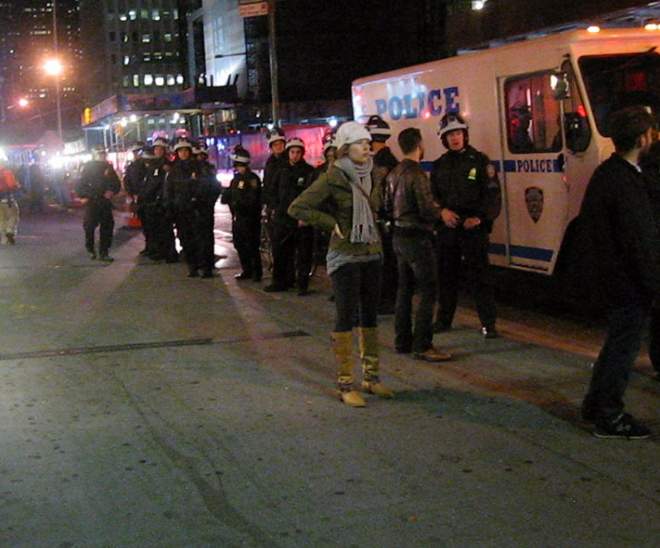
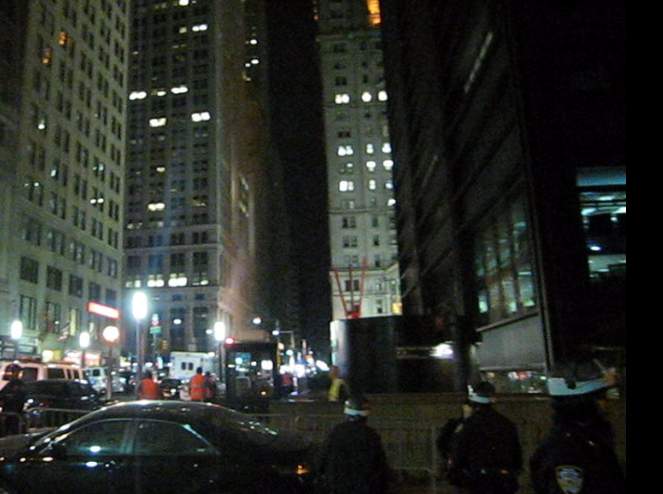
Legal Fallout From OWS Raid In New York City
Very early last Tuesday morning, teams of New York City Police in full riot gear descended upon the 2 acre park known by protesters as Liberty Square, home of Occupy Wall Street. Hundreds were arrested as police and bulldozers dismantled and tore down tents, confiscated gear, computers and clothes. Plain clothes construction workers assisted in filling large dump trucks with personal belongings and equipment from the encampment. The massive eviction is one of many reported across the country in past weeks.
Attorney Danny Alterman:
- There’s been a core group of 20 or 30 people working on issues that effect the occupiers down on Wall Street.
- We talked strategy, we created a document that would decide and get us into court in the morning.
- We are arranged to meet Judge Billings at 6AM
- We wanted to judge to issue a temporary restraining order which means that the police could not continue to evict people and order them back into the park with their belongings.
- We got a signed order from the judge to let our clients back in.
- We served Brookfield Properties which is the owner of the park, the city of New York through the corporation council, and the police department by fax with a copy of the order.
- What this reminded me of is was what had happened precisely in 1971 when the Attica Massacre happened. When we got a court order to go in because people were dying and getting shot, inside and the prison authorities refused to open up for medics and lawyers, causing the death of other people.
- Finally I said to one guy who was getting on me and getting on another lawyer that was there. I said listen, this reminds me of Attica, he said I’ve never been to Attica, I said we can make those arrangements.
- I said, you realize you’re violating a court order, and in contempt of court.
- Mayor Bloomberg in the course of us getting an order and finding out about it, had decided to close the park, which was the complete opposite of what the court said which was to re-open the park.
- Homeland Security was definitely there, you can tell by the crew cuts and the shoes.
- There was a temporary restraining order issued at 6:30 AM. We didn’t think Judge Billings would stay on the case. She didn’t. We went back at 11:30AM, and once a judge was assigned had about a 2 hour argument.
- We received papers as we walked into court from the city which contained a affidavit which is a legal document swearing to issues of public safety, health issues, other kinds of issues, that was clearly prepared before they evicted the protesters 10 hours before.
- What this means is that the city knew in preparing these papers that there was going to be a legal challenge.
- Brookfield Properties a descendant from US Steel. This is direct descendant from US Steel.
- We may be looking at 21st century speech assembling petitioning.
- Its a privilege and an honor to represent these people and I think the people have the pulse of the country and its happening.
Guest – Civil rights attorney Danny Alterman, Danny is part of the Liberty Park Legal Working Group.
———–
Global Capitalist Crisis and Long Term US Unemployment
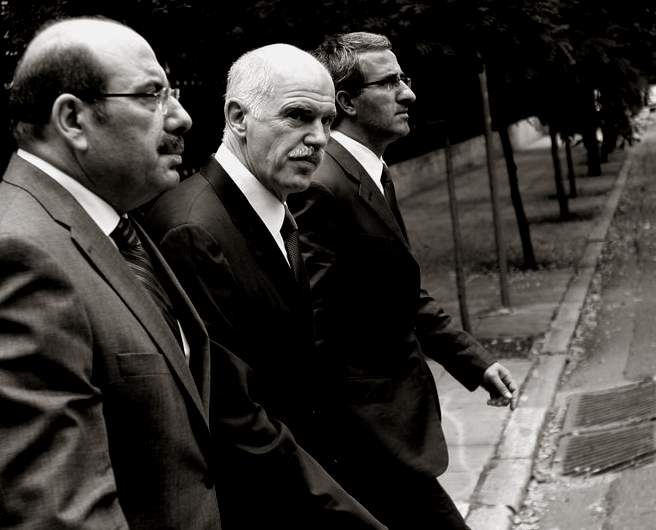
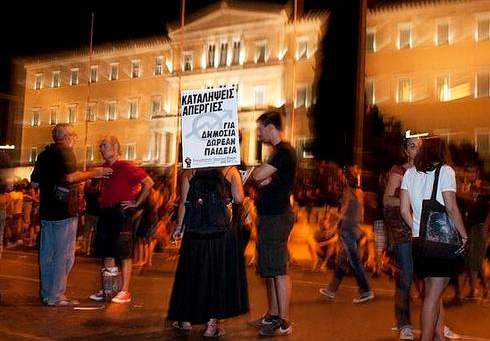
Thousands around the country continue to stand in solidarity with the Occupy Wall Street movement. The movement claims to defend the 99 percent of Americans against the wealthiest 1 percent who control 50 percent of the wealth in the United States. Meanwhile, long term US unemployment is taking a heavy toll socially. The social costs are high, the stress, tension and anxiety within families, the costs of counseling, and much more. We discuss these topics with returning guest, economics professor Rick Wolff who says, enormous wealth could be produced right now with the unused tools and raw materials put together with the nation’s unemployed people, we could rebuild our cities and infrastructure.
- Debt is always a sign of something else. You go into debt because you see a need or opportunity for which you don’t have the money and so you either forego the need or opportunity or borrow.
- If you see off the chart increases of debt like you do in the case of individuals in the last 30 years, or corporations and in the case of governments at a slow rate over the last 30 years, then you have to ask the question why?
- The 1970s come along and that period of 150 years of rising wages is over. It’s over because the computer replaces large numbers of people they don’t need to be hired. Production is moving out of the United States.
- Immigrants are flowing into the United States because the uneven development of the world economy, makes them poorer and the United States look more attractive.
- Suddenly employers have the greatest of all possibilities, they don’t have to raise wages anymore.
- Employers: If you’re not happy here, there’s a lot of other people that will be.
- Meanwhile you’re drumming into the American people, you should live better, everybody should have more. . .
- You put the American people into an impossible situation. You might have been able to handle it by having a real political leadership in America. We didn’t have that conversation, no politician wanted to be the bearer of that bad news.
- What can the American people do? They did more work. You borrow money. Whenever there’s a debt, there’s a lender and a borrower. This is a strange game to blame the borrower.
- Greece, now you have a situation that invites all kinds of corporations to make a decision.
- When the Greek Drachma, their old currency disappears to be replaced by the Euro, all kinds of business decisions became different.
- There was no border, you couldn’t have a tariff as you could before. Once you have a uniform currency you can’t do that. It’s like Tennessee erecting a tariff against products from Kentucky.
- Who lent to the Greek government? Above all, the French and German banks.
- It’s the banks that are making money because of the concentration of production in their country, with which they came to the poor countries and said hey, we got a lot of money you got a lot of need.
- A lot of money has been made off of Greek debt. It’s not some gift to the folks in Greece.
- As usual its a partnership and deciding that its all the fault of the Greeks as if the French and German banks didn’t make a fortune off of this.
- Italy is now where Greece was approximately six to eight months ago.
- The debt of Italy is four to five times the debt of Greece. Italy is the eight largest economy on this planet. They have over 2 trillion dollars of debt outstanding. We sell a very important part of our output to the Europeans.
- I would demand now, an immediate government employment program. A commitment by the United States government.
Guest – Richard D. Wolff is Professor of Economics Emeritus, University of Massachusetts, Amherst where he taught economics from 1973 to 2008. He is currently a Visiting Professor in the Graduate Program in International Affairs of the New School University, New York City. He also teaches classes regularly at the Brecht Forum in Manhattan.
————————