
Welcome to Law and Disorder Radio
Law and Disorder is a weekly independent civil liberties radio program airing on more than 150 stations and on Apple podcast. Law and Disorder provides timely legal perspectives on issues concerning civil liberties, privacy, right to dissent and practices of torture exercised by the US government and private corporations.
Law and Disorder March 15, 2010
Podcast: Play in new window | Download
Updates:
- Armenian Genocide Resolution in Congress 2010 /April 24 observes 1.5 million Armenians killed.
- Defense contractors Lockheed/Boeing/Raytheon say Genocide resolution may hurt business.
- Liz Cheney Campaign – The Al-Qaeda Nine
- The only reason lawyers aren’t getting prosecuted right now for aiding terrorism is that they’re deciding not to.
- Reshuffling 9/11 Trials Being Played To A Political Audience
—
Rachel Corrie wrongful death v Israel
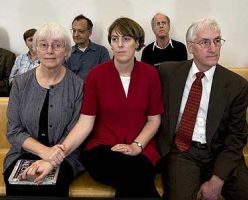
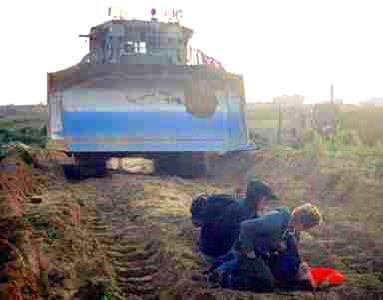
This month, the Haifa District Court in Israel will begin hearing eyewitness testimonies in a civil lawsuit filed in 2005 by Rachel Corrie’s family against the State of Israel for her unlawful killing in Rafah, Gaza. On March 16, 2003, Rachel was crushed to death by a Caterpillar D9R bulldozer while trying to protect the home of a Palestinian doctor from demolition. She was run over and killed by an IDF soldier who was operating the bulldozer. Seven years later, Rachel’s parents are still seeking the truth. The trial is expected to show the circumstances of her death and hold the Israeli military reponsible. Four eyewitnesses to Rachel’s killing have been recently granted visas by Israel to testify but Israel is refusing to allow the Palestinian doctor who treated Rachel and confirmed her death into Israel.
Maria LaHood:
- CCR represented Rachel Corrie in the United States because she was run over by a Caterpillar bulldozer. The same month in 2005, the Corries brought a suit against Israel, in Israel for the killing.
- This suit was on the advice of the US State Department. You can sue Israel, the country. Israel claims immunity.
- Israel’s defense that the bulldozer driver couldn’t see Rachel Corrie in the bright orange jacket.
- Expert witness says Israel’s heavy machinery operator policy says do not use around people.
- Rachel was defending the home and the bulldozer crushed her. Rachel was with the International Solidarity Movement. The Corrie family will present their evidence to the Israeli court and then there’s a 30 day break in the trial. This is not a jury trial, it is before a judge. Corries are asking for information, and accountability.
- In the attacks of Gaza a year ago, more than 4000 houses were demolished.
- Someone was filming at the border at the time of Rachel’s death, the actual part of the tape where she was crushed is missing.
- Mamilla Cemetery Case Update: We’ve asked the special rapporteurs of the United Nations to intervene.
- Michael Ratner: It does seem to be intentionally provocative. To be doing this on a cemetery and calling it the “Center for Tolerance” MamillaCampaign website.
Guest – Staff attorney Maria LaHood. Maria specializes in international human rights litigation, seeking to hold government officials and corporations accountable for torture, extrajudicial killings, and war crimes abroad. Her cases include Arar v. Ashcroft, against U.S. officials for sending Canadian citizen Maher Arar to Syria where he was tortured and detained for a year; Matar v. Dichter, against an Israeli official responsible for a “targeted assassination” that killed 15 Palestinians; Belhas v. Ya’alon, against a former Israeli official responsible for the 1996 shelling of a United Nations compound in Qana, Lebanon, that killed over 100 civilians; Corrie v. Caterpillar, on behalf of Palestinians killed and injured in home demolitions, and Rachel Corrie, a U.S. human rights defender who was killed trying to protect a home from being demolished.
———–
JFK and the Unspeakable: Why He Died and Why It Matters by Jim Douglass
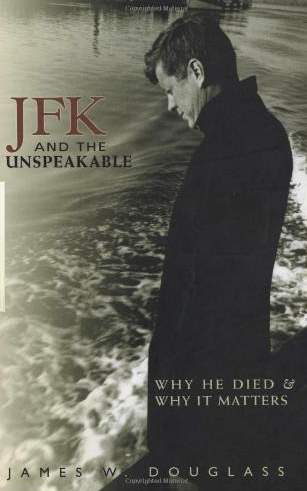
JFK, The Unspeakable, is the first book of 3 on the assassinations of the 1960s. Orbis Books has commissioned author James W. Douglass to write about the murders of JFK, Malcolm X and Martin Luther King, and his the third will be on the assassination of Bobby Kennedy. The heart of JFK the Unthinkable, is not how Kennedy was killed or how Kennedy became a threat to the systemic war machine, but why DID Kennedy die? Author James Douglass says Kennedy knew that he would die and had the guts to stand up to the system and take the hit. This narrative was lost for decades, obscured by disinformation about Kennedy’s character and the conspiracy of his assassination. One review summarizes Douglass’s book in this way : JFK’s belated effort to turn America from an armed culture of victory to a member of an international peaceful world was shot down in Texas for a reason.
Jim Douglass:
- John F. Kennedy’s experience in WWII: He was in the South Pacific, he volunteered. He was on that PT boat.
- What happened on that PT boat, is that it got split into two by a Japanese destroyer. He lost brothers and friends at that time. An extraordinary experience being adrift on the ocean warning other PT boats. The experience create a distrust in military authority.
- He said that he wanted to splinter the CIA into a thousand pieces and scatter to the winds.
- As Kennedy said to his friends, “they figured me all wrong.”
- The Unspeakable: the kind of evil and deceit that seems to go beyond the capacity of words to describe. The midst of war and nuclear arms race, the assassinations of Kennedy, Martin Luther King and Malcom X that the term was used.
- JFK’s vision is articulated in the address June 10, 1963, arising from the turnaround of the missile crisis and Bay of Pigs.
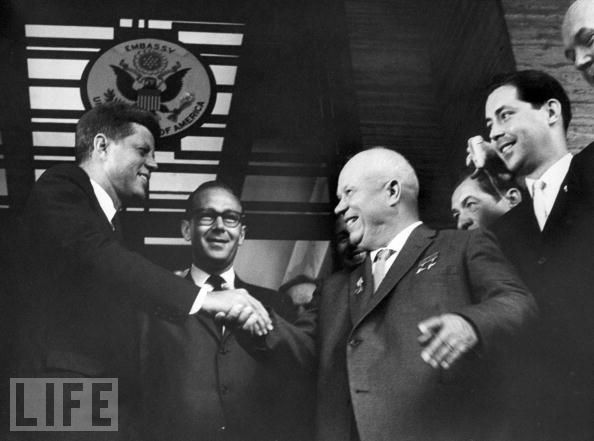
- He wanted to move step by step into a disarmed world. Nikita Khrushchev put that speech all over the Soviet Union. The Cuban Missile Crisis is a deeply misunderstood part of our history, because it’s usually portrayed as Kennedy going to war with Nikita Khrushchev and beating him.
- The truth was that Kennedy and Nikita Khrushchev were in over their heads, the US generals wanted nuclear war, because they had more warheads than the Soviets.
- Nikita Khrushchev: We now have a common enemy from those pushing us toward war.
- At that point the Cold War turned upside down because Kennedy and Khruschev became closer to each other than either was toward their own military power system.
- Vietnam: Kennedy’s military people would not give him an exit policy. He signed the withdrawal order from Vietnam before he was assassinated.
- His friends said that he had an obsession with death. It was not an obsession but a real assessment that he was going to die. If you try to turn around a national security state that is dominating the world,
- and you do so as president of the United States, of course you’re going to die. Kennedy knew that.
- The book is a story on the deliberate destruction of hope, the vision of change, a turning of this country all of which was happening and had to be stopped. US Agencies killed Dr. Martin Luther King – 1999 Verdict
- We’re in the same scene right now with Petraeus and McChrystal setting up Obama. They were dictating terms to Obama, unlike Kennedy, he did not face them down.
- We need to get out ahead of Obama so that he can do something.
Guest -author, James W. Douglass. He’s a longtime peace activist and writer. James and his wife Shelley are co-founders of the Ground Zero Center for Nonviolent Action in Poulsbo, Washington, and Mary’s House, a Catholic Worker house of hospitality in Birmingham, Alabama.
—————————
Law and Disorder March 8, 2010
Podcast: Play in new window | Download
Updates:
—–
Mass Demonstration Planned: March Forward
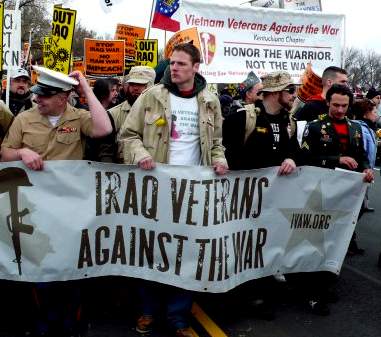
On Saturday March 20, there will be a massive National March and Rally in Washington DC organized against the Iraq and Afghanistan wars, while fighting for social and economic justice at home. The demonstrations will pull together veterans, active-duty service members and those have served in the US military. Other mass rallies will be held on the same day in San Francisco, and Los Angeles. The day before on Friday March 19, there will be a day of action and outreach. Today Michael Prysner joins us to give us more information and details on this mass demonstration. Michael recently delivered a powerful speech as an IVAW member. From Michael’s speech, ” Our real enemies are not those living in a distant land whose names or policies we don’t understand; The real enemy is a system that wages war when it’s profitable, the CEOs who lay us off our jobs when it’s profitable, the Insurance Companies who deny us Health care when it’s profitable, the Banks who take away our homes when it’s profitable. Our enemies are not several hundred thousands away. They are right here in front of us.”
Mike Prysner:
- I’m a co-founder of March Forward, it’s also an affiliate with the ANSWER coalition which is Act Now To Stop War End Racism. We know now that there are more people who are becoming tired of the wars and watching 500 million dollars a day squandered on these senseless wars and occupations.
- On March 20, you’re going to see thousands of people from all over the country. We’re coming off of a year of President Obama being elected. Many people thought that they were voting for an to the war, and change to the colonial policies of the US government.
- So, change comes not from an election, but through a struggle and mass movement. We need to be there on the anniversary of the criminal invasion of Iraq.
- Demands: US out of Iraq and Afghanistan. An immediate end to occupations. Freedom for Palestine, reparations for Haiti, money for jobs, education, housing and health care, not for war.
- WAR: This is about the United States expanding its reach economically, to seize the local economies and natural resources and the markets of these countries. These wars are for empire to expand US business interests.
- I went to Iraq in 2003 during the invasion, and then month after month I thought we were there for a very different purpose. There was a growing frustration within the military, people don’t want to go and kill and be killed. People join the military because they need access to a job, education, health care.
- It was the Iraqi children that I saw, that cried and screamed at us, I dragged from their houses during raids. It was innocent Iraqis that were shot. This is what turned me around.
- Seeing their faces, that made me realize that we were not the liberators that we thought we were going to be.
- Afghanistan: Soldiers are used as bait. They are put at an outpost and wait to get attacked. They get attacked and call in air strikes. Soldiers are put in danger, without any real expressed purpose. Now the Generals have warned us that we should be braced for hundreds of casualties every month.
- We have these 2 things, the horrible deaths and destruction and then no reason why. It’s cloaked in chauvinism and racism, and that’s the only justification.
Guest – Michael Prysner, lead coordinator of March Forward and Iraq Veterans Against the War member.
————

John Brown’s Farm Faces Possible Closure – Update
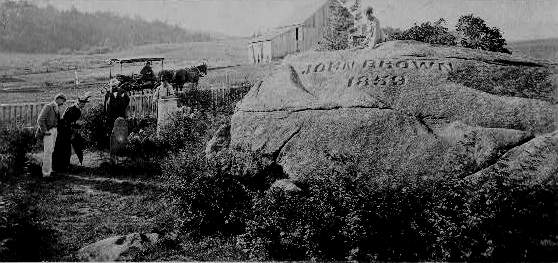
Today we look into the possible closure of the John Brown Farm State Historic Site in North Elba, New York. State lawmakers have announced that budget cuts could result in the closure of the farm where the famed abolitionist lived with his family and is now buried. There are others buried there, those that perished in Brown’s 1859 raid on a federal arsenal in Harper’s Ferry. Historic sites and parks are often the first casualties of budget cuts. In one scenario, the New York legislature would have to approve a proposed transfer of 5 million dollars from the Environmental Protection Fund to shore up the budget cuts that would affect New York parks including John Brown’s farm. Meanwhile, many New York residents are pulling together to speak out and save this historic area. John Brown’s Body – song Recent News: John Brown Resolution Introduced by Senator
- The land was given to John Brown by Gerrit Smith who gave land grants to many including “free blacks” from New York State. The area was nicknamed Tim Buk Tu. John Brown lived up there in a rented farm, but later his son in law built the farm house that is there (1854)
- He was somewhat of a black nationalist as well as being a forerunner in the civil rights movement. He supported black self determination. Some people had said it was an underground railroad stop and it really wasn’t.
- For years, African American churches made trips to the farm, John Brown was buried there, of course after being hanged in W. Virginia in 1859. It’s a spiritual experience, you ascend this road, you get to the top, you see the farm house there. There’s a great boulder where John Brown loved to sit on this boulder and read his Bible.
- I brought Charles 37X up there as an elderly man in 1999. I’ll never forget the impact this had, the connections he made up there. It’s marginalized in American memory.
- I believe as we progress as a society that this will a place that’s more treasured.
- There’s optimism but still the real possibility (of the farm to be closed)
- Write to: Assembly woman Teresa Sayward / 940 Legislative Office Bldg / Albany NY / 12248 / EMAIL: sayward@assembly.state.ny.us
- State Senator Betty Little / Room 506 / Legislative Office Bldg / Albany NY / 12247/ EMAIL: little@senate.state.ny.us
Guest – Louis A. DeCaro, Jr. Ph.D., is Assistant Professor of History at Alliance Theological Seminary’s New York City campus, and is also the pastor of an urban church. Of course, he often dreams of being a full-time researcher and student of the life and letters of John Brown the abolitionist. His latest work is entitled, “John Brown: The Man Who Lived” (Lulu, 2009), a collection of essays prepared in honor of the sesquicentennial of the Harper’s Ferry Raid and the hanging of John Brown. Lou’s previous works on the abolitionist are “John Brown–the Cost of Freedom” (International Publishers, 2007)–which features new insights based on cutting edge research and transcriptions of twenty John Brown letters, and ‘Fire from the Midst of You’: A Religious Life of John Brown” (New York University Press, 2002). He is also a contributor to “The Afterlife of John Brown,” edited by Eldrid Herrington and Andrew Taylor (2005), and Jean Libby’s monumental “John Brown Photo Chronology” (2009).
——————————————————————————————
Law and Disorder March 1, 2010
Podcast: Play in new window | Download
Updates:
- Office of Professional Responsibility Report Confirms Need For Torture Investigations
- Torture Lawyers On Trial In Spain
—
People v Bush, Charlotte Dennett
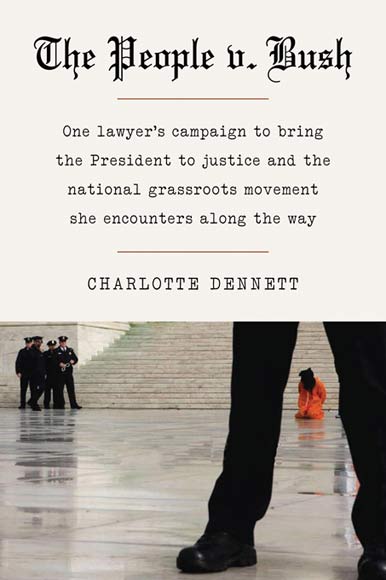
Today we talk with former Vermont Attorney General Candidate Charlotte Dennett. Listeners may remember Charlotte ran for office of Attorney General on the platform that if elected she would immediately undertake the prosecution of George W. Bush for the unnecessary deaths of Vermont soldiers in Iraq. The strategy was to establish jurisdiction in the cases for Attorneys General in each state as outlined in The Prosecution of George W. Bush for Murder, written by former prosecutor Vincent Bugliosi. Charlotte Dennett didn’t get the votes to become Vermont’s new attorney general. Now, a year later Charlotte describes from an inside perspective the “accountability movement” in her new book titled The People v. Bush. Is impeachment or prosecution still off the table?
- If we don’t act on them now, then the impunity will get worse, we have to clamour for Cheney’s prosecution. We’ve got to keep the pressure on the department of justice. We know that the Spanish prosecutors have done that.
- I’ve come to realize that Obama’s mantra that we have to move forward and not look backward is really translated into: Don’t Prosecute.
- Brennan who was involved with crafting torture policy is playing a role advising Obama not to prosecute.
- It’s up to the accountability movement to step forward. There are going to be major events on March 20th, the anniversary of the war on Iraq.
- In my book the People v. Bush, I’ve got 10 pages in the appendix of all the different resources that people can turn to, to pressure Congress, sign petitions.
- The first half of the book is about my campaign for attorney general in Vermont, where I pledged to prosecute Bush for murder. I also lay out the evidence of how we can still do this, we can still do this by the way.
- I became hooked on accountability, this is a struggle for democracy and the soul of our nation.
- The book also looks at how the Obama Administration deals with the crimes of its predecessors.
- I have to tell you Michael Ratner, you were one of the first people to start raising the alarms (Obama Administration). My book shows the gradual shock and disillusionment of his supporters.
- People are upset that John Yoo, is doing talk shows, he showed up on John Stewart recently (OUCH)
- Regarding Sen. Leahy of Vermont: I tracked his effort to put together a truth commission and not prosecution. There were 37 towns in Vermont, that in their town meetings, voted for impeachment.
Guest – Charlotte Dennett, is an author and attorney who resides in Cambridge Vermont. She and her husband, Gerard Colby, have lived in Vermont since 1984. Charlotte has been practicing law since 1997, representing injured Vermonters in negligence, medical malpractice and wrongful death cases, as well as civil rights litigation and family law, and has argued before the Vermont Supreme Court.
——-

Lawyers You’ll Like: Center For Constitutional Rights Legal Director, Bill Quiqley
This week, CCR Legal Director Bill Quigley joined Law and Disorder hosts during a marathon 3 hour fund raiser for Pacifica’s WBAI. Bill talked about his trip to Gaza during Operation Cast Lead, his recent trip to Haiti and his death penalty work in Louisiana.
- I went to Gaza with activist Audrey Stewart and Kathy Kelly, an International Peace Activist.
- We went over there, a year ago January, while the bombing was still going on. We were on the Egyptian side of the border where we could see the bombing of Gaza
- There were constant drones going over head, they had aerial balloons that were doing surveillance. It was sort of like a sociopath beating a baby. There was no defense, there was no anti-aircraft, people were literally sitting ducks.
- In my life, it compared to a time when one of my clients was being executed, in death row in Louisiana. To see the apparatus of the state, move into action, very calm, step by step.
- Then with full force and the respect of state behind it, pull on a switch and my client was no more. (at that time) It was a surprise that anyone in the U.S. would support the Palestinians.
- Death Penalty: there really is a community of deathy penalty advocates who train themselves how to communicate with juries. It is trending in the right direction by it still continues as a terrible tool, that the state has an opportunity to use when they choose to.
- Stop and frisk case update: New York is fighting this every step of the way. The term they use to justify this is: Furtive activity
- Culture of Intimidation: If young men don’t look at them the way they want to be looked at, if people don’t recognize their presence with the kind of respect that the police department thinks that they’re entitled to by the mere fact that they’re wearing a uniform and carrying a weapon.
- It is something that clearly could stop if the message was sent from the top.
- But clearly something has a green light from the top to engage in this. Authoritarian order that inconsistent with law and order, with the constitution.
- Endemic: If you have a society that values violence, the violence we institute around the world, the way we support Israel, the way they deal with Palestine. If we value deep racism, then what else what would we expect from a police or a military. The police and military are tools of a violent and racist regime.
- Part of our job is to re-educate police officers. We are going to be engaged in this activity over again, in every city in the country in varying degrees. The root problem is that we have a racist and violent criminal justice system, education system, a racist and marginalizing housing system, employment system.
- Most people don’t have the educational opportunities to know what’s going on with Haiti, Gaza, Iraq and even within our own country. Haiti: You could travel for miles and see no indication that international community even cared about what happened in Haiti. Most people were under a sheet or a blanket, could break some of the sun.
Guest – Bill Quigley. Bill is the Legal Director for the Center for Constitutional Rights, a national legal and educational organization dedicated to advancing and defending the rights guaranteed by the United States Constitution and the Universal Declaration of Human Rights. Bill joined CCR on sabbatical from his position as law professor and Director of the Law Clinic and the Gillis Long Poverty Law Center at Loyola University New Orleans. He has been an active public interest lawyer since 1977.
———————————————-