
Welcome to Law and Disorder Radio
Law and Disorder is a weekly independent civil liberties radio program airing on more than 150 stations and on Apple podcast. Law and Disorder provides timely legal perspectives on issues concerning civil liberties, privacy, right to dissent and practices of torture exercised by the US government and private corporations.
Law and Disorder April 26, 2010
Podcast: Play in new window | Download
Updates:
- CCR Lawsuit: U.S. Census Bureau Sued for Racial Discrimination in Temporary Hiring
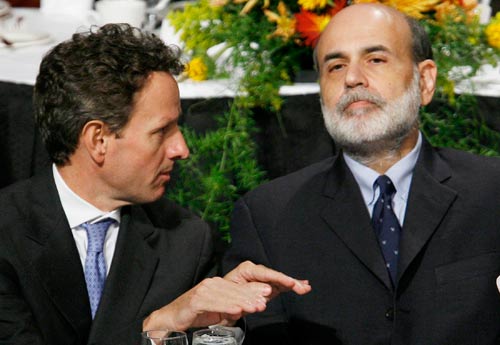
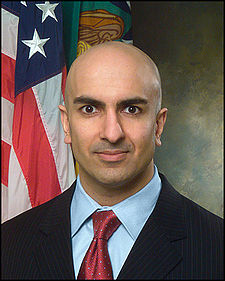
- Goldman Sachs Top People Revolving Positions From Federal to Private to Federal
- Henry Paulson / Neel Keskhari / Ben Bernanke / Tim Geithner
——–

Jobless Recovery and the Federal Reserve Holdout
Today we welcome back Rick Wolff, Professor of Economics at the University of Massachusetts and his son Max Wolff freelance researcher, strategist, and writer in the areas of international finance and macroeconomics to discuss the current economic recovery, is it recovering without job growth? Rick is also the author of the book, Capitalism Hits the Fan: The Global Economic Meltdown and What to Do About It, where he takes the reader back to 2005 and step by step reveals how policies, economic structures and wage-to-profit systems led to a global economic collapse.
We get a critical update from both Rich and Max. Will there be another leg down as predicted. Another leg down meaning, will the economy continue to drop? This was mentioned because of the way people were investing, investing in a way that expected the market to drop.
Rick Wolff / Max Wolff :
- There’s a recovery in some parts and not others. The missing piece of the economic puzzle is job growth.
- Housing assets are 35 percent off their 2006 peaks. 15.5 million people unemployed. 1 out of 6 in the labor force in a dire economic situation. Misery index, looks at long term unemployed – 27 weeks or more.
- 41 percent of our unemployed have been out of work for 27 weeks.
- Average unemployment benefits cap out at 2000.00 a month
- “Phony ‘Economic Recovery’, Real Alternatives” – article by Rick Wolff
- You have to wonder that we live in a time of massive unemployment, the recovery didn’t deal with that problem, and yet we don’t have a national discussion of “direct employment.” We did need a banking bailout, we chose to bail out some elements of society and not others.
- A couple of hundred billion dollars for say kids to continue to got to school on the subway, or community colleges can stay open, or job training programs, or the state of California can stay open, we decided was a waste of money?
- The average person in the US has a 30 day life expectancy without International finance.
- 61 thousand UAW workers laid off.
- US Cash for Clunkers program, borrowed European model but replaced old used cars with new SUVs, and increased price of used car parts.
- Oregon Example: Last summer, the state legislature controlled completely by the Democratic party passed a bill to face their 700 hundred million dollar shortfall, not by cutting social programs, but by taxing the corporations and the rich. Unions, liberal folks, and the democratic party (left of where it is in the rest of the country)
- We need 110 – 120 thousand new jobs a month to keep up with population growth. Jobless growth recovery from 2002 to 2007 was from explosive consumer debt.
- People buying more things without getting jobs (credit) The last 18 months we witnessed the largest re-distribution of wealth in US history. The bottom 80 percent stood still and the top 20 percent lead by the top 5 percent shot up.
- 7.8 million homes in the foreclosure pipeline
Guest – Richard D. Wolff is Professor of Economics Emeritus, University of Massachusetts, Amherst where he taught economics from 1973 to 2008. He is currently a Visiting Professor in the Graduate Program in International Affairs of the New School University, New York City. He also teaches classes regularly at the Brecht Forum in Manhattan.
Guest – Max Fraad Wolff , freelance researcher, strategist, and writer in the areas of international finance and macroeconomics. Max’s work can be seen at the Huffington Post, The AsiaTimes, Prudent Bear, SeekingAlpha and many other outlets.
———-
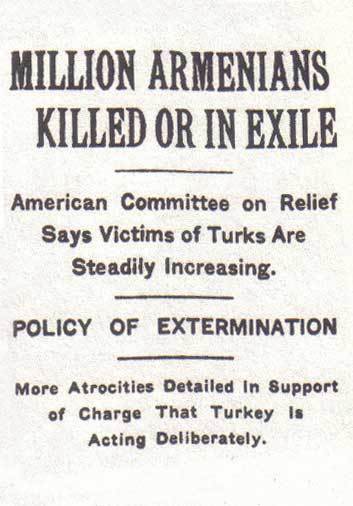
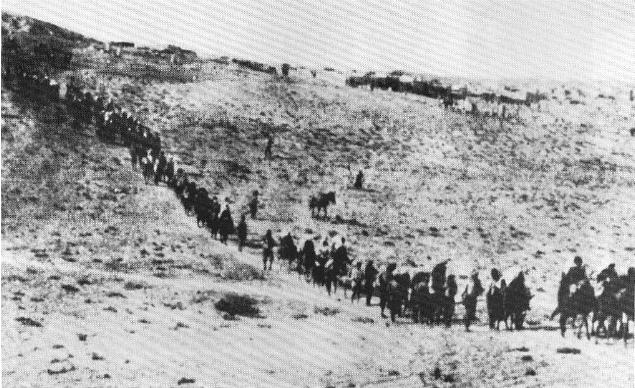
Radio Documentary – It Was Genocide: Armenian Survivor Stories
April 24, 2010 marks the beginning of the systematic implementation of a plan to exterminate the Armenian race 95 years ago. Carried out by the Young Turk government of the Ottoman Empire, over half of the Armenians living in the Empire were killed. To commemorate this, the first genocide of the 20th century, Law and Disorder co-host Heidi Boghosian and producer Geoff Brady present a 90-minute program titled, It Was Genocide: Armenian Survivor Stories.
We wish to thank WBAI for their commitment to recognizing the Armenian genocide, and are grateful to the individuals we interviewed for opening their hearts and sharing the difficult memories of the past.
————————————————–
Law and Disorder April 19, 2010
Podcast: Play in new window | Download
Updates:
—–

Israeli Policy and Palestinian Children – Nora Barrows-Friedman
We talk today with the Nora Barrows-Friedman, she is the host of radio show Flashpoints at KPFA in Berkeley California. Nora spent the last month in the occupied West Bank and East Jerusalem. She’s been investigating stories about the ongoing violations of Palestinian human rights and has been frequently traveling to Palestine since 2004. Today we look specifically at the Israeli policy against children from arresting, detaining, interrogating, torturing, imprisoning and beating children, some as young as 10. Nora says International laws designed to protect children — including the UN convention on the rights of the child are being circumvented and violated on a daily.
Nora Barrows Friedman:
- Kids randomly picked off the street, allegedly for throwing stones. The Israeli punishment is 10 years in prison for a child.
- Israeli military can arrest (Palestinian only) children as young as 12. Right now there are 300 Palestinian children in Israeli prisons.
- Hebron is a city where settlers have been given half of the old city, a settlement colony is inside the Palestinian community
- These two young children were followed and taken into a military center inside the settlement colony.
- This whole family had been destoryed by these illegal actions against these 2 brothers. The only recourse this family has is to take it to the Israeli military court. Motive: trying to get Palestinian families to leave.
- This family lives in an area where settlers have their eye on, seems to be very deliberate.
- There are hundreds of women in Israeli prisons, there’s a story where a woman gave birth in the prison, and the baby is now a prisoner.
Guest – Nora Barrows Friedman: Senior producer and co-host of KPFA’s Flashpoints.
————-
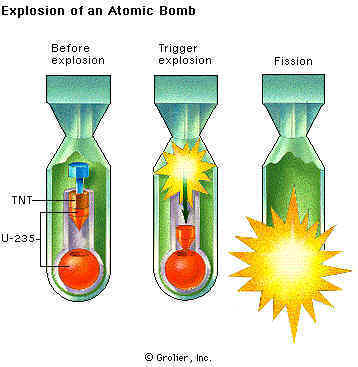

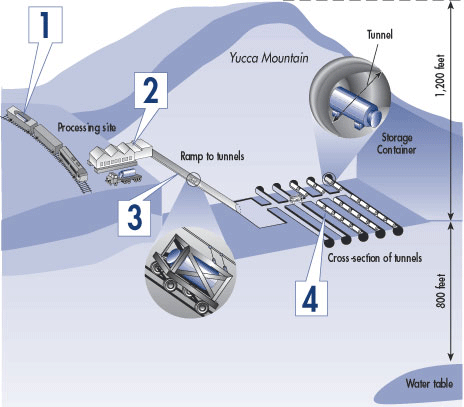
Obama’s Plan for Elimination of Nation-Controlled Nuclear Power
Nine nations now have a combined total of more than 22 thousand nuclear weapons. The United States has about 5 thousand nuclear weapons, 500 of them are land based warheads which can fly in three to four minutes after the order is given. President Obama recently hosted a nuclear security summit in DC with more than 45 foreign leaders, he traveled to Prague and signed a treaty that would cut the combined US and Russian stockpile by a third. Meanwhile, the US nuclear stockpiles have been shrinking for the last 40 years. We talk more about the current nuclear disarmament effort with attorney Peter Weiss is Vice-President, former President, of the International Association of Lawyers Against Nuclear Arms.
Peter Weiss:
- Leave the doomsday clock where it is. Reaffirming of the status quo. The agreement with Russia in reducing the nuclear weapons allowed to each country from 2200 to 1500. They count all the warheads on a bomber plane as one, instead of 10 or 12 weapons.
- Jimmy Carter: A single nuclear armed submarine had enough weaponry to destroy every Russian city of 100 thousand or more.
- Nuclear Posture Review – Zero document / “It’s difficult to operationalize a vision.”
- Obviously there is a great danger of loose nukes. No one seems ready to adopt an anti-nuclear convention except the countries that don’t have nuclear weapons.
- Conference in Riverside Church on May 1, 2010, United For Peace and Justice
- The anti-nuke movment will be re-energized.
- The US wants to be the sole repository of weapons grade nuclear material, committment from Chile, and Canada, to ship WGNM to the US. That’s kind of weird isn’t it?
Guest – Peter Weiss, former Vice President, Center for Constitutional Rights and Vice President, of the International Association of Lawyers Against Nuclear Arms.
——
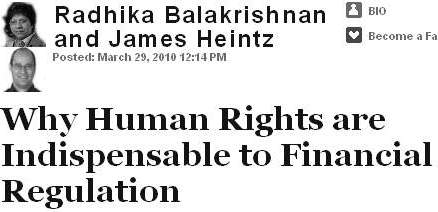

Why Human Rights are Indispensable to Financial Regulation
Today we speak with Radhika Balakrishnan, Professor of Economics and International Studies at Marymount Manhattan College, about her recent article in the Huffington Post titled Why Human Rights are Indispensable to Financial Regulation. Balakrishnan enumerates the global human fallout from the world financial crisis. The World Bank estimates an additional 400 thousand children will die before their fifth birthday, while those responsible for the turmoil are benefiting from bailouts and promotions. She references the Universal Declaration of Human Rights and its inclusion of economic and social rights, that is the right to work, to education, to rest, to an adequate standard of living. Dr. Balakrishnan has also outlined steps for meaningful reform that we will also examine today. She is currently working on a project trying to use human rights norms to evaluate and construct macroeconomic policy.
Radhika Barakrishnan:
- We pretend there is no criteria regulating (economic policies) We argue in our piece, that human rights have a way to set up an ethical basis and framework. Most people don’t know that human rights include economic and social rights.
- In the United States the assumption is you can vote the people in to give you social and economic rights.
- The idea that the market is this Greek Oracle that we can’t question. . . is a problem.
- We’re saying there is a form of biased market regulation, where the state has the interest of the financiers and the banks.
- and not those of the working people and the working class. One example is the minimum wage.
- The Federal Reserve has a dual mandate, one is to have price stability, the other is the right to work.
- In the United States, we have not signed the Convenant on Economic and Human Rights.
- The Federal Reserve is a government agency and the fact that they act in a cloak of secrecy is a real problem.
- I think there is a great case to be brought, as far as freedom of information.
- What kind of financial models are they using to make their decisions? This cloak of secrecy because you independence to make monetary policy? But independence doesn’t mean secret.
- Their Board of Governors are from the commercial banks, whose interest will they work for?
- Bailout Bill – TARP / This went to financial agencies to give them the money. 720 Billion dollars overnighted to the Federal Reserve has not gone out? The Stimulus Money, for employment creation, though it was used for tax cuts.
- Congress did not extend unemployment benefits for Spring recess.
- The United States is coming up for the Universal Periodic Review in the Human Rights Council of Geneva
- The Center for Women’s Global Leadership
Guest – Radhika Balakrishnan, Executive Director of the Center for Women’s Global Leadership and Professor in Women’s and Gender Studies. She has a Ph.D. in Economics from Rutgers University. Previously, she was Professor of Economics and International Studies at Marymount Manhattan College. She has worked at the Ford Foundation as a program officer in the Asia Regional Program. She is currently the Chair of the Board of the US Human Rights Network and on the Board of the Center for Constitutional Rights. She has published in the field of gender and development.
——————————————————————————
Law and Disorder April 12, 2010
Podcast: Play in new window | Download
Updates:
- Comcast Ruling Victory in Short Term Raises Questions for the Future
- Pope infallibility correction.
—————-
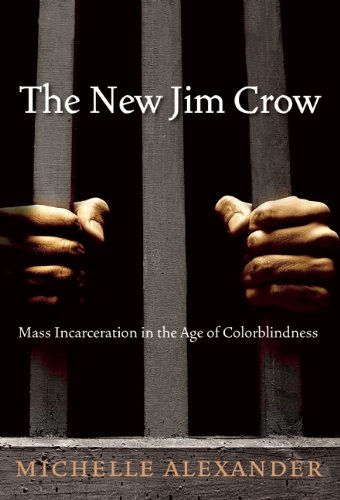

The New Jim Crow: Mass Incarceration in the Age of Colorblindness – Michelle Alexander
Michelle Alexander, author of the new book The New Jim Crow: Mass Incarceration in the Age of Colorblindness joins hosts. Michelle book has been called an incisive critique of racial caste system in America. As many celebrate the “triumph over race” with the election Barack Obama, the majority of young black men in the US are locked behind bars or permenantly labeled felons. Michelle Alexander, a former litigator who is a legal scholar, argues that the civil rights community—and all of us— are challenged to place mass incarceration at the forefront of a new movement for racial justice in America.
- I began in my own research to question the prevailing political media narrative about the reasons of people of color and ghetto communities cycle through the criminal justice system today, it is not as it appears.
- I argue that in a few decades after the collapse of Jim Crow, we as a nation, have managed to re-create as a racial caste in America, in some major American cities, the majority of African American men, are locked behind bars, labeled felons for life.
- Legally discriminated in employment, housing, access to education, and public benefits. We have not ended racial caste, we redesigned it.
- The Drug War was declared in relation to racial politics, not drug crime. About 30 million were arrested for drug offenses after the launch of the drug war. Most were for marijuana possession, now considered less harmful than alcohol or tobacco.
- Drug markets like American society generally are segregated by race and class
- The Supreme Court has made it virtually impossible for these cases to be brought.
- Baldus Study: McKleskey v Kemp
- Finding proof of conscious intentional discrimination is nearly impossible. Severe racial disparities are of no consequence, immunized not just the death penalty.
- I wrote this book, largely because I was deeply troubled by the failure of civil rights organizations and black leadership in this country to place mass incarceration and the war on drugs at the top of our racial justice agenda.
- Ten of millions of people in the United States are now regulated permanently to an under-caste, who are barred by law from seeking jobs or housing, public benefits, food stamps.
- Prisons have been holding many rural towns together as jobs have disappeared. The majority of people put behind bars are non-violent offenders. Every race suffers from this drug war, there are white people doing decades in prison for drug possession charges. The suffering of the drug crosses the color lines, and we got to be able to galvanize a level of public awareness and support.
- Something akin to a racial caste system is alive and well in the United States.
Guest – Professor Michelle Alexander, joined the OSU faculty in 2005. She holds a joint appointment with the Moritz College of Law and the Kirwan Institute for the Study of Race and Ethnicity. Prior to joining the OSU faculty, she was a member of the Stanford Law School faculty, where she served as Director of the Civil Rights Clinic.
Professor Alexander has significant experience in the field of civil rights advocacy and litigation. She has litigated civil rights cases in private practice as well as engaged in innovative litigation and advocacy efforts in the non-profit sector. For several years, Professor Alexander served as the Director of the Racial Justice Project for the ACLU of Northern California.
———



Ayman Mohyeldin, Al-Jazeera TV correspondent
Ayman joins hosts in the studio. He is an Al Jazeera TV correspondent and former CNN producer based in Baghdad. He was the only news producer allowed to observe and report on the US handover of Saddam Hussein to an Iraqi judge. Ayman has been stationed in the Gaza Strip since May 2008, where he has covered the Gaza siege. Ayman talks with hosts about his experience covering the destruction during Operation Cast Lead. Filmmakers and producers are working on a documentary film about Ayman’s war reporting in Palestine. Facebook link
- Saturday December 27th, 2008, I had been based in Gaza. It had been quiet in Gaza up to November 4th.
- We started hearing the first wave of Israeli air-strikes that destroyed government buildings, police station within minutes. It kicked of a series of air strikes throughout the day. 200 hundred Palestinians were killed that day.
- We really saw everything, I can’t begin to describe the horrors of what we saw. On the first day we went to the main Gaza hospital.
- People of Gaza were trapped in a territory subjected to a very modern sophisticated, well trained and equipped Army.
- By Israel’s own admission rocket fire into Israel had dropped 98 percent 4 months ago (before Operation CastLead)
- What were the real reasons for the attack, the war was unnecessary given what was achieved in the 4 months prior.
- The siege on Gaza has allowed Hamas to tighten it’s grip on Gaza. The siege has not punished Hamas.
- Palestinians have recycled the rubber and steel from the destruction.
- I was standing on a rooftop and they were dropping hundreds of leaflets from planes, that read “your area is going to be attacked, if have any information about Hamas, please call this number.”
- Goldstone Report: Israel while bombing did not distinguish between military and civilian targets. Not a mistake.
- Targets include – Mosques, schools, ambulance drivers, government buildings, ministries, Palestinian Legislative Council Building.
- Gaza, historically was not an affluent place, it was a merchant trade route from Africa into Asia and Europe.
- Stunted growth is starting to appear among Palestinian children.
- Gaza: Desperate, frustrated, a sense of abandonment by the international community.
Guest- Ayman Mohyeldin, Arab American journalist based in the Middle East and is the Gaza Correspondent for the English language channel Al-Jazeera. Previously a producer with CNN and NBC, Ayman was one of the first western journalists allowed to enter and report on the handing over and trial of the deposed President of Iraq Saddam Hussein by the Iraqi Interim Government for crimes against humanity
———————-