
Welcome to Law and Disorder Radio
Law and Disorder is a weekly independent civil liberties radio program airing on more than 150 stations and on Apple podcast. Law and Disorder provides timely legal perspectives on issues concerning civil liberties, privacy, right to dissent and practices of torture exercised by the US government and private corporations.
Law and Disorder November 17, 2008
Podcast: Play in new window | Download
Host Updates
- Ward Churchill Lawsuit Update
- European Governments To Offer Humanitarian Protection For GTMO Detainees
- A Preventive Detention Law: Throwing Gasoline On An Almost Extinguished Fire – JustLeft.org
- Iraq War Ends According to This Version of the New York Times
- WNYC Radio: Michael Ratner Picked For Attorney General For Obama Dream Cabinet
Related News Stories
- UC Berkeley Report Details Shattered Lives of Released Guantanamo Detainees
- Taser Shockwave: Taser’s Latest in Taming Dissent – Posted By Dalia Hashad
- 1.2 Million Fake New York Times Distributed (Video)
- New York Times Special Edition Video News Release
- Israel bans foreign journalists in Gaza

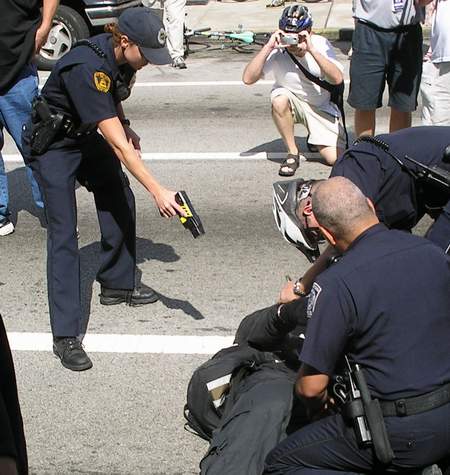
Pittsburgh Taser Case: Two Women Bring Lawsuit
Here on Law and Disorder we’ve given periodic updates on key situations regarding tasers. We’ve covered cases in California and Florida, and on Amnesty International’s position. We bring another case where Mike Healey an attorney in Pittsburgh is cooperating with the Center For Constitutional Rights. Taser Shockwave: Taser’s Latest in Taming Dissent – Posted By Dalia Hashad
The case was brought by two people who were tasered multiple times even after they were arrested and put in police custody. Watch Video: Unneccessary Taser Use At Anti-War Demo Warning: Strong language/ Note also, use of canine intimidation.
Past Law and Disorder Taser Segments
- Law and Disorder June 16, 2008
- Law and Disorder April 21, 2008
- Law and Disorder December 3, 2007
- Law and Disorder January 15, 2007
- Law and Disorder Taser series – Part 1, Part 2, Part 3
Guest – Mike Healey, Pittsburgh attorney cooperating with the Center For Constitutional Rights.
—-
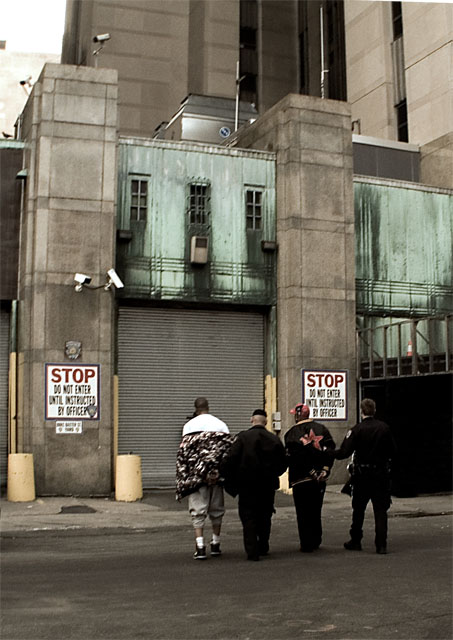
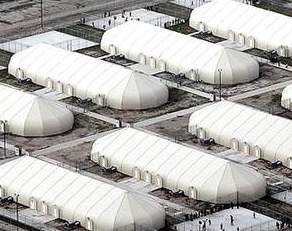

Mass Transfer Of Detainees From New York City To Texas
Today we’re joined by National Lawyers Guild attorney Maunica Sthanki to discuss the transfer of thousands of prisoners from detention centers in New York City to South Texas. Maunica works in a detention center in South Texas and says that unlike criminal cases, in detention cases there is no right to free court appointed counsel. The detainees are faced with navigating through a complex unfamiliar system. Detainees with mental illness were not always represented by a lawyer.
Maunica is working at Probar, a Texas based legal aid group. She explains the differences of between immigration law and criminal law to detainees. “When New Yorkers (detainees) come down to Texas, they’re used to the legal aid and Santuary for Families and all these non-profit service providers and then they find out I’m the only one to help out.”
- “. . .so what we do at ProBar is . . we help people pro se”
- They’re picked up through ICE raids or inadvertently put in custody. Mostly for drug crimes.
- South Texas Pro Bono Asylum Representation Project
- The Port Isabel Processing Center
- 4200 Beds In Rio Grande Detention Facility
- Some Immigrants Stay In Detention For Up To 3 Years
- Related: Privatizing Misery
Guest – Immigration attorney, Maunica Sthanki, she also describes the severity of the problems that detainess with mental health problems face while in detention centers.
————————————————————————–
Law and Disorder November 10, 2008
Podcast: Play in new window | Download
Host Updates:
- Michael Ratner – A Black Family In the White House That Slaves Built
Related News Stories:
- Bush’s Last 100 Days: The Ones To Watch
- Rahm Emanuel: Wikipedia Entry
- The End of International Law?
- Thousands of Indian Farmers Commit Suicide After Using GM Crops
- President-Elect Obama: First Press Conference
- President-Elect Obama: 100 days to Demonstrate Commitment to Human Rights
—
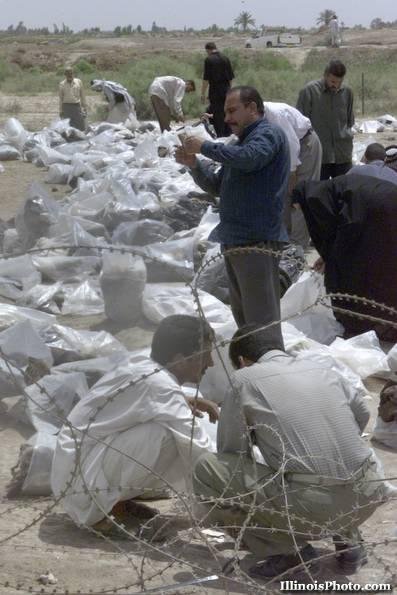
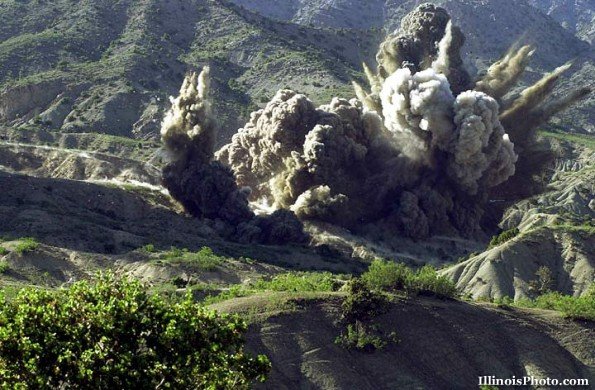
Stephen Kinzer: The Reality of War in Afghanistan
In his recent article The Reality of War in Afghanistan, author and veteran New York Times correspondent Stephen Kinzer describes how the current war strategy in Afghanistan is not really based in reality. Kinzer points to how history has shown that victory over the Taliban is near impossible and adds that peace through skillful negotiation among Taliban clan leaders could be the best approach instead of deploying more soldiers. He adds that Afghanistan civilians are collateral damage amid US bombings, helping to recruit new Taliban soldiers.
Stephen Kinzer:
“There is still an overwhelming feeling in the U.S. that we still need to take revenge for the crimes on September 11 and who are we going to take revenge against? Well, its the Taliban and Al-Quaeda is the answer that the people in Washington would give you. The Taliban and Al-Quaeda are very different forces. To negotiate with Al-Quada is morally repugnant but the Taliban is something different. They have a broad base inside Afghanistan.”
- Its not a surrender, its a cold calculated way to achieve an end outside of the military means.
- We need to put aside our emotions and look at this real politique.
- The war in Afghanistan is antiseptic – to compromise with a force that was our enemy is unpopular.
- The poppy crop in Afghanistan is almost the source of all the world’s heroin.
- To wipe out the poppy crop is not achievable.
- You can’t continue to spray and burn the crop and hope that’s going to end the problem.
“The yearly value of the Afghan poppy crop is about 4 billion dollars.” Kinzer’s idea is to not wipe it all out and impoverish Afghanistan communities. Instead, he says that NATO should purchase crop. “Because when people buy heroin on the street that money goes right to the coffers of terrorists to buy weapons. Kinzer says cut them all off, turn a portion into morphine and destroy the rest.”
Guest – Stephen Kinzer, a veteran New York Times correspondent who has reported from more than fifty countries on five continents. He was the New York Times bureau chief in Istanbul. Stephen currently teaches journalism and United States foreign policy at Northwestern University.
——


Crossing Hitler: The Man Who Put the Nazis on the Witness Stand
Author Benjamin Hett outlines the fascinating and tragic story of a young lawyer Hans Litten in his recent book Crossing Hitler: The Man Who Put the Nazis on the Witness Stand. Before the Nazis rose to power in the early 1930s, they incited calculated violence among the working class in German taverns. Four Nazi stormtroopers were charged with firing randomly into a dance hall where a communist hiking club were holding a party. Three young men were wounded. Hans Litton was the advocate for the 3 men.
Hans Litten called Hitler to the witness stand to show that the Nazi party was a violent party, and by cross examining Hitler he tried to prove that. Litten forced Hitler to contradict himself, reducing him to humiliating rage that revealed his true intention. At that time, Hitler wanted to be a legal party in Germany and of course you couldn’t be a party that was extra-constitutional and legal but at the same time he didn’t want to disappoint the base of his party which was this violent working class aspect. Two years later, the Nazi Party rose to power.
What came after the Reichstag Fire was the arrest of about 5 thousand people across Germany who the Nazis have identified as opponents or potential opponents. Hans Litten was among them and sent to a concentration camp. Author Benjamin Hett describes a powerful narrative of Hans facing torture yet still telling stories and teaching art to other prisoners.
Hans Litten was born in 1903 in Halle in Central Germany, his father was a law professor and Jewish but converted to German evangelical (Lutheran).
Guest – Benjamin Hett, author of Crossing Hitler: The Man Who Put the Nazis on the Witness Stand. He’s a former trial lawyer, and now Associate Professor of History at Hunter College.
——————————————————————————————–
Law and Disorder November 3, 2008
Podcast: Play in new window | Download
Updates:
- Troy Davis Update (Dalia Hashad)
- Guantanamo Update: Mohamed Jawad
- Bush Launches Last Minute Deregulation Push
- Emanuel (Toto) Constant – Haitian Death Squad Leader Sentenced To Prison On Mortgage Fraud
- Muslim, Arab, Men Rounded Up Post 9/11 Based On Racial Profiling: Ashcroft, Others Knew.
- R.A.N.D. Lobbys Pentagon: Start War To Save US Economy
- A Torturer’s Tale: Trained By The US, This is Why He Stopped
- Calls Go Out To Save Autistic Scots Hacker From Threat of US Prison.
—


Iraq Veterans Against The War: Jose Vasquez
The group Iraq Veterans Against The War or IVAW has emerged as the leading antiwar group in the United States. Recently, thousands of IVAW members held rallies and marches at the RNC and nearly 10 thousand marched at the DNC in Denver. The demonstrations urged presidential candidates to endorse ending the Iraq war and paying reparations to the people of Iraq.
The IVAW also calls for the immediate withdrawal of all occupying forces in Iraq, stopping the corporate pillaging of Iraq, and full benefits, adequate healthcare for returning servicemen and women. IVAW chapters are in 48 states, Canada and DC, members include recent veterans and active duty servicemen and women from all branches of military service, National Guard members, and reservists who have served in the United States military since September 11, 2001.
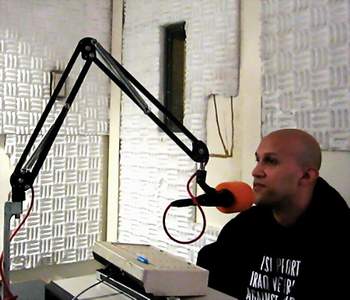
Guest – Jose Vasquez, a 14 year US Army veteran and conscientious objector. He is an active member of Iraq Veterans Against the War (IVAW) serving as the New York City chapter president. Jose was also a key organizer of Winter Soldier: Iraq and Afghanistan.
—
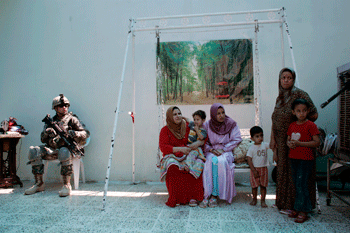
Iraq War – Status of Forces Agreement: Anthony Arnove
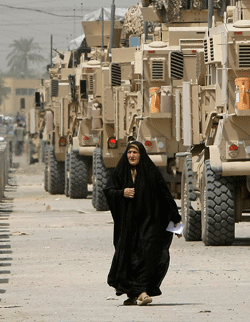
Nearly 4,200 US soldiers and 1 million Iraqi civilians have been killed in the US occupation of Iraq since 2003. .Right now there are 75 major US bases in Iraq, 140 thousand US troops and 180 thousand private contractors operating in Iraq. The cost of the Iraq War so far is 3 trillion and this year the monthly average expense is 12 billion dollars.
A pact recently negotiated in secret by the US government intends to extend the US occupation 3 more years in Iraq despite public and Congressional opposition. Tens of thousands of Iraqis have demonstrated against the pact that calls for full US withdrawal by 2012, but the agreement also leaves open the possible later date of withdrawal.
Anthony Arnove:
- Status of Forces Agreement; Orwellian slieght of hand – Combat troop withdrawal only.
- US is currently responsible for the detention of thousands of Iraqis who are being held without trial.
- 14 permanent US bases in Iraq: Areas to project power from in the future.
- Iraq: World’s second largest oil reserves, and world’s most strategic shipping routes.
- In the SOFA agreements, the US is making a condition to pass a national oil law.
- Iraq’s oil is distributed unevenly, leading to regional tensions between Kurdish and Shia regions.
- Obama rhetoric: Blaming the Iraqi people – the Iraqis haven’t spent money or achieved political reconciliation, or passed a national oil law
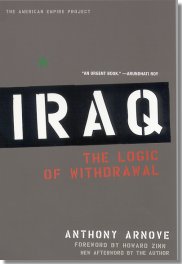
Guest – Editor and writer, Anthony Arnove, author of Iraq: The Logic Of Withdrawal.
Anthony Arnove Wikipedia Entry:
Arnove is best known for his books on Iraq and the Iraq War. Arnove is the author of the book Iraq: The Logic of Withdrawal, published in hardcover by the New Press and in paperback by Haymarket Books. Arnove toured the country promoting the book in spring 2006 as part of the New Press’ “End the War Tour”.
Arnove is also the editor of Iraq Under Siege, published by South End Press, the co-editor with Howard Zinn of Voices of a People’s History of the United States, published by Seven Stories Press, and the editor of The Essential Noam Chomsky, published by the New Press. He writes frequently for left-wing publications; he is a featured author at ZNet, a columnist for Socialist Worker, and on the editorial board of the International Socialist Review. He has also written for The Nation, In These Times, Le Nouvel Observateur, L’Humanité, and The Financial Times.
————————————————————————————————-