Welcome to Law and Disorder Radio
Law and Disorder is a weekly independent civil liberties radio program airing on more than 150 stations and on Apple podcast. Law and Disorder provides timely legal perspectives on issues concerning civil liberties, privacy, right to dissent and practices of torture exercised by the US government and private corporations.
Law and Disorder October 20, 2025
Podcast: Play in new window | Download
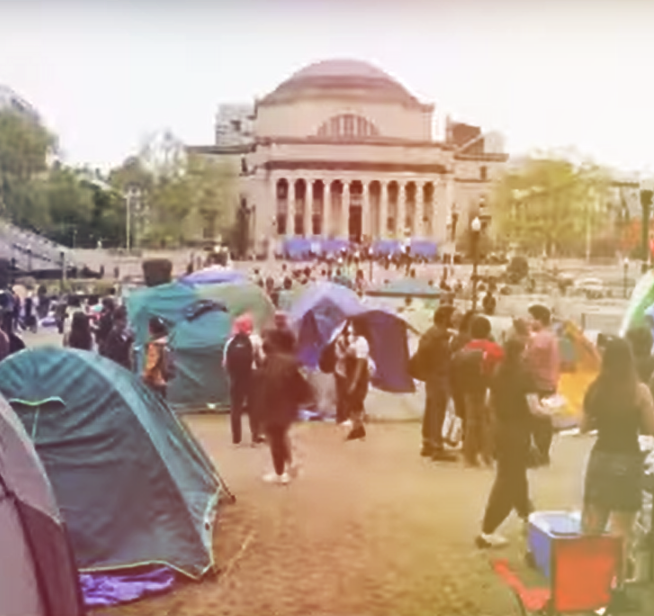
Non Citizens And Free Speech Rights: AAUP v Rubio
On September 30, 2025 a federal judge in Boston issued one of the most important decisions that has been rendered during the 9 months of Donald Trump’s second term. Following a nine-day trial in July that included the testimony of 15 witnesses and the admission of scores of documents, US District Judge William G. Young of the U.S. District Court for the District of Massachusetts ruled that the Trump administration’s policy of arresting, detaining, and deporting noncitizen students and faculty members for their pro-Palestinian advocacy violates the First Amendment. Judge Young was nominated by President Ronald Reagan and has served on the court for over 40 years. While there have been over 200 other court rulings involving Trump since January, this was the first decision following a full-dress trial.
The case, known as AAUP v Rubio, was brought by the Knight First Amendment Institute at Columbia University, partnering with the law firm of Sher Tremonte LLP, representing the American Association of University Professors, including AAUP chapters at Harvard, Rutgers, and NYU, and the Middle East Studies Association (MESA). The associations’ members include tens of thousands of faculty and students across the country.
In his historic ruling, Judge Young wrote, “This case—perhaps the most important ever to fall within the jurisdiction of this district court—squarely presents the issue whether non-citizens lawfully present here in [the] United States actually have the same free speech rights as the rest of us. The Court answers this Constitutional question unequivocally ‘yes, they do.’ ‘No law’ means ‘no law.’ The First Amendment does not draw President Trump’s invidious distinction and it is not to be found in our history or jurisprudence.”
Jameel Jaffer, executive director at the Knight First Amendment Institute, called it “a historic ruling that should have immediate implications for the Trump administration’s policies. If the First Amendment means anything, it means the government can’t imprison people simply because it disagrees with their political views. We welcome the court’s reaffirmation of this basic idea, which is foundational to our democracy.” Todd Wolfson, president of the AAUP, issued the following statement shortly after Judge Young issued his historic ruling: “The Trump administration’s attempt to deport students for their political views is an assault on the Constitution and a betrayal of American values. This trial exposed their true aim: to intimidate and silence anyone who dares oppose them. If we fail to fight back, Trump’s thought police won’t stop at pro-Palestinian voices—they will come for anyone who speaks out. Defending democracy means standing up now—loudly, visibly, and together.”
Having found that the policy violates the First Amendment, in the coming weeks, Judge Young is expected to turn to the question of what appropriate judicial relief should be granted.
Guest – Ramya Krishnan, senior staff attorney at the Knight First Amendment Institute. Ramya served as lead counsel at the trial and presented the opening and closing arguments to the court. She holds a B.A. and LL.B. from the University of Sydney, where she served as an editor of the Sydney Law Review, and an LL.M. from Columbia Law School, where she was a Raymond J. Baer Scholar.
—
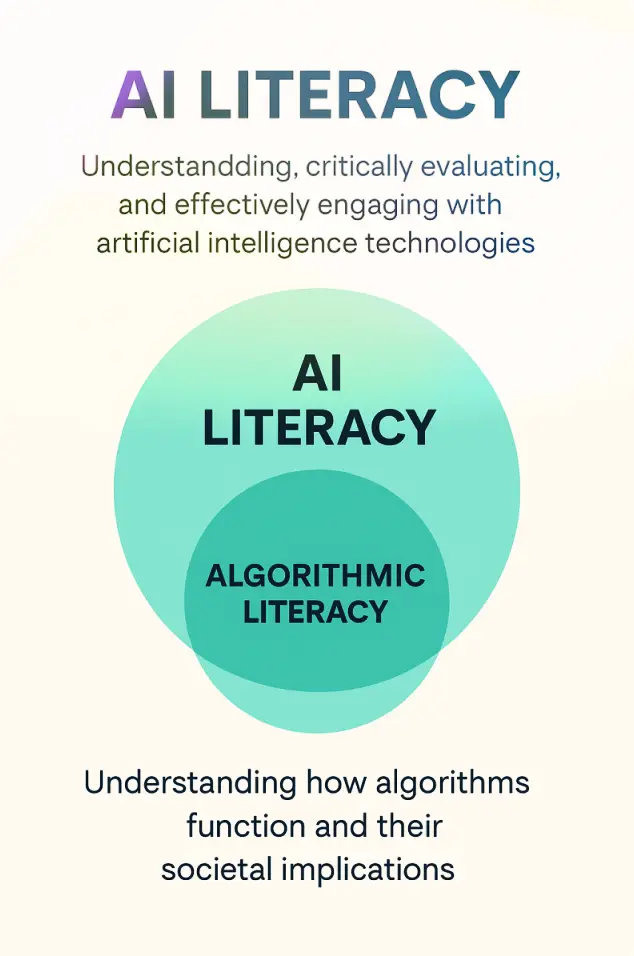
Algorithmic Literacy for Journalists
Artificial intelligence is transforming the newsroom—from how stories are written, and headlines are chosen, to which readers see which articles. Algorithms, those invisible sets of instructions that guide everything from Google searches to social media feeds, are now shaping journalism itself. They can amplify—or silence—voices, and determine which stories gain traction in the public sphere. For journalists, understanding how these systems work isn’t just technical—it’s essential to democracy.
Algorithmic Literacy for Journalists is a new online resource that helps reporters and editors navigate this complex new terrain. The project equips journalists to hold technology platforms accountable, explain AI’s influence to the public, and confront the hidden biases and power structures embedded in algorithmic systems.
Guest – founder of Algorithmic Literacy for Journalists, Dr. Andy Lee Roth the editor-at-large for Project Censored and its publishing imprint, The Censored Press. He co-edits the State of the Free Press yearbook series and co-authored The Media and Me: A Guide to Critical Media Literacy for Young People. A sociologist, since joining Project Censored in 2006, Andy has led media literacy initiatives, including developing Algorithmic Literacy for Journalists, a web resource helping reporters understand how AI shapes—and sometimes distorts—news and society.

———————-
Law and Disorder October 13, 2025
Podcast: Play in new window | Download
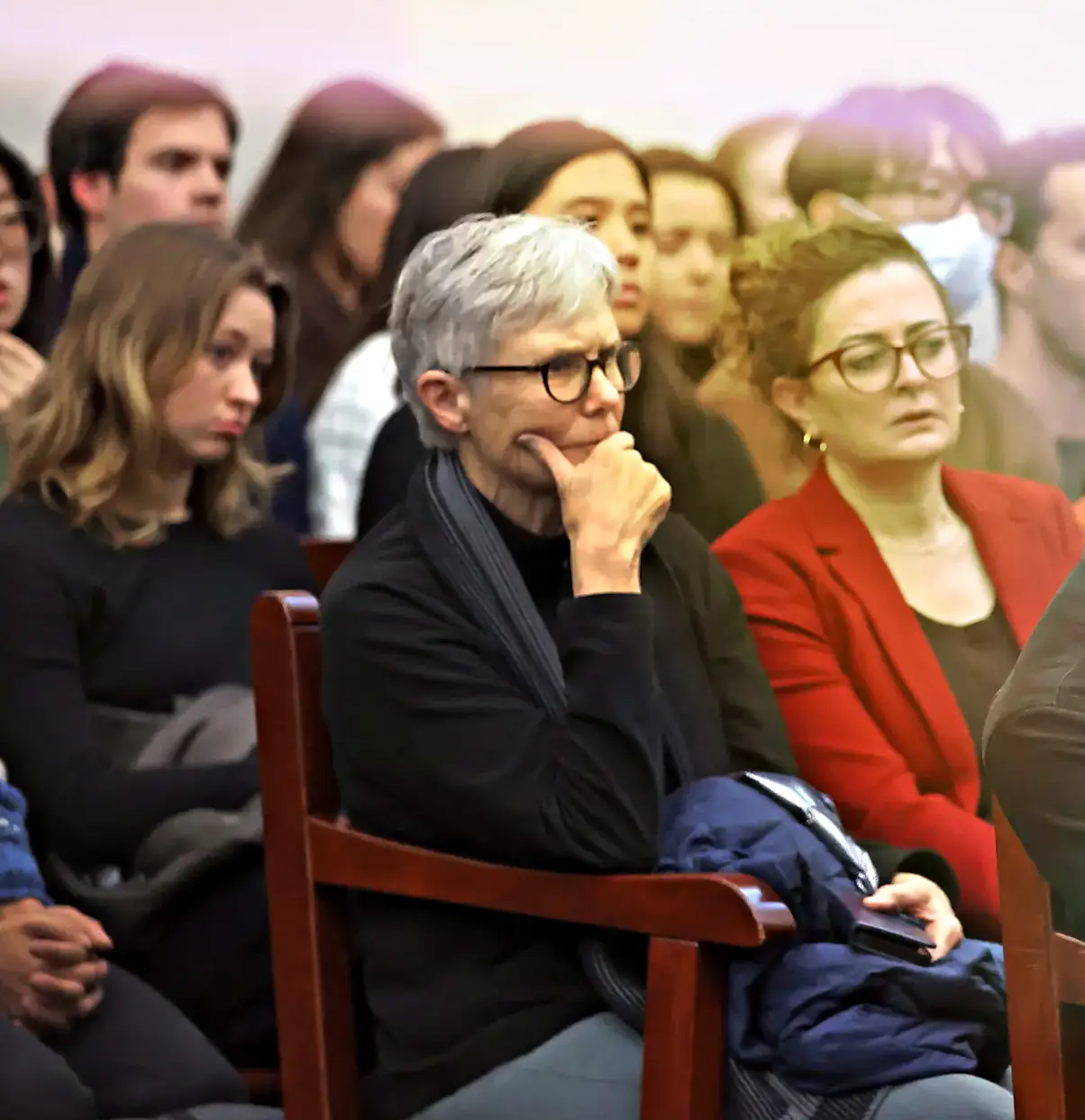

Court Watchers: Immigrant Solidarity Working Group Monitor Deportation Cases
In New York City, a quiet act of resistance is taking place every week inside the federal immigration courts. Members of the Professional Staff Congress—the union representing faculty and staff across the City University of New York—have been showing up not as lawyers or law enforcement, but as witnesses. They call themselves court watchers. Their goal: to stand beside immigrants facing possible deportation, document abuses, and assert the public’s right to observe what happens inside these halls of power.
The union’s Immigrant Solidarity Working Group launched this effort over the summer, after reports that armed ICE agents were making mass arrests in and around federal courthouses—even detaining people who had appeared voluntarily for hearings. For many PSC members, this was a line they couldn’t ignore. Each Friday morning in Foley Square, educators gather before entering the courthouse. They’re trained to document what they see, to provide moral support, and to help loved ones locate those taken into detention. Their presence sends a message: that New Yorkers will not turn away from injustice carried out in their name.
What began as an act of witness has become a form of civic education. Teachers who spend their days in classrooms are now learning new lessons about power, vulnerability, and courage. In the process, they’re showing their students—and the city—what solidarity looks like in action.
Guest – PSC Secretary Andrea Vásquez is an associate director of the American Social History Project at the CUNY Graduate Center, and a managing director of the New Media Lab.
—-
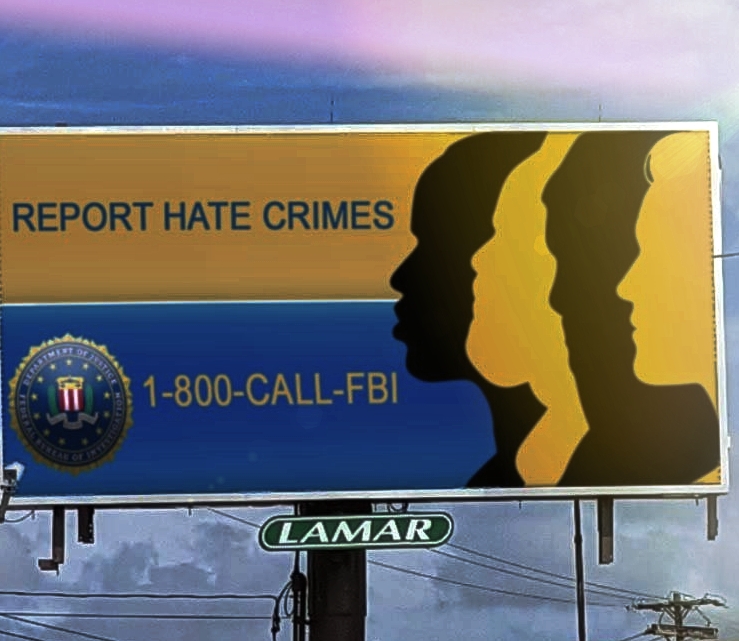
Across the country, tensions are high as hate-fueled incidents make headlines almost daily. Just last month, a transgender woman in Washington State was assaulted by a mob yelling transphobic slurs while one attacker choked her. In this charged environment, politicians are weighing in — some pledging to crack down, others blurring the line between hateful speech and protected expression.
The Trump administration formed a Federal Task Force to Combat Anti-Semitism and is targeting universities across the nation. Attorney General Pam Bondi has said the Department of Justice will “target” and “go after” individuals who threaten others with hate speech. But what does it mean when political figures invoke hate crime laws as tools of ideology rather than justice? And what are the real implications for free speech, civil rights, and public safety?
Guest – Zachary Wolfe, editor of Hate Crimes Law and a leading scholar on how the United States defines, prosecutes, and debates hate-motivated offenses. He’s here to help us understand how these laws are being used—and sometimes misused—in today’s polarized climate. Blog: profzwolfe.com
——————————————–
Law and Disorder October 6, 2025
Podcast: Play in new window | Download
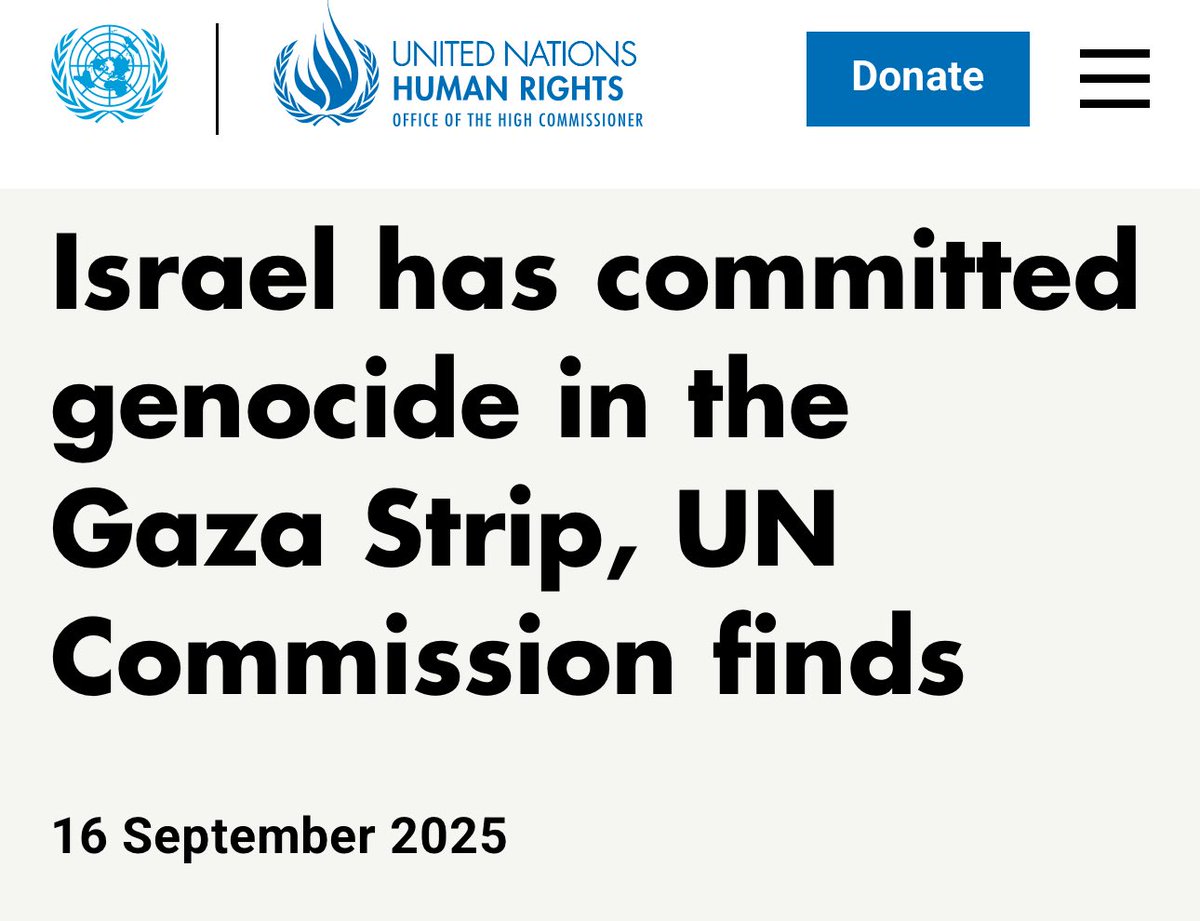
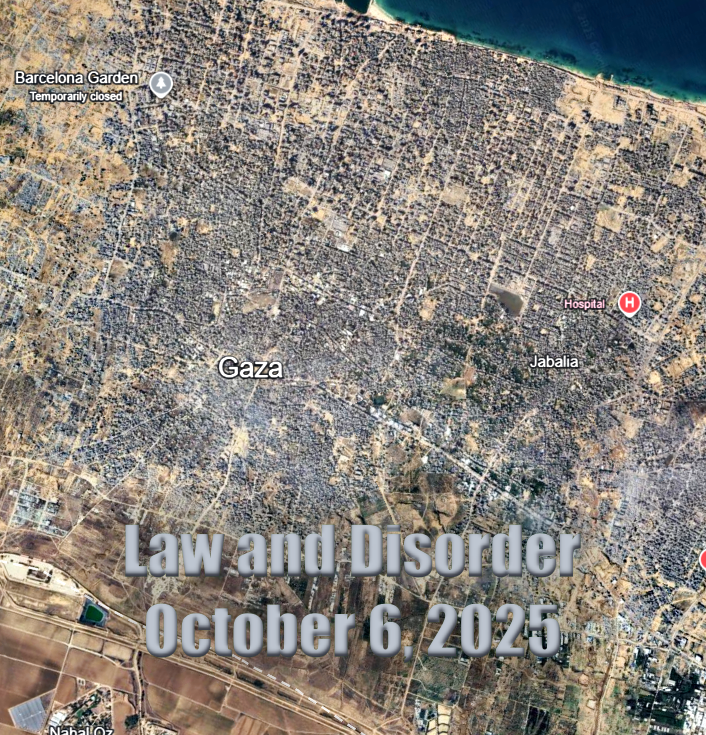
Taxpayers Against Genocide and the National Lawyers Guild Submit Petition To UN
Eighty years ago, after 2 world wars claimed millions of lives, nations worldwide — including the United States — came together and established the UN system “to save succeeding generations from the scourge of war.” The UN Charter requires that all states settle their disputes peacefully and refrain from the use of armed force, except in self-defense after an armed attack against a UN state by another state, or when the Security Council authorizes it.
But, motivated by American exceptionalism — the notion that the U.S. is unique and morally superior and thus not bound by the rules — successive U.S. governments have violated the commands of the UN Charter and illegally attacked other countries with impunity. Trump has ignored the straightforward rules about the lawful use of force, but he is not the first U.S. president to do so. The last five presidents have launched armed attacks without Security Council approval against countries that had not carried out armed attacks on the U.S. or other UN member countries.
Besides violating the Charter’s prohibition on the use of force, the U.S. government – under both Biden and Trump – has aided and abetted Israel’s commission of genocide in Gaza. As the number of Palestinians killed by Israel exceeds 66,000, and famine has reached the “catastrophic” phase, thousands of taxpayers across the country have united with Palestinian-Americans to file an international legal complaint against the U.S. government for funding Israel’s genocide in Gaza.
An initial petition was filed in the Inter-American Commission on Human Rights in May by Taxpayers Against Genocide and the National Lawyers Guild. It charged the U.S. with aiding and abetting Israel in genocide, war crimes, and crimes against humanity. Tomorrow, the petitioners will file a new petition with the Commission. It includes substantial evidence of the U.S. role in Israel’s campaign of starvation.
Guest – Marjorie Cohn is Professor Emerita at Thomas Jefferson School of Law, Dean of the People’s Academy of International Law, and former president of the National Lawyers Guild. She is a legal political analyst who does commentary and writes columns on Truthout and other outlets, and she a former host on Law and Disorder radio. Her most recent book is Drones and Targeted Killing: Legal, Moral, and Geopolitical Issues. Marjorie wrote an article published last week on Truthout about U.S. violations of the UN Charter. Her article about the petition to be filed in the Inter-American Commission will be published tomorrow on Scheer Post.
—
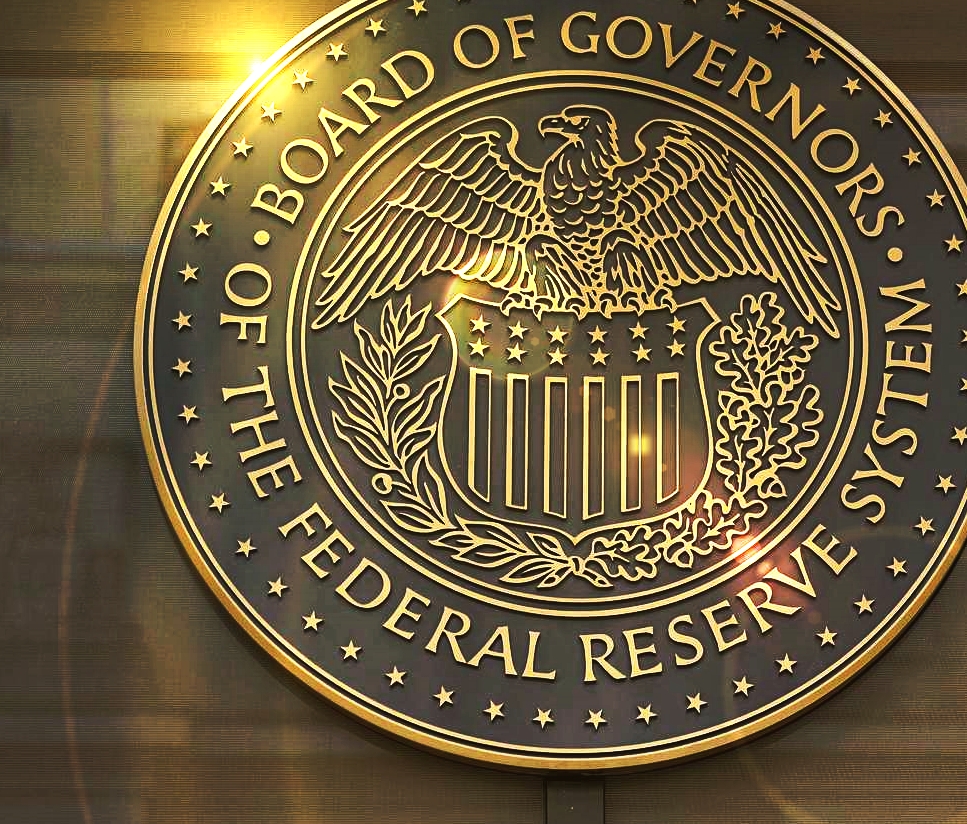
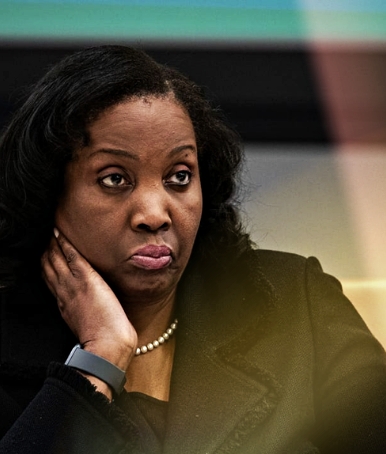
Lisa Cook is ‘Low Hanging Fruit—While Jerome Powell Is a Bridge Too Far
Sharon Kyle is the publisher of the L.A. Progressive. She has written a couple of fine articles about racism in American life in that publication. One of them, written at the end of August, is titled, Lisa Cook is ‘Low Hanging Fruit—While Jerome Powell Is a Bridge Too Far. She maintains that when political commentators, and the corporate media, describe Cook as “low hanging fruit” they expose the racism in American life and politics.
So, we’ve invited Sharon Kyle to be our guest today to explain her claim of racism in connection with Trump’s efforts to get rid of Cook on the vitally important Federal Reserve Board, and replace her with someone who would do his bidding.
Guest – Sharon Kyle is not only the publisher of the L.A. Progressive, a must read, online daily newsletter for all serious political thinkers and activists in and around L.A. She is also the former president of the Peoples College of Law, a former member of the Board of Directors of the ACLU of Southern California, and is on the editorial board of the BlackCommentator.com.
Remembering Assata Shakur (1947-2025)
————————————————-