Civil Liberties, Criminalizing Dissent, Human Rights, NSA Spying, Political Prisoner, Surveillance
Podcast: Play in new window | Download
Update:
—-

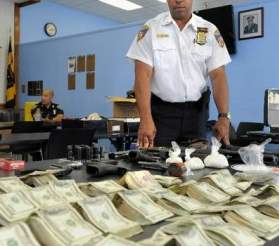
Fair Punishment Project: Civil Asset Forfeiture Reform Efforts
Controversial and antiquated civil forfeiture procedures across the nation are causing many, including the country’s poorest, to have assets seized by law enforcement agencies to fill department coffers.
In 2016 the manager of a Burmese Christian Rock Band had just completed a five-month tour across the country, raising over $50K for an orphanage in Thailand and a college in Burma, when police pulled him over for a broken tail light. A routine traffic stop soon turned into a months-long nightmare.
After a drug dog allegedly “alerted” to the car, police searched it, but found no evidence of drugs. They did, however, seize the cash donations as supposed “drug proceeds.” After interrogating the band manager for six hours, the police eventually let him go, but kept the cash. Within a month, the Muskogee County District Attorney filed a civil-forfeiture action to keep the money for good.
In light of Attorney General Session’s announcement that he plans to increase the use of civil forfeiture, we can expect many more cases like this one.
Guest – Josie Duffy Rice is a lawyer and writer in New York. Josie is research director of the Fair Punishment Project.
—-

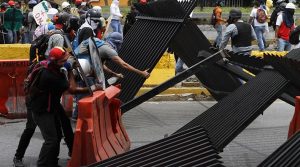
Venezuela: Media Distortion And Analysis
The great Latin American historic figure Simon Bolivar, known as the liberator, famously said that “the United States seems destined by Providence to plague America with misery in the name of the liberty.” The current situation in Venezuela seems to be a case and point. That country’s Foreign Minister Samuel Moncada and Carlos Ron, an official at the Venezuelan embassy, have recently accused Florida Senator Marco Rubio and CIA director Mike Pompeo of secretly conspiring to overthrow the democratically elected government of Nicholas Monduro.
The United States has a history of causing regime change to governments in Latin America. These include the governments of Guatemala, Brazil, the Dominican Republic , Bolivia, Grenada, Chile, Panama, Argentina, Nicaragua, and Cuba where “regime change” is written into American law. There has recently been a wave of violence in Venezuela including assassinations, violence at demonstrations, and distruction of property.
Guest – Gregory Wilpert has lived in Caracas,Venezuela, and is now based in Quito, Ecuador. He is the author of Changing Venezuela by Taking Power: The History and Policies of the Chavez Government. As a journalist, he is the founder of VenezuelaAnalysis.com. He is married to Carol Delgado Arria, who has served the Venezuelan government as ambassador to Ecuador and consul general in New York. He is currently visiting Caracas and joins us from there.
————————————————————–
CIA Sponsored Terror, Civil Liberties, Criminalizing Dissent, Habeas Corpus, Human Rights, NSA Spying, Surveillance, Targeting Muslims, Truth to Power, War Resister
Podcast: Play in new window | Download
Update:
- Rev Billy And The Stop Shopping Choir: Radical Ritual At Trump Tower
—-
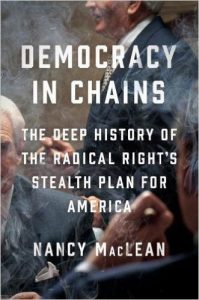
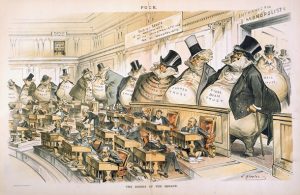
Democracy in Chains: The Deep History of the Radical Right’s Stealth Plan for America
The spectacle of President Donald Trump and the palace intrigue in the White House has served daily to distract people from the political strategy and accomplishments of the radical right, which is taking over the Republican Party.
Over time, the GOP has been transformed into operation conducting a concerted effort to curb democratic rule in favor of capitalist interests in every branch of government, whatever the consequences. It is marching ever closer to the ultimate goal of reshaping the Constitution to protect monied interests. This gradual take over of a major political party happened steadily, over several decades, and often in plain sight.
Duke University Professor Nancy MacLean exposes the architecture of this change and it’s ultimate aim. She has written that “both my research and my observations as a citizen lead me to believe American democracy is in peril”.
Guest – Professor Nancy MacLean, whose new book, Democracy in Chains: The Deep History of the Radical Right’s Stealth Plan for America, has been described by Publishers Weekly as “a thoroughly researched and gripping narrative… [and] a feat of American intellectual and political history.” Booklist called it “perhaps the best explanation to date of the roots of the political divide that threatens to irrevocably alter American government.” The author of four other books, including Freedom is Not Enough: The Opening of the American Workplace (2006) called by the Chicago Tribune “contemporary history at its best,” and Behind the Mask of Chivalry: The Making of the Second Ku Klux Klan, named a New York Times “noteworthy” book of 1994, MacLean is the William H. Chafe Professor of History and Public Policy.
—-
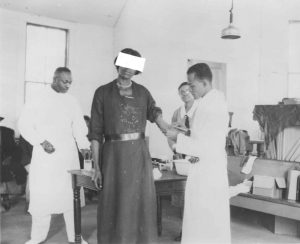
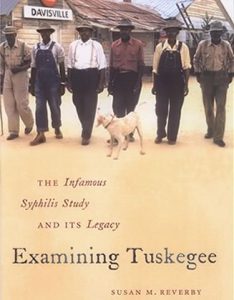
Tuskegee Syphilis Study Aftermath
The Tuskegee Syphilis Study was a biomedical clinical study conducted by the US Public Health Service for four decades between 1932 and 1972. Its purpose was to observe the natural progression of untreated syphilis in rural African-American men in Alabama under the guise of receiving free health care from the government.
It collaborated with the historically black Tuskegee University in Alabama. Investigators enrolled a total of 600 impoverished African American sharecroppers from Macon County, Alabama. Of these men, 399 had previously contracted syphilis before the study began, and 201 did not have the disease. They were given free medical care, meals, and free burial insurance for participating in the study. After a cure for syphilis was discovered in penicillin, the study still continued without informing the men they would never be treated. According to the Centers for Disease Control, the men were told they were being treated for “bad blood,” a local term for various illnesses that include syphilis, anemia, and fatigue.
Guest – Professor Susan Reverby is Marion Butler McLean Professor in the History of Ideas and Professor of Women’s Studies at Wellesley College. She is editor of Tuskegee’s Truths: Rethinking the Tuskegee Syphilis Study.
——————————————
Academic Freedom, Civil Liberties, Criminalizing Dissent, Human Rights, Surveillance, Truth to Power
Podcast: Play in new window | Download
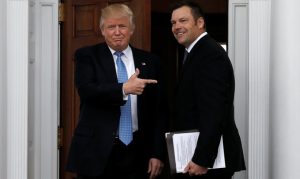
Trump Election Fraud Investigation
Donald Trump lost last November’s election by some 3 million of the popular vote. Subsequently, he falsely asserted that between 3 and 5 million votes were cast illegally. Then in May of this year, by executive order, Trump established The Election Integrity Commission. The nominal head of the commission is Vice President Mike Pence, but the functioning head is Kris Kobach, the Kansas Secretary of State who has a long history of successful voter suppression. He is running for governor on this record. Kobach was recently fined by a federal magistrate for “making patently misleading representations to the court” and “abusing the judicial process” when he lied to the judge about the content of certain papers that he shared with Trump concerning voter suppression.
Kobach is helping Trump lay the groundwork for a national voter suppression effort. His commission wrote to the 50 Secretaries of State in the U.S. asking for private information on the voters in their states. Forty-four of the 50 Secretaries of State have told Kobach that they will give him a little or no information. A leading resister, Virginia Governor Terry McAuliffe said “at best this committee was set up as a pretext to validate Donald Trump’s alternative election facts, and at worst is a tool to commit large scale voter suppression.”
Guest – Eliza Carney is the senior editor at The American Prospect. She wrote an article about Kris Kobach titled The Limits of Lying and Cheating in the June 29 issue.
—-
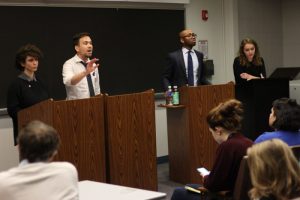

Offense Strategy For Left
The election of Donald Trump has greatly emboldened the forces on the right. We have seen lynchings, stabbings and even murder. The acquittal of murderous cops is almost routine. Deportations number in the tens of thousands. A number of left-wing professors have been suppressed. Right wing provocateurs and racist speakers have appeared on campuses. Fascists have a attempted to organize rallies in major cities.
Hard core groups such as the Klan, racist skinheads and outright fascist organizations like Richard Spencer’s National Policy Institute have been growing and so have militia organizations. The Republican Party, the congressional freedom caucus, fundamentalist, FOXNews aficionados, and neocons have also seen their strength and numbers and influence increase.
How do we fight this? Should we ask the government for help? Should we confront the right? Do we need a mass movement? Do we have to present a political alternative to provide real answers to real problems?
Guest – Jon Kurinsky is a Chicago activist, he recently gave a speech on the topic of fighting the right at the Socialism 2017 conference in Chicago which had a record attendance of more than 2000 people.
————————————
CIA Sponsored Terror, Civil Liberties, Criminalizing Dissent, Human Rights, Political Prisoner, Surveillance, Targeting Muslims, Truth to Power, War Resister
Podcast: Play in new window | Download
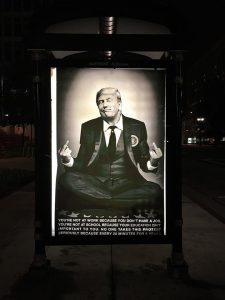
This is Not Populism : John Bellamy Foster
Is Trump a neofascist? Thoughtful analysts on the left like Cornell West, Noam Chomsky, and Judith Butler think he is. But mainstream liberal commentators refuse to associate the Trump phenomena with fascism. They call him a right wing populist. What is neofascism? Right wing Populism? Does it really matter what Trump is called? The great German playwright and political thinker who lived in Germany during Hitler’s reign, Berthold Brecht, asked in 1935: “How can anyone tell the truth about fascism, unless he’s willing to speak out against capitalism, which brings it fourth?” We speak today with John Bellamy Foster, the editor of the venerable magazine “Monthly Review”. He wrote the lead article in the current June 2017 issue titled “This Is Not Populism.”
Guest – John Bellamy Foster is editor of Monthly Review and professor of sociology at the University of Oregon. He has written widely on political economy and has established a reputation as a major environmental sociologist. He is the author of Marx’s Ecology: Materialism and Nature (2000), The Great Financial Crisis: Causes and Consequences (with Fred Magdoff, 2009), The Ecological Rift: Capitalism’s War on the Earth (with Brett Clark and Richard York, 2010), and The Theory of Monopoly Capitalism: An Elaboration of Marxian Political Economy (New Edition, 2014), among many others.
—-
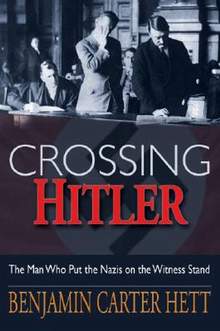

Crossing Hitler: The Man Who Put the Nazis on the Witness Stand
Author Benjamin Hett outlines the fascinating and tragic story of a young lawyer Hans Litten in his recent book Crossing Hitler: The Man Who Put the Nazis on the Witness Stand. Before the Nazis rose to power in the early 1930s, they incited calculated violence among the working class in German taverns. Four Nazi stormtroopers were charged with firing randomly into a dance hall where a communist hiking club were holding a party. Three young men were wounded. Hans Litton was the advocate for the 3 men.
Hans Litten called Hitler to the witness stand to show that the Nazi party was a violent party, and by cross examining Hitler he tried to prove that. Litten forced Hitler to contradict himself, reducing him to humiliating rage that revealed his true intention. At that time, Hitler wanted to be a legal party in Germany and of course you couldn’t be a party that was extra-constitutional and legal but at the same time he didn’t want to disappoint the base of his party which was this violent working class aspect. Two years later, the Nazi Party rose to power.
What came after the Reichstag Fire was the arrest of about 5 thousand people across Germany who the Nazis have identified as opponents or potential opponents. Hans Litten was among them and sent to a concentration camp. Author Benjamin Hett describes a powerful narrative of Hans facing torture yet still telling stories and teaching art to other prisoners.
Hans Litten was born in 1903 in Halle in Central Germany, his father was a law professor and Jewish but converted to German evangelical (Lutheran).
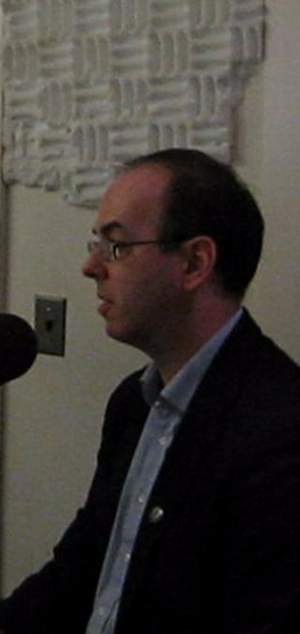
Guest – Benjamin Hett, author of Crossing Hitler: The Man Who Put the Nazis on the Witness Stand. Hett is a former trial lawyer, and now Associate Professor of History at Hunter College.
————————————————–
CIA Sponsored Terror, Civil Liberties, Crony Capitalism, NSA Spying, Supreme Court, Targeting Muslims, Torture
Podcast: Play in new window | Download
Law and Disorder Outtakes: Disorderly Bloopers
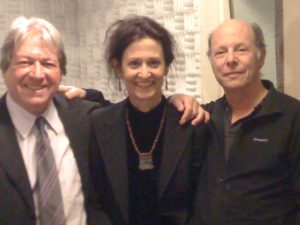
We first began recording Law and Disorder in 2004, the same year the Republican National Convention—and large protests—were held in New York City. When we started, we had four hosts—Dalia Hashad and Michael Ratner along with Michael Smith and Heidi Boghosian.
After a few years, Dalia moved to California, leaving us with three hosts. In late spring 2016 we lost Michael Ratner to cancer. Now there are just two of us.
It is our special pleasure to share with listeners our first segment of The Disorderly Bloopers, behind-the-scenes audio outtakes from the first years we were on the air.
Law and Disorder was created during the George W. Bush administration to cover what we thought would be some of the darkest days in the nation’s history. As part of our special summer episode we thought these studio snippets might provide a few minutes of much-needed levity.
It’s important to take a few minutes to laugh at ourselves, and to look back at the hundreds of fun days that we here at Law and Disorder have had over the years.This has also been a trip down memory lane for Heidi and Michael as we hear hilarious interchanges with Dalia and Michael Ratner.
As we covered some of the most serious topics in the news, and amidst the enormous respect we had for all of our guests, the four of us wholeheartedly enjoyed a special relationship, along with our longstanding producer Geoff Brady. It’s a relationship that comes from working closely together and respecting each other as colleagues and friends.
—-
Hosts Read Some of the Best Courtroom Transcripts
Q: Doctor, before you performed the autopsy, did you check for a pulse?
A: No.
Q: Did you check for blood pressure?
A: No.
Q: Did you check for breathing?
A: No.
Q: So, then it is possible that the patient was alive when you began the autopsy?
A: No.
Q: How can you be so sure, Doctor?
A: Because his brain was sitting on my desk in a jar.
Q: But could the patient have still been alive nevertheless?
A: It is possible that he could have been alive and practicing law somewhere.
—-
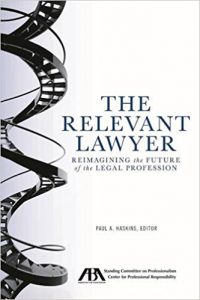
The Relevant Lawyer: Reimagining the Future of the Legal Profession
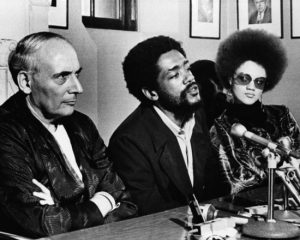
Hosts alternate in reading part of a chapter on Attorney Charles Garry in the book The Relevant Lawyer: Reimagining the Future of the Legal Profession by Paul A. Haskins. Haskins is senior counsel in the American Bar Association Center for Professional Responsibility and lead counsel for the Standing Committee on Professionalism.
——————————————————-