CIA Sponsored Terror, Civil Liberties, Habeas Corpus, Human Rights, Political Prisoner, Targeting Muslims, Truth to Power, War Resister
Podcast: Play in new window | Download
Updates:
—-
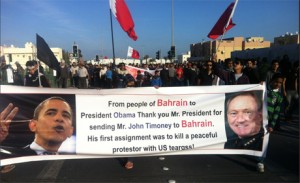

White-washing Human Rights Abuses and Suppressing a Popular Revolution
Two years since the Arab-Spring demonstrations erupted in Bahrain, human rights abuses continue to this day. In 2011, an independent report exposes these abuses that compelled the Kingdom of Bahrain to hire former NYPD police chief John Timoney to white was acts of political repression. Who is John Timoney and why was he outsourced to Bahrain? We ask legal worker and journalist Kris Hermes who recently penned the article John Timoney and Kingdom of Bahrain: White-washing Human Rights Abuses and Suppressing a Popular Revolution.
Kris Hermes:
- Shortly after the Arab Spring began in 2011, Bahrain followed in the footsteps of Tunisia and Egypt by demonstrating against the ruling monarchy that’s been in power for more than 200 years.
- Those protests were met with intense repression by King Hamad.
- The protests made of the Shiite population who argue they’ve been systematically discriminated against in employment, housing, education.
- The ministry of interior hired John Timoney as well as John Yates who is from the UK.from Britains metropolitan police department.
- John Timoney started with a long career in the New York City Police Department, he was probably most well known for his handling of the Tomkins Square Park riots in 1988.
- Regardless of what he did to clean up the Philadelphia Police Department, his handling of the Republican National Convention protests were abysmal. He came down very hard on protesters in 2000, essentially establishing a new form of policing in the United States that for the most part was intolerant of political demonstrations.
- He became the police chief of Miami in 2002 and oversaw one of the most violent police reactions in modern history. He not only used what he learned in Philadelphia, conducting preemptive raids, using infiltration and heavy surveillance, brutalizing protesters on the street, and wrongfully arresting hundreds of people.
- In Miami he used a whole panaply of weapons against protesters, including tear gas, pepper spray, rubber and wooden bullets, bean bag rounds, tasers and electric shields.
- He gained a reputation both in Philly and Miami.
- He’s been in Bahrain for a year and a half now and has a two year contract and its just about up.
- That’s the reason why the article was done, an assessment on how Timoney has done in Bahrain in terms of his crown control measures.
- Andrews International: Part of a security apparatus that is increasingly private in terms of policing and security personnel that are deployed around the world.
- It allows the US to expand its militia around the world as well.
- The death toll of political demonstrators has only increased since Timoney arrived on the scene. One of his favorite tools to suppress demonstrations in the United States is tear gas.
- Things are pretty dire for political dissidents in Bahrain.
Guest – Kris Hermes, activist who provides legal support work on cases involving political dissidents.
—-
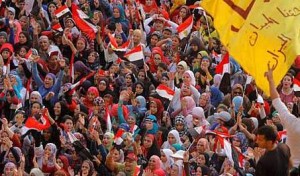
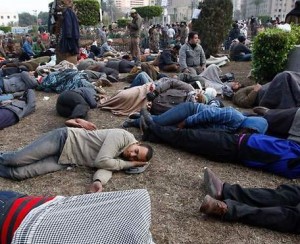
Egyptian President Mohamed Morsi Ousted Following Days of Massive Largest Anti-Government Protest
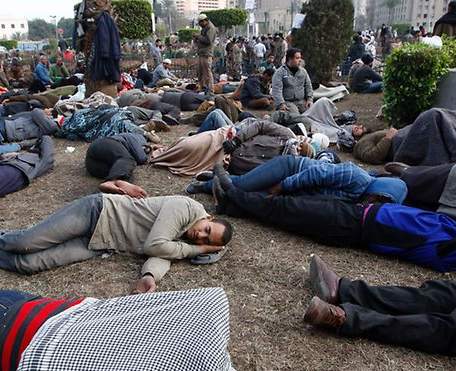
Last week, democratically elected President Mohamed Morsi was ousted following historic demonstrations by Egyptian protesters. Morsi and his advisors have been held under house arrest in the Egyptian Republican Guard Club, the highest Brotherhood leader, Mohammed Badie, and some associates of his have been arrested. Protesters accused Morsi of supporting Obama’s anti-Syrian agenda, ignoring critical economic problems and betraying his support for Palestinians. However, what are the some of the economic issues involved that led up to these massive protests?
Omar el-Shafei:
- We’re going through a real historic process. At least you had 20 million people in the streets expressing their anger in different Egyptian cities.
- This is a continuation of the process that started in January 2011, not just Egyptian but an Arab phenomenon.
- I think its a complete anger, bitterness and disillusionment of the rule of the Muslim Brotherhood.
- We have to remember that the Muslim Brotherhood has been the largest opposition force during the last decade of the Mubarack dictatorship.
- After one year in power they managed to alienate everybody. They were essentially ruling as a continuation of the old regime, and pro-imperialist foreign policy.
- The dominant image of the Arab Spring is purely political, middle class, youthful mobilization aiming at democratizing despotic regimes.
- The Mubarack dictatorship for years and sometimes decades have applied neoliberal economic policy that tremendously increased class divide, so the social element of this revolution was vital.
- In the case of Egypt, the revolution in 2011 came after five years of the biggest wave of workers struggle in the history of the country, since the 1940s.
- The continuation of the revolution is in large part of the worker mobilization. After the revolution we didn’t have independent trade unions, they incorporated by the state.
- More like the agent of the state against the liberal movement.
- Since then we’ve witnessed an emergence of thousands of trade unions and they are playing an important part in the revolution in social demands.
- The message from below even when it is apparently limited demands it has the potential of raising people’s confidence and enhance a process of self radicalization that can link these demands to a wider vision of transformation in society.
- What happened in Turkey a few weeks ago and Brazil more recently has very much has inspired the Egyptian struggle.
- What we are witnessing is a huge mobilization against the Muslim Brotherhood. The military prefer to remain in the background.
- We are in a prolonged revolutionary process and I think that the people are learning from their own experience.
Guest – Omar el-Shafei, political activist, and independent researcher currently living in NYC. He is a doctoral candidate of International Law at Paris VII University in France. Omar is a founding member of the “Committee of Solidarity with the Struggle of the Egyptian People” in Paris, France, and author of “Workers, Trade Unions, and the State in Egypt, 1984-1989,” Cairo Papers in Social Science, American University in Cairo Press (Volume 18, Monograph 2, Summer 1995).
———————————————————————
Afghanistan War, Civil Liberties, FBI Intrusion, Human Rights, Surveillance, Targeting Muslims, Torture, War Resister
Podcast: Play in new window | Download
Updates:
- ‘We Steal Secrets’: State Agitprop by Chris Hedges
- Banality of Don’t Be Evil – A Response To The Book – The New Digital Age
- Michael Ratner Discusses Bradley Manning Trial – Hundreds of Protesters
- Get Whistleblowers First Then Journalists
- A Phone Call To Save Lynne Stewart’s Life:
- Attorney General Eric Holder – 1 202 514 2001
- White House President Obama – 1 202 456 1414
- Federal Bureau of Prisons – Director Charles Samuels – 1 202 307 3198 ext 3
——
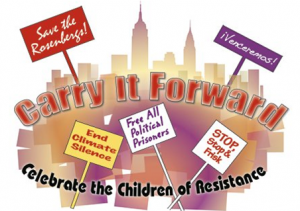
Carry it Forward: Celebrate the Children of Resistance – 60th Anniversary of Rosenberg Execution
Today we speak to Robert Rosenberg, the younger son of Ethel and Julius Rosenberg. He’s an author, activist, attorney and public speaker. He sued the FBI and CIA to force the release of 300 thousand previously secret documents about his parents. Robert founded the Rosenberg Fund For Children which provided educational and emotional needs of both targeted activist youth and children whose parents have been harassed, injured, jailed or died because or during their activism. This week the event Carry it Forward: Celebrate the Children of Resistance – 60th Anniversary of Rosenberg Execution on Sunday June 16, 2013.
Robert Meeropol:
- The Rosenberg Fund For Children is a public foundation that provides for the educational and the emotional needs of the children of targeted activists in the United States.
- I founded this organization in 1990. We help hundreds of children of targeted activists.
- In some ways you can say that the Rosenberg Fund For Children was a vehicle for me to create something positive in response to the destruction that was visited upon me when my parents were arrested when I was just 3 years old.
- Judge Kaufman’s sentencing statement justifying a death sentence after a conviction for conspiracy to commit espionage by using the word treason.
- The parallel today is the Bradley Manning case which is going on right at this moment. He is being charged with conspiracy to commit espionage under the exact same law that my parents were charged under.
- The question being asked is: Is he a whistle-blower or is he a traitor?
- We now know from the government’s own files that my parents had nothing to do with the secret of the atomic bomb.
- The government wanted to make a big show trial and demonstrate that people who wanted to take this conscious driven action posed a threat to the entire nation.
- Sixty years on, this case is just as relevant today as the day it was born.
- The change that has occurred is the government learned the lessons of my parents’ case and has now figured out ways in post 911 America to make all the illegal activities that they engaged in in other to obtain this big show trial conviction in the 1950s legal today.
- We went through hell between the years of the arrest and the execution. I grew up with this sense, this unmet need to do something about this.
- It wasn’t until I was 43 years old in 1990 that I figured out what to do and that was to start a foundation in my parents name that would help children and young people in similar circumstances today.
- Law and Disorder Interview On The Rosenbergs
Guest – Robert Meeropol, the younger son of Ethel and Julius Rosenberg. In 1953, when he was six years old, the United States Government executed his parents for “conspiring to steal the secret of the atomic bomb.” For more than 40 years he has been a progressive activist, author and public speaker. In the 1970’s he and his brother, Michael, successfully sued the FBI and CIA to force the release of 300,000 previously secret documents about their parents. He earned undergraduate and graduate degrees in Anthropology from the University of Michigan, graduated law school in 1985, and was admitted to the Massachusetts Bar
——-

Welcome to the Gilded City of New York: Low Wage Workers Unite
Last month in an article titled Welcome to the Gilded City by The Nation, the collaborative work of editors compiled a detailed overview of Mayor Bloomberg’s legacy. The article assesses the various personas the New York mayor used to further specific agendas, among them are the “top cop” presiding over a vast surveillance program, the union buster waging war on organized labor, the imperialist undermining the city’s term limits. New York City’s income inequality has grown rapidly in the last 3 decades, outpacing New York state and the nation. The article points out that there were choices available to New York City’s government to counter this economic trend yet they’ve been basically ignored.
Lizzy Ratner:
- We’re at a fulcrum moment in New York City, we’re at the end of the Bloomberg era, he is finally term limited at the end of this year.
- In thinking about what New York City is now, we came upon a central theme and that is “inequality.”
- Peel back the cellophane a little bit and what you see is deep struggle, deep poverty.
- Because New York is an emblem sometimes for the larger country, what does it tells us about the country?
- In 1980 about 21 percent of New York City’s population lived at or below the federal poverty line.
- In the last 30 years we’ve had effectively no progress in the realm of fighting poverty in this city.
- In 2011, about 400 thousand people or about 1 out of 10 of the city’s workers, worked by didn’t earn enough money to get out of poverty.
- That same year about 600 thousand people earned 10 dollars an hour or less.
- The point of the metaphor was to contrast these two New York Citys, these two different worlds. The gilded world, which is flashy, which everybody sees on TV, which is the one that’s been promoted by the Bloomberg administration.
- There is this perception of Bloomberg as a great liberal icon. There is a certain disturbing truth to that in that liberalism is being defined these days as social progressiveism.
- We have these sacrificed populations in the city which are being targeted.
- The mayor took control of public schools, claimed control when he took office. The justification for that was this was a way to tame an unruly system, narrow the education gap between students of color and white students.
- One of his signature failures (Bloomberg) was not addressing the horrifying inequality and job loss (during recession)
- Bloomberg Obstructed or Vetoed: Paid Sick Leave Law, Living Wage Bill, Anti-Predatory Lending Bill
- If you want to look at Bloomberg’s failure around poverty you just need to look at homelessness. Homelessness had almost doubled under his tenure.
- A lot of organizations and grass roots groups have started building power and have come together in various ways to change conditions for workers in this city.
Guest – Lizzy Ratner, co-editor of this Nation article. Lizzy is a journalist and co-editor of The Goldstone Report: The Legacy of the Landmark Investigation of the Gaza Conflict.
Past Law and Disorder interviews with Lizzy Ratner
—————————————————–
Afghanistan War, CIA Sponsored Terror, Civil Liberties, Criminalizing Dissent, FBI Intrusion, Guantanamo, Habeas Corpus, Human Rights, Political Prisoner, Prison Industry, Surveillance, Targeting Muslims, Torture, Truth to Power, War Resister
Podcast: Play in new window | Download
Updates:
——-
MOVE Bombing: 28th Anniversary
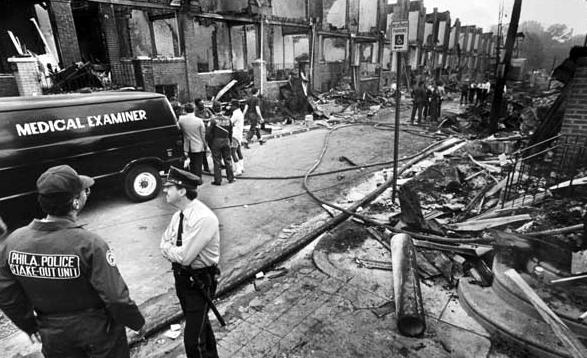
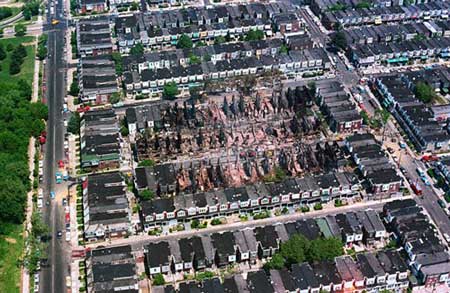
This week marks the 28th anniversary of an armed police mission in Philadelphia that ended in a helicopter bombing of the headquarters of the group known as MOVE. The fire commissioner in that city allowed a fire to rage unabated at 6221 Osage Avenue in West Philadelphia, killing six adults and five children, destroying 65 homes and leaving more than 200 people homeless. Despite two Grand Jury investigations, and a commission finding that top officials were grossly negligent, no one from city government was ever criminally charged. A recent film called Let the Fire Burn, chronicles the events leading up to the conflagration.
Ramona Africa:
- The government, through the media had mislead people to believe that what happened in May of 1985 was because of complaints from neighbors which is absolutely not true.
- What happened on May 13, 1985 happened because of our unrelenting fight for the release of our innocent sisters and brothers known as the MOVE 9 who were arrested in August 1978.
- After years of abuse, physical abuse, judicial abuse by this system, MOVE babies being killed through miscarriage and a 3 week old baby being trampled to death by police, after countless unprovoked beatings of MOVE men and women, children, even pregnant women, MOVE people took a stand and said listen, we are uncompromisingly opposed to violence, we’re a peaceful people. We’re not stupid and we’re not masochistic or suicidal.
- We do believe in self defense which is the law, the law of life. There is not a species on this Earth that doesn’t defend itself, when threatened, when attacked.
- When MOVE took that stand, the government became enraged.
- They alleged housing code violations, and they wanted MOVE to move out of the home based on housing code violations.
- MOVE people wouldn’t go along with that. A judge gave MOVE people til August 1 to get out.
- On August 2, 1985, a judge issued warrants on any MOVE people he knew of including people he knew were not in the house.
- After the warrants were issued, hundreds and hundreds of cops were sent out to our home.
- They shot thousands of bullets into that house. The fire department used deluge hoses to flood our home.
- The officer that was killed was standing on street level while everybody including the police acknowledged that all MOVE people were in the basement of our home.
- This policeman was shot from a bullet traveling on a downward angle.
- Hours after I was arrested on August 17, the city sent a demolition team out and completely demolished MOVE’s home which was the scene of the crime.
- The MOVE 9 trial was a bench trial, not a jury trial.
- They did it to silence our righteous protest and our unrelenting fight for the release of our family the MOVE 9.
- They came out to our home on Mother’s Day, May 12 1985, with warrants they obtained on May 11.
- The Fire Department as in 1978 was their first mode of attack.
- They came out there to kill, that’s the bottom line.
- When their ten thousand rounds of bullets didn’t kill us, the water hoses, the tear gas didn’t do the job, they concocted a bomb made from powerful military explosives, C4.
- They got the C4 from the federal government, from the FBI.
- The state police helicopter flew over our home without any warning, and two Philadelphia Police bomb squad police officers dropped that bomb on the roof our home. It ignited a fire. They made a conscious decision not to put the fire out.
Guest – Ramona Africa, the sole adult survivor of the 1985 police bombing of the home occupied by members of the MOVE organization. Email Ramona – onamovelleja (at) gmail.com
——–
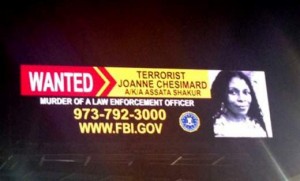

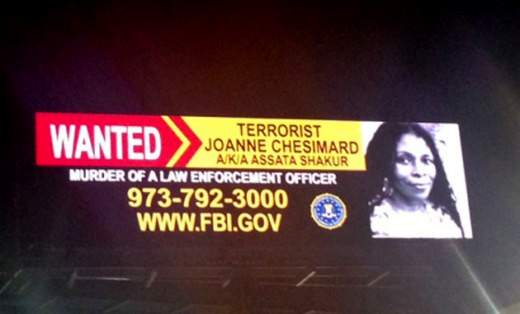
Assata Shakur Placed On FBI Terror List
Last week, the FBI placed Assata Shakur on its Most Wanted Terrorists list, while the state of New Jersey raised the bounty on her head to 2 million dollars. These actions fall on the 40th anniversary of the 1973 shoot out in in which police allege Shakur killed a police officer during a traffic stop on the New Jersey turnpike. Assata also known as JoAnne Deborah Byron is an African American activist was a member of the Black Panther Party and the Black Liberation Army. Assata Shakur: Understanding the politics behind the FBI’s new attack.
Eugene Puryear:
- I think why a 65 year old grandmother has been put on the FBI terrorist list is a reflection of the United States government’s fear of that which opposes it.
- Assata Shakur was part of the 60s movements . . . a movement that the Nixon administration attempted to criminalize, to say that political dissent and political opposition to the US government and its imperial moves around the world.
- She does fit the profile of what the US government has been trying to perpetuate for the last 30 years, in a sense an extension of COINTELPRO.
- One person’s terrorist is another person’s freedom fighter.
- Assata Shakur, her actions and beliefs is certainly not something that is beyond the pale but the US government view her as a terrorist.
- By placing her on this terrorist list, it’s a way of criminalizing dissent.
- Assata’s trial was moved several times, it was placed in counties that were mostly wealthy, mostly white where pre-trial publicity around the case had biased people in a major way against Assata Shakur.
- When the government wants to put someone away and they know they don’t have the evidence they want to do everything possible to both manipulate the venue and also bring in people whose predisposition will make them more likely to believe the government’s version of events.
- Assata was in a position to be put in prison for the rest of her life in these human-breaking conditions.
- The day before this happened, the US government refused to remove Cuba from the state sponsors of terrorism list. This is used in part for keeping Cuba on that list.
- Also to give a chilling effect to progressive movements in the United States.
- The US seems to be redefining what are terrorist actions and what its responses are.
- The lock down of Boston, the reclassification of Assata Shakur, the issuing of the drone memo of what eminence actually means.
- The US is attempting to create enough ambiguity in the statutes.
Guest – Eugene Puryear, Eugene is a writer and on the editorial board of the Liberation, Newspaper of the Party for Socialism and Liberations.
—–
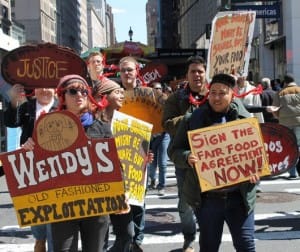
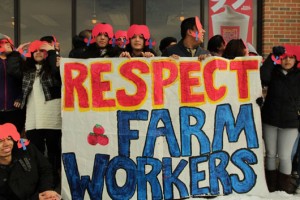
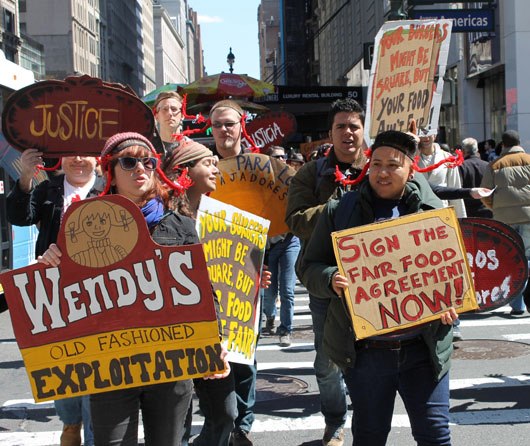
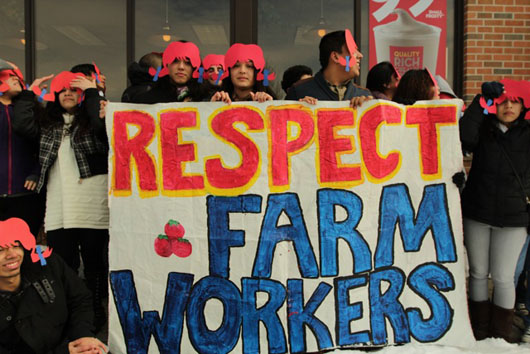
CIW – Fair Food Program: Wendy’s
Last year Trader Joe’s and the Coalition of Immokalee Workers signed an agreement that formalized the ways in which Trader Joe’s support the CIW’s Fair Food Program, a hard won victory.. Since then efforts have turned to companies such as Publix supermarkets in Florida and the Wendy’s fast food chain. Recently, Fair Food activists across the country visited their local Wendy’s to deliver a message: It’s time to join the rest of the fast-food industry and support the Fair Food Program.
Emilio Faustino:
Translator Joe Parker:
- We’re farm workers who come from the town Immokalee, Florida that’s based in the Southwestern part of the state. Our community is a farm worker community and for many years we faced a number of different kinds of exploitation, poverty, wage theft, physical and verbal abuse as well as sexual harassment of many women working in the fields.
- We began our campaign focused on the big corporate buyers of the produce that we pick back in 2001 in an effort to improve wages and working conditions in the fields, we began with Taco Bell and from there had campaigns with McDonald’s, Burger King, until as you said 11 other companies came to the table to dialogue with farm workers and work to improving those wages and working conditions in their supply chains.
- We’re here in New York focused on Wendy’s fast food chain. For a number of years the coalition has been sending letters to the fast food chain asking them to join the Fair Food program. We launched a public campaign with them earlier this year but thus far they have ignored us.
- We want Wendy’s to do what most of these corporations have done, that’s pay one penny more for each tomato that they buy.
- We’re here for the Wendy’s shareholder action, and we’re going to be organizing an protest on Saturday, May 18, at 2PM at Union Square to send a message to company’s investors that this is something that farmworkers in Wendy’s supply chain really deserve. There will also be a number of actions taking place that day all over the country in a number of communities standing together with the CIW.
- Contact: www.ciw-online.org, email: workers@ciw-online.org, 239-657-8311
Guest – Emelio Faustino, farm worker, CIW activist living in Florida. He is among other workers picking tomatoes by hand for 10-12 hours per day, while getting paid 50 cents per bin, or about 200 to 283 dollars per week.
Guest – Joe Parker, CIW spokesman and translator.
—————————————————–
Civil Liberties, Criminalizing Dissent, FBI Intrusion, Habeas Corpus, Human Rights, Political Prisoner, Prison Industry, Supreme Court, Torture, Truth to Power
Podcast: Play in new window | Download
Updates:
—
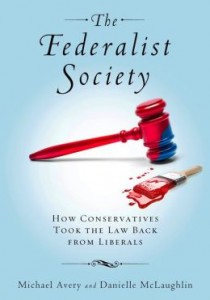
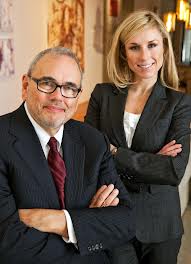
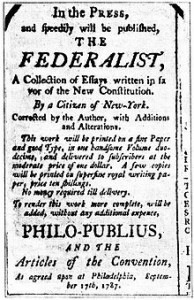
The Federalist Society: How Conservatives Took the Law Back from Liberals
Has the Department of Justice been taken over by a conservative organization little known to the average citizen? In the recently published book titled The Federalist Society: How Conservatives Took the Law Back from Liberals authored by attorney Michael Avery and Danielle McLaughlin track the movements of a small group of conservative law students and their influence. The Federalist Society has lawyer chapters in every major city in the United States and student chapters in every accredited law school. Members include economic conservatives, social conservatives, Christian conservatives, and libertarians. They all differ with each other on significant issues, but cooperate in advancing a broad conservative agenda.
Attorney Michael Avery:
- I saw how much power and influence the Federalist Society had during the years George W. Bush was president and at the same time I realized most people don’t know very much about them.
- They remained under the radar, I thought it was important to tell their story.
- They came along just at the right time for them, it was really kind of a perfect storm for them. Ronald Reagan was in the White House, you had a general renaissance of conservative thought that was promoted by people like Bill Buckley in the National Review, you had resistance to school integration and forced bussing. So there was a backlash waiting to happen against some of the things that happened in the law.
- It’s very important to recognize the role Ed Meese played. First he was counselor to the president then he was attorney general, later he became a principle figure at the Heritage Society.
- Many people are open members of the Federalist Society, others not so much but through a variety of sources I think we’re very confident that the people in that appendix either are members or very close to the society and sometimes I call that list the 100 most powerful people in the country and most of them you never heard of.
- About half the members that George W. Bush appointed to the Federal Court of Appeals were members of the Federalist Society.
- This battle over whether the government is able regulate private property has been one of the principle ideological battles of American Constitutional law since the end of the 19th century.
- They argue that property rights are a natural right that everybody is entitled to.
- It’s better to tolerate disagreement than to try to be 100 percent correct all the time.
Attorney Danielle McLaughlin:
- The substantive areas of law that we’re seeing this test cases brought in are very much reflective of the core values of the society. Those are notions of small government in particular small federal government. The idea that the state exists to preserve freedom.
- Many are involved in public interest law firms who go out and find plaintiffs and challenge regulation at the state level and in many cases have been successful in challenging laws in opposition to their world view all the way up to the Supreme Court.
- They really worked this very large network that they developed.
- Olen Foundation says here’s some money go out and build an institution.
- The Federalist Society today is not handicapped by having to report back or meet short term goals. The conservative funders believed in long term institution building.
- There are Federalist Society student groups on the campus of every single accredited and some unaccredited law schools. There are lawyer chapters in every single major city. There are affiliated Federalist Society groups outside the country.
Guest – Civil rights lawyer Michael Avery, professor at Suffolk University Law School and former president of the National Lawyers Guild from 2003 to 2006.
Guest – Co-author and attorney Danielle McLauglin, member of the Litigation and Dispute resolution group.
—–
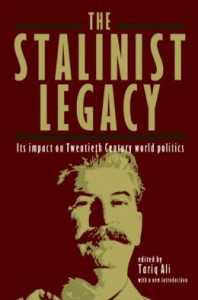
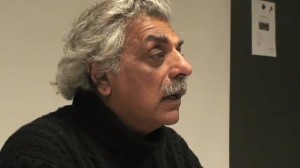
The Stalinist Legacy: Its Impact on Twentieth Century World Politics
We go now to hear a presentation by internationally acclaimed Pakistani writer and film maker Tariq Ali during a New York City book launch of his new book The Stalinist Legacy: Its Impact on Twentieth Century World Politics. Karl Marx’s often quoted observation “History weighs like a nightmare on the brain of the living” is so true. Even 20 years after the Soviet Union’s collapse, activists are still confronted by the legacy of Stalinism at the same time capitalism has failed millions of working people in the United States and across the world.
————–
CIA Sponsored Terror, Civil Liberties, Criminalizing Dissent, Human Rights, Torture, Truth to Power
Podcast: Play in new window | Download
Updates:
- New York Times Continues To Deceive About Iraq War
—
New York City Stop and Frisk Trial Begins
Here on Law and Disorder, we’ve been covering the stop and frisk case known as Floyd v City of New York and the New York Police Department. This is a federal class action lawsuit challenging New York City Police Departments’ practice of stopping and frisking hundreds of thousands of New Yorkers each year. Some five million within the last few years. The high majority of which are Latino and African American. It’s taken the Center for Constitutional Rights along with its allies united with a group called Communities United for Police Reform many years to bring this case to trial. It’s an historic moment for challenging these practices in New York and a precedent that will hopefully lead to ending this practice, not only here in New York but throughout the country. The trial began last week in federal court in Manhattan. It will last some 4 to 6 weeks.
Annette Dickerson:
- In order to be legal the stops need to be based on reasonable suspicion of criminal activity and we’re challenging the city’s use of these illegal stops.
- They violate the 14 Amendment guarantee of equal protection because they are racially discriminatory.
- 87 percent of those stopped are black and Latino.
- The NYPD commissioner seemed to have dug in his heels deeper, as has the mayor in defending the program.
- There is no empirical data that “stop and frisk” has a role in reducing crime.
- It severely damages relationships between the police and the community.
- This is an historic moment in the lifelong struggle of members of the community and organizations like CCR. Our first case against the police department was Daniels which was filed in 1999 in the aftermath of the shooting of Amadou Diallo.
- David Floyd was actually helping someone who was locked out of their apartment, he had an extra set of keys.
- In 2011 685 thousand people stopped.
- There are many other people in the community who are stopped including members of the LGBT community, the immigrant community, people who are homeless, women.
- There is a presumption of criminality.
- On the first day of trial, the courtroom was packed, as was the overflow room.
Guest – Annette Warren-Dickerson, the Director of Education and Outreach at the Center for Constitutional Rights (CCR), is responsible for overseeing the development of CCR’s political and public education strategies as a companion to CCR’s litigation. Annette served as the Statewide Coordinator of the New York Campaign for Telephone Justice, which successfully ended the high collect call rates for the families of those incarcerated in New York State prisons.
—-
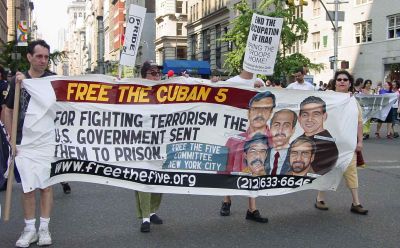
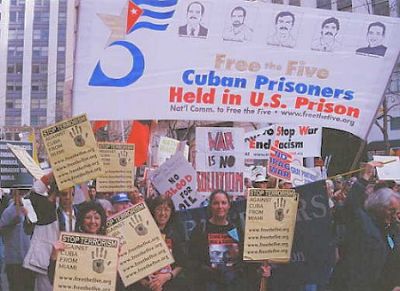
Cuban Five Case Update: Free The Cuban Five – Columbia University 2013
Fourteen years ago, the Cuban Five were convicted on conspiracy to commit espionage at some time in the future. Recently, prominent First Amendment attorney Martin Garbus joined the case of the Cuban Five. He’s help expose how US government paid journalists in Miami who received hundreds and thousands of dollars of payments from the office of Cuba broadcasting. A fact unknown to the defense at the time of the trial. As listeners may know, those paid reporters covered the case in an almost hysterical and prejudicial fashion. This month, Martin Garbus and many others will be discussing the case of the Cuban Five during an event held at Columbia University March 29.
Attorney Martin Garbus:
- During the time the jury was deliberating, the television media bombarded the Miami area with pictures of the jurors. The judge barred any pictures of the jurors going out because she didn’t want the jurors intimidated by a public awareness of who they were.
- Because she was concerned pressure would be put on them.
- Unknown to the judge and defense lawyers at the time, the channels each day repeatedly showed the faces of the jurors, sometimes identifying them so that the entire community knew who they were.
- And they presented very slanted interpretations of the case.
- Television misuse: we found it not only for the time the jurors were deliberating but we’ve now traced it throughout the entire trial.
- Where are now is we’ve submitted our papers and the judge is sitting on it.
- Radio Marti was made to beam into Havana, it can most anything it wants. What happened hear is that Radio Marti beamed into the entire Miami area. You have a 38 million dollar budget beaming into Miami endless stories. Then you have the US government through Radio Marti and various democracy projects also paying the print media to write propaganda. Each one of these articles are a violation of the law.
- On March 29, at the Roone Arledge Auditorium, Lerner Hall, Columbia University, 116th Street and Broadway in Manhattan.
- Martin Garbus, Lead Attorney for the Cuban Five
Ambassador Rodolfo Reyes, Cuban Ambassador to the United Nations
Ambassador Julio Escalona, Venezuelan Deputy Ambassador to the United Nations
Luis Rosa, Puerto Rican independence fighter, political prisoner for 19 years
Imani Brown, Columbia University Caribbean Students Association
Guest – Attorney Martin Garbus, one of the country’s leading trial lawyers. He has appeared before the United States Supreme Court and the highest state and federal courts in the nation. Time Magazine has named him “legendary . . . one of the best trial lawyers in the country.” He’s also known as the most prominent First Amendment lawyer.
—
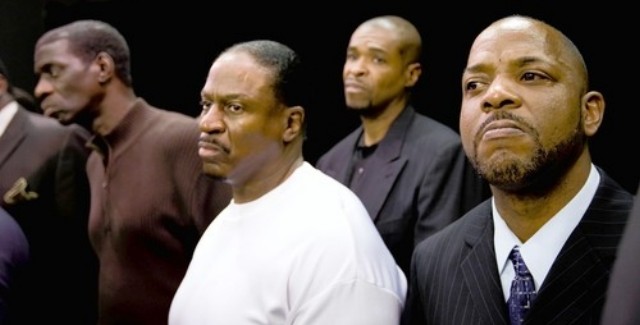
Racism, Torture, and Impunity in Chicago
Here on Law and Disorder, we continue to follow up on the Chicago torture cases and since the conviction and sentencing of former Chicago Police Commander Jon Burge in 2011, the Chicago criminal courts have become a model in seeking justice for crimes of torture. Last year we discussed with our guest attorney Flint Taylor how the city’s new administration will handle the hundreds of ongoing torture cases of African American men. The question is answered in Flint Taylor’s recently published article in the The Nation titled Racism, Torture and Impunity in Chicago.
In the article, Flint writes “Chicago City Council and Mayor Rahm Emanuel signed off on a settlement for another torture survivor, Michael Tillman, who was exonerated in 2010. It was the perfect chance for the mayor to apologize on behalf of the city to the African-American community that helped elect him. He chose not to do so. Instead, picking up where the Daley administration left off, the mayor has continued to fund Burge’s defense, paying private lawyers a total of $3.8 million to date in the Cannon and Kitchen cases alone.”
Attorney Flint Taylor:
- In the civil rights cases we are seeking the testimony of Richard Daley, the former mayor and former states attorney to question him in detail of his long standing and central role of the police torture scandal here in Chicago.
- Evidence was brought directly to Daley through the Chicago Police Superintendent of the torture of a specific man by the use of electric shock, bagging, beating and burning to get a confession.
- Daley decided not to investigate Jon Burge, not to prosecute Jon Burge and as a result of that over 75 African American men were tortured, gave confessions, many of them went to death row.
- At this point we’ve tried to negotiate with his lawyers (Daley) they are paid for by the tax payer. We moved in court to compel him to testify.
- It took a long time, very hard struggle by community groups, lawyers activists and of course the families of the victims themselves.
- The media (local) is interested when the name Daley comes up.
- The called the box that they electrocuted them with the “n*****” box.
- We see the attacks on the genitals again and again.
- It’s a remarkable racist conspiracy. We’re using the Civil Rights Act that was used during Reconstruction, right after the Civil War, which is called the Anti Klu Klux Klan Act.
- We’re trying to get a statute passed in Congress to make torture a Federal crime.
Guest – G. Flint Taylor, a graduate of Brown University and Northwestern Law School, is a founding partner of the People’s Law Office in Chicago, an office which has been dedicated to litigating civil rights, police violence, government misconduct, and death penalty cases for more than 40 years.
—-
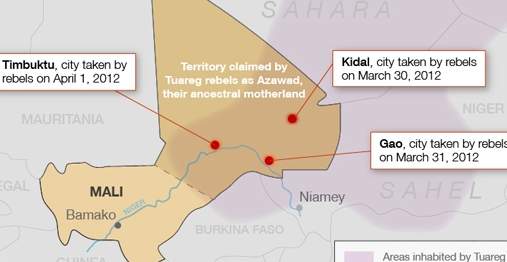
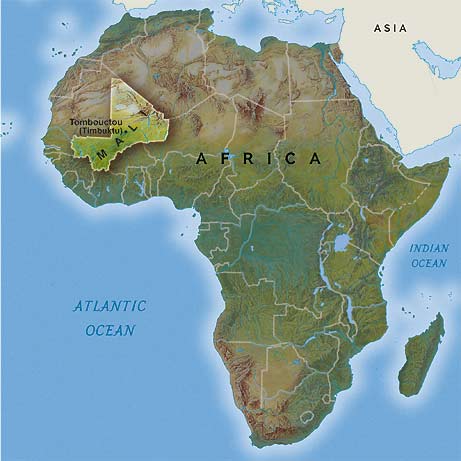
French-led Invasion of Mali, Africa
The Obama Administration has recently stepped up US military deployment within the French led military offensive to force out Islamist rebels in Mali, Africa. The U.S. Reaper drones are helping to provide targeting information for French aerial attacks. Those countries publicly supporting France include Canada, Belgium, Denmark and Germany. Meanwhile, human rights groups call for independent investigations into civilian deaths in Mali.
Ernie Harsch:
- The stakes are not so much Mali. Some of the insurgent forces, some have local grievances, like the Tuareg in Northern Mali.
- Others consider themselves Jihadists. They also target, US, French and other European in the region and elsewhere in the world.
- Whatever happens in Mali, could have wider implications. The situation in Mali is quite serious. There are lots of risks.
- Mali, Africa is a former French colony and after decolonization the French were active in intervening into the former colonies of Africa.
- There was a popular upsurge in the 90s, (in Mali) that regime was ousted by a military coup. That leader of the coup quickly transitioned to an elected leader of a civilian government.
- In Mali in particular you also had a series of rebellions in the North by an ethnic group called the Tuareg.
- The basic issues never got resolved. You didn’t have development up in the North, you didn’t have autonomy which is what they were pressing for.
- What happened in 2011, we had the Arab Spring, in like many periods of revolution or popular upsurge, old coercive states may collapse and you have opportunities for popular action but you also have other people who come in because states are fragmented.
- Some of the fighters that had been with Gaddafi, they were from Mali, and they had been Tuareg.
- Now its sort of dragging down into a protracted guerrilla phase.
- To be clear, the French intervention has gotten political backing from the African Union and from the economic community group, the Economic Community of West African States or ECOWAS.
- The French PR justification has worked fairly well.
- This is open terrain, this is semi-desert area. With air power and heavy equipment you can push far and very quickly. You can take cities and towns. The Islamists, there’s a few thousand. They’ve pulled back up into the mountains. They know the terrain better than the French actually.
- The chance of French mounting losses is there.
- Since 2005, the US has spent 1 billion dollars for counter-terror operations in the region.
- This isn’t all military by any means. A lot of it has to do with training local African military forces in counter-terrorism operations and coordinate and logistics support.
- Also, basically propaganda.
- They do humanitarian actions to curry favor with local populations.
- This isn’t well known, but the US has air bases all across Africa.
- Sometimes they’re simply a hangar operated in secret at some African military or civilian air base.
- They’re (U.S. Government) setting up an airbase in Niger, that’s openly acknowledged.
- They started out with surveillance drones in Somalia but then they used a few strikes against Islamists leaders there in Somalia.
- Everything is going to be framed in the language of the war on terror. That’s the justification. That’s a real concern for the US authorities.
- Also material resource interests. Not so much gold, but Mali does have gold in the northwest.
- Things that are very vital to the Western dominated global economy.
- There is a rivalry that’s developed with China, it’s not been terribly direct at the moment.
- It’s blowback.
Guest – Ernie Harsch, a 40 year journalist who has made numerous trips to Africa. He’s a former editor of the magazine Africa Renewal. He joins us today to discuss the conflicts in Mali and the big picture regarding the seizure of natural resources in Africa.
————————————————————————-