Civil Liberties, Criminalizing Dissent, FBI Intrusion, Guantanamo, Habeas Corpus, Human Rights, Political Prisoner, Surveillance, Targeting Muslims, Torture, Truth to Power
Podcast: Play in new window | Download
Updates:
————-
In Memory:
The remarkable and heroic progressive lawyer Len Weinglass died on March 23. Among his cases were the Chicago 8, the Ellsberg case and the Cuban 5. Listen to the 4 interviews Law and Disorder did with him over the last 4 years. He was our close comrade and will be missed by his friends and all those seeking a better world. – Michael Ratner.
————-
Death Penalty Abolished In Illinois
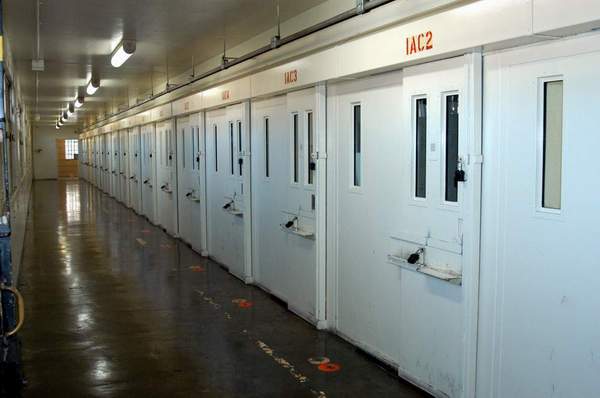
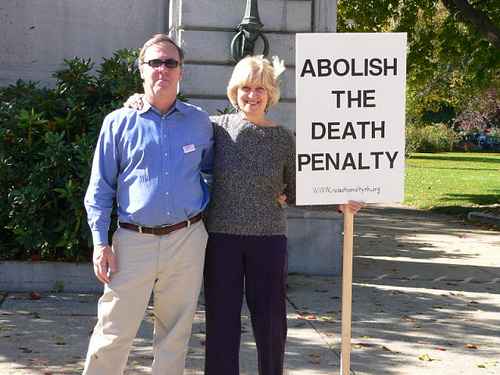
Last week, Governor Pat Quinn of Illinois signed into law SB3539, which repeals the death penalty in that state. This development is yet another in what appears to be signal a trend of moving away from capital punishment. Early last year we covered the American Law Institute’s declaration that the death penalty in this country has been a failure. Listeners may recall that the A.L.I. created the intellectual framework and justification for the current capital justice system. The movement away from this most final form of punishment seems to be due in large part to the public’s increased awareness about its inherent flaws such as great racial disparity on who gets executed and for what reason. Publicity around exonerations stemming from DNA evidence has also added to general awareness of procedural errors in the system.
Attorney Charles Hoffman:
- In 2003, Governor Ryan cleared out death row, he granted to the 167 men and women on death row and pardoned four.
- that prompted the legislature to pass a modicum of reform. The governor afterward assembled a commission that recommended 85 reforms.
- The legislature passed five or six. The legislature also created a death penalty reform study commission.
- One of the reforms was that all confessions in police custody had to be videotaped in murder cases.
- No matter what safeguards you implement, there’s no system that can prevent the conviction and condemning of an innocent person.
- Prosecutors around the state were asking for the death penalty in cases that weren’t death penalty prosecutions just so the state would bear the costs rather than the county.
- The legislature is cash-strapped and we were wasting millions and millions of dollars prosecuting capital cases when here in Illinois we have the very strict alternative of life without parole.
- Final Report: Death Penalty Legislative Study Committee. Illinois Death Penalty Reform Study Commission PDF
- After Governor Ryan cleared out death row in 2003, Illinois put 17 men on death row. 2 had committed suicide, which left 15 on death row when Governor Quinn signed the abolition bill and also granted sentence commutation to all 15. He commuted their death sentences to life without parole.
- As the problems with the death penalty have been exposed, the arbitrariness, the racism, as mistakes have gone into public consciousness, juries have been rejecting the death penalty.
- Illinois has become the 16th state to abolish the death penalty, following on the heels of New Mexico, New Jersey and New York. The federal government and the military do have it.
- The “deathbelt” in this country is in the South and Texas, and is just a legacy of slavery in this country.
- Most executions occur in former slave states. One obvious flaw of the death penalty, studies have shown the death penalty is most likely to be inflicted in a case when the victim is white and the odds go up even further if the defendant is black or Hispanic.
- Its very gratifying to get rid of this barbaric practice. I represented 35 men and women who were sentenced to death. I do the direct appeals. I’ve had one client executed, I’ve had one client go home.
- Some states have made illegal purchases of the drug. (lethal injection drug shortage)
- Some states are using just one drug, a massive overdose of a barbiturate.
- Life without parole is very draconian, it means there’s no prospect for rehabilitation.
Guest – Assistant Defender in the Supreme Court Unit at the Office of the State Appellate Defender, and member of the board of directors of the Illinois Coalition to Abolish the Death Penalty.
———

Communities Battle Against Gas Drilling To Protect Water, Way of Life
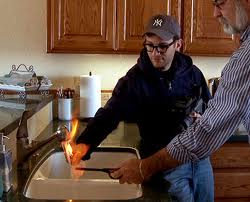
Environmental community groups from New York, New Jersey and Pennsylvania continue to band together and try to protect the Marcellus Shale watershed from natural gas drilling and hydraulic fracturing. The EPA has stated it will investigate how hydraulic fracturing impacts water supplies and water quality in New York State yet the drilling moratorium ends this June. The shale is believed to hold some of the world’s largest deposits of natural gas, and those that want to mine this resource say it will reduce dependence on foreign oil and boost the economy. However, many have shown this statement to be false as the natural gas from the United States is being sold to foreign countries such as Norway and France.
Ninety percent of the New York City’s drinking water comes from ground zero of where various oil companies want to drill into the Marcelle Shale for natural gas. Environmental and public health costs are enormous for each well. Every time a well is drilled, the companies use an estimate of 5 to 9 million gallons of water. Each time a well is fractured, it’s another 5-9 million gallons of water, a well can be fractured multiple times. Up to 275 different toxic chemicals are used in the process and after the well is drilled, there are millions of gallons of industrial waste, it’s essentially radioactive water. 40-70 percent of this water stays underground. The hydro-fracturing process has no federal regulating body. Some of the companies involved are Halliburton, Chesapeake Energy, Fortuna, and Talisman Hess.
Tracy Carluccio:
- My organization has been working on the issue for a few years to try to keep gas drilling from moving ahead.
- Right now there is a moratorium in place on the Delaware River Watershed. It took a year and a half to get that into place. Regulatory measures that are in place now for gas drilling are not doing their job.
- The bottom line is we’re facing an industry that wants to move ahead.
- The industry is very strong. There are international concerns.
- They’re backed by the government in many ways, they enjoy subsidies.
- This industry is going to move like heck to drill everyplace gas can be gotten.
- The Delaware River Watershed has its origins in the Catskill region of New York State.
- The east and west branches come together in Hancock, New York.
- 330 miles from Hancock to the Atlantic Ocean.
- The watershed is 13 thousand square miles and includes four states. It’s overseen by an agency that was born out of water wars.
- Back in the 1950s, all the states were suing each other about who would get water for development.
- In 1961, there was a Supreme Court decree and compact and President Kennedy signed a document that began the Delaware River Basin Commission. As a result of this compact, a large part of the Delaware River goes to New York City.
- There have been regulations federally (Represented by the Army Corp of Engineers) and regionally laid out by the Delaware River Basin Commission
- New York moratorium on gas drilling is tied to late June when there is supposed to be a new draft of the Draft Supplemental Generic Environmental Impact Statement on high volume hydraulic fracturing.
- In order to crack the rock to get at the gas is intrinsically polluting and there’s no way out of that.
- The question of how to stop it is tied to the scientific analysis free from bias.
- Without that bottom up movement, without that cry for government regulators, the industry would be moving ahead exactly as planned.
Guest – Tracy Carluccio, deputy director with Delaware Riverkeeper Network. Delaware Riverkeeper – a watershed wide advocacy program, Delaware Riverkeeper Network takes a strong stance on regional and local issues that threaten water quality and the ecosystems of the Delaware River and its watershed. In fact, Delaware Riverkeeper Network is the only advocacy organization working throughout the entire Delaware River Watershed.
—–
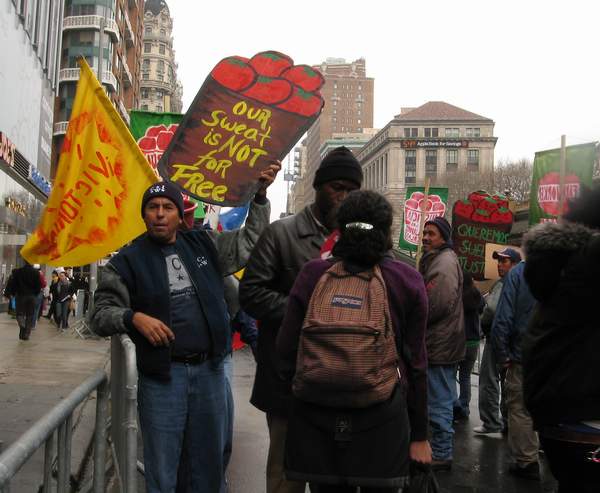
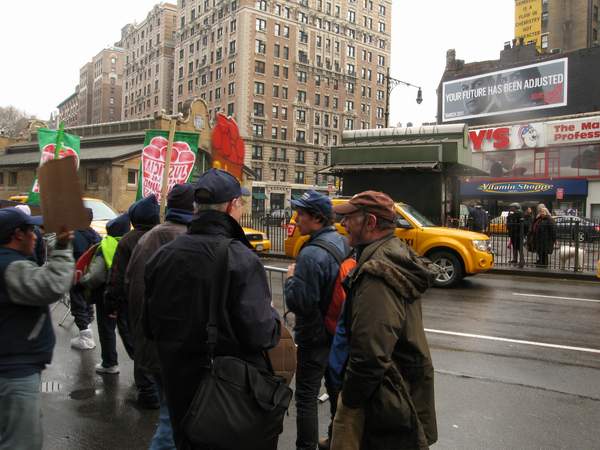
Farmworkers, Consumers Protest Trader Joe’s Demanding Fair Labor Standards for Farmworkers
Late last month, a busload of farm workers from Florida joined members of the NYC Community Farm worker Alliance at Trader Joe’s Upper West Side store. Men and women who pick tomatoes under very harsh conditions demand to be treated more humanely and with improved farm labor wages. Our own Michael Ratner was at the demonstration, we hear some of the interviews.
———————————————————————-
Civil Liberties, Criminalizing Dissent, FBI Intrusion, Gaza, Human Rights, Surveillance, Targeting Muslims
Podcast: Play in new window | Download
Updates:
—-
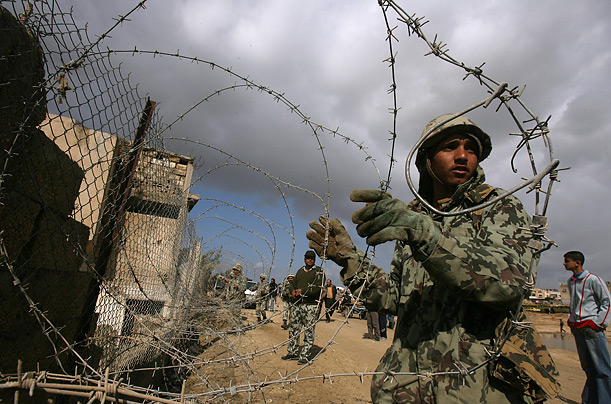
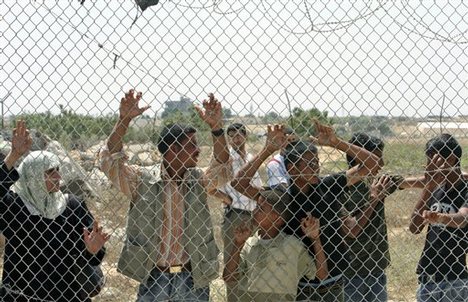
Middle East Protests – Israel / Palestine
Uprisings have continued to sweep through the middle east from Tunisia, Egypt, Libya, Bahrain, Yemen, Iran, Iraq and China. Economic hardships and desperate living conditions are partly the cause for some of the mass protests. In one article describing the Wisconsin protests, the journalist wrote, there were many voices this last month that raised the cry, “We are all Egyptians!”
Governments are said to be scrambling to squelch popular dissent. How will these protests begin to reshape countries in the middle east and and what government structures are standing by to replace decadent tyrannies and corrupt monarchies? How are Palestinians in Gaza and the West Bank responding to the massive dissent in nearby Arab countries?
Ali Abunimah:
- The events over the past weeks have been historic and we still don’t know how they’re all going to play out.
- The aspirations of Tunisians, Egyptians, Libyans, Jordanians, Palestinians are very clear.
- What remains to be seen is if they succeed in completing the revolutions. There is a strong counter-revolutionary push, not just from old regime elements but also from the United States.
- The mass uprising was sudden, but its important to know that there were Egyptian activists risking their lives for many many years to lay the ground for the uprising.
- The upper echelons of the Army are fully implicated in the old regime.
- You have a parade of Americans going to Egypt trying to minimize any shift in the region away from the Israeli-American axis and more into an independent orbit.
- The only guarantee is the continued mobilization of Egyptian people, of Egyptian workers.
- One of the myths in the American media is that this uprising is entirely about internal domestic issues.
- The Rafah crossing into Palestine needs to be open permanently, the situation at the border normalized.
- Egypt’s revolution and Israel: “Bad for the Jews” Ilan Pappe, The Electronic Intifada, 14 February 2011
- The view from Israel is that if they indeed succeed, the Tunisian and Egyptian revolutions are very bad. They make the Israeli occupation and apartheid policies in Palestine look like the acts of a typical “Arab” regime.
- The war in Gaza probably could not have been carried out without Egyptian complicity.
- In Palestine, the complete death of the peace process. The Palestine Papers – revealed by Al Jazeera.
- You can’t have functioning democracy and normal politics under Israel’s occupation.
- Your rights are not given to you from above, you have to fight for them.
Guest – Ali Abunimah, a Palestinian American journalist and author of One Country, A Bold Proposal to End the Israeli-Palestinian Impasse and a co-founder of The Electronic Intifada, a not-for-profit, independent online publication about the Israeli-Palestinian Conflict. Born in Washington D.C., he spent his early years in the United Kingdom and Belgium before returning to the United States to attend college.
—–
Cracks In The Neo-Liberal Empire
Political unrest in North Africa continue to ripple through the Middle East with some of the biggest anti-government demonstration yet in Bahrain. Meanwhile, the protests in Libya have turned deadly as the regime’s military has killed hundreds of demonstrators. New York Professor of Middle Eastern and Islamic Studies and History Zachary Lockman joins us with an analysis on the mass protests. In Egypt, Lockman says the old political parties in Egypt have no credibility.
Professor Zachary Lockman:
- Egypt: There were huge labor strikes going back to 2008. One of the groups that launched on January 25, called itself the April 6 youth movement – called itself that because there was supposed to be a big general strike of textile workers in 2008.
- The tremendous demand from Egyptians which help fuel the uprising, for some kind of change to the neo-liberal economic policies that Mubarak regime implemented 20 years ago.
- Egypt back in the 50s and 60s under the Nassir government carried through a series of social reforms.
- The largest estates held by the largest land owners were broken up, and millions of landless peasants even if they didn’t get land, they could farm some land and have reasonable security.
- Those kinds of things were rolled back in the 1990s under pressure from the IMF and the World Bank and with the approval of US government.
- Which means these farmers were kicked off the land in large number and ended up having to move to the cities in search of work for meager wages.
- Much of the public sector was privatized at fire sale prices to cronies of Mubarak.
- This is an opportunity when millions of Egyptian workers see an opportunity to create their own independent trade union movement. One doesn’t want to downplay the heroism of the young people who took to the streets on January 25.
- Mubarak was told to go by the generals who were told to preserve as much of the regime as possible in the face of this popular uprising. The generals now running Egypt are products of the Mubarak regime. The danger is that we’ll have the Mubarak regime without Mubarak.
- There is a new independent federation trade union being established in different industries. (Egypt)
- If there is something that approaches a more representative, democratic government, that government will be less likely to take orders from Washington in the way that Mubarak was very happy to.
- We’ve been waiting for something like this for decades, and in Egypt’s case for 30 years.
- It opens up dramatic new possibilities on a world scale. That boogieman of Islamic threat used to justify autocratic regimes which has been used across the region, is still there but as we’ve seen in Egypt and elsewhere, it’s time to put it aside.
- Since the 1970s, Saudi Arabia which has been on the defensive of more nationalist Pan Arab forces asserted it’s influence to buy friends and intimidate enemies and has been the bulwark of this conservative autocratic origin in the region.
Guest – Professor Zachary Lockman, New York Professor of Middle Eastern and Islamic Studies and History. He is the author of many books including Contending Visions of the Middle East: The History and Politics of Orientalism and “Explorations in the Field: Lost Voices and Emerging Practices in Egypt, 1882-1914.”Background: My main research and teaching field is the socioeconomic, cultural and political history of the modern Middle East, particularly the Mashriq. Under the influence of the “new social history” and “history from below” movements of the 1960s and 1970s, I did my doctoral dissertation on the emergence and evolution of a working class and labor movement in Egypt from the late nineteenth century until the Second World War; it was published in 1987 in a book co-authored with Joel Beinin. Harvard University, Ph. D., 1983.
———————————————————
Civil Liberties, Criminalizing Dissent, FBI Intrusion, Habeas Corpus, Human Rights, Surveillance, Targeting Muslims, Truth to Power, War Resister
Podcast: Play in new window | Download
Updates:
—-
Right-Wing Firms Train Public Servants on Terror Threats
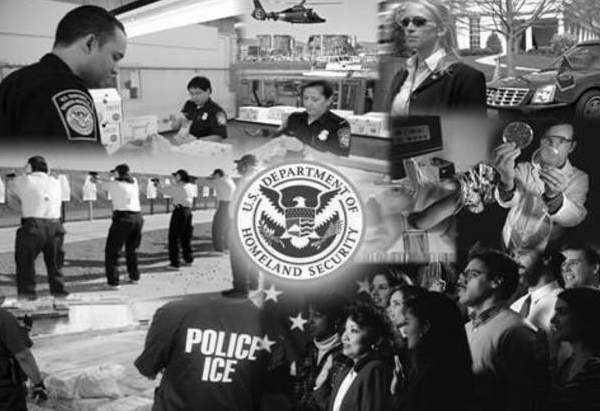
There is a sprawling hidden world of counter-terrorism organizations growing beyond control in the United States. Twenty-four of them were created by the end of 2001, including the Office of Homeland Security and the Foreign Terrorist Asset Tracking Task Force. The next year, 37 more were created to track weapons of mass destruction and collect threat tips. By 2009, nearly 260 organizations were created as 854 thousand civil servants, military personnel and private contractors with top-secret security clearances monitor national security concerns. However, according to a report from the Public Research Associates, those same concerns have bolstered a class of self-proclaimed terrorism experts who decry Islam as an evil religion of terrorists and routinely brand Muslims as primitive, vengeful, duplicitous, and belligerent people who oppress women and gays, and have values irreconcilable with “western Judeo-Christian civilization.”
In fact, when PRA discovered earlier this year that the Massachusetts Bay Transportation Authority (MBTA) had contracted with Security Solutions International to conduct a training on radical Islam, they notified the Muslim American Society, ACLU, and our other advocacy partners, who used PRA’s research to compel the MBTA to cancel the agency’s training.
Chip Berlet :
- As part of the Homeland Security Initiatives and working with the FBI in other aspects of the national security apparatus, there was a need to train thousands as part of a local state and federal counter-terrorism “experts.”
- Some of these trainings are quite good. The problem is that there are a handful of groups that train hundreds and hundreds of local, state and federal counter-terrorism experts, with rhetoric that is basically Islamophobic.
- In the late 1970s there was an attempt to restrain this illegal surveillance. I’d have to say right now it’s worse.
- What used to be done illegally and covertly is now done ostensibly legally and openly and in fact proudly by both Democrats and Republicans who should be ashamed.
- The whole strategic suspicious reporting initiative which basically is a pipeline for unverified rumor and innuendo through local police departments up through a chain of information agencies to the federal government. We know in Europe this kind of reporting is unconstitutional and bad for society.
- Now, everyone that was considered illegal and unconstitutional for which there were Congressional hearings and reforms under Jimmy Carter, now we do it.
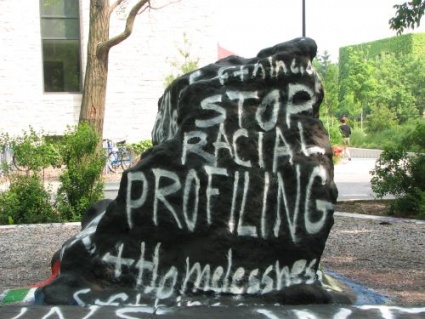
- In proper training that is actually looking for criminal activity, not people of color who wear garb that we’re scared of. What’s going on here is untrained, badly trained officers are reporting the names of people up into a huge infrastructure of information data storage, based on bias they’ve not been trained to resist or confront within themselves.
- We described this whole process as a platform for prejudice in a report by Tom Cincotta
- Tom has on his wall a wall chart of all the agencies of this information reporting system and it has 150 dots so inter-connected, no one can control this.
- I’m urging people to form broad coalitions across the political spectrum.
Guest – Chip Berlet, (senior analyst) is a veteran freelance writer and photographer who specializes in investigating right-wing social movements, apocalyptic scapegoating and conspiracism, and authoritarianism. A PRA staffer since 1982, he has written, edited and co-authored numerous articles on right-wing activity and government repression for publications as varied as the Boston Globe, the New York Times, The Progressive, The Nation, The Humanist, and the St. Louis Journalism Review.
—
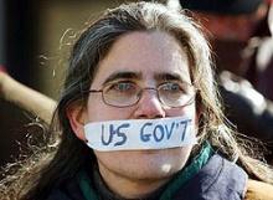
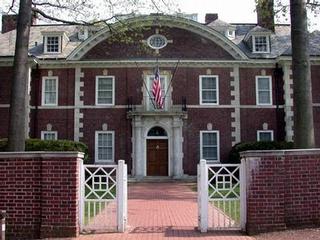
Lawyers You’ll Like – Sally Frank
For our Lawyers You’ll Like series, we’re delighted to have with us attorney, activist and Drake University law professor Sally Frank. Sally specializes in family law and domestic violence. Her activism began when she was a student at Princeton University. She filed suit against the Cottage Club, the Ivy Club and the Tiger Inn because they refused to admit her as a member based on gender. 13 years later she won the case and the three eating clubs became coed. Now Sally Frank lectures on women in law and encourages law students to be activists.
Attorney Sally Frank:
- They (Princeton) had 13 eating clubs and 3 of them were all male.
- I sued three of the clubs and the University, it began when I was a 19 year old junior at Princeton in 1979.
- My problem with it was they were very important institutions on campus, they ratified discrimination. A couple of them were the most prestigious clubs, if the most prestigious people discriminated, that kinda made it ok and it radiated it back onto to the campus in other aspects of life.
- The question was whether they were public accommodations or not.
- When I was in 5th grade I watched Inherit The Wind five times.
- Seeing William Kunstler and the Chicago 8 and how he supported the protesters and the rights of the people, and how Clarence Darrow did, made me want to be a people’s lawyer. Clerk for Emily Goodman as first job out of law school. I learned so much from her, I learned how to make a record.
- The Joint Terrorism Task Force began to investigate the peace movement in Des Moines, Iowa.
- There was question that my email was being watched. They subpoenaed 4 peace activists to a grand jury. Drake University was subpoenaed for information on the National Lawyers Guild members.
- After I found out about the Drake subpoena, there was a gag order on the subpoena.
- Leading up to 2008 RNC in Minneapolis, FBI leaving cards with peace activists in Iowa. What was going on here was an intelligence gathering that we were able to stop.
- Do not talk to the FBI, NSA, ICE. It’s very hard for people who were brought up to be polite, not to answer a question.
- We lived in a condo on the 8th floor and Bush came to the senior citizens center next door. We unfurled a banner from the balcony, a half hour before Bush was expected and we got a knock on the door by the secret service.
- I checked with the ACLU and they couldn’t bust in. Exigent circumstances.
- Most of what I do are civil cases.
- There’s certainly more government resentment and government attitude.
Guest – Attorney Sally Frank, longtime activist and law professor at Drake University. As a lawyer and law professor, Sally Frank represents protesters, victims of discrimination and poor people in housing. In her teaching and practice, Sally has helped the disenfranchised in family law and domestic abuse cases. “This is the work of the public interest lawyer. We see the problems of the system and work with our clients and others to achieve justice for them and for society as a whole.”
————————————————
Criminalizing Dissent, FBI Intrusion, Surveillance, Targeting Muslims, Truth to Power
Podcast: Play in new window | Download
Updates:
—-
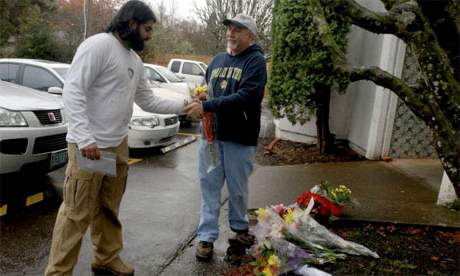
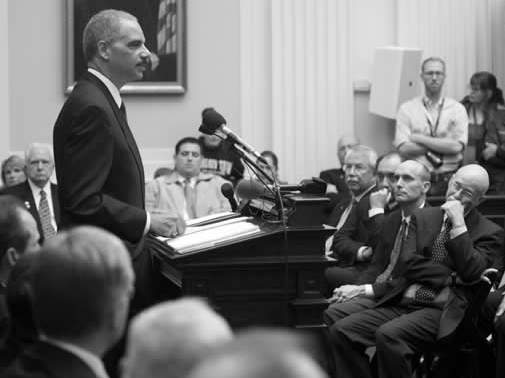
Holder Calls Terrorism Sting Operations ‘Essential’
US Attorney General Eric Holder delivered a 20 minute speech last week at the annual dinner of Muslim Advocates a national legal advocacy and civil rights organization. While speaking to a room of nearly 300 Muslim community leaders, Holder defended the sting operation in the Oregon bombing case and called it a “successful undercover operation.” The room fell silent. Holder continued by saying if you think its entrapment, you simply don’t have the facts straight.
Farhana Khera president of Muslim Advocates and a previous guest on Law and Disorder, criticized Holder’s comments saying the FBI is getting people involved with terrorism who wouldn’t have otherwise and resources are being diverted that could be used for actual threats. Holder continued to justify the counter terrorism techniques including sending informers into mosques to find a would-be terrorists and creating elaborate sting operations.
We’ve looked into some of the “undercover operations” and in those cases informants were used, often immigrants offered large sums of money, or plea deals for whatever crime they committed if they agree to work with the FBI. Those cases include the Newburgh Four, the Fort Dix Five and Yassir Aref in Albany. The sting operations create fear among Muslim communities and help prop up the wars raging in Afghanistan, Pakistan, Yemen and Iraq.
Dalia Hashad:
- There are 3 things that need to happen for someone to be entrapped by law enforcement.
- The idea of committing the crime had to come from government agents, not from the person accused of committing the crime. The government agent persuaded the person into committing the crime.
- The person wasn’t willing to commit the crime before the government agents spoke to them.
- These cases look the same because the FBI go after the same type of guy.
- I don’t like to get into the details of these cases because the narrative is controlled by the FBI.
- Eric Holder had no business being invited and headlining the event.
- Eric Holder Entraps at Muslim Advocates Dinner
- The FBI has more than 100 Joint Terrorism Task Forces, which includes more than 10 thousand FBI agents.
- They partner with other agents, even IRS agents.
- We basically have law enforcement agents out there spying on people who’ve done nothing wrong.
Zaher Billoo:
- I went to this dinner thinking, what are people going to be talking about, are people going to be afraid of hate crimes? People were more worried about the FBI’s tactics than anything.
- The concern is, instead of getting them the help that they need, and preventing an incident and hopefully bettering the community for that, what we’re seeing is the FBI converting them into operational terrorists
- One of the troubles of the war on terror is that we can’t prove whether its successful or not but we want to continue to spend money on it.
- This type of incident justifies that type of offense. The counterproductive measure here is that it puts the community on guard.
- Instead of building relationships with the community they’re trying to work with, they’re burning bridges. This conversation about informants, not knowing who you can trust or who you can candidly speak with, is reminiscent of some of the regimes that people were escaping.
- It’s nothing new. We continue to fall into these patterns.
- An important thing for us as activists and advocates for the community is to insure we’re making these parallels and building coalitions based on that.
- In this last year, people have started to say that it feels as though it’s as bad here as it was a year ago.
- The anti-Muslim sentiment is stronger now in 2010 than it was in 2001.
Guest – former Law and Disorder co-host, Dalia Hashad, attorney and independent consultant specializing in human rights and civil rights. She has run programs at Amnesty International and the ACLU, and she has served as a human rights legal adviser in the Occupied Palestinian Territories. At Amnesty International, Ms. Hashad was the Director of the USA Program, focusing on racial profiling, criminal justice and national security. She also served as AIUSA’s policy specialist in global identity discrimination, addressing issues of race, sexual orientation, religion and gender.
Guest- Attorney Zahra Billoo, executive director of CAIR San Francisco Bay Area CAIR ( the Council on American-Islamic Relations.) Zahra started as an intern for a local chapter of the California Faculty Association, a labor union for California State University (CSU) faculty members. Zahra has also worked as Field Organizer for the Service Employees International Union, and was awarded Peggy Browning Fund Fellowship to work with the National Employment Law Project. Zahra graduated Cum Laude from California State University, Long Beach with a B.S. in Human Resources Management and B.A. in Political Science. She completed her law degree at the University of California, Hastings College of Law.
———-
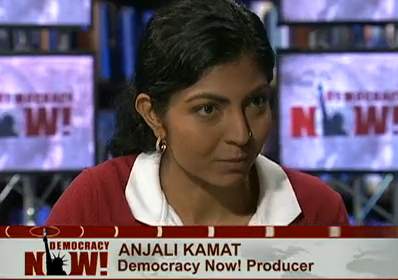
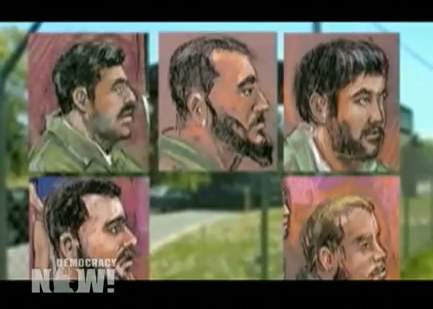
Entrapped, a documentary film exposing the FBI
We’ve discussed the many cases of FBI entrapment here on the show and we are delighted to have with us Big Noise film maker and producer for Democracy Now, Anjali Kamat. Anjali had recently finished the film titled, Entrapped, a documentary examing the role of the FBI and government agencies funding and entrapping people by infiltrating specific ethnic and religious communities. She had traveled through Muslim communities in New York and New Jersey interviewing families of those Muslim men arrested on terrorism charges. Recent cases such as the Fort Dix Five, the Newburgh Four and Yassin Aref in Albany are highlighted in the film.
Anjali Kamat:
- I did the film as a piece of investigating reporting for Democracy Now along with from Big Noise Films. It’s available at Big Noise Films and Democracy Now DVD
- We had a screening at a restaurant off of Coney Island Avenue, hosted by the Coney Island Avenue Project.
- When these cases come about, they’re often talked about as sting operations. The FBI has been doing undercover work and they discovered this terrorist plot.
- They’re on the evening news, talking about how much safer we all are now as a result of the FBI’s excellent work.
- When you dig a little deeper you realize it’s not really a sting, in most cases. It can be called entrapment.
- Informants: In the cases I looked at, there was a Pakistani immigrant and an Egyptian immigrant, they are offered large sums of money, offered at times a plea deal for whatever crime they committed if they agree to work for the FBI.
- There are 3 cases I looked at, 3 out of dozens of cases. The first case took place in Albany in 2004 that involves a Bangladeshi pizza owner and a Kurdish Imam. They were both convicted and their prison time was reduced from 30 years to 15 years, because the case was very thin and there was an outpouring of community support.
- The second case is the Ft Dix Case, which took place in Pennsylvania. All five of the men were convicted. They are serving life sentences. Four out of the five men were ethnic Albanians from Macedonia. They were construction workers, their father had a roofing business. The fourth was a Palestinian American. Informant encouraged Palestinian American to download more and more jihadi videos.
- These videos are key because they are what was shown at the trial to the jury. The third case, the sentencing hasn’t happened yet. The Newburgh four.
- On the domestic front it allows the government to show its being tough on terror at a time when there is no evidence of where Osama Bin Laden is. At a time when the democrats seem very weak on a number of fronts.
- Another use of this is to create fear among Muslim communities. Now there’s a great sense of doubt whenever someone new comes into the community. Could this person be a government informant?
- It helps justify the wars that are continuing abroad.
Guest – Anjali Kamat, independent radio and print journalist from south India. She has lived in Egypt and Jordan and reported on movements for justice across the Middle East and South Asia. Her work has appeared in Corpwatch, Left Turn, and Samar magazine, and national newspapers in India and Egypt (The Hindu, Frontline, Outlook, and Al-Ahram Weekly). In addition to producing Democracy Now!, she co-hosts and co-produces a weekly radio show on WBAI called Global Movements Urban Struggles.
——————————————————–
CIA Sponsored Terror, FBI Intrusion, Human Rights, Surveillance, Targeting Muslims, Torture, Truth to Power
Podcast: Play in new window | Download
Updates:
—
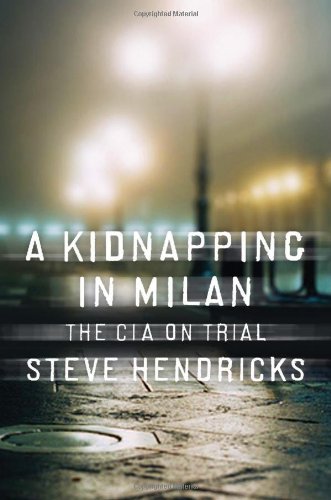
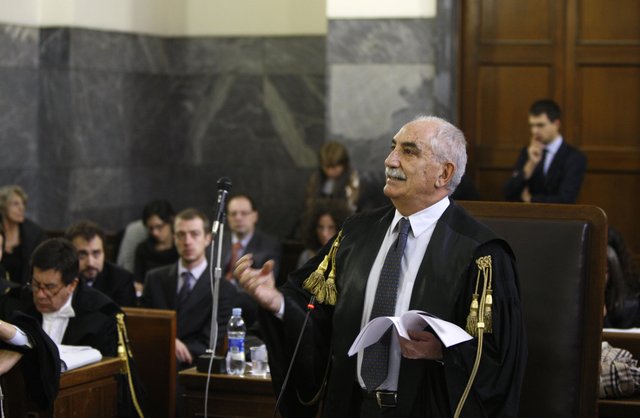
A Kidnapping In Milan: The CIA On Trial
A Kidnapping In Milan: The CIA On Trial is the title of Steve Hendricks’ new book. It is a fast paced account of the realities of counter terrroism. Hendricks gives the reader a beginning to end view of international Islamist terrorist networks in Europre while examining the questions of justice and the rule of law. He writes in detail on the February 2003 disappearance of the radical imam Abu Omar and how under the leadership of prosecutor Armando Spataro, Omar was kidnapped, and sent to be tortured in Egypt. Hendricks traces Omar’s roots in the jihadist world of the Middle East and his travels to Pakistan, Albania and eventually the rundown fringes of Milan. Rivalries, mistrust and bad communication is chronicled amid the CIA, the FBI and the Italian counter terrorism agencies as operatives snatched Abu Omar from the streets of Italy.
Steve Hendricks:
- The Italian counterterror police had this imam, Abu Omar under tight surveillance, under suspicion of terrorism. He was one of the ring leaders of a terrorist cell. They were about a month away from arresting him. But one fine day in February 2003, he sets off for his mosque and disappears.
- The CIA had grabbed him off the street literally at high noon. They roughed him up, gagged him, drove him several hours across northern Italy –sent him to Cairo were for months and months he was savagely tortured.
- The Muslim Brotherhood, which really might thought of as the godfathers of radical Islam, got its start in Egypt and toehold in Alexandria. Islam is not going to be re-born simply on its goodness, we have to fight for it.
- The Egyptian authorities cracked down on the radicals and a great number of them fled all over the world, they scattered. Europe was tolerant of foreigners, Italy was one of those countries.
- Abu Omar was tortured for about a year and then they let him out and said don’t talk about it.
- Armando Spataro is this charismatic figure. He did his formative work as a magistrate prosecuting terrorists of the left.
- When the kidnapping in Milan (by the CIA) happened on his watch, he treated it like anything else. He put his foot down on the rule of law.
- SIM Card – Subscriber Identity Module. It’s not just reading the radio waves, it’s in constant contact with the cell tower back and forth. Most cell companies keep record of those interactions. What these kidnappers sloppily did is use their cellphones like teenagers.
- The Italian prosecutors were able to find these kidnappers, they were able to track their movements everywhere they went. Armando Spataro eventually brought charges against 25 CIA agents and one US Air Force Colonel that coordinated the arrival of agents at Aviano Air Base.
- 23 of the 26 of the accused were convicted of kidnapping. They recieved five to eight years depending upon their degree of involvment. What moved me to write this book, over everything was outrage over our inhumanity.
- America has been conducting renditions for about a century.
Guest – Steve Hendricks, a freelance writer living in Knoxville, Tennessee, and Helena, Montana. He is the author, most recently, of A Kidnapping in Milan: The CIA on Trial. His previous book, The Unquiet Grave: The FBI and the Struggle for the Soul of Indian Country, made several best-of-the-year lists in 2006.
—
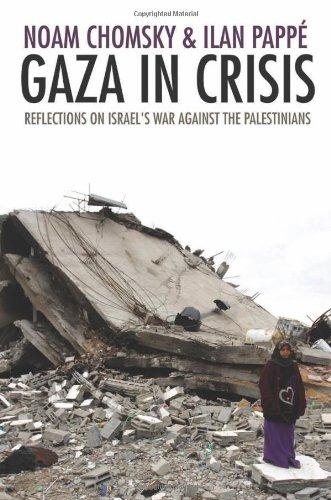
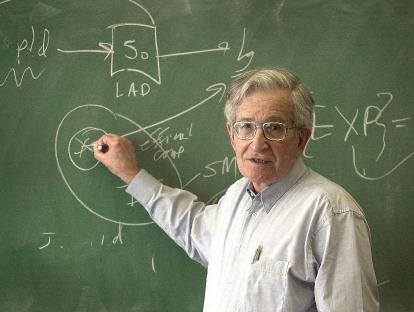
Noam Chomsky – Gaza in Crisis: Reflections on Israel’s War Against the Palestinians
Here on Law and Disorder we’ve chronicled the events of Israeli forces in Gaza and the West Bank. Today we’re delighted to have with us Noam Chomsky, one of the world’s foremost social critics, institute professor emeritus in the MIT Department of Linguistics and Philosophy and author of many books including Failed States and Hegemony or Survival, but we talk with him today about his latest book Gaza in Crisis: Reflections on Israel’s War Against the Palestinians. Noam Chomsky wrote Gaza In Crisis with Ilan Pappé, professor of history at the University of Exeter in the UK. This book surveys Israel’s recent attacks on Gaza from Operation Cast Lead to the Gaza Freedom Flotilla in a very sobering analysis.
Noam Chomsky:
- Let’s start with wikileaks. One of the interesting cables from the Tel Aviv embassy and it was to Clinton.
- It was giving her talking points, about the attack on Gaza, and it tells her Israel had to attack on December 2008 in self defense because Hamas had violated the truce.
- In December 2008 Hamas called for a renewal of the truce that Israel had broken. Israel considered it and rejected it. I should say US/Israel because these are joint activities.
- The fact that this can pass without comment, tells you quite a lot.
- In the whole wikileaks episode, in my opinion is the remarkable fact is the absolute contempt of democracy that’s revealed by the embassies.
- The most critical issue is did Israel have any right to use force in the first place? Any right?
- Why have a border cutting Galilee in half?
- The only way I know how to proceed is to get the United States to join the rest of the world and stop its rejectionist opposition to the overwhelming international consensus, agree to a two state settlement.
- The strongest support for Israeli crimes is coming from the business world.
- The most rabid supporter of Israel in the media is the Wall Street Journal. They’re not part of AIPAC, that’s the business world.
- US military intelligence are tightly integrated with Israel. Israel destroyed secular Arab nationalism, that’s when US / Israeli relations took off in their current form.
- It’s about expansion of settlements. Israel already controls 42 percent of the West Bank.
- The issue is the settlements, they are all illegal.
- It designed so that there will be no Palestinian self determination.
Guest – Noam Chomsky, n American linguist, philosopher, cognitive scientist, and political activist. He is an Institute Professor and professor emeritus of linguistics at the Massachusetts Institute of Technology. Chomsky is well known in the academic and scientific community as one of the fathers of modern linguistics, and a major figure of analytic philosophy. Since the 1960s, he has become known more widely as a political dissident and an anarchist, referring to himself as a libertarian socialist. Chomsky is the author of more than 150 books and has received worldwide attention for his views, despite being typically absent from the mainstream media.
————-
Civil Liberties, Criminalizing Dissent, FBI Intrusion, Human Rights, Surveillance, Targeting Muslims, Truth to Power
Podcast: Play in new window | Download
Updates:
Oklahoma:Voters Approve Sharia Law Ban
—
French Labor Activism, US Labor Passivism
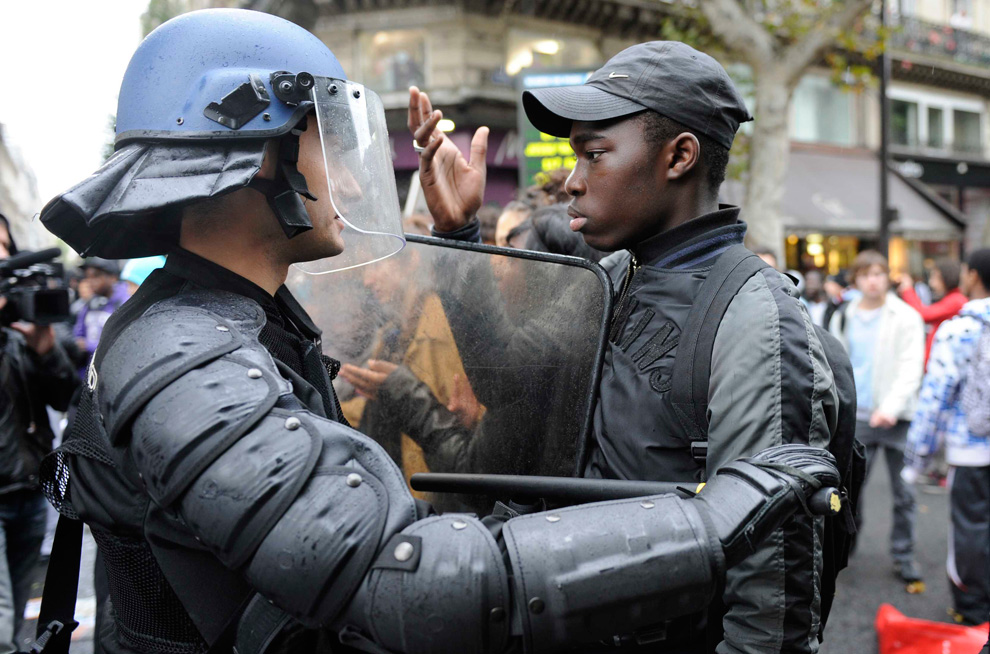
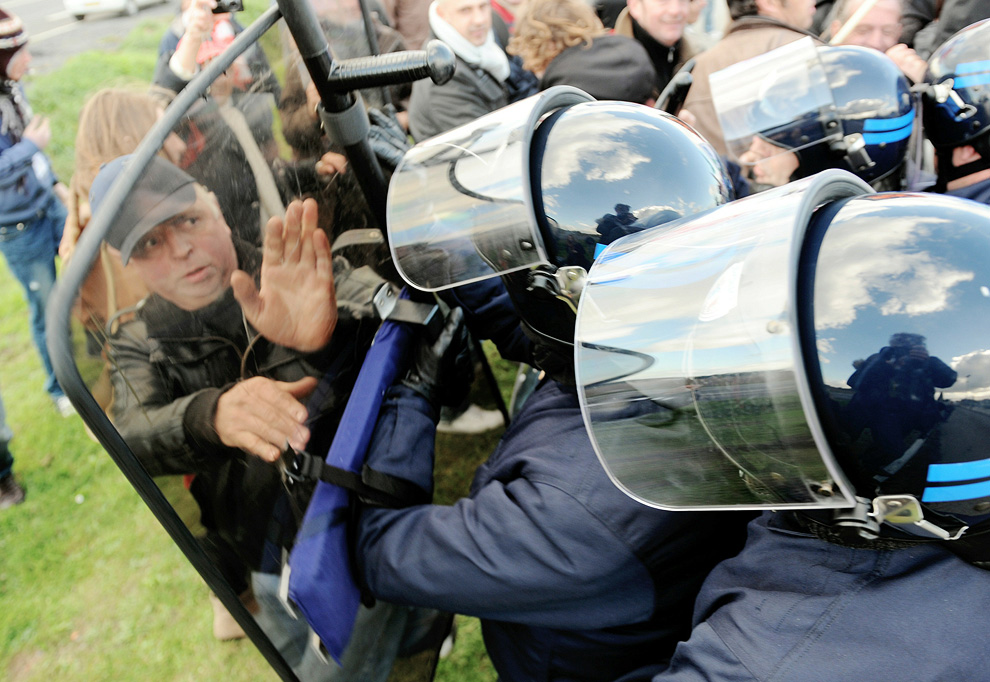
In the United States, unemployment rose from its level in 2008 (5.8 %) to its level in the second quarter of 2010 (9.7 %). These are numbers never seen before. However, by comparison, French unemployment rose from 7.4 % in 2008 to 9.2 % in the second quarter of 2010. This data from the Bureau of Labor Statistics show unemployment had risen further and faster in the US than in France across in the last 3 years. This is found in Economics Professor Rick Wolff’s article French Labor Activism, US Labor Passivism.
Yet French workers are in the streets by the millions demonstration against anti-worker “austerity policies.” Government policies that could cut workers payroll or the services that are provided to the public. Meanwhile US workers are taking it sitting down, there’s no resistance. In California, there’s now a 22 percent unemployment and it takes the average unemployed American about 35 weeks to find a job. US states and towns cut payrolls and public services and as President Obama’s special commission gets ready to reduce social security benefits to the American people. Consider that in September 2010, according to the BLS, while the total US private sector added 64,000 jobs, state and local governments fired 77,000 people.
Rick Wolff:
- This is a tsunami of a political movement. All the six different organizations of trade unions have unified in organizing and moving these demonstrations. They haven’t unified on anything for a long time. They’ve drawn in students.
- Sarkozy almost in a way provoked the students to join the demonstrations in huge numbers.
- The students quickly understood that if the older workers stayed in their jobs an extra 2 years, those are jobs they’re not going to get. 70 percent of the French people support demonstrations. What we see now is a minority government, isolated, entrenched.
- If you want to see a movement that is doing something, mobilizing mass opinion, you got it.
- If you read what the French are saying, it’s this. We’ve already paid for the crisis, with unemployment, lost homes, insecure jobs.
- We’ve done our part, we’ve accepted that. We’ve drawn our line in the sand. We’re not gonna pay for fixing this mess from which have suffered. Why is this relevant? It is exactly like the United States.
- The atrophy of left here is much more palpable, then what happened there. We’ve had a much worse decline of our trade union movement then they did.
- We have to create anew the organizations that could bring people together into an effective coalition. The last thing we need is 800 single issued groups, cultivating its own garden and not talking to the other.
Guest-Richard D. Wolff, Professor of Economics Emeritus, University of Massachusetts, Amherst where he taught economics from 1973 to 2008. He is currently a Visiting Professor in the Graduate Program in International Affairs of the New School University, New York City. He also teaches classes regularly at the Brecht Forum in Manhattan.
—
Entrapment and Conviction of the Newburgh Four
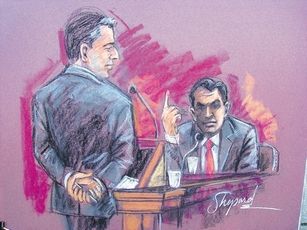
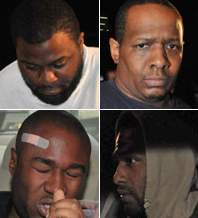
Last week, the four men accused of planting bombs outside synagogues in the Bronx and plotting to fire missiles at military planes were convicted in a case that was the test of the entrapment defense. The jury of the Newburgh 4 trial convicted James Cromitie, David Williams, Onta Williams and Laguerre Payen of plotting to bomb synagogues and shoot military planes. Cromitie and David Williams were also convicted of conspiring to kill officers and employees of the government. Sentencing is scheduled for March. The four face life sentences.
It wasn’t difficult for Shahed Hussain, a government agent provocateur who was facing incarceration, to offer food, money, marijuana, cars and vacations to the four men and ultimately coercing them to collaborate on so-called “terror plots.”
According to a press release by Project Salam (Support And Legal Advocacy for Muslims) The defendants had absolutely no intention to commit any terrorist crimes until the FBI agent provocateur, Shahed Hussain, promised them each $5,000––and in one case $250,000––if they did his bidding. He posed as a rich man who could give the defendants everything they’d ever wanted. He chose the targets, he told them how it would all work, and the FBI paid for everything. The four defendants were petty criminals, none of whom had a car or even a driver’s license. When the so-called leader, James Cromitie, decided to back away from Hussain’s scheme and refused to answer his calls for about a month, Hussain said, “Brother, I told you you could have $250,000, but you don’t want it.” Cromitie’s response: “OK, I’m in.”
Attorney Steve Downs:
- We were really surprised, we thought the edge had been reached here. They (Newburgh Four) were convicted of participating in this plot that had been cooked up, manufactured by the FBI
- These are four individuals who had no way to undertake any kind of terrorist plot. They had no automobile, no driver’s license, no money, no training, they had nothing. The FBI simply provided everything, including driving them to a spot where all they had to do is deliver a package, outside of building to complete this crime which the FBI concocted. There’s no other way to look at it.
- There is the pre-disposition idea and that comes from the ready-response argument. That has simply been misused.
- Example: Would like a loan of 5 thousand dollars, or a gift of 5 thousand dollars? Then only afterward you find out this “gift” has to do with money laundering.
- In the meantime, the person is being asked to make a ready-response. In the Newburgh case, Shahed Hussien, the informant, suggested an illegal plot. The main person he was working on James Crominic, essentially backed out of it.
- There’s a six week period that James didn’t correspond with the government at all. Then finally, Shahed called and said look you’ve got 250 thousand dollars here if you go through with this.
- These people had been somewhat exposed to Islam in prison, but didn’t know much about the religion.
- One of them had a crack-cocaine problem, another had mental problems, very serious mental problems.
- You could’ve gone to any place in upstate New York and found somebody who would grab at a deal like this.
- It was a lot of money for potentially very little activity.
- The building that was going to blow up would be unoccupied, the plane was on the ground without people in it.
- They were paid to make a political statement and not to kill anybody.
- These things are very very cleverly crafted by the FBI.
- Because people don’t know much about Islam, the government is free to play upon stereotypes and fears that people have.
Guest – Attorney Steve Downs, retired chief attorney with the New York Commission on Judicial Conduct, is a founder of Project SALAM (Support and Legal Advocacy for Muslims).
———————————————