
Welcome to Law and Disorder Radio
Law and Disorder is a weekly independent civil liberties radio program airing on more than 150 stations and on Apple podcast. Law and Disorder provides timely legal perspectives on issues concerning civil liberties, privacy, right to dissent and practices of torture exercised by the US government and private corporations.
Law and Disorder May 6, 2013
Podcast: Play in new window | Download

IRS Allows Private Prison Corporation Tax Exemption Status
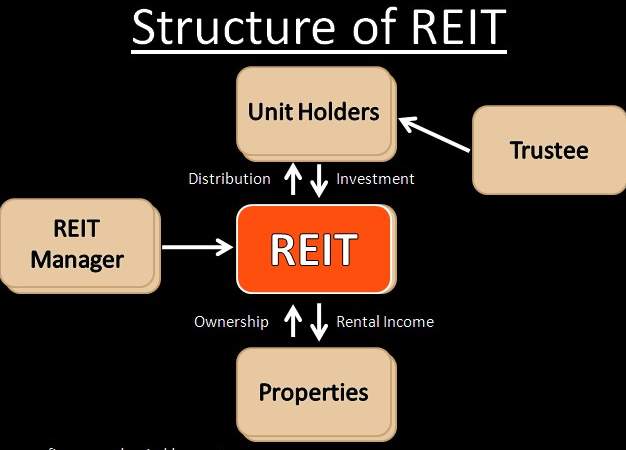
Billboard companies, casinos and private prisons are among many American corporations declaring the status of special trusts in order to avoid paying federal taxes. The Corrections Corporation of America which owns and operates 44 prisons and detention centers in the United States has quietly received permission by the Internal Revenue Service to switch it’s status saving millions on taxes. These special trust structures however are usually reserved by funds holding real estate. As we’ve discussed on Law and Disorder handing over state related tasks such as running penal institutions to the private sector is often at the expense of the inmates’ welfare.
- REIT is increasingly popular these days as an investment choice by both some institutions and individuals.
- REIT’s by law have advantageous tax treatment, its a legal structure of ownership and it requires you to get a better tax structure to pay out 90 percent of your earnings in dividends.
- What you have is individuals and institutions, looking to get an income on their wealth and finding it difficult to find appealing incomes on that wealth.
- This drives them into the area of REIT, its a unit investment trust.
- The tax rates on dividends and capital gains are lower, than say the people who work for a living in standard jobs are then compensated then taxed.
- This was probably made famous in a comment by Warren Buffet who wrote a famous letter and proposed a solution now called the Buffet Rule.
- Tax based on labor income vs. investment income
- The real estate class of investments enjoys any number of special abilities to generate income and pay less taxes. One of them is ensconced in the law of Real Estate Investment.
- The Corrections Corporation of America, private prisons – – if they are a unit investment trust, and they do get their income from rents, from a variety or type, from a property or type, its a prison, then they can get tax exempt treatment.
- Once you have a popular with investors category that can also receive advantageous tax treatment, then teams of lawyers will go out and get to work with economists and accountants and figure out how to shove everything they possibly can into that bucket.
- The regulators are usually a bit behind, in the staffing and acumen of their various attorneys. We call it regulation arbitrage.
- Anytime you can take a series of assets and reduce the tax burden on those assets, it means the various state and local authorities depending or needing those tax revenues, will go without.
- We’ll see more regressive taxes, in terms of more lottery tickets sold, hitting the general public for more money or reducing services.
- Part of what we’re seeing here is privatization of public assets.
- The United States of America has a fairly high corporate tax rate, legal not effective. 35 percent corporate tax rate.
- Once you’re a multinational enterprise you will try to pay taxes in whatever jurisdiction has the lowest rate.
- At one point in the 50s and 60s corporations paid about 30 percent of their income to the federal government in taxes. As we sit and chat now in New York City, they pay about 8 percent of the taxes.
- Tax avoidance strategy, Dutch Double Irish, its done by most of the leading tech companies. Maybe most aggressively pursued by Apple.
- Hundreds of thousands of people make a good living helping people pay less taxes.
- We now know its hundreds of billions of dollars in money that the government didn’t collect.
- The middle, upper middle class American is paying virtually the entire tax bill.
- Very very affluent Americans are able to off-load significant portions of their tax liability and large corporations.
Guest – Max Wolff – teacher of economics in the New School University Graduate Program in International Affairs. He’s
Senior Analyst & Chief Economist at Greencrest Capital. Mr. Wolff is an economist specializing in international finance and macroeconomics. Before joining Greencrest Capital he spent four years as the senior hedge fund analyst at the Beryl Consulting Group, LLC. Mr. Wolff teaches finance and statistical research methods in the New School University’s Graduate Program in International Affairs. Mr. Wolff’s financial markets and macroeconomics work appears regularly in Seeking Alpha, The Wall Street Journal, Reuters, Bloomberg, The BBC, Russia Today TV, and Al Jazeera English.
——-

Bush Library Direct Action: We Will Not Be Silent
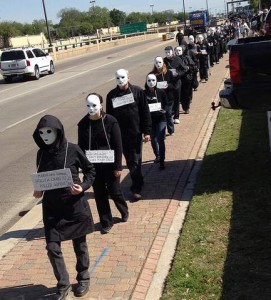
Late last month in Dallas, Texas, four living presidents and countless dignitaries attended the opening of the Bush Library. In response to the library opening, relegated to the so called free speech zone across the street were the members of the white masked group, March of the Dead. While George W. Bush was being celebrated a procession of We Will Not Be Silent marchers carried the names of many who lost their lives in Afghanistan, Iraq, Bagram, Abu Ghraib and Guantanamo prisons. The marchers also carried names of civilians, US military and detainees tortured to death because of war crimes committed by the Bush Administration. WeWillNotBeSilent.net
- We made some signs just for this and the one we designed was The Bush Library: A Crime Against the Mind.
- Hearing that the library was opening, this was several years ago, I felt compelled that we had to be there.
- The organizing force behind this were people in Dallas.
- They organized something called the people’s response.
- We were invited to do something we did in Washington, the March of the Dead.
- So, the March of the Dead returned to the opening of the Bush Library.
- We searched names that lost their lives in prisons under the Bush regime.
- They call it a “free speech zone” which is really Orwellian, we call it a “no speech zone” where they try to render us invisible.
- We were across a highway, several lane highway. They even tried to take that away. They tried to use an old ordinance – you can’t hold a sign within 75 feet of a highway.
- A lot of people now know the truth about Iraq, that we shouldn’t have gone in there.
- There were no weapons of mass destruction, no imminent threat.
- Lawrence B. “Larry” Wilkerson is a retired United States Army Colonel and former chief of staff to United States Secretary of State Colin Powell says we invaded Iraq because of oil.
- We have a war criminal that is being honored by 4 other living presidents. I can understand his father showing up, but Barack Obama, Clinton, Carter, caught in pictures that the media showed, laughing and joking around . . ?
- This man gave orders to torture people and admitted with his vice president on a book tour.
- How do you follow, with having men admit publicly that they did water-board, water boarding is torture, torture is a crime and the law is not coming to prosecute them.
- That’s a crime against our mind too and our intelligence.
- I also look at Lynne Stewart as another casualty in Bush’s war on terror.
- Sign Lynne Stewart Petition For Her Compassionate Release
- We pulled up right to the prison (where Lynne Stewart is currently being held) and about 15 of us came together, 2 of us from New York carrying signs that said “release Lynne Stewart, compassion, the right to justice, “
Guest – Laurie Arbieter helped coordinate the direct action at the opening of the George W. Bush Library, Laurie is an artist/activist and creator of the “We Will Not Be Silent” collective.
—————————————————————-
Law and Disorder April 29, 2013
Podcast: Play in new window | Download
Updates:
- Public Safety Exception to Miranda
- Sign Lynne Stewart Petition For Her Compassionate Release
—

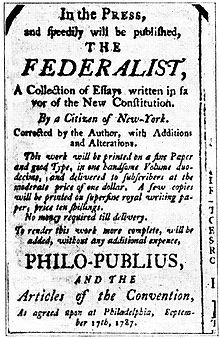
The Federalist Society: How Conservatives Took the Law Back from Liberals
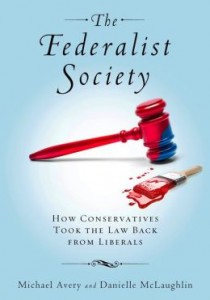
Has the Department of Justice been taken over by a conservative organization little known to the average citizen? In the recently published book titled The Federalist Society: How Conservatives Took the Law Back from Liberals authored by attorney Michael Avery and Danielle McLaughlin track the movements of a small group of conservative law students and their influence. The Federalist Society has lawyer chapters in every major city in the United States and student chapters in every accredited law school. Members include economic conservatives, social conservatives, Christian conservatives, and libertarians. They all differ with each other on significant issues, but cooperate in advancing a broad conservative agenda.
Attorney Michael Avery:
- I saw how much power and influence the Federalist Society had during the years George W. Bush was president and at the same time I realized most people don’t know very much about them.
- They remained under the radar, I thought it was important to tell their story.
- They came along just at the right time for them, it was really kind of a perfect storm for them. Ronald Reagan was in the White House, you had a general renaissance of conservative thought that was promoted by people like Bill Buckley in the National Review, you had resistance to school integration and forced bussing. So there was a backlash waiting to happen against some of the things that happened in the law.
- It’s very important to recognize the role Ed Meese played. First he was counselor to the president then he was attorney general, later he became a principle figure at the Heritage Society.
- Many people are open members of the Federalist Society, others not so much but through a variety of sources I think we’re very confident that the people in that appendix either are members or very close to the society and sometimes I call that list the 100 most powerful people in the country and most of them you never heard of.
- About half the members that George W. Bush appointed to the Federal Court of Appeals were members of the Federalist Society.
- This battle over whether the government is able regulate private property has been one of the principle ideological battles of American Constitutional law since the end of the 19th century.
- They argue that property rights are a natural right that everybody is entitled to.
- It’s better to tolerate disagreement than to try to be 100 percent correct all the time.
Attorney Danielle McLaughlin:
- The substantive areas of law that we’re seeing this test cases brought in are very much reflective of the core values of the society. Those are notions of small government in particular small federal government. The idea that the state exists to preserve freedom.
- Many are involved in public interest law firms who go out and find plaintiffs and challenge regulation at the state level and in many cases have been successful in challenging laws in opposition to their world view all the way up to the Supreme Court.
- They really worked this very large network that they developed.
- Olen Foundation says here’s some money go out and build an institution.
- The Federalist Society today is not handicapped by having to report back or meet short term goals. The conservative funders believed in long term institution building.
- There are Federalist Society student groups on the campus of every single accredited and some unaccredited law schools. There are lawyer chapters in every single major city. There are affiliated Federalist Society groups outside the country.
Guest – Civil rights lawyer Michael Avery, professor at Suffolk University Law School and former president of the National Lawyers Guild from 2003 to 2006.
Guest – Co-author and attorney Danielle McLauglin, member of the Litigation and Dispute resolution group.
—–
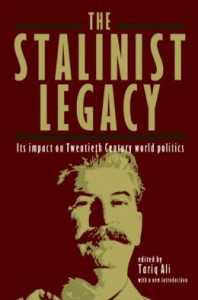
The Stalinist Legacy: Its Impact on Twentieth Century World Politics
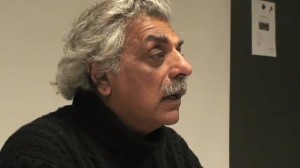
We go now to hear a presentation by internationally acclaimed Pakistani writer and film maker Tariq Ali during a New York City book launch of his new book The Stalinist Legacy: Its Impact on Twentieth Century World Politics. Karl Marx’s often quoted observation “History weighs like a nightmare on the brain of the living” is so true. Even 20 years after the Soviet Union’s collapse, activists are still confronted by the legacy of Stalinism at the same time capitalism has failed millions of working people in the United States and across the world.
————–
Law and Disorder April 22, 2013
Podcast: Play in new window | Download
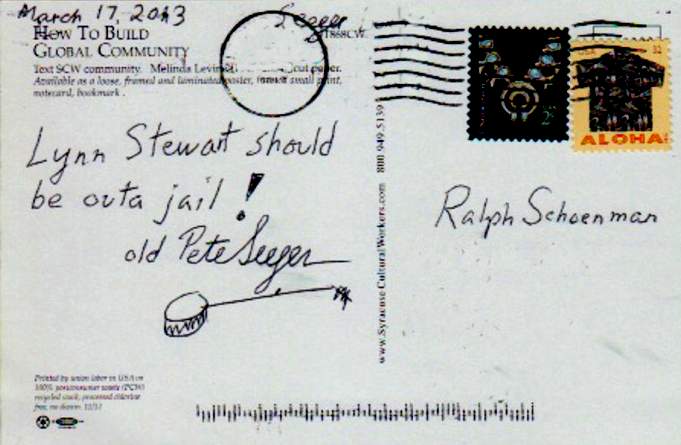
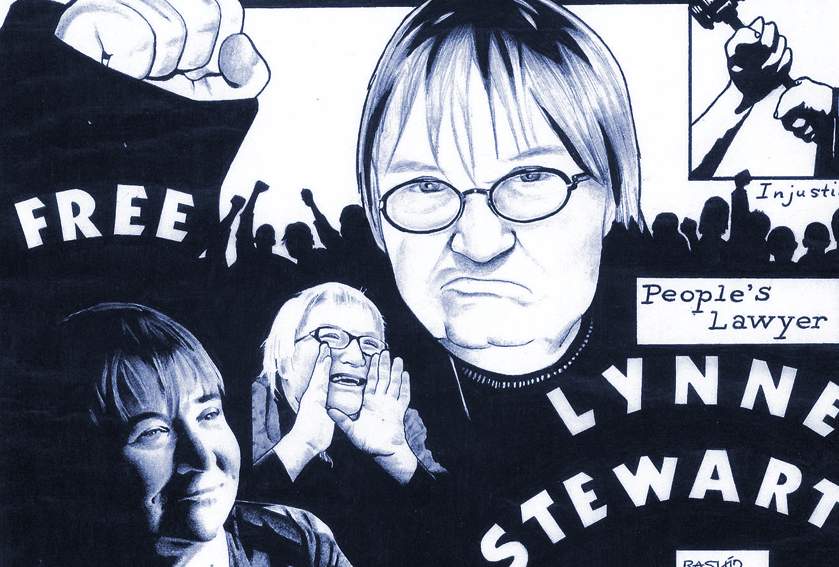
Please Sign Petition To Help Lynne Stewart
Long time literary agent Francis Goldin has for years visited inmates on death row. She’s recently returned from visiting Lynne Stewart in the Carswell Medical Facility in Texas. She joins hosts to talk about her visit.
- We were there for 4 days and most of the time we were in the prison with her.
- If we kissed more than once, or hugged more than once she would be fined.
- That’s how they become correctional by denying kissing and hugging and loving.
- We were only there for about 70 hours, we didn’t have enough time to talk.
- The day we left, all the plans were changed, no more 4 day visits, only Saturday and Sunday. The inmates were heart broken.
- The breast cancer has moved to her lungs. The reason she has it in her lungs is because they didn’t treat her when they should have.
- It’s tremendously important to go to LynneStewart.org and sign on for this release.
- When you sign on, email every person on your list whether its 10 or 500.
- It’s really important that we send a million signatures.
- I visited Maroon for 27 years, every 3 months. I was there for 2 whole days.
- Lynne Stewart Compassionate Release Petition
- Please Also Write to: Charles E Samuels Jr. / Federal Bureau of Prisons /
- 320 1st Street Northwest / Washington DC 20534
Guest – Francis Goldin, has worked in publishing for 63 years, as an agent and as editor-in-chief of a children’s publishing company; she founded the Frances Goldin Literary Agency and sold her first book in 1977. Authored by Black anthropologist Betty Lou Valentine and titled Hustling and Other Hard Work, the book continued to receive royalties for 32 years. Among her clients are Barbara Kingsolver, who she has represented for all of her 14 books, Mumia Abu-Jamal, Dorothy Allison, Frances Fox Piven, Martin Duberman, iconic feminists including Charlotte Bunch and Esther Newton, more.
——–
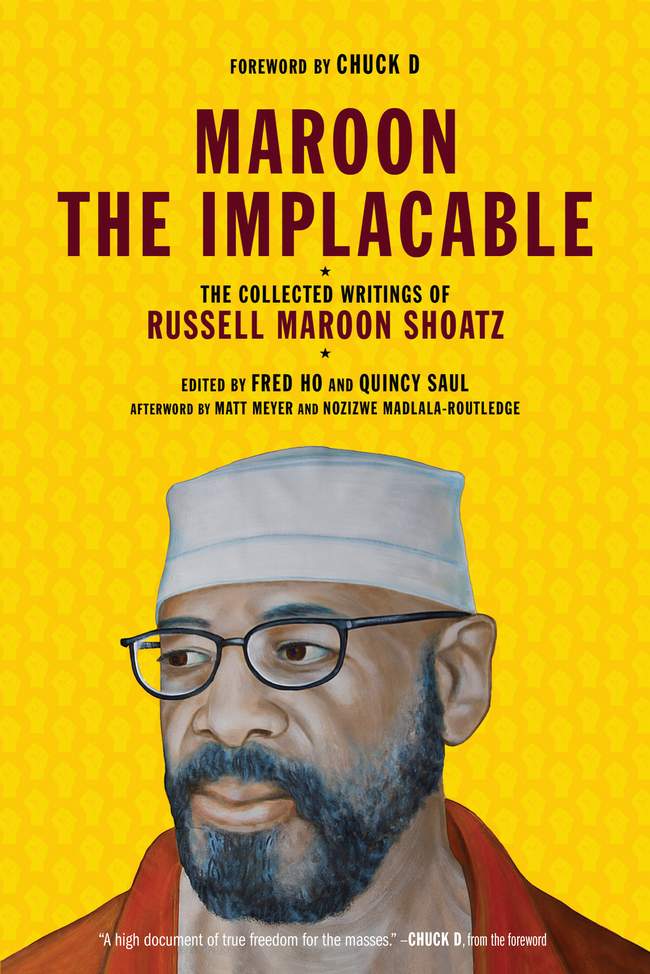
We welcome back Teresa Shoatz, daughter of political prisoner Russell Maroon Shoatz who has spent 39 years in the US prison system. As many listeners may know, Russell Shoatz has been held under intense lock down spending no more than one hour a day outside of his cell for the past 21 of those years. He was locked up in 1972 for his activity as a member of the Black Liberation Army.
Meanwhile, Theresa Shoatz is on book tour promoting her father’s book titled Maroon The Implacable. We catch up with her in Chicago while on tour. Maroon The Implacable is the first published collection of his accumulated written works analyzing the prison system, imperialism, the drug war. He also writes with great insight about the Maroon communities throughout America. Newer essays examine current political movements including eco-feminism and matriarchy
- Maroon had been told that he would die at SCI Greene. For him to be free from prison in general, would be when I would say we have won.
- We’ve been fortunate to have Bret Grote, assistant to the legal team. Dan Kovalic and we just got a major commitment from a big law firm.
- Maroon has been writing since the eighties. In the nineties, some anarchists took his writings and put them in a zine, and took them throughout the United States and into Canada. They were used for education.
- So you get Maroon’s span from the eighties, to the present day.
- His view now on women is so incredible because he stressed how important women are to the movement throughout the sixties and the seventies.
- At that time he didn’t recognize how important the women were. The women, I would say are really the back bone of any community.
- On his second escape we was returned to prison an inmate said to him, they had a hell of a manhunt on you, you were chased down like a “Maroon.”
- He didn’t know anything about the Maroons. He dug in deep about their history and how they came about.
- The Maroons were slaves who had escaped from plantations, some went deep into the woods and joined with Native Americans and some poor whites who were totally against this slave thing.
- His digging into the history of the Maroons, he also involved me and my siblings. They were so awesome because they were fighting off attacks, also in the Caribbean areas, even into Mexico.
- Maroon has endured such torture, just outrageous treatment. Twenty plus years of no-contact visits. The impact of this really does control mindsets.
- Maroon doesn’t have computers nor has he seen one up close. He does everything long hand, and through snail-mail.
- Right now, I’m at the University of Texas. I’m presently with the dean and a professor in a writing class.
- If they haven’t heard of him, they want to know more.
- We have to step over what this government has thrown at us.
- They have more a hand on these youth than some these youths own parents.
- When you can punch right through that wall that’s candy coated reality system that our youth are mixed up in, its not only uplifting for me but for them.
Guest – Theresa Shoatz, a Philadelphia-based prison justice activist and the daughter of Russell “Maroon” Shoatz.
——-


Shadow Lives: How the War on Terror in England Became a War on Women and Children
It’s obvious and yet an unfortunate reality, war, prisoners of war and the prison industrial complex tear apart families. Very seldom are the voices of family members heard that were left behind by the tragedies of war. In the book Shadow Lives: How the War on Terror in England Became a War on Women and Children, author Victoria Brittain brings the reader close to these individuals who’s lives were capsized by war. They’re usually socially invisible and their civil liberties are often trampled by the state under the guise of the “war on terror.”
- I got involved way back when people began disappearing and they were described as the worst of the worst by Donald Rumsfeld and George Bush. Some of those people came from Britain and we didn’t know anything about them.
- A friend of mine had a project to do verbatim plays about the families, and he asked me to be the person to interview the families to try to find out who these people were and what had brought them together in Guantanamo Bay.
- I find complete confusion. Nobody in the families knew anything about why their son or their brother had ended up in Guantanamo Bay. In the course of that I got to know some of the families.
- I was particularly curious about one family that didn’ t want to cooperate in the play which was a Palestinian woman with five children, living alone and not speaking much English.
- I wrote to her about the play and told her how ashamed I was of my country from the research that I’ve done.
- We became close friends. Through her and her children, I met other women.
- Over these past ten years its been a rich experience, and sobering experience about injustice.
- I think she was suppressing the agony and loneliness and fear that she was in, course she was so desperate to have her children approach something of a normal life.
- It was only when other people began to come back to Britain from Guantanamo, that we began to get a picture the conditions in which people were.
- Her husband had gone off to west Africa with 3 or 4 other men to try and start a peanut business. This was his idea as a refugee Palestinian in Britain. He wanted to find a way of making a life for his family.
- When she found out he was taken from Afghanistan to Guantanamo, she was completely, . . there was no explanation.
- There was absolutely no recourse for her for a long time.
- It’s so sad, the Obama administration, he said he was going to close Guantanamo, here we are years down the road, these innocent people are still there and in the last 3 months, these people have become so desperate, because Congress is blocking them from getting out.
- Again and again, every legal victory from CCR has been overturned by a higher court.
- For these men, they really feel they’re at the end of the road.
- The horror of this has been so well laid out by so many lawyers. I find it astounding that there isn’t an uproar in Congress.
- Thank goodness Sami-Al-Arien is no longer in prison, but he’s under house arrest.
- Most of their friends turned away from them.
- He spent about five years in about a dozen maximum security prisons.
- FreeSamiAlArian
- The British and American intelligences work so closely together.
Guest – Victoria Brittain has lived and worked as a journalist in Washington, Nairobi, Saigon and London. She worked at the Guardian for 20 years and is the author of Death of Dignity: Angola’s Civil War, and Enemy Combatant.
———————————————————————————