CIA Sponsored Terror, Civil Liberties, Gaza, Habeas Corpus, Human Rights, Military Tribunal, NSA Spying, Political Prisoner, Surveillance, Targeting Muslims, Torture, Truth to Power, War Resister
Podcast: Play in new window | Download

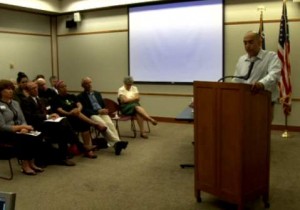
Ali Abunimah On Gaza, His New Book The Battle For Justice in Palestine and Censorship
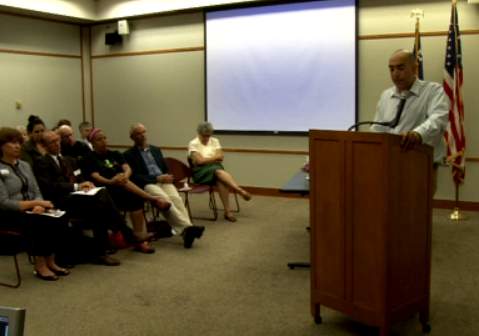
ElectronicIntifada co-founder Ali Abunimah is the author of new book The Battle For Justice in Palestine. He shares with hosts the recent news of what’s happening in Gaza, the resistance around the world, as well as on campus and in the United States. Ali was scheduled to speak at the Evanston Public Library in early August. The library later sent an email telling him he couldn’t be allowed to speak without an Israeli speaker to ensure balance. Neighbors for Peace an organization of antiwar activists based in the Chicago suburb of Evanston, Illinois who initially brought Abunimah to speak suspected the library’s director was pressured to censor the event. The event was canceled the following day and after some activism and demonstration, the presentation was rescheduled. Ali spoke about his recent book The Battle For Justice In Palestine, the event was packed. Last year at Brooklyn College a similar controversy erupted when Palestinian BDS advocate Omar Barghouti and University of California Berkeley philosopher and BDS supporter Judith Butler we’re scheduled to speak.
Ali Abunimah:
- The situation has gotten considerably worse (in Gaza) over the past year because of the coup in Egypt.
- The current regime in Egypt is very closely aligned with Israel. They’ve made it just impossible for 1.8 million people to live in Gaza.
- The demands from Palestinian civil society is lift the siege, open the crossing, allow farmers to farm, allow fishermen to fish, allow factories to function, allow travelers to travel, students to go to their universities, patients to reach their hospitals, allow medicines to come in, allow books to come in.
- You mentioned my book The Battle for Justice in Palestine. Well, there’s no way to get that book into Gaza.
- It’s also a siege on human contact, culture, education and nourishment. They killed now more than 2000 people in Gaza which is 1 out of every 1000 residents in Gaza.
- Entire families have been wiped out, nobody feels safe. This massacre Israel thought would break people’s will and get them to accept and go back under siege.
- But Israel won’t (lift the siege) it’s a matter of pride for them, it’s a matter of colonial control.
- The most frightening statement about where they’re (Israel) going was made more than 10 years ago. I wrote about this recently in an article called The Gaza Massacre Is The Price of Living In A Jewish State.
- At that time you hearing fantasy about Gaza becoming the new Singapore on the Mediterranean. The Israelis were saying to themselves that Gaza was going to become a giant holding pen for human beings who are not Jewish.
- If we’re going to wait for government to do the right thing or the UN to get its act together, then we’re doomed.
- Despite the multiple levels of complicity by this government in this country, and governments in Europe and the Arab world, something is happening.
- We’re not starting from zero we have a really important and sustained Boycott Divestment and Sanctions movement.
- They’re firing artillery, mortar shells that are designed to be indiscriminate into populated areas of Gaza with the intended consequence of causing widespread destruction.
- We have to go after the weapons manufacturer, we have to after the people who approve these sales from around the world and its because of public pressure that the UK announced last week that they will suspend armed exports to Israel if significant hostilities resume.
- Well now they have resumed, let’s see what they do.
- Look what’s happening just this week, an Israeli cargo ship was prevented from unloading for 4 days in Oakland because solidarity activists and unionized port workers have been working together to prevent that.
- Israel can only maintain its dominance over Palestinians through brute force and use of violence against Palestinians there, and through attempts to suppress debate, suppress political action on behalf of Palestinians in the United States and around the world.
- Mainstream media is more closed to Palestinian voices than what I’ve seen in 20 years. I used to get on CNN, I used to get on MSNBC.
- The librarian let me know that the event was canceled until they could get a pro-Israel speaker.
- There was such an uproar, it was amazing. They did a U-turn pretty quickly.
- As Israel and its apologists lobbies lose control of the narrative, lose control of the politics in this country, there is a more blatant resort to outright repression such as what is going on now at the University of Illinois and other institutions around the country.
- In that chapter I site an organization called the David Project, which is a Zionist group that’s been working for ten years attacking and targeting professors.
Guest – Ali Abunimah, a Palestinian American journalist who has been described as “the leading American proponent of a one-state solution to the Israeli-Palestinian conflict. A resident of Chicago who contributes regularly to such publications as The Chicago Tribune and The Los Angeles Times, he has also served as the Vice-President on the Board of Directors of the Arab American Action Network, is a fellow at the Palestine Center, and is co-founder of The Electronic Intifada.
———
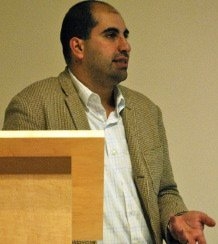
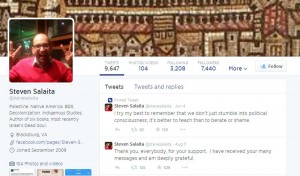
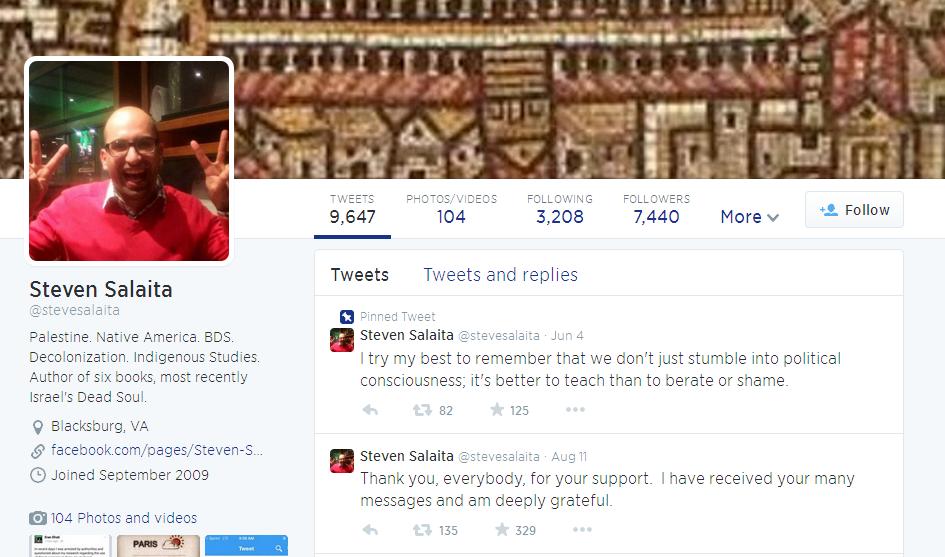
Top Legal Scholars Decry Chilling Effect of Dehiring Professor Steven Salaita
The University of Illinois has rescinded the job offer of the professor who wrote controversial social media posts about the war in Gaza. Professor Steven Salaita was essentially dehired from the American Indian Studies program at the University of Illinois at Urbana-Champaign because of his statements on social media criticizing Israel’s conduct of military operations in Gaza. This has raised serious concerns under established principles of academic freedom. Those principles are enshrined in Illinois law, in the U.S. Constitution, and in the written principles of the American Association of University Professors. Recently, scholars from law schools at Columbia, Cornell, Berkeley, Georgetown, and other universities have come out with a very strong letter condemning the decision of the University of Illinois to dehire Steven Salaita. Read letter here.
Professor Katherine Franke:
- Professor Salaita was made a tenured offer of appointment at the University of Illinois in their American Indian studies program last year. He accepted it and negotiated the terms of the offer. Then during the most recent assault on Gaza, he was active on twitter expressing his views on the Middle East and colonialism.
- The University of Illinois came under a tremendous amount of pressure to revoke the offer of employment to Professor Salaita.
- The offer wasn’t finalized, there’s usually a rubber stamp process where the department and the head of the university have to take appointment to the Board of Trustees.
- The chancellor of the university Phyllis Wise informed Professor Salaita that she would not be bringing his appointment to the Board of Trustees and was unwilling to finalize his appointment.
- He had already resigned his position at Virgina Tech and was getting ready to move. He’s a well known scholar, not only of American Indian studies but of colonialism more generally and has connected up the struggle for sovereignty and analysis of genocide and occupation in the United States to the struggles that the Palestinians have suffered in the Middle East.
- He certainly didn’t depart from views he expressed before but I think they, in the heat of the moment of this recent assault on Gaza, the university basically buckled and withdrew the offer, and he’s now without a job and an income.
- It’s because of his speech on the issue of war crimes that may have been committed by Israel in the assault on Gaza.
- His tweets have been rather even across the board I think in terms of criticizing the critics of Israel when they’ve overstepped but also criticizing Israel itself.
- He’s a fiery guy with strong opinions and rigorous academic critiques of colonialism and colonial violence.
- I thought it would be useful to add constitutional and legal analysis of the problem, situated historically in threats to free speech on campus. I drafted a letter for Constitutional law professors, not in which they would agree to boycott universities . . . more offering a constitutional analysis of retaliation against unpopular speech.
- The law in this area has been made by faculty and sometimes students.
- I brought it back to Urbana-Champaign and their own history of threats to free speech both during the McCarthy period when bills were introduced in Springfield to punish or purge people who had back then what they call Communist sympathies when working in public universities. In 1960, there was a professor in the biology department at Urbana-Champaign that had written and spoke about human sexuality and premarital sex, and had actually endorsed premarital sex.
- There are a couple of principles that are at stake here, one has to do with the state punishing any citizen for speaking on an unpopular topic and particularly punishing for the viewpoint they take.
- There’s another faculty member at the University of Illinois Kerry Nelson who has been a rather enthusiastic advocate of Israel’s right to attack Gaza. He said things that are quite inflammatory, he’s not been fired. He’s not been punished for the positions he’s taken on the Middle East.
- Viewpoint discrimination, that’s the first point. The second point is academic freedom. Universities are the primary bastion of protection. A domain where we protect the pursuit of unpopular ideas, controversial ideas, of ideas that might even be frightening.
- That is the commitment that we make as part of the academic endeavor. The point of that concept of academic freedom is that we don’t want to have a kind of orthodoxy or an official version of the truth.
- Dr. Wise comes out of a somewhat corporate background. She, I think is the poster woman if you will for the executive that is now leading universities and thinks of universities as a business.
- The presidents are making an economic calculation, that they can pay off someone like Salaita and satisfy their donors.
- We can’t just agree to do nothing which what a boycott is. In a way it’s the easiest thing to do.
- I would say I have a lot of faith in students.
Guest – Katherine Franke, Isidor and Seville Sulzbacher Professor of Law; Director, Center for Gender and Sexuality Law at Columbia University. She was awarded a 2011 Guggenheim Fellowship, and is among the nation’s leading scholars in the area of feminism, sexuality and race. In addition to her scholarly writing on sexual harassment, gender equality, sexual rights, and racial history, she writes regularly for a more popular audience in the Gender and Sexuality Law Blog. Franke is also on the Executive Committee for Columbia’s Institute for Research on Women and Gender, and the Center for Palestine Studies and teaches at a medium security women’s prison in Manhattan. Her legal career began as a civil rights lawyer, first specializing in HIV discrimination cases and then race and sex cases more generally. In the last 25 years she has authored briefs in cases addressing HIV discrimination, forced sterilization, same-sex sexual harassment, gender stereotyping, and transgender discrimination in the Supreme Court and other lower courts.
——
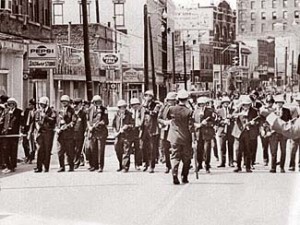
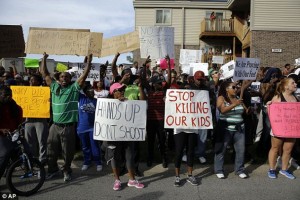
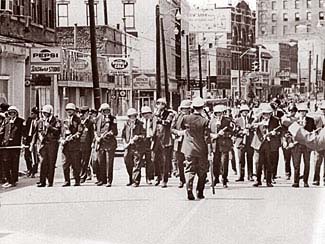
History Of Police Brutality And The Militarization of Local Law Enforcement
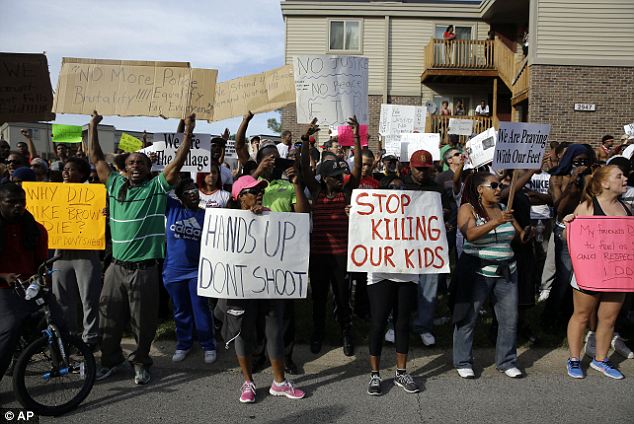
In the days since the uproar over the police shooting and killing of unarmed teenager Michael Brown, state and local law enforcement have been cycling through different approaches demonstrators in Ferguson, Missouri. They rolled out armored vehicles, while police in riot gear deployed tear gas, stun grenades and shotguns. Another decision permitted the Missouri State Highway Patrol to march with protestors. The National Guard was also ordered in. We examine the history and consequences of militarizing local law enforcement with Baruch College Civil Rights Professor Clarence Taylor.
Professor Clarence Taylor:
- We can’t talk about a post civil rights era. These issues are still with us today.
- It’s the people on the ground, who have gone through this, that are fed up.
- It’s not just arguing for a black face in a high place.
- There is no requirement of the police of Ferguson to live in that community.
- Having black officers would change the nature of the investigation.
- This is something that’s been argued going back in the 1930s and the 1940s and people were organizing against police brutality.
- We should not take our eyes off the racial component of this.
- Police brutality would still go on without the militarization of the police.
- You throw all these new toys at the police department and once you have a big enough hammer, everything looks like a nail.
- Diversifying police departments is very very important and emphasizing more community policing.
Guest – Professor Clarence Taylor, His research is in modern civil rights, black power movements and African American religion. He’s the author of many books including co-editor of Civil Rights Since 1787: A Reader in the Black Struggle. He’s currently writing a history of police brutality in New York City from the 1930s to the 1960s. In 1991, Clarence received his PhD in American history and began teaching at Le Moyne College in Syracuse, New York. He reworked his dissertation into a book, The Black Churches of Brooklyn from the 19th Century to the Civil Rights Era, and it was published by Columbia University Press in 1994. In 1996, Clarence became a member of the history department and the African-New World Studies Program at Florida International University.
————————————————————
Afghanistan War, CIA Sponsored Terror, Civil Liberties, Criminalizing Dissent, FBI Intrusion, Gaza, Guantanamo, Habeas Corpus, Human Rights, Military Tribunal, NSA Spying, Political Prisoner, Surveillance, Targeting Muslims, Torture, War Resister
Podcast: Play in new window | Download
Updates:
- Attorney Michael Smith Remembers 69th Anniversary of U.S. Dropping A-Bombs On Japan
- Atomic Diplomacy: Hiroshima and Potsdam: The Use of the Atomic Bomb and the American Confrontation with Soviet Power
—–

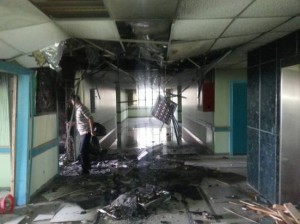
The Logic of Israeli Violence
Ongoing reports of Israel engaging in senseless cruel violence against Palestinian people in Gaza throughout Operation Protective Edge is not a random bombing campaign but a strategic war experiment in colonial management as Greg Shupak explains in his recent article The Logic of Israeli Violence. Shupak points out the attacks on civilians fleeing for shelter, the bombing of the medical infrastructure, fishing boats and wheat mills, killing Arab speaking journalists are in the larger plan of ethnicide and to render the Palestinian people dependent. His article reminds readers that there is a measured plan of attack to systematically erase the historic memory of the Palestinian society.
Greg Shupak:
- There’s good reason to believe according to some reporting by 97 Magazine and Max Blumenthal that the Israeli security forces knew quite perfectly well the teens were almost certainly killed as soon as they were abducted and yet they carried on this charade of pretending that they could be rescued in some way.
- Rocket fire from Hamas didn’t start until after Israel carried out strikes within Gaza, and carrying out various forms of killing Palestinian civilians and or people they described as militants.
- The rockets were a response to Israeli violence.
- Israeli propaganda has insinuated that these tunnels have in fact been used to kill Israeli civilians or that they may well be, but that simply has not happened.
- If the aim was to destroy tunnels, Egypt which is being ruled by a brutal regime, in its own right, was able to get rid of these tunnels without killing huge numbers of civilians.
- Israel’s aim vis a vis Gaza is to isolate Palestinians there from the outside world render them dependent on external benevolence and at the same time absolve Israel of responsibility toward them.
- The thesis I put forth about the current violence of Operation Protective Edge, is that one way Israel is attempting to achieve that goal, that goal of Jewish supremacy in historic Palestine with as much land as possible and as few Palestinians as possible is to aim to obliterate Palestinians as a people with the capacity to live independently in their homeland.
- The pattern of Israeli violence . . . is not only to kill and maim Palestinians but to impede their capacity to live autonomously in historic Palestine.
- It’s a settler colonial project.
- This is part of a longer term pattern. If you look at the work of Dr. Sarah Roy of Harvard she has documented extensively what she calls the deliberate de-development of the Gaza Strip economy. She has warned that Gazans are at risk for mass starvation.
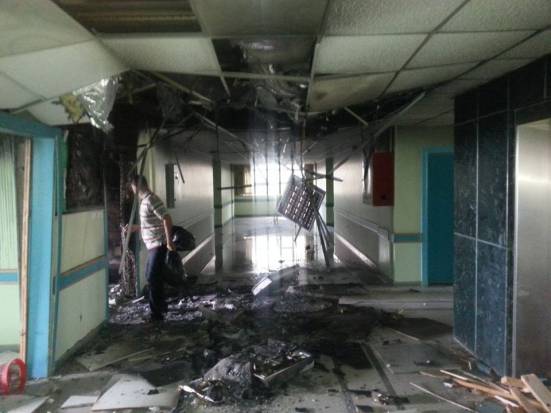
- Five hospitals have been shut down. 24 health facilities have been damaged.
- We also that there’s been direct strikes on hospitals from Israeli fire.
- The ability of Palestinians to care for themselves has very much been undermined.
- Two thirds of Gaza’s wheat mills are inoperative, 3000 of its herders are in need of animal feed. We’ve seen fishermen attacked, we’ve seen attacks on agricultural sites, these are all part of those processes that Sarah Roy has talked about in the longer term.
- If religion is way for a cultural group to understand its identity then attacking the cultural institutions of that religion are ispo facto an attack on the people to have an identity.
- When you attack an educational institution you undermine the ability of a people to educate their young, to train them for future work, to train them to think critically, to develop artists, and inventors and so on.
- This to me is a very significant way for stifling a cultural groups independent existence.
- At its simplest, Israel can be seen as a giant military base for the United States.
Guest – Greg Shupak, a writer, activist and PhD candidate at the University of Guelph’s School of English and Theatre Studies. He teaches Media Studies at the University of Guelph, Ontario, Canada.
——–
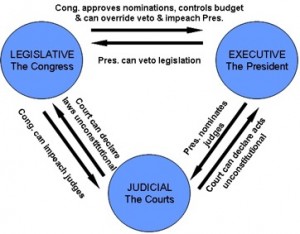
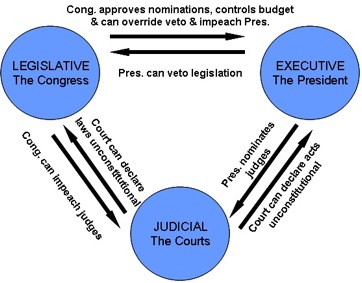
The National Security State: The End of Separation of Powers
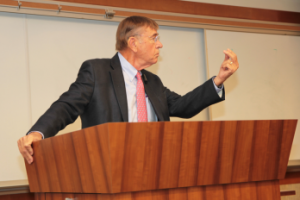
Retired Professor of Law from Duke University Michael Tigar joins hosts to talk about his recent article The National Security State: The End of Separation of Powers published in the latest Monthly Review Magazine. Michael has explained how the Executive branch of government has come to dominate both the Judicial and Legislative branches of the United States government. Attorney Michael Tigar has been working on social issues for many years, his books include Law and The Rise of Capitalism, Fighting Injustice, and Thinking About Terrorism: The Threat To Civil Liberties In Times of National Emergency.
Attorney Michael Tigar:
- The basic principle of constitutional government that is established in our Constitution is that the actions of the legislative and executive branches, particularly the executive branch, are always reviewable by independently appointed judges and that the legality of whatever the executive branch does harms any protected interest, citizen or otherwise ought to be reviewable in the courts of the United States.
- The main thing about this is the harm to the judicial branch is in a real sense a self inflicted wound.
- That is to say judges confronted with assertions of executive power have proven inadequate to the task of restraining exercises of executive power
- We recall the massive illegality of the Japanese relocation at the beginning of the Second World War.
- It is now been shown that the premise upon which that relocation took place confining Japanese-Americans in concentration camps was false.
- At the time the Constitution was being debated Patrick Henry opposed the adoption of the Constitution on the ground that the ideal that independent judiciary could act as an effective check upon the exercise of executive power particularly military power was bound to be dis-proven in history.
- Law is legal ideology. That is to say its erected around social relations. In every time of recorded history there is a sense in which the formal guarantees that rules of law make about individual rights are simply lies the regime tells the people in order to sustain itself.
- That was the burden of book I wrote called Law and The Rise of Capitalism.
- The ideal that you rally people to the cause of social change by promising them liberty is also not new.
- The Cherokee people of Georgia read the Constitution and they said Aha, the Constitution guarantees that any group or individual can exercise certain social rights.
- So they drafted a Constitution for their nation and set up institutions then they brought suit against the state of Georgia to enforce these rights, that the letter of the American Constitution guaranteed that.
- What did Chief Justice Marshall say? What a minute, these are inferior and subject people. When the Constitution gives the right to all people, persons, citizens whatever, to bring lawsuits under Article 3 and to bring them to us, it wasn’t talking about these people.
- Michael Ratner you and others, courageous lawyers who have been struggling to get reviewablility of unlawful executive action should not give up the fight.
- The kinds of effort you make deserve support and turn out in historic context to be important.
- Historically the role of lawyers has been to articulate people’s claims for justice.
- What Edward Snowden and Julian Assange have done is reveal to the world fundamental defects in the way that the American political society has been operating and yet rather than saying thank you in some form of another, the government is hell-bent on prosecuting them.
Guest – Michael Tigar, a research professor of law. He holds expertise in Constitutional Law; Supreme Court; French legal system; criminal law and procedure; human rights. He is fluent in French. Tigar represented Terry Nichols in the Oklahoma City bombing trial. One of the most renowned lawyers in the country today, he has argued seven cases before the U.S. Supreme Court and more than 100 appellate cases. Tigar has written extensively about litigation, aspects of trial practice, criminal law, the death penalty, and the role of the criminal defense lawyer. His books include Fighting Injustice (ABA, 2002); Federal Appeals: Jurisdiction and Practice; and Examining Witnesses. In addition, he has written several plays about famous trials. Throughout his career, Tigar has been active in pro bono cases, the American Bar Association, continuing legal education programs, and international human rights. During the apartheid period, he went to South Africa to train black lawyers. Prior to joining AU, Tigar served as a professor at the University of Texas Law School.
—————————————————————————————–

Please help support Law and Disorder, the show is now a sponsored project of Fractured Atlas, a non-profit arts service organization. Contributions for the charitable purposes of Law and Disorder must be made payable to Fractured Atlas only and are tax-deductible to the extent permitted by law.
Censorship, CIA Sponsored Terror, Civil Liberties, Criminalizing Dissent, FBI Intrusion, Green Scare, Human Rights, NSA Spying, Political Prisoner, Supreme Court, Surveillance, Truth to Power, War Resister
Podcast: Play in new window | Download

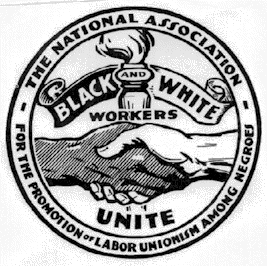
Folk Music, Labor Movements and Radical Politics
Especially in times of revolution or crisis, the role of music has been a defining element in telling the stories of labor movements, against the war in Vietnam and civil rights. Folk musician Eli Smith gave a presentation at the Left Forum this year on satirical songs of the IWW including the work of Joe Hill and many others. The early works of Pete Seeger, Woody Guthrie are a great place to start along with the lesser known work of John L. Handcox, and the Southern Tenant Farmers Union. It was the first racially integrated union in the South that used indigenous folk music to fight for the rights of sharecroppers.
Guest – Eli Smith, a banjo player, writer, researcher and promoter of folk music living in New York City. Eli is a Smithsonian Folkways recording artist and produces two folk festivals annually, the Brooklyn Folk Festival in the Spring and Washington Square Park Folk Festival in the Fall. He has appeared as a guest on terrestrial radio stations such as WBAI, WNYC, WKCR and WDST in New York and KPFA, KPFK and KUCI in California. Eli has presented panels and discussions on folk music at the Left Forum conference at Cooper Union and at the Podcamp podcasting conference in New York City. He has performed and recorded with his old time string band The Down Hill Strugglers, Peter Stampfel, John Cohen and Sam Shepard. The Down Hill Strugglers were recently featured on the soundtrack album to the Coen Brothers’ film “Inside Llewyn Davis,” which was produced by T Bone Burnett.
———
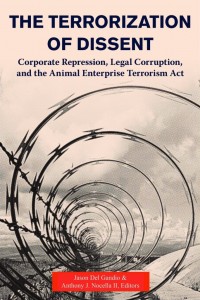
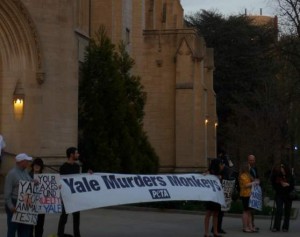
Terrorization of Dissent: Corporate Repression, Legal Corruption, and the Animal Enterprise Terrorism Act
Terrorization of Dissent: Corporate Repression, Legal Corruption, and the Animal Enterprise Terrorism Act is a collection of essays by lawyers, scholars and activists that includes interviews with those who suffered from the AETA’s conspiracy provisions. Editors Jason Del Gandio and Anthony Nocella have compiled essential information to document how the Animal Enterprise Terrorism Act is a clear violation of the First Amendment. Specifically, the book documents how corporations and the U.S. Government conspire under this law to prosecute animal rights activists and acts of civil disobedience involving environmental issues under the specter of terrorism. Right now, according to Nocella and Del Gandio, corporate profit determines what can or can’t be done to animals and the environment.
Anthony Nocella:
- The importance of this act has really shaped how the government looks at one of the larger movements in the United States.
- The animal advocacy, animal rights, animal liberation movements have been demonized and stigmatized as terrorists, through the media and the government through this particular act.
- What are the effects of this law? Who influenced this act to be pushed into law? It wasn’t really government.
- There were main organizations that pushed this law into effect. The Animal Enterprise Protection Coalition, The Animal Legislative Exchange Council (ALEC) The Center for Consumer Freedom.
- Any logical CEO of a corporation will say I don’t want anything to threaten my product.
- That product in the case of animals is any where from circuses to sea world, to clothing, from leather to fur, to also eating.
- We can do away with circuses and fur and a lot of different clothing, but one thing we can’t live without is food.
- We have to look at the real conflict and that’s between food.
- Do we want people to have a plant based diet or an animal based diet?
- There are hundreds of billions of dollars protecting that paradigm of people eating meat, fish and chicken.
- If anyone threatens that industry, under the Animal Enterprise Terrorism Act, you’re deemed a terrorist.
- To wash away all the rhetoric that is what this law is specifically speaking about. That’s why it was expanded from the Animal Enterprise Protection Act to the Animal Enterprise Terrorism Act.
- CCR Condemns Terrorism Indictment for Activists Freeing Mink from Fur Farms
- The point is – regarding the book, law schools, political science departments, think tanks, need a text that comes from a variety of viewpoints specifically looking at the Animal Enterprise Terrorism Act.
- I think we have understand the difference between how corporations are influencing laws and literally writing the bills into laws and into effect, while political repression is really law enforcement and senators influencing laws.
- We’re not criminalizing activists like we did in the 70s and 80s, now we’re labeling them as terrorists.
- National Weekend of the Animal Enterprise Terrorism Act – Sept 5-6-7, 2014
- Website – The Institute For Critical Animal Studies
Guest – Anthony Nocella II, Ph.D., an intersectional academic-activist, is Senior Fellow of the Dispute Resolution Institute at the Hamline Law School, co-founder and Director of the Institute for Critical Animal Studies, and editor of the Peace Studies Journal. He has published more than sixteen books including Terrorists or Freedom Fighters?: Reflections on the Liberation of Animals (2004), Call to Compassion: Religious Perspectives on Animal Advocacy (2011), and Defining Critical Animal Studies: An Intersectional Social Justice Approach for Liberation (2014).
————————————————————————————-
Afghanistan War, CIA Sponsored Terror, Civil Liberties, Criminalizing Dissent, FBI Intrusion, Guantanamo, Habeas Corpus, Human Rights, Military Tribunal, NSA Spying, Political Prisoner, Prison Industry, Surveillance, Targeting Muslims, Torture, Truth to Power, War Resister
Podcast: Play in new window | Download
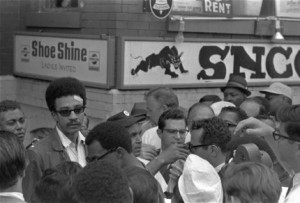

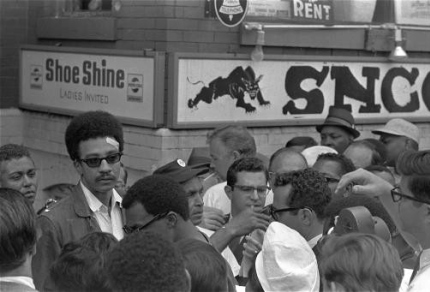
Campaign Demanding Proper Health Care For Incarcerated COINTELPRO Target Imam Jamil Al-Amin (H. Rap Brown)
A campaign was recently launched demanding immediate health care for political prisoner Imam Jamil Al-Amin, formerly known as H. Rap Brown. Once the chairperson of the Student Nonviolent Coordinating Committee and minister of justice for the Black Panther Party, Al-Amin was one of the original four targets of the FBI’s infamous COINTELPRO. Now 70 years old, he has been held in a federal prison at Florence, Colorado since 2006 where he is serving a life sentence for what many claim was the wrongful conviction in 2002 for shooting two deputy sheriffs. At the time, four leading Muslim organizations – CAIR, the AMC, ISNA and the Muslim American Society – issued a joint statement: “The charges against Imam Jamil are especially troubling because they are inconsistent with what is known of his moral character and past behavior as a Muslim.”
Al-Amin has multiple health issues have rapidly accelerated, including dental problems, a swollen jaw, broken teeth and swollen legs, ankles and feet, and has lost 30 pounds in just a few weeks, likely the result of recently-diagnosed cancer. Recently, former U.S. Attorney General Ramsey Clark visited Al-Amin.
Attorney Karima Al-Almin:
- I met Jamil on July 1st 1967. I had graduated from college and started a job on that day. He walked into the job where I was to see someone who he was staying with.
- At that time he was under house arrest and he could only stay in the borough of Manhattan, the Bronx and then William Kunstler’s house up there in Westchester county.
- He invited me to go to lunch. The lunch was with Louis Farrakhan. So I met him on the same day, we joke about that but I married Jamil.
- In May of 1967 he was elected chairperson of SNCC Student Nonviolent Coordinating Committee.
- Based on the fact that he didn’t appear for trial in Maryland for inciting to riot charge which was later dismissed, he was put on the 10 most wanted list in May 1970.
- For 19 months he was being sought and not found but then he was found and capture in October 1971. He was attempting to clean up New York City’s drug problem.
- There was an H. Rap Brown Anti-Dope Campaign. As a result he was captured in what was labeled as an “armed robbery.” He did go to trial and William Kunstler and Howard Moore defended him.
- He was given a sentence of 5-15 years. He served 5 years in the New York State prison system and then he got out in 1976.
- After getting out in October 1976 he can come to Atlanta where I had moved.
- He spent years, establishing a Muslim community again cleaning up the neighborhood making it safe for families and children.
- In May of 1999 he was stopped which ended up being an illegal stop outside of Atlanta city limits. He was charged with driving a stolen car which he did not know about.
- In January of 2000 he was given a date to appear in court on those charges there was a storm and it was postponed. He didn’t know he was supposed to return and a warrant was issued in March 2000. That’s when the incident happened.
- A Fulton County deputy was killed and one was shot and then we had the trial in 2002. There were so many problems with the trial. There were so many constitutional violations during the trial. As a result he was found guilty in March 2002 and given a life sentence without the possibility of parole.
- Georgia in 2003 tried to get him transferred and held in a federal facility, but it didn’t come to happen until July 2007. They were moving him based on his popularity.
- Georgia (the state of) is paying a per diem to the Federal Bureau of Prisons for him to be housed.
- It goes back to what he thought was a dental problem about a year and a half ago. He developed abscesses. He was unable to get out of bed.
- A petition has already been sent to President Obama, Eric Holder and Charles Samuels.
- Call ADMAX – 719-784-9464.
- Create an email and fax flood. Email FLM/execassistant@bop.gov or use the form at http://www.bop.gov/inmates/concerns.jsp (location Florence ADMAX USP). Fax 719-784-5290. Jamil Al-Amin, #99974555
- He dared to step out when he was 23 years old to speak out about injustices and make a difference.
Guest – Attorney Karima Al-Amin is an attorney at law and the wife of political prisoner Imam Jamil Abdullah Al-Amin. In addition to her private practice, Mrs. Al-Amin continues to work with attorneys in appealing her husband’s conviction and in working on his civil lawsuits challenging First Amendment and religious violations. Mrs. Al-Amin is a member of several legal and community organizations, including the American Immigration Lawyers Association (AILA), the Clarkston Business Association, and the Georgia Association of Muslim Lawyers (GAML).
——
US Attorney General Ramsey Clark:
- I met first through FBI memos, a stack that reached floor to ceiling. He had a wonderful talent to irritate the FBI.
- The country needs that sort of skill. So I got a lot of memos before I even met him.
- He committed the supreme offense in the hierarchy of offenses of the FBI that is he embarrassed the bureau by making them look foolish cause they couldn’t catch him.
- The legal staff were cheering him on. He made our day with narrow escapes. After this Congress enacted this absurd statute in his honor that shows he was a productive citizen concerned for our welfare.
- He’s big strong tall guy and he has to duck under that door on the other side of that glass that you meet him through, he looked smaller.
- Usually his energy level is very high. His energy level is way down, he looked frail in spite of his large frame.
- Went back Sunday and his condition was the same, confirmed. He’s got a real health problem that needs to be addressed.
- I think ideally he’d go to the Mayo Clinic first, get the thorough work up and diagnosis and everything. If its going to be long range treatment get him over to North Carolina.
- The main thing is he needs the help of caring people from all over the country. We have to organize that to pressure the United States to do the only moral thing.
Guest – Ramsey Clark, former Attorney General of the United States, under President Lyndon B. Johnson. The first Attorney General at the Justice Department to call for the elimination of the death penalty and all electronic surveillance. After he left the Johnson administration, he became a vociferous critic of the Vietnam War and continued on a radical path, defending the underdog, defending the rights of people worldwide, from Palestinians to Iraqis, to anyone who found themselves at the repressive end of government action.
——-
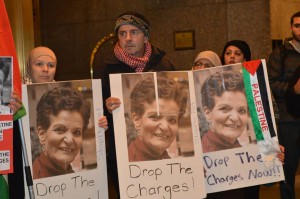
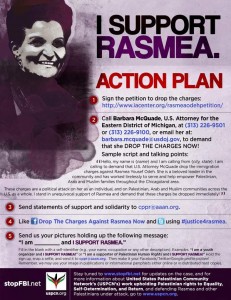
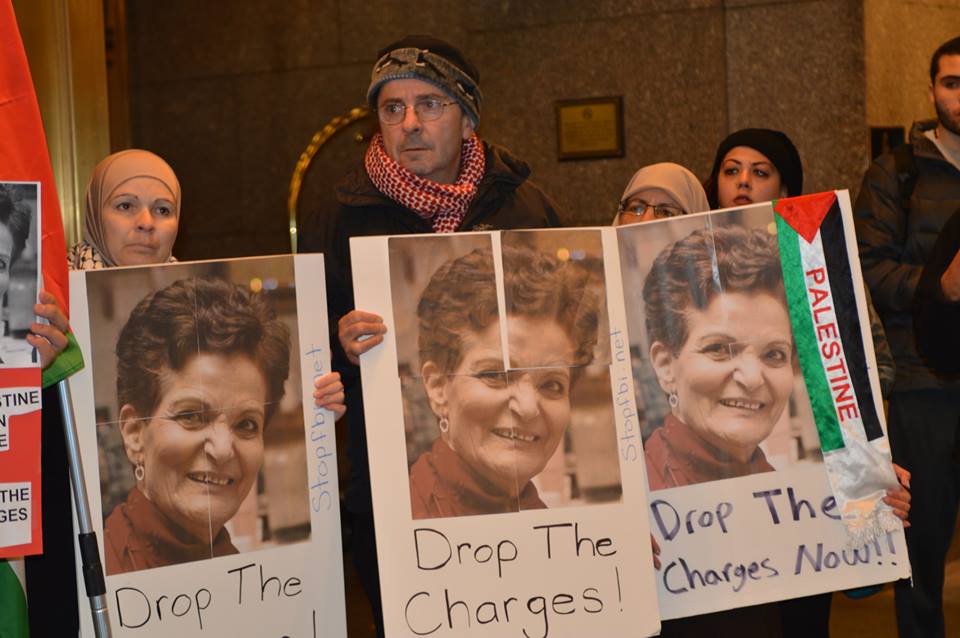
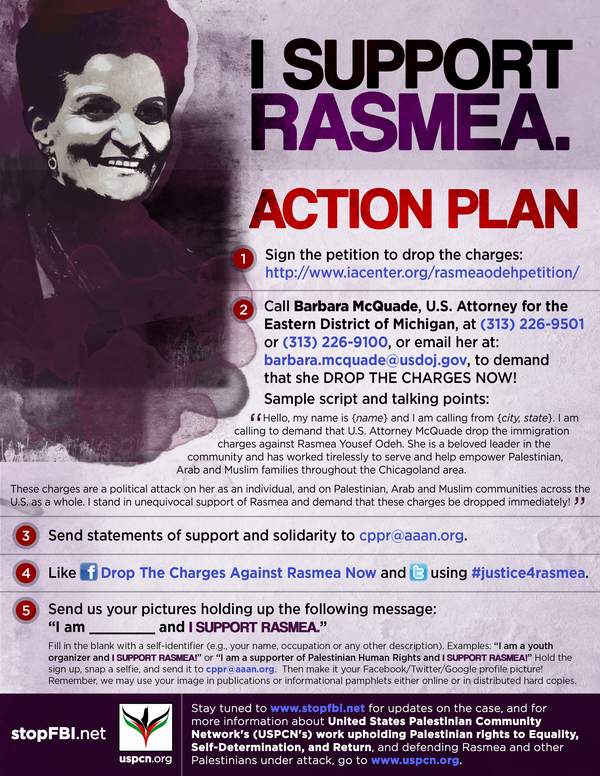
U.S. Government To Prosecute 67-year-old Palestinian-American Rasmea Odeh
In the fall of 2013, the Department of Homeland Security arrested Rasmea Odeh, a 67 year old Palestinian American community activitist and teacher in her Chicago home for failing to disclose a 1969 conviction in an Israeli military court. She was charged with unlawful procurement of naturalization. Odeh had allegedly failed to disclose her time in an Israeli prison 45 years ago. In 1969 Rasmea Odeh, her father and fiancee were brutally tortured in an Israel relating to a bombing at a Jerusalem supermarket. Israel extracted a confession from Odeh, and she spent 10 years in an Israeli prison where she was tortured and sexually assaulted.
Odeh is Associate Director of the Arab American Action Network and leader of that group’s Arab Women’s Committee. The events bring together disenfranchised women, mostly recent immigrants, from Arabic-speaking countries. Odeh is scheduled for trial at a Detroit Federal court in September. If convicted she could be imprisoned, have her citizenship revoked and be deported. Human rights campaigners in the United States are calling on the Obama administration to drop charges against Rasmea Odeh, a Palestinian-American community organizer in Chicago who is accused of lying on a citizenship application two decades ago.
Attorney Michael Deutsch:
- She was arrested Israel military and secret police in February of 1969. Her family, her father and two sisters were also arrested, taken out of the house in the middle of the night.
- She was then transported by herself to a prison in Ramallah. On the way she was brutally beaten, when she arrived at the prison she was beaten again to the point where her whole body turned black.
- She was then transferred to another prison which is called the Russian compound which is in the West Jerusalem.
- There she was horrifically beaten subject to electronic torture, alligator clips to her breasts and genitals.
- Prisoners and soldiers came into her room, she was raped repeatedly. She was raped with sticks. She was denied food, denied sleep, this went on for 45 days until she gave in and confessed.
- Her father was brought in a room with her and they said her father was going to rape her. Her father of course refused and they beat her father to the point of unconsciousness and they dragged him out.
- She was accused of being involved in two bombings one at a British counsel and one at an Israeli grocery store.
- When she was brought into an alleged court, which was a military court run by soldiers, she renounced her confession and said that she was innocent. That was ignored and she was convicted of these bombings and being a member of an illegal organization and given a life sentence.
- Ultimately in 1979, she was traded with 70 other Palestinian prisoners for the return of an Israeli soldier where she was taken to Syria, then Lebanon then to Jordan where she lived til 1994. She obtained a VISA to come to the United States.
- Basically for almost the following ten years she’s been working as a community activist in Chicago particularly with the Arab-American Action Network.
- In 2010 there were all these raids by the FBI toward anti-war activists and the executive director of the AAAN. He was subpoenaed to a grand jury after the FBI raided his home and took all his papers.
- They claim that he was providing material support for the PFLP and as a result the whole AAAN was put under investigation and the grand jury subpoenaed all the documents of the organization.
- As a result of this investigation into the AAAN, the US attorney in Chicago sent word to Washington that they wanted to get Rasmea’s files from Israel.
- In a year or two years they got the records or alleged to be her records of arrest, conviction and sentence by the Israeli military court.
- I don’t believe a conviction or arrest by the IDF and a conviction by an Israeli military tribunal is consistent with International Law, fundamental fairness or due process.
- One of the things were going to say is that the conviction and arrest can’t be given any kind of credit in a U.S. courtroom because its fundamentally unfair and shouldn’t be considered.
- The question is whether she answered those questions with an intent to falsely procure her naturalization.
- I would add the judge in this case has been a fervent supporter of Israel since the 50s.
- The Israeli tribunals are not only based on torture but illegal occupation. They invade a people’s land and set up these military courts.
- The question in my mind in Rasmea’s trial is how are they going to keep out the issue of torture? Which is want they’re going to want to do.
- To support Rasmea Odeh, contact the Arab-American Action Network
- CCR Statement
Guest – Attorney Michael Deutsch, after clerking for United States Court of Appeals Judge Otto Kerner, Mr. Deutsch went into private practice, joining People’s Law Office in 1970 where he has represented political activists and victims of police and government civil rights violations. His advocacy has taken him all around the world, including to hearings in the United Nations. He has tried many civil and criminal cases in federal and state courts, and has written and argued numerous appeals, including several in the United States Supreme Court.
——————————————————
Please help support Law and Disorder, the show is now a sponsored project of Fractured Atlas, a non-profit arts service organization. Contributions for the charitable purposes of Law and Disorder must be made payable to Fractured Atlas only and are tax-deductible to the extent permitted by law.
CIA Sponsored Terror, Civil Liberties, Criminalizing Dissent, Gaza, Guantanamo, Human Rights, Military Tribunal, Prison Industry, Surveillance, Targeting Muslims, Torture
Podcast: Play in new window | Download
Updates
——
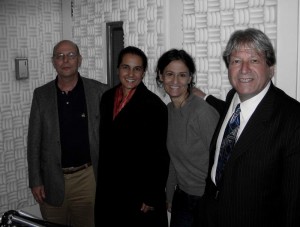
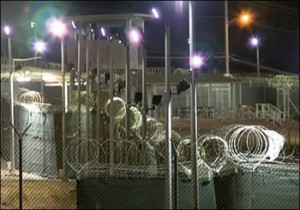
Michael Ratner Marks CCR Case Rasul v Bush: Courage To Stand Up At The Right Time
In early 2002, the Center for Constitutional Rights filed two habeas petitions, Rasul v. Bush and Habib v. Bush. This challenged the U.S. government’s practice of holding foreign nationals captured in connection with its war on Afghanistan and al-Qaeda in indefinite detention. This is without counsel and without the right to a trial or to know the charges against them. Michael Ratner then explains the timeline of how the Supreme Court, over the administration’s objections, agreed in November 2003 to hear the cases of the Guantanamo detainees, and also the case of al Odah v. Bush. This week’s anniversary marks the historic ruling on June 28th, 2004 that detainees have access to U.S. Courts to challenge their detention.
Attorney Michael Ratner:
- We won that in June 28, 2004. We won it in a 6-3 decision. The Center for Constitutional Rights was the only human rights organization on the case. The only one willing to take that case.
- Many of my colleagues, not me, thought that would be the end of Guantanamo (Bay Prison)
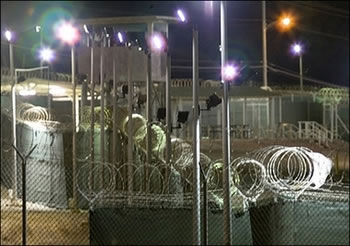
- There are still 149 people left in Guantanamo, over half of them have been cleared for release. The reason I want to mark this is because it talks about a struggle that in some ways was successful and in some ways not successful.
- It also talks about the courage of these lawyers that started these cases in the thick of the most anger in the country and . . . fears that we would lose our fund raising.
- We thought at that time, as I said some of our friends, said that we would close Guantanamo. But since that time there’s been incredible stubborn resistance by all 3 branches of government.
- Bush first, then Obama, despite promises has failed to live up to them, promises to close Guantanamo. The courts are therefore useless now in this.
- Congress is going retrograde at a speed unimaginable, trying to ban every transfer for the rest of our days from Guantanamo.
- Within 2 months of the 911 attacks, President Bush issued Military Order Number 1. It’s November 13, 2001 Military Order, I thought a coup de tat happened in the country. It said the president had the authority to pick anyone, anywhere in the world. Hold them indefinitely, incommunicado and abolish habeas corpus.
- We tried to get other human rights organizations to do it. No one else to their shame would come aboard with the Center for Constitutional Rights.
- The Center for Constitutional Rights could’ve gone under for this. Let me be clear. It was a much smaller institution. It didn’t have that much funding. There was a high risk that we were going to get cut off completely.
- January 11, 2002, they take the people, the first plane load to Guantanamo.
- We never expected the Supreme Court to take the case in 2003. When it finally did, it accepted the case. It was argued in April 2004. It was decided in our favor on June 28.
- We then put out a call for other lawyers to join us. Over a hundred lawyers joined us immediately. 600 within a year or two. We then created what I call a mass movement of lawyers to fight this.
- As a result of the 2004 ruling, our first attorney went down (to Guantanamo) Gita Gutierrez. The big thing that Gita’s visit represented is that we found out about torture at Guantanamo.
- You begin to understand when a government does incommunicado detention in an offshore facility that doesn’t have any court review, there’s a reason, and the reason is almost entirely torture.
- There’s been no prosecution. Obama has given them all a huge pass unfortunately. It’s really damaging because what it has done for torture is its saying, torture isn’t necessarily illegal, Obama claims it’s illegal but he didn’t prosecute anybody.
- So, next time we have another “scare” like this people will say it’s a political issue, we can torture, it works, etc.
Guest – Law and Disorder Co-host Attorney Michael Ratner, President Emeritus of the Center for Constitutional Rights (CCR), a non-profit human rights litigation organization based in New York City and president of the European Center for Constitutional and Human Rights (ECCHR) based in Berlin. Ratner and CCR are currently the attorneys in the United States for publishers Julian Assange and Wikileaks. He was co-counsel in representing the Guantanamo Bay detainees in the United States Supreme Court, where, in June 2004, the court decided his clients have the right to test the legality of their detentions in court. Ratner is also a past president of the National Lawyers Guild and the author of numerous books and articles, including the books Who Killed Che? How the CIA Got Away With Murder, The Trial of Donald Rumsfeld: A Prosecution by Book, Against War with Iraq and Guantanamo: What the World Should Know, as well as a textbook on international human rights.
——-
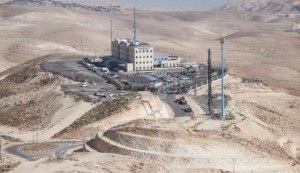

Israel Increases Rate of Palestinian Home and Structure Demolition
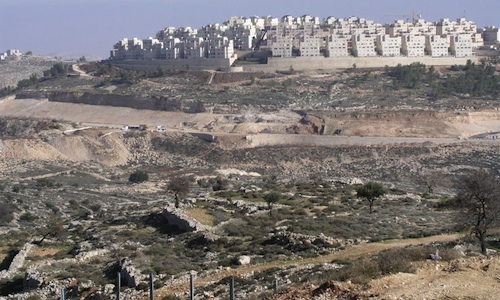
In the past few months, the Israeli government has stepped up its campaign of Palestinian home demolitions, specifically in the E1 area between Jerusalem and the Maale Adumim settlement. United Nations reports show 231 Palestinians had been displaced from their homes in early 2014. This is at a much quicker pace than 2013. Remember the demolishing of homes include livestock pens, fences, water reservoirs, schools, all vital to the livelihood and communal life of Palestinians. The Israeli Committee Against House Demolitions estimates since 1967, nearly 29 thousand Palestinian homes and livelihood structures were demolished in the Occupied Territories. However, at the same time the Israeli government has announced the construction of thousands of homes and buildings in the settlements of the West Bank and East Jerusalem.
Dr. Jeff Halper:
- This is an area called E1, that’s the planner’s jargon.
- The significance of E1 is that it closes the last north south corridor the Palestinians have from the north of west bank to the south since they can’t come through Jerusalem.
- Even the United States say if Israel build in E1 and closes that corridor that’s the end of the two state solution.
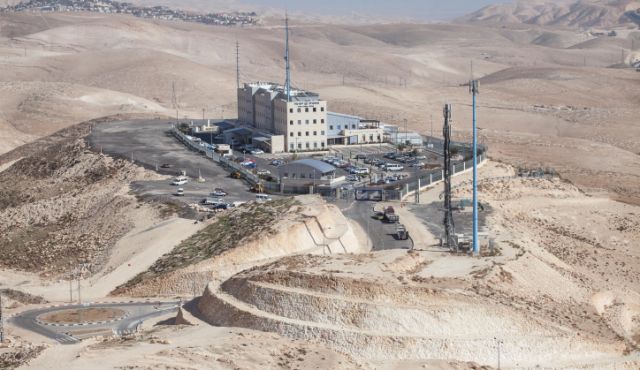
- This guy Irwin Moskowitz who is a big casino out in California gives millions to the settlements. He bought for the Israeli government a 10 million dollar state of the art police station. It’s the main police headquarters for all the West Bank that is in the E1.
- There’s a whole infrastructure of roads leading to Jerusalem, but Israel has still refrained from actually building. The plan is to build 3,500 housing units that absolutely, thickly closes that corridor to Palestinians.
- The 2 state solution is gone but this (building of E1 area) would be an absolute measure of the ending of the 2 state solution.
- We’re trying to mobilize international civil society against the occupation. The occupation is not going to end because the Israeli public rise up and end it.
- They’re living the good life, they’re profiting from the occupation especially from the point of view of testing and developing and selling weapons systems tested on Palestinians.
- And the governments of the world aren’t doing their job. Governments manage conflicts, they don’t resolve conflicts.
- So I’m here in the United States to try to speak to activist groups, church groups because the churches here have a very strong moral voice.
- We’re dependent on the Palestinians for leadership on where to go next. Not being Palestinians, we can’t tell them what the solution is.
- I think its urgent we formulate a one state solution. A one democratic bi-national state.
- I think there has to be a bi-national component in which both peoples have a sense of self expression and limited self determination within the common country.
- You have to create structures of sharing power.
- I think the Palestinians would have the ability to achieve a fair amount of parity with Israel within a short amount of time if we create this consociational type of state.
- Israel is beginning to be more and more of an albatross around the American’s neck.
- Operation My Brother’s Keeper had nothing to do with these kids who disappeared. It was a stand alone operation that used the disappearance as a trigger for being launched. The whole idea was to crack down on Hamas, to weaken the PA to keep it dependent on Israel.
- I think what’s happening is we’re in the midst of collapse.
- Jeff@ICAHD.org
Guest – Dr. Jeff Halper, co-founder and Director of ICAHD, the Israeli Committee Against House Demolitions. He was born in 1946 in Minnesota and emigrated to Israel in 1973. Since then he has been a tireless advocate for justice and civil rights for all Israelis and Palestinians. He spent ten years as a community worker in Jerusalem aiding low-income Mizrahi families. He co-founded ICAHD in 1997 to help resist Israel’s strategy of house demolitions in the Occupied Palestinian Territory. He is the author of three books, ‘Between Redemption and Revival: The Jewish Yishuv in Jerusalem in the Nineteenth Century’, ‘An Israeli in Palestine: Resisting Possession, Redeeming Israel’, and ‘Obstacles to Peace: A reframing of the Palestinian – Israeli Conflict’. In 2006 Dr. Halper was nominated for the Nobel Peace Prize, citing ICAHD’s work “to liberate both the Palestinian and the Israeli people from the yoke of structural violence” and “to build equality between their people by recognizing and celebrating their common humanity.”
—————————————————————————-
Please help support Law and Disorder, the show is now a sponsored project of Fractured Atlas, a non-profit arts service organization. Contributions for the charitable purposes of Law and Disorder must be made payable to Fractured Atlas only and are tax-deductible to the extent permitted by law.