CIA Sponsored Terror, Civil Liberties, Criminalizing Dissent, FBI Intrusion, Habeas Corpus, Human Rights, Supreme Court, Surveillance, Truth to Power, War Resister
Podcast: Play in new window | Download
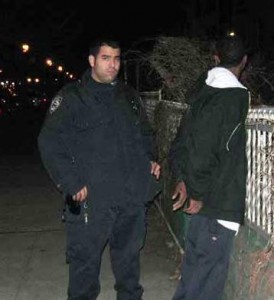
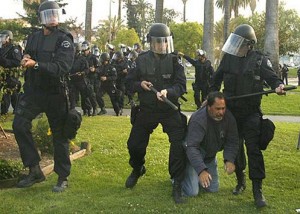
NYPD Chief Bill Bratton – Broken Windows – Stop and Frisk
New York City Mayor-elect Bill de Blasio announced Mr. Bratton’s appointment as the new commissioner of the New York Police Department this month. He lauded Mr. Bratton’s work in Los Angeles, saying he could police fairly while still bringing down crime. After a 7 years leading the Los Angeles Police Department there’s been an increase in police presence among the homeless in and around Skid Row, plus excessive stops of pedestrians especially in poorer communities.
Attorney Carol Sobel:
- Broken Windows is a program that Bratton began in New York with a sociologist that he worked with.
- It’s basically the theory that if you stop the petty issues, you prevent greater crime.
- I use that example because in Los Angeles that’s exactly what they started doing – arresting people on Skid Row for littering, and littering could be the ashes that fell off their cigarette.
- It didn’t reduce crime, it created a statistical reduction.
- Bratton used to do a radio show Ask The Chief on one of the radio stations (In Los Angeles)
- I sued him early and often on Skid Row in particular.
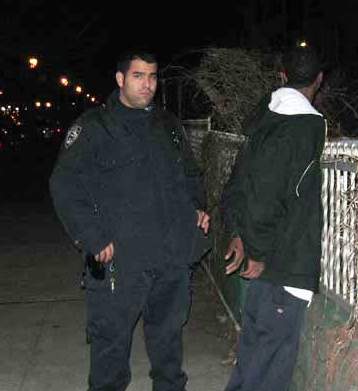
- They would stop every black man on the street, or someone they thought was homeless, cuff them, twist them. If they didn’t have a good ID they’d take em to the station.
- I do think that Bratton was good for the department at that time, and that he changed, from the time that he came til he left.
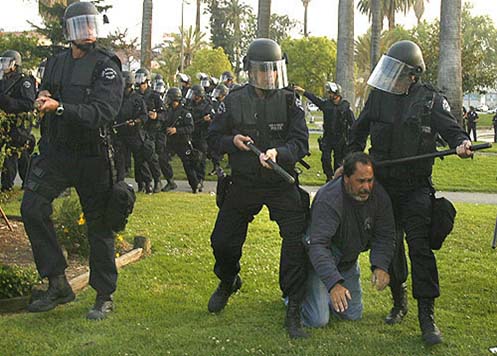
- We had one of the biggest police assaults on a peaceful crowd on May 1, 2006.
- The one thing I think is fair to say about Bratton is that he will take direction which is one thing he didn’t do before.
Guest – Attorney Carol Sobel, is a solo practitioner in Santa Monica, California. Prior to going into private practice, she spent 20 years working in various positions for the ACLU, including as Senior Staff Attorney for the last seven years she was at the ACLU. She has been involved in numerous significant cases in federal and state courts. Carol serves as local counsel for the Center for Constitutional Rights in Humanitarian Law Project v. Ashcroft and served on the Rampart Blue Ribbon Panel. Since 2002, she was named as one of Los Angeles’ Super Lawyers for Civil Rights. Attorney Carol Sobel is a graduate of the Peoples College of Law.
——
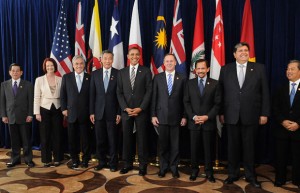
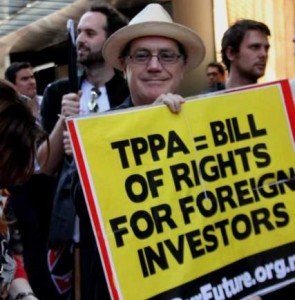
Wikileaks Reveals Quiet Plans and Secret Meetings Behind Trans-Pacific Partnership
Have you heard about the Trans Pacific Partnership? We mentioned it in an update a couple weeks ago. It’s described as an agreement to enhance trade and investments, promote innovation and economic growth among 12 trans-Pacific countries. Those countries include the US, Canada, Japan, Mexico, New Zealand, Australia, Brunei, Chile, Malaysia, Peru, Singapore and Vietnam. As negotiations and talks continue among the countries, much of it is done in secret including an international trade treaty that could have far reaching effects on internet services, copyright law and civil-liberties.
George Kohl:
- It masquerades as a trade deal but its really an economic integration agreement which represents 40 percent of the world’s economy and its a series of countries that circle the Pacific Ocean.
- Its secret negotiations. Unlike most negotiations where you would know what the objectives are of this trade deal. What are the objectives our country is seeking? None of that’s available.
- Congress can’t see what the text is and yet there are 600 corporate lobbyists who get to weigh in and make suggestions.
- It’s a major economic agreement that governs investment. It governs the rights of companies to sue corporations. It governs environmental regulations in our country.
- It governs health and safety regulations here. It will impact food labeling for example.
- We (CWA) were pushing a bill that said if you talk to a call center, you should know where that person works. You should be able to talk to somebody in the United States and that your information should be protected.
- A bill like that could be viewed as interfering with trade and the TPP and the trades that get negotiated would supplant the ability to implement language like that.
- They (TPP) sets up situations that already exist in which companies can sue a country for having environmental protections. Right now there are 14 billion dollars worth of suits where companies are saying my right to gain profit was obstructed by these environmental or other kind of regulations.
- Why is it and who set it up where we open up a trade agreement to Vietnam which pays 20 cents an hour as a minimum wage, which only drive down our wages.
- The objectives that we have in a trade agreement is how do we promote collective bargaining? How do we create growth that benefits working people and that’s not in this picture.
- We’ve got a government that is supposed to be acting of and by the people and instead our government is acting of and by international corporate interests.
- All of this is about creating a structure that lets companies maximize profit but really doesn’t deal with people in their daily lives.
- Where we are at right at this moment is telling Congress that NAFTA didn’t work. There was a promise of 200 thousand jobs, we lost 700 thousand jobs.
- Recently we had a Korea trade deal and promised 70 thousand jobs but we lost 40 thousand jobs.
- People need to reach out to their Congress person now and say be against the Trans-Pacific Partnership.
- You have to ask why is our government acting on behalf of this company (corporations) why isn’t it acting on our behalf?
Guest – George Kohl, Senior Director at the Communications Workers of America.
——
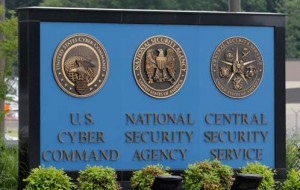
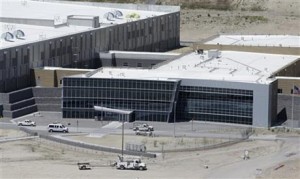
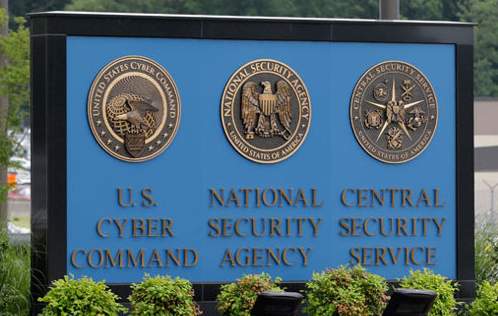
Reform Measures For MetaData Collection, the NSA and EPIC
We take a wide look on recent stories about data mining and privacy, data aggregate corporations, the legal fights to protect personal information and the NSA. Recently a Congressional inquiry revealed how local law enforcement made nearly 10 thousand requests last year for what are called “tower dumps.”
Attorney Alan Butler:
- I think that the core issues that were identified in the letter from the six companies are important issues. Especially the issue of ending bulk surveillance, of increasing transparency of the intelligence process and of improving oversight.
- There are reforms in a number of different areas. We’ve been pushing for transparency of NSA intelligence gathering in the context of criminal investigations for example.
- We’ve been pushing on the intelligence and judiciary committees of Congress and the government to provide public accountability for these programs so people can understand how they function.
- The bulk collection of meta data. . . that program needs to end.
- There’s a bill in Congress right now proposed by Senator Leahy and Rep Sensenbrenner that would end the bulk collection of telephone records if passed today.
- There’s a competing bill introduced by Senator Feinstein and other intelligence committee heads that would enshrine the current bulk collection of telephone records in law.
- Its great to have these companies on board for these reforms but at the same time we’ve been pushing for a number of years for these companies to do more themselves to protect their users.
- Housing this data alone, creates the opportunity for government surveillance in the first place.
- The answer has to be transparency and public oversight of the programs.
- The transparency reports that Google and Apple have published have been impressive documents. They’re putting forward the type of data that they collect on users and the type of data that’s turned over to law enforcement.
- Location data is uniquely sensitive in terms of telephone records because it reveals where a person is, where they go, their associations, their behaviors and can also reveal whether they’re in a private place like a home.
- EPIC is a public advocacy organization and we really seek to inform the public about current and important privacy issues.
- One area of our work is the open government field. We file FOIA requests seeking records on government programs, typically federal agencies. We’re looking at what DHS is doing, what the FBI is doing.
- I worked on a case where we were able to get thousands of records from the FBI on cell phone surveillance technology they use called the Stingray.
- It’s a technology that can be used to intercept cell phones or content.
- I believe that we can build a system where we have oversight mechanisms in place that we can all trust.
- Our organization was founded on strong encryption technology in 1990s where the NSA at the time was trying to establish the “Clipper Chip.”
Guest – Attorney Alan Butler, is the EPIC Appellate Advocacy Counsel. He manages the Appellate Docket at EPIC, including the Amicus Program, and authors briefs in significant privacy, civil liberties, and national security law cases. Recent cases include In re EPIC, United States v. Jones, Clapper v. Amnesty International USA, and Maryland v. King. Mr. Butler focuses on a range of privacy law subjects including the Foreign Intelligence Surveillance Act (FISA), the Electronic Communications Privacy Act (ECPA), location privacy, and other digital Fourth Amendment issues.
————————————————————-
Afghanistan War, CIA Sponsored Terror, Civil Liberties, Criminalizing Dissent, Habeas Corpus, Human Rights, Political Prisoner, Prison Industry, Supreme Court, Surveillance, Truth to Power, War Resister
Podcast: Play in new window | Download
Updates:
- Jeremy Hammond Sentenced to 10 Years With 3 Additional Years of Supervised Probation
- Jeremy Hammond and Barrett Brown Were Outspoken In Exposing Corporate Collusion With The Government In Conducting Intelligence
- Sarah Kunstler Argument On Behalf Of Jeremy Hammond
—-
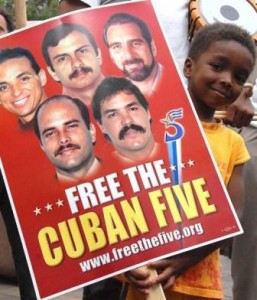
The Cuban Five Case Update: Attorney Martin Garbus
We’re joined today by prominent First Amendment attorney Martin Garbus to get an update on the Cuban Five case. Martin joined the case of the Cuban Five last year and had concentrated his efforts to expose how U.S. government paid journalists in Miami received hundreds of thousands of dollars from the office of Cuba broadcasting to slant the story against the Cuban Five. There’s a lot going on with the case lately such as a habeas corpus appeal, and a NSA / FISA related motion.
Attorney Martin Garbus:
- In 1996, 4 planes from Cuba shot down Brothers to the Rescue planes that’s a right wing group that operates in Miami and has over the years made intrusions to Cuban air space.
- After years of negotiations with the Cuban government and the American government where the American government said they would everything they could to stop these flights.
- Washington intended to do that but by the time it got down to Miami, the orders were ignored.
- So these planes went up in Feb 1996 and were shot down over Cuban air space.
- At the trial the jury concluded that the planes were shot down over international waters. They also concluded that the defendants in this case played some kind of role in the shoot down.
- Both administrations at the time (Bush / Clinton) wanted to be very hard on left wing Cubans or Cuba itself by pressing this prosecution.
- Although the shoot down was 1996, and the government had all the information it needed, it didn’t arrest these defendants until 2 and half years later.
- There was a conviction, at first the appellate court set aside the conviction. Lenny Weinglass argued that brilliantly in that a motion for change of venue should’ve been granted.
- Ultimately, that’s rejected, the Supreme Court denies cert, I get involved in the habaes corpus petition and that’s what we’re talking about now.
- We’re about to file other papers about NSA surveillance which has been revealed recently arising out of Snowden’s revelations.
- What I’m now telling you has not yet appeared anywhere else.
- The defense lawyers in the case, as they prepared the case itself, from the time they were appointed in 1998, to the time of the conviction, and now, Lenny Weinglass leading the defense, – these lawyers traveled back and forth to Cuba.
- We now understand and this applies to you, this applies to anyone who goes to Cuba.
- Anytime you go to Cuba, you’re picked up by NSA surveillance.
- The NSA listening post, the prime one was in Puerto Rico and it was made up largely of US Navy personnel, assigned to the Naval Security Group which is an NSA component.
- When I got back to the United States (from Cuba) they would continue to monitor me. If I were a defense lawyer, my communications with my client would gathered and sent to the FBI and Department of Justice.
- That’s the motion we’re about to file in the next 2 weeks.
- The Solicitor General, on October about 6 weeks ago, admitted there had been surveillance of cases where there had been convictions.
- Our case presents unique problems, Cuba at that time was designated a terrorist state.
- I’ve got the details in the way information was intercepted.
- A large part of the NSA budget last year I think was 52 billion dollars. 25 percent of it is for the CIA.
- What the CIA was doing under the umbrella of the NSA was exactly what the Church Committee said they couldn’t do.
- Journalists that worked for the Miami Herald or CBS, or local Spanish stations . . on the government payroll.
- The stations or newspapers that hired these journalists, didn’t know that they were also getting monies from the government. In 2006, the Miami Herald found out about it.
- One journalist got 286 thousand dollars.
- If you look at the Radio Marti stories, and you look at the Miami Herald stories, you have the same sentences, same paragraphs and its clear its coming out of a central cookie cutter.
- The Radio Marti budget was 15 million dollars a year.
Guest – Attorney Martin Garbus, one of the country’s leading trial lawyers. He has appeared before the United States Supreme Court and the highest state and federal courts in the nation. Time Magazine has named him “legendary . . . one of the best trial lawyers in the country.” He’s also known as the most prominent First Amendment lawyer.
—-

Global NATO and the Catastrophic Failure in Libya: Lessons for Africa in the Forging of African Unity
The course of events that led to NATO’s intervention in Libya is outlined in our guests Horace Campbell’s recently published book Global NATO and the Catastrophic Failure in Libya: Lessons for Africa in the Forging of African Unity. He traces the origin of the Libya conflict in the context of the Arab Spring uprisings and argues how NATO is used by the North American and European capitalist class to impose its political will on the rest of the world. It’s a new model, he explains, of bombing campaigns, militias, terrorist campaigns and private contractors. This NATO campaign caused many civilian deaths and destroyed Libya’s infrastructure. We talk about the broader attacks on the African continent and the investigations into the US embassy killings.
Professor Horace Campbell:
- The revolutionary upheavals that took place in Tunisia and Egypt have had great implication for all societies in this region.
- Libya which has been underdeveloped politically was a place where the western powers manipulated which was supposed to be an insipient uprising in Benghazi, militarized it and turned it into a base for the destabilization for all of North Africa.
- Today as we speak they continue to manipulate what is going on in the Libyan society.
- The book is called Global NATO because the governments of the North Atlantic region, namely the United States and its western European allies to internationalize the basis for military intervention by this NATO.
- NATO was created by this cold war instrument with a mandate to defend western Europe.
- NATO is in alliance with the most conservative countries in the Middle East called the Gulf Cooperation Council.
- We’ve had an attempt by the Wall Street elements to use NATO as an instrument for the United States military management of the international system.
- Why was NATO intervening? To control the resources of Libya, to destabilize North Africa, to stop the African Union project and to create confusion by supporting the same al-Qaeda elements that they’re supposed to be fighting in the “war on terror.”
- These are the reasons why the Left and the peace movement should have opposed the NATO intervention.
- Just like in Syria and Iran, there’s confusion among the Left and progressive forces about what’s going on.
- We need a resolution with responsibility to protect inside of Libya. To protect from the forces of NATO and to protect the Libyan people from the militias that have been unleashed by al-Qaeda, supported by the CIA and NATO.
- President Obama exercised intense pressure on the South African presidents and other presidents. I think he telephoned directly for them to vote for this resolution.
- The matter of Libya is not over.
- The same NATO that created the problem in Libya, the same United States, France and Britain is now seeking the support of Congress to go into Libya, into the same place that they created the problem.
- The U.S. designs on the continent of Africa is quite confused at the moment. It’s confused because of the assertiveness of the African Union and the African people.
- It turns out as we’ve seen in Libya, that it is the United States and the western forces that are supporting jihadists who are called terrorists. We’ve seen in a place like Somalia where the African people themselves through the African Union have been able to bring some stability to Somalia.
- There’s no military body that monitors the work of private military contractors.
- Now the peace movement should be calling for a reduction in the military budget.
- In the case of Libya, General Petraeus was using Benghazi as a base to recruit conservative Islamic fundamentalists from Libya to go to Syria to fight.
- Here’s a web of conspiracy of military, of Israel, Saudi Arabia and the CIA fomenting instability all across North Africa and the Middle East.
- There was no consulate in Benghazi, this was a CIA facility that was being used to support al-Qaeda elements.
- We have a situation in Libya where the country is in complete disarray. There’s no law, there’s no order. The people of Tripoli demonstrated two weeks ago against these militias and 40 people were killed.
Guest – Professor Horace Campbell is Professor of African American Studies and Political Science at Syracuse University. His recent book is Global NATO and the Catastrophic Failure in Libya. He is author of: Rasta and Resistance From Marcus Garvey to Walter Rodney; Reclaiming Zimbabwe: The Exhaustion of the Patriarchal Model of Liberation; Pan Africanism, Pan Africanists and African Liberation in the 21st Century; and Barack Obama and 21st Century Politics.
——————————————————————
CIA Sponsored Terror, Civil Liberties, Criminalizing Dissent, FBI Intrusion, Habeas Corpus, Human Rights, Political Prisoner, Surveillance, Truth to Power, War Resister
Podcast: Play in new window | Download
Updates:
- Socialist Wins Seat on Seattle City Council
—–
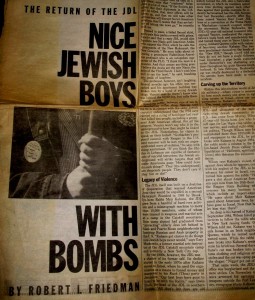
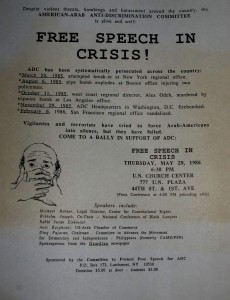
Alex Odeh Case – Abdeen Jabara
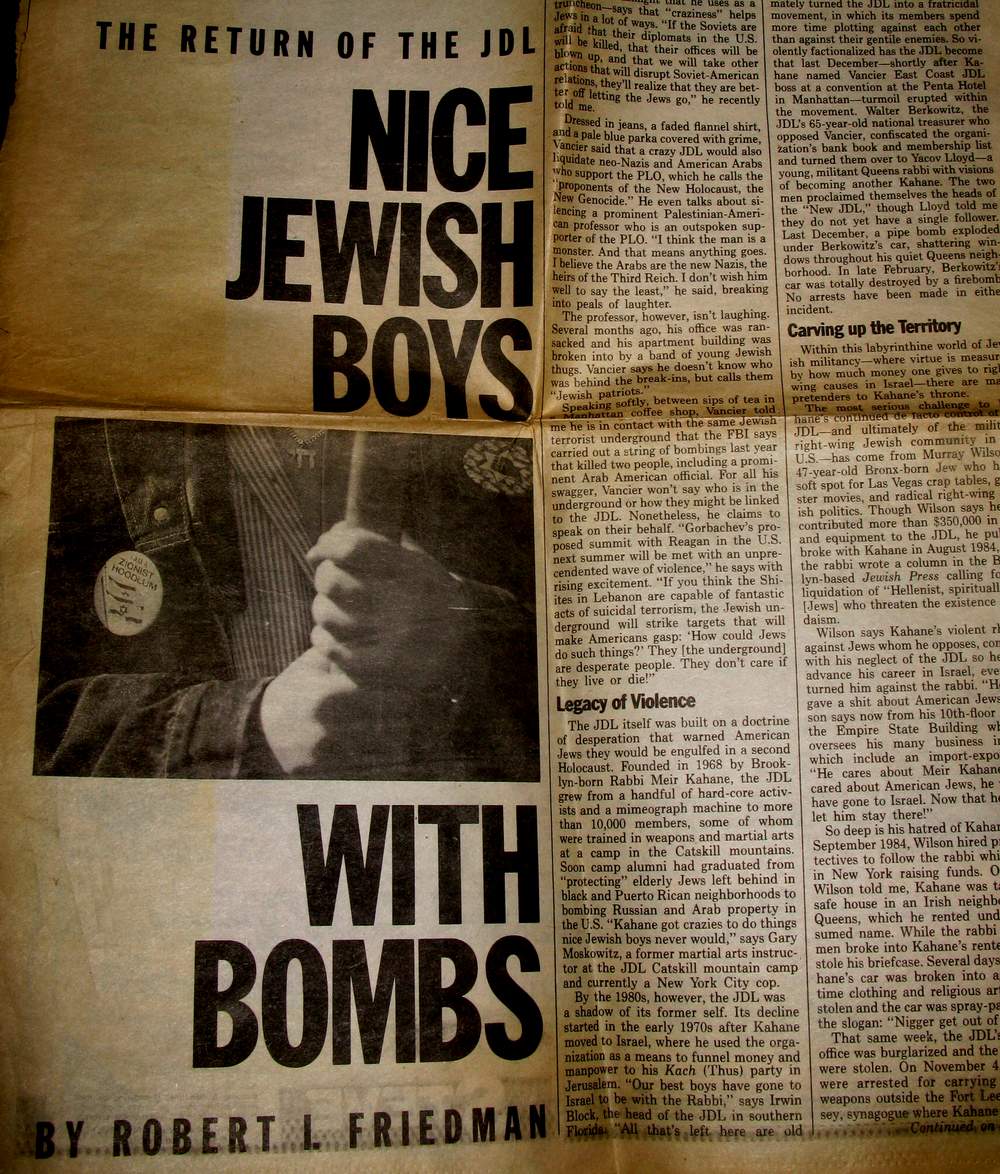
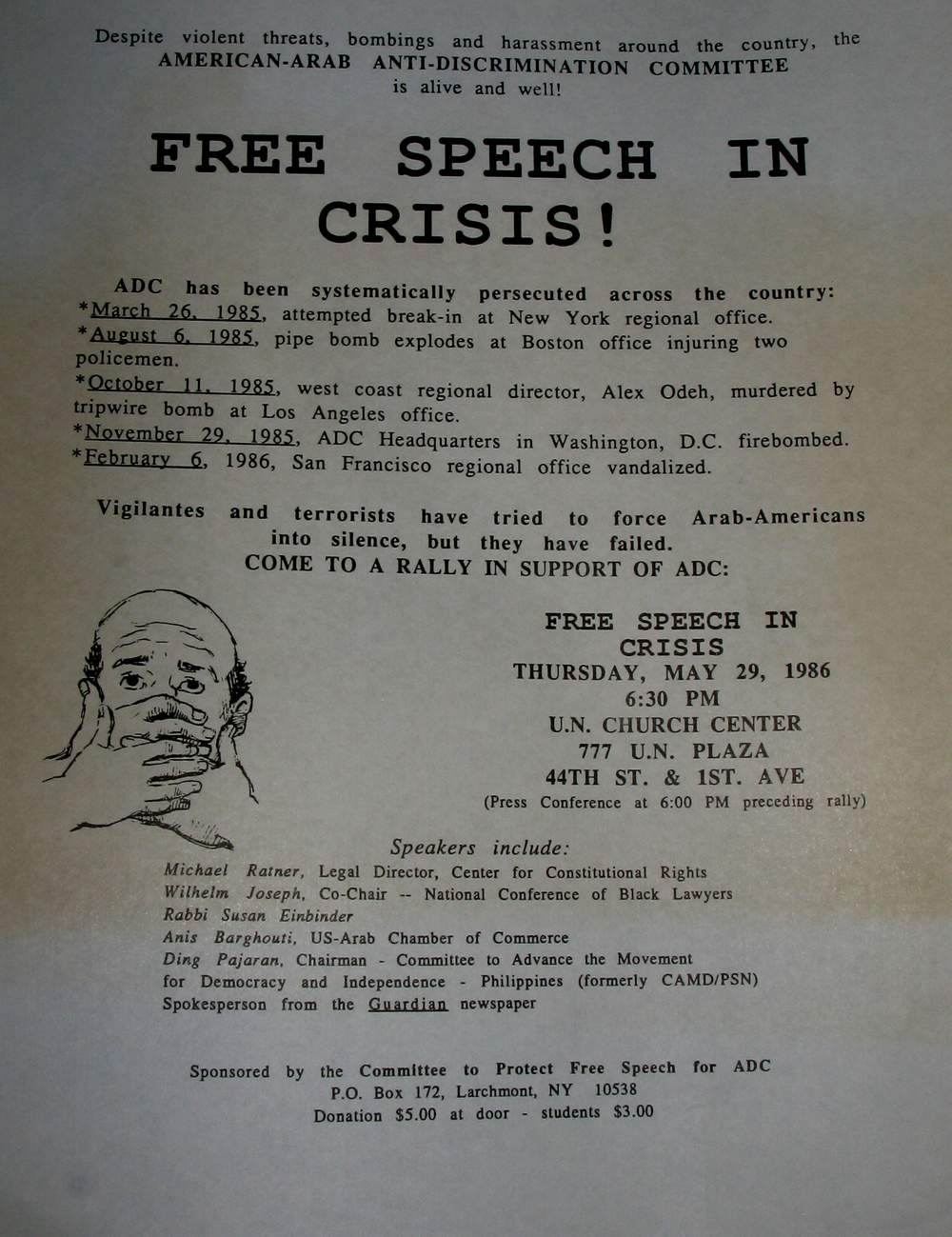
On October 11, 1985, prominent Palestinian-American leader Alex Odeh was killed by a pipe bomb at the offices of the American-Arab Anti-Discrimination Committee, where he worked as the group’s western regional director in Santa Ana, California. Now, the FBI and Justice Department are being urged to renew its investigation into this shocking political murder. history.
Very quickly, the FBI named the militant Jewish Defense League, or JDL, as a focus of its investigations. Yet, more than two decades later, no one has been questioned or indicted for Odeh’s murder. Today we welcome back civil rights attorney Abdeen Jabara who helped found the American-Arab Anti-Discrimination Committee. He joins us to talk more about the reopening of this political murder investigation 28 years later.
Attorney Abdeen Jabara:
- The FBI says the case has not been closed and its an ongoing investigation.
- We’re talking about 28 years after the fact.
- Congresswoman Sanchez from Orange County, California from the 46th district wrote a letter to Eric Holder and to the FBI requesting some closure on this case and she got back a very unsatisfactory reply.
- She has joined with several other Congress people, John Conyers of Michigan and others to ask for hearings in the Judiciary Committee of the House on this case.
- There have been many ups and downs in the case since Alex was killed.
- Several people have been arrested in the case but not for the assassination of Alex Odeh.
- The JDL was created in 1968 by Meir Kahane.
- Chairman of our organization, Jim Abarez was contacted by the FBI and was told that he, myself and two other individuals were placed on a hit list by the Jewish Defense Organization.
- Prior to the killing of Alex Odeh, there were a number of incidences. We had our regional office in Boston burned. We had attacks here at our office in New York City. A number of telegrams, threatening calls, all types of harassment was occurring on a daily basis and then Alex Odeh was killed.
- He left 3 beautiful daughters and a widow in Orange County and they are active to this day and his brother is active in trying to maintain the pressure to keep this case alive and bring justice about.
- The Israeli government has not been cooperative with this FBI investigation.
- The fact of the matter is that Arab-Americans have little or no political power in this country.
- I think there is a possibility of movement and we need to have people contact Eric Holder’s office. The FBI is part of the Justice Department, the FBI is responsible for investigating these cases.
Guest – Attorney Abdeen Jabara, co-founder of the American-Arab Anti-Discrimination Committee.
——
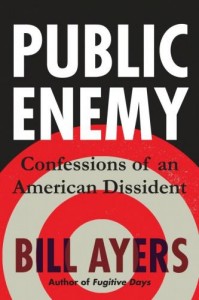
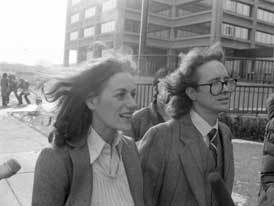
Public Enemy: Confessions Of An American Dissident
A sequel to Fugitive Days, Public Enemy: Confessions of An American Dissident chronicles Bill Ayers life after the Weather Underground. Since his memoir Fugtive Days was published September 10, 2001 about his life in Students for a Democratic Society and later the Weather Underground, Ayers was under attack by right wing media which tied him to the catastrophes of 9/11 based on a New York Times interview quote. Bill Ayers became famous in the early 1970s as a leader of the Weather Underground; he is known to have participated in the bombings of New York City Police Department headquarters in 1970, the US Capitol building in 1971, and the Pentagon in 1972. He surfaced in the mid-1970s, when the government charges against him were dismissed for prosecutorial misconduct.
His new book Public Enemy starts during the 2008 presidential debate in which his neighbor Barack Obama in the Hyde Park community of Chicago was confronted about their association. The book also describes how Ayers and his wife Bernadine Dohrn rebuilt their lives as public figures. Ayers became a professor of education at the Chicago campus of the University of Illinois.
Bill Ayers:
- The American dissident part came pretty naturally. I grew up in the heat of the civil rights movement.
- I came of age when the world was on fire.
- In our own country it was the black freedom movement finding the moral agenda for the whole nation and I found myself drawn inexorably into it.
- The public enemy part comes from continuing to live a long life as a radical, and as a public radical and not being willing to trim my sails or my revolutionary hope stream spirit.
- Come the 2008 election, the national election. I was thrown unwittingly, unwillingly into that national campaign.
- The narrative that Barack Obama palled around with terrorists, that Barack Obama had a shady Palestinian friend or the narrative that he hung around with a black nationalist preacher, that narrative was spun by Hilliary Clinton long before Palin and McCain picked it up.
- The ole American favorite past time, guilt by association, that’s how I became a public enemy.
- I was a kid coming out of a privileged background. I went to the University of Michigan and I couldn’t sleep for about 2 years because the world was on fire.
- I was arrested opposing the war in Vietnam. I spent ten days in county jail and there I met a man whose wife just founded a freedom school.
- I marched out of jail into my first teaching job. For me teaching was always linked deeply with the quest for social justice. I returned to teaching in 1978, after our first child was born.
- The ideal is that every human being is of incalculable value in a country that found on the idea that we are all equal.
- What we ought to be demanding is an educational system that creates free people, people with minds of their own, people who are able to interrogate the world before them.
- In Nazi, Germany, they had wonderful schools that taught amazing literature and music, arts and so on, and they also had a system based on obedience and conformity and doing what you’re told and following the rules. That’s a recipe for catastrophe in any free society.
- What I’ve spent most of my adult life doing is fighting for an educational system where the fullest development of each becomes the condition for the full development of all and the fullest development of all becomes the condition for the full development of each.
- Who are you? How did you get here? Why are you in the freedom movement? What are you trying to accomplish and where do you want to go? The message of those questions are revolutionary.
- The Highlander Folk School
- We don’t have a king that can save us. We are sovereign.
- Those of us who still think of ourselves as revolutionaries living in difficult times, dark times, have to find ways to become movement builders. Movement building is on the agenda. Bringing those together who are working in various fields to change the frame of the discussion.
Guest – William Ayers, Distinguished Professor of Education and Senior Bill Ayers University Scholar at the University of Illinois at Chicago (retired), member of the executive committee of the Faculty Senate and founder of both the Small Schools Workshop and the Center for Youth and Society, taught courses in interpretive and qualitative research, oral history, creative non-fiction, urban school change, and teaching and the modern predicament. A graduate of the University of Michigan, the Bank Street College of Education, Bennington College, and Teachers College, Columbia University, Ayers has written extensively about social justice, democracy and education, the cultural contexts of schooling, and teaching as an essentially intellectual, ethical, and political enterprise.
——————————————————————–
CIA Sponsored Terror, Civil Liberties, Criminalizing Dissent, Habeas Corpus, Human Rights, Military Tribunal, Supreme Court, Surveillance, Targeting Muslims, Torture, War Resister
Podcast: Play in new window | Download
Updates:
——
Pan African Solidarity Hague Campaign to Delegitimize the ICC
In the month June last year, the Pan-African Solidarity Hague Committee delivered a petition to the International Criminal Court at the Hague, Netherlands demanding they prosecute the United States, Great Britain, France, Italy, Canada, and NATO for war crimes and crimes against humanity in Libya, Cote d’lvoire, Haiti and the US. This campaign began in May of 2011 when thousands gathered to protest the US/NATO bombing of Libya, attacks on Zimbabwe and the racist assault against African-Americans in the United States. 16 months after delivering the petition and sending follow up letters, the Pan African Solidarity Hague Committee haven’t received a response. The organization is now reaching out to National Lawyers Guild members and law students to help expose the International Criminal Court.
Attorney Roger Wareham:
- The International Criminal Court was established in 2001-2002, supposedly to replace the different ad-hoc international tribunals that had been set up to deal with war crimes and crimes against humanity.
- It’s supposed to be even handed, no double standard – everyone is held to the same level of accountability.
- The membership, you have to sign on to be a part of it. The United States was closely involved in the process of setting up the ICC.
- The U.S. insisted that it would not be subject to prosecution by the ICC, although under the Security Council of the United Nations could recommend cases for the ICC.
- Given the plethora of human rights violations and war crimes that have been committed around the world, the only people that the ICC is presently prosecuting are Africans.
- The only prosecutions have been of Africans.
- Our involvement in taking it to the ICC was in particular to expose its nature that its really not an international tribunal that would look at the question of war crimes across the board and that its really another instrument in the West’s arsenal of the exploitation of Africa.
- Ostensibly, dealing with human rights violations, the ICC has zeroed in on Africa.
- There’s been a response and rebellion among several of the African countries around this clear bias.
- Three of the five permanent members are not on the ICC, Russia, United States and China.
- I think what we want to do is we want a single standard or no ICC.
- Email: D12M@aol.com
- www.PASHC2012.blogspot.com
Guest – Attorney Roger Wareham, a member of the December 12th Movement, an organization of African people which organizes in the Black and Latino community around human rights violations, particularly police terror. Wareham is also the International Secretary-General of the International Association Against Torture (AICT), a non-governmental organization that has consultative status before the United Nations.
—–
Lawyers You’ll Like – Attorney Mel Wulf
We’re joined today by Attorney Mel Wulf, former legal director with the American Civil Liberties Union for 15 years. He was a law partner with former US Attorney General Ramsey Clark during the Kennedy Administration and much more. Wulf was part of some of the greatest contributions to the civil rights movement. He’s now retired after practicing law for 54 years. As part of our Lawyers You’ll Like series, we talk with Wulf about his work with the ACLU during the early 60s, and also about the forming of the Lawyers Constitutional Defense Committee.
Attorney Mel Wulf:
- Phil Agee was a dissident CIA agent who spent decades working against the CIA, published a couple of books.
- He lost his passport because when the dissidents took over the embassy in Tehran in 1979, the New York Post carried a story accusing Phil of helping the students who’d invaded the embassy to put together all of that written material that had been shredded.
- It was another New York Post bald faced lie.
- The State Department, based upon that story revoked his passport.
- I had represented Phil Agee, I was his principle lawyer for 30 years.
- Agee was very widely disliked in Washington because he was well known to be a CIA dissident who disclosed the names of many CIA agents.
- If Snowden went the same route today, he would do even worse in this Supreme Court than I did. That’s why Snowden won’t get his passport, thanks to me.
- I was for the workers and not for the bosses and I’ve always been for the workers and not for the bosses, which I think is the distinguishing political factor in our world. Which side are you on?
- I got my Bachelors Degree in ’52 and I had a Navy Commission which I had gotten from the New York State Maritime Academy earlier on.
- The draft board sent me a 1A notice, I applied to Columbia and when I finished Columbia they sent me another 1A notice because the draft was still on. I spent 2 years in the Navy as a Liuetenant Junior Grade Officer in Southern California.
- I went to work at the ACLU in 1958 as the assistant legal director, in 1962 I was given the job of the legal director of the ACLU.
- I had actually been going down to Mississippi from 1961 to 1962, working with then one of the two black lawyers who were practicing in Mississippi.
- We tried a couple of capitol cases in Mississippi. I continued to argue the systematic exclusion of blacks from the jury.
- I finally got a case up to the Supreme Court on that issue.
- Lawyers Constitutional Defense Committee: We had several hundred lawyers who went down to Mississippi for periods of a week or two. They were representing people being arrested during the Mississippi summer.
- Most of the judges allowed these lawyers to make some sort of presentation.
Guest – Attorney Mel Wulf, former legal director with the American Civil Liberties Union for 15 years. He was a law partner with former US Attorney General Ramsey Clark during the Kennedy Administration and much more. Wulf was part of some of the greatest contributions to the civil rights movement. He’s now retired after practicing law for 54 years.
——————————————————–
CIA Sponsored Terror, Civil Liberties, Criminalizing Dissent, FBI Intrusion, Habeas Corpus, Human Rights, Political Prisoner, Prison Industry, Supreme Court, Surveillance, Truth to Power, War Resister
Podcast: Play in new window | Download
Updates:
- Wikileaks Film titled The Fifth Estate Is A Propaganda Piece Against the Disclosures of Wikileaks
- Wikileaks Film titled MediaStan Is Produced By Julian Assange
—-
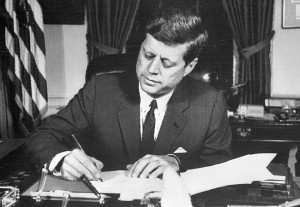
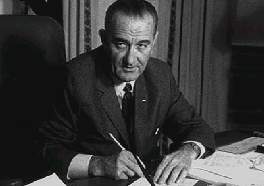
50th Anniversary of the Kennedy Assassination – Zachary Sklar, Screenwriter of the Film: JFK
November 22, 2013 will mark the 50th anniversary of the assassination of President John F. Kennedy. More than 600 books have been written on this national tragedy and yet the implausible explanations the Warren Commission report put forward remain as the official story. We’re joined today by Zachary Sklar to discuss some of those challenges and his work investigating those involved in the planning and covering up of assassinations.
Zach Sklar:
- The Warren Commission was a creature appointed by Lyndon Johnson.
- He persuaded Earl Warren to head this commission against his wishes. He was Chief Justice of the Supreme Court at the time.
- To bolster him on the commission, the one who did most of the work and guided the findings was Alan Dulles, former CIA directory. A man who’d been fired by John Kennedy after the Bay of Pigs invasion.
- The other one who was on it was Gerald Ford of course.
- So, there was a dissenting group of southern Congress people who really didn’t have much power. Ultimately, the power was with Alan Dulles.
- The CIA had overthrown Mossadegh in Iran, Arbenz in Guatemala, not only overthrowing governments but assassinating leaders.
- The commission report – that conclusion was decided upon and then they had to come up with some reasons to support it.
- The reasons were designed by Arlen Specter. He was a staff lawyer at the time and later a Senator from Pennsylvania. He came up with the Magic Bullet Theory.
- Because the Zapruder film came out with the time frame of 5.62 seconds and there were 3 bullets during that time frame, all the wounds in John Kennedy and John Connelly.
- Lee Oswald was given a paraffin test the day of his arrest. It was negative. It had proven he’d not fired a rifle that day.
- According to the Marines, Oswald was a mediocre marksman at best.
- The rifle that he was supposed to have used. . . if you ask any rifle dealer what the worst rifle, the least accurate rifle you could ever come up with they would tell you its the Mannlicher-Carcano. It’s called the humanitarian rifle by the Italians.
- All this should’ve been put to rest in 1979 when the House Select Committee on Assassinations investigated and came up with acoustical evidence from a police dictabelt recording and found that there was a 4th shot.
- If there was a 4th shot, there had to have been a second shooter. If there was a second shooter, there had to have been a conspiracy.
- Kennedy was well aware that the anti-Communist ideology of the cold warriors was fundamentally flawed. The whole domino theory is fundamentally flawed.
- After he was killed, very quickly, his (Kennedy’s) policies were reversed by Lyndon Johnson.
- The fact is that 4 days after he was killed Lyndon Johnson issued National Security Action Memorandum 273 which reversed Kennedy’s order and actually ok’s US military operations in Vietnam.
- On the very day he was assassinated Kennedy had sent a liaison to Cuba, to negotiate with Fidel Castro.
- At the top of the list are the leaders of the CIA.
- You have to understand that the Cold War had gone on for a long time, and people made careers, peoples’ livelihoods depended on the Cold War continuing. Big defense contracts depended on it.
- A lot of people had the motivation to kill Kennedy.
Guest – Zachary Sklar, Oscar-nominated co-screenwriter of Oliver Stone’s film JFK, and author of the book JFK: The Book of the Film. He’s a journalist, and a professor at the Columbia School of Journalism. He was also a contributor to The Lies of Our Times, a monthly journal dedicated to exposing the truth behind the mainstream media. Zach collaborated with director Oliver Stone on the screenplay of the movie “JFK” and was editor of Jim Garrison’s book “On the Trail of the Assassins.”
—–
Lawyers You’ll Like: Attorney Bill Schapp
Attorney William Schaap graduated from the University of Chicago Law School in 1964 and has been a practicing lawyer since. Bill specialized in military law and practiced in Asia and Europe. He later became the editor in chief of the Military Law Reporter in Washington for a number of years. In the 70’s and 80’s he was a staff counsel of the Center for Constitutional Rights in New York City. In the late 80s, he was an adjunct professor at John J. College of Criminal Justice of the City University of New York where he taught courses on propaganda and disinformation.
Attorney William Schapp:
- One of first cases at this big Wall Street firm, they had some outside counsel working on it, one of whom was David Lubel, and Dave Lubel who had I think been a recruiter for the Communist Party in his youth, was always good at spotting somebody who was always worth recruiting and he started to tell me there was this convention of this lawyers group.
- It was this 1967 Lawyers Guild Convention in New York. He dragged me to one event, I met Bill Kunstler, I met Arthur Kinoy, I met Victor Rabbinowitz. I’d been on Wall Street for a year or two, I said I didn’t know there were lawyers like this.
- I joined the same day and met Bernadine Dorhn and a few weeks she called me and said we need your help.
- She said you gotta defend a bunch of Columbia students. The next thing I knew the riot started at Columbia and she said you have to go down there and defend them.
- I signed up to be staff counsel on the National Lawyers Guild Military Law Project in Okinawa, Japan.
- When you work overseas in that kind of a climate with the military you learn a lot fast about American imperialism.
- Once you learn that, you learn about the CIA.
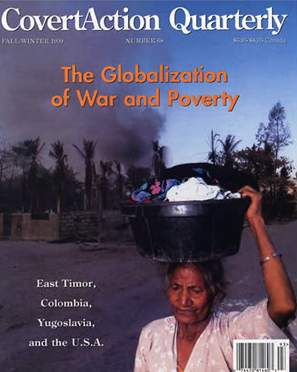
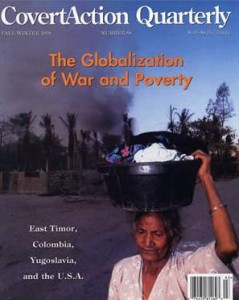
- That led us to originally working on Counter Spy magazine and then on Covert Action Magazine.
- The original purpose was to expose the CIA. We worked with Lou Wolf who is an expert in uncovering CIA agents in US embassies, not through any classified documents but because if you knew how to read the paperwork and State Department things, you could tell who are the “ringers.”
- We were so successful that Congress passed a law against us.
- Our goal was to make these people ineffective because the only way most CIA could work, particularly the ones that were assigned to an embassy was to have to pretend to be something else.
- They were all third assistant political secretaries and those were all phony things. Their job was to finagle their way into various community organizations in whatever foreign capital they were posted to recruit people to turn against their own countries and become traitors to their own countries, to become spies for the U.S.
- We thought if we identified these people, it might make their job a little bit harder, which it did.
- Of course, the problem with that is the government said we were trying to get them killed which we weren’t trying to do and nobody we did expose ever did get killed.
- He (Philip Agee) had been an adviser to Counter Spy. Counter Spy folded when Welch got killed, cause the pressure was too much and started Covert Action Quarterly.
- He was not the person discovering who the under cover people were, Lou Wolf was doing that.
- Phil wrote articles for us in every issue and we worked very closely with him.
- Once you start exposing these things, they really don’t have any defense.
- They tried to catch us in something phony. We would get tips that would turn out to be CIA trying to get us to print some story that wasn’t true so they could then discredit us.
- We had more interference from the government when we were doing military law work, before Covert Action Quarterly.
- They would plant bugs in our attic in Okinawa, things like that.
- The Intelligence Identity Protection Act has 2 parts. One makes it a crime for someone in the government who has classified information to reveal someone’s identity. The second part makes it a crime to reveal the identity of someone you did not learn from classified information or you position. (But if you were in the business of exposing these people . . .)
- Regarding his newsletter The Lies of Our Times – It was in the 90s, from 1990 to 1995 I think. To a certain extent, the abuses we were crying about got a little bit less over time because that’s sometimes the helpful result of that kind of exposure.
- We were just tired of people thinking that if it was in the New York Times it must be true.
- The fact is that those people lie all the time.
- I think we’ve gotten to a point where people recognize that the government lies to them and that there’s an awful lot that goes on that they don’t know.
Guest – Attorney William Schapp graduated from the University of Chicago Law School in 1964 and has been a practicing lawyer since. Bill specialized in military law and practiced in Asia and Europe. He later became the editor in chief of the Military Law Reporter in Washington for a number of years. In the 70’s and 80’s he was a staff counsel of the Center for Constitutional Rights in New York City. In the late 80s, he was an adjunct professor at John J. College of Criminal Justice of the City University of New York where he taught courses on propaganda and disinformation.
In addition to being a practicing lawyer, Bill was a journalist, publisher and a writer specializing in intelligence as it relates to media. He was the co-publisher of a magazine called the Covert Action Quarterly for more than 20 years. He also published a magazine on propaganda and disinformation titled Lies Of Our Times. Attorney Bill Schapp has written numerous articles and edited many books on the topic of media and intelligence.
——————————————————————