Civil Liberties, Criminalizing Dissent, Gaza, Human Rights, Prosecution of the Bush Administration, Supreme Court, Surveillance, Targeting Muslims, Torture
Podcast: Play in new window | Download
Updates:
—
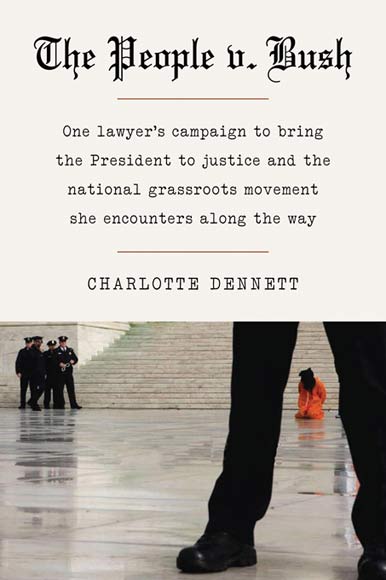
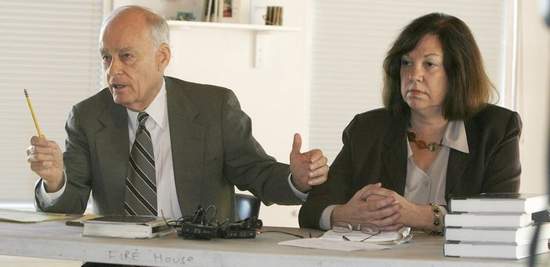
People v Bush, Charlotte Dennett
Today we talk with former Vermont Attorney General Candidate Charlotte Dennett. Listeners may remember Charlotte ran for office of Attorney General on the platform that if elected she would immediately undertake the prosecution of George W. Bush for the unnecessary deaths of Vermont soldiers in Iraq. The strategy was to establish jurisdiction in the cases for Attorneys General in each state as outlined in The Prosecution of George W. Bush for Murder, written by former prosecutor Vincent Bugliosi. Charlotte Dennett didn’t get the votes to become Vermont’s new attorney general. Now, a year later Charlotte describes from an inside perspective the “accountability movement” in her new book titled The People v. Bush. Is impeachment or prosecution still off the table?
Charlotte Dennett:
- If we don’t act on them now, then the impunity will get worse, we have to clamour for Cheney’s prosecution. We’ve got to keep the pressure on the department of justice. We know that the Spanish prosecutors have done that.
- I’ve come to realize that Obama’s mantra that we have to move forward and not look backward is really translated into: Don’t Prosecute.
- Brennan who was involved with crafting torture policy is playing a role advising Obama not to prosecute.
- It’s up to the accountability movement to step forward. There are going to be major events on March 20th, the anniversary of the war on Iraq.
- In my book the People v. Bush, I’ve got 10 pages in the appendix of all the different resources that people can turn to, to pressure Congress, sign petitions.
- The first half of the book is about my campaign for attorney general in Vermont, where I pledged to prosecute Bush for murder. I also lay out the evidence of how we can still do this, we can still do this by the way.
- I became hooked on accountability, this is a struggle for democracy and the soul of our nation.
- The book also looks at how the Obama Administration deals with the crimes of its predecessors.
- I have to tell you Michael Ratner, you were one of the first people to start raising the alarms (Obama Administration). My book shows the gradual shock and disillusionment of his supporters.
- People are upset that John Yoo, is doing talk shows, he showed up on John Stewart recently (OUCH)
- Regarding Sen. Leahy of Vermont: I tracked his effort to put together a truth commission and not prosecution. There were 37 towns in Vermont, that in their town meetings, voted for impeachment.
Guest – Charlotte Dennett, is an author and attorney who resides in Cambridge Vermont. She and her husband, Gerard Colby, have lived in Vermont since 1984. Charlotte has been practicing law since 1997, representing injured Vermonters in negligence, medical malpractice and wrongful death cases, as well as civil rights litigation and family law, and has argued before the Vermont Supreme Court.
——-
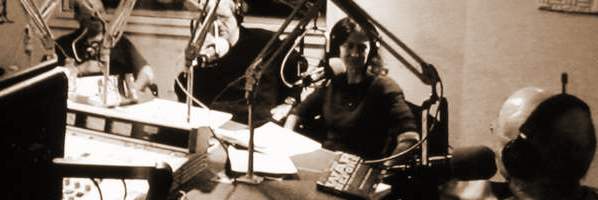
Lawyers You’ll Like: Center For Constitutional Rights Legal Director, Bill Quiqley
This week, CCR Legal Director Bill Quigley joined Law and Disorder hosts during a marathon 3 hour fund raiser for Pacifica’s WBAI. Bill talked about his trip to Gaza during Operation Cast Lead, his recent trip to Haiti and his death penalty work in Louisiana.
Bill Quigley:
- I went to Gaza with activist Audrey Stewart and Kathy Kelly, an International Peace Activist.
- We went over there, a year ago January, while the bombing was still going on. We were on the Egyptian side of the border where we could see the bombing of Gaza
- There were constant drones going over head, they had aerial balloons that were doing surveillance. It was sort of like a sociopath beating a baby. There was no defense, there was no anti-aircraft, people were literally sitting ducks.
- In my life, it compared to a time when one of my clients was being executed, in death row in Louisiana. To see the apparatus of the state, move into action, very calm, step by step.
- Then with full force and the respect of state behind it, pull on a switch and my client was no more. (at that time) It was a surprise that anyone in the U.S. would support the Palestinians.
- Death Penalty: there really is a community of deathy penalty advocates who train themselves how to communicate with juries. It is trending in the right direction by it still continues as a terrible tool, that the state has an opportunity to use when they choose to.
- Stop and frisk case update: New York is fighting this every step of the way. The term they use to justify this is: Furtive activity
- Culture of Intimidation: If young men don’t look at them the way they want to be looked at, if people don’t recognize their presence with the kind of respect that the police department thinks that they’re entitled to by the mere fact that they’re wearing a uniform and carrying a weapon.
- It is something that clearly could stop if the message was sent from the top.
- But clearly something has a green light from the top to engage in this. Authoritarian order that inconsistent with law and order, with the constitution.
- Endemic: If you have a society that values violence, the violence we institute around the world, the way we support Israel, the way they deal with Palestine. If we value deep racism, then what else what would we expect from a police or a military. The police and military are tools of a violent and racist regime.
- Part of our job is to re-educate police officers. We are going to be engaged in this activity over again, in every city in the country in varying degrees. The root problem is that we have a racist and violent criminal justice system, education system, a racist and marginalizing housing system, employment system.
- Most people don’t have the educational opportunities to know what’s going on with Haiti, Gaza, Iraq and even within our own country. Haiti: You could travel for miles and see no indication that international community even cared about what happened in Haiti. Most people were under a sheet or a blanket, could break some of the sun.
Guest – Bill Quigley. Bill is the Legal Director for the Center for Constitutional Rights, a national legal and educational organization dedicated to advancing and defending the rights guaranteed by the United States Constitution and the Universal Declaration of Human Rights. Bill joined CCR on sabbatical from his position as law professor and Director of the Law Clinic and the Gillis Long Poverty Law Center at Loyola University New Orleans. He has been an active public interest lawyer since 1977.
———————————————-
Civil Liberties, Criminalizing Dissent, FBI Intrusion, Gaza, Human Rights, Prison Industry, Truth to Power
Podcast: Play in new window | Download
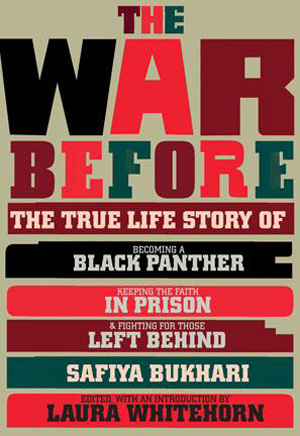
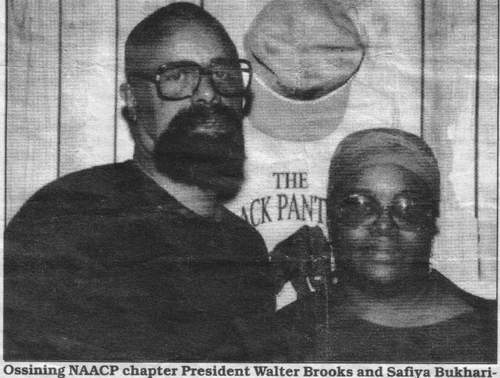
The War Before: The Story of Black Panther and Political Prisoner Safiya Bukhari – By Laura Whitehorn
We’re delighted to have political activist and former Weather Underground member Laura Whitehorn back with us to talk about her new book titled, The War Before. In the book about Laura introduces us to Safiya Bukhari, a member of the Black Panther Party in the late 1960s. The War Before traces Safiya’s life’s commitment of organizing around the rights of the oppressed. Through Safiya’s personal writings, we hear her unique perspective of what had happened to the Black Panther Party and her personal insights into the incarceration of outspoken radicals. Safiya, herself a longtime political prisoner and jailhouse activist, died in 2003. It was at the request of Safiya’s daughter Wonda Jones, that Laura assembled and edited the War Before.
Laura Whitehorn/Sundiata Sadiq:
- When I was first in prison there was no library. Nothing. Whoever we were as political prisoners, we would have met Safiya. When she got out of prison in 1983, she made it her business to go and fight for every political prisoner in this country, that she could get to who wanted to be part of a movement to free political prisoners.
- Safiya: The fight for the freedom of political prisoners can’t be separate from the fight against repression in general whomever that is effecting. If she were alive today, I’m sure she would have been at the rally for Fahad Hashmi and fighting for the rights of immigrant detainees.
- Safiya: Political prisoners will continue to arise if people oppose the government.
- This book began with Wonda Jones (Safiya’s daughter) Wonda in some ways has been working on this book for her entire life.
- Safiya was aware all the time that the “freedom and democracy” that this country promotes as its image only exists on the suffering of so many people. Her politics were a challenge to the government all along, her being was a challenge.
- Some of these are essays, some of these are speeches. Safiya was investigating, she was questioning, she was willing to look at herself, what each of us brings into a movement. There is a connection between her humility, her honesty and her commitment.
- Sundiata: I became close to Herman Ferguson and Safiya.
- Laura: I was in prison when Jericho was founded.
- Sundiata: I was asked to get Sofiya into the Sing Sing Prison to talk to the brothers.
- They had to remove her (Safiya) uterus because of fibroids.
- In the February issue of the Monthly Review we have an excerpt of Sofiya’s chapters. It’s about post traumatic stress symptoms in the Black Panther party. When I was putting this manuscript together and re-read it, I thought, I would like people to read this book from beginning to end.
Guest: Laura Whitehorn – revolutionary ex-political prisoner and native New Yorker Laura Whitehorn. Since the 1960s Laura was active in supporting groups such as the Black Panther Party, the Black Liberation Movement and was active with Students for a Democratic Society and the Weather Underground. Laura also worked to expose the FBI’s Counter Intelligence.
Guest – Sundiata Sadiq. (Walter Brooks) He is a leading member of the Free Mumia Abu-Jamal Coalition in New York City and was a close friend of Safiya Bukhari for many years. Sudiata has been politically active since the late sixties, and he was also the president of the Ossining, New York Chapter of the NAACP.
—-
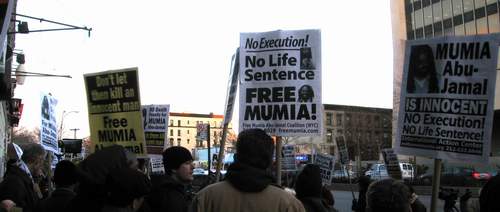
Educators for Mumia Abu-Jamal: Johanna Fernandez
The U.S. Supreme Court recently re-opened the possibility that Pennsylvania may execute award-winning journalist and world-renowned “Voice of the Voiceless” Mumia Abu-Jamal. The high Court referred his case back to the Third Circuit to reconsider its 2008 decision that Mumia could have a new penalty phase hearing in light of the Court’s ruling in the Ohio case of Smith v. Spisak. Spisak’s jury-imposed death sentence had been reversed when his attorneys, like Mumia’s, successfully invoked a critical 1988 Supreme Court decision in the Mills V. Maryland case. Mills rejected the idea that jurors had to be unanimous on the mitigating circumstances that existed in a case. Before Mills, juries had little or no alternative but to impose death if even one juror blocked consideration of a mitigating circumstance. The High Court’s recent decision in Mills will now make it easier to obtain death sentences in capital cases; Mumia’s attorneys will argue that his case is distinguishable from Spisak’s.
Mumia as many know, was convicted and sentenced to death for the 1981 murder of police officer Daniel Faulkner. A previous guest here on Law and Disorder, author/ journalist J. Patrick O’Connor who wrote The Framing of Mumia Abu Jamal, says the real shooter was Kenneth Freeman a business partner of Mumia’s brother. Freeman, was found dead in 1985, bound and cuffed in a Philadelphia parking lot.
Professor Johanna Fernandez:
- Educators for Mumia Abu-Jamal emerged in the 1990s to build a profile for Mumia on college campuses among educators and students.
- We’re also making the movement mainstream in pointing out what’s wrong with the criminal justice system.
- We’re getting a hip hop show for schools for spring break (Pennsylvania colleges)
- We want to educate young people and students in a nation that incarcerates 3 million people. That’s the size of San Francisco.
- I’ve known Mumia for about five years. I have used Mumia in the classroom live through phone conference. He speaks on issues such as the Vietnam War, the civil rights movement, the Black Panther Party and the criminal justice system today. These live conferences are incredibly powerful.
- Conversations with Mumia are intense, we talk about politics, Obama. We talk a lot about what life is like on death row. His cell is the size of a small bathroom. He’s only allowed 20 books at any given time. His cell is messy because he’s a researcher, a writer.
- Mumia: food is horrendous. They’re allowed to buy food, MRE style pre-packaged dry food. The servicing of inmates in this country is a billion dollar industry.
- What’s interesting about his situation is the state has tried to strip him of his intellectual vitality. Although they have failed, he’s written six books from death row, he’s got his radio journals.
- The first thing the movement is asking people to do is to arm themselves with the facts of the case. Then you can sign a petition. There’s another petition calling for Obama to make a statement on the case.
- If you’re a student or a university professor we are asking you to help us organize a large town hall meeting, for April 3, 2010 (likely in NYC) Mumia’s case should be taken up during Black History Month by colleges all over the city.
Guest – Educators for Mumia member Johanna Fernandez. Johanna Fernandez is a native New Yorker. She received a Ph.D. in History from Columbia University and a B.A. in Literature and American Civilization from Brown University.
——-
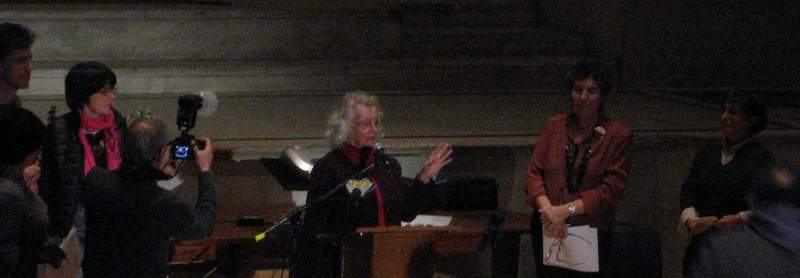
Gaza Freedom March Report Back Speeches
We hear another strong speech from Palestinian teacher and filmmaker Fida Qishta. Fida is from Rafah, Southern Gaza.
Gaza Freedom March Commitments Include:
- Palestinian Self-Determination
- Ending the Occupation
- Equal Rights for All within historic Palestine
- The full Right of Return for Palestinian refugees
From: Waging Nonviolence blog. The Egyptian government didn’t let most of the over 1,300 protesters from around the world into Gaza for the planned march, but those at Judson said that they witnessed a new stage in the emergence of a global movement, facilitated by the Internet, that may well be poised to end the international support that makes Israel’s policies possible. The lynchpin of the movement, the Cairo Declaration of the Gaza Freedom March, was drafted by would-be marchers while they waited in Egypt.
——————————————————————————————–
Censorship, Civil Liberties, Criminalizing Dissent, Gaza, Human Rights, Targeting Muslims, Truth to Power
Podcast: Play in new window | Download
Updates:
——–
Gaza Freedom March Report Back Speeches
We hear strong speeches detailing the experience at the Gaza Freedom March by Ali Abunimah, co-founder of the Electronic Intifada and author of One Country: A Bold Proposal to End the Israeli-Palestinian Conflict and our own co-host Michael Ratner, president of the Center for Constitutional Rights. As many listeners know, hundreds of activists with the Gaza Freedom Marchers returned from Israel, Palestine and Egypt from the largest international mobilization of people in solidarity. The Egyptian authorities refused to allow the 1,365 participants from 43 countries to enter the Gaza Strip, but later 100 people were let in to Gaza.
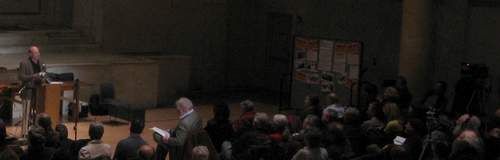
Michael Ratner’s Article: From Hebron to Yad Vashem: Jewish Sorrow Justifying the Sorrow of Others
Gaza Freedom March Commitments Include:
- Palestinian Self-Determination
- Ending the Occupation
- Equal Rights for All within historic Palestine
- The full Right of Return for Palestinian refugees
From: Waging Nonviolence blog. The Egyptian government didn’t let most of the over 1,300 protesters from around the world into Gaza for the planned march, but those at Judson said that they witnessed a new stage in the emergence of a global movement, facilitated by the Internet, that may well be poised to end the international support that makes Israel’s policies possible. The lynchpin of the movement, the Cairo Declaration of the Gaza Freedom March, was drafted by would-be marchers while they waited in Egypt.
—-
Faculty for Israeli-Palestinian Peace
In the wake of Gaza Siege earlier this year, many groups such as Code Pink have brought delegations of people to Israel to visit and bring support to Palestinian refugees and families. Today we talk with Joel Bitar, he’s a student who traveled to Israel with the group Faculty for Israeli-Palestinian Peace. The group is an international network of academics and students supporting a complete end to the illegal Israeli occupation of lands seized in 1967. Last summer, Joel was among many who visited Israeli universities, the Israeli settlements in the West Bank, and stayed with Palestinian families. These delegations call on the international academic community to take a stand in supporting the end to occupation in Gaza and the West Bank.
Joel Bitar:
- Most of my life I tried to hide my Palestinian identity and this trip was all about confronting and realizing who I am. For so long, especially after 9/11 it wasn’t respectable to be an Arab in America.
- I was kind of ashamed of my Dad’s history and culture for a long time. This trip was about inner healing and understanding where I came from.
- I went to the West Bank for a month and a half.
- It’s all about fitting in and surviving, being a confrontational force in a culture is something I didn’t have the courage to do unfortunately. My family has been apolitical. Doing activism around this (Gaza) has been unifying for my family.
- It’s enabled us to confront all the awful aspects of American culture and society.
- What happened in Gaza, shook me, woke me up. I’ve been doing a lot of investigating about the conflict, it seemed so mystical and mysterious. I read a couple books, it’s really not that complicated, it’s very simple. Palestine Peace Not Apartheid – Jimmy Carter / The Israel Lobby and US Foreign Policy.
- I learned about Norman Finkelstein and conflict between him and Alan Dershwitz.
- Simple in terms of the law. The law is very clear. You can’t acquire territory by force. Something you learn when you’re growing up, don’t bully people, don’t take their stuff.
- We visited numerous hot spots of the occupation, we went to Hebron, which is under vicious occupation by Israeli soldiers.
- 8 Meter high concrete slabs in many places. 85 percent of the wall runs on Palestinian land.
- Duel road systems and duel license plates.
- My Palestinian family pay taxes but don’t get the benefits of the taxes, they’re living in an imposed ghetto.
- They don’t have access to water 24/7 like every other Jew in the settlement. There’s garbage everywhere.
- We’ve been doing a lot of work with the Gaza Freedom March, with the anti-war movement at Hunter.
- A lot of the Jews who do an iota of research at Hunter know that what Israel did was awful. Breaking The Silence Report
Guest: Joel Bitar, a Hunter College student who traveled to Israel with the group Faculty for Israeli-Palestinian Peace. The group is an international network of academics and students supporting a complete end to the illegal Israeli occupation of lands seized in 1967. Joel is active with the Hunter College Campus Anti-War Network.
———————————————————————
Afghanistan War, Civil Liberties, Criminalizing Dissent, Death Penalty, FBI Intrusion, Human Rights, Prison Industry, Supreme Court, Surveillance, Targeting Muslims, Torture, Truth to Power
Podcast: Play in new window | Download
Updates:
—
The Death Penalty Loses Support of The American Law Institute
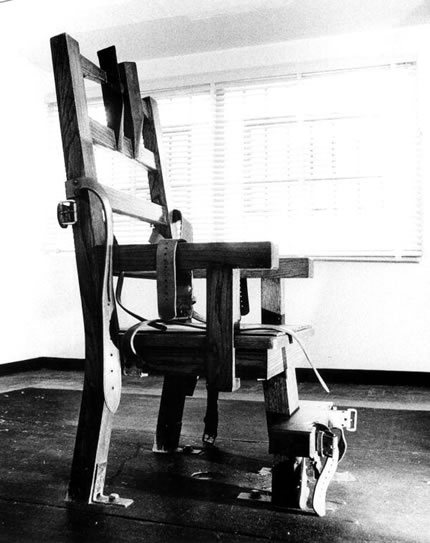
In late 2009, the American Law Institute, which created the intellectual structure for the current capital justice system for nearly 50 years, essentially announced that its project has failed. The American Law Institute or A.L.I. is made up of around 4 thousand judges, lawyers and law professors, streamlines law and model codes to provide coherence in a federal legal system that is usually taking a varied approach. In a 1962 Model Code, the best legal minds of the institute framed a way for the death penalty to be carried out fairly, it then was re-instated in 1976. Now, the same people disavow the structure saying there is no fair system of capital punishment. The New York Times, in one article wrote (quote) the institute’s move represents a tectonic shift in legal theory. The article also points out that capital punishment was plagued by problems including racial disparities.
David Seth Michaels:
- American Law Institute, the intellectual group that tries to cobble together federal law in the United States including capital punishment. The capital punishment rules that they invented fifty years ago, have been the groundwork on which everything has happened since.
- So, it comes as a bit of a shock that fifty years later, they say “oh, oh.” It doesn’t work. It won’t work, we can’t make it work, so we’re going to fold up our tents. We won’t have anything else to do with it.
- Unworkable elements in the system: They’re troubled by the racial disparity on who gets executed, there’s tremendous disparity that is regional across the U.S. The prospect of capital punishment is ridiculously expensive. There’s risk of executing innocent people and politics of appointed judges who wantonly convict.
- It’s one of these circumstances that it is irreparably falling apart, broken. Everywhere you turn you find horrendous errors, egregious discrimination.
- The murder rate is higher in places where they have the death penalty than places where they don’t have the death penalty. Public support for the death penalty has been slowly and gradually decreasing.
- In the early 70s I became concerned about conditions in the prisons and mental hospitals in Tennesee and Mississippi. This is after the restoration of the death penalty in 1976.
- I can’t wait for the day that capital punishment is abolished. This system can’t die soon enough. You got nobody supporting the death penalty on an intellectual basis.
- National Coalition Against the Death Penalty.
Guest – Attorney David Seth Michaels. David has represented clients for 30 years, clients such as prison inmates in Mississippi and Tennessee. He’s worked with Brooklyn Legal Services B and with the Federal Defenders Service Appeals. He is also a novelist, has his own practice in New York.
—————————-
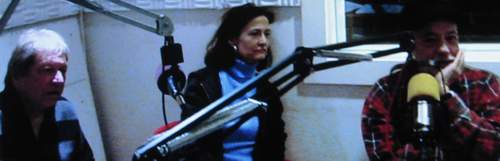
Lawyers You’ll Like: Jim Lafferty Part II
We’re delighted to have back with us attorney Jim Lafferty for the second half of our Lawyers You’ll Like series. He is the Executive Director of the National Lawyers Guild in Los Angeles and host of The Lawyers Guild Show, a weekly public affairs program on Pacifica radio sister station KPFK, 90.7 FM in L.A.
He has served as a chief officer of, and spokesperson for, various national anti-war coalitions, including the National Peace Action Coalition, the anti-Vietnam War coalition that organized the largest protests during that war; the National Coalition for Peace in the Middle East; and, the National Campaign to End U.S. Intervention in the Philippines. In the 60s and 70s, his law firm, Lafferty, Reosti, Jabara, Papakian & Smith, represented virtually all of the left political movements in and around Detroit, Michigan, during which time he became one of this nation’s leading experts on Selective Service law and military law.
In the early 80’s, Mr. Lafferty founded and chaired the largest A.C.L.U. Chapter in the State of Michigan. In New York City, in the late 80’s and early 90’s, he traveled the world organizing on behalf of the labor rights of merchant seafarers. During this time he also taught a course at the New School for Social Research, entitled, Vietnam: The War at Home and Abroad. More recently, Jim Lafferty was the Coordinator of the L.A. Coalition to Stop the Execution of Mumia Abu-Jamal, as well as a member of the national steering committee of the Campaign to Stop the Execution of Mumia Abu-Jamal.
Jim Lafferty:
- The man who was presented to me as my uncle, when I was sixteen he died, my mother acknowledged that he was my father. A friend of mine, she was a white nurse and she was married to a white school teacher and had a 3 year old daughter.
- She divorced that man and married a black surgeon. Her mother and former husband wanted custody feeling it was inappropriate for child to be raised in biracial home. George Crockett was one of the lawyers in the National Lawyers Guild in Michigan, took the case only if I clerked and read every opinion on domestic relations given down by the Michigan Supreme Court.
- We lost that case, and I continued working with that firm. They made a movie about that called “One Potato, Two Potato”
- The firm had been lawyers for UAW. I had gone down South to work with the lawyers guild in 1963, I was taking depositions for the Freedom Democratic Party. That’s where I met Mary Robinson.
- Bill Kunstler and Arthur Kinoy / Bill Kunstler’s book (1966) Deep In My Heart
- Michael Smith: Jeff Haas says Fred Hampton had Bill’s book, Deep In My Heart on his bed.
- When you finally take a stand, even though it leads to your incarceration and apparent lack of freedom, you’re finally free. Anti-war movements: Some friends of mine ran as peace candidates just to bring up the question of the war. We ran the entire campaign for 3300.00. Including 10 small billboards. Later we put together the Detroit Coalition to End the War in Vietnam Now.
- I wasn’t representing people anymore, but as the head of this coalition, you were doing public speaking, and getting an appreciation for what the power of people could do. To the credit of those lawyers who were winning those victories, even then they were saying to younger lawyers like me, but the real important thing is what goes on in the streets.
- Los Angeles Chapter of the National Lawyers Guild, – Labor Movement is vital. The anti-war movement is vibrant. You can’t blame the young activists for not knowing history, because nobody’s bothered to teach them. I’d like to see the movement coalesce around a meaningful left socialist third party.
- On the issue of the war, we’re worse off than we were with Bush.
- Healthcare plan: boondoggle for insurance companies, if you insure people who haven’t been insured, the profits of insurance companies aren’t gonna go down, you and I will pay more. Whereas the government should be paying more. NY Times article: putting aside the public option, you get past it by not dealing with it.
Guest – Attorney Jim Lafferty, Executive Director of the National Lawyers Guild in Los Angeles and host of The Lawyers Guild Show, a weekly public affairs program on Pacifica radio sister station KPFK, 90.7 FM in L.A.
————————————————————–
Censorship, Civil Liberties, Criminalizing Dissent, Gaza, Guantanamo, Habeas Corpus, Human Rights, Military Tribunal, Prison Industry, Targeting Muslims, Torture, Truth to Power
Podcast: Play in new window | Download
Updates:
—
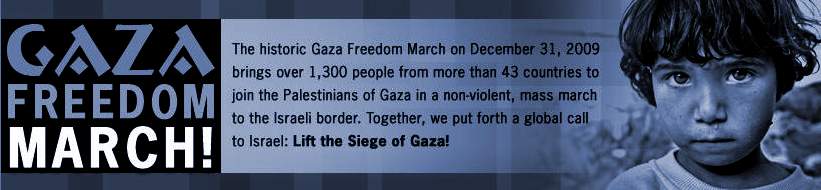
Historic International Support: Gaza Freedom March Debrief
Hundreds of activists with the Gaza Freedom Marchers have returned from Israel, Palestine and Egypt bringing home incredible stories from the largest international mobilization of people in solidarity. We hear first hand accounts from our own Michael Ratner who with his family were among the 13 hundred solidarity marchers. We are also joined by Felice Gelman who has also returned from the Gaza Freedom March. As many listeners may know, the Egyptian authorities refused to allow the 1,365 participants from 43 countries to enter the Gaza Strip, but later 100 people were let in to Gaza.
Felice Gelman / Michael Ratner:
- It was a remarkable event despite not getting into Gaza. 1400 people from 43 countries, Europe India, Australia, South Africa. Within 3 days the Egyptian government went from we need more info, we’re working with you to . . . you’re not coming.
- We were unable to get a meeting place at any time for any group of people. The Egyptians said that any gathering of more than six people would be illegal. One of the prerequisites in order to get into Gaza is you don’t engage with local opposition in Egypt. In a way it was a perfect demonstration of what the siege in Gaza is all about.
- Egypt is a police state. There are 2 million police for a population of 60 million.
- Egyptian police are very brutal with their people. They’re disappeared, they’re tortured. No room for democracy. No support for a civil society to express itself to protest.
- The thing that was incredible was the number of Egyptians that wanted to join us. There were a couple of instances where people were hurt. The secret police would try to single people out at a demonstration and punch or hit them.
- They would identify women who were Muslims. I don’t know if was that they were Egyptian and they (secret police) thought they could get away with it. They beat up a 12 year old girl and a 75 year old woman, they were not discriminating.
- Egyptians (opposition) joined in with GFM demonstrations in Cairo.
- We had a demonstration at the US Embassy in Cairo, the police surrounded them for five hours before they could get into Embassy. The US Embassy didn’t seem to think that this was bizarre until they were reminded of their legal obligation to help their citizens.
- the US Embassy informed the Egyptian police that they had no objection of us going to Gaza.
- There were some people who went to Al-Arish, and the Egyptian police were onto that. They surrounded a hotel in Al-Arish
- (Michael Ratner) I can’t imagine the logistics and the organizing nightmare it was for you guys
- I can’t think of a time since the Spanish Civil War, that there was a contingent of such size and national breadth that traveled to assist people in their distress from a brutal attack.
- I think this was an incredible demonstration of where the world stands on Gaza.
- My kids 19 and 21, seeing people with the courage to go to these demonstrations from all over the world. Out of that I think there will be a global organizing structure.
- The other thing is the drafting of the Cairo Declaration, drafted by the South African delegation. Calling on the ending of the occupations of Gaza and the West Bank, primarily with global BDS movements. (Palestinian unified call)
- When Gaza was getting attacked, it was the South African trade unionists that refused to load the weapons that were being sent to Israel.
- The potential for labor to move on this is enormous and powerful.
- The Gaza Freedom March website will be handed over to the committee working on the Cairo Declaration.
- New York Report Back – Judson Memorial Church January 21 / 55 Washington Square S.
Guest: Felice Gelman, member of the Wespac Middle East Committee and a member of the Steering Committee that organized The Gaza Freedom March. She has traveled to Gaza twice since the Israeli invasion last year.
—————–
The Response: Sig Libowitz – Combatant Status Review Tribunals
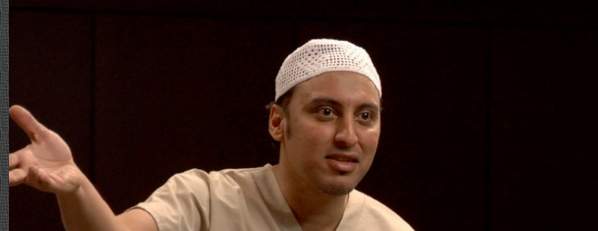
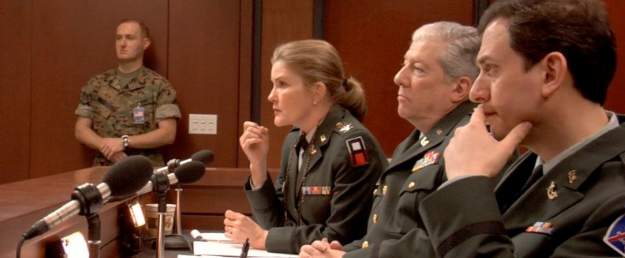
January 11, 2010 marked the 8th anniversary since the Bush administration turned the US Naval Base at Guantanamo Bay, Cuba into a “enemy combatant” detention facility. Essentially re-commissioning the base as a torture chamber and legal black hole, where prisoner suicides are considered acts of war. As we’ve reported on in the last few months, the Obama administration has held on to the power to allow for a preventive detention system that would indefinitely jail terror suspects in the United States without trial. Meanwhile, military tribunals are now mainstream news, the tribunals are called Combatant Status Review Tribunals, where military justices discern who is an enemy combatant. These trials are also the subject of a 30 minute film titled The Response. The film is written and produced by actor Sig Libowitz who is transitioning from being an actor playing an attorney on the TV series Law and Order, to becoming a real lawyer. While in law school, Libowitz was tranfixed by the tribunal process of no jury and no defense lawyer. The film is based on actual court transcripts and is shortlisted for The Academy Award. The Response is screening at Columbia University’s School of Law on January 20th at 6pm.
Sig Libowitz:
- Michael Ratner: First of all there was no real process for people in Guantanamo. Then we won the right to Habeas Corpus, to go into a federal court and challenge their detention. At that point the Bush Administration set up a special process in Guantanamo.
- As we depict in the film, this is a process where the detainees don’t have a lawyer, they are not provided with the evidence that’s against them. The real transcripts told the story of the detainees and the judges in these CSRTs. From that I saw an incredible movie, and incredible opportunity.
- Because, I thought I had an understanding of what Guantanamo was all about, then I read the transcripts (of a CSRT) It gives a human dimension to the detainee and the military judges.
- Screening at Columbia Law School, Wednesday January 20th 6PM All the cast will be there and Shane Kadidal and Matthew Waxman. We’ve screened the movie at the Pentagon.
Guest: Sig Libowitz, an American lawyer, actor, film executive and director. Libowitz is notable for producing, directing and starring in a film, The Response, he wrote after reading some transcripts from Guantanamo captives‘ Combatant Status Review Tribunals. Libowitz is an executive for the acquisitions department of Turner Classic movies. He had a recurring roles in The Sopranos and Law and Order.
——————

Free Fahad Hashmi
Fahad Hashmi a Pakistani born American student, has spent nearly 2 1/2 years in solitary confinement in a Manhattan detention facility. He has been isolated for one of the longest periods in America as a suspect before trial. Hosts reported on this case in March 2008, we spoke with Fahad Hashmi’s father Syed Anwar, and Fahad’s attorney Sean Mayer. Fahad is accused of storing waterproof socks, ponchos and raincoats. The US charges were based on allowing an acquaintance “Janaid Babar” to store this rain gear in the closet of his London flat. Janaid Babar was a paid government cooperator who has been used to testify against Muslims around the world. Nicknamed ‘Supergrass’ by the British media, Babar was used by the UK government to testify against Omar Khyam and several other Muslim men in the so-called Fertilizer Case. Meanwhile Fahad’s trial is expected in January 2010, the prosecution will use Junaid as a main witness. Hashmi has been held under the SAM’s Special Administrative Measures that include a 23 hour a day lockdown, constant video surveillance of his cell and limited visitation.
(Fahad’s Brother)Faisal Hashmi:
- I’m under SAMs as our family is. Our visits with him, we can’t talk about it, but I can say from open court, he looks frail, he looks jittery He’s been in solitary confinement for 2 and half years.
- He’s in the Metropolitan Correctional Center a few blocks from here. Within his own cell, he’s videotaped at all times. He’s not allowed to talk out loud. He has a microphone in his cell.
- This is about deconstructing a human being, depriving him of his humanity. He’s 29 years old.
- Charged with four counts of material support for terrorism. He stored ponchos and rain gear.
- In 2004, this acquaintance while working on his Master’s degree stayed with Fahad.
- This was January 2004, he went to the US in April 2004, was arrested, and became a cooperating witness for the US government. At this time about 8 people got arrested, some in Pakistan, London and Canada, all on Junaid Barbar’s witness cooperation.
- In June 2006, my brother gets arrested. They tell Fahad, that Junaid gave the ponchos and gloves to Al-Qaeda and you gave material support to terrorists. You let Junaid use your cell phone, and Juanaid borrowed 300.00 from Fahad, saying that his ailing daughter needed the money. Fahad’s trial starts January 6, 2010
- FreeFahad.com This case has nothing to do with ponchos and socks.
Jeanne Theoharis:
- This is a case we need to be concerned about for those who value the first amendment. I had Fahad as a student in Brooklyn College in 2002
- There’s no way to understand this case without understanding the way Fahad was being watched many years ago even as a college student. We’ve sent a letter to the attorney general addressing 3 main issues, the conditions of his confinement, the way his due process is being violated and then first amendment issues.
- The letter was signed by more than 550 scholars and writers. Organizing among the Muslim student community.
- Theaters Against War calling attention to Fahad’s case.
- Free Fahad Vigil January 18, 2010
Guests: Fahad’s brother Faisal Hashmi and Jeanne Theoharis, an associate professor of political science at Brooklyn College, City University of New York. She was one of Fahad’s professors and she has been following this case.
———————————————————————
Civil Liberties, Criminalizing Dissent, Guantanamo, Habeas Corpus, Human Rights, Surveillance, Targeting Muslims, Truth to Power
Podcast: Play in new window | Download
Updates:
WBAI Listeners Click Here For Rundown on Tito Gerassi
———–
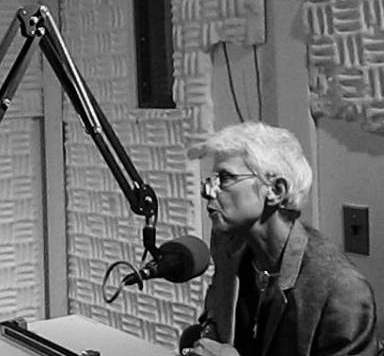
Lawyer’s You’ll Like: Rhonda Copelon Part II
This is the second part of our Lawyers You’ll Like interview with attorney Rhonda Copelon. She is a professor at the Law School of the City University of New York and director of the school’s International Human Rights Law Clinic. Rhonda is also the Legal Advisor to the Women’s Caucus for Gender Justice. Rhonda shares with us, her history of fighting for the constitutionality of the abortion cases in New York City and its effect on poor women in a pre-Roe v Wade climate. She also discuss the Harlem 6 case. Let’s have a listen.
From Article on New International Criminal Court: “The breadth and specificity of gender crimes in the court’s enabling statutes are directly attributable to a global caucus of women that formed in 1997 in the face of apathy and active resistance to prosecuting gender-based crimes. “Women made a huge difference,” said Rhonda Copeland, a professor at the Law School of the City University of New York and director of the school’s International Human Rights Law Clinic.
“They made it impossible to ignore that women have been left out of justice and that we have to be in it,” Copeland said. “If there were nobody there saying ‘this is violence,’ I don’t know how it would have happened.”Rhonda shares with listeners, her history of fighting for the constitutionality of the abortion cases in New York City and its effect on poor women in a pre-Roe v Wade climate. She also discuss the Harlem 6 case.
Rhonda Copelon:
- Harris v McRae – Rhonda Copelon argued. The case tried to get the federal government to pay for poor women’s abortions. We didn’t go to court to get medicaid for women, we went to court to save it.
- McRae has become a 2 line footnote in text books today and there’s a certain way that people have accepted that medicaid doesn’t have to pay for abortions
- 30 years is enough campaign.
- The more these terrible precedents come down, the more we absorb them as culture instead of viewing them as needing to be reversed.
- Historically, based on race and class, women have been treated differently in terms of their reproductive rights.
- When the original anti-abortion laws started to come in to the United States, it was primarily wanting to be sure that the white population of the US would not be out reproduced by the immigrant population and the way to do that was to cut back on abortion.
- The anti-abortion law, the original purposes was to increase reproduction among the elite and also to get rid of those women lay-healers.
- The original abortion laws were class based. In 20th century, class based eugenics laws, sterilization laws. Buck v Bell / you sterilize those who are socially inappropriate.
- Puerto Rican sterilization program. Before Roe v Wade, you couldn’t get a legal sterilization without the rule of 120.
- Religion twisted this around. The Catholic church in the mid 70s – a pastoral plan for pro-life activities.
- The goal was a human right amendment, which was a complete prohibition on abortion. Affecting poor women dependent on tax payer money.
- There’s a lot of evidence that the church went along with family planning in poor neighborhoods in the 60s because it had a population reduction role.
- When you get to abortion, they put the political / religious ahead of the population goals, and what you get is this mobilization to stop medicaid funding for poor women.
- In 1978, you had a historic coming together of the Catholic church and the Protestant evangelicals on the issue of abortion.
- It’s very important to look at the role of extremist religion in this country. When you look at the mega-churches, the power they’ve had to undo the first amendment, in terms of establishment of religion.
- Hyde amendment: the cutoff of medicaid.
Guest – Attorney Rhonda Copelon, professor at the Law School of the City University of New York and director of the school’s International Human Rights Law Clinic. Rhonda is also the legal adviser to the Women’s Caucus for Gender Justice.
———
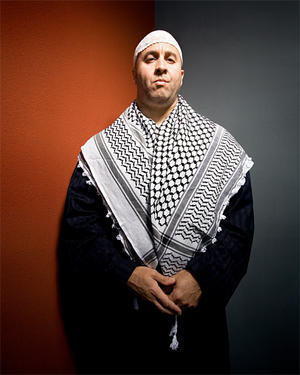
(Encore Interview:) FBI Defends Use of Informants To Spy On Mosques
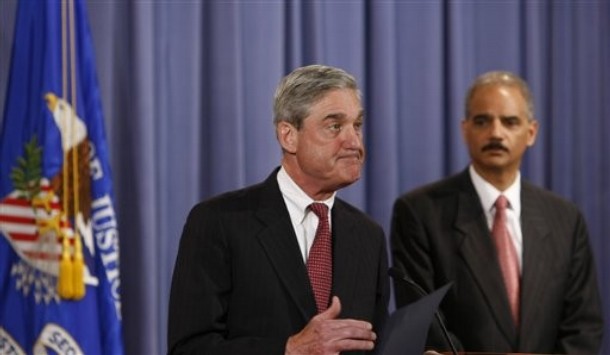
FBI Director Robert Mueller defended the practice of using informants to monitor mosques in the United States, despite being heavily criticized by attorneys, and Muslim American leaders. Last month a judge ordered the FBI to submit 100 documents detailing the bureau’s surveillance of Muslim leaders in California, which revealed the FBI paid informants to be provocateurs. These cases fit into patterns where paid informants (often a former felon) entice innocent people into a crime, not unlike the Liberty 7 case, the Fort Dix case and the Memorial Day weekend terror plot in upstate New York. In the New York case, Mike German, a former FBI agent of 16 years and now an attorney with the ACLU told Law and Disorder, they “could have wrapped up without making it seem like they’re saving New York City from this terrible destruction.” The media then reports the story which will often prop up the ongoing “War on Terror.”
Shakeel Syed:
- Council of Islamic Organizations sent a letter to Attny Gen. Eric Holder complaining about the FBI infiltration and harassment
- We are baffled at this time, there is a great deal of surplus of rhetoric by the current administration and a deficit at the policy level.
- When Mueller says the FBI will escalate surveillance of mosques and the Obama Administration is silent, that disturbs me.
- This is legal religious bigotry, Mueller is lying in regard to they’re not surveilling the mosques but only the suspected individuals.
- I have stopped using the word provocateur, I shuffle between using the word provocateur and predator.
- Those targeted have pending immigration and naturalization files or converting from H1 visa to resident visa.
- When our community was doing outreach with public officers, I was in the FBI offices during 2003-2005, and I realized then I was being tailgated.
- My phone was tapped on. A few times the phone automatically dialed the local police.
- My hope as a Muslim American is that good American people will stand up in these challenging times.
Guest – Shakeel Syed, Executive Director of the Islamic Shura Council of Southern California.
———————————————————–